Another hurrah for D-Day veterans

D-Day vets at Nazareth Boro Park in 2013

D-Day veterans (from left) Raymond Davis, Joe Motil, Dick Schermerhorn, the Rev. Ed McElduff, Nate Kline and Bob Gangewere.

Every year the Lehigh Valley Veterans of the Battle of the Bulge hold a picnic to salute D-Day veterans. This photo by Dick Musselman, a Navy veteran who’s dedicated to honoring World War II vets, shows the men who came to this year’s June 6 event in Nazareth Boro Park.

Raymond Davis was with the 90th Infantry Division, Utah Beach.
Joe Motil was with the 22nd Infantry Regiment, 4th Infantry Division, Utah Beach.
Dick Schermerhorn was with the 531st Engineer Shore Regiment, Utah Beach.
The Rev. Ed McElduff, a retired Catholic priest, was a Navy ensign aboard a landing ship tank, the LST 981.
Nate Kline flew in a B-26 with the 454th Bomb Squadron, 323rd Bomb Group.
And Bob Gangewere was with the 357th Infantry Regiment, 90th Infantry Division, Utah Beach.

I’ve done “in their own words” war stories for The Morning Call on all but Davis.

To get an idea of how old these guys are: D-Day was 69 years ago.

Others from the Lehigh Valley who weren’t at the picnic are:

Dr. John Hoch, who served on a landing craft that came in to Omaha Beach;
Walter Kuchinos, a flight engineer/gunner on a B-24 with the 861st Bomb Squadron, 493rd Bomb Group;
Bill Munsch of the 357th Infantry Regiment, 90th Infantry Division;
And Dan Curatola of the 16th Infantry Regiment, 1st Infantry Division, who’s in the VA hospital at Wilkes-Barre.

We lost two D-Day veterans in the last few months:

Ralph Mann of the 508th Parachute Infantry Regiment attached to the 82nd Airborne Division, died May 14.
And Bench Hartman of the 502nd Parachute Infantry Regiment, 101st Airborne Division, was in hospice care at the time of the picnic and died two days later, on June 8.

Other D-Day vets I’ve written about who are no longer living:

Duncan Cameron of the 26th Infantry Regiment, 1st Infantry Division, died in 2012.
Harold Saylor of the 16th Infantry Regiment, 1st Infantry Division, died in 2006.
Ernie Leh of the 18th Infantry Regiment, 1st Infantry Division, died in 2010.
John Umlauf, who commanded a Navy gunboat, died in 2007.
John Desrosiers Jr., who was at the helm of a minesweeper, died in 2009.
Frank Cudzil of the 16th Infantry Regiment, 1st Infantry Division, died in 2004.
And John Feninez Jr., an amphibious engineer with the 487th Port Battalion, died in 2005.

They are gone but not forgotten.

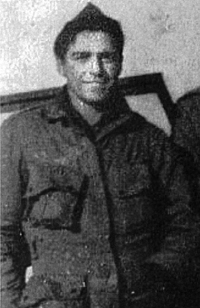
Bench Hartman, 1924-2013

Bench Hartman of Company C, 502nd Parachute Infantry Regiment, 101st Airborne Division

Bench Hartman of Company C, 502nd Parachute Infantry Regiment, 101st Airborne Division

The call came from “Bench” Hartman in May. As happened every spring, he had gotten an invitation in the mail to be a guest of the Lehigh Valley’s Battle of the Bulge veterans as they honored local men who participated in the D-Day assault.

“Can you give me a ride to this thing?”

Of course I could. I’d been taking him to the annual D-Day Remembrance picnic in Nazareth for several years, ever since he started going.

Bench had been with the 101st Airborne Division. He grew up in Hokendauqua in a family of 10 and worked at the Durable Pants factory in Northampton, pressing pants for the British army, before joining the U.S. Army and volunteering to be a paratrooper for the extra pay.

He made the D-Day jump behind Utah Beach with Company C of the 502nd Parachute Infantry Regiment and later parachuted into Holland and fought on a hill near Bastogne during the Battle of the Bulge. He was wounded twice in the legs and earned a Bronze Star for heroism at Chants, Belgium. The citation says he “volunteered to lay a communication wire and carry ammunition to isolated outposts…crossing 300 yards of open terrain, under machine gun and sniper fire.”

Early in 2006, I got a phone tip from a Lower Macungie man who knew about Bench’s role in the war. Bench agreed to talk about it, and that was the beginning of our friendship.

After his story ran on the D-Day anniversary that year, we stayed in touch. Once or twice a year, he’d call and say, “I made some scrapple. Can you come over tomorrow?” The old Dutchman, as he called himself, would spend hours whipping up scrapple and liver pudding in the basement of his Hokendauqua home. I’d follow him downstairs and watch as he sliced 3-pound slabs of scrapple and separated each slice with waxed paper that he’d cut into small rectangles. Then he’d put the slices together to re-form the slab and wrap it in freezer paper. The waxed paper made it easy to get at the slices when you got the slab out of the freezer.

He’d give me a plastic bag with five or six chunks of scrapple and a few pounds of liver pudding and sometimes a bottle of homemade wine, and we’d troop upstairs to his living room and chat for a while. He had lots of family pictures there, and some of his friend Matt Millen, the former NFL linebacker and head of the Detroit Lions who was raised in the neighborhood. The photos were always fodder for conversation.

Once, I gave some of Bench’s scrapple to my mom, who said it was the best she ever had and wrote him a note. The compliment tickled him, and he mentioned several times how pleased he was to hear from her.

In 2011, I included his World War II story in my book, War Stories in Their Own Words, and gave him a few copies.

Last Tuesday, his granddaughter Janine called and said he had suffered a stroke and, in keeping with his wishes that no extraordinary measures be taken to keep him alive, the family was letting him go and had moved him to St. Luke’s Hospice House outside Bethlehem.

The news came as a shock. Even at age 89, Howard W. Hartman was one of the toughest, hardiest guys I knew. He had Popeye forearms. On top of the rigorous training he underwent as a paratrooper, which he partly credited for his longevity, he had worked for many years as a builder and bricklayer. He was fine when my wife, Mary, and I visited him one Sunday in March. I couldn’t imagine his being laid low.

On Thursday, June 6, about the time I would have picked him up for the D-Day picnic, I went to see him at St. Luke’s. He was unconscious and not expected to recover. His breathing was labored. A woman on the staff said hearing is the last to go, so I sat by his bed and talked to him for half an hour, about things like the picnic, his scrapple-making and his stories of growing up in Hokendauqua. I recited the 23rd Psalm for him.

When Janine called Saturday to say her grandfather had died, it didn’t hit me so hard.

I’d had the chance to tell him goodbye.

A Memorial Day message: the accidents of war

This is the talk I gave Sunday at Bushkill Township’s Veterans Remembrance ceremony, part of the Memorial Day weekend:

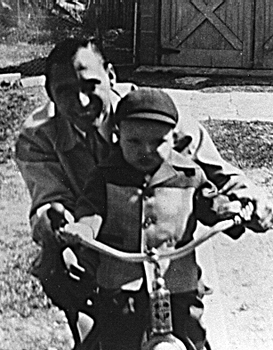
Sam Venditta and his nephew, Nicky Venditti

Sam Venditta and his nephew, Nicky Venditti

There is an old family photograph that gave me a stab in the heart when I came across it years ago. It’s nothing dramatic, really.

It shows a toddler on a tricycle. He’s wearing a cap and facing the camera. A man in a jacket and tie is crouching behind him, smiling widely. The man’s face is inches from the boy’s, and his hands are on the handlebars, just behind the boy’s hands.

The boy is my cousin Nicky, not yet 2 years old. The man is our Uncle Sam, one of my dad’s brothers.

It’s a moment like a million others, but what got me about this photo is the unseen specter that is stalking Nicky and Uncle Sam. It is the specter of life cut short by the accidents of war.

Uncle Sam was 31 when this picture was taken in 1950 in a backyard in Malvern, Pa. He had maybe a few months to live. He was a World War II veteran who had suffered a head injury in the South Pacific that would kill him five years after the war ended.

None of my relatives could tell me what happened to Uncle Sam when he was overseas, so I wrote to the VA and got his Army medical records, an inch-thick file. They show that he was in a Coast Artillery regiment on Bora Bora island in 1942 when he began having “episodes of unconsciousness.”

Bora Bora was a place where U.S. ships could anchor and refuel on the 8,000-mile trip to Australia. Uncle Sam worked 18 hours a day on a demolition squad, blasting coral to clear the way for ships to dock. The explosions, one after another, damaged his brain.

Army doctors determined he had epilepsy before he entered the service, and that the blasting aggravated his condition. He was sent home and discharged.

At home he suffered uncontrollable trembling in his arms and legs, and terrible anxiety, and worst of all he would black out with no warning, which was especially tough for a guy who made his living driving a truck. He confided to others his fear that one day he would pass out and never regain consciousness.

That’s exactly what happened one night in May 1950. He came home from Philly’s ShibePark after seeing baseball’s Athletics lose to Cleveland and went to bed. Within minutes, he cried out in the darkness and died.

My mom says Uncle Sam was the nicest man you could ever meet, but I would never have that opportunity. He was gone before I was born.

It was somewhat different with the little boy on the tricycle, my cousin Nicky. I saw him at gatherings of our big Italian family over the years, but had hardly any interaction with him. We lived in different towns, and he was five years older, and when you’re a kid five years is like trying to see across the Grand Canyon. I do remember he said hi to me once at a picnic when I was maybe 10, and I saw him when his parents had a party to send him off to boot camp.

Nicky became an Army helicopter pilot and went to Vietnam in the summer of 1969, and he was dead in 11 days. He had arrived at a large U.S. base called Chu Lai to join the Americal Division. During his week of orientation, he was in a classroom where an Army sergeant was giving a lecture on grenade safety to about 40 soldiers who had just arrived in the country. The instructor had a gimmick to get the guys’ attention. He pulled the pin on a grenade and tossed the grenade at them to see how they would react. It rolled under the table up front where Nicky was sitting with three of his friends.

Of course, the grenade was supposed to be a dud. But for reasons that were never determined, this one was live.

In five seconds, it detonated. One soldier was killed instantly. Nicky lost a leg and hung on for five days before dying at a hospital on the base. A pilot who had been sitting beside Nicky lost both legs and died.

The Army said it was an accident.

Nicky and Uncle Sam were my only relatives who died from war. And yet they represent a mere fraction of the death toll in any conflict. Most fall at the hands of the enemy, from hostile fire, and that’s mainly who we think of on Memorial Day, when we honor the war dead.

From my interviews with a hundred veterans over the last dozen years, the stories that most stand out are the ones about engaging in battle with the enemy. Some veterans, when I spoke with them, were still deeply affected, even traumatized, by the loss of life that happened around them decades earlier when they were young.

Don Miller from Emmaus was a flight engineer on a B-17 bomber and couldn’t go on his crew’s 12th mission because he was sick.

“I had to stay down because I had a bad head cold,” he told me. “You can’t fly when you have a cold. You could bust an eardrum when you’re coming down from 25,000 feet.

“That day, I lost my crew. I watched the sky as our squadron came back and didn’t see them. They were the one plane missing. They’d gone down over the target and all aboard were killed. It was one of the saddest days of my life.

“I should have been with them.”

A few years ago I took Don to see a B-17 that flew into Lehigh Valley International Airport. He gave me a tour of it. Afterward when I was driving him home, he said he’d been leery about accepting my invitation to see the plane. He was afraid that when he was in it, he would see the faces of his lost crewmates at their stations.

He did see them, he told me, but it wasn’t as bad as he thought it would be.

Dan Curatola from Bethlehem hit Omaha Beach on D-Day in the first wave. The night before, he was on a ship in the English Channel fully dressed and ready to attack Normandy.

“We had nothing else to do,” he said, “so we played cards. About six of us were playing blackjack. Not a single one of those guys lived. One night I’m playing cards with them, and the next night they were all dead.”

When Dan reached the shore, a shell exploded and he hit the dirt. He tapped a corporal in front of him and said, “Boy, that was close, wasn’t it?” But the corporal didn’t answer. He was dead.

The saddest story came from Horace Rehrig, who grew up in West Bowmanstown. He was on the carrier Ticonderoga when two kamikazes crashed into it. He found his cousin injured on the fantail and helped carry him down to sick bay. On the way he saw a familiar sailor lying on the floor of the hangar deck. It was his good friend Bob Selby. Horace got his cousin to the hospital area and ran back up to the hangar deck to Selby.

“He was really bleeding bad,” Horace told me. “His right arm was completely severed at the shoulder, blown off, but he was conscious. He looked like he was flash-burned from the thousand-pound bomb that exploded on the hangar deck. I quick took some packing and held it on his wound and put his head in my lap and tried to comfort him. ‘Hang in there, I’ll take care of you.’ He was crying, he kept saying, ‘I’ll never make it.’ I said, ‘Don’t talk like that. You’ll pull through this.’

“But I knew it was a critical wound – he had lost too much blood.

“I kept yelling for help, and finally we put Selby on a stretcher and got him down to sick bay. The doctors put him right on an operating table, and I stood there waiting. He had his knees up and was waving them back and forth.

“And then they just stopped.

“It just plays hell with you when you see stuff like that,” Horace said. “I felt so bad about it that I just can’t ever forget it.”

This weekend we remember the Nickys, the Uncle Sams, the Bob Selbys, all those who put on a uniform when the country called, and did not survive. That’s 1,130,000 Americans from the Civil War up to Iraq and Afghanistan – and we’re still counting.

We thank them for their sacrifice. It kept us free.

A final farewell to two Normandy invaders

Two more of the war veterans I’ve interviewed in the past dozen years died last week – Ralph Mann of Coopersburg and Jerome Neff of Allentown.

Ralph, who was 90, died May 14. Jerome was 88 and died the next day.

Both were in on the Normandy invasion. Ralph, a paratrooper with the 82nd Airborne Division, made the drop the night before the assault on the beaches. On the ground, he joined up with a few other guys.

“We walked through a field and the damn cows followed us. Every time we moved, they moved. We were afraid they’d give us away, so we crawled into a ditch along a hedgerow and waited until it started to get light.”

Jerome Neff, serving in a gasoline supply company supporting the 29th Infantry Division, came ashore at Omaha Beach on D-Day plus one and helped dig graves.

“I never even talked about this to my family or anybody, but there were guys without limbs, with guts hanging out, guys with clothing blown off from a concussion, all kinds of very terrible sights.”

Jerome’s story ran in The Morning Call on Memorial Day 2011. Ralph’s ran a week later, on the D-Day anniversary. You can read them at www.mcall.com/warstories.

Of the veterans I’ve interviewed, about two-thirds are gone. I know this is something I have to expect, but that doesn’t make it easy.

‘Before their voices are silent’

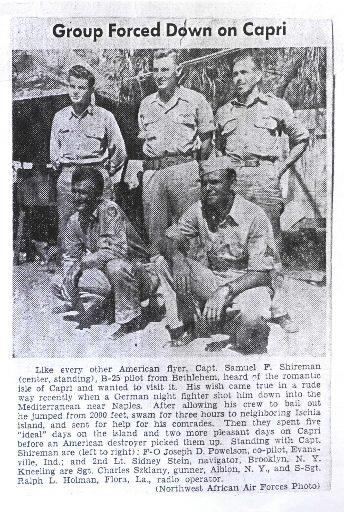
Pilot Samuel F. Shireman (center, standing) and his crew after they were rescued. Standing with Sam are co-pilot Joseph D. Powelson (left) of Evansville, Ind., and navigator Sidney Stein of Brooklyn, N.Y. Crouching are gunner Charles Szkiany (left) of Albion, N.Y., and radio operator Ralph L. Holman of Flora, La.

Pilot Samuel F. Shireman (center, standing) and his crew after they were rescued. Standing with Sam are co-pilot Joseph D. Powelson (left) of Evansville, Ind., and navigator Sidney Stein of Brooklyn, N.Y. Crouching are gunner Charles Szkiany (left) of Albion, N.Y., and radio operator Ralph L. Holman of Flora, La.

Another of my war story subjects died April 28 — Army Air Forces veteran Sam Shireman, who was 94 and had been living in Fellowship Manor, Whitehall.

Shireman as a WWII flier

A snapshot of Shireman as a young flier

I attended a calling time last week at the manor and met some of his family members and friends. My story on him, which ran in The Morning Call on Sept. 9, 2010, the 67th anniversary of the mission on which his B-25 Mitchell bomber was shot down, was displayed on an easel, along with photos that included one of Sam and me standing together as he held the plastic model of a B-25 I had built years ago. It was my gift to him.

Afterward at home, I went through my file on Sam. It includes that photo, as well as a copy of the Sept. 30, 1943, telegram to his wife, Alice, in Bethlehem reporting that “Capt. Samuel F. Shireman has been reported missing in action since nine September,” a copy of his wartime diary and other papers and emails.

Sam was on his 39th mission as a B-25 pilot, assigned to knock out German military installations in the Naples area. His plane would never return to the base on Sicily. After dropping its bombs that night, it veered away from Italy’s coast and got hit by anti-aircraft fire. Then a German fighter pounced on its tail, and Sam dived and turned to evade it. “Our plane was on fire,” he told me. “We had to bail out.”

Sam’s descent by parachute landed him in the warm Tyrrhenian Sea. He swam in the darkness to the island of Ischia, where he was reunited with his co-pilot, Joseph D. Powelson of Evansville, Ind.; navigator, Sidney Stein of Brooklyn, N.Y.; gunner, Charles Szklany of Albion, N.Y.; and radio operator, Ralph L. Holman of Flora, La. The Navy rescued them and took them to the nearby resort of Capri.

Sam Shireman and me

Sam Shireman poses with me while holding the model B-25 Mitchell bomber I gave him after doing his story for The Morning Call in 2010. He sent me the photo in a Christmas card the next year. I built the plastic model and used it during my interviews with him.

One of the papers in my file is a map Sam drew for me showing where his plane was hit, where he smacked into the sea and his path to Ischia and Capri.

Another item is an eloquent email I got from an acquaintance of Sam after the story ran. It sums up the importance of recording veterans’ stories for posterity. Here it is:

Sam Shireman's B-25

This is the B-25 Mitchell bomber Shireman was flying when he was shot down, “Lil’ Bea Hind.” It’s not clear whether he is in the picture.

“Thank you for telling Sam Shireman’s story. I know Sam, but never knew about his service to America.

“Since he’s one of the many from the Greatest Generation who have their stories to tell, I think it’s important for those stories to be told before it is too late and their voices are silent.

“My own father was a tail gunner in the Pacific Theater during WWII and unfortunately his early death in 1984 prevented him from eventually opening up about many of his war experiences later on, as others like Sam have done.

“It’s difficult to believe that in 2011 it will be 70 years since the Japanese attack on Pearl Harbor and America’s entry into the Second World War. That means that fewer and fewer of the generation who fought against tyranny and preserved freedom remain.

“Their lessons and stories about the history in which they participated need to be preserved. Thank you for adding to that roll call with your interview of Sam.”

When grenades go off by accident

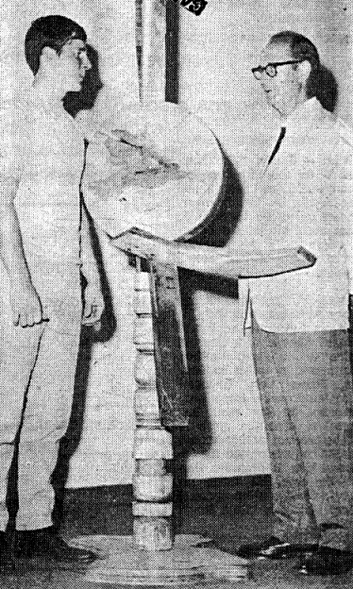
Bradley Boswell

Bradley Boswell, a senior at Freedom High School in Bethlehem Township, presents Principal Joseph McIntyre the abstract wood sculpture Bradley made for the school’s sculpture garden. The photo ran in The Morning Call of Allentown on June 4, 1969.

While going through my files on my cousin Nicky who was killed in Vietnam, I came across some clippings I had tucked away years ago. They come from an old file envelope in the archives of The Morning Call and concern a young Marine named Bradley L. Boswell.

I don’t know how I knew about him, but it’s clear why I copied the two newspaper clippings and saved them.

Bradley met a fate similar to Nicky’s.

A corporal from Bethlehem Township, he was 20 years old when he was killed in Vietnam when a grenade accidentally went off during routine training. It happened on Sept. 15, 1970, in Quang Nam province.

Nicky, an Army helicopter pilot, was also 20 when he died under similar circumstances more than a year earlier, at Chu Lai.

I know little about Bradley other than what’s in the two clips. One is headlined “Marine Loses Life in Grenade Accident” and has a photo of him in his dress uniform. He was a 1969 graduate of Freedom High School in Bethlehem Township, he intended to be a career Marine and enlisted in July 1969 – the month Nicky was killed.

The other clip says “Freedom Opens Sculpture Garden” and has a photo of Bradley presenting Freedom’s principal a large abstract wood sculpture for the school’s sculpture garden in early June 1969. It had taken Bradley the entire school year to complete.

Bradley’s sister Betty Jane Schmoyer, who goes by B.J., said there was no open casket to view his remains, so the family never had the opportunity to say goodbye to him, and that was hard to take.

“You still think he’s going to come through that door,” she said.

The  family never got a full explanation from the military about the circumstances of Bradley’s death, B.J. said. That was also the case with the grenade explosion that mortally wounded Nicky and his friend Billy Vachon, and killed another soldier, Tim Williams, on July 10, 1969, at LZ Bayonet.

B.J. said her sister Barbara Boswell tried to find out more and even had contact with guys in Bradley’s unit. But B.J. doesn’t know what came of that, and Barbara, a Navy veteran, died in 2003.

Bradley’s mother died in 1980 and his father died in 2002.

Besides Bradley, Nicky, Billy and Tim, I wonder how many others lost their lives in Vietnam when grenades went off by accident.

It’s WWII and Grandpop wants to be a U.S. citizen

Mary and Nicola Venditta

Mary and Nicola Venditta

My grandfather came to America from Italy in the spring of 1903, when he was 20, but almost four decades passed before he got interested in becoming a U.S. citizen.

Apparently the country’s entry into World War II had something to do with it. From his home in Malvern, Pa., Nicola Venditta applied to the Immigration and Naturalization Service on Feb. 9, 1942, two months after the Pearl Harbor attack.

He already had two sons in uniform. Sam was in the Army Coast Artillery, bound for Bora Bora in the Pacific, and Frank was an Army medic in Panama. Two other sons would follow them. Louie would enter the service in a year and serve with the Army Air Forces in England. My dad, Carmine, would join the Coast Guard in 1944.

With only a modest grip on English, Grandpop got help with his application from another son’s wife, a native of Italy. She wrote that he was born in 1883 in Gambatese in central Italy, came by steamship to New York in June 1903, married Mary Cugino of Philadelphia in 1905 in Landisville, N.J., had been employed by the Chester Valley Lime Co. since 1936 and now had 10 children. (There had been a dozen, but two had died.)

Grandpop’s application described him as 5 feet 6 inches tall, 135 pounds, with blue eyes and a scar on his left cheek. “Beats the hell out of me how he got that scar,” my Uncle Frank said when I asked him about his dad in 1998. “One of those stone quarries, I guess.”

Grandmom and Grandpop had left South Jersey for the mountains of central Pennsylvania, where he wielded a pick and shovel in a Bethlehem Steel limestone quarry.  The family’s next move was to Glassboro, N.J., where Grandpop worked in a glass factory. Frank said his pop’s hair was burned off in an accident on the job and never grew back on top, just around the fringes.

The Vendittas returned to Pennsylvania’s Mifflin County, where they lived in Naginey along Laurel Creek and Grandpop again worked in the Bethlehem Steel quarry. Naginey was where my dad was born in 1927. “We lived in a big company house with pig pens and chicken pens,” Frank said. “There were two rows of company houses, separated but all alike, and a bake oven where women used to take their turns baking loaves of bread.”

When Grandpop lost his job in a workforce cutback, the family left Naginey for Camden, N.J. Grandpop would go out Saturday nights to play cards for wine, walking several blocks to a paisano’s house with Frank. The boy would curl up in a chair and nap until 3 or 4 in the morning while the men played Three Sevens. The game usually involved four to six players who formed two teams, and whichever side lost a hand would have to buy a bottle from the host. More card-playing determined the “boss,” who had the authority to award a glass of wine to any one of the players as long as another player, the “underboss,” agreed with his choice.

“The boss would say, ‘Should we give a glass to this guy?’ And the underboss would say, ‘No, he’s not my friend.’ They all ended up drinking all the wine,” Frank said.

It was in Camden that a baby daughter died after catching a cold, Frank said, the first of several tragedies to hit the family.

With the coming of the Great Depression, jobs vanished.

“There was no work, so my oldest brother Jimmy and Pop and Frank Passarelli, who was from the same village as Pop in Italy, and Tony Peccia started walking from Camden out in this direction [toward Malvern]. Someone told them there were quarries out here. They had a burlap bag, a couple loaves of bread, some pepperoni, sausage, cheese and wine, and that’s it. They got as far as Howellville [about 25 miles from Camden]. This car, a big Buick, stopped. A guy got out of the passenger side, Sam Gibbons. He was an enormous man, about 6 foot 5. No arms. He had a nephew driving. Sam said, ‘Where are you guys going?’ ‘We’re looking for work.’ ‘What kind of work you do?’ ‘Quarry work.’ ‘You’re the guys we want. Get in the car.’

“He had just bought a quarry down in Valley Store. Christ, they went down there and they opened that quarry up, and he had both arms blown off in a dynamite blast.”

Grandpop and Jimmy lived in company shacks. In the meantime, they cleaned up an old, abandoned stone house atop a hill at Valley Store. Grandpop brought the family there. The house had no running water or electricity, but he paid $17 to have a power line run to the kitchen. There were two wells, one for drinking water and the other to catch rainwater that Grandmom used for washing clothes. The family took in friends from Camden as paying boarders. Grandpop and his older boys worked in the quarry, shoveling stone, running crushers and planting dynamite.

Tragedy struck again in 1934, when Jimmy was killed in an accident with a drunken driver.

Near the end of the decade, my grandparents moved for the last time. Grandpop had left the quarry to tend the grounds and dig graves at Philadelphia Memorial Park. He took his family several miles away to the house in Malvern, where they spent the rest of their lives. In 1950, he lost another son when Sam died of a non-combat injury from his days on Bora Bora.

Grandpop died in 1971, outliving his wife and a grandson, Nicky, an Army helicopter pilot who was killed in Vietnam two years earlier.

But my grandfather never did become a U.S. citizen.

Uncle Frank thought that some local official might have offered to help Grandpop get his citizenship for a price, and he got angry about it and dropped the matter for good.


‘Adolf Hitler is in person appearing’

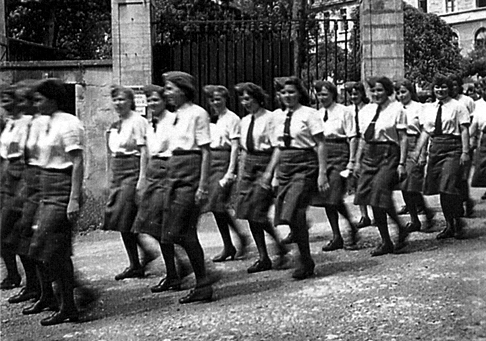
Luftwaffe assistants march in Vesoul, France.

Luftwaffenhelferinnen, assistants in the Luftwaffe, march in Vesoul, France. This photo belongs to an 89-year-old Lehigh Valley woman who says she was among the marchers.

Over the last year, I’ve been meeting with a Lehigh Valley woman, now 89, who served in the German air force during World War II.

She offered a fascinating glimpse of life in Nazi Germany, and now I’m going to share it with you.

At age 18, she was drafted into the Luftwaffe in March 1942. After training in Stuttgart for the air-protection service, she worked in a Munich bunker. Her job was to take information from lookouts scanning the skies for enemy bombers, and then alert civil defense authorities to set off the sirens that called residents to underground shelters.

Later she served in German-occupied France.

After the war, she fell in love with a GI in the occupation force and followed him to his home in the Lehigh Valley, where they were married.

Here is her story, as she told it to me:


The messages came from the soldiers in the mountains. They looked out for the enemy planes, and from the lookout commander we got the Meldungen [messages] over the phone: “Five bombers are approaching 1582.” That would be the code for Munich. “Attention for the siren.”

We had to give real fast the messages to the station where they had a siren. We were in charge that the siren went off so all the people would rush into the bunkers. It was very hard and dangerous work. The English, the Russians, the American bombers came. There was no rest. We were young girls; we should have had fun with boys. We should have had a teenage life, with dances and parties.

Those sirens could wake up the dead. When it was over, we got the message: Enemy planes are leaving. When there was everything clear, then we gave the message that it’s clear and the people came out of the bunkers.

Hermann Goering was my boss. He was obsessed with his planes. The belly he had! He treated us very good. He came to our bunker in the Luftgaukommando [air defense district command headquarters], checking up. The Luftgaukommando was a big building in the middle of the city. The basement was the bunker. It was specially made for protection. There were about six or eight women in there. We were Helferin [Luftwaffe female assistants]. Later I was promoted to Oberhelferin.

One time in Munich, I have to tell you, they really came – the Americans. There must have been 15 or 20 bombers. I just got the message out when we got a full hit. It knocked down at least four stories of our building. Everything was destroyed, but we were not hurt because of the way the bunker was built.

There were soldiers that were put on that spot to watch, and the windows were marked in fluorescent color where we were, so in case we were buried they could find us. Our room was still there and a big barrel of water with blankets, and we threw the blankets over us and the soldiers pulled us out of the windows. This was near the Englischen Garten – it was a park — and it was all fire. We could see the phosphorus bombs.

I think I had a nervous breakdown. I was in a hospital for some time.

My mom’s parents came from northern Italy. My dad came from Niederbayern. We lived in Tegernsee, a resort near Munich. Tegernsee is a big lake. My father was a brewmaster, but when he came back from world war 1914-18 he didn’t work anymore because he was injured. He had a short leg. He got a pretty good pension. We could live not extravagantly but modest.

We had a beautiful childhood, nothing but skiing and mountain climbing and skating. I was good at skiing. I zigzagged down 1,200-meter mountains. We went swimming in the lake and played by the waterfall. We picked berries and gathered wood for the big stove in our kitchen. Our house was a chalet on a hill. We had a radio. We had a dog, a cat and a deer named Hansy for our pets. Hansy slept on the floor by my bed. We had a big family – eight girls and two boys. It was like the Waltons [on TV].

One day we were in school. I was at least 14. The teacher said, “12 o’clock a train will arrive at the station and we’re all going to go up there. Adolf Hitler is in person appearing there.” We were glad to be called out of school. We were looking forward to seeing him. I thought he was a good leader.

We walked to the station, up the hill. We were boys and girls together, I would say about 40. I saw this train and all this commotion. There was the railroad station gate and the building where you buy your tickets, and there were benches to sit down and there was a fence.

Hitler was behind the fence. He had the Gestapo with him, bodyguards. Every one of us got a chance to squeeze through and see him close, from 6 to 8 feet. Our greeting was all together, “Heil Hitler,” with our right arms at eye level. He was talking to us and the teachers. He made a speech about how we should grow up and we should behave ourselves.

That crazy Hitler was a man that anybody would have accepted because he brought work, he had good ideas – the Autobahn – and Germany just grew and grew. So you lift up your arm, “Heil Hitler” – how many times! But then we found out that there was something wrong.

One time the Gestapo came to my house, four of them. They said to my mother, “You are under arrest. You bought from the Jews and you were told not to.” There were three or four of us together, and we were very scared for my mom. I was hanging onto her. She said, “I have 10 kids. I have every one in a Catholic school and I need clothes for them, and the Jewish people are the only ones who give credit.”

She went to Munich and bought clothes from the Jews. It was in a black book where they mark what you owe, and the Gestapo had that book. They knew everything. They were going to put her in a concentration camp for that. So she said, “I’ll go with you all right, but wait till I get my Golden Cross. You can give it back to Hitler. I don’t want it.” She went in her bedroom and got it.

She had the Golden Cross because she had 10 children. Hitler worshiped German mothers. The Buergermeister gave my mom the medal. He was the biggest Nazi in town.

The Gestapo said entschuldigen [excuse us]. They were shocked that they bothered my mother. They took off. They were more scared than we were. Hitler would have had their heads.

In my hometown, the Jews had to wear a yellow star and they were not supposed to be served in a hotel, restaurant or anywhere. My mom thought that was terrible. She said, “Why are they doing that to these poor people?” We were raised to love people. We were not raised like that. My mom loved all people and animals. She had a heart of gold. She passed on that love to every one of us. I’m proud of her for that.

You won’t believe the movies they showed in school! They showed us movies about what the Jews did to young girls. They made it that you actually hated them because of how cruel they were and how they chopped the heads off animals and sacrificed them.

I heard they were rounded up in trucks, they were put in trains, but I never saw them rounded up in my hometown. It was a small village.

The more Hitler got power, the more he tried to destroy and make wars against small countries, the more you started realizing he’s going too far. But you couldn’t say anything. You were never allowed to question his speeches. At the end, we just listened to marching songs — “Deutschland Ueber Alles” [“Germany Over All”] and “Die Fahne Hof” [“The Flag Flies High”] – and raised our arms.

When I graduated from Berufschule, I got drafted. I had to go to Stuttgart with another group of girls. That was our learning place. The instructors were all Luftwaffe officers. We had to know the planes. We had an awful lot of gymnastics. Hitler was nuts with that. We had to always be very healthy.

Finally the instructors said, “You’re ready for plane attacks, you’re ready for the job,” and we were set up at different bunkers. I was sent to work in the Luftgaukommando in Munich, which was the most important headquarters.

When we were finished with our jobs, we had get-togethers and dancing. They had a band, they had waltzes – Johann Strauss. We were in uniform, sometimes we dressed in our civilian clothes. Officers were there. That’s where I met [a bomber pilot] and he asked me to dance. He was handsome, and he was happy and relaxed – different from other pilots. We got engaged.

I think I was in France when he was shot down over London and killed. That was hard in the beginning. I got a letter from his parents. I sent all his pictures back to them.

After Munich, then I wound up in France. First we were stationed in Vesoul, then in Rennes, where we were still in combat with our pilots, and there I saw no bombings. We were there to occupy the country. The French people hated us — can’t blame them. They killed one girl from my hometown who was in the Luftwaffe. She was pushed into the subway in Paris. It was her own fault. She wasn’t supposed to go by herself. She was supposed to have a soldier with her.

First in Rennes they were teaching us Morse code, but that is for the birds. We were going to be transferred to Sweden. Then everything changed. I learned first aid. They took the swastika off and put the red cross on the arm of our uniform and we were helping the nurses. We had to take care of the wounded German and English fliers. You think these English would take a cup of milk or tea from us? No way. They were scared we’d poison them. Those young boys were very nervous, so scared.

When I came back was a fiasco. The officers took off by plane or cars and left us behind. Soldiers took off too. We were released from our duty. We were told the war was over. Now let’s find our way home from France, 1,000 kilometer. We didn’t know what to do. We could not travel by day because they were still shooting, the Spitfires were coming down.

We were tired of sitting in the woods, so one day we took a chance to get into a hay wagon – three, four guys and three, four girls. A French farmer, he had farm stuff in the wagon. I had my duffel bag on my lap.

Wouldn’t you know, over the top of a tree comes this Spitfire and starts shooting. One of the soldiers said, “Achtung, raus von Wagen! Schnell, macht schnell!” [Get off the wagon, hurry!] Somebody gave me a push and I flew into a ditch. One girl got off too late and got hit in the back. She had a white sweater on. Blood was gushing all over. She collapsed and died. They rolled her into a ditch and left her there.

My duffel bag on the wagon was all full of holes. It had perfume from France. I had delicious French rolls in the bag, and they were soaked in perfume.

We went back into the woods. We never did go by day anymore. It took me two weeks, maybe three, to get to Munich, mostly walking. Of course, Munich was a pile of stones. My aunt lived in a big apartment house. It was in pretty bad shape. She gave me what she had to eat and I slept with her for a while, then she helped me find a train that was still running that took me back home.

I find nobody. Through the loudspeakers they’d been saying: “Everybody defend yourselves. Kill or be killed. The Americans have black faces. They have knives and machetes and they chop your head off. They will murder you. Germans will all die.” That was Goebbels making propaganda, Goebbels with his big mouth.

It scared everybody, so my people went into the mountains. I couldn’t find my mom and my sisters – my father died of kidney failure during the war. Finally, I just had an idea where they might be, and I walked in the woods and looked around, and I found them. My mom was there with a big rucksack where she had a stale loaf of bread, for God’s sake. She made a promise to God. There was a Virgin Mary chapel on a big mountain, and she was going to go there on a long walk because she thanked God I made it back. And she did.

We stayed in the woods until it got dark. Then we inched ourselves down. Not a soul in town. There was nothing wrong, and no black Americans were there trying to kill us with knives. My mom burned my uniform. I had a T-shirt with a big swastika on it. She didn’t want anyone to see that.

Days went by and we looked down the hill at the dirt road. One of my sisters hollered, “There’s a funny-looking brown car with soldiers in it.” My mom said to us, “Get up the attic, go hide!” It was a jeep and there were four American guys in there, and they were all white like we were. They were not black at all.

The Americans came into the house. They were gentlemen, but one guy put his big boot on the table. My mom called to us, “You can come down now. It’s OK.”  She said the Nazis were big liars, like they always were. The soldiers gave us candy bars, chocolate, and they were very nice.

Later, truckloads of black and white American soldiers came to my village. There was no truth about black people being any different from the rest of us.

Some soldiers picked me up in a truck at my house and said, “You were in the service. You have to be interrogated because of the concentration camps.” They took me to Bad Aibling. They had me at the prison camp two weeks. I slept on straw.

I was interrogated by Jewish men in uniforms. They were cold and accusing. They went through my whole family, what I did in the war, what my brothers and sisters did. They asked me in German: “Did you go near any of those concentration camps? Did you ever go in them?” I said, “I don’t know what you’re talking about.” That was the God’s-honest truth.

When they found out I was just doing my job, they released me.

Was I glad that stupid war was over!

New clues change theory of Hunley crew’s fate

Did you catch the news over the weekend about the Confederate sub Hunley?

Over the years I’ve been following the mystery of what happened to the H.L. Hunley, which was found in 1995. It’s not as compelling a mystery as, for example, what happened to Amelia Earhart. (I’ve been following those efforts too, with a clip file.) But it’s still fascinating.

There was a made-for-TV movie about the Hunley, the first sub in history to sink an enemy ship. You had to feel sick about what happened to the eight crew members. Historians thought they ran out of air before they could back to shore at Charleston, S.C., and that’s how they died. Slow and agonizing.

Now there are new clues that show the crew might not have suffered so much that day in 1864, according to an Associated Press story.

The Hunley had a 16-foot spar for delivering its torpedo to the Union blockade ship, the Housatonic. Scientists have found remnants of the torpedo’s casing on the spar, indicating the torpedo exploded while still attached. The sub, then, was too close to its target. The concussion from the explosion might have knocked the crew unconscious. It might have caused water to rush in.

Some or all of  the eight men, who were found at their seats when the sub was brought up, might have died without ever coming to.

Scientists expect more answers. They’ll be removing encrustations from the outer hull and doing a computer simulation that might reveal how the explosion affected the Hunley. So this is one nagging mystery that has a fair shot at being solved.

Now if only we could get a break on Amelia.


‘The plane fell thousands of feet’

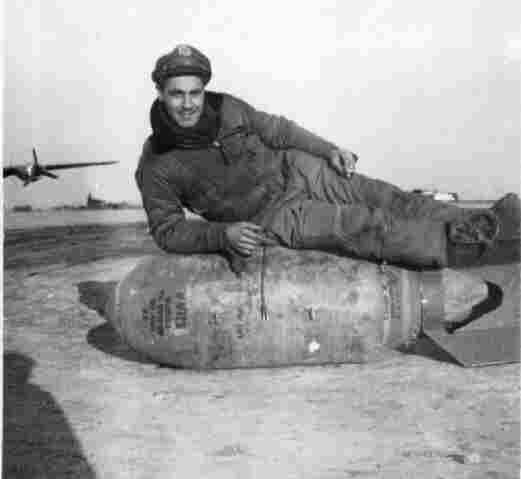
Bob Reichard in Italy

Bob Reichard with the 15th Air Force in Italy

Bob Reichard of East Penn Township flew 24 missions as a bombardier and one as a navigator on a B-24 in World War II with the rank of first lieutenant. He served in the 15th Air Force, assigned to the 745th Squadron of the 456th Bomb Group and based near Cerignola, Italy. He was the squadron assistant intelligence officer and trained as a B-24 radar (Mickey) operator.

He was the subject of one of my “War Stories: In Their Own Words” installments on Veterans Day 1999.

We’ve stayed in touch and I visited him at his old Carbon County farmhouse in December. Below, I’m posting a story he recently sent me. For photos and more of his personal accounts, culled from a three-decade career with service in the Korean War and the Cold War as well as World War II, go to http://bobreichard.com/.

Here is Bob’s story about a B-24 mission he flew over Europe on Dec. 11, 1944:

By BOB REICHARD

A bomb run over the 500-plus heavy anti-aircraft guns of Vienna in November and December 1944 resulted in a lifetime of excitement for the crew members, and for some it was an eternity.

On 11 December 1944, crew #6459 with a substitute navigator on board ran that gauntlet of fire, smoke, and steel in a B-24 Liberator.

I talked myself into crawling forward, after “bombs away,” to see where the bombs were hitting. That wasn’t necessary, because we had cameras for that. When I was on my belly looking down, a piece of flak entered my forward glass, and that would have gotten me in the head or chest if I hadn’t been lying down. The nose wheel hub, which was pulled into the plane just behind my place, had a hole through the hub.

The upper turret gunner was knocked from his turret when a fragment broke through the horizontal gear ring. That slowed the piece down so it embedded in the rubber earphone ring of his helmet and knocked him from the turret. The piece was still stuck in his helmet and it didn’t draw any blood.

The plane surrendered to the 34 hits it had taken on the bomb run. It fell thousands of feet before the pilots could put out an engine fire and gain control. They couldn’t maintain altitude, so the crew lightened the load by tossing everything possible overboard, including guns and ammunition.

The radio operator was on one of the waist guns and the engineer was on his knees throwing chaff. He asked the radio operator to help him and when he bent down, a blast of flak tore through the place where he had been standing.

When we threw the first long belt of ammo from a tail gun turret, we fed it out foot by foot. A big mistake, because when the last 10 or so feet were being pulled out by gravity and the slip stream, the last 10 feet or so whipped toward the front of the plane and if anyone had been standing there, they would have their body torn open or their head cut off. It was good that one of the cartridges didn’t fire when they hit the deck before going out. The next long belt, from the other tail gun, we rolled into a big bundle and threw it out that way.

With that done we were able to clear the mountains to the south. The navigator set a course for a partisan-held island called Vis, off the coast of Yugoslavia. His course was true and we landed on a crash strip there an hour or so later.

The hydraulic system had been knocked out, so the plane had no brakes. Landing on the 3,500-foot crash strip on Vis Island required brakes. So, we took two parachutes and hooked them to the waist gun mounts. When the plane was down on the strip, the pilot rang the bailout bell and we pulled the rip cords on the parachutes, and they slowed the plane down so we didn’t go off the end of the air strip.

The navigator had done a great job, because he had crapped in his flying suit and couldn’t get rid of that until we were on the ground.