Books for the Vietnam War reader

If you want to write about the Vietnam War, you need to read about it.

But there’s so much material out there, where do you start?

Go right to Vietnam: A History by former Time, Life and Washington Post Southeast Asia correspondent Stanley Karnow. Published in 1983 as a companion to the PBS series “Vietnam: A Television History,” it’s a sweeping narrative of American involvement in Vietnam.

A close second is A Bright Shining Lie: John Paul Vann and America in Vietnam by Neil Sheehan, a Vietnam War correspondent for UPI and The New York Times. The Pulitzer Prize-winner from 1988 tells the story of an Army lieutenant colonel who at first challenged, then embraced, how America was fighting the war. This book will help you see why we lost it.

Two books made up my early reading of the Vietnam War: Ron Kovics’ Born on the Fourth of July, from 1976 (later made into a movie), and Michael Herr’s Dispatches, from 1977. I was a year out of college when my dad recommended Dispatches, saying it was powerful enough to give him nightmares.

Waiting for medivac helicopter, Long Khanh Province, 1966

Waiting for helicopter to evacuate a fallen soldier, Long Khanh Province, 1966

To understand infantry combat in Vietnam, read We Were Soldiers Once … and Young, by Lt. Gen. Harold G. Moore (retired) and Joseph L. Galloway. This 1992 book, also made into a movie, is the story about the men of the 7th Cavalry who in 1965 fought the North Vietnamese in the Ia Drang Valley.

A must book for writers is Stolen Valor: How the Vietnam Generation was Robbed of its Heroes and its History by B.G. Burkett and Glenna Whitley, published in 1998. Burkett, a Vietnam veteran, and Whitley expose phony heroes and show how Vietnam vets have been unfairly demonized. The book gives a valuable lesson in getting military documents under the Freedom of Information Act.

I also recommend Dear America: Letters Home from Vietnam, originally published in 1985 by The New York Vietnam Veterans Memorial Commission. Kurt Vonnegut called this collection of letters and poems “the sad and beautiful countermelody of truth.”

In fiction, there’s Tim O’Brien’s The Things They Carried, first published in 1990. Interestingly for me, O’Brien served with the Army’s Americal Division, the more common name of the 23rd Infantry Division, in Vietnam in 1969. My cousin Nicky Venditti, an Army helicopter pilot who is the subject of my book, Quiet Man Rising: A Soldier’s Life and Death in Vietnam, was also assigned to the Americal Division and was also in Vietnam in 1969. Nicky, however, only survived eleven days.

Two books that deal with the Americal Division helped me with my story about Nicky. One is Maj. Gen. Lloyd B. Ramsey, U.S. Army Retired: A Memoir, from 2006. Ramsey was the commander of the Americal Division at the time Nicky was on the Americal’s base at Chu Lai. My wife, Mary, and I visited the general at his home in McLean, Virginia, in 1998, and I have had numerous phone interviews with him.
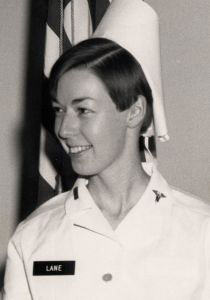
Sharon Lane, Army nurse killed by enemy fire, 1969

1st Lt. Sharon Lane

The other book is Hostile Fire: The Life and Death of First Lieutenant Sharon Lane, written by Philip Bigler and published in 1996. Sharon Lane was a nurse at the evac hospital at Chu Lai. She was killed in a North Vietnamese rocket attack in June 1969 and was to be the only American servicewoman killed by enemy fire in the war.

Sharon’s replacement at the evac hospital was the subject of my last blog, Lynn O’Malley Bedics, who in July 1969 tended to Nicky as he lay dying after an Army instructor unwittingly detonated a grenade.

Reading these books about the Vietnam era has helped me connect the people I meet who were there with the events that dominated the headlines. Talking with Gen. Ramsey and Lynn O’Malley Bedics and reading of their experiences gave me the material I needed to fill out Nicky’s story.
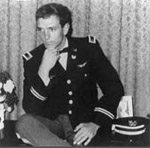
Making an Improbable Connection

Researching veterans’ stories is always rewarding, but sometimes you’ll come across information that will knock your socks off.

Consider this: The Army nurse who tended to my cousin Nicky as he lay dying in an evacuation hospital in Vietnam four decades ago lives in my neighborhood. I found out about her one day when my project to write a book about Nicky and my work on veterans stories for The Morning Call collided.

Nicky Venditti at home, June 1969

Nicky Venditti at home, June 1969

It happened in 1998, after I had begun researching Nicky’s life and death as an Army helicopter pilot in the Vietnam War. That year, the success of Steven Spielberg’s film Saving Private Ryan spurred aging veterans to talk about their experiences, many for the first time. We at The Call in Allentown, Pennsylvania, planned a special section for Veterans Day 1998 called War Stories, and I was the editor.

One reporter was to write 10 short articles based on interviews with veterans of World War II and the Korean and Vietnam wars. I told the reporter, Ron Devlin, to include a woman who had been a front-line nurse.

“I got a great nurse,” Ron got back to me. “Here in town.”

She had served in Vietnam, he said. Immediately I asked him where and when.

“Chu Lai,” Ron said, “1969.”

The time and place were a match for Nicky, who died July 15, 1969, five days after an Army instructor unwittingly detonated a grenade in a class for new arrivals.

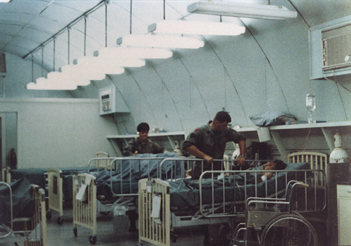
Tending the Wounded, 1969, Chu Lai

Tending the Wounded, 1969, Chu Lai

In the three years I had been following Nicky’s path, I had never spoken with any nurses who worked in the evac hospital where he died. Had this one been there?

Her name was Lynn Bedics, and she was the nurse manager at the Allentown Veterans Affairs Outpatient Clinic. Within minutes, I called her and she said yes, she was in the intensive care unit at the 312th/91st Evac Hospital in July 1969, but she didn’t remember Nicky’s name, Venditti. Still, the ICU only had about 15 patients at any given time, so she had probably seen him.

Lynn agreed to meet with me.

I didn’t know at the time that I already had files linking Lynn to Nicky. I had asked the National Personnel Records Center in St. Louis to send me copies of any paperwork pertaining to Nicky’s care at the 27th Surgical Hospital, where his left leg was amputated below the knee, and the 312th/91st Evac, where he hung on to life for a few days. In response, I got nearly 50 pages of clinical records from both Chu Lai hospitals and studied them.

Now I scoured the records again for nurses’ names and saw two blood transfusion forms with the signature “L. O’Malley, 2LT ANC.” That was 2nd Lt. Lynn O’Malley of the Army Nurse Corps. O’Malley was Lynn’s maiden name, something I knew because Ron included it in his story about her, which noted she was 22 and single in 1969. The records show Lynn gave Nicky 500 milliliters of whole blood at 4 a.m. on July 14. She “hung” an additional 500 milliliters for him at 6:15 a.m.

Nicky died the next day.

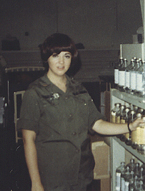
army nurse, vietnam

Lynn Bedics, Vietnam, 1969

When I met with Lynn in April 1999, I showed her the forms proving she had ministered to Nicky. It was a bonding moment for both of us, even though she still didn’t remember Nicky and didn’t recognize him from pictures.

Today Lynn is retired from the government. She still lives a five-minute walk from my home in west Allentown. We’ve had lunch together, we see each other at the Farmers Market and exchange e-mail and phone calls. She knows many of the vets I’ve interviewed for my Morning Call series War Stories: In Their Own Words, and even steered me to one. And she looks forward to publication of my book about Nicky, Quiet Man Rising: A Soldier’s Life and Death in Vietnam.

Lynn’s connection to both Nicky in Vietnam and me in Allentown was improbable but didn’t happen on its own. The pieces had to be put together. In the end, it was a lesson in the importance of listening closely, examining the right documents and paying attention to detail.

News from the front: How do we know what’s going on?

WHY NO REPORTING OF AFGHANISTAN CASUALTIES?

Afghanistan_&_American_soldiers_in_Tora_Bora

Afghanistan & American soldiers in Tora Bora

It galls my friend Bob Faro, a veterans advocate in the Lehigh Valley, that local newspapers publish little on the Iraq and Afghanistan wars “unless it is reactive, as in a local service member’s death.”

His son Joey, a 19-year-old Marine, was seriously wounded by a roadside bomb in Afghanistan a few weeks ago and is being treated at the National Naval Medical Center in Bethesda, Md. “I ask just as I have with every known service member being injured,” he said in an e-mail to me and others, “why no reporting?”

I don’t think it’s deliberate.

Mainly, there is no central, authoritative clearinghouse for information on wounded soldiers, sailors and Marines. In the case of deaths, the Department of Defense makes it easy: It posts name, rank, hometown, branch of service, unit and cause of death on its website for all to see. Newspapers and other media take it from there. http://www.defense.gov/releases/

THE WAY IT USED TO BE

Things were different not so very long ago, during World War II.

The paper I work for, The Morning Call in Allentown, Pennsylvania, has clip files in its newsroom library that prove it.

In the old days, a paper’s employees cut out stories about people and put them in small brown envelopes. The cutouts are called clips. The envelopes were filed in alphabetical order in a metal cabinet in a room that used to be called a “morgue.” One file might have clips covering a person’s life from birth to death.

The veteran I interviewed for my story marking the 66th anniversary of D-Day, E. Duncan Cameron, was a 1940 graduate of Allentown High School. He hit Omaha Beach on D-Day, June 6, 1944. Sure enough, The Call has a clip file on him. It’s similar to Morning Call files I’ve seen on other World War II vets. Not only is there a story about his getting wounded, but an update on his recovery.

45th Division roadblock, Battle of the Bulge, 1944

45th Division roadblock, Battle of the Bulge, 1944

There is a clip on what happened to him three months after D-Day: “E. Duncan Cameron Wounded in Germany.” The paper got the news from his parents, who had gotten a letter from Duncan and showed it to the newspaper. “Was hit in the left arm by shrapnel from a mortar shell, the shrapnel penetrating the arm just above the wrist,” Duncan wrote.

The story ran with a photo his parents had previously given the paper. The picture was used first with a June 23, 1944, story headlined: “Pfc. E.D. Cameron Jr. Sends Letter Home From Invasion Front.”

Another clip, dated March 6, 1945, reported that Duncan was home on furlough from the hospital in Tennessee where doctors had grafted a bone to his wrist. Again, the story ran with a photo.

It was a different time. The community that a newspaper served was closer-knit than it is today.

MY OWN EXPERIENCE WITH THE VIETNAM WAR

That intimacy was gone just a generation later, when the sons of World War II vets were fighting in Vietnam.

Nicky Vendetta home in Malvern, Pennsylvania, 1969

Nicky Venditti home in Malvern, 1969

My cousin Nicky Venditti came from little Malvern, Pennsylvania. The local paper was in the neighboring town, West Chester. Nicky joined the Army, became a helicopter pilot, arrived in Vietnam on the Fourth of July 1969 and was gravely wounded in a grenade explosion six days later. There was nothing in the paper about it.

Nicky, the subject of my book, Quiet Man Rising: A Soldier’s Life and Death in Vietnam, hung on to life for almost a week at an evacuation hospital in Vietnam.

The Daily Local News of West Chester did not have a story until July 21, seven days after his death. “The Defense Department reported only that Warrant Officer Nicholas L. Venditti died in a military hospital [in Vietnam] on July 15,” the paper said. There was nothing from his family in the story, and no indication the paper tried to contact them.

It wasn’t necessary.

Within hours after his parents got the telegram saying Nicky had been hit and there was “cause for concern,” everyone who cared about him knew it.

They knew it by the oldest means of passing on information – a method that still hasn’t lost its potency.

Word of mouth.

A D-Day Veteran Remembered

The anniversary of D-Day is always the occasion for an interview in my series War Stories: In Their Own Words for Allentown’s The Morning Call. This year, I’ve been interviewing an 89-year-old World War II veteran. His story will run in the newspaper on the D-Day anniversary, June 6, 2010.

Approaching Omaha Beach, June 1944

Approaching Omaha Beach, June 1944

When I interview a vet, I find it helpful to take along maps and photos to jog the memory. Over the years I’ve amassed a good-sized library* of material on the Normandy invasion. This year,my interview is with a man who had been with the 1st Infantry Division, called the “Big Red One.” He was in the 26th Infantry Regiment, which was held in reserve and didn’t hit Omaha Beach until late afternoon; the two other regiments of the “Big Red One” hit the beach earlier in the day. While leafing through my copy of Stephen E. Ambrose’s D-Day, June 6, 1944 I found a map of the position of my vet’s battalion on Omaha Beach on the evening of  June 6th. I showed him that page. Sure enough, it jogged his memory.

It wasn’t until I had Ambrose’s book back home that I remembered where I had gotten it. For my D-Day anniversary story five years ago in The Morning Call, I interviewed 1st Infantry Division vet Harold Saylor of North Catasauqua, Pennsylvania, who hit Omaha Beach in a hail of German gunfire at 7:30 a.m. carrying a pair of Bangalore torpedoes, long metal pipes packed with high explosive and used for blowing up barbed-wire entanglements.

Always eager to see me, Harold would have scraps of paper for me with notes of some detail he wanted to make sure I knew. One, giving an idea of how much he was weighed down when he went ashore, was typed out: “170 pounds of equipment, including the clothing.” Another typed-out note to me read: “I could not swim either, and to this day I still cannot swim.” One day when I arrived, he handed me seven pages that he’d scrawled brief notes on. “I talked to Ernie Pyle,” he’d written on the first page, referring to the famous war correspondent.

In his small home office crowded with books,  files and photo albums, Harold knew where everything was. Sometimes he would shake his head and say that he didn’t know what would become of this stuff when he was gone.

His story ran on June 6, 2005, under a headline that was a quote from him: “On the beach, there was no place to hide.” An e-mail I got from a reader said: “I’m at my desk at work and crying my eyes out.”

American Casualty, Omaha Beach, June 1944

American Casualty, Omaha Beach, June 1944

In the months after Harold’s story ran, his health declined. The last time I saw him, he was in a hospital bed in his living room and didn’t seem to know who I was. I rested my hand on his and our eyes met. He died a few weeks later, at age 81, before another D-Day anniversary came.

One day his widow, Anna, called and asked me to come over. Harold had left something for me, she said. It was Ambrose’s account of D-Day. She said Harold wanted me to have it, as well as any other of his books I’d like to have.

Perhaps he hadn’t recognized me in the end, but he did remember me.

On Sunday, June 6, my newest D-Day interview will be in the newspaper and I’ll be going to the annual picnic held in Nazareth, Pennsylvania, by the Lehigh Valley Chapter of the Veterans of the Battle of the Bulge to honor D-Day veterans. I’ll be bringing 90-year-old Dan Curatola, one of Harold’s fellow infantrymen in the 1st Infantry Division’s 16th Infantry Regiment who also hit Omaha Beach that day 66 years ago. And I will think of Harold again.

*Venditta’s Pick of D-Day Photograph Albums

Time-Life editors. THE SECOND FRONT, Time-Life Books World War II  39-book series

Life commemorative edition by Richard Holmes. D-DAY EXPERIENCE, a photo-filled magazine to mark D-Day’s 60th anniversary, 2006

Time special issue, D-DAY: WHY IT MATTERS 60 YEARS LATER, 2006

National Geographic’s issue, “Untold Stories of D-Day,” 2002 which has the most detailed map of the invasion beaches I’ve ever seen

American Heritage‘s  issue “D-Day: What It Took, What It Meant, What it Cost.”1994

Normandy Invasion, June 1944

Normandy Invasion, June 1944

Veterans Live On In Their War Stories

They buried Ernie Leh with his 1st Infantry Division pin.

At the service last week in Schnecksville, Pennsylvania, the Rev. Robert D. Machamer Jr. read aloud from the story I wrote about Ernie six years ago as part of my series in The Morning Call newspaper, War Stories: In Their Own Words. He read not just a few lines, but the top third of the article. It was about Ernie’s landing at Omaha Beach on D-Day, June 6, 1944.

The minister, a friend of Ernie’s, was taken by an occurrence on the beach that would have been humorous if the situation hadn’t been so grave:

“On my way up the slope, I had to relieve myself. I stopped and went behind a rock about 5 or 6 feet high. Others passed me and went on ahead. I remember seeing a major and some enlisted men pass by. Just as they got over the next rise, a shell exploded right in their midst, getting all of them. That, I thought, might have been me if I had not stopped to urinate. The brief delay had saved my life.”

Soldiers on their way to France, June 6, 1944

Soldiers on their way to France, June 6, 1944

Machamer paused and said with a smile that you had to figure Ernie was meant to survive.

As he went on with the story, which I’d put together from Ernie’s own writings and my interviews with him, I thought about the enduring value of recording veterans’ stories, how important they are to family and friends and not least of all, posterity.

By special arrangement, my stories in The Morning Call have permanent homes in the National World War II Museum in New Orleans and the Library of Congress’ Veterans History Project.

Some of my subjects were recommended to me by sons and daughters of World War II veterans whose dads were in poor health. Their children felt they had limited time left and asked me to get their stories down. It’s an appeal I find hard to resist.

Two such interviewees were Earl Metz and Earl Schantzenbach. I worked on them without delay. Their stories ran in March 2003 in the days after the Iraq war began. Metz, who had been a combat engineer in Europe, lived for two more years. Schantzenbach, an infantryman who was awarded the Silver Star for gallantry, died just five weeks after his story appeared. But their stories will live on.

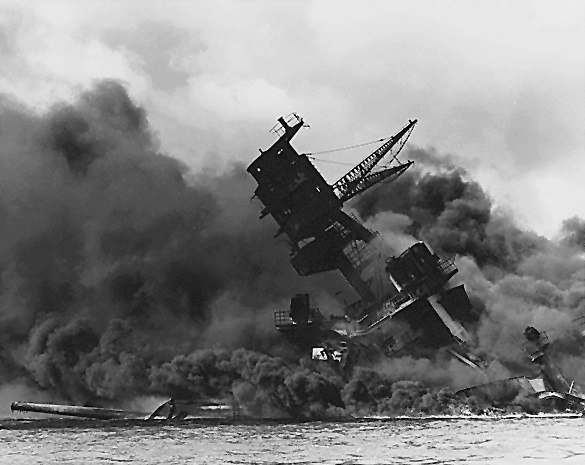
USS Arizona sunk at Pearl Harbor, December 7, 1941

USS Arizona sunk at Pearl Harbor, December 7, 1941

A Pearl Harbor survivor who agreed to talk with me did not live to see his tale in print. John Minnich’s heart gave out several days after my second interview with him. His family gave me permission to run the story as a tribute to him, and it appeared on the Pearl Harbor anniversary on Dec. 7, 2001. I sometimes wonder if he didn’t sense the end was near.

Veterans themselves embrace the idea that their stories will live after them. Most memorable to me was Joe Poster, who endured the Bataan Death March and more than three years as a prisoner of the Japanese. As his health failed in the months after his story appeared, I heard him tell people on more than one occasion, “That story is in the Library of Congress.” His two-part account is at  http://www.mcall.com/news/warstories/all-josephposter1,0,2658608.story and http://www.mcall.com/news/warstories/all-josephposter2,0,2724145.story.

State Representative Jennifer Mann of  Allentown contributes to the perception of permanence. When my war story subjects are constituents of hers, Rep. Mann sends them laminated copies of the articles with a note thanking them for their service to the country. This helps veterans see that people beyond family and friends are grateful for what they’ve done.

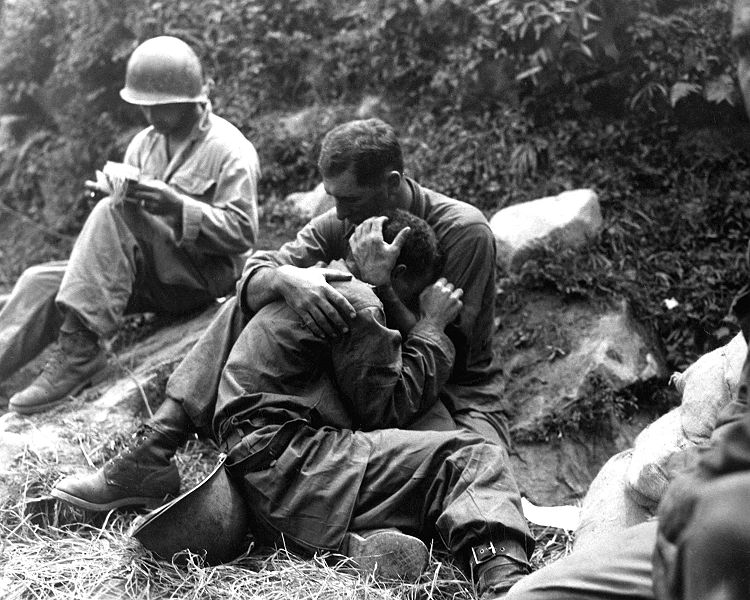
Korean War Fallen Soldier, August 28, 1950

Korean War Fallen Soldier, August 28, 1950

Even in obituaries, families have noted their loved ones were featured in the series. When nurse Cecilia Sulkowski died in 2008, the reference to my work read in part: “On July 5, 2002, Cecilia was featured in a lengthy article with photos in The Morning Call titled ‘Mending broken spirits, shattered bodies in Korea.’ In the article, she describes her Army experience which included setting up the first-ever Mobile Army Surgical Hospital during the first six months of the Korean War… Her vivid descriptions and sharp memory made this story mesmerizing.”

At veterans’ funerals, my stories have appeared among photos and other memorabilia for mourners to see. This is more than gratifying. That’s because beyond the thanks of veterans themselves and their families and friends, writing veterans’ stories is meaningful and lasting. It not only preserves legacies for generations to come, it contributes to our understanding of history.

That’s partly what I aim for in my book about my cousin Nicky Venditti, an Army helicopter pilot who answered his country’s call. In QUIET MAN RISING: A Soldier’s Life and Death in Vietnam. In this book which took me many years to write, I also give voice to a young man whose story – like the stories of countless other veterans – would otherwise lie with him in the grave, untold and unappreciated.

I can’t let that happen.

The power of letters home from Vietnam

When I got involved in researching my cousin Nicky’s death in Vietnam, I spoke with family, friends, his fiancee and Army buddies. Their remembrances – and the way they still feel about him – touched me deeply. Nothing affected me more intensely than the letters he wrote home.

Nicky Venditti at home in Malvern, PA, 1969

Nicky Venditti at home in Malvern, PA, 1969

Nicky Venditti’s tour of duty lasted only eleven days. He was an American soldier ready to fight for his country for only a week before his grievous accident. His final  five days were spent unconscious in an Army hospital. Arriving in South Vietnam on the Fourth of July, 1969, he wrote to his parents first thing, like many GIs who had reached their destination. Both of his parents had remarried after their divorce, so he sent two sets of letters, one to his mother and stepfather, the other to his father and stepmother.

Twenty years after Nicky’s tragic death, all four of his parents raided their musty attics to pull out his old letters from cigar and shoe boxes. They’d never gotten rid of them;they even kept the air mail envelopes with their red, white and blue borders.

In what might have been a last letting-go in their old age, they turned their son’s letters over to me. Not copies, but the originals, all on lined composition paper six by eight-and-a-half inches. I’m looking at them as I write this, for perhaps the hundredth time, and fighting back tears.

There is something immediate, timeless and unforgettably intimate about handwritten letters. When I look at Nicky’s, they’re as fresh as if he had dashed them off today. I can see him writing them in his barracks, the Army helicopter pilot eager to get his hands on the controls of a Huey, to do his job and go home in a year to the girl he plans to marry.

It’s the beginning of July 1969 again. Nicky is alive and well.

His first letter home is tinged with irony.

“Well I arrived in this wonderful place called Viet Nam yesterday at three,” he wrote to his dad and stepmother on July 5. “I still can’t believe I’m here. But when I look around I get more assured I am!!…Oh, I’m at Cam Rahn Bay Replacement Center right now. It’s about 150 miles from Saigon. It’s probably the safest place in Viet Nam. Too bad I can’t get stationed here.”

Nicky wrote three more letters to his parents before July 10, when an Army instructor’s grenade slashed him with metal fragments, almost tearing off his left leg, in a classroom just off the Americal Division base at Chu Lai. All of his letters look as if he’d scribed them with the same blue ballpoint pen. He must have had it handy.

“I’m sorry this is a little sloppy, Dad, but it’s hotter than hell here…Well I’ll let you in on the situation. It’s not too good. There used to be only companies of V.C. around here, but now there are regiments and divisions of them. The lieutenant who briefed us said they expect an offensive, but do not know when…That’s all I can let you know for now. Besides I wouldn’t tell you anymore anyway, because you’ll worry your head off.”

The next day, July 7, he wrote to his mom: “This place is lousy. I can’t even see why we are here because Viet Nam isn’t worth a nickel.”

Nicky sent other letters before he was wounded. They were to his teenage fiancee, Terri, but I never saw them. After his death, she had her best friend burn them because it hurt her too much to read them – and she didn’t want to be the one to destroy them.

When Nicky’s belongings were sent home to his parents, they included an unopened letter to Terri. Nicky hadn’t had a chance to mail it, and Terri never read it or even knew that it existed. Nicky’s stepmother promptly had it burned in the back yard, still in the sealed envelope. She felt it would only have intensified Terri’s grief, and wanted to spare her.

As part of my research for my book on Nicky, Quiet Man Rising: A Soldier’s Life and Death in Vietnam, I read Dear America: Letters Home from Vietnam, edited by Vietnam veteran Bernard Edelman. It cut to my heart.

The purpose of Dear America, the book’s jacket says, is to “evoke reconciliation and an awareness of the enduring human values which are reflected in the conflicting experiences of the Vietnam war.”

Nicky’s letters home would have fit in nicely.

Home Is Where You Dig It

Marine Writing a Letter, Vietnam, 1968

Tracking Down the Truth: How to Check the Facts in a War Story

The newspaper I work for has fact checkers on staff. The fact-checking for stories about veterans provides special challenges because their material is from so long ago and far away. Of the more than 80 military veterans I’ve interviewed over the last decade, a few have told me stories about major brushes with famous people, and in one case with a particularly notorious bomb.

I had to be careful for my series in The Morning Call of Allentown, Pa., “War Stories: In Their Own Words.” Memories of long-ago events can be hazy, and age can play tricks on a person. When a veteran tells me stories that feature high-profile people, I find  it isn’t enough to run to the library or search the Internet for checking information.  When I can’t find the answers in the library or online, I have to come up with other ways of verifying the stories. Accuracy, after all, is everything, and I didn’t want someone knowledgeable telling me after publication: That has never happened with my stories.

One of my interviewees, Andrew Cisar, was a cryptographic technician with Gen. George Patton’s 3rd Army headquarters in England in 1944. His story was that he deciphered a top-secret message from the supreme Allied commander, Gen. Dwight Eisenhower, informing Patton of the final date for the invasion of Normandy, D-Day. Cisar remembered the hour and day he got the message for deciphering, and how it was so critical, he had to deliver it to Patton personally.

How could I confirm this?

It’s is easy to contact a professor, a government historian or an independent scholar who has published to good reviews.  All of these types are used to phone calls and will advise you.

I went right to the top – Martin Blumenson, a military historian who served as a historical officer with the U.S. Third and Seventh Armies in World War II.  Blumenson has been described by The Washington Post as “a leading historian of World War II who wrote the Army’s official account of the D-Day invasion and was perhaps the foremost authority on the life of Gen. George S. Patton Jr.” It wasn’t hard to get Blumenson on the phone. After I told him Cisar’s account, and answered questions he had about Cisar’s service, he said Cisar’s story was plausible. The story ran on June 6, 2004.

LC-USZ62-25600 Library of Congress image

Eisenhower addressing paratroopers (LC-USZ62-25600)

Jerry Webre was a Navy lieutenant who co-piloted cargo planes across the South Pacific. On a summer day, he saw unusual freight loaded onto his plane at a base along the San Francisco Bay. He said it was the tail assembly for the atomic bomb that would be dropped on Hiroshima. His C-54 carried the part to Honolulu, he said, and another crew took the plane from there.

How to check?

An online search turned up Alan Carr, historian at Los Alamos National Laboratory in New Mexico, where work was done on the atomic bomb. I e-mailed him the details of Webre’s account.

“No red flag here,” he e-mailed back. “Though I can’t confirm Mr. Webre’s involvement, his story certainly seems plausible.”

H.M. King George VI of the United Kingdom.

H.M. King George VI

Another Navy vet, Dr. John Hoch, recalled that  he had been on a landing craft moored in southern England in the days before the D-Day invasion, waiting to take troops across the English Channel on June 6, 1944.  He said General Eisenhower and King George VI appeared on the dock about 30 feet away from him.

I couldn’t find anything that put Ike and the king together at that time. A newsroom librarian couldn’t either.

But a historian at The National World War II Museum (formerly the National D-Day Museum) in New Orleans suggested I contact an expert on George VI. So I looked up British historians and, through a publicist, reached Antony Beevor, author of D-Day: The Battle for Normandy.

In an e-mail, Beevor wrote of Hoch’s seeing Eisenhower and the king together: “It is plausible on 4th or 5th of June, but not on June 6th, as ships had left and the King was broadcasting live to the nation that morning.”

With that, Hoch’s story got the green light.

For my book QUIET MAN RISING: A Soldier’s Life and Death in Vietnam, about my cousin Nicky, I interviewed many veterans who had known Nicky. Before I wrote up my interviews with them, I asked the National Personnel Records Center in St. Louis for their personnel records.  A veteran’s service is public record, though some information, such as birth dates and current addresses, are withheld by law as a matter of privacy. This way, I could make sure the vet was who he said he was.

No matter how daunting the task, there’s always some way to go about verifying a veteran’s account. You might not be able to nail it down completely, but at least you can approach the truth. It’s a matter of taking the time to ask around, then following through. Professors, independent scholars and government historians can advise you on checking out the information you have about a veteran. If you go to the Resources page on my website, you will find a list of places that can help you get started in verifying veterans’ stories.

Lessons I Learned from Pat Tillman’s Story

After reading Jon Krakauer’s Where Men Win Glory: The Odyssey of Pat Tillman, I couldn’t help but compare the story of the NFL player killed by friendly fire in Afghanistan to what happened to my cousin Nicky Venditti in Vietnam 35 years earlier.

– Tillman was a famous athlete. Nicky was athletic, too, but hardly known outside his hometown of Malvern, Pennsylvania. Still, they both felt a duty to serve their country in wartime, and both enlisted in the Army – Tillman to be an elite Ranger, Nicky to become a helicopter pilot.

– The military clearly knew how Tillman died in 2004; the evidence all pointed to gunfire coming from his own platoon, near the Pakistan border.

In Nicky’s case, the Army couldn’t determine how an instructor at the Americal Division base at Chu Lai happened to toss a live grenade in his classroom. For lack of evidence, the brass ended up calling the 1969 explosion that killed Nicky, Billy Vachon and Tim Williams an accident. But it might not have been friendly fire. It might have been the work of a Viet Cong saboteur, as the instructor himself now suggests. We will never know.

– There were cries of cover-up in both cases. Ranger leaders stupidly withheld the details of Tillman’s death, leading his family and the American public to believe he was gunned down by the enemy.

After the deaths of Nicky, Billy and Tim at Chu Lai, some soldiers complained that the truth of what happened wouldn’t come out. There was an investigation, but in years of searching I’ve never been able to find any paperwork on it. In the immediate aftermath, the families were told little more than that a grenade had gone off by accident in a classroom.

– A big difference between the two incidents was how Tillman’s family responded to the news of his death. They would not rest until they learned the details surrounding his fatal shooting. Ultimately, after pressing the government relentlessly to come clean, they got some satisfaction.

Nicky’s parents and those of Billy Vachon and Tim Williams did not seek the details of what happened to their boys or question the Army at all about it. They accepted the word that was handed down to them.

Perhaps that has something to do with who they were: the generation that fought World War II — and still did not doubt the military, even during the unpopular war in Vietnam.

But it was something else, too, that was more basic: To Nicky’s parents, it didn’t matter how he died, only that he was gone.

What happened to Tillman and Nicky didn’t diminish their sacrifice, no matter how you classify their deaths. They both stood up for their country in its time of need, and died for it.

The Ritual of Military Memory: Lunacy or Legacy?

I just finished reading Paul Fussell’s masterly study of the First World War and its impact on literature, The Great War and Modern Memory. Near the end he writes about “the ritual of military memory,” and it’s a section that really hit home for me as a chronicler of veterans’ stories.

Fussell, a World War II vet who was badly wounded in Europe, says vets have vivid memories of their brushes with death and feel a powerful, ritual obligation to revisit old battlefields in their minds. It is, Fussell says, a “lunacy of voluntary torment.”

I see it all the time.

It’s mostly evident in World War II vets, who are now in their 80s and beyond. Recently, the wife of a submariner I’d done a story on touched on that. Hank Kudzik had dodged death repeatedly beneath the waves and experienced heart-rending losses in the Pacific. His wife, Jackie, told me: “He never used to talk about this, but now it’s always on his mind. He can’t talk about it enough.”

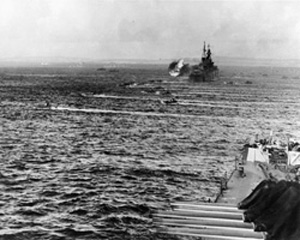
LVTs (Landing Vehicle Tracked) heading for the shore of Saipan Island on 15 June 1944

LVTs heading for Saipan Island on 15 June 1944.

Several years ago I showed up late for a banquet of the Military Order of the Purple Heart outside Allentown, Pennsylvania  where I write a series War Stories: In Their Own Words for the newspaper, The Morning Call. There was only one seat left. I sat down next to a pleasant vet I didn’t know. His name was Charlie Toth, and he said he’d been a Marine on Saipan and Iwo Jima and how terrible the fighting was. I asked him if he’d like to talk about his experiences for publication. He gave a firm “no.”

I said, “If you change your mind, please call me,” and gave him my card. I didn’t expect to hear from him.

Red Beach 2 during the landings on Saipan, 15 June 1944. More than 300 LVTs landed 8,000 Marines in about two hours.

Red Beach during the landings on Saipan, 15 June 1944. More than 300 LVTs landed 8,000 Marines in about two hours.

Within two weeks, Charlie called and said he would talk to me. Our first day together, we sat at the dining room table in his home, and he spoke of the Marines in the island fighting and the accomplishments of his unit. I listened politely for a while and asked a few questions but had to stop him. “Charlie, if this is going to work, I need you to talk about what you experienced. The people who read this story will want to know about you, about what happened to you.”

He just stared at me, then said:

“If I started telling you what I have seen, I would never sleep again.”

That became the first line of Charlie’s haunting story about facing fanatical Japanese in battle and barely escaping with his life. Here’s the link to the story, which ran in The Morning Call on Memorial Day 2006:

http://www.mcall.com/news/local/warstories/all-charlestoth,0,7762498.story

Initially reluctant, Charlie had come around to speaking from his heart – even saying he had confessed to his Catholic priest after he got home from the war:

“Father, I was away almost four years. I think I have committed every crime that’s known to the human race.”


“Son,” he said, “I know. You’re forgiven. Your country forgives you. You’ve done your job. You’re home.”


But I didn’t feel forgiven.

It is one thing for a vet to revisit battlefields in his memory, and quite another to do it for a few hundred thousand readers. Still, in my interviews for War Stories: In Their Own Words, I have seen that veterans like Charlie Toth who tell their stories for publication find some relief in it. It’s more than establishing a record that will live long after they’re gone. It’s a way of unburdening themselves, of conveying their sacrifices so that others might understand.

Yes, it might be voluntary torment, as Fussell puts it, but it’s not all lunacy.

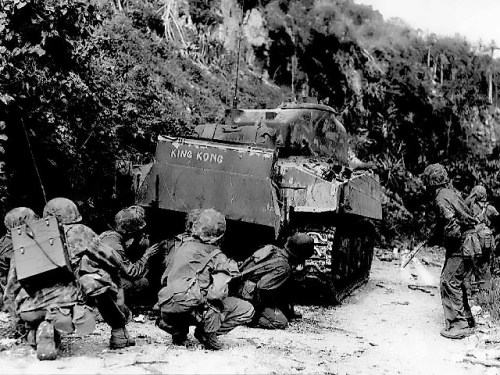
Marines take cover behind a M4 Sherman tank while clearing out the northern end of Saipan, 8 July 1944.

Marines take cover behind a M4 Sherman tank during the clearing out of the northern end of Saipan Island, 8 July 1944.

Bringing Out the Horrors of the Dachau Death Camp

Donald Burdick was a pre-med student at the University of Scranton when the Army drafted him during World War II. In July 1944, the private first class landed in northern France with a field artillery observation battalion. Five months later, on Dec. 16, his unit was in Luxembourg when the Germans attacked and the Battle of the Bulge began. At 84, Don shared his experiences holding out during the siege of Bastogne with the Morning Call readers in a column in my series,  War Stories: In Their Own Words.
US Army jeep at the gates of Dachau, 1945

US Army jeep at the gates of Dachau, 1945

In that interview Don also showed me some photographs he had taken when his unit was sent to Dachau in the spring to liberate that concentration camp from the Nazis. He had had these pictures for more than sixty years and had never shown them to a soul. On my final interview, Morning Call photographer Harry Fisher not only photographed and videoed Don, he also photographed Don’s Dachau photos so we could post them on The Morning Call website and run them in the paper.

Back in the newsroom, the executive editor examined the photos in her office with a deputy managing editor, who told me we could run the pictures but not with the Bastogne story. That would be forcing them into the paper, she said, without the proper context. She didn’t want them “shoehorned” into a story about Bastogne that only mentioned Dachau in passing. The executive editor suggested that the following April, about the time of Holocaust Remembrance Day, I write a separate story about Don’s experience at Dachau, and it would run with some of the photos.

That was the plan, and it worked out exactly like that. Harry Fisher and I spent more time with Don at his home in the spring of 2009. The executive editor reviewed the grisly photos and OK’d the use of several inside the paper, with the story’s runover.

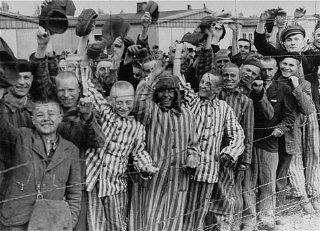
Prisoners wave at troops at the liberation of Dachau, 1945

Prisoners wave at troops during the liberation of Dachau, 1945

And that’s the way it went. The story ran on Page 1 on Sunday, April 19, 2009, with the pictures inside. The story featured a box telling readers that April 20 was Holocaust Remembrance Day. The Jewish Federation of the Lehigh Valley holds a program at the Jewish Community Center in Allentown to commemorate the event each year. Not only were the photos in the paper, they were also online at The Morning Call with a two-minute video Harry had shot of Don talking about his day at Dachau.

Response to the story was electric. A year went by. Shari Spark, head of the Holocaust Resource Center at the Jewish Federation, called me looking for Don. She wanted to contact him to see if he’d speak at the 2010 Holocaust Remembrance Day program. I gave her Don’s phone number.

Two weeks later, she called me again with an idea. She had been impressed with how articulate Don was when they had spoken together in his living room. I knew what she was talking about: Don is a natural raconteur and from decades of teaching high school science could get the point across concisely.  Shari wondered if Don’s presentation would be more effective if it would take the form of a casual interview. The interviewer would have to be someone Don felt comfortable with.

I could see it coming. Shari asked me: Would you consider doing it? I had to get permission from my supervisor, who had no problem with my participation in the event. Shari spent three hours with Don and me one day, going over the material. The interview during the ceremony could last only a half-hour and I had to cover everything we discussed over many hours of interviews. I used a notebook to record the important points and listed them in order. I brought them to the ceremony to be sure my questions structured Don’s story. I kept my questions open-ended, giving him room for spontaneity and illumination. I never interrupted him, waiting until it was clear he had said what he wanted to say. Sure enough, Don sustained a powerful, emotional delivery. The audience gave him a standing ovation.

After the ceremony, people lingered and talked. They shared their own stories and asked Don more questions. Just as Shari predicted, he had connected with them.