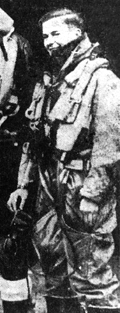
Happy birthday to you, Duncan Cameron

E. Duncan Cameron at his 90th birthday party on April 8

D-Day veteran E. Duncan Cameron at his 90th birthday party on April 8. Photo by Deborah Greener

E. Duncan Cameron struck a philosophical note on his 90th birthday Friday.

“We can’t live forever,” the World War II veteran told me with a smile, surrounded by family and friends who had surprised him at the Mary Ellen Convalescent Home south of Hellertown.

I’d been invited by Duncan’s nephew, R. Bruce MacDougall, and his wife, Pat. It was Bruce who put me on to his “Uncle Dunc” a year earlier, when I ran a query in The Morning Call seeking D-Day veterans. Bruce’s response led me to interview Duncan for a story that ran Sunday, June 6, 2010, marking the 66th anniversary of the Normandy invasion. Here’s the link: http://www.mcall.com/news/warstories/mc-e-duncan-cameron,0,3056405.story

Bruce and Pat’s son, Mike, came to the party. He works at Lehigh University, a connection he shares with his grand-uncle – Duncan got a degree in business administration from Lehigh after the war. Duncan’s niece Cathy Spiller was there, along with his friend since the 1960s Marshall Cabe; and Barbara Greener, whose husband and Duncan were childhood friends in west Allentown, near my home. She came with her daughter, Deborah.

Duncan has been struggling with Parkinson’s; he can’t walk and has no use of his left arm, but his right still gives you an iron-grip handshake. Last year he was among several D-Day veterans who attended a picnic in Nazareth put on by the Lehigh Valley Chapter of the Veterans of the Battle of the Bulge to honor them. One of the speakers, state Rep. Steve Samuelson, held up that morning’s paper for all to see. It had my story on Duncan and his picture prominently on the front page.

Amazingly, Duncan kept a diary while with the 1st Infantry Division. In what was his first exposure to combat, his Company C, 26th Infantry Regiment hit Omaha Beach on D-Day more than 11 hours after the first troops came ashore – and still faced hot German fire.

Duncan’s entry for June 6, 1944: “D-Day! Landed about 6 p.m. in water up to our necks. Our boat almost got it maneuvering into shore. Plenty of hell on the beach. One barrage whistled right overhead & I thought surely I got it. Sam, Sgt. North, Frey & Robbie were wounded. Lynne was killed. Marched all night – no sleep. Plenty of close calls. Ran into a Jerry patrol.”

Even more amazing, Duncan wrote a poem in his pocket diary a few days after D-Day while in a foxhole amid Normandy’s hedgerows. We published it with my story.

 In 2003, Duncan donated his diary and other writings to the Veterans History Project, American Folklife Center, Library of Congress. Here’s the collection info: http://lcweb2.loc.gov/diglib/vhp/bib/6555

A photo The Morning Call ran shows Duncan outside a hospital in Memphis, Tenn., in the spring of 1945, one arm in a sling. He had been wounded on Sept. 19, 1944, near Stolberg, Germany. In the photo, he’s standing close to his sister in uniform, Cpl. Betty Cameron of the Women’s Army Corps – Bruce MacDougall’s mother. Both are grinning broadly. It is one of the most heartwarming war story pictures we’ve ever printed. 

Almost a year has passed. On Friday, April 8, we sang “Happy Birthday” to Duncan, which he followed with the observation: “They’re no singers, but they’re pretty good.” A cake was shared with the dozens of other nursing home residents gathered in the community room. Duncan opened gifts of candy and fruit, his sky blue eyes alight.

Just before I left, Pat MacDougall showed me something that affirmed yet again the value of getting vets’ stories into the newspaper. She took me to Duncan’s room, where all three pages of his Morning Call story hang side by side on the wall next to his bed.

“Everybody reads it,” she said.
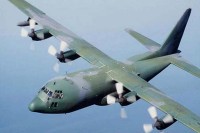
My terrible adventure out of Willow Grove NAS

C-130 Hercules

C-130 Hercules

News of the last military aircraft flying out of Willow Grove Naval Air Station last Wednesday brought back memories of my most embarrassing moment as a newspaperman.

 It happened 30 years ago, when I was working for The Daily Intelligencer in Doylestown. The paper had gotten an invitation from the Air Force Reserve: We’d like someone on your staff to join some of our Weekend Warriors on a simulated combat mission. A squadron of C-130 Hercules turboprop transports from the 913th Airlift Group would fly from Willow Grove to Michigan for exercises.

I was interested — it passed for adventure in my otherwise routine job — and got the OK to go.

There’s not much to tell, mostly because I’ve repressed the chain of events out of misery. I do remember that on the flight out to the Detroit area, the crew put me in front of the controls in the pilot’s seat. I banked the plane left and right, amazed at how responsive it was to the slightest touch.

My misfortune came the next day, when we took off on a simulated combat mission after lunch.  There were several C-130s ahead of us as we formed what’s called a fluid trail. The prop wash from those aircraft jostled our own plane, and I felt dizzy, with a bad churning in my stomach.

You guessed it: I got sick, real sick, there on the flight deck. Fortunately for the crew, I had a barf bag one of the guys had handed me when he saw me turning green.

The crewmen were polite, but I could tell they were looking askance at me as if I were a wuss. Well, yes, I’m prone to motion sickness, and we’d taken off when I was on a full stomach, and I hadn’t fully appreciated what I’d gotten myself into.

I was miserable as we flew on and, as part of the drill, dived straight down over a lake, pulling up seemingly at the last instant. I’d had enough.

The rest of the weekend was – and remains — a blur.

The story I wrote for the Intelligencer that summer of 1981 was forgettable. It ran on the front of the features section, paired with a military story that was very well written by a fellow staff writer. My piece was rescued from near worthlessness by the ministrations of the features editor, Sandy Bauers. (Sandy went on to The Philadelphia Inquirer, where she’s been doing terrific reporting and writing for years.)

I didn’t keep a copy of my story and tried to put the ugly business behind me. Then, about a month later, I called the Willow Grove base for information I don’t think was related to the Michigan trip, and happened to speak with one of the Air Force guys I’d flown with.

“Oh yeah,” he said. “You’re the guy that threw up on the flight deck.”

Ouch.

And so, with the military planes gone from the base in eastern Montgomery County and personnel working toward a shutdown in six months, I say goodbye to Willow Grove with a wave of nausea, barf bag in hand.

Captain vs. crew on the USS Allentown

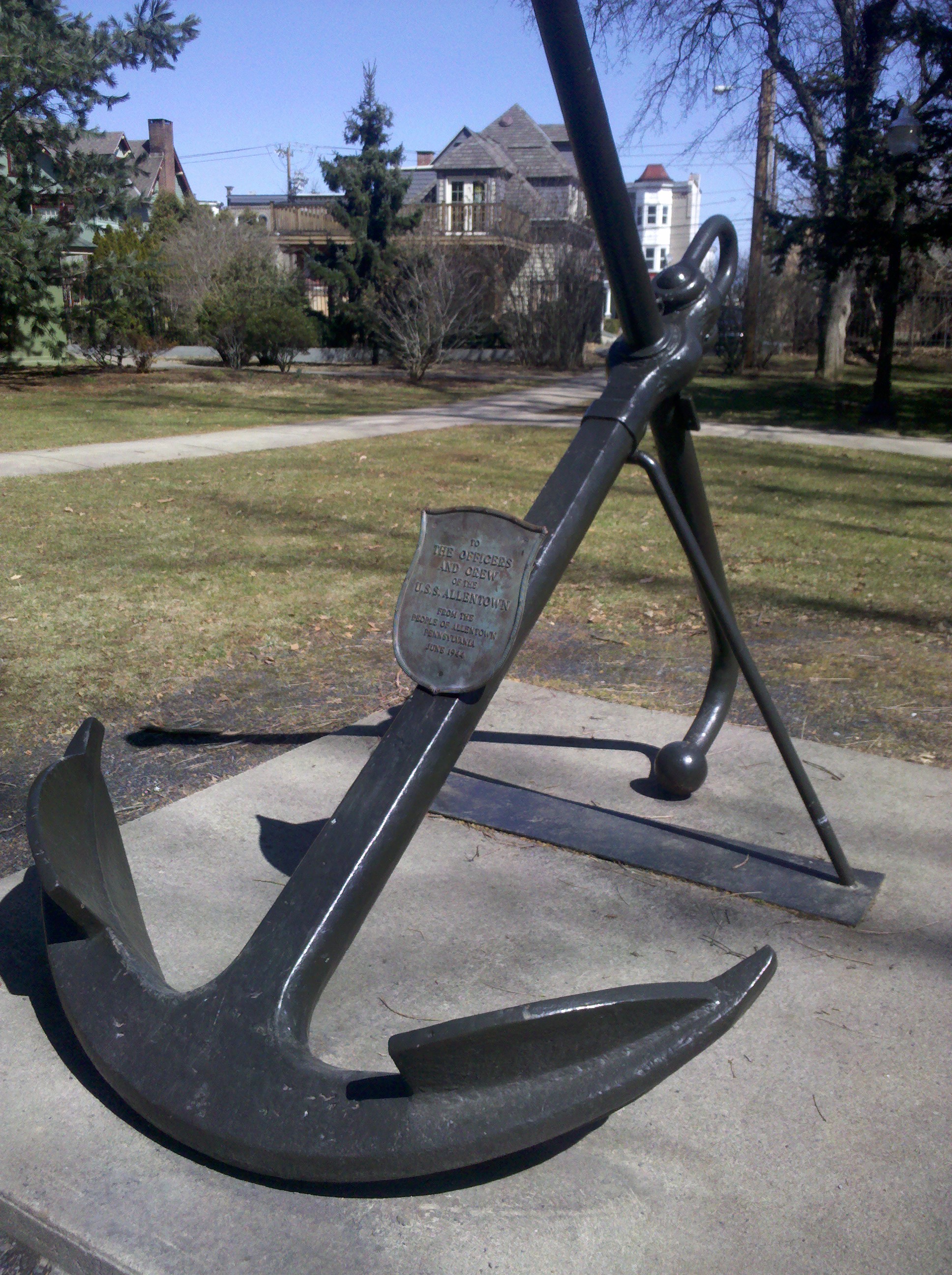
USS Allentown monument, West Park

USS Allentown monument in West Park, Allentown

One of my favorite walking paths takes me through Allentown’s West Park, where there’s a row of war monuments, including one that stands out by its shape. It’s in the form of a ship’s anchor and reads:

 TO THE OFFICERS AND CREW OF THE USS ALLENTOWN
FROM THE PEOPLE OF ALLENTOWN PENNSYLVANIA
JUNE 1944

What’s that about, anyway?

Google the name and you get 46,600 hits, including a website, http://www.pf52.org/, dedicated to the ship and its men.

 The Morning Call archives contain numerous stories about the Allentown, the most definitive of which was written by my friend Gerry Shields in August 1990. It revealed the captain as having a personality like the fictional Capt. Queeg of The Caine Mutiny.

Seven years after Gerry’s story appeared, one of the Allentown’s officers made a poignant confession concerning the captain during the crew’s last national reunion, held in the city. 

The Allentown, called the “Amazing A” by its crew, was among 75 patrol frigates built by the Navy and manned by the Coast Guard during World War II. It was the kind of ship my dad, a radio operator, served on. Ultimately it was scrapped.

Named after U.S. cities, patrol frigates were used to track weather conditions – the duty my father had in the North Atlantic – escort destroyers and fight submarines.

 The Allentown, PF-52, was launched July 3, 1943, and christened by Allentown High School teacher Joyce Breary, daughter of Gen. Frank D. Beary, a Spanish-American War vet and the civil defense chairman in the Lehigh Valley.   

Crew members made their first trip to Allentown on July 10, 1944, with the city holding a party for them at the Americus Hotel. After that, the warship left for the Pacific, where its captain, Garland W. Collins, made their lives miserable.

“It was a hell ship for a while,” wrote Philip Garlington, a lieutenant on board. “The crew figured he was more of an enemy than the Japanese.”

Another lieutenant, Allan Emery, said the captain sent him and another man on a mission to a refrigerator ship for frozen peas and strawberries — during a Japanese air raid. They were rebuffed and returned empty-handed. Collins hurried to the loudspeaker and announced to the crew: “Mr. Emery has failed us again.”

At the crew’s last reunion in September 1997, Emery told a story he’d “never told before because it puts me in a poor light.”

Morning Call columnist Jim Kelly covered the event, in what was then the Hilton in downtown Allentown, and wrote the following:

“I was not a favorite of the captain and he was not one of mine,” [Emery said]. On the evening Collins was relieved of command…, “Suddenly the source of all my problems was going to be taken away. I was staggered.”

It was a dark night and Emery had walked up to the flying bridge and was silently pondering the news when the captain also reached the bridge. Emery stayed in the shadows and listened as the captain spoke aloud to himself.

“They’ve beaten you, Collins,” he said. “All your life you’ve planned for this and they’ve taken it away. But you’re not going to let them know how hurt you are.”

Emery did not come forward, he said, but wanted the crew to know that over the years he had come to realize what a lonely and frightened man the captain was.

“Perhaps I could have reached out and helped….It has been an important lesson of my life…to realize that some of our most noisy, bothersome people also deserve our help.

“I make that confession unproudly because that’s the way it is,” he said, and quietly walked to his seat to the applause of the men.

A footnote: The only sailor from the Lehigh Valley to serve on the USS Allentown was George R. Holko of Catasauqua, who died in 1979 at age 56.

Tribute to a World War II fighter ace

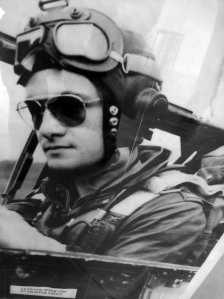
Frank E. Speer, WWII fighter ace

Lt. Frank E. Speer of the 334th Fighter Squadron, 4th Fighter Group based at Debden, England

My wife, Mary, and I met Frank Speer in March 2003 at the Military Order of the Purple Heart banquet in Fullerton.  Frank was the speaker for the annual gathering of Lehigh Valley Chapter 190. He was there with his companion, Anne Kramer. Mary and I were guests of Purple Heart leader Ernest “Whitey” Eschbach, an Army veteran whose Guadalcanal story I got into The Morning Call the previous Veterans Day. We all sat together.

I was in awe of Frank, a veteran of the 334th Fighter Squadron, 4th Fighter Group based at Debden, England, who had graduated from Allentown High School in 1939. He was credited with six kills and had a Distinguished Flying Cross for heroism. Though we’d never spoken until now, I’d heard about him. He was a World War II fighter ace who in his 70s had started writing about his experiences and speaking at schools and events like this one.

Frank and I stayed in touch. I wanted to do his story for the next Veterans Day. But that year I was busy with the writing and editing of The Morning Call’s narrative history, Forging America: The Story of Bethlehem Steel. Frank’s story could still get in the paper, but not the way I usually do the installments in my series War Stories: In Their Own Words. Mostly, I spend hours with the veteran and record his or her remembrances, then transcribe the recording and shape it into a narrative.

With Frank, I would ask him to write his own story for the newspaper, and I would be his editor. That would save me time. He started working on it in early October. He wrote about being shot down near Poland in May 1944 in his P-51 Mustang, trudging 400 miles over eight days across northern Germany and getting captured by the Germans after passing out from exhaustion and lack of food. He served almost a year in three Stalags and eventually escaped with the help of French forced laborers, whom he then led in capturing two dozen German soldiers.

When his draft was done, we worked on it together at his Emmaus home until both of us were satisfied. Mainly, it had to be cut down, and in some places I drew him out for richer detail – for example, where he describes his plane going down.

The story ran on Page 1 of The Morning Call on Nov. 11, 2003, with a portrait by Call photographer Chuck Zovko, who has since left the paper, and the photo that appears with this blog, showing Frank in the cockpit of his P-51, nicknamed Turnip Termite. The headline read: “I could feel the bullets hitting my plane.” On an inside page, we ran a painting by artist James Doddy that shows Speer’s Mustang attacking a Messerschmitt 109. Doddy did the painting in the mid-1990s after reading an account of the dogfight in Speer’s book Wingman. Here’s the link to the story: http://www.mcall.com/news/warstories/all-frankspeer,0,2668864.story?page=1

Frank and I fell out of touch after that. Anne, who was his second wife, died in 2009. He went to live with his son Jeff in Cedarburg, Wis. Jeff said his dad had congestive heart failure and was hospitalized on Christmas Eve, then went into assisted living. Several weeks ago, on March 1, he died in his sleep. He was 89.

A memorial service was held Friday at Nativity Lutheran Church, Allentown.  A couple of other World War II fliers were there to salute him – Nathan Kline and Wendall Phillips. Among the mourners was artist James Doddy.

Frank’s children spoke of him as a motivator who urged them to always try their hardest, to never give up, to keep moving ahead. He led by example, reinventing himself over the decades – he took up tennis, bonsai, painting, public speaking and writing. Besides Wingman, his books include One Down, One Dead; The Debden Warbirds; and the latest, 81 Aces of the 4th Fighter Group, which Jeff told me his dad spent years researching.

To me, Frank had made his appreciation clear. In my copy of One Down, One Dead, he wrote: “To David, who wants the Greatest Generation remembered.” And I’ll never forget his authoritative voice the day his story appeared in The Morning Call, when he called me and said simply, “Good job.”

It’s my turn now.

So long, Frank. Good job.

An ancestor in the ‘War of the Rebellion’

George D. Conn, Civil War veteran

Civil War veteran George D. Conn, who served in Pennsylvania's 175th Regiment Infantry

All the chatter about this year marking the 150th anniversary of the Civil War sent me to my file cabinet for some research I did more than a dozen years ago.

A relative had shown me a portrait photo of my great-great-grandfather, Union Army veteran George D. Conn, in his later years wearing a medal. She wanted to know what the medal was.

That was enough to crank up my interest.

George was my maternal grandmother’s maternal grandfather. He lived in my native Chester County, Pa., and died in 1923 at age 85. Other than that, I didn’t know anything about him.

But I did know where to go for information — the U.S. Army Military History Institute in Carlisle, Pa., which has a terrific library. http://www.carlisle.army.mil/AHEC/USAMHI/default.cfm  I drove there in January 1998. A library volunteer helped me, tracking George to Pennsylvania’s 175th Regiment Infantry.

The volunteer then looked up reference materials on the 175th Regiment, which included Samuel P. Bates’ History of the Pennsylvania Volunteers, 1861-5, originally published in 1870, and Civil War Connecticut volunteer Frederick H. Dyer’s A Compendium of the War of the Rebellion, Vol. 2.

Bates’ book has a brief history and roster of the regiment, which consisted of 10 companies of Pennsylvania volunteers. Eight of the companies were Chester County-based; two were from neighboring Montgomery County. The regiment’s commander was Col. Samuel A. Dyer.

In the roster, George is listed as a private in Company E who joined the service on Nov. 6, 1862, the day the regiment formed in Philadelphia. He was 25 years old at the time. The date he was mustered out isn’t on there, but the regiment disbanded at the end of its term of service Aug. 7, 1863.

The 175th had duty in Suffolk, Va., till Dec. 28, 1862, when it marched to New Bern, N.C.

“In March, 1863,” Bates wrote, “when the enemy was threatening Newbern, the One Hundred and Seventy-fifth threw up a strong line of earth-works, on the south side of the river Trent, and joined in repelling the attack which was sluggishly made on the town. It also made several expeditions in search of Colonel Woodford’s guerrillas, but never succeeded in inducing them to risk a fight.”

At Little Washington, N.C., where the regiment had garrison duty, nearly two dozen of the men died from malaria.

According to the worker who helped me, the library’s Photo Archive had images of individuals in the 175th. I checked but George wasn’t in there. We fixed that. They made a negative of the picture I carried (shown with this blog) so a print of George could be added to the collection, which at the time had photos of 85,000 Union troops.

Oh, and about the medal George is wearing. It’s a GAR Badge, the membership badge of the Grand Army of the Republic, an organization of Union veterans who fought in the “War of the Rebellion.”

One more thing: A lot of the information I found at Carlisle is available online now, including Dyer’s Compendium and Bates’ History of Pennsylvania Volunteers. Just Google them.


Dedication, but thinning ranks, among Purple Heart vets

Military Order of the Purple Heart logo

The logo of the Military Order of the Purple Heart

Some of them, the World War II veterans in their late 80s and beyond, shuffled into the Fullerton fire hall with the help of canes. The Korean War vets were somewhat better off, and those who served in the Vietnam War looked hardy.

They are the men who have been awarded the Purple Heart, the nation’s oldest military decoration. Conferred on combat-wounded veterans, it is “a true badge of courage, and every breast that wears it can beat with pride,” Gen. Douglas MacArthur once said.

Every March, the Military Order of the Purple Heart, Lehigh Valley Chapter 190, holds a banquet to celebrate the birthday of George Washington, who created the medal on Aug. 7, 1782. The banquet on Saturday was the chapter’s 27th. I’ve been going since 2003, and it struck me how the crowd gets thinner each year. A hall that used to be packed was now half empty. The older vets are passing or too frail to attend, while the younger ones aren’t participating.

This chapter is the group that for years has provided coffee and doughnuts at the Allentown Veterans Affairs Clinic on Mondays.  

Some of the talk on Saturday was about Frank Buckles, the last known American veteran of World War I, who died earlier in the week at his home in West Virginia at the age of 110. That war is now fully gone from modern memory, a reality not lost on the aging warriors as they remembered their comrades who died in the past year — Frank Dergosits, Gene Salay, Jayme Gangaway, Russell Stocker and Graydon Woods.

Like all such events, this one brimmed with patriotic ceremony. Commander Mike Mescavage and Finance Officer Chuck Jackson presided. Girls from Dieruff High School’s Air Force Junior ROTC smartly presented the colors. All stood for the Pledge of Allegiance, the singing of “God Bless America,” and later on, the playing of taps.

Politicians had their say. Retired Air Force Maj. Nathan Kline, Allentown’s liaison to the military, read a proclamation on behalf of Mayor Ed Pawlowski. State Sen. Pat Browne, who stayed throughout, and Rep. Doug Reichley saluted the vets for their sacrifice.

Member Charles “Bud” Dillon, a 62-year-old former Philadelphia highway patrolman, received a national law enforcement citation from the Purple Heart organization “in recognition for resolute action and wounds received in the performance of duties on June 1, 1988,” when he exchanged gunfire with a car thief.

Surveying the tables where some 60 guests sat, I thought of all the Purple Heart vets from this group I had done stories on. They include Salay and Woods, Ernest “Whitey” Eschbach, Charles Kowalchuk, Charles Toth and 92-year-old Joseph Motil, who was at the banquet. You can read their stories on The Morning Call’s website at http://www.mcall.com/news/local/warstories/.

The banquet’s keynote speaker, Air Force Master Sgt. Willard E. Jones, offered hope to the passing generation that there will be capable leaders in the future. Since 1992, he has overseen Dieruff’s award-winning Junior ROTC program.

An old magazine, a connection to Midway survivor

Ensign George Gay on Life cover

Ensign George Gay, sole survivor of Torpedo Squadron 8, after the Battle of Midway

I was trying to find order in my cluttered home office over the weekend and came across my treasure trove of Life magazines – 27 copies from 1941 and 1942. When I moved them closer to my desk, I had no problem deciding which one to stack on top.

The cover of the Aug. 31, 1942, issue shows a Navy flier pointing to a map of the Pacific. The caption says “Ensign Gay of Torpedo Squadron 8.”

George Gay, known as Tex, was the sole survivor of a squadron of 15 torpedo bombers that engaged the Japanese at the Battle of Midway. The story is Gay’s account of that day, June 4, 1942, when his Douglas Devastator was shot up and careened into the sea. Wounded in the arm, he floated in the Pacific and, as Life puts it, “had a fish’s-eye view of the main action.”

Gay was the first veteran I ever interviewed and wrote about.

It was 35 years ago and I was in my first newspaper job out of college, at The Bradford Era in north central Pennsylvania. Gay had come to town to visit his married daughter. I spoke with him at her home in Bradford. The tall, hardy Texan wowed me.

My story ran on the day Midway, the 1976 star-studded account of the naval battle, started showing at the small city’s only theater. I was in the audience, and so were Gay and his family. He had been a consultant for the film and is portrayed in it by actor Kevin Dobson. Many in the theater apparently had read my story, because a loud cheer erupted when Dobson appeared on screen and a subtitle identified him as Gay.

I don’t have a copy of my story, which included an image of the Life cover. At the time, it was nothing special, so I didn’t save it. It never crossed my mind that I might have a future in war stories.

Gay and I had no further contact. He died in 1994 at age 77.

My stash of Life magazines once belonged to my uncle Louie Venditti. He got them from a resident of an apartment complex in Malvern, Pa., where Louie was in charge of maintenance. My Aunt Bert gave the magazines to me in the late 1990s after her husband died.

Louie probably enjoyed having the wartime issues as mementos. He was proud of his service as a ground crewman with the 8th Air Force in England, proud that he and three of his brothers, including my dad, had served in the armed forces during World War II.

And he was proud of his son Nicky, an Army helicopter pilot who was killed in Vietnam.

Nicky is the subject of my yet-to-be-published book Quiet Man Rising: A Soldier’s Life and Death in Vietnamhttp://www.davidvenditta.com/

Tale of a doughboy, my Great-Uncle George

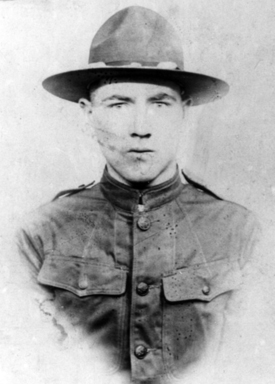
Pfc. George F. Cunningham, U.S. Army, World War I

Pfc. George F. Cunningham of Company B, 14th Engineers, during the First World War

A framed photo I keep on a file cabinet in my home office shows a stone-faced young doughboy, circa 1917.

He was my only relative who served in the First World War. Actually our relationship was pretty distant and not by blood. He was a great-uncle by marriage, and dead before I was born.

The grainy photo of Pfc. George F. Cunningham of West Chester, Pa., was in the form of a postcard in an old family album my mom has. I first saw the image in the early 1990s. Intrigued, I had a negative and a print made.

And I set out to see what Great-Uncle George did “over there” in World War I as a member of Company B, 14th Engineer Regiment, U.S. Army.

I struck out with the National Personnel Records Center in St. Louis http://www.archives.gov/st-louis/. They didn’t have a file on him. Apparently it was one of up to 18 million military personnel files destroyed in a 1973 fire.

But someone told me that under some circumstances, for example if George had been wounded and was getting compensation, the U.S. Department of Veterans Affairs might have a copy of his records, and I could find out with a simple phone call to the VA’s regional office in Philadelphia.

According to family lore, George had been poison-gassed in France. Maybe the VA had his records. It was worth a shot.

I don’t know if it’s this easy anymore, but one day in 1996 I called Veterans Affairs in Philly and an actual person answered the phone, punched George’s name into the computer and got a hit.

Yes, the VA had a file on him.

The guy gave me George’s service number, which I needed in order to make a formal, written request to the VA for a copy of George’s file.

Within a few months, I got a packet of more than 80 pages. It turned out there is no mention in George’s file that he was gassed. The papers say he wasn’t wounded, he was discharged in “good” physical condition and there’s no record of any medical treatment. Rather, the VA had a copy of his military records because after he died, his widow received death pension benefits from the government – initially $48 a month.

His widow was the former Ethyl Mae Pierce, one of my maternal grandmother’s older sisters. Ethyl and George, who was a carpenter, were married in June 1919, two months after he returned from Europe.

I know little about George. Family members told me he was troubled by what he had seen of the fighting in France. He might have been gassed, even if his records don’t show it, because documents don’t always tell the truth.

An aunt said George kept pigeons and fussed over them.

He died at age 58 in 1953, the year before I was born. Ethyl outlived him by more than three decades.

The papers I got from the VA show George enlisted in the Pennsylvania National Guard in May 1917, the month after the United States went to war against Germany to make the world “safe for democracy.” He was 21, of “excellent” character and in good health. One of the questions on his application was: “When were you last treated by a physician?” He scribbled “1912.”

He served with the American Expeditionary Force in France from March 1918 to April 1919, five months after the armistice. He was in on the defense of the Somme in April and May 1918, and the Allies’ Aisne-Marne counteroffensive that summer.

I wanted to know about George’s outfit, the 14th Engineers, so in 1997 I wrote to the U.S. Army Military History Institute in Carlisle, Pa. I got a packet of info saying the institute has three copies of a “History of the Fourteenth Engineers, U.S. Army, from May 1917 to May 1919,” published in 1923.

One day I drove out to Carlisle, two hours from my home in Allentown, and looked through the book. It has an appendix that lists George as one of about 225 men in Company B, part of a regimental roster that totaled 1,050 men. Their job was to build, operate and maintain light military railroads.

George F. Cunningham's field glasses

My Great-Uncle George’s World War I field glasses

The picture of Great-Uncle George isn’t the only memento I have. On my bookshelf are Army Signal Corps binoculars, made at the U.S. Naval Gun Factory Optical Shop Annex in Rochester, N.Y.  I don’t see a date on them, but they were George’s and he had given them to my grandfather.

I used to play with them when I was little, and once dropped them down the concrete steps to my grandparents’ basement. The last time my mom came to visit, she showed me the nick on one of the eyepieces.

You won’t catch me playing with them again.

Mentors for vets in trouble with the law?

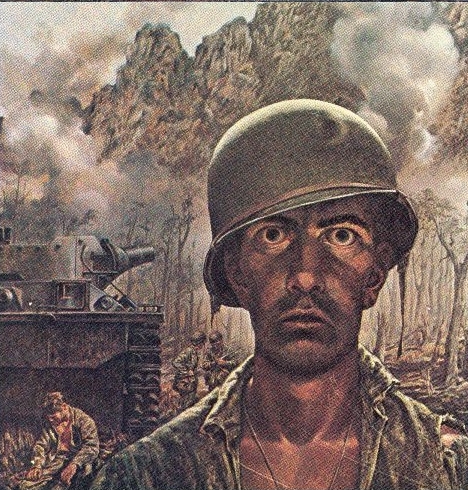
Tom Lea's portrait, "Two-Thousand Yard Stare"

"Two-Thousand Yard Stare," Tom Lea's portrait of a Marine

The long wars in Iraq and Afghanistan have sent home physically and emotionally scarred veterans, adding to those from World War II and the Korean, Vietnam and Persian Gulf wars.

 Across the country, we’ve seen the rise of veterans treatment courts that give nonviolent offenders a chance to straighten out their lives. In Allentown, the opening of the Veterans Sanctuary for vets beset with drug and alcohol problems and post-traumatic stress holds new hope for effective, respectful care.

Now the Lehigh County district attorney’s office is also reaching out to help troubled veterans. It’s working with a team that aims to identify criminal defendants who have mental health, alcohol and drug problems. The idea is to get them into treatment and, if appropriate, keep them out of prison.

One way to do that is to involve other veterans in the community as mentors. So the DA’s office and Lehigh County’s Team MISA, which stands for mental illness and substance abuse, are thinking about setting up a program in which vets would help other vets caught up in the criminal justice system.

“We recognize that medical and mental health treatment is extremely important but can only do so much,” District Attorney James Martin said in a Feb. 4 news release. “There are times when a person may need the compassion that only another veteran with similar experiences can provide.”

Mentors could volunteer to talk with the vets, drive them to medical and other appointments and give support to discourage them from getting into trouble with the law again. If it works, Martin said, the vets and their communities would be better off, and the criminal justice system would run more smoothly.

It’s worth a try, don’t you think?

Mentoring would be a challenge, but volunteering to help a vet who’s fallen on hard times would have its rewards – the satisfaction of making a difference in another person’s life and in your community.

This is something the Lehigh Valley Military Affairs Council should consider taking up. Maybe it could help get the word out and mobilize members. The council’s next meeting is at noon Wednesday at Saucon Valley Manor in Hellertown.

The mentoring program would be run by the district attorney’s office with Team MISA, which is made up of employees in the DA’s office, public defender’s office, Lehigh Valley Pretrial Services, the Adult Probation Department’s SPORE unit (Special Programs for Offenders in Rehabilitation and Education), Lehigh County Drug and Alcohol, the county prison and mental health caseworkers.

 If you’re a veteran and you’re interested in becoming a mentor, contact Debbie Garlicki in the DA’s office at 610-782-3230.  You’ll have to provide a copy of your summary of service at discharge, Form DD-214. Plus, you’ll be interviewed by the DA’s office and subject to a criminal background check.      

The Bob Riedy story: an Allentown lad in the RCAF

RCAF Sgt. Robert H. Riedy of Allentown

Robert H. Riedy of Allentown in England in early 1942 as a sergeant in the Royal Canadian Air Force

A few weeks ago I mentioned I had once looked into the World War II death of a flier from Allentown who served in the Royal Canadian Air Force.

It’s fairly easy to get hold of documents on people who were in the U.S. armed forces. But how do you get information on someone who signed up with another country?

I can tell you my experience starting in the early 1990s, when I got interested in the fate of Bob Riedy, a 1938 graduate of Allentown High School.

In 1992, we had a story in The Morning Call marking the 50th anniversary of Bob’s death. It quoted one of his friends as saying he heard Bob was shot down over the English Channel in his Hurricane fighter.

The friend didn’t have direct knowledge. What was the truth?

Bob was working as an aeronautical engineer in the fall of 1940 when he slipped across the Canadian border and joined the RCAF. The war was raging in Europe, but the U.S. was still neutral and Bob wanted to get into the fight. He was inspired by the gallant British fliers’ defense of their homeland.

First I wrote to the history department of Canada’s defense headquarters. Here’s the address:

Directorate of History
National Defence Headquarters
101 Colonel By Drive
Ottawa, Ontario
K1A OK2
Canada

A researcher wrote back and said the Canadian National Archives has Bob’s service file. But the defense office had some information on Bob, including the revelation that Bob didn’t die in combat: “It appears that he died in a flying accident while posted to No. 15 Operational Training Unit.” The researcher gave me Bob’s service number, which he said I’d need to get the service file.

So I wrote to the National Archives at this address:

Personnel Records Centre
National Archives of Canada
395 Wellington St.
Ottawa, Ontario
K1A ON3
Canada

Five months later, I got photocopies of Robert Harvey Riedy’s service record. They show Bob was killed when the twin-engine Wellington medium bomber he was aboard hit a twin-engine Hudson light bomber while taking off.  The accident happened at 1:25 p.m. on March 18, 1942, at the RAF’s Mount Farm airfield in Oxfordshire, near Oxford.

Also from the National Archives, on an inter-library loan, I got the operational record books for the Canadian training schools that Bob attended. They offer a glimpse into the way pilot trainees lived.

Next I wrote to the British, because the crash was at an RAF base:

Royal Air Force Museum
Grahame Park Way
Hendon, London NW9 5LL
England

A museum researcher sent me the accident card for Wellington W4265, which identifies the pilot of Bob’s plane as Sgt. C.G. Wiley of the RCAF. Wiley was killed, and a third crew member was injured. According to the card:

“W4265 swung off runway during take-off, attempted to become airbourne but struck stationary aircraft on edge of fire track, aircraft rose 200ft in vertical climb, stalled and crashed.

“Pilot contrary to training instructions failed to stop aircraft and line up runway prior to take-off. Station commander: Accident due to swing & pilot inexperience and error of judgement.”

I also got a bill for 9.23 pounds sterling, which was about $20 at the time.

The researcher suggested I write to the RAF historical branch for the Wellington’s aircraft casualty file:

Air Historical Branch (RAF)
Ministry of Defence
3-5 Great Scotland Yard
London SW1A 2HW
England

A researcher wrote back, saying he couldn’t add to the information I already had on the Wellington. But if I came to the U.K., I could examine the No. 15 Operations Record Books (ORBs) at the Public Records Office in Surrey. “These records detail the activities of the unit and may include details of the flights undertaken by Sgt. Riedy.” Short of a visit, I could hire a record agent to do the research for me. I chose not to take my research that far.

In search of info about the lone survivor of the three men on the Wellington, Sgt. William John Donald Carter of the RAF Volunteer Reserve, I wrote to:

Royal Air Force
Personnel Management Agency
Royal Air Force Innsworth
Gloucester GL3 1EZ
England

That office forwarded my letters to Carter’s last known home address and next of kin. To this day, almost 11 years later, I haven’t heard back from anyone.

I placed queries in these two publications for RAF veterans in June 2000:

The Intercom
Aircrew Association
51 Townside
Haddenham
Bucks HP17 8AW
England

The cost was 10 pounds sterling, or $21.72 at the time.

Air Mail
RAFATRAD Ltd.
Royal Air Force Association
Unit 17, Sovereign Park
Coronation Road
London NW10 7QP
England

That cost 20 pounds sterling, or $37.57 at the time.

The query in The Intercom prompted a response from Basil Moslin in Manchester, U.K., who was in the RAF Bomber Command during the war. He put me on to Frank Gee of Surrey, who had extensive reference material.

“The gunner, Sgt. W.J.D. Carter, must have survived the war because I have made enquiries at the Commonwealth War Graves Commission and he is not listed as a casualty,” Gee wrote to me in July 2002. “Pity we don’t know what squadron he joined after getting fit again, presuming he wasn’t grounded because of his injuries. That may have been a way of tracing him through his squadron association.”

Gee also had these thoughts on blaming C.G. Wiley, the Wellington’s pilot, for the crash:

“I don’t accept that. It is so easy to put it down to pilot error without taking into account that the Wellington was war-weary and should have been pensioned off. Just think of the punishment she took in the hands of sprog pilots in the Operational Training Unit, the heavy landings. Anything could have happened to cause her to swing from side to side during the take-off run.”

An Internet contact, Ross McNeill of Worcestershire, U.K., was very helpful. He researches the RAF bomber, fighter and coastal commands from 1939 to 1945. I quoted him in my story about Bob. Here’s his website: http://www.rafcommands.com/

 What don’t I know about Bob’s service in the RCAF?

 Even though he was in training, there’s evidence that flew in at least one combat mission. After his death, his parents got a letter from him that included a clipping from the Times of London headlined: “They swept into battle against the Scharnhorst and the Gneisenau.” The photo shows Bob and five other grinning fliers.

The German battleships Scharnhorst and Gneisenau made a dash for home across the English Channel from Brest, France, on Feb. 12 and 13, 1942. A large RAF force, in an effort code-named Operation Fuller, tried to stop them. If the newspaper account is accurate, Bob was in on the chase.

“Riedy could have taken part in the attack, but it would take quite a search of the archives to prove it,” McNeill told me in an e-mail. “The records for units involved in Operation Fuller are very confused and incomplete.”  

Bob Riedy was memorialized as the first Allentown serviceman to be killed in Europe during the war.

 Here’s the link to my April 2, 2000, Morning Call story about him: http://articles.mcall.com/2000-04-02/news/3313740_1_bomber-wellington-takeoff