
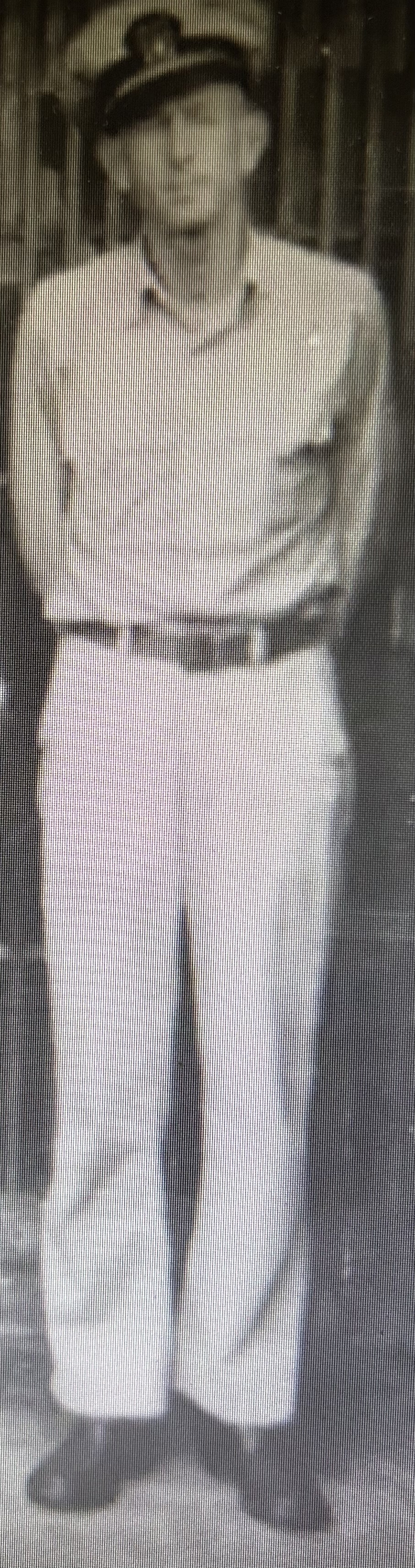
(National Archives)
An American naval officer and former POW was court-martialed after World War II on charges he collaborated with the Japanese. More than two dozen witnesses spoke against Lieutenant Commander Edward N. Little. One prison camp survivor, a soldier from Pennsylvania’s coal country, gave off-the-record testimony that wasn’t part of the trial. I’m going to share it with you.
Little was the highest-ranking Navy officer at Fukuoka Camp 17 on Japan’s Kyushu Island. He was in charge of the prisoners’ mess hall.
Fellow ex-prisoners said Little ate more than his share of food from Red Cross parcels, threw away edible rice as a punishment, deprived POWs of meals, beat a U.S. Army corporal and ordered the beating of another, reported four prisoners to the Japanese for stealing or selling food, two of whom were killed.
An online National Archives post gives a thorough account of Little’s case, detailing the charges against him, how he defended himself, and what became of him. It was written in 2018 by archives technician William Green. You can read it here.
Green’s source was the court-martial record of Little’s 1947 trial, which takes up 2,066 pages. I have it on a compact disc, which I got many years ago from the Department of the Navy’s Office of the Judge Advocate General. I’d been working on a story about POW Joseph L. Szczepanski, an Army Air Corps sergeant and onetime amateur boxer from Nanticoke who served in the Philippines.

Szczepanski, a clerk at Nichols Field outside Manila, was taken prisoner in April 1942 and walked in the Bataan Death March. He was held at Cabanatuan Camp 1 on Luzon and then at Fukuoka, where he was forced to work in a coal mine near Omuta. I wrote about him for The Morning Call of Allentown in 2009 and again in 2020, after his son Rick went to Japan to see where his father had been enslaved.
It was at Fukuoka that Sergeant Szczepanski came to revile Lieutenant Commander Little.
Later as a free man, Szczepanski testified for the War Crimes Office of the War Department about Japanese atrocities and mistreatment of prisoners. He was interviewed on April 1, 1947, in Larksville, Pennsylvania, near his hometown, by Special Agent Don B. Berntson of the Counter Intelligence Corps.
After Szczepanski died in 2005, Rick wrote to the National Personnel Records Center in St. Louis for his dad’s military file. He was surprised to get the report of Joe’s war-crimes testimony, in which he told of his own horrific experiences and complained bitterly about Little.
But Joe Szczepanski wouldn’t go on the record about the Navy officer, so Berntson wrote a separate, confidential report on which he listed Szczepanski as “reliable.” He noted Szczepanski thought Little had been tried and convicted “for his treason-like actions.” In fact, Little’s court-martial had begun in January 1947 and was still underway in Washington, D.C., at the time Berntson interviewed Szczepanski.
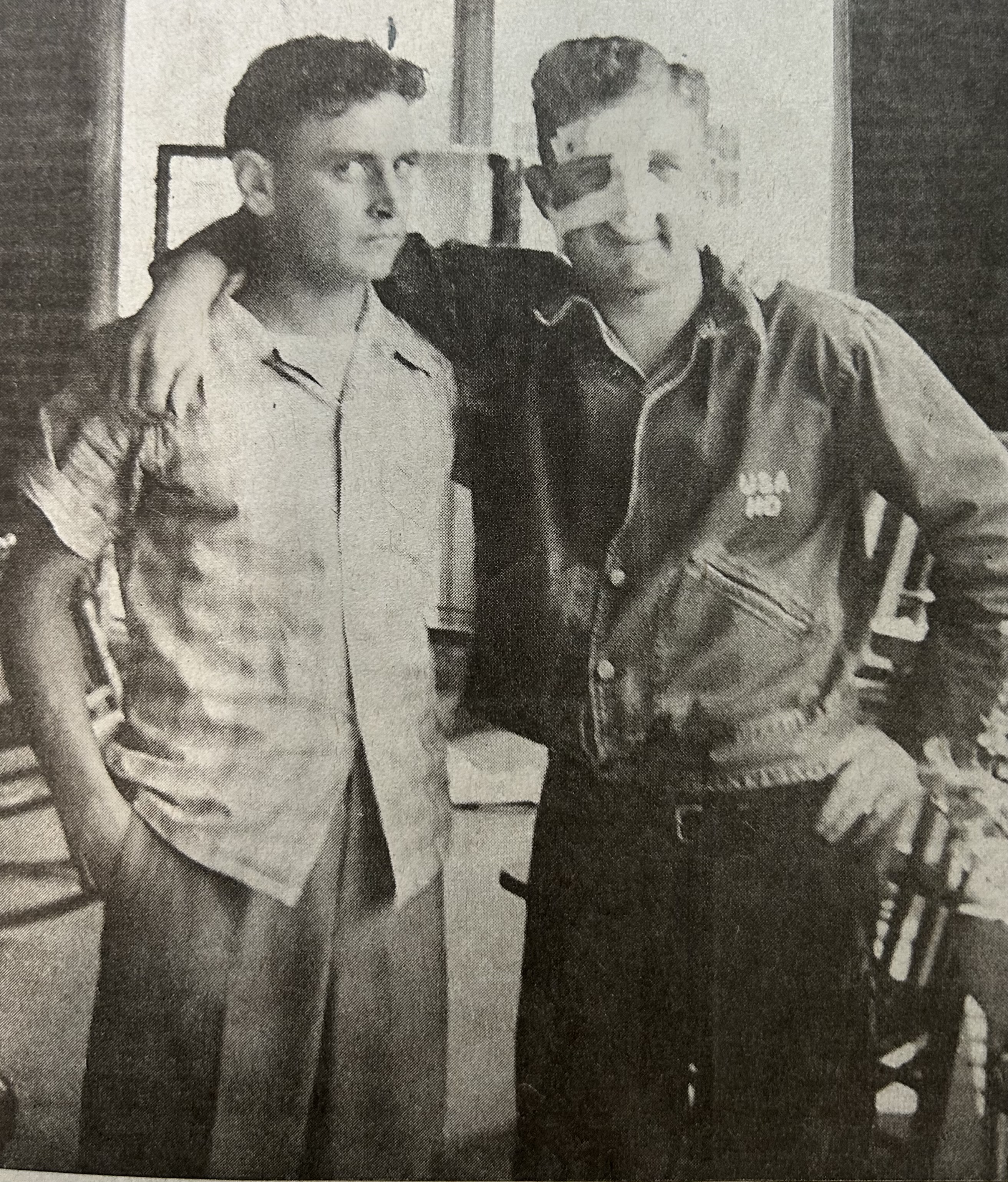
Here is Berntson’s report:
CONFIDENTIAL
War Department
Counter Intelligence Corps
Scranton, Pennsylvania
1 April 1947
Subject: Collaboration with Japanese during World War II by Navy Lieut. LITTLE, USN.
Summary of Information:
During war crime testimony of Sgt. JOSEPH L. SZCZEPANSKI … he related how at Fukuoka POW Camp No. 17, Japan, a U.S. Naval Lieutenant by the name of LITTLE had collaborated with the enemy, thus costing the lives of two American soldiers and causing severe beatings to a number of other American soldiers in order to make his own position with the Japanese solid and luxurious. SZCZEPANSKI stated that he did not want his name mentioned in connection with Lt. LITTLE’s criminal deeds and that he did not want it to become part of his regular testimony on conditions at Fukuoka Camp No. 17. He stated that he believes that Lt. LITTLE was court-martialed by the U.S. Navy at Brooklyn, N.Y., and that he was sentenced to twenty years in prison for his treason-like actions during the war.

SZCZEPANSKI related how a pugilistic soldier from the 4th U.S. Marines, called “Jimmy the Greek” PAVLOCKAS, of either Detroit or Chicago, had never gotten along very well with Lt. LITTLE because of Lt. LITTLE’s being a “general bully” [who] considered no one’s welfare except his own and that of the Japanese. In November 1943, Jimmy the Greek was apprehended by Lt. LITTLE while trading his rice for cigarettes. He was in a group of soldiers doing the same thing, but Lt. LITTLE singled him out of the group, and rather than to take him before Major JOHN [R.] MAMEROW, USAAF (now of March Field, California), he took him to the Japanese camp commander who ordered PAVLOCKAS to a dungeon in 22- to 24-degree temperatures, clad in only pants and shirt and fed a half cup of rice and one cup of water per day. Thirty-nine days later PAVLOCKAS died of hunger and exposure.
SZCZEPANSKI related how an American soldier, NOAH C. HURD, had stolen food from the Red Cross warehouse due to the fact that the Japanese did not distribute it anyway. He was apprehended by LITTLE about June 1944 and subsequently taken to the Japanese camp commander, KEN YURI, who personally tried HURD and personally beheaded him with a samurai sword in the presence of a Lt. PERKINS, a Lt. CHRISTY, and a Lt. [Owen W.] ROMAINE of the U.S. Army. LITTLE was also responsible for the beating death of a U.S. Army Corporal KNIGHT following his stealing rice. He was beaten to death in a Jap guard house by guards and by the then-camp commander of Fukuoka No. 17, Captain ISAO FUKIHARA.
LITTLE also threatened death to Corporal SAMUEL SHULMAN, AAF, of New York City when he took offense at remarks made by LITTLE on one occasion.

LITTLE was also responsible for the starving of an American soldier by the name of MONTOYA, believed to be from New Mexico, when he had received a stolen jacket from someone.
LITTLE had also reputedly told the Japanese that a half-bowl of rice was sufficient for the American soldiers when Major MAMEROW had attempted to have the Japanese increase the rations instead of to lessen them. LITTLE also took the initiative to prohibit smoking in the mess hall by U.S. Army personnel.
It is believed that LITTLE is a native of California and that his wife is a native of Brooklyn, N.Y.
Corporal JACK KUCHNER, of the Bronx, N.Y.C., can corroborate this aforementioned report together with the aforementioned U.S. Army officers and noncommissioned officers listed herein. Capt. HOWARD HEWLETT, U.S. Army Medical Corps, can also corroborate this testimony.
Don B. Berntson
Special Agent
Counter Intelligence Corps
The report misspells the names of Schulman, Fukuhara, Kei Yuri, Charles P. Christie and James G. Pavlakos, a Marine corporal. … Hurd’s correct name was Noah C. Heard. An Army corporal, he was beaten and killed in May 1944. Accounts of his execution differed. Some POWs said he was bayoneted to death, while Szczepanski and others said he was beheaded. … It’s not clear whether Szczepanski is referring to Benjamin or Horacio Montoya. Both brothers were at the Fukuoka camp and survived. … William N. Knight, an Army private, was starved and beaten to death. … Howard Hewlett appears to have been Thomas H. Hewlett. … Little was from Monrovia, California. … USAAF stands for U.S. Army Air Forces.
—
Szczepanski wasn’t alone in his hostility toward Little. In the court-martial, 31 witnesses testified against the commander. Among them was Schulman, an Army technical sergeant, who told the nine Navy officers hearing the case:

“Mr. Little was in charge of the mess hall. He had — and he wielded — a mighty stick. He had the full cooperation of the Japanese behind him. He can get just about anything he wanted from the Japanese. The Japanese liked Mr. Little, because they sure saved him a lot of guards and a lot of work, and the men were scared of Mr. Little because they knew that if they went against Mr. Little, he could cause trouble for them.
“Every man hated him in that camp. There wasn’t a one that didn’t hate him, including myself.”
Little and 42 others testified on his behalf. The defense argued he had not broken Navy regulations, which call for punishment “of any person in the Navy who refuses or fails to use his utmost exertions to detect, apprehend, and bring to punishment all offenders, or to aid all persons appointed for that purpose.” So, the argument went, Little had a duty to report offenders.
In June 1947, after five months of trial, he was found not guilty of the three charges against him — conduct unbecoming an officer and a gentleman, maltreatment of a person subject to his orders, and conduct to the prejudice of good order and discipline – plus 22 additional specifications.
—
As a POW, Szczepanski suffered from dry beriberi, dysentery, malaria, parasites in his blood, a hernia, a broken nose, a busted jaw with loss of teeth, and a broken instep from purposely crushing his foot with a chunk of coal to get out of work in the Omuta mine. Decades of mental and emotional stress followed.
He made a career of teaching Spanish at Bethlehem Catholic High School and died at 86.
“Dad never really got over what took place in the prison camps, until in the mid-1980s he finally let go,” Rick Szczepanski told me. “It didn’t bother him anymore.”
 David Venditta
Thanks for preserving the past.
LikeLiked by 1 person
Whether good or bad history, we must remember it.
LikeLike
Hi David, just read your article on Lt. Cmdr. Little. Thanks for writing these stories. I love reading the historical accounts of events you can’t always find in the history books. My name is Tom Ewing and I graduated with Nicky, Great Valley 1966. In fact , in our junior year we played together on the baseball team. Of course after graduating we went our separate ways. I went to college for a couple of years, then enlisted into the Navy (1968-1972). About 25 years later, one of my shipmates sent me link to a virtual Vietnam Wall memorial where it was possible to type in your hometown and see who served over there. So I typed in Malvern and there he was Nicholas Venditti. Also a link to see what happened to him. I was saddened when it said he died in a helicopter crash only days after arriving. Now let’s jump to February 2025. I just connected with another classmate from ‘66, Dan Rossi, through the Classmates website. So we were chatting about what we have been doing for the last 59 years. Naturally we reminisced about GV and Malvern. I told that I went to the dedication of the Vietnam memorial at Great Valley to honor our fallen heroes and classmates. That’s when Dan told me about the true story of how Nicky died. He told me about your book Tragedy at Chu Lai. I immediately got a copy. Couldn’t put it down. Wow! Said, it was great, beautifully written, heart breaking, and bittersweet, but the references to old time Malvern brought back many fond memories. I lived outside of Malvern borough, on Forest Ln. off Sugartown Rd. across from the Phelps School. Of course my Dad was born and raised in Malvern and after the war he came home, married and went work at the Building and Loan on King St. then it became Malvern Savings and Loan and then the Malvern Federal Savings and Loan. So needless to say , no strangers to Malvern, particularly Chief Cockerham, knew him well. It was a great read and I enjoyed it very much. Thank you for telling the true story. Keep writing, I enjoy your work. Stay well, Tom
LikeLike
Dave, gre
LikeLike