

Join me now for a look at a Life magazine printed six weeks after Pearl Harbor. The cover story of the January 19, 1942, issue, “North Atlantic Patrol,” was written by New York mural painter and nautical expert Griffith Baily Coale. The Navy had allowed him to sail on a U.S. destroyer escorting ships from Newfoundland to Iceland.
Another major piece dealt with President Franklin D. Roosevelt’s State of the Union address January 6. “Last week the President told the nation what it would take to win the war,” the story began. “The words he used, the figures he cited were enormous, staggering, beyond anything ever attempted by any nation on earth.”

At the time, Life was a large-format weekly that cost a dime, or $4.50 for a year’s subscription. The January 19 issue was 92 pages.
A quick aside: My Uncle Louie got the magazine and 26 other issues from a resident of an apartment complex in Malvern, Pennsylvania, where Louie did maintenance work. Louie was a proud World War II veteran – he’d been a ground crewman with the 8th Air Force in England – so he had a particular interest in periodicals from the early ’40s. After he died in 1996, Aunt Bert offered me the mags, the earliest of which is dated December 1, 1941, and the rest from 1942.
In his speech, FDR called for U.S. factories to build 60,000 planes, 45,000 tanks, 20,000 antiaircraft guns, 8 million tons of new shipping in 1942 alone. For 1943, the goal was 125,000 more planes, 75,000 more tanks, 35,000 more antiaircraft guns, 10 million more tons of ships.
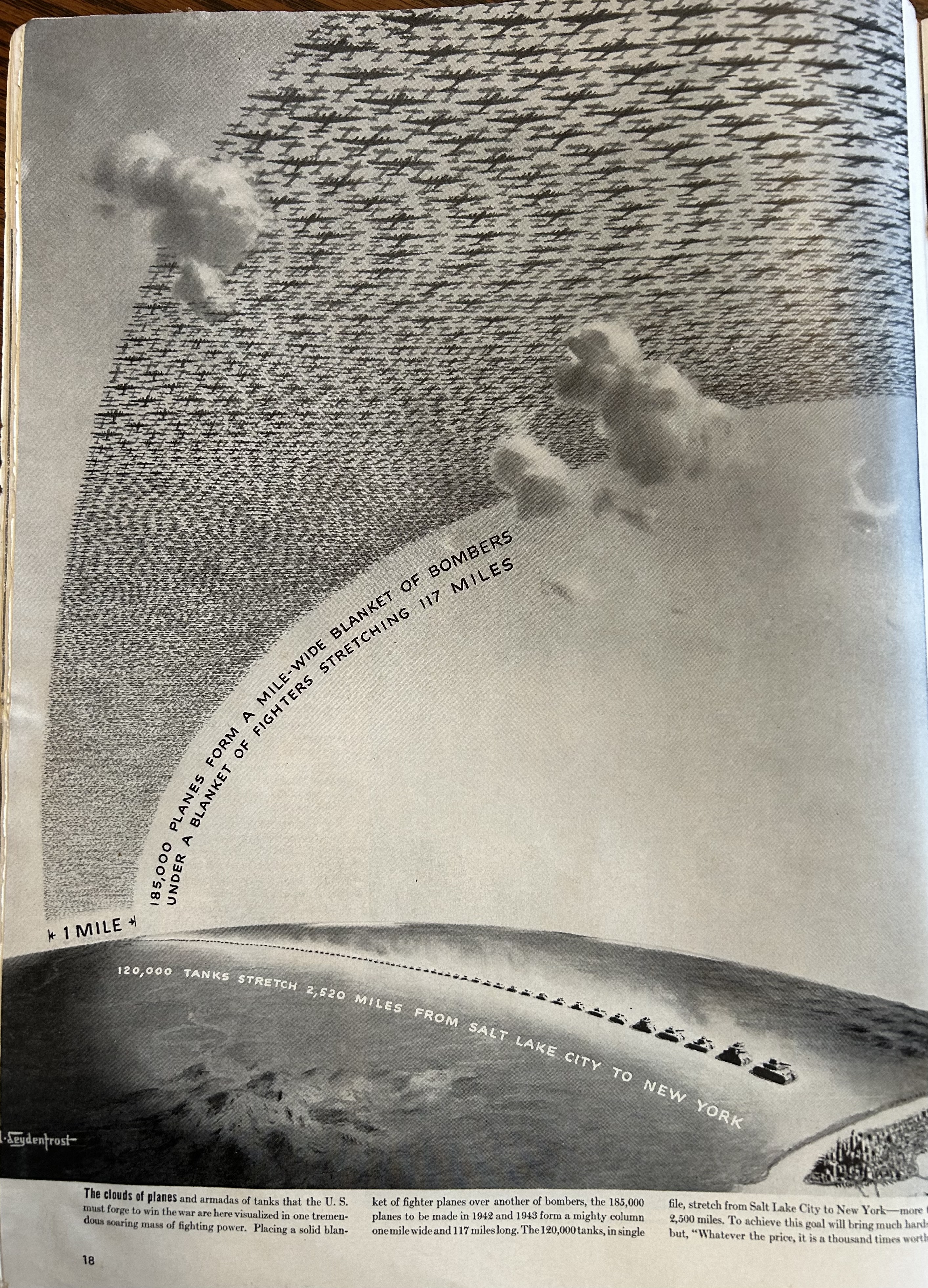
“The cost – in blood, in sweat, in dollars – would be prodigious,” Life wrote. “For the average U.S. citizen, scarcely able to grasp the President’s vast figures, but willing to undertake anything that would mean the end of Hitler, the war was coming closer. From now on, except for the bare necessities of living, everything that Americans could make or earn must go toward winning the war.”
Life used full-page illustrations to give its readers an idea of the scope of U.S. war plans. The caption on one, shown above, reads: “The clouds of planes and armadas of tanks that the U.S. must forge to win the war are here visualized in one tremendous soaring mass of fighting power. Placing a solid blanket of fighter planes over another of bombers, the 185,000 planes to be made in 1942 and 1943 form a mighty column one mile wide and 117 miles long. The 120,000 tanks, in single file, stretch from Salt Lake City to New York – more than 2,500 miles.”

A dizzying, gray graphic crowded with tiny white specks takes up more than two-thirds of the facing page. It’s shown at left, with this line across the top: “There are 60,000 white dots in the square below, one for each of the airplanes that U.S. factories must produce during 1942.” If the same number of planes were lined up together, Life said, “they would blanket a field the size of Manhattan Island.”
The Life story, which carries no byline, continues:
This was the blueprint of victory that Americans had been eagerly waiting for ever since Pearl Harbor. The President followed it with words that reached every American heart. “We shall carry the attack to the enemy – we shall hit him and hit him again wherever and whenever we can reach him.” For the present, American armed forces will operate “in the Far East … on all the oceans … in the British Isles … in this hemisphere….” This was worldwide war. It would require not one new AEF [American Expeditionary Forces], but many.”

Roosevelt said the U.S. had to build 5,000 planes a month in 1942 and more than 10,000 a month the next year to give the Allies overwhelming superiority.
Life went on:
His figures were overwhelming, but they were not beyond the reach of a united, determined America. From government agencies, from scores of industrialists, from labor leaders, congressmen, editors and plain U.S. citizens came an immediate response: “We can do it; we will do it.”
They didn’t do it, not quite. By year’s end, 46,907 bombers, fighters and patrol craft had been built, or 78% of FDR’s goal. In 1943, the total was 84,853, or 68%.
Still, it was an awesome beginning.
 David Venditta
Thanks for the histoical notes of how our people met the challenge.
LikeLike
Hi Fred, thanks for the message. I like to look back at how newspapers and magazines dealt with war in the moment.
Hope the new year has been good to you so far.
LikeLike
Dave, interesting th
LikeLike