

Last spring, I posted a two-part blog about Howard Lee Strohl, an Army officer who was killed in France in the First World War. A nice surprise followed. I heard from his great-niece, a researcher of her family’s history. She had never seen the photo that prompted me to write about him – the last picture taken of him before German artillery felled him in August 1918. Nor had she seen the letter he penned to his aunt and uncle in Allentown just days before his death.

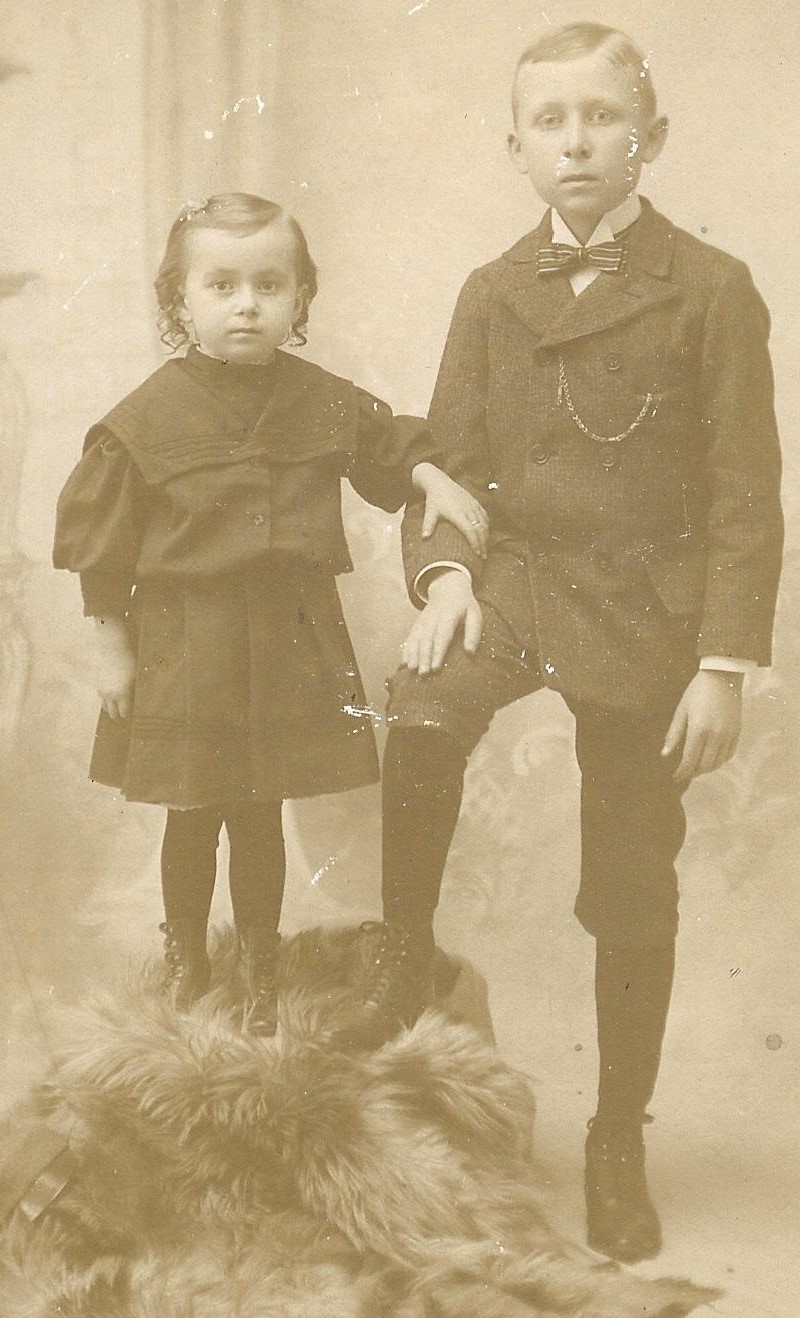
But she has something of Strohl’s that has survived the last 105 years – a terrific heirloom, his footlocker – and photos of him that I’m posting here.
The great-niece, whose name I’m withholding at her request, is an Army veteran of the Persian Gulf and Iraq wars who grew up and lives in the Washington, D.C., area. Her parents were from the Lehigh Valley, Strohl’s home turf. Her grandfather, Mitchell, was Strohl’s younger brother.
She said her father, Mitchell Jr., took the footlocker with him when he went to the Citadel, the Military College of South Carolina, in 1938. He was there for a year before entering the Naval Academy.
In Naval Academy tradition, everything is issued to midshipmen, down to their skivvies. So, the footlocker stayed home in Pennsylvania for the next four years and throughout his World War II service in the Pacific. It joined the naval officer again as he moved from post to post with his family every few years.
In the 1950s, he took the footlocker to Italy when he was ordered to Naples, and he had it in Paris for two years in the early Sixties. When his daughter was an Army officer, it went with her to Germany.
“The footlocker still has one of its original handles; the other is long gone,” she wrote. “The front, you can’t close and has been broken as long as I can remember. The footlocker still has a couple of the post-World War II shipping labels from my parents’ moves. The red one on the left from 1961 would have been from when the family went to Paris for my father’s retirement tour in the Navy, on the SS United States.
“On the top of the footlocker, the Army Transport Service had painted a swath of tan paint with my father’s name, rank, serial number, and my grandparents’ address in Pennsylvania. I removed that with paint remover about 35 years ago. … If you look at old Sears, Roebuck catalogs of the 1900-18 period, or in specialty catalogs for military uniforms and equipment, you will see footlockers like these for general sale.”
—
I had no luck getting Lieutenant Howard Strohl’s personnel file from the National Personnel Records Center in St. Louis. It’s not there.
“If the record were here on July 12, 1973, it would have been in the area that suffered the most damage in the fire on that date and may have been destroyed,” an archives technician wrote. “The fire destroyed the major portion of records of Army military personnel for the period 1912 through 1959.”
Strohl’s great-niece said her late brother Randy, who got her started in genealogy research, hit the same roadblock years ago. But she shared two primary sources I hadn’t seen. One is an Army Transport Service manifest. It shows 2nd Lieutenant Strohl of the 109th Machine Gun Battalion shipped out to France from Hoboken, New Jersey, on April 30, 1918, aboard the troop transport Finland. Hoboken was the U.S. military’s main port of embarkation. The Finland, built in Philadelphia, had been an ocean liner.

The other item is a burial card. Strohl was initially buried on the battlefield at Fismes, France, where he was killed in action. A diary kept by a Private John W. Feather has this August 9 entry: “Lieut. Strohl killed by a shell.” And this one for August 12: “George McKinney, Sam Curley and I recovered Sergeant Bechtel’s body from the bridge and buried it aside Lieut. Strohl and Wolfe.”
On October 26, Strohl was reburied in American Expeditionary Forces Cemetery 617 at Fismes. He didn’t come home for a year-and-a-half.

“It was not safe, nor could resources be devoted to returning human remains while the war was going on,” his great-niece said.
On April 9, 1921, his remains were disinterred. They were shipped from Antwerp, Belgium, to Hoboken, arriving on May 18. From there, they were sent to his father, William, in Bethlehem.
—
For months, I’ve puzzled over discrepancies in Howard Strohl’s story. Some references list him as dying August 8, not August 9, and put his rank as first lieutenant, not second lieutenant. While the National Personnel Records Center was a dead-end for Strohl’s official paperwork, I’m hoping the Army Human Resources Command at Fort Knox, Kentucky, has his casualty file. I wrote for it in early May but haven’t heard back.
His great-niece said I shouldn’t get too wrapped up in those particulars.
“In the end, a young man of twenty-three gave his life for his country, and his family mourned his passage from their presence, particularly his mother. And that’s what we need to remember.”
 David Venditta
Wow another great family history story
LikeLike
Thanks, Sue. There are lots of them to tell!
LikeLike
David…I always appreciate your writings and this article is quite a collection of story, fact, and photos. I am so happy that you are still writing. Your remembrances are so valuable!
LikeLike
Thank you, Susan. It’s gratifying work, and I’m glad I can do it.
LikeLike
Truly amazing and wonderful how your writing somehow reaches extended family members. Must be a great feeling to check your email and find these unexpected connections!
LikeLike
It is, Jan. There are genealogy-minded folks out there who, I think, routinely do Google searches on their family name and come across stuff I’ve written. Thanks, as always, faithful reader!
LikeLike