

(Harry Fisher/The Morning Call)
The Jewish Federation of the Lehigh Valley last week marked Yom HaShoah, a remembrance of the six million Jews murdered in the Holocaust. It was held at the Jewish Community Center in Allentown, and I was one of the speakers.
Here’s how that came about: At the Holocaust program 15 years ago, I interviewed a Dachau liberator, Don Burdick, on the auditorium stage. I had written about him for The Morning Call. Now I was invited back to join in commemorating the Jewish victims of Nazi Germany 80 years after its defeat. My wife came with me.
And here’s what I said:

—
I knew Don Burdick from lunches of the Battle of the Bulge veterans. I’d go there to meet the vets, hear their stories and write about them. Don always wore a jacket and tie to these meetings and, in his rich, full voice, said the opening prayer.
His story was compelling. He was among the U.S. troops surrounded by the Germans at Bastogne. He was among the first Americans to enter Dachau. He took pictures there that he kept for always.
On the advice of The Morning Call’s editor, I split up Don’s story. His account of the Bulge ran during the battle’s anniversary in December 2008. His photos of the dead ran the following April with my story about his Dachau experience.
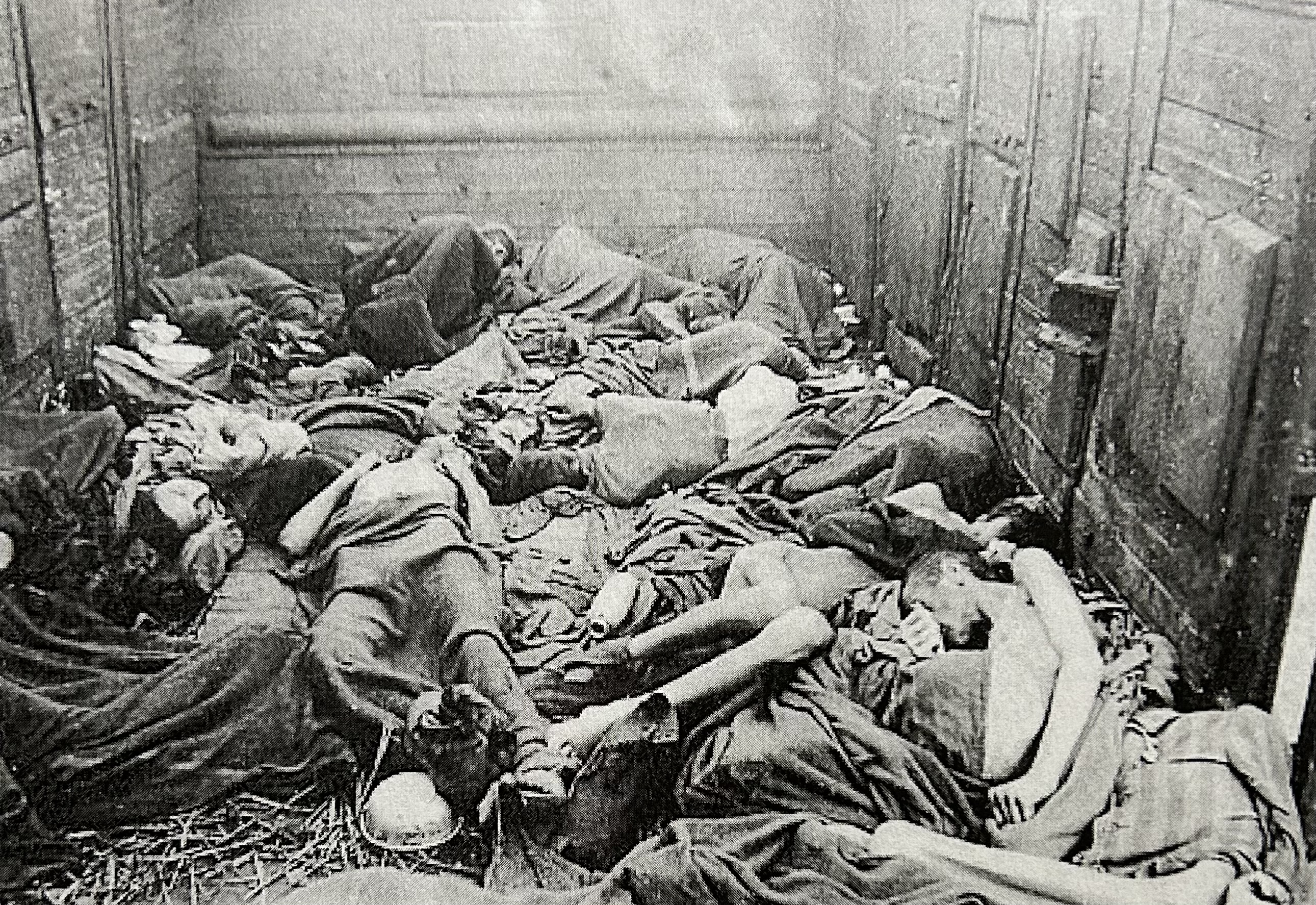
It was in April 1945 that Don’s unit – a field artillery observation battalion – reached the camp near Munich. He was 21, a private first class. He carried a German camera he had picked up along the way.
The following is from the transcript of my interviews with him:
There was a noxious odor in the air. I said, “Smells like something rotten.”
Coming into Dachau, the closer you got, the stronger the odor was. It was putrid. As we were coming down this particular road, there were piles of bodies like you would stack lumber. The Germans had put quicklime on them to burn up the flesh. … The smell and sight of decaying bodies was gut-wrenching. I was sick to my stomach for days after that.

There were people clinging to the fences. They were emaciated, hardly covered with clothes. One building we looked at, we could see bodies piled like a pyramid. A guy said, “The only way we’re going to get them out is to bulldoze the building.”
I was so disgusted at what I was seeing. For me to explain this to somebody else, I felt the best way to do this was to take pictures. … When I developed the pictures, I knew that I had my evidence that I could support the fact that this was an atrocity, that it was a concentration camp, and I could verify what I had seen.
—
Reader response was immediate. It was in line with Don’s commitment to get the word out to as many people as possible.

An English as a Second Language teacher at Allen High School said his students were reading the diary of Anne Frank and he’d be using Don’s story in his class. He wrote: “I think it would be a very enriching experience for these students to see how the Holocaust impacted and still does impact people, even within this community.”
When I passed this message on to Don, he offered to visit the class.
An English teacher at Northeast Middle School in Bethlehem asked if Don would speak to her eighth-graders. She wanted to prepare them for a visit from Auschwitz survivor Julius Jacobs. She wrote: “There’s no better way to help our students connect with history and truly understand it than hearing it firsthand.”
Yes, Don spoke to her classes. And in 2010, with me at his side, he spoke here for the Holocaust remembrance.
As a former teacher, Don aced these appearances. He had a presence and a keen ability to communicate. I’m glad I met him, became his friend and helped get his Dachau story out.

He had been at the camp for just one day, a soldier passing through early on. The gaunt survivors, he noted, weren’t being cared for. He didn’t see any medics while he was there. The suffering and death troubled him for a lifetime.
“I couldn’t believe that the human race could annihilate people in this atrocious way,” he said. “I had no idea the Germans would go to the length they did at Dachau.”
Don died eight years ago at his home in Forks Township. He was 93. His witness to the Holocaust will live on.
 David Venditta