In 1944, The Berwyn Post was in its second year of publication.
It is a Page 1 roll call of 1944 casualties.
Army Air Corps Sergeant Maurice Houston, 30, son of a First World War officer, was killed in action August 12 in Indonesia. Private John McKelvey, 24, married with a toddler son, was killed on Saipan. Private First Class Edwin Benner, 19, was killed February 16 on the Anzio beachhead.
Marine Private First Class James Newman was wounded July 21 on Guam. Army Private First Class James D’Innocenzo, 22, was wounded July 26 in France. Army Corporal Angelo DiMarino of Devon, whose family and mine had a connection broken by a terrible accident, was slightly wounded in France on August 3 while in a convoy strafed by German planes.
Those casualties appear in the September 1944 issue of The Berwyn Post, a monthly tabloid published on Philadelphia’s Main Line “by Berwyn men and women on the Home Front for the Berwyn men and women on the Fighting Fronts.” The masthead notes the paper went to all graduates and students of Tredyffrin-Easttown High School in the service, by arrangement with the Paoli-Berwyn-Malvern Rotary Club. If you were in the military and a Berwyn resident or T-E grad, your subscription was free. Others in the service and civilians got the paper for a small price.
My dad graduated from Tredyffrin-Easttown in 1944 and went on to join the Coast Guard. But I’m not sure that’s how I happen to have this slightly torn eight-page issue of The Post. Still, when I found it in my file cabinet a few weeks ago, I couldn’t put it down. You can see how popular it must have been. Main Line servicemen and women all over the world were getting news from home about people they knew. They saw photos of hometown buildings and street scenes. They could read about the high school’s sports teams. They could turn to The Chaplain’s Corner for inspiration from the likes of Methodist minister Henry F. Hamer Jr., who wrote that “faith is the most precious of our possessions” and gave advice on how to keep it. On the front page, they learned what was most compelling: Who among them would not return?
The inside pages are full of chatty columns. A Mailbag takes up more than two full pages. In one typical letter, Army Corporal Norman L. Duncan writes from France: “Seems kind of tough to be in a country where most of the people are trying to be friendly and you can’t ever hold a conversation with them due to not being able to speak or understand their language. However, we are kept too busy to have any time to mingle with them. Let me tell you this sleeping in a ‘foxhole’ isn’t at all what it’s cracked up to be, especially if it is pouring rain. Food was rough for a while but is getting better every day and I don’t imagine it is going to be too tough.”
The paper printed excerpts from a letter James Newman, the Marine wounded on Guam, wrote to his mom: “[W]e descended from the transports via cargo nets into the Higgins boats and shoved off for the beach. We were the guests at this party and the host gave us a warm welcome — in fact, as hot as Hades.
“We hit the beach with mortars popping all around us, and I don’t know how we managed to dodge them and start our individual jobs. I was up with the infantry for about a week and I saw plenty of the sights that I’ve heard so much about since this war started. The infantry — honest to goodness — is the best there is, they are real artists when it comes to exterminating Japs. I saw them knock out three Nip tanks in one day and it is amazing how they all work together, calm, collected and with precision adjustment.”
This item on Larry B. Mercer ran on Page 2 of the September 1944 issue of The Berwyn Post. In the Navy, an ARM2 is an aviation radioman second class.
Navy flyer Larry B. Mercer of Berwyn got a Commendation Ribbon for “meritorious and efficient performance of duty as air gunner of a dive bomber in an attack on enemy shipping in Rabaul Harbor, New Britain Island, on Nov. 11, 1943.”
The Post ran a picture of him and the complete text of his citation. Part of it states “Mercer, by maintaining a heavy and accurate fire from his gun against large numbers of enemy fighter planes, assisted materially in repelling their assault against the bomber formations.” The four-paragraph story adds Mercer was awarded a Purple Heart for wounds suffered at Tarawa and that he was now in California awaiting his next assignment.
The Post masthead lists its editors as the Rev. Elbert Ross, William W. Eadie, Charles T. Smith, Theodore Lamborn Jr. and Joseph Kelly. In bringing the war home, and home to those in the war, they served their community well.
Angelo DiMarino, the wounded Army corporal I mentioned above, was an older brother of John DiMarino, who was engaged to my aunt Josephine Venditta of Malvern. John was killed in a B-24 training accident on April 5, 1944. I wrote about him in my December 2, 2021, blog “How a WWII bomber crash in Colorado hit home.”
Join me now for a look at a Life magazine printed six weeks after Pearl Harbor. The cover story of the January 19, 1942, issue, “North Atlantic Patrol,” was written by New York mural painter and nautical expert Griffith Baily Coale. The Navy had allowed him to sail on a U.S. destroyer escorting ships from Newfoundland to Iceland.
Another major piece dealt with President Franklin D. Roosevelt’s State of the Union address January 6. “Last week the President told the nation what it would take to win the war,” the story began. “The words he used, the figures he cited were enormous, staggering, beyond anything ever attempted by any nation on earth.”
At the time, Life was a large-format weekly that cost a dime, or $4.50 for a year’s subscription. The January 19 issue was 92 pages.
A quick aside: My Uncle Louie got the magazine and 26 other issues from a resident of an apartment complex in Malvern, Pennsylvania, where Louie did maintenance work. Louie was a proud World War II veteran – he’d been a ground crewman with the 8th Air Force in England – so he had a particular interest in periodicals from the early ’40s. After he died in 1996, Aunt Bert offered me the mags, the earliest of which is dated December 1, 1941, and the rest from 1942.
In his speech, FDR called for U.S. factories to build 60,000 planes, 45,000 tanks, 20,000 antiaircraft guns, 8 million tons of new shipping in 1942 alone. For 1943, the goal was 125,000 more planes, 75,000 more tanks, 35,000 more antiaircraft guns, 10 million more tons of ships.
“The cost – in blood, in sweat, in dollars – would be prodigious,” Life wrote. “For the average U.S. citizen, scarcely able to grasp the President’s vast figures, but willing to undertake anything that would mean the end of Hitler, the war was coming closer. From now on, except for the bare necessities of living, everything that Americans could make or earn must go toward winning the war.”
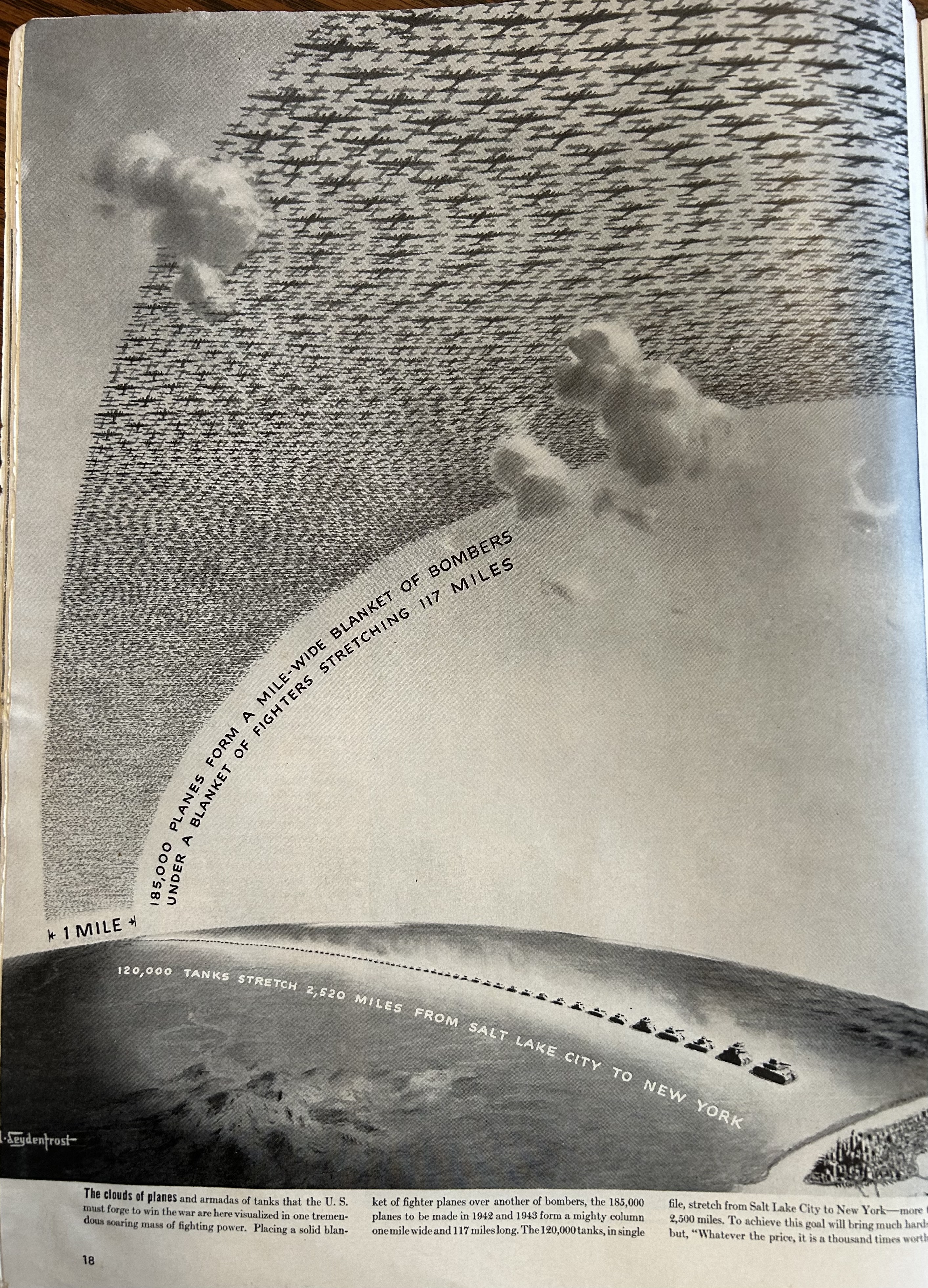
Life used full-page illustrations to give its readers an idea of the scope of U.S. war plans. The caption on one, shown above, reads: “The clouds of planes and armadas of tanks that the U.S. must forge to win the war are here visualized in one tremendous soaring mass of fighting power. Placing a solid blanket of fighter planes over another of bombers, the 185,000 planes to be made in 1942 and 1943 form a mighty column one mile wide and 117 miles long. The 120,000 tanks, in single file, stretch from Salt Lake City to New York – more than 2,500 miles.”
A dizzying, gray graphic crowded with tiny white specks takes up more than two-thirds of the facing page. It’s shown at left, with this line across the top: “There are 60,000 white dots in the square below, one for each of the airplanes that U.S. factories must produce during 1942.” If the same number of planes were lined up together, Life said, “they would blanket a field the size of Manhattan Island.”
The Life story, which carries no byline, continues:
This was the blueprint of victory that Americans had been eagerly waiting for ever since Pearl Harbor. The President followed it with words that reached every American heart. “We shall carry the attack to the enemy –we shall hit him and hit him again wherever and whenever we can reach him.” For the present, American armed forces will operate “in the Far East … on all the oceans … in the British Isles … in this hemisphere….” This was worldwide war. It would require not one new AEF [American Expeditionary Forces], but many.”
A full-page ad from the January 19, 1942, issue of Life: Oldsmobile touts its contribution to the war effort.
Roosevelt said the U.S. had to build 5,000 planes a month in 1942 and more than 10,000 a month the next year to give the Allies overwhelming superiority.
Life went on:
His figures were overwhelming, but they were not beyond the reach of a united, determined America. From government agencies, from scores of industrialists, from labor leaders, congressmen, editors and plain U.S. citizens came an immediate response: “We can do it; we will do it.”
They didn’t do it, not quite. By year’s end, 46,907 bombers, fighters and patrol craft had been built, or 78% of FDR’s goal. In 1943, the total was 84,853, or 68%.
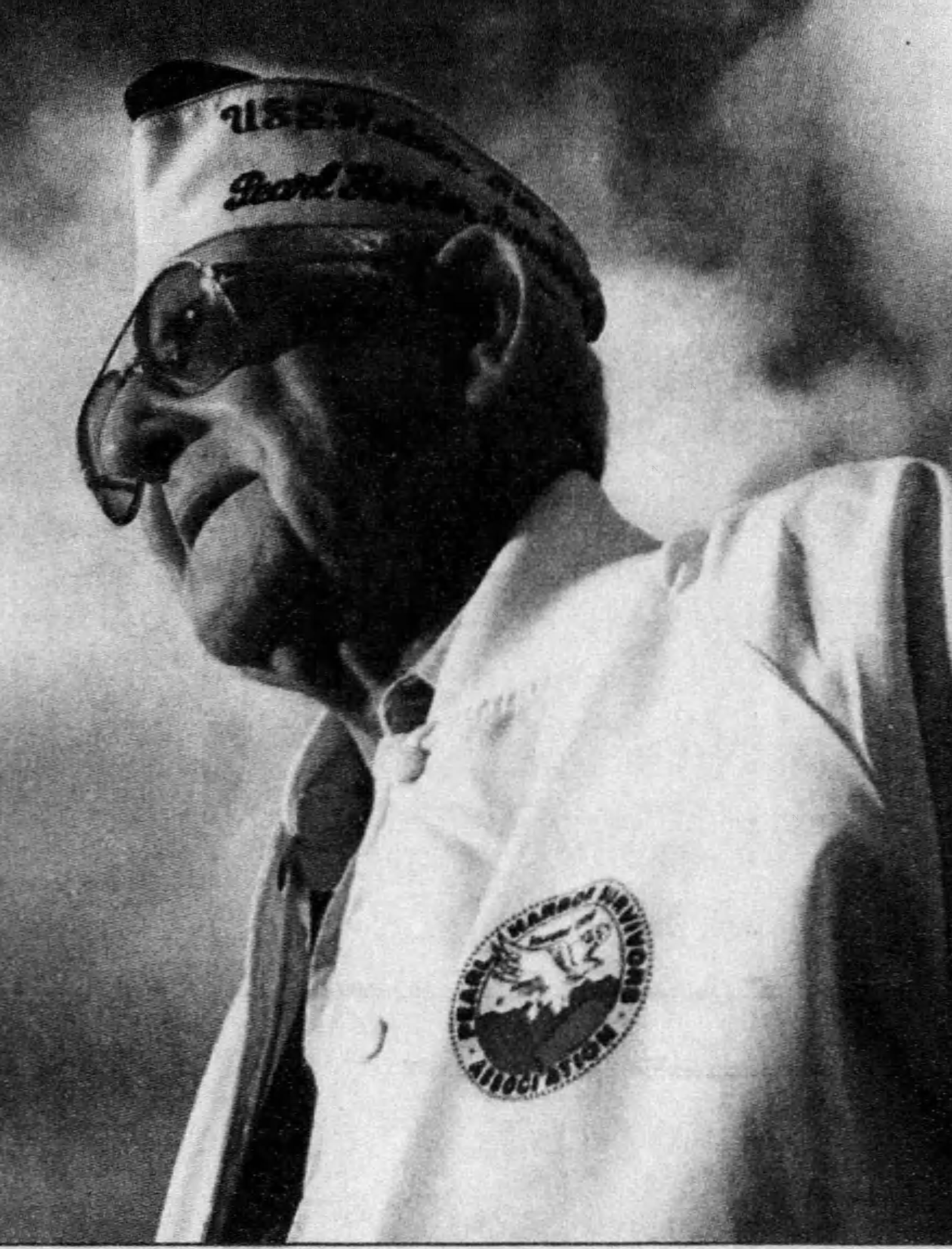
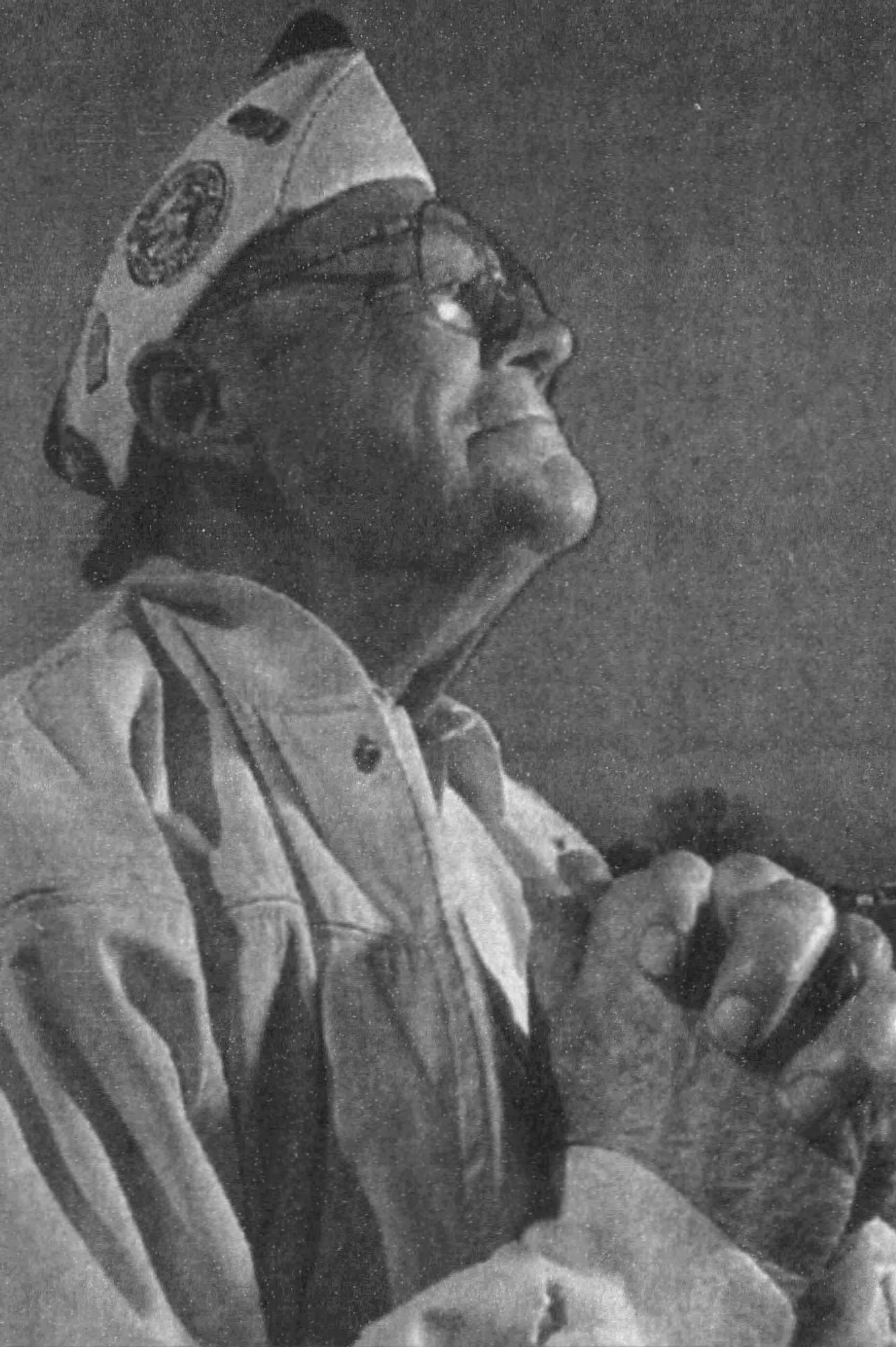
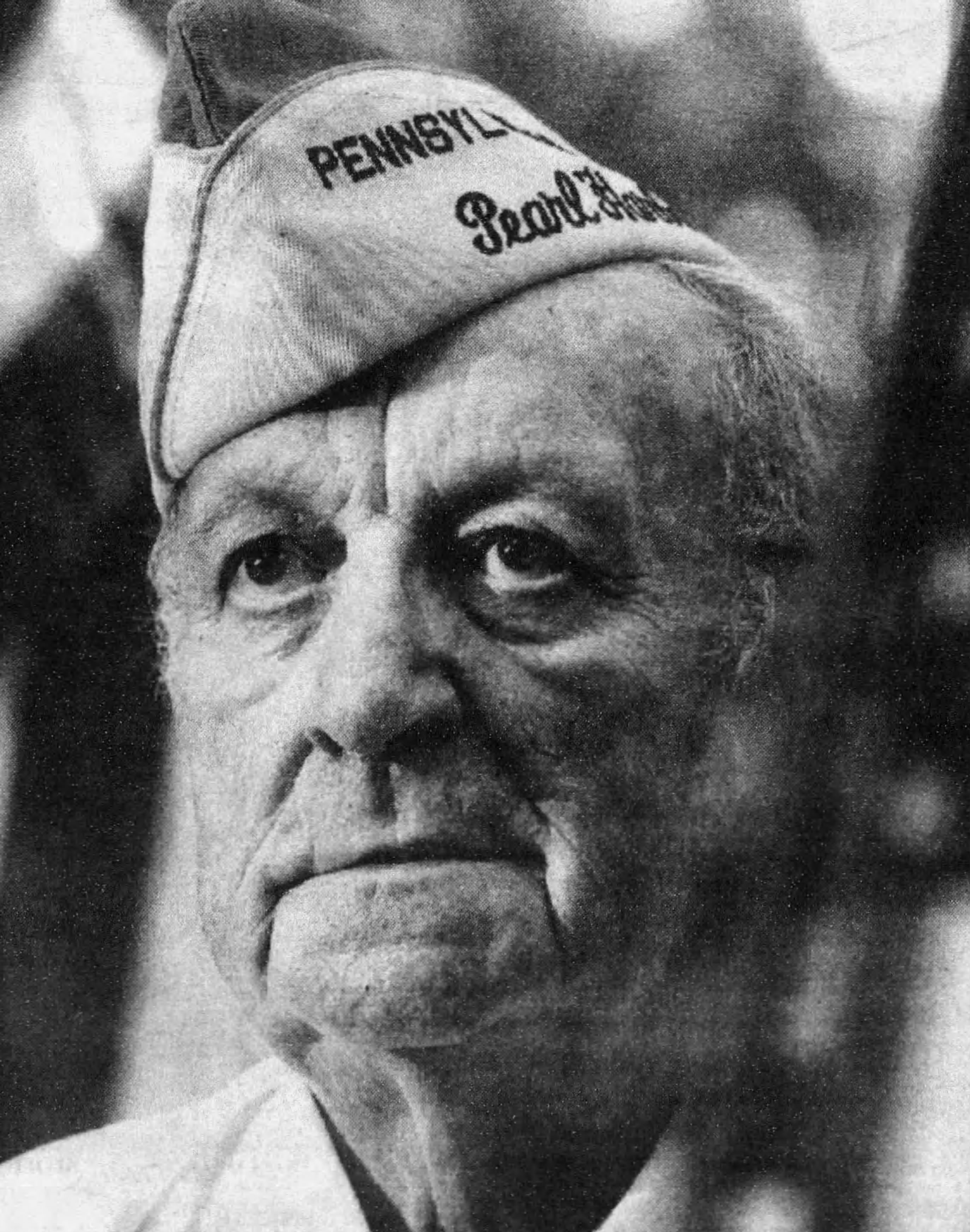
On this 83rd anniversary of the Japanese attack on Pearl Harbor, I’d like you to meet the Pearl Harbor survivors I’ve known and written about. All 13 of these servicemen lived in Pennsylvania, and all, sorry to say, are gone. Here’s my salute to them:
—
Jim Murdy lived in Allentown. He died in 2018. (Morning Call, 1999)
Navy electrician Jim Murdy was aboard the light cruiser Helena on December 7, 1941. The Helena was tied up alongside the minelayer Oglala in Pearl Harbor’s repair dock. Just before 8 a.m., an aerial torpedo passed underneath the Oglala and hit the Helena’s forward engine room. General quarters sounded, and Murdy hurried to his repair-party station. “What happened?” he asked an officer running past. “You damn fool, we’re being bombed by the Japanese!” “We are?” Murdy asked. “What the hell did we do to them?” After the attack, the captain addressed his crew. Here’s how Murdy remembered it: “The Helena‘s old man took the horn and announced, ‘Gentlemen, we had a rough time today. We had 35 men killed, and there’s 105 men put in the hospital, and there’s a number of those who are not going to survive. This is probably going to be a long war. And the one thing I will tell you is: Make your every move count. We will win! But make your every move count!'” From my interview with Murdy in the December 7, 1999, Morning Call of Allentown, Pennsylvania
John Minnich lived in Richmond Township, Berks County. He died in 2001, five days after I interviewed him. (Morning Call, 2001)
John Minnich was a truck driver with the Hawaiian Air Force at Wheeler Field. Explosions woke him. Dive bombers had hit the fighter base, and Zeros were screaming in. “About 50 of us from the transportation department started running across a field toward a little woods. We were like a pack of dogs, all scared and bunched together. I could see the Japanese pilots as their planes dived down and machine-gunned us. … The roar [of the Zeros] went right through me like an electric shock.” From my interview with Minnich in the December 7, 2001, Morning Call
Paul Moyer lived in Richland Township, Bucks County. He died in 2011. (Morning Call, 2002)
Paul Moyer was a private first class with the Army’s 21st Infantry Regiment at Schofield Barracks. After breakfast, he and two others left for a work detail that was to start at 8 a.m., but turned back when several Japanese planes flew overhead. “We stood there and watched them like idiots, until we saw the black smoke coming up from Wheeler Field. … We loaded up and got out of there, went to the Eucalyptus Forest to get ready for any kind of raid they might pull on us. A couple of days after the attack, we went to secure Kolekole Pass so the Japanese wouldn’t land troops at the big beach in back of it. … My dad received a telegram that I’d been killed in the Japanese attack. He didn’t know the truth for three months.” From my interview with Moyer in the December 7, 2002, Morning Call
Joe Moore lived in Allentown. He died in 2013. (Morning Call, 2005)
Joe Moore was a corporal and master gunner with the 98th Coast Artillery Regiment (Antiaircraft) at Upper Schofield, up a mountainside from the main Schofield barracks. “This one plane that had dropped his stuff at Wheeler came whoopin’ by with his machine guns running. He was low, just off the ground, strafing the area between our barracks and the one next door. You could see the dirt flying. … I was in the barracks when the island shook like it was having an earthquake. From the force of the jolting, I had a pretty good idea what had happened: A battleship was blowing up. Later that day, everybody knew what had happened to the USS Arizona.” From my interview with Moore in the December 7, 2005, Morning Call
Clifford Ryerson lived in Tannersville, Monroe County. He died in 2009. (Morning Call, 2006)
Clifford Ryerson was the navigator on the auxiliary minesweeper Tern, undergoing maintenance at the Navy’s 1010 dock across from Ford Island and Battleship Row. On December 7, Chief Quartermaster Ryerson and another sailor had the 4 to 8 a.m. watch. When the attack started, Ryerson saw planes flying “quite low” to torpedo the battleships. He fired at the enemy with the .45-caliber handgun he carried on his overnight watch. The Tern’s machine gunners opened up on an incoming plane. It crashed near the Officers Club – one of the 29 aircraft the Japanese lost that day. From my interview with Ryerson and his son and daughterin the December 7, 2006, Morning Call
Warren Peters lived in Catasauqua. He died in 2011. (Morning Call, 2008)
Warren Peters was a private first class in the Army’s 15th Coast Artillery at Fort Weaver, at the western entrance to Pearl Harbor. “There was an outfit right near us, and they had 3-inch antiaircraft guns. They were making all kinds of racket, and we were moaning the blues and all that: ‘Oh, it’s a Sunday morning, give us a break!’ That night, long after the attack, all of the men were at their guns. Several planes dropped flares to see where the landing fields were. “And when they did that, one big umbrella of fire went up from our antiaircraft guns — everybody firing at the planes from different angles. … Our gunners shot them all down. They were our own planes.” From my interview with Peters in theDecember 7, 2008, Morning Call
Alfred Taglang lived in Allentown. He died in 2011. (Morning Call, 2009)
Alfred Taglang was an Army supply sergeant in a Coast Artillery gun battery at Fort Kamehameha near the Hickam Field bomber base and Pearl Harbor. After shooting hoops that Sunday morning, he and a friend headed for 8 a.m. Mass. The attack began just as they got to the church. Low-flying enemy planes fired at the pair as they raced back to their quarters. “I saw dirt flying up from the bullets hitting the ground maybe 10 yards away.” He hurried to his 90-millimeter gun at Battery C. “My job was handing shells to the guy who loaded them into the gun. … We waited for our ammunition to come so we could join in the fight. Waited and waited and waited. … Our shells never arrived.” From my interview with Taglang in the December 7, 2009, Morning Call
Burdell Hontz lived in Bangor. He died in 2016. (Morning Call, 2010)
Burdell Hontz was an Army Air Corps corporal who worked in the message center of a B-17 bomber unit, the 11th Bombardment Group, at Hickam Field. He spoke of a friendly fire episode that happened after the Japanese attack got underway. “There was a group of fresh B-17s coming in from California. I could see them coming in for a landing, and these guys with rifles were shooting at them, and I yelled, ‘What the hell are you doing? Can’t you see they’re our planes?’ ” When Hontz had gotten up that morning, he decided to make his bed before going to breakfast, a task he didn’t ordinarily do. A bomb landed on the mess hall, killing 35 men. “I tell people I could have been a statistic, too, if I’d gone to breakfast. Thank God, I was making my bed.” From my interview with Hontz in the December 7, 2010, Morning Call
World War II radar men (from left) Joe Lockard, Bob McKenney and Dick Schimmel. Lockard lived in Lower Paxton Township, Dauphin County, and died in 2012. McKenney lived in Allentown. He died in 2013. Schimmel also lived in Allentown. He died last February. (Morning Call, 2011)
Joe Lockard, Bob McKenney and Dick Schimmel all were in the Army Signal Corps Aircraft Warning Service on Oahu. Privates Lockard and McKenney worked at the Opana mobile radar station on the island’s northern tip. McKenney said he and Lockard “were the only experienced so-called crew chiefs there.” Schimmel, a private first class, was a plotter and switchboard operator at Fort Shafter, where an information center linked the island’s five radar sites.
Lockard
Lockard lost a coin toss to McKenney and had to supervise the early shift at Opana. At 7:02 a.m., he and his partner, George Elliott, saw “a huge echo” on the oscilloscope, 136 miles out and closing fast. In a call that would put Lockard in the history books, he told Air Corps Lieutenant Kermit Tyler at the info center “we had never seen anything like this on radar, and that it obviously had to be planes.” Tyler said, “Don’t worry about it.”
McKenney
Schimmel
Switchboard operator Joseph McDonald, feeling uneasy about what he had heard from the Opana site, went to the tent he shared with Schimmel, woke him and said, “Hey Shim, the Japs are coming.” Schimmel asked him to explain. “We were sitting there talking for a while,” Schimmel told me, “and all of a sudden BOOM! Here we thought the Navy was having a sham battle. Where we were situated, on a high plateau, we could look over and see Pearl Harbor. We ran out of the tent. We’d see a plane dive, hear an explosion and see smoke.” He and McDonald got up on the mess hall roof for a better view, then got their gear and ran to the info center to man the switchboard and plotting board.
Up north, the truck carrying Lockard and Elliott back to camp at Kawailoa passed one taking McKenney and others to Opana. “They were waving and shouting at us,” Lockard said, “but we couldn’t understand what they were saying. … When we got to Kawailoa, they told us we had been attacked. We knew immediately that what we had seen were those planes.” From my story in the Sunday, December 4, 2011, Morning Call
Bob Kroner lived in Hanover Township, Northampton County. He died in 2016. ( Morning Call, 2012)
Bob Kroner was a staff sergeant in the Army Signal Corps who led a team of cipherers in the Hickam Field control center. “We ran across the street to this building where three or four guys were working. … There were a lot of bombs dropping all around us. The guys were sending an SOS [by radio telegraph]. The message was in plain English: ‘SOS: Japs attacking Oahu.’ I sat down and started sending the SOS with the other guys. We kept sending it and sending it and sending it, hoping it would be picked up by the right people. All of a sudden, a bomb hit close to where I was. … Somebody yelled ‘Gas!’” Kroner hid in a back room, but there wasn’t any gas. He went back to sending the SOS. From my interview with Kroner in the December 7, 2012, Morning Call
Gary Runey lived in Emmaus. He died in 2018. (Morning Call, 2015)
Gary Runey was an Army Air Corps future pilot stationed at Wheeler Field, where he taxied and maintained P-36 and P-40 fighters. He went to mechanic school at Hickam Field and was later moved to a tent area on the base’s perimeter. After guard duty until 6 a.m. December 7, he went to sleep and didn’t awake until the battleship Arizona blew up. “Three Zeros came to attack us. They were low down on the ground, maybe 20 feet up, going maybe 135 miles an hour and strafing. One went by, I could actually see the pilot clearly in his goggles.” No one was hurt, Runey said. Hours later, he saw a big truck on the access road to Hickam. “It was piled with bodies that they were taking out to a mortuary. It was pretty gruesome.” From my interview with Runey in the December 7, 2015, Morning Call
















 David Venditta