

(The Morning Call)
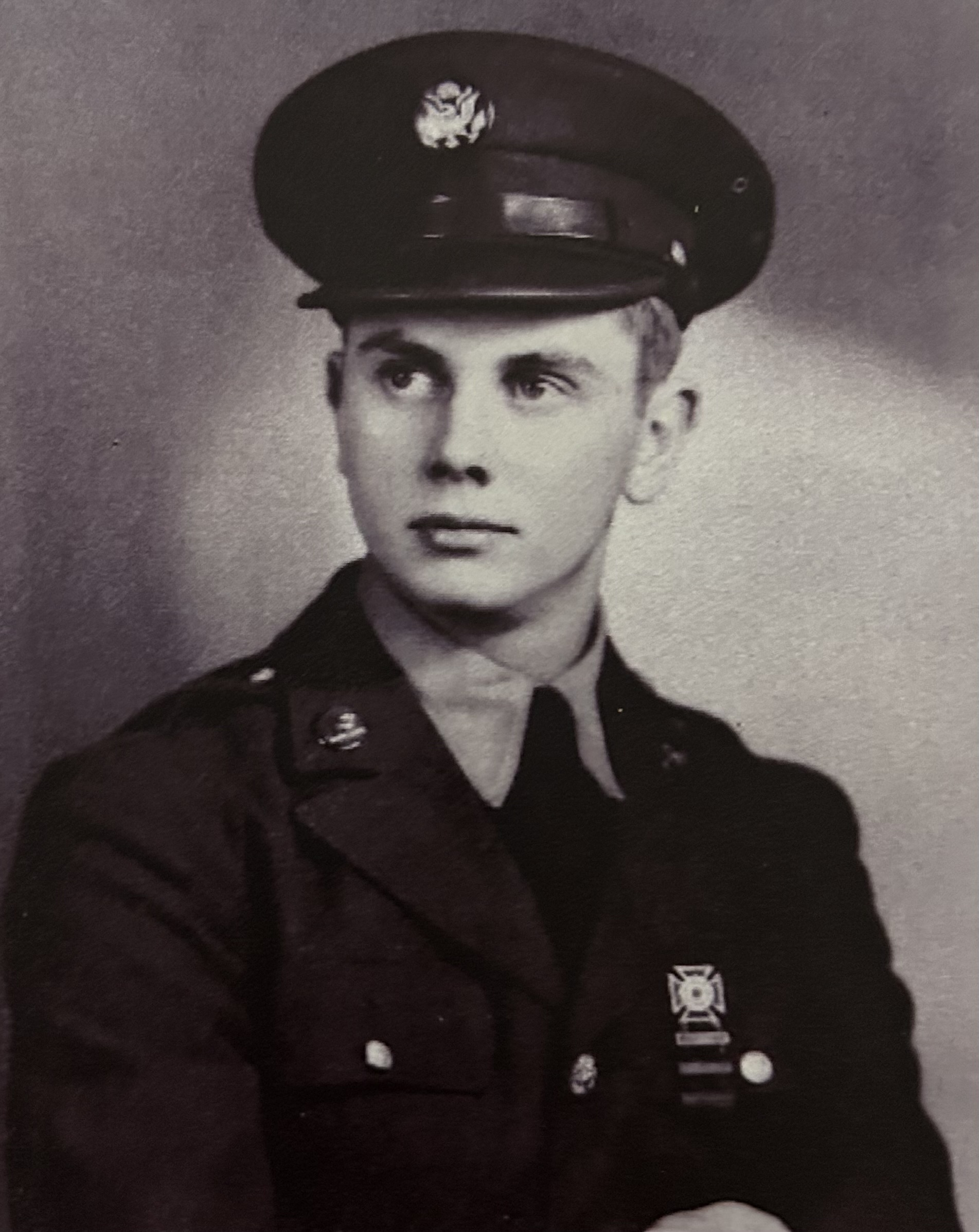
Dick Schermerhorn was a 22-year-old Army corporal when he hit Utah Beach on D-Day. Originally from upstate New York, he moved to Allentown, Pennsylvania, after the war.
A dozen years ago, I interviewed him for an “in their own words” story about his experience on June 6, 1944, with the 531st Engineer Shore Regiment. Last Tuesday, Schermerhorn died at age 102. Again, I wrote about him for The Morning Call.
In tribute, here are excerpts from my initial interview with him in May 2013:
—
We had been in Plymouth [England]. We didn’t train there, but that’s where we were billeted. There was a town called Slapton Sands that was evacuated completely. We used to go a few miles out in the Channel and make a practice landing on this town. Somewhere I have a prayer book from the Church of England, and it has “Slapton Sands” on it.
D-Day, as far as you could see, there was all kinds of ships. As we got close to Normandy beach, we went down these rope ladders into the landing craft. It was still dark. We were packed in there like sardines. There must’ve been 35-40 of us. Anybody tells you they’re not scared, there’s something wrong with them. There was a medical officer on the landing craft with me, and I happened to turn around and look at him, and his face was as white as a sheet.
The main object of the 531st was to establish a beachhead. In other words, our thrust was not to make a landing and push the Germans and keep moving. We were there to make it easier for troops that were coming in. We had heavy equipment, we had ducks [amphibious trucks], we had different kinds of plows. We had Bangalore torpedoes to blow up entanglements.
We had impregnated clothing to prevent poison gas. We had a gas mask. We had to carry these heavy M-1s – I would’ve preferred a carbine, much lighter. I had a mine detector, it was waterproofed. It picked up every bolt, screw, nut.
[When the ramp went down,] some guys were hit. The water was up to our necks. I was in pretty good shape, so I could handle it. We were getting fired on, but not to the extent of our buddies on Omaha [Beach]. You could see bullets hitting the water. It was machine-gun fire. There were some dead in the water.
We were getting artillery fire. Every once in a while a Messerschmitt or some other plane would come in.
I can remember the first dead person I saw as I got to the beach. It shook me up. I looked at his dog tag and he was from New York State. His leg was off and he was still alive. He was in shock. There was no question he didn’t survive, because there were no medics around.
I ran in about 20 yards. We got in there and tried to get assembled, a group of us. The 4th Division was with us. We worked with them. As they were pushing the [German] troops back, we were trying to establish a landing place. Our job was to work minefields.
We lucked out on Utah. On Omaha, they had that cliff, and we didn’t have that. [But] it was dangerous. The Germans had been there so long, they had such a long time to work at this. They had the shoe mine. If you stepped on it, it would take the top of your foot off. Then they had mines that would explode waist-high and throw off ball bearings.
This fella from Clearfield, out past State College, he was my buddy. He was a mine detector too. We’d take turns. One guy would sweep and the other guy probes. When you get a reading, you’re still holding onto your mine detector, and the other guy has a bayonet, and he’d be digging to find out what it was.
Once in a while, you’d hear a ping as somebody was shooting at you.
You don’t always dig a mine out. If it was a tank mine, they had a handle on them. We would fasten something on the handle and pull the mine out. Ninety-nine times out of a hundred, nothing would happen. You got back a ways, because if it was booby-trapped, it would go off.
Practically in the beginning, we were sweeping this area. My buddy saw this paratrooper laying there dead. He said, “Dick, get that knife for me.” So I’m trying to get this off his belt, and I happened to turn my head, and I saw [Brigadier General Teddy Roosevelt Jr.] I could see the one star on his helmet and I got up quick, because he could accuse you of going through a guy’s pocket. He was all alone like he was out for a Sunday walk.
Snipers were shooting. There was a wall along there and you could hear the bullets hitting the wall. And Roosevelt come up and he says, “You finding many mines, men?” I said, “No sir, not at this point.” Then he says, “Dammit, I thought there’d be millions of them.” There were, but we weren’t into the thick of them yet.
Last time I saw Roosevelt, frogmen were blowing up obstacles the Germans had in the water to prevent boats from coming in. The frogmen put up a purple flare when they had a charge, and you were supposed to hit the deck. This one time, lying prone, I look up and here’s Roosevelt standing there looking around, and he only wore his helmet liner.
I ended up clearing about a hundred mines on D-Day. When it got dark, we dug foxholes inland a little.
We had other duties, handling supplies. A lot of equipment was coming in. [In early August] when the tanks started coming in, we had pulled 24-hour duty without any rest, and we were sitting, three or four of us, and we were smoking, and [Lieutenant General George S. Patton] said, “Don’t you know there’s a war on?” He called us a bunch of old women. He said he was going to report us, but he never did.
We had a lot of trouble after D-Day, Navy guys coming looking for souvenirs, and they picked up stuff, and the Germans had a lot of stuff booby-trapped. Some of the guys got wounded or killed. Sometimes we had to go in a minefield to get them. At that time, there was no real action on the beach because the enemy had been pushed back. Our infantry and tanks had moved inland.
I was [on Utah Beach] about two months. Then I was transferred to the 279th Combat Engineers. There was three of us, the only veterans in the outfit. We went all the way into France, we went into Aachen – one of the first towns into Germany – Remagen area, Rhineland and all across northern Germany. Our task was to work with different infantry divisions with mines, explosives.
There are a lot of rivers in Germany, and one of our jobs was you had an assault boat and two engineers, one in front and one in the back, maybe 10 or 12 infantrymen in, and you’d go back and forth at night. And you’d let them off, and you’d come back. Of course the Germans were on the other side. We did that all the way across [Germany].
The last river we came to was the Elbe. We were stationed on the west bank and we stayed there until the war ended. Then we had a big problem.
See, the Russians were going to take Berlin, and the Germans knew this, and they were smart enough to know that things were over for them, and we had all these [Nazi] troops coming. They knew the American lines were to the west. We didn’t know what to do with them all. They wanted to give up. In time, it was taken care of, because they were put in prison camps.
Then we met up with the Russians, the wildest bunch of guys you ever saw.
 David Venditta