Tag Archives: philippines

Palawan chaplain: ‘Every man down on his knees!’

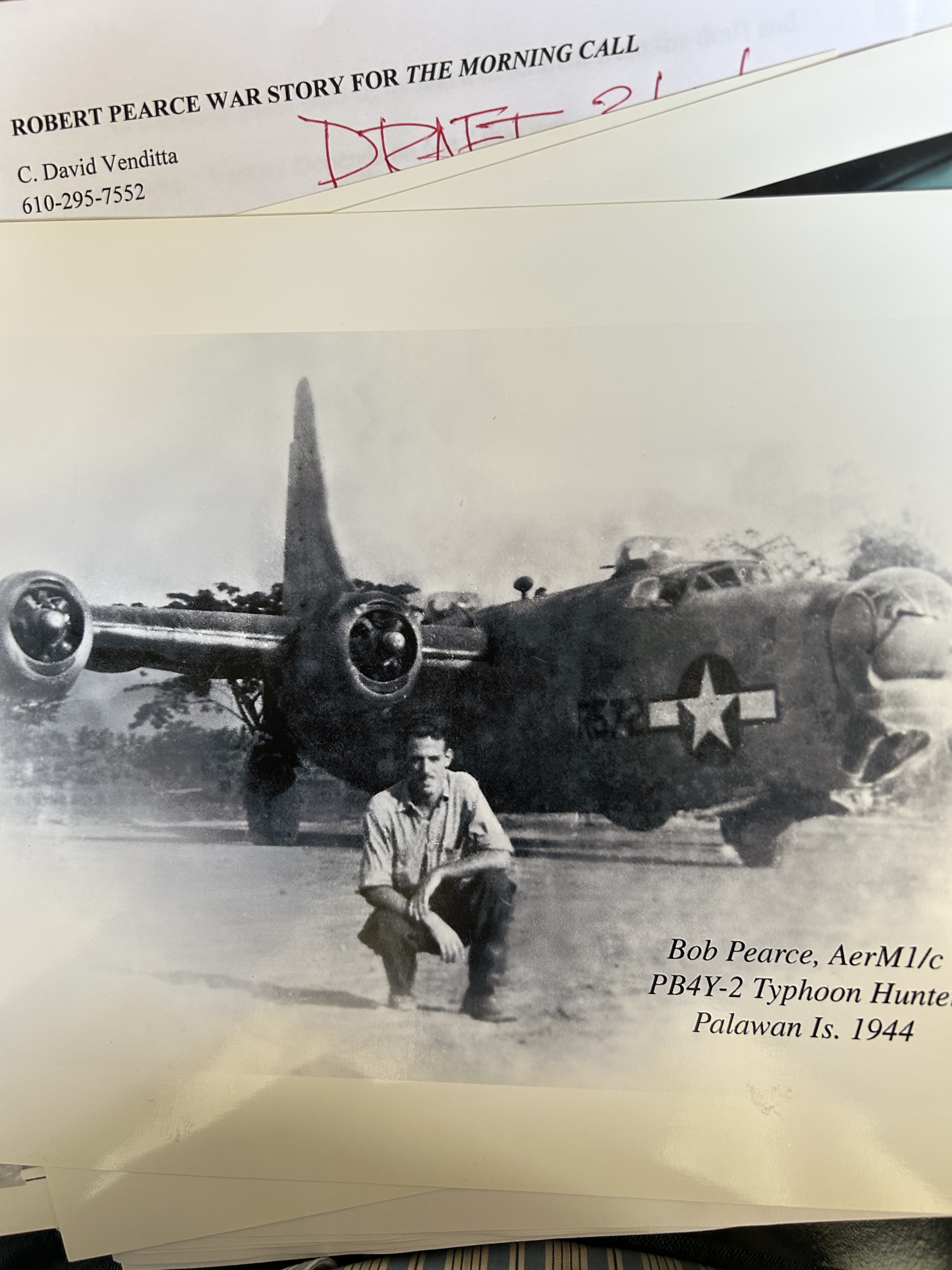
Robert Pearce, a Navy aerographer’s mate first class, in front of a PB4Y-2 Privateer used for ‘typhoon hunting’ in the Pacific, 1945. Pearce went on some of those missions.

Over the last few weeks, I’ve been interviewing a 102-year-old World War II veteran about his experiences as a Navy weatherman in the Philippines.

Robert Pearce grew up in Philadelphia and has lived in Lehigh County since the war. He is a former pilot and an organist who worked nearly five decades for Allen Organ Company. I had material that helped me put together his story — a memoir he wrote for his grandchildren a dozen years ago and a video of a talk he gave in 2023 for the Lehigh Valley Veterans History Project, which I attended.

My two-part “in their own words” war story is running in The Morning Call of Allentown. Part 1 appeared online March 19, and Part 2 the next day. It’s running in print this week.

I want to share with you an anecdote Pearce told me that isn’t in the story. It’s gruesome but reflects the reality of life on Palawan, which until early 1945 was occupied by the Japanese. The island is etched in World War II history as the place where, on December 14, 1944, Japanese troops executed 139 American POWs. It happened near the town of Puerto Princesa, where the enemy had an airfield.
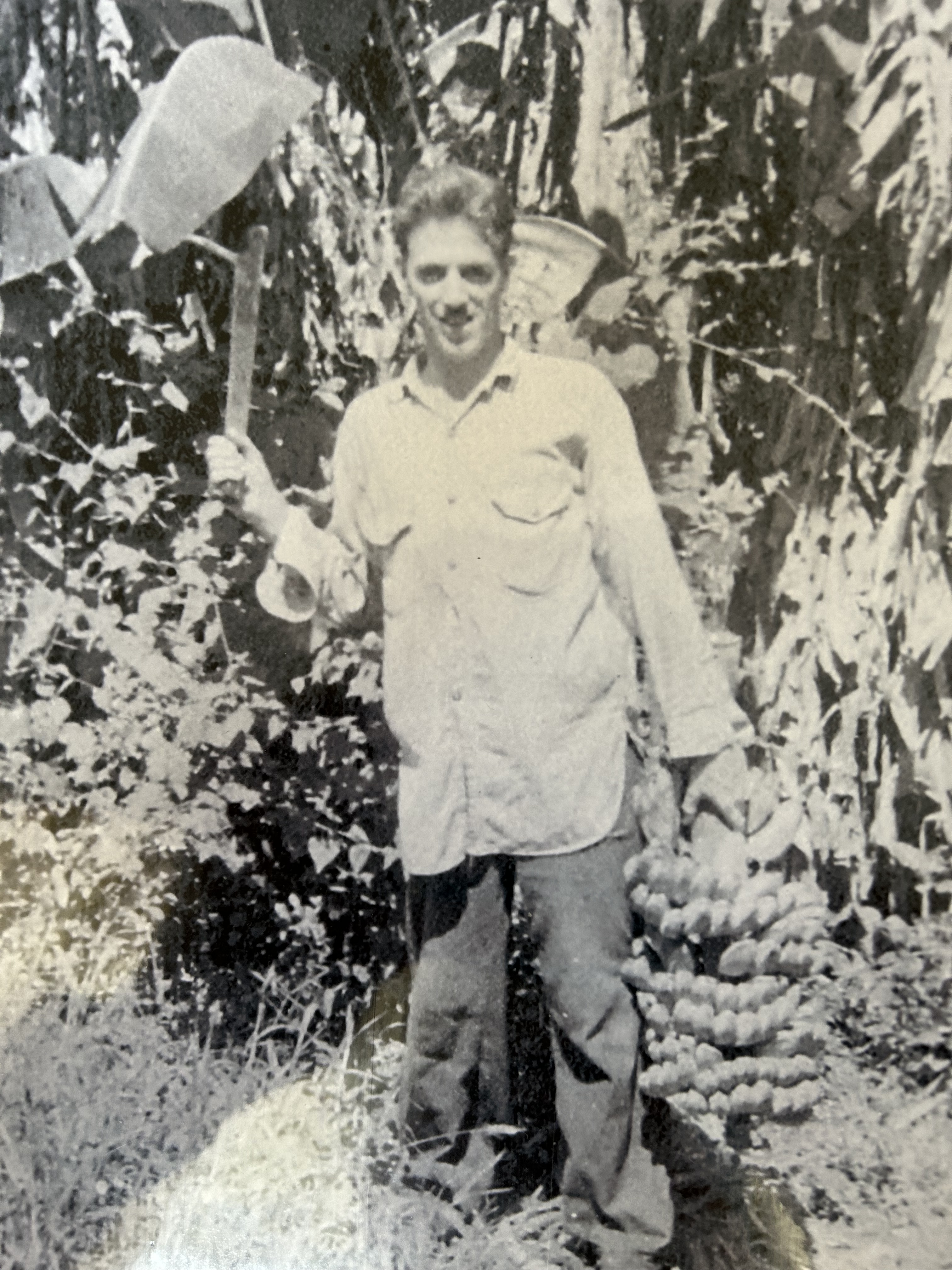
Pearce with a bolo knife and batch of bananas on Palawan

U.S. planes bombed the town for four months. Then at the end of February 1945, part of the Army’s 41st Infantry Division landed there and captured the airfield. The Puerto Princesa strip was rebuilt and used by the 13th Air Force Fighter Command until war’s end.

Pearce’s Navy unit, Fleet Air Wing 10, arrived in mid-April. It was tasked with conducting patrol plane operations against shipping in the South China Sea and along the Indochina coast. An aerographer’s mate first class, Pearce ran a weather office of six enlisted men. Their officer was Art Lund, a leading singer with the Benny Goodman Orchestra. Pearce and Lund would fly out to ships at sea, where Lund would entertain the men as Pearce accompanied him on the organ.

Pearce remembered episodes of horror at Puerto Princesa — fatal plane crashes on the airfield and, far more disturbing, Filipino revenge on the Japanese.

Pearce, 102, at his home in Lower Macungie Township on February 28, 2025

“The natives were primitive,” Pearce said. “They loved us because we were helping to ferret out the hated Japanese soldiers who were hiding out on the north side. Their thing was to capture one, chop his head off and proudly carry it by the hair through our camp. This time it was in front of the chapel while I was talking to the chaplain and some others. The chaplain shouted, “I want every man down on his knees!” He did not address the Filipino, and let him pass.

“Hatred of the Japanese was fueled by the fact that when they had the island, rape and killing were common.”

A search of Pearce’s name on Newspapers.com turned up a gem.

Pearce was a 19-year-old Navy trainee at Bainbridge, Maryland, at the end of 1942. He wrote a song that was performed by the boot camp’s stage band. He wasn’t married but wrote the lyrics as if he were a husband and father.

I’d love to be at home for Christmas,
But it’s my duty to be here.
When the snow is drifting on your window,
I’ll be thinking of you, dear.

I’d love to see our kids at Christmas,
Watch them tripping down the stair,
See them picking up each toy I sent them,
I can just picture them there.

I don’t like to talk about the war.
It seems that’s all one ever hears.
We all know what we’re fighting for:
A home that’s safe through the years.

I’d love to be at home for Christmas
At the end of ’43.
But my darling you must not expect us
Till we march home in victory.

In the first days of 1943, the Associated Press reported on a flurry of songs being written by sailors at Bainbridge Naval Training Center. It ran in newspapers across the country. “Embryo tars write songs at Bainbridge” was the headline in the Anderson Herald of Indiana. The subhead was: “Musicians are affected by the newness of mushroom camp on Susquehanna.”

Of Pearce, AP writer James E. Hague wrote:

“The Bainbridge charm worked even more quickly on Robert Pearce, ex-organist from Philadelphia. A week after his arrival, he wrote words and music — while on cleaning detail — for the top song of the Bainbridge ‘Hit Parade’ — ‘I’d Love to Be Home for Christmas.’

“If sailors could whistle while they work, its easy-to-whistle melody would be chirped by half the sailors at the station. And its popularity shows no signs of flagging.”

Pearce didn’t know about the story until I showed him the clip. He was delighted.
‘We were full of piss and vinegar, and no brains’

Mathias Francis Gutman: 1925-2024

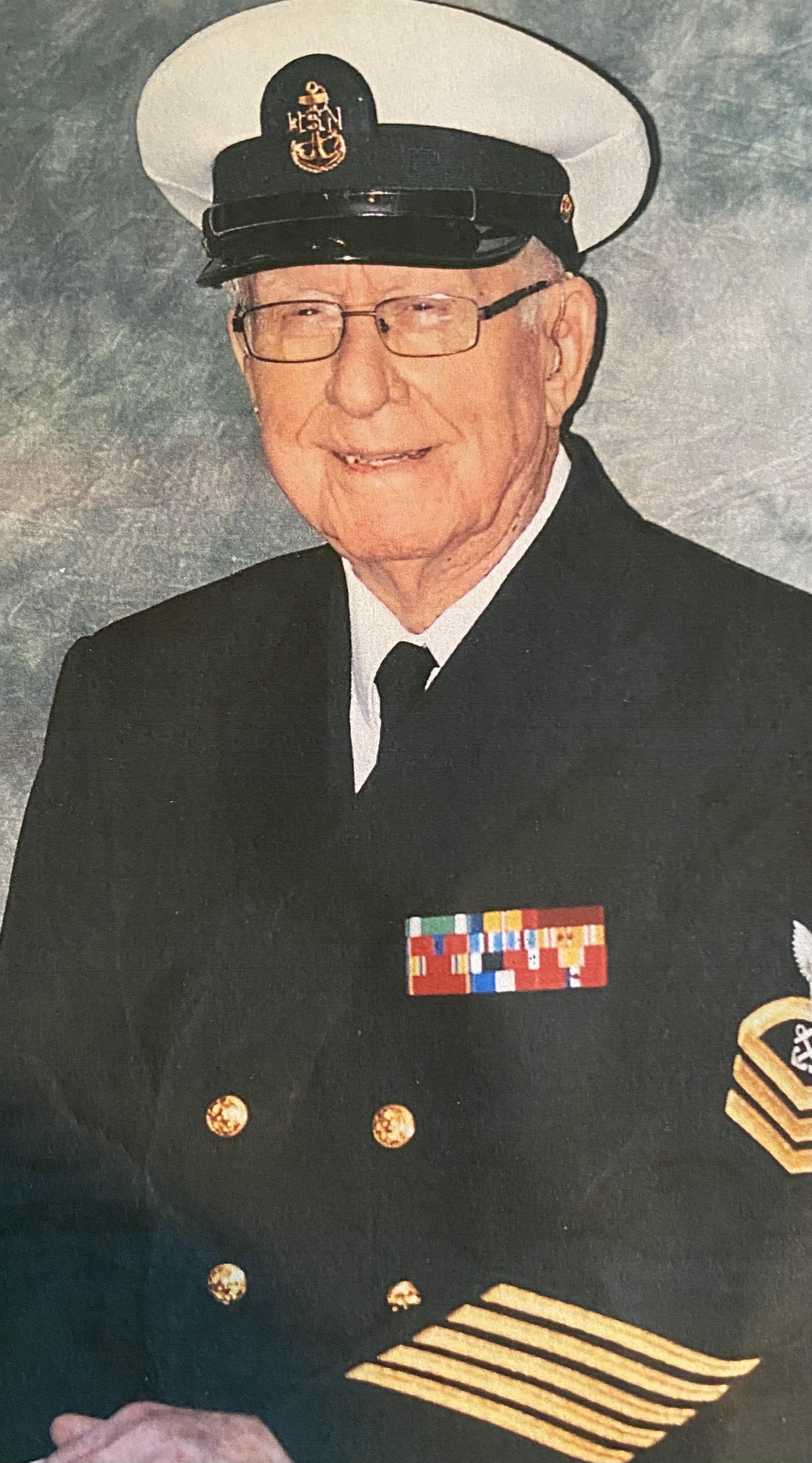
World War II veteran Matt Gutman died last Thursday, November 7, at his apartment in Allentown, Pennsylvania. He was 99. I wrote a story about his passing for my old employer, The Morning Call. For you, I’m sharing a partial transcript of my August 18, 2022, interview with him. Here, he tells about joining the Navy in 1943 and heading for the fight against Japan.

I didn’t want to be trapped in the Army or Marines.

When I was in junior high school, my brother who was in the Navy gave me one of these sea caps, and I used to wear it to school. I sort of liked the Navy because, first of all, I wanted to have good, warm chow and a bunk to sleep in, not a mud hole. … And that’s why I chose the Navy.

I enlisted at the Navy recruiting station in Allentown. … I wanted to go into the Seabees originally, [so] I talked to the chief Seabee, and he says, “What’s your occupation? What did you do?” I said, “No, I just come out of high school. I had basic electric.” He said, “Look, son, go next door. Talk to the Navy recruiter. We can’t be teaching you. We want people that are already trained.” So then I went next door to the chief of the Navy, and he enlisted me.

Then I went to Sampson, New York, for seven weeks of basic training. There was 106 of us. We trained together, marched together, ate together, everything together as a unit, and then, of course, graduated and then were given a seven-day leave to go and visit our parents, our friends. After seven days, we had to report back to Sampson for fleet assignment.

Gutman left Allentown High School in 1943 to sign up, and served in the Naval Amphibious Forces.

They sent me with a group of others by train down to Camp Bradford, Virginia, for amphibious training. First of all, I didn’t know what it would entail. … I knew it was land and sea. This was something new. When we got down there, they showed us all the different types of ships they used for invading an island, went over every one of them. They also told us about what to expect on those ships, and they told us these ships were made only to invade an island. That’s why they called them amphibious. They carried troops and tanks to invade an island.

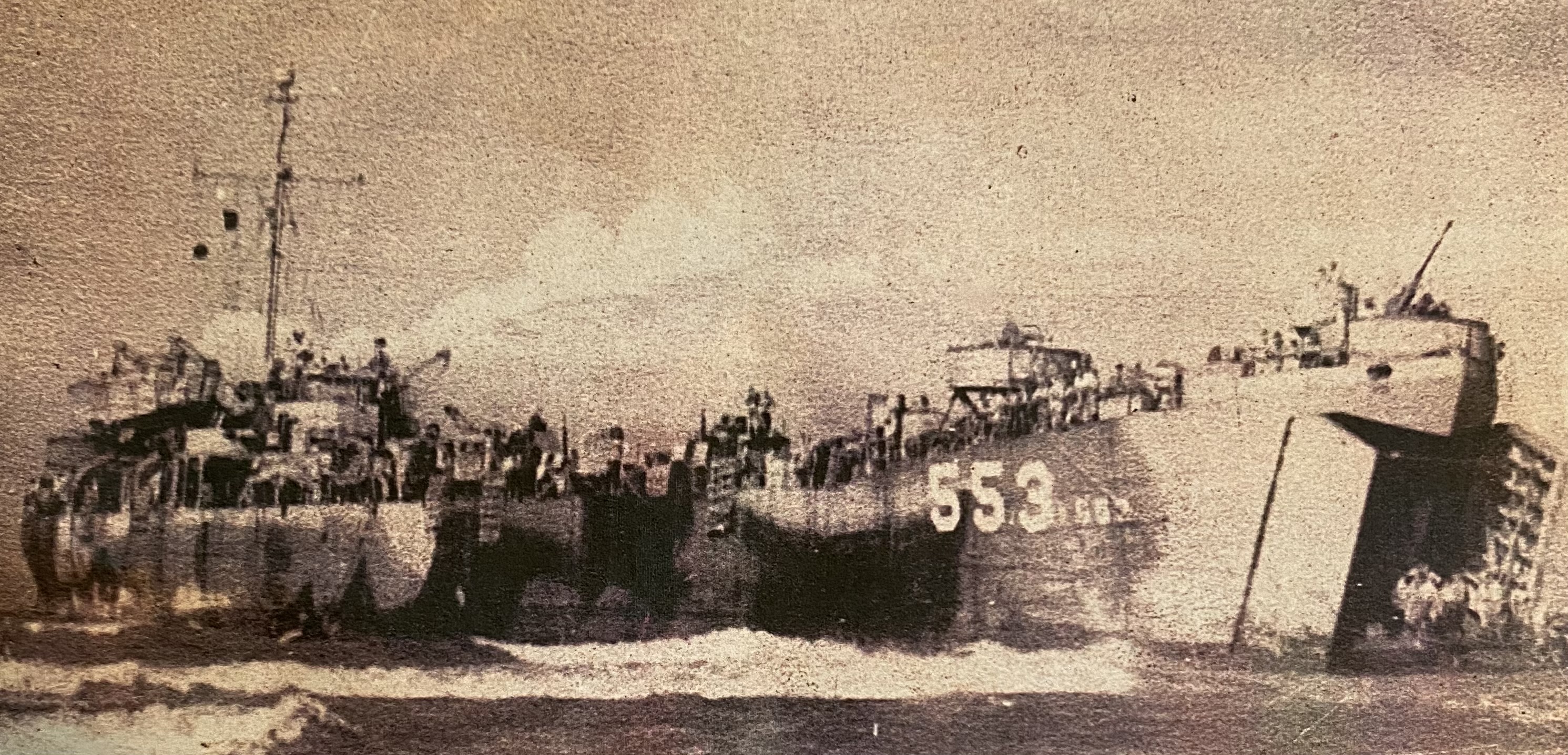
That was the main purpose of the ship that I was assigned on. It was called a landing ship, tank, an LST, and they were all numbered. They never had no names. Mine was 553. I was with it all through the war. It was camouflaged brown and green. You know why? Because when we boarded that ship in Evansville, Indiana, where it was built, we seen that ship was all in tropical colors. Tropical! We knew right then and there that ship was going to be assigned to the Pacific Theater, not European, because once that ship beaches, it blends with the foliage on that island.

They taught me how to operate the Higgins boat, and I was in charge of the Higgins boat on our ship when we made the landings. I was a seaman first class then. I don’t know why I was picked, but they came and asked me if I’d like to do that, and I said, “Why not? I’m in the Navy, I’ll do what I can.” And I operated that landing craft all through my landings in the Pacific. …

Gutman’s LST, a landing ship, tank

After they trained me, I went to San Pedro [in Los Angeles] and Hawaii, I used that boat a lot to take people to shore, back and forth. So I was trained all along with it, you know what I mean? It only had one propeller. You had to watch the wind and currents. Well anyway, they trained me pretty well.

We only had two Higgins boats on our ship, one to starboard and one on the port side. I had the one on the port side. [As coxswain] I was in the stern. I always had to watch where I was going. These Marines and Army men we had in there, they’re all hunkered down. I had to see where I’m going, you know. I had to stand because I wanted to see where I was going, because the bow doors were up pretty high. It had a diesel engine, very noisy, and it always smelled awful. But we were young guys, we could take it. We were all young, full of piss and vinegar, and no brains.

Getting smooched by The Magnolia Sadies, a vintage dance troupe, on May 8 at a V-E Day picnic honoring World War II veterans in Macungie Memorial Park

They shipped a crew of us to Evansville, Indiana, where we picked up our ship. It was built there, right alongside the Ohio River. We boarded that ship in April 1944. The skipper took her down the Ohio River, the Mississippi River to New Orleans. That’s when the ship was commissioned. We stayed in New Orleans for four days, taking on supplies – water, fuel. Then we headed back down the Mississippi to the Gulf of Mexico.

While in the gulf, the skipper put the ship through what is called a shakedown cruise. A shakedown cruise consists of testing all the components of that ship – the navigation equipment, all the guns were working properly, checking out the fire system we had, the fire hoses, check everything to see that that ship was ready for combat. From there we went to Panama City, Florida, where they taught us how to distinguish all types of shipboard fires we might encounter in combat. We were there about four days.

From there, we went to Gulfport, Mississippi. We were there to pick up creosote pilings. They were large logs, about 18 foot long and 2 foot wide. We wondered, what the hell is this gonna be? They loaded them on our tank deck. We went through the gulf and the Panama Canal with about seven other LST’s. And we we went up along the coast to San Diego, 108 men and eight officers. … We enjoyed liberty there. We were there maybe three or four days. We took on more supplies. We also took on a contingent of Seabees.

We left San Diego with a fleet of ships going due west. The skipper was on the P.A. system and he said, “We are now heading for Pearl Harbor.”

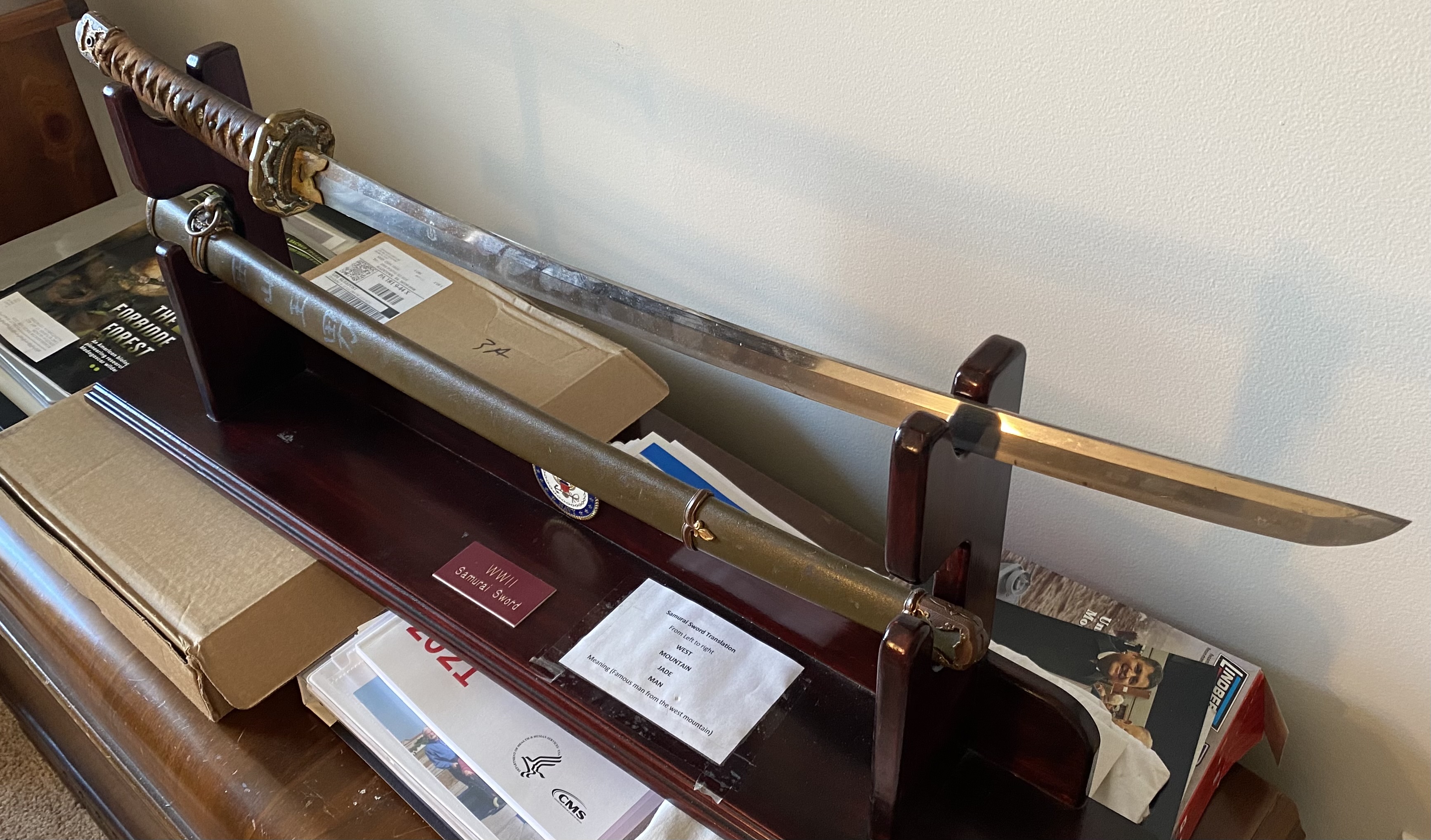
A sword and scabbard Gutman took from a Japanese officer after the surrender. ‘Sir, you will not need this any longer,’ he told the man while helping to disarm enemy troops on a Pacific island.

When we entered Pearl Harbor, we could still see a lot of the destruction that took place when they [the Japanese] bombed that harbor. We then found out that these creosote pilings, along with the Seabees, were brought there to repair the docks and ships that were destroyed in the bombings. We were there maybe about a week. We enjoyed liberty. A lot of guys got drunk, got pie-eyed. I think I had a couple of beers. We had a lot of fun. I guess the skipper wanted us to have fun.

We knew from there, God only knows where we’re gonna go.

In September 1944, Gutman landed Marines on Peleliu in his Higgins boat under fire. He went on to take troops ashore at four sites in the Philippines and at Okinawa. At war’s end, he and some others on his LST volunteered to sweep pressure mines that U.S. planes had dropped in Japanese harbors. For “the personal danger involved,” he was awarded a Navy Commendation Medal. Back home, he had active duty in the Reserve as an instructor and recruiter, retiring in 1967 as a chief petty officer.

He was more than a distinguished veteran and the subject of several stories I wrote for the newspaper over the past few years. He was my friend.

 ‘Uncle Earl, you have never been forgotten’

Private Earl Seibert came home yesterday, May 25, 2024. He’d been gone for a long time.

A burial detail removes Private Earl Seibert’s casket from a carriage May 25 at Grandview Cemetery outside Allentown.

The mechanic from Allentown, Pennsylvania, died 82 years ago in a Japanese POW camp in the Philippines. He was buried there in a common grave.

His family knew he was missing and presumed dead. Not until World War II ended did they learn he had succumbed to diphtheria in 1942 at Cabanatuan Camp 1 on Luzon. He was 23. Early this year, the Defense Department announced his remains had been identified.

Seibert arrived at Philadelphia International Airport for a “dignified transfer” on May 21. Yesterday, the military and a throng of mourners paid tribute to him at Jordan United Church of Christ and Grandview Cemetery outside Allentown. I wrote about him in February, so I had a special interest in being there.

Private Earl Seibert of Headquarters Company, 803rd Engineer Aviation Battalion, attached to the Far East Air Force in the Philippines

In the fall of 1941, Seibert and six hometown buddies shipped out to Luzon with the Army’s 803rd Engineer Aviation Battalion to work on airfields. They were at Clark Field when the Japanese attacked Pearl Harbor and the Philippines. With the surrender in April 1942, they were among thousands of U.S. and Filipino troops taken on the Bataan Death March and held in squalid camps. Only three of the seven survived.

At the church service, Seibert’s niece Ginnie-Lee Henry shared a letter she wrote that begins “Dear Uncle Earl.” She told him that his father learned from the War Department in 1951 that his remains could not be recovered.

Both his parents and his sister – Henry’s mother – and then Henry herself “started to investigate what had happened to you.” It took many years. Henry found that when the prisoners couldn’t work or got sick, they were placed in housing the Americans called Barracks 0, so called because men had a zero chance of coming out alive.

“It is believed you were placed into Barracks 0 in the beginning of July 1942. Your personal belongings were taken by the Japanese guards, including your identification tag as a souvenir. The Army believes you died at 4 a.m. on July 27, 1942, having your death recorded on a condensed milk can label by another POW. You were one of twenty who died that day.”

Seibert’s cousin Tommy Sweeney, a private in the 20th Air Base Group, also was captured on Bataan. He died at the Cabanatuan camp June 23, 1942, of Vincent’s angina .

This carriage pulled by Percheron draft horses took Seibert’s casket from Jordan United Church of Christ to Grandview Cemetery.

The POWs were exhumed at war’s end and reburied in the Manila American Cemetery, where the “unknowns” lay in a common grave. Six years ago, Henry and other family members provided their DNA to the Defense POW/MIA Accounting Agency. Last summer, it identified one set of remains as those of Seibert.

At the church yesterday, a half-open casket contained Seibert’s remains, enfolded in an Army uniform. His medals were on display, including a Bronze Star for his role in the defense of Bataan and two Purple Hearts, one because he was wounded January 16, 1942, and the other because he died at the hands of the enemy.

The Missing Man Table with a single chair was on display. On top of it was a folded American flag, a Bible, a candle, an inverted glass, a red rose in a vase tied with a yellow ribbon, a slice of lemon and some salt. The lemon is a reminder of a POW/MIA’s bitter fate. The salt symbolizes the family’s tears.

The flag is lifted from Seibert’s casket to be folded and presented to his niece Ginnie-Lee Henry.

In times of sadness, there is comfort in ritual. I felt it.

Under the noontime sun, the casket rode to the cemetery two-and-a-half miles away in a horse-drawn carriage, to the clip-clop cadence of two Percherons’ hooves. A bugler played Taps. Riflemen fired three volleys in salute. We recited the 23rd Psalm aloud. With solemn respect, two soldiers lifted the American flag off the casket and folded it precisely. Another presented it to Henry as she sobbed. Three shell casings from the rifle salute were handed to her, symbolic of duty, honor, country.

“Welcome home, Uncle Earl,” Henry had written in her letter to him. “We remembered you. So did many others, too.”

Remembering a lost defender of Bataan

Private Earl Seibert of Headquarters Company, 803rd Engineer Aviation Battalion
(Newspapers.com)

Private Earl Seibert died eighty-two years ago at a prison camp in the Philippines and was buried there. When the Defense Department announced last month that his remains have been identified, I reached for my filing cabinet.

In 2002, I interviewed a veteran who had much in common with Seibert– eastern Pennsylvania hometowns, service in the same Army unit, the Bataan Death March and a camp where more than 2,500 POWs died. The difference was that Joe Poster was spared.

Seibert was among seven men from Allentown who shipped out to the Philippines in the fall of 1941. Along with thousands of other U.S. and Filipino troops, they were taken prisoner the following spring, several months after Japanese forces invaded the islands. Ahead of them was the Death March and horrific captivity. Only three would survive.

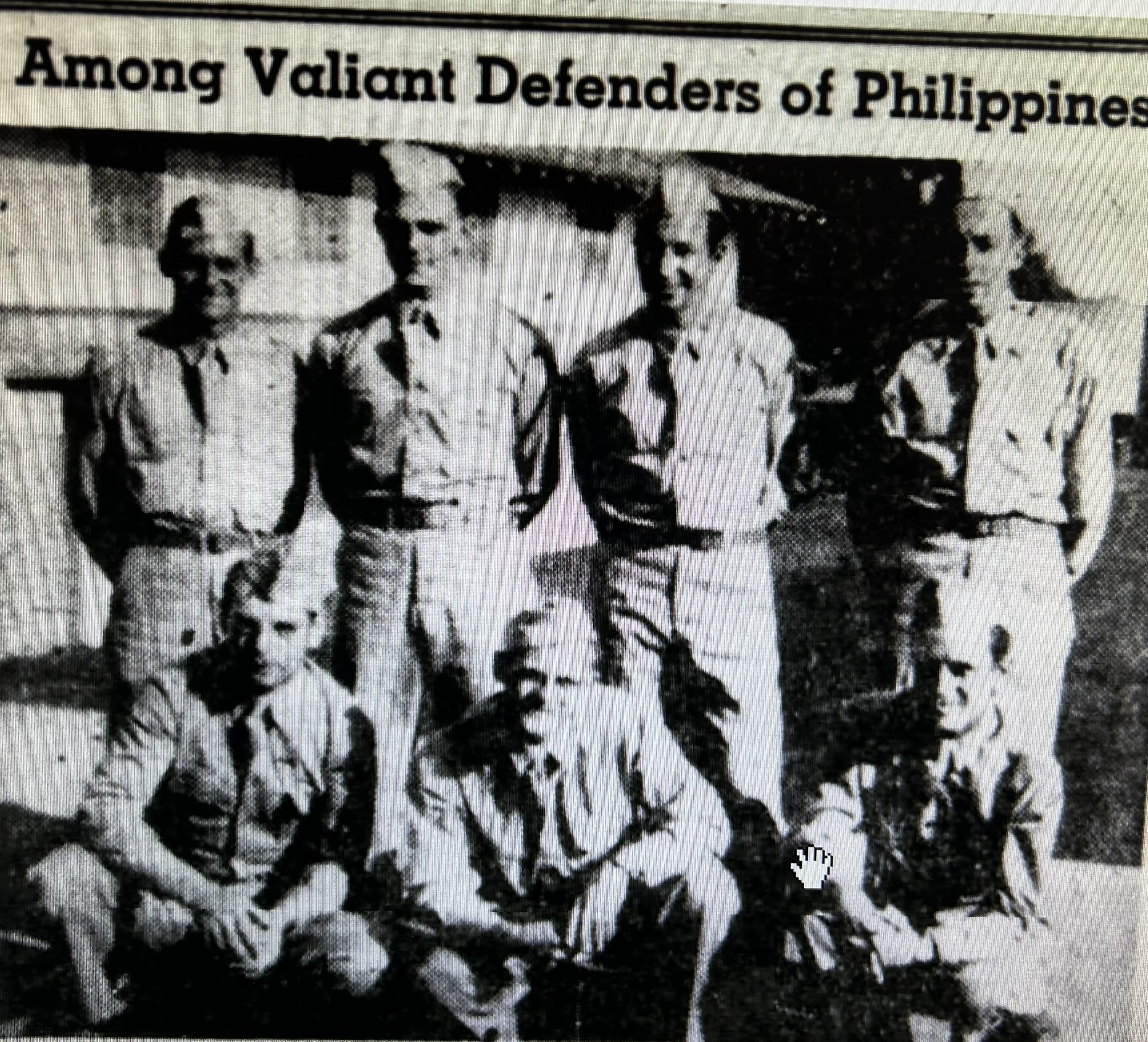
Soldiers from Allentown (crouching, from left) John Sokalsky, Raymond George and Eugene McNamara; (standing, from left) William Johnson, Walter Lamm, Earl Seibert and Edwin Warfield. All belonged to the 803rd Engineer Battalion. The photo ran December 29, 1941, in their hometown paper, The Morning Call.
(Newspapers.com)

In December 1941, just days after the Japanese landed, The Morning Call of Allentown ran a photo of the seven men – Seibert, Eugene McNamara, Edwin Warfield, John Sokalsky, Raymond George, William Johnson and Walter Lamm. Citing a letter from McNamara dated November 29, the paper said they were together at Fort Stotsenburg/Clark Field, about fifty miles from Manila.

Before his Army service, Seibert was a mechanic at Hoffman Bros. auto salvage. He and the six others were inducted in June 1941 and got basic military engineer training at Fort Belvoir, Virginia. Assigned to the 803rd Engineer Aviation Battalion, they arrived on Luzon in October and were attached to the Far East Air Force. Their job was building airfields.

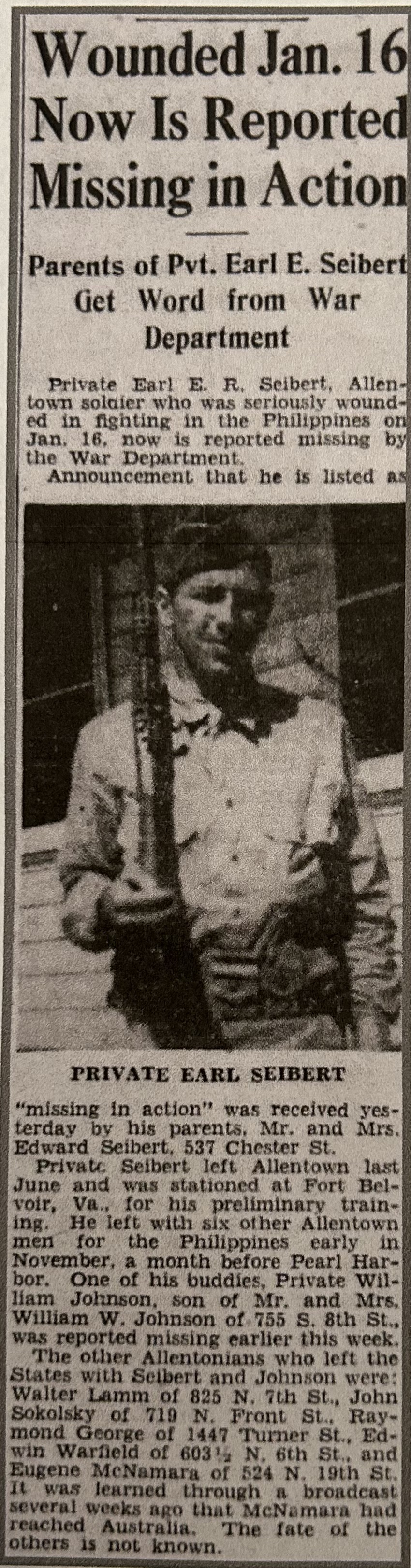
An update in The Morning Call of May 30, 1942
(Newspapers.com)

Seibert, of Headquarters Company, was badly wounded January 16, 1942, as the Americans and Filipinos fought to defend the Bataan peninsula. There were no details on his injuries.

After the Allies surrendered April 9, most of the men in the 803rd’s three companies on Bataan – a fourth company was on Corregidor — walked from Mariveles to San Fernando on the Death March, according to Good Outfit: The 803rd Engineer Battalion and the Defense of the Philippines, 1941-1942, by Paul W. Ropp.  They were taken by train to Capas for internment at nearby Camp O’Donnell. Many of the engineers left the camp to toil for their captors in the mountains of northern Luzon. After a few months, they were marched to Cabanatuan Camp 1 , where disease, malnutrition and maltreatment took a dreadful toll.

Seibert, age twenty-three, died of diphtheria at Cabanatuan on July 27, 1942. He was buried in a common grave at the camp cemetery. His parents didn’t learn of his death until three years later, after Japan’s surrender.

Ropp’s 559-page history of the battalion lists what happened to its members. Here’s what the book says about the six other soldiers from Allentown, all of them members of Company B:

Lamm

— Private Walter Lamm survived the war. He left Cabanatuan in September 1942, was transported on the hell ship Tottori Maru to Korea and then to a POW camp in Mukden, Manchuria. (He died in 2008 at age eighty-nine.)

Warfield

— Private First Class Edwin Warfield survived the war. He was taken from Cabanatuan in July 1944, transported on the hell ship Sehiiko Maru and held captive near Osaka, Japan. (He was eighty-six when he died in 2000.)

Sokalsky

— Private First Class John Sokalsky survived the war. He was taken from Cabanatuan, transported on the Tottori Maru and taken to Mukden in October 1944. (He died in 1984 at age sixty-eight.)

— Private Eugene McNamara died May 1, 1942, at Camp O’Donnell of cerebral malaria and dysentery.

George

— Private Raymond George, twenty-four, died in the Cabanatuan hospital August 27, 1942, of dysentery. He had been wounded in action April 8. (Warfield helped bury him.)

Johnson

— Private William Johnson, twenty-eight, died April 15, 1942, of a fractured skull during the Death March. He might have been murdered near Balanga. According to a November 1945 story in The Morning Call, Warfield told Johnson’s parents their son collapsed during the march and was carried away, never to be seen again.

Poster in photo taken September 8, 1945, after he was liberated from Mukden camp

Word that Seibert died at Cabanatuan and his remains have been identified took me back to an interview I did for The Morning Call twenty-two years ago. Joe Poster grew up in Pottstown and served in Company B of the 803rd. He went on the Death March and the work detail in the mountains. At Cabanatuan, he once helped bury the dead. Sent to Manchuria, he almost died of nephritis at the Mukden camp.

“I can’t say how I made it,” Poster told me. “I lived day to day. I was scared all the time. I thought maybe tomorrow those Japanese will kill me. I never knew whether they were going to murder us or not. That’s the way it was for three-and-a-half years, even till the last day.”

Poster came home late in 1945. He got married, worked for Mack Trucks in Allentown and was a national commander of the American Defenders of Bataan and Corregidor.

When I arrived at his home for one of our interview sessions, he yelled that I was making him remember “all this stuff.” He was still haunted and couldn’t sleep.

He died in 2003, a year after my story ran. He was eighty-three.