Tag Archives: military-history

PR lessons a colonel learned from Vietnam ‘mutiny’

Robert C. Bacon, then a captain, on the June 12, 1964, cover of Life. In the photo taken by British journalist Larry Burrows, Bacon leads South Vietnamese soldiers in the Mekong Delta. In 2001, he sent the image to me with this note: “Thanks for taking your time and energy to honor your fallen cousin. He and the others are all heroes in my mind — as ever your friend Bobby Bacon.”

Thirty years ago, while trying to find out how my cousin Nicky died in Vietnam, I struck up a friendship with a retired Army colonel who figured in the story. He also had been caught up in a deeply controversial episode of the war and had much to say about how the military handled bad publicity. It’s an issue that resonates today.

Robert C. Bacon of Columbia, South Carolina, was a West Point graduate who served two tours in Vietnam, the first in 1963-64 as an adviser to a South Vietnamese battalion, a role that put him on the cover of Life magazine. In the second, from 1969-70, he briefly headed a unit that provided training and orientation for troops newly arrived at Chu Lai, the Americal Division base along the South China Sea.

Nicky, a 20-year-old Army helicopter pilot, was among the soldiers who landed there in July 1969. On his sixth day in Vietnam, he was trucked to a firebase called LZ Bayonet for a class on grenade safety. The sergeant/instructor, in a gimmick to get the men’s attention, unwittingly tossed a live grenade onto the floor. Nicky lost a leg from the blast and died five days later, on July 15, at Chu Lai’s 312th Evacuation Hospital. Back home in Malvern, Pennsylvania, his parents received a bereavement letter from Bacon, commandant of the 23rd Adjutant General Replacement Company, the Americal Combat Center.

Except that they didn’t, really.

Bacon graduated from Peacock Military Academy, a college prep school in San Antonio, Texas, with the Class of 1951.
(Kadet Yearbook)

I’d hoped Bacon could help me understand what happened in the classroom but was in for a disappointment. When I first spoke with him in 1996, he said didn’t join the replacement company until five days after Nicky died. He refused to sign the letter that was dropped on his desk, because the “horrible, unfortunate accident” didn’t happen “on my watch” and he had no first-hand knowledge of it. Someone signed the letter for him.

If he had been in charge earlier, Bacon said, he would have halted the grenade-tossing routine as too dangerous.

“It is still hard to believe the attention-getting stunt the sergeant used,” he wrote to me. “One of the best attention-getters was to say at the start of the class, ‘Probably either you or the man sitting next to you will be killed or wounded during your tour. If you pay attention, it might not be you.'”

Lieutenant Colonel Bacon went on to lead the 3rd Battalion, 21st Infantry of the 196th Light Infantry Brigade and earned a Silver Star for gallantry. His name appeared in news accounts around the world after troops under his command reportedly mutinied in the Song Chang Valley near Da Nang. He reassigned the inexperienced lieutenant whose men were involved, saying at the time that he “wasn’t satisfied with the progress the company was making.” Pointedly, he always maintained there had been no mutiny.

Warrant Officer Nicholas L. Venditti, my cousin, at home on leave a few weeks before he died in Vietnam

My story on Nicky’s fate, two decades in the making, would become a book. I stayed in touch with Bacon almost until his death eight years ago, giving him updates on my research and further questioning him as more information came to light. He encouraged me in phone calls and in cards and letters he signed “Bobby,” and invited me to visit him, which I was never able to do. He eagerly shared letters, articles and other remembrances of his Army experience, in particular those concerning the so-called mutiny of Alpha Company in August 1969.

***

The Pentagon’s evasive posture over the blasting of alleged drug-runners’ boats in the Caribbean and eastern Pacific sent me thumbing through my thick folder on Bacon. One of the items he’d sent me was a term paper he wrote for the Army War College in Carlisle, Pennsylvania, in 1973 while pursuing a master’s degree. The paper was for a communications class. In it, he cites the “mutiny” episode as a case study in botched public relations.

His advice to the Army hierarchy on what to do when bad news breaks? Come clean, and do it promptly.

Before you read Bacon’s paper below, I’ll show you the 1969 news story in The New York Times that rankled him for the rest of his days. It ran at the top of Page 1 on a Tuesday and was written by Associated Press staffers Horst Faas and Peter Arnett, both of whom had won Pulitzer Prizes for their coverage of the war — Faas in 1965 for combat photography, and Arnett in 1966 for international reporting. Bacon protested that the story was unfair; they responded respectfully that it was “absolutely fair.” Here is the complete article, followed by the writers’ letter to Bacon addressing his complaint:
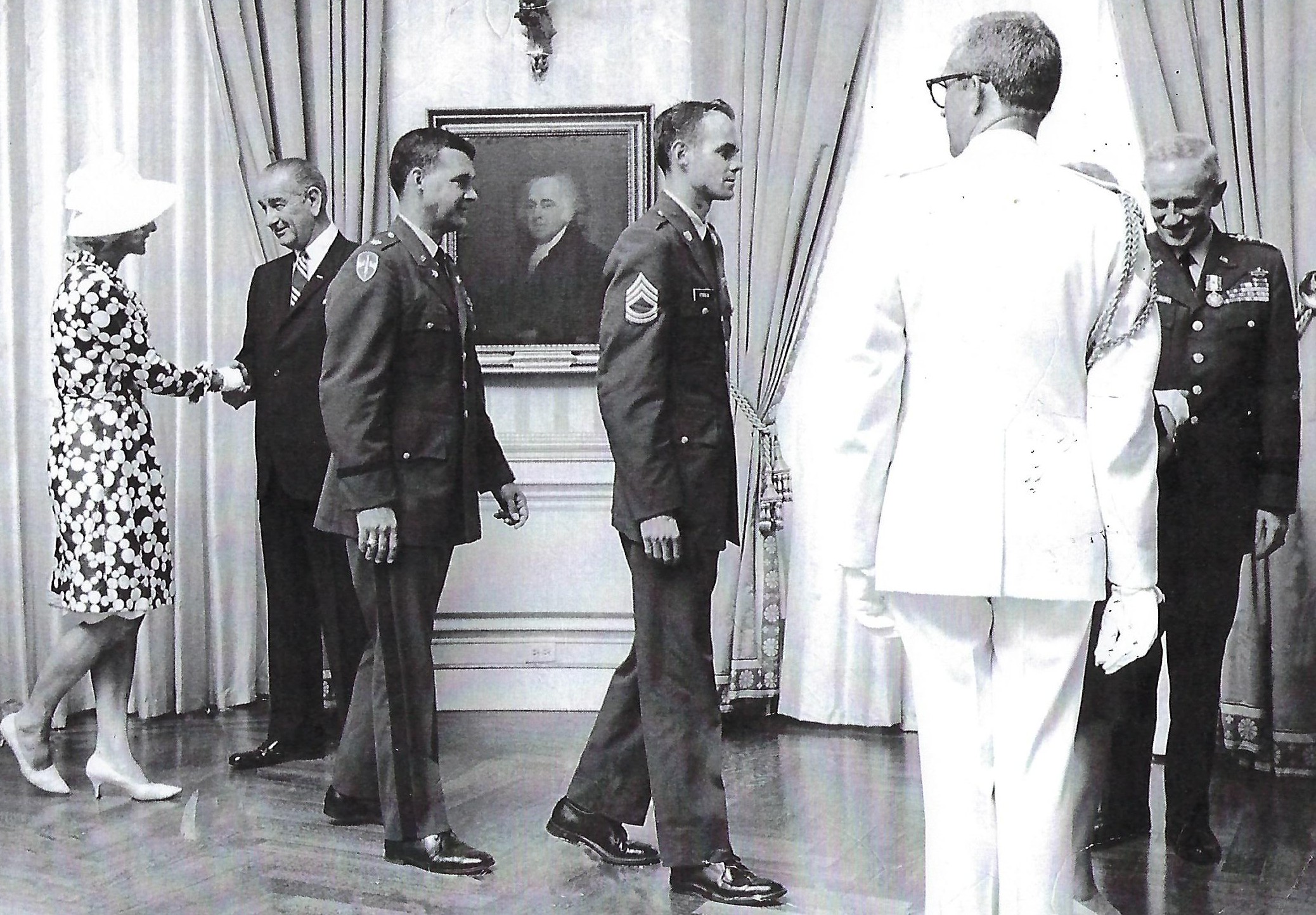
Bacon passes in front of President Lyndon B. Johnson in this 1960s White House photo taken during a ceremony for a Medal of Honor recipient. At the time, Bacon was protocol officer for the Army’s chief of staff.

Told to Move Again
On 6th Deathly Day,
Company A Refuses

The following dispatch is by Horst Faas and Peter Arnett of The Associated Press.

SONGCHANG VALLEY, South Vietnam, Aug. 25 — “I am sorry, sir, but my men refused to go — we cannot move out,” Lieut. Eugene Shurtz Jr. reported to his battalion commander over a crackling field telephone.

Company A of the 196th Light Infantry Brigade’s battle-worn Third Battalion had been ordered at dawn yesterday, to move once more down the jungled rocky slope of Nuilon Mountain into a labyrinth of North Vietnamese bunkers and trench lines 31 miles south of Da Nang.

For five days the company had obeyed orders to make this push. Each time it had been thrown back by invisible enemy forces, which waited through bombs and artillery shells for the Americans to come close, then picked them off.

Colonel Lost in Crash

The battalion commander, Lieut. Col. Robert C. Bacon, had been waiting impatiently for Company A to move out. Colonel Bacon had taken over the battalion after Lieut. Col. Eli P. Howard was killed in a helicopter crash with seven others. Since the crash Tuesday the battalion had been trying to get to the wreckage.

Yesterday morning Colonel Bacon was leading three of his companies in the assault. He paled as Lieutenant Shurtz told him that the soldiers of Company A would not follow orders.

Bacon’s copy of AP’s ‘mutiny’ story

“Repeat that, please,” the colonel said without raising his voice. “Have you told them what it means to disobey orders under fire?”

“I think they understand,” the lieutenant replied, “but some of them simply had enough — they are broken. There are boys here who have only 90 days left in Vietnam. They want to go home in one piece. The situation is psychic here.”

“Are you talking about enlisted men, or are the N.C.O.’s also involved?” the colonel asked.

“That’s the difficulty here,” Lieutenant Shurtz said. “We’ve got a leadership problem. Most of our squad and platoon leaders have been killed or wounded.”

At one point in the fight, Company A was down to 60 men, half of its assigned combat strength.

Bunkers Believed Empty

The colonel told Lieutenant Shurtz: “Go talk to them again and tell them that to the best of our knowledge the bunkers are now empty — the enemy has withdrawn. The mission of A company today is to recover their dead. They have no reason to be afraid. Please take a hand count of how many really do not want to go.”

The lieutenant came back a few minutes later: “They won’t go, colonel, and I did not ask for the hand count because I am afraid that they all stick together even though some might prefer to go.”

The colonel told him: “Leave these men on the hill and take your C.P. element and move to the objective.”

The lieutenant said he was preparing to move his command post and asked: “What do we do with the ammunition supplies? Shall we destroy them?”

“Leave it with them,” the colonel ordered.

Little Comforts Missing

Then Colonel Bacon told his executive officer, Maj. Richard Waite, and one of his Vietnam veterans, Sgt. Okey Blankenship, to fly from the battalion base across the valley to talk with Company A.

“Give them a pep talk and a kick in the butt,” he said.

They found the men exhausted in the tall, blackened elephant grass, their uniforms ripped and caked with dirt.

“One of them was crying,” Sergeant Blankenship said.

The soldiers told why they would not move. “It poured out of them,” the sergeant said.

They said they were sick of the endless battling in torrid heat, the constant danger of sudden firefights by day and the mortar fire and enemy probing at night. They said that they had not had enough sleep and that they were being pushed too hard. They had not had any mail or hot food. They had not had any of the little comforts that made the war endurable.

Helicopters brought in the basic needs — ammunition, food and water — at a tremendous risk under heavy enemy ground fire. But the men believed that they were in danger of annihilation and would go no farther.

Major Waite and Sergeant Blankenship listened to the soldiers, most of them a generation younger, draftees 19 and 20 years old.

Sergeant Blankenship, a quick-tempered man, began arguing.

“One of them yelled to me that his company had suffered too much and that it should not have to go on,” Sergeant Blankenship said. “I answered him that another company was down to 15 men still on the move — and I lied to him — and he asked me, ‘Why did they do it?’ “

“Maybe they have got something a little more than what you have got,” the sergeant replied.

“Don’t call us cowards, we are not cowards,” the soldier howled, running toward Sergeant Blankenship, fists up.

Sergeant Blankenship turned and walked down the ridge line to the company commander.

The sergeant looked back and saw that the men of Company A were stirring. They picked up their rifles, fell into a loose formation and followed him down the cratered slope.

***

Bacon complained about the story to Arnett and Faas. He sent me a copy of their response. Here it is:

Faas and Arnett’s response to Bacon

The Associated Press
P.O. Box 702
Saigon

August 26, 1969

Lt. Colonel Robert C. Bacon
Commander, 3rd Battalion, 21st Infantry
196th Light Infantry Brigade

Dear Colonel Bacon,

Enclosed for your information is the story we did on “A” Company last weekend.

We hear that some kind of investigation has been ordered into this story, and we truly hope that this has not inconvenienced you, or interfered with your business of getting on with the war.

We feel the story was absolutely fair, and on reading it, I believe you and the others will agree. War is a very human experience, and we seek to portray this human side just as much as we do the statistics. Just as you and your officers have as your duty to fight the war to the best of your abilities, we have the duty to report it. The story of “A” Company was as moving a piece as we have written out of the war, and we tried very hard to emphasize your own coolness during the crisis, and the ability of Major Waite and SFC Blankenship in convincing the men on the hill to go back into the fight.

You and your men were very kind to us both, and to all the other AP people who visited you during a very trying period. We hope you don’t feel we have “betrayed” you. On the contrary, we feel that the “Gimlets” are as fine a bunch of men in the whole war, and that the story of “A” company bore that out.

Sincerely,
Peter Arnett & Horst Faas

***

Here is Bacon’s Army War College paper:

MUTINY IN COMPANY A — FACT OR FICTION
A CASE STUDY IN PUBLIC RELATIONS

By Robert C. Bacon
March 1973

Bacon’s Army War College term paper, written for a communications class at nearby Shippensburg State College, now a university.

For most Americans, 26 August 1969 started as a typical hot summer Tuesday … that is until they had their first cup of coffee and opened their morning newspaper. It was at that moment that many were startled and stunned by headlines such as “Company A Refuses to Go,” or “Weary Viet GIs Defy Orders.” Their shock was warranted, for this appeared to be the first large-scale combat refusal by U.S. soldiers in over seven years of participation in the war. The message was not confined to the United States, as was pointed out by David Lawrence in his article in U.S. News & World Report titled “What’s Become of Voluntary Censorship?”

“… [T]he dispatch which revealed that American troops were engaged in a mutiny was promptly spread around the world. The North Vietnamese officials read it, and so did the leaders in Moscow and Peking. The impression was conveyed that the United States had on its hands an incipient rebellion in the ranks of its armed services. Broadcasts by Viet Cong radio hailed the news and predicted more such incidents would follow.”

Others felt that the alleged incident was having a profound impact on President Nixon. For example, in The New York Times of 27 August, James Reston in a commentary entitled “A Whiff of Mutiny” inferred that the president now had to consider a revolt by all the military men in Vietnam. Similar inferences were undoubtedly drawn by enemy negotiators at Paris who were undoubtedly encouraged to postpone any concessions toward a peaceful resolution of the war.

Since the incident took place several years ago, the entire initial article by Horst Faas and Peter Arnett is repeated on the following page as it appeared in The New York Times of 26 August 1969.

In the next few days following the release of the article, nothing was done on the part of the Army to refute or explain had had actually happened. The complete vacuum of press releases by the Army undoubtedly occurred because:

— The article came as a complete surprise and had not been anticipated even by those members of the Army directly involved in the incident.

— The Army, for a period of three days, closed the gates of communication to other members of the press corps who were trying to dig deeper into the story.

Thus, two cardinal rules of good public relations were violated:

— Anticipate adverse publicity as it is developing and be prepared to react.

— After an incident occurs, maximum disclosure with minimum delay should be the standard.

Why wasn’t the story anticipated? Principally it was because I, as the battalion commander, did not view it in the same light as the two reporters. To me, the entire unit, including Company A, had fought a magnificent and courageous battle over a period of six days against very tough opposition. Company A had hesitated to get into battle for a period of about 55 minutes only because their inexperienced and battle-weary company commander had failed to give them a direct order to do so. Accordingly two days before the article had appeared in the news, I had relieved the company commander and praised the soldiers in Company A. At the time, I would have thought it was incredible that anyone could have inferred that the entire company had been cowardly and refused to fight.

Bacon points to his medals for a story about him that ran May 26, 2011, in South Carolina’s Fort Jackson Leader. He was stationed at the fort from 1976-83 and retired from the Army in 1985. Susanne Kappler took the photo and wrote the article after Bacon appeared at a Retiree Appreciation Days event.

Further, it was anticipated that any stories by Mr. Faas and Mr. Arnett would be centered around the combat actions of the battalion as well as the recovery of their compatriot, Mr. Oliver Noonan, [a freelance photographer for The Boston Globe] who had been shot down in a helicopter in the early phase of the battle. Further, neither Mr. Arnett nor Mr. Faas had ever been with Company A or any of its members during any part of the operation. They were quite congenial when they departed — asked no questions about Company A and appeared only interested in verifying their account of the operation. This initial assessment of what they might write appeared to be substantiated by articles in the Times on 24 and 25 August. In these articles, the battle and the recovery of Mr. Noonan were well-covered in detail, and it was not until 26 August [that] the balloon burst.

In reflection, perhaps the single most important reason I did not anticipate or expect an article of this nature was my previous experiences long ago with Mr. Faas and other members of the press corps. Perhaps I might have been more wary had the information officer or someone else clued me in on the subtle change and pressures on the press corps since my previous assignment in Vietnam.

On my first tour in 1963-64, there were few Americans in the field, and it was not uncommon to have a member of the media tag along on an operation. The first correspondent I recall encountering was Mr. Larry Burrows, who was killed about two years ago [in 1971] when his Vietnamese helicopter was shot down over Laos. Larry was courageous, professional, attended his own needs in the field and was a pleasure to be around. In June of 1964, he took a picture of me that ended up on the cover of Life magazine, and in the same issue was some very objective reporting on atrocities by both the Viet Cong and South Vietnamese soldiers. Horst Faas was a lot like Larry and got his job done with a minimum interference with the operation. His photographic skills and moving dialogue graced many newspapers in those days. Particularly impressive was a story he did on the Viet Cong bombing of a floating Chinese restaurant in Saigon. Once, I asked why he didn’t use any Japanese cameras and fondly recall his reply in a thick German accent — “One thing about a Leica, it always works.”

In those days, the press corps in Saigon was primarily composed of tested, experienced, responsible, mature combat correspondents. While I might not have liked what they had to say in some articles, it was normally always objectively reported and well-documented. Later, with the surge of U.S. units, younger, less experienced correspondents flooded into Saigon. These [Y]oung Turks knew where the action was, and some would go to any extreme to sensationalize to get that all important byline on the front page of major newspapers. Some of the most stirring accounts of battles were written by some of these men who never got out of Saigon. Their reports were strictly based on what they had picked up at the daily press conference, spiced up with information they had picked up at the local bars. These grandstand plays by the [Y]oung Turks undoubtedly put extreme pressure on some of the older correspondents to sensationalize. Unfortunately, I was unaware of this metamorphosis in the press corps. Hence, without benefit of a pre-brief by the information officer, I considered Horst Faas to be as responsible, objective and mature as in our early encounters. I should have suspected he had changed when, after being out in the field for about six hours, I had to give him half a canteen of water.

As protocol officer for General Harold Johnson, the Army chief of staff in 1968, Bacon helped organize the funeral of Senator Robert F. Kennedy. The next year, he had the same role under General William Westmoreland for the funeral of former President Dwight D. Eisenhower.

Well, this leads to perhaps the most important rule in public relations:

— Know your reporter/advisory [sic].

Some will be experienced, sympathetic, objective and responsible. Others will quote you out of context, distort the facts or maybe even sensationalize. Forewarned is fore-armed. Always get your public affairs/information officer to give a pre-brief so that you will be prepared for the challenge.

In this particular incident, I was taken completely by surprise. Mr. Faas and Mr. Arnett must have known they were sitting on a gold mine and felt the same sense of euphoria as an addict that mainlines for the first time.

When the story broke, we couldn’t believe it and were in a momentary state of shock. We quickly recovered and wanted to set the record straight, and even without any public relations background, realized that time was critical and any impact to contradict or explain the situation had to be done quickly. The communication to explain what had transpired was in our hands.

— The company did not fail to obey an order. They were never given an order. When an order was given, the entire unit had moved out.

— The article was written as a first-hand account, yet neither Mr. Faas or Mr. Arnett was ever with the unit and had not talked with a single soldier in Company A.

— The hesitation lasted about 55 minutes, and the company was still in the field doing a good job.

Other points could be mentioned, but the big problem, for some unexplainable reason, was a blockout [sic] imposed on the media for two days. Why the Army didn’t follow a policy of maximum exposure with minimum delay still astounds me.

The location of my unit was, as they say in Army jargon, out in the boonies. The only way we could be reached was by helicopter. When the reporters finally arrived, we told the story as honestly as possible and invited them out to see Company A, which was still in the field.

The following are some quotes from articles that appeared some time after the incident, which if released in a timely manner might have overcome some of the adverse publicity of the original article.

In Newsweek, 8 September, in a commentary titled “The Alpha Incident”: “… [T]he article a gross injustice to all concerned.”

In Pittsburgh Press, 2 September 1969, in an interview with Specialist 4 Curtis, a member of Company A: “We never at any time said we wouldn’t go down the hill. … When Lieutenant Shurtz gave us a direct order, we started moving.”

In Time, 8 September 1969, in an article “Incident in Song Chang Valley”: “Neither Faas or Arnett saw or spoke to anyone in Alpha first hand. … [T]heir report that nearly all the soldiers of A Company broke was plainly exaggerated.”

In Detroit News, 2 September 1969: “Captain Bligh would have sniffed with a Charles Laughton disdain had anyone suggested to him the incident … was mutiny, which is how some commentators have described it.”

In Waterville, Maine Morning Sentinel, 13 September 1969, interview with [Private First Class] Batchelder, A Company, who lived in Dexter, Maine: “Please let the people know that this company is not chicken. We lost half our company and were exhausted from five days of fighting. … There was no mutiny, and to say otherwise is a disgrace.”

While there is no way of knowing the impact of these articles, we could certainly conclude that it was somewhat less than if they had been dispatched in a timely manner. At least this would have caused the public to look at other facets of the issue. Perhaps then they might have come to the conclusion that no one relishes the thought of going into battle. That the soldiers in Company A were tired and frightened and hesitated on going into battle primarily because their company commander could not meet the awesome challenge of ordering them to do so. Finally, they might have concluded, as I did, that Company A was a very courageous company that overcame their infectious fear and accomplished their mission in a truly outstanding manner.

It is not the purpose of this paper to be overly critical of Mr. Faas or Mr. Arnett. They both were undoubtedly under pressure to get a big story whenever they could. Had they bothered to check more deeply prior to publishing the story, they too might have come up with a different version. Their story was based on what they overheard on the radio and a conversation with a sergeant [Blankenship] who I had sent out to Company A. Considering their sources, the article could be classified as object [sic], albeit not in-depth, reporting. Certainly the letter they dispatched to me, on the following page, would indicate their sincerity.

To me, there is a contradiction between the actual article and the last sentence in the letter. I cannot see how the article as written would lead the public to believe that the Gimlets (my battalion) were “as fine a bunch of men in the whole war, and the story of A Company bore that out.[“] However, admittedly I too am looking at the article in a nonobjective and parochial manner.

Well, the chapter is closed on this episode, but to me there were some worthwhile lessons.

— Always try to find out the background of a reporter that will visit you or your unit.

— Anticipate and look for not only the good news, but also the bad news. This should be done on a continuing basis and not just when a reporter is visiting you.

— When a story breaks, be prepared to react. The reaction should be honest and factual. It should be a maximum disclosure and given rapidly. The public knows that no one is perfect, especially an organization as large as an army. While there may be some initial embarrassment, it will quickly fade away. Any attempt to cover up or distort the facts will only draw more attention to the issue, and as we all know, the truth will eventually be brought to light.

***

I’ve written several blogs about the episode from soldiers who were there. One was an interview with Alpha Company medic Fred Sanders. Another was an account by artillery officer Alan Freeman, and another by company “grunt” James Dieli. All maintained there had been no mutiny.

Bacon lived to see my book on my cousin, Warrant Officer Nicholas L. Venditti, which was titled Tragedy at Chu Lai and published by McFarland & Co. in 2016. The next year, Bacon died from cancer at 83. Here is his obituary.

He had once written: “I know your book is a labor of love, but you have probably gotten much more out of your efforts than just a book.

“I am sorry I’m a little sketchy on the details, but what I did tell you is 100% true. Thankfully because of the grace of God, many of the bad experiences, injuries, etc. are hidden deeply in our brains. For example, it is difficult to remember the pain of a serious injury. Were it otherwise, I think more of us would have gone mad.”

How a ‘bully’ drew wrath of fellow POWs in Japan

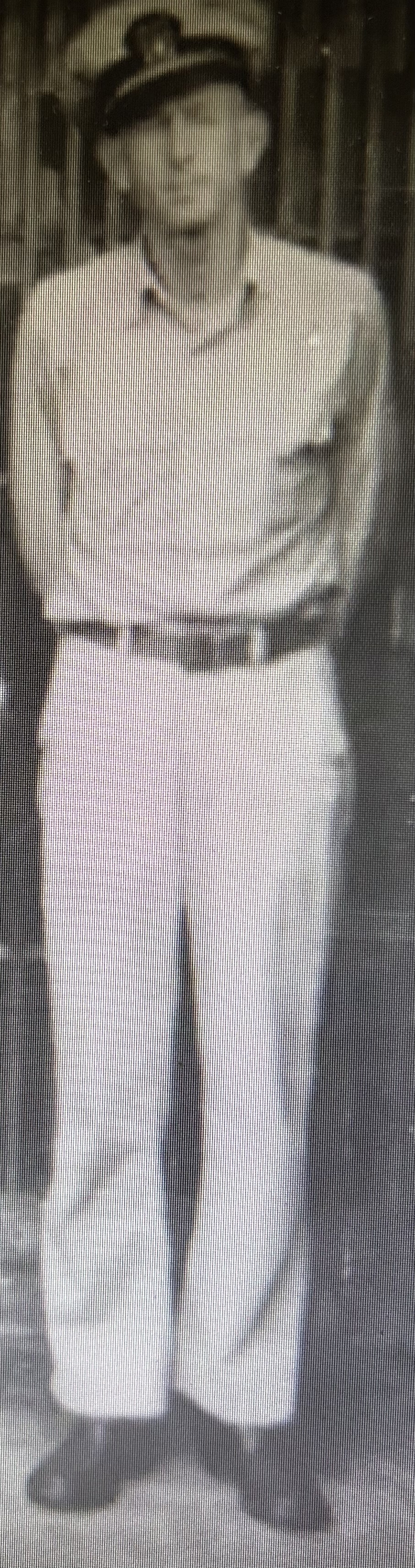
Lieutenant Commander Edward N. Little after Fukuoka Camp 17 was liberated in September 1945
(National Archives)

An American naval officer and former POW was court-martialed after World War II on charges he collaborated with the Japanese. More than two dozen witnesses spoke against Lieutenant Commander Edward N. Little. One prison camp survivor, a soldier from Pennsylvania’s coal country, gave off-the-record testimony that wasn’t part of the trial. I’m going to share it with you.

Little was the highest-ranking Navy officer at Fukuoka Camp 17 on Japan’s Kyushu Island. He was in charge of the prisoners’ mess hall.

Fellow ex-prisoners said Little ate more than his share of food from Red Cross parcels, threw away edible rice as a punishment, deprived POWs of meals, beat a U.S. Army corporal and ordered the beating of another, reported four prisoners to the Japanese for stealing or selling food, two of whom were killed.

An online National Archives post gives a thorough account of Little’s case, detailing the charges against him, how he defended himself, and what became of him. It was written in 2018 by archives technician William Green. You can read it here.

Green’s source was the court-martial record of Little’s 1947 trial, which takes up 2,066 pages. I have it on a compact disc, which I got many years ago from the Department of the Navy’s Office of the Judge Advocate General. I’d been working on a story about POW Joseph L. Szczepanski, an Army Air Corps sergeant and onetime amateur boxer from Nanticoke who served in the Philippines.

Joe Szczepanski handles a canister of chemicals on Oahu, Hawaii, in 1938. At the time, he was serving with Company A, 1st Separate Chemical Warfare Systems Battalion.

Szczepanski, a clerk at Nichols Field outside Manila, was taken prisoner in April 1942 and walked in the Bataan Death March. He was held at Cabanatuan Camp 1 on Luzon and then at Fukuoka, where he was forced to work in a coal mine near Omuta. I wrote about him for The Morning Call of Allentown in 2009 and again in 2020, after his son Rick went to Japan to see where his father had been enslaved.

It was at Fukuoka that Sergeant Szczepanski came to revile Lieutenant Commander Little.

Later as a free man, Szczepanski testified for the War Crimes Office of the War Department about Japanese atrocities and mistreatment of prisoners. He was interviewed on April 1, 1947, in Larksville, Pennsylvania, near his hometown, by Special Agent Don B. Berntson of the Counter Intelligence Corps.

After Szczepanski died in 2005, Rick wrote to the National Personnel Records Center in St. Louis for his dad’s military file. He was surprised to get the report of Joe’s war-crimes testimony, in which he told of his own horrific experiences and complained bitterly about Little.

But Joe Szczepanski wouldn’t go on the record about the Navy officer, so Berntson wrote a separate, confidential report on which he listed Szczepanski as “reliable.” He noted Szczepanski thought Little had been tried and convicted “for his treason-like actions.” In fact, Little’s court-martial had begun in January 1947 and was still underway in Washington, D.C., at the time Berntson interviewed Szczepanski.

Szczepanski in 1946 at Valley Forge General Hospital after surgery on his broken nose. He spent 18 months recuperating from illnesses and injuries he suffered as a POW. The other man is unidentified.

Here is Berntson’s report:

CONFIDENTIAL
War Department
Counter Intelligence Corps
Scranton, Pennsylvania
1 April 1947

Subject: Collaboration with Japanese during World War II by Navy Lieut. LITTLE, USN.

Summary of Information:

During war crime testimony of Sgt. JOSEPH L. SZCZEPANSKI … he related how at Fukuoka POW Camp No. 17, Japan, a U.S. Naval Lieutenant by the name of LITTLE had collaborated with the enemy, thus costing the lives of two American soldiers and causing severe beatings to a number of other American soldiers in order to make his own position with the Japanese solid and luxurious. SZCZEPANSKI stated that he did not want his name mentioned in connection with Lt. LITTLE’s criminal deeds and that he did not want it to become part of his regular testimony on conditions at Fukuoka Camp No. 17. He stated that he believes that Lt. LITTLE was court-martialed by the U.S. Navy at Brooklyn, N.Y., and that he was sentenced to twenty years in prison for his treason-like actions during the war.

The 1947 report on Szczepanski’s off-the-record testimony against Little

SZCZEPANSKI related how a pugilistic soldier from the 4th U.S. Marines, called “Jimmy the Greek” PAVLOCKAS, of either Detroit or Chicago, had never gotten along very well with Lt. LITTLE because of Lt. LITTLE’s being a “general bully” [who] considered no one’s welfare except his own and that of the Japanese. In November 1943, Jimmy the Greek was apprehended by Lt. LITTLE while trading his rice for cigarettes. He was in a group of soldiers doing the same thing, but Lt. LITTLE singled him out of the group, and rather than to take him before Major JOHN [R.] MAMEROW, USAAF (now of March Field, California), he took him to the Japanese camp commander who ordered PAVLOCKAS to a dungeon in 22- to 24-degree temperatures, clad in only pants and shirt and fed a half cup of rice and one cup of water per day. Thirty-nine days later PAVLOCKAS died of hunger and exposure.

SZCZEPANSKI related how an American soldier, NOAH C. HURD, had stolen food from the Red Cross warehouse due to the fact that the Japanese did not distribute it anyway. He was apprehended by LITTLE about June 1944 and subsequently taken to the Japanese camp commander, KEN YURI, who personally tried HURD and personally beheaded him with a samurai sword in the presence of a Lt. PERKINS, a Lt. CHRISTY, and a Lt. [Owen W.] ROMAINE of the U.S. Army. LITTLE was also responsible for the beating death of a U.S. Army Corporal KNIGHT following his stealing rice. He was beaten to death in a Jap guard house by guards and by the then-camp commander of Fukuoka No. 17, Captain ISAO FUKIHARA.

LITTLE also threatened death to Corporal SAMUEL SHULMAN, AAF, of New York City when he took offense at remarks made by LITTLE on one occasion.

My 2009 story about Szczepanski in The Morning Call of Allentown. It was based on interviews with his son Rick.

LITTLE was also responsible for the starving of an American soldier by the name of MONTOYA, believed to be from New Mexico, when he had received a stolen jacket from someone.

LITTLE had also reputedly told the Japanese that a half-bowl of rice was sufficient for the American soldiers when Major MAMEROW had attempted to have the Japanese increase the rations instead of to lessen them. LITTLE also took the initiative to prohibit smoking in the mess hall by U.S. Army personnel.

It is believed that LITTLE is a native of California and that his wife is a native of Brooklyn, N.Y.

Corporal JACK KUCHNER, of the Bronx, N.Y.C., can corroborate this aforementioned report together with the aforementioned U.S. Army officers and noncommissioned officers listed herein. Capt. HOWARD HEWLETT, U.S. Army Medical Corps, can also corroborate this testimony.

Don B. Berntson
Special Agent
Counter Intelligence Corps

The report misspells the names of Schulman, Fukuhara, Kei Yuri, Charles P. Christie and James G. Pavlakos, a Marine corporal. … Hurd’s correct name was Noah C. Heard. An Army corporal, he was beaten and killed in May 1944. Accounts of his execution differed. Some POWs said he was bayoneted to death, while Szczepanski and others said he was beheaded. … It’s not clear whether Szczepanski is referring to Benjamin or Horacio Montoya. Both brothers were at the Fukuoka camp and survived. … William N. Knight, an Army private, was starved and beaten to death. … Howard Hewlett appears to have been Thomas H. Hewlett. … Little was from Monrovia, California. … USAAF stands for U.S. Army Air Forces.

Szczepanski wasn’t alone in his hostility toward Little. In the court-martial, 31 witnesses testified against the commander. Among them was Schulman, an Army technical sergeant, who told the nine Navy officers hearing the case:

Entries in Szczepanski’s diary after he was freed from Fukuoka Camp 17 in Japan. He had been shipped there in July 1943 after more than a year at Cabanatuan Camp 1 on Luzon. The Fukuoka camp was liberated on September 2, 1945.

“Mr. Little was in charge of the mess hall. He had — and he wielded — a mighty stick. He had the full cooperation of the Japanese behind him. He can get just about anything he wanted from the Japanese. The Japanese liked Mr. Little, because they sure saved him a lot of guards and a lot of work, and the men were scared of Mr. Little because they knew that if they went against Mr. Little, he could cause trouble for them.

“Every man hated him in that camp. There wasn’t a one that didn’t hate him, including myself.”

Little and 42 others testified on his behalf. The defense argued he had not broken Navy regulations, which call for punishment “of any person in the Navy who refuses or fails to use his utmost exertions to detect, apprehend, and bring to punishment all offenders, or to aid all persons appointed for that purpose.” So, the argument went, Little had a duty to report offenders.

In June 1947, after five months of trial, he was found not guilty of the three charges against him — conduct unbecoming an officer and a gentleman, maltreatment of a person subject to his orders, and conduct to the prejudice of good order and discipline – plus 22 additional specifications.

As a POW, Szczepanski suffered from dry beriberi, dysentery, malaria, parasites in his blood, a hernia, a broken nose, a busted jaw with loss of teeth, and a broken instep from purposely crushing his foot with a chunk of coal to get out of work in the Omuta mine. Decades of mental and emotional stress followed.

He made a career of teaching Spanish at Bethlehem Catholic High School and died at 86.

“Dad never really got over what took place in the prison camps, until in the mid-1980s he finally let go,” Rick Szczepanski told me. “It didn’t bother him anymore.”

‘We were full of piss and vinegar, and no brains’

Mathias Francis Gutman: 1925-2024

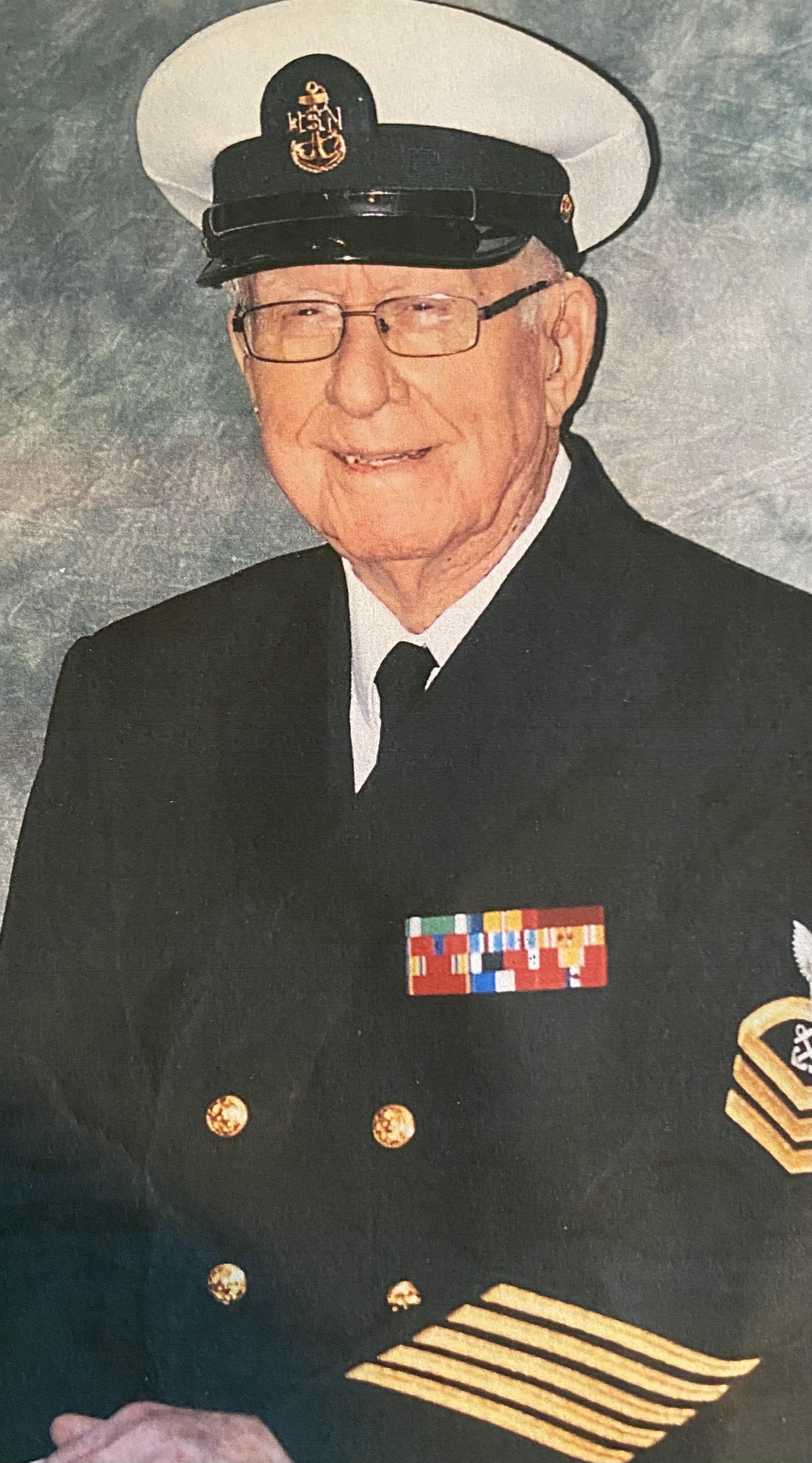
World War II veteran Matt Gutman died last Thursday, November 7, at his apartment in Allentown, Pennsylvania. He was 99. I wrote a story about his passing for my old employer, The Morning Call. For you, I’m sharing a partial transcript of my August 18, 2022, interview with him. Here, he tells about joining the Navy in 1943 and heading for the fight against Japan.

I didn’t want to be trapped in the Army or Marines.

When I was in junior high school, my brother who was in the Navy gave me one of these sea caps, and I used to wear it to school. I sort of liked the Navy because, first of all, I wanted to have good, warm chow and a bunk to sleep in, not a mud hole. … And that’s why I chose the Navy.

I enlisted at the Navy recruiting station in Allentown. … I wanted to go into the Seabees originally, [so] I talked to the chief Seabee, and he says, “What’s your occupation? What did you do?” I said, “No, I just come out of high school. I had basic electric.” He said, “Look, son, go next door. Talk to the Navy recruiter. We can’t be teaching you. We want people that are already trained.” So then I went next door to the chief of the Navy, and he enlisted me.

Then I went to Sampson, New York, for seven weeks of basic training. There was 106 of us. We trained together, marched together, ate together, everything together as a unit, and then, of course, graduated and then were given a seven-day leave to go and visit our parents, our friends. After seven days, we had to report back to Sampson for fleet assignment.

Gutman left Allentown High School in 1943 to sign up, and served in the Naval Amphibious Forces.

They sent me with a group of others by train down to Camp Bradford, Virginia, for amphibious training. First of all, I didn’t know what it would entail. … I knew it was land and sea. This was something new. When we got down there, they showed us all the different types of ships they used for invading an island, went over every one of them. They also told us about what to expect on those ships, and they told us these ships were made only to invade an island. That’s why they called them amphibious. They carried troops and tanks to invade an island.

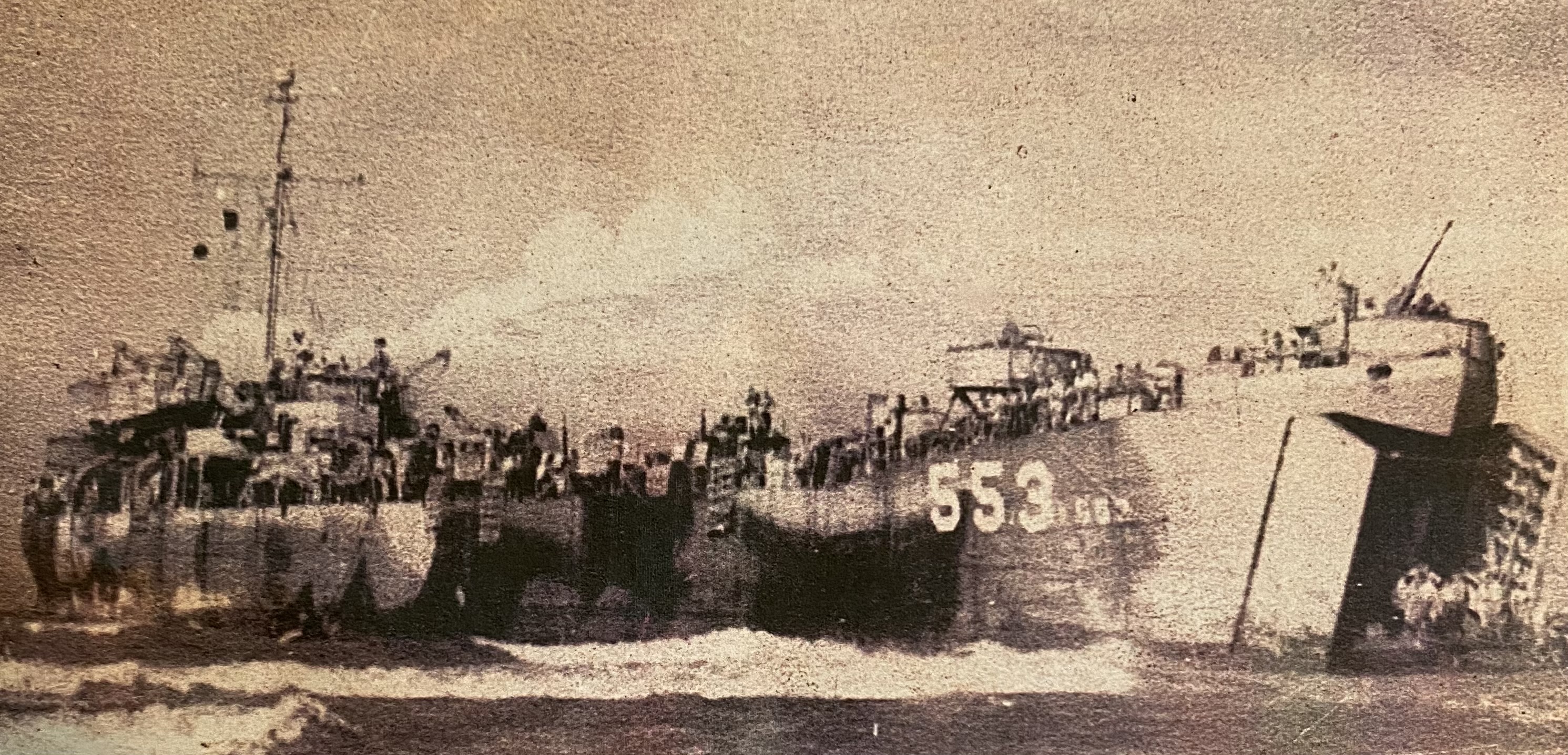
That was the main purpose of the ship that I was assigned on. It was called a landing ship, tank, an LST, and they were all numbered. They never had no names. Mine was 553. I was with it all through the war. It was camouflaged brown and green. You know why? Because when we boarded that ship in Evansville, Indiana, where it was built, we seen that ship was all in tropical colors. Tropical! We knew right then and there that ship was going to be assigned to the Pacific Theater, not European, because once that ship beaches, it blends with the foliage on that island.

They taught me how to operate the Higgins boat, and I was in charge of the Higgins boat on our ship when we made the landings. I was a seaman first class then. I don’t know why I was picked, but they came and asked me if I’d like to do that, and I said, “Why not? I’m in the Navy, I’ll do what I can.” And I operated that landing craft all through my landings in the Pacific. …

Gutman’s LST, a landing ship, tank

After they trained me, I went to San Pedro [in Los Angeles] and Hawaii, I used that boat a lot to take people to shore, back and forth. So I was trained all along with it, you know what I mean? It only had one propeller. You had to watch the wind and currents. Well anyway, they trained me pretty well.

We only had two Higgins boats on our ship, one to starboard and one on the port side. I had the one on the port side. [As coxswain] I was in the stern. I always had to watch where I was going. These Marines and Army men we had in there, they’re all hunkered down. I had to see where I’m going, you know. I had to stand because I wanted to see where I was going, because the bow doors were up pretty high. It had a diesel engine, very noisy, and it always smelled awful. But we were young guys, we could take it. We were all young, full of piss and vinegar, and no brains.

Getting smooched by The Magnolia Sadies, a vintage dance troupe, on May 8 at a V-E Day picnic honoring World War II veterans in Macungie Memorial Park

They shipped a crew of us to Evansville, Indiana, where we picked up our ship. It was built there, right alongside the Ohio River. We boarded that ship in April 1944. The skipper took her down the Ohio River, the Mississippi River to New Orleans. That’s when the ship was commissioned. We stayed in New Orleans for four days, taking on supplies – water, fuel. Then we headed back down the Mississippi to the Gulf of Mexico.

While in the gulf, the skipper put the ship through what is called a shakedown cruise. A shakedown cruise consists of testing all the components of that ship – the navigation equipment, all the guns were working properly, checking out the fire system we had, the fire hoses, check everything to see that that ship was ready for combat. From there we went to Panama City, Florida, where they taught us how to distinguish all types of shipboard fires we might encounter in combat. We were there about four days.

From there, we went to Gulfport, Mississippi. We were there to pick up creosote pilings. They were large logs, about 18 foot long and 2 foot wide. We wondered, what the hell is this gonna be? They loaded them on our tank deck. We went through the gulf and the Panama Canal with about seven other LST’s. And we we went up along the coast to San Diego, 108 men and eight officers. … We enjoyed liberty there. We were there maybe three or four days. We took on more supplies. We also took on a contingent of Seabees.

We left San Diego with a fleet of ships going due west. The skipper was on the P.A. system and he said, “We are now heading for Pearl Harbor.”

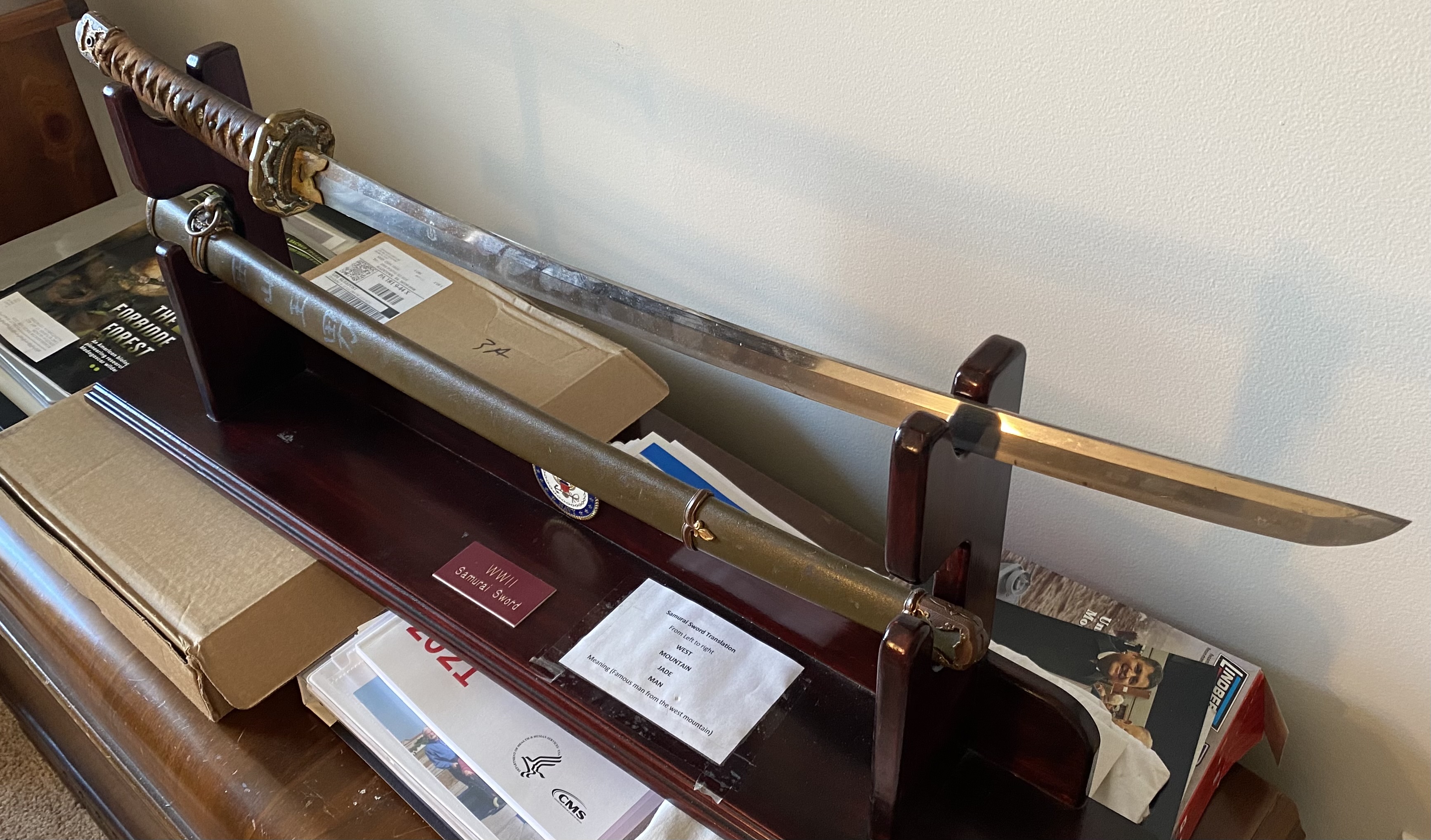
A sword and scabbard Gutman took from a Japanese officer after the surrender. ‘Sir, you will not need this any longer,’ he told the man while helping to disarm enemy troops on a Pacific island.

When we entered Pearl Harbor, we could still see a lot of the destruction that took place when they [the Japanese] bombed that harbor. We then found out that these creosote pilings, along with the Seabees, were brought there to repair the docks and ships that were destroyed in the bombings. We were there maybe about a week. We enjoyed liberty. A lot of guys got drunk, got pie-eyed. I think I had a couple of beers. We had a lot of fun. I guess the skipper wanted us to have fun.

We knew from there, God only knows where we’re gonna go.

In September 1944, Gutman landed Marines on Peleliu in his Higgins boat under fire. He went on to take troops ashore at four sites in the Philippines and at Okinawa. At war’s end, he and some others on his LST volunteered to sweep pressure mines that U.S. planes had dropped in Japanese harbors. For “the personal danger involved,” he was awarded a Navy Commendation Medal. Back home, he had active duty in the Reserve as an instructor and recruiter, retiring in 1967 as a chief petty officer.

He was more than a distinguished veteran and the subject of several stories I wrote for the newspaper over the past few years. He was my friend.

A newspaperman/soldier on the Mexican border

Clarence J. Smith in 1918

It’s the spring of 1916, and there’s talk of war with Mexico. National Guard troops leave Pennsylvania to protect the border. One of their officers is the city editor of The Morning Call in Allentown, who aims to keep the folks back home informed. Captain Clarence J. Smith, quartermaster of the 4th Infantry Regiment, sends stories about how the soldiers geared up for duty and managed camp life in the west Texas desert.

The Guard call-up stemmed from a March 1916 raid on Columbus, New Mexico, by Mexican bandits under Pancho Villa that left 17 Americans dead. President Woodrow Wilson ordered a punitive expedition led by Brigadier General “Black Jack” Pershing and sent more than 100,000 Guardsmen to the border. They included three companies from Allentown and neighboring Bethlehem that were part of the 4th Regiment, 7th Division. (It was reorganized as the 28th Division in 1917.)

The assembly point for the Pennsylvanians was an old cavalry site 32 miles east of Harrisburg called Mount Gretna. Smith wrote his first dispatch after the Lehigh Valley companies and the 4th Hospital Corps arrived there on Saturday, June 24.

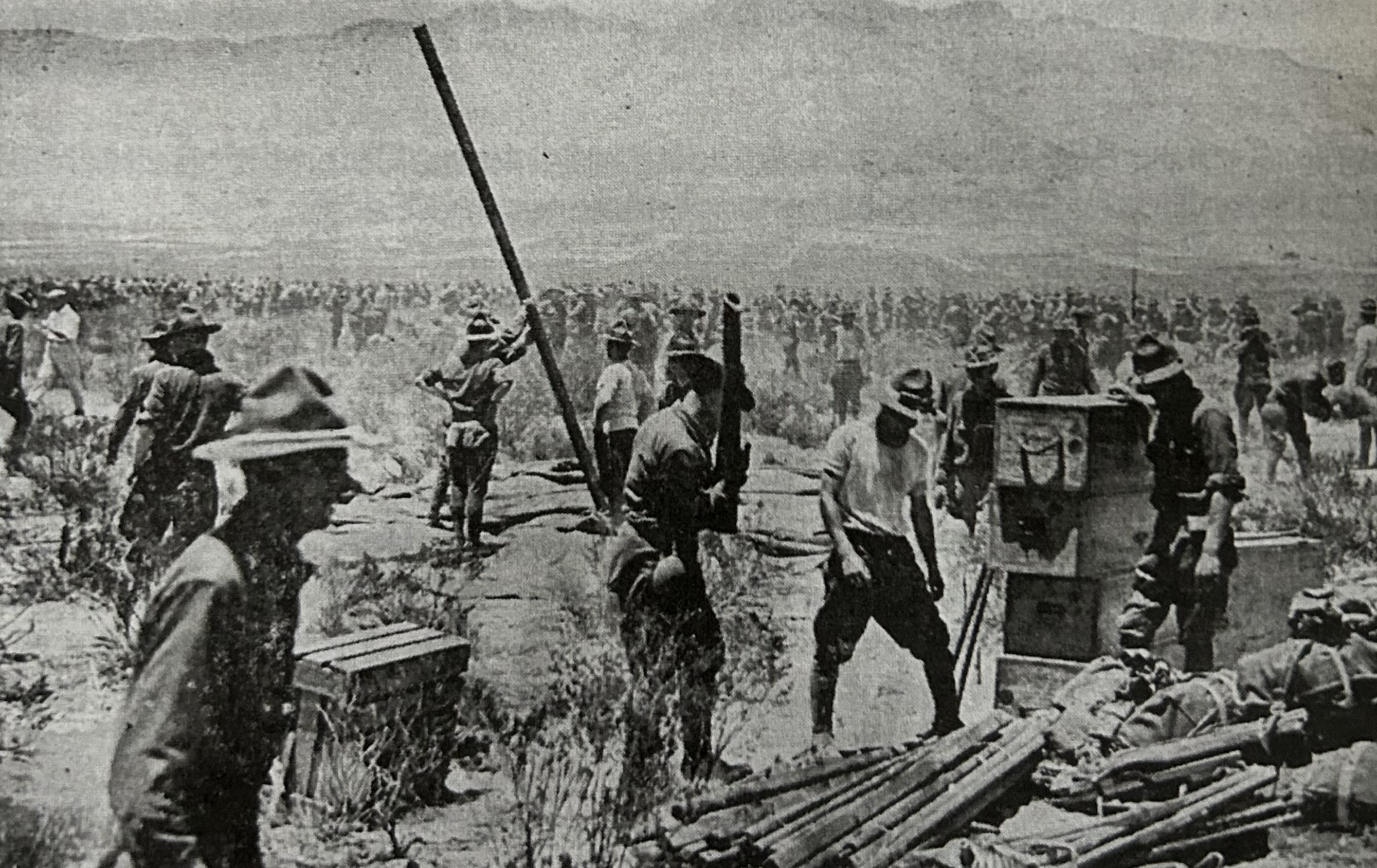
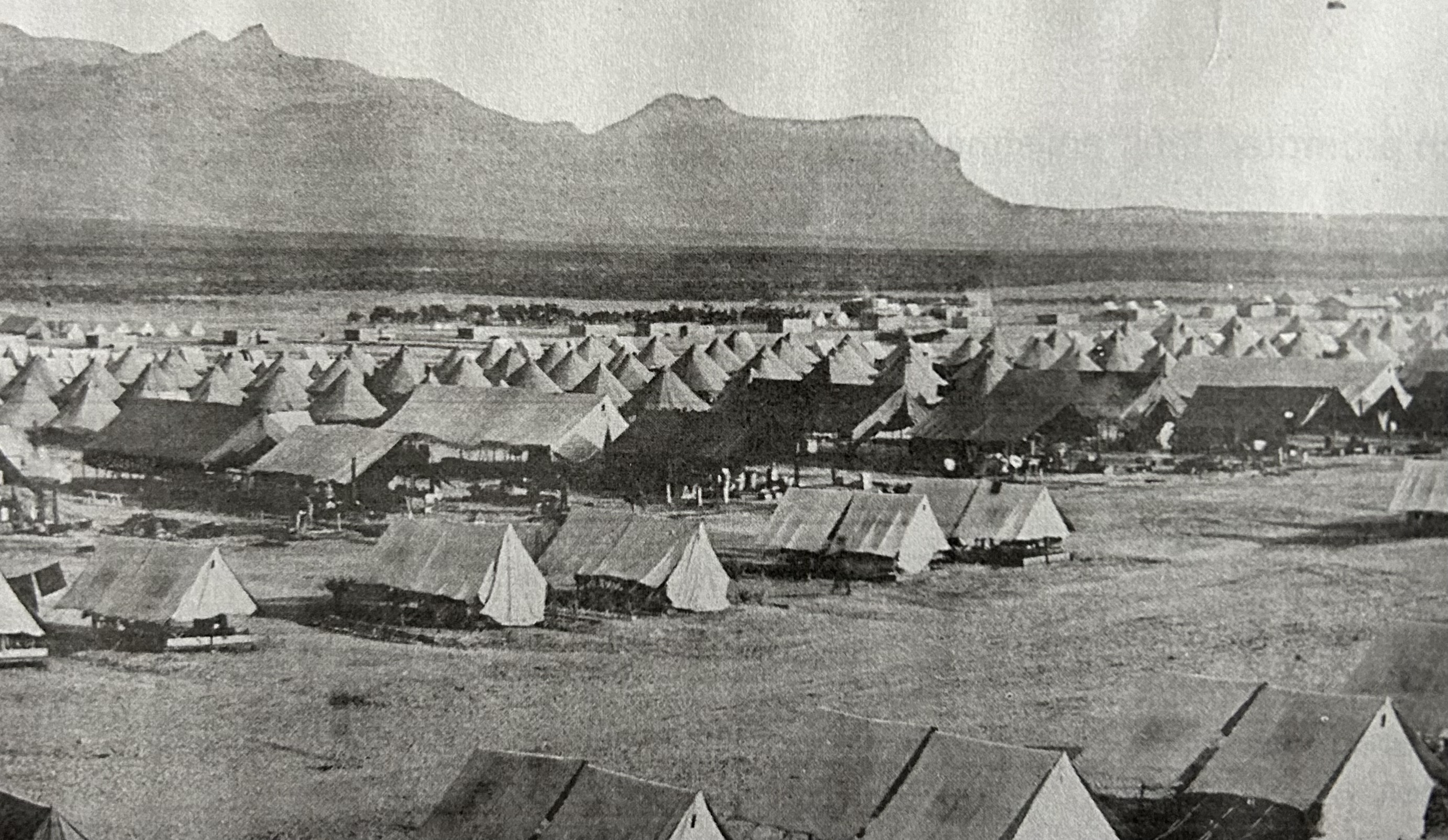
“Arriving at Camp Stewart”: Pennsylvania Guardsmen set up camp outside El Paso, Texas.

The first night in camp … was one that would test the mettle of the most active soldiers. This regiment arrived in camp under a hot June sun and spent the afternoon on Saturday going to work at housekeeping. A total absence of horses and mules necessitated the men carrying all baggage from the troop train, and it was a tired bunch of soldiers, half in khaki and half in civilian dress, that turned in to sleep. …

The spirit of the men in camp in the last few days in the face of absence of clothing, blankets, etc., with its soggy tents and muddy fields, is most commendable, and every detail for duty is responded to with alacrity.

Several days later, Smith wrote:

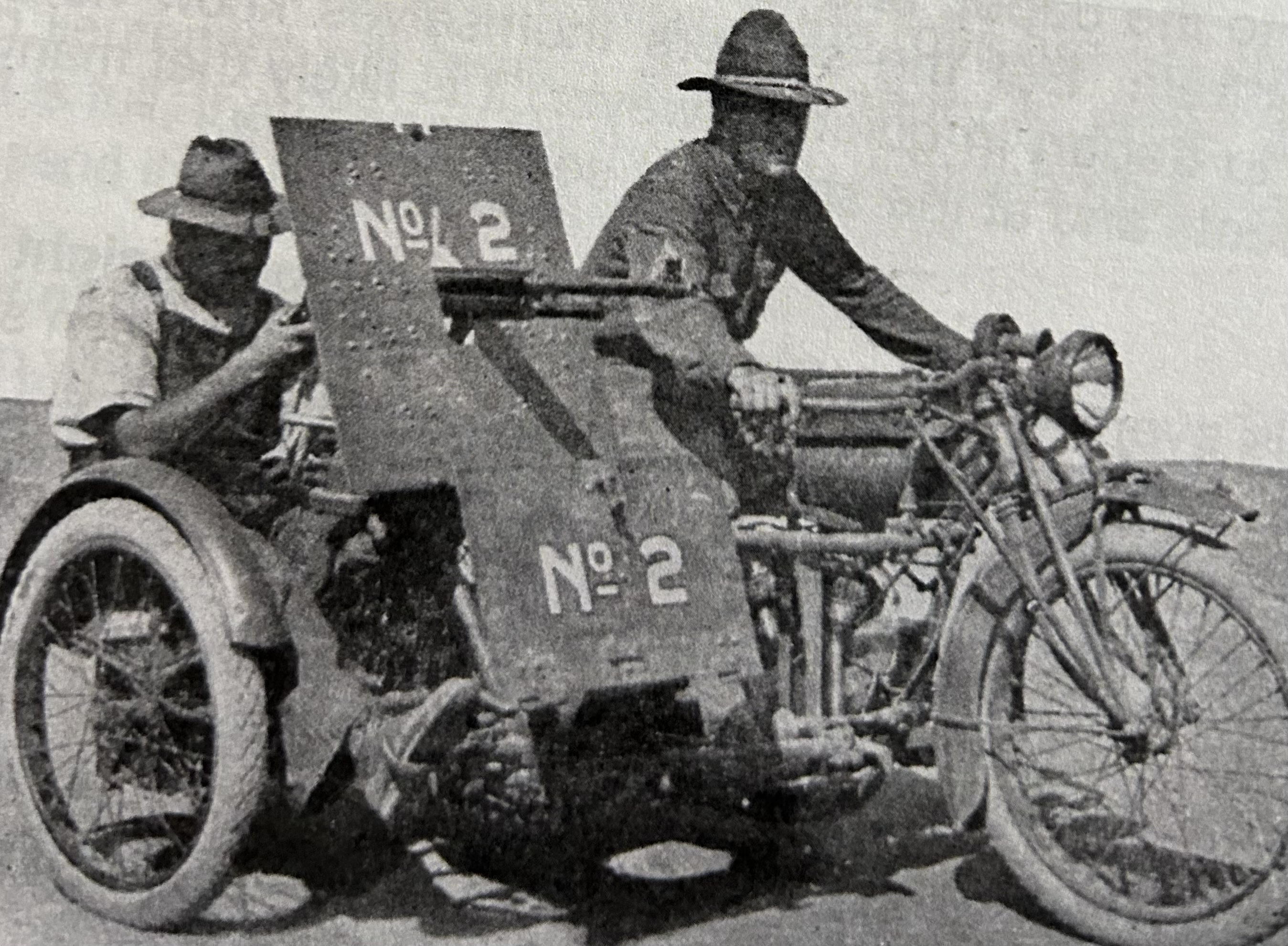
“Machine gun motorcycle”

Orders were received at noon by the medical officers, and immediately all were at the hospital to rush vaccination of the men and the inoculation against typhoid fever. … All of the men stood this ordeal with fortitude. …

Much of the time Sunday and Monday was occupied with putting the camp into the best sanitary condition, and it fell to the lot of many a “rookie” newly enlisted man to wield a pick and shovel while other details swung an axe so that the cooks might have the sort of fires that would ensure meals on time.

The mess tents being in use as sleeping quarters for the new men, the members of the regiment line up for mess with their meat pans and tin cups, taking his turn in front of the cooks and receiving the share of the mess.

Everyone is ready when meal time comes, and when the cooks call out “Come and get it,” there are no laggards. The men eat their meals seated about on the sod, and a heartier bunch of appetites it would be hard to find. The ration issue is excellent, and the men are being fed well.

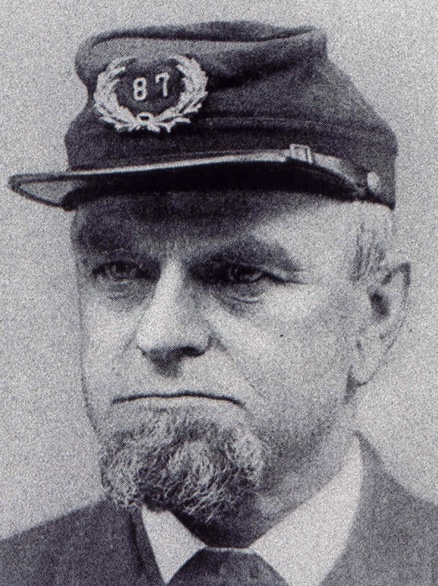
Ignatz Gresser

On Saturday, July 8, the men of the 4th Regiment left for El Paso, the Texas town on the Rio Grande. Before boarding the train, as they were drawn up in company formation at their Mount Gretna campsite, a Civil War hero arrived to see them off.

This was Ignatz Gresser, a German immigrant, Allentown shoemaker and Medal of Honor recipient for bravery during the 1862 Battle of Antietam.  After serving in the Allen Rifles, a “First Defenders” company, he signed up as a corporal in Company D, 128th Pennsylvania Infantry. He got the medal for carrying a wounded comrade from the field while exposed to Confederate fire. The soldier he saved, Corporal William Sowden, went on to become a Pennsylvania congressman and saw that Gresser received the honor.

The Guardsmen gave Gresser, 80, an ovation.

At Camp Stewart in the desert on the edge of El Paso, the men of the 4th Regiment slept in tents, drilled and marched. Smith wrote for his newspaper in mid-July:

“Drivers in training near Camp Stewart”

The arrival in camp at 10:30 o’clock Monday night of Harry A. Hall of Company B and Lieutenant Robert A. Barber of Company D with two batches of recruits furnished a lively diversion in the two companies. …There were hearty handshakes and congratulations. …

With the arrival of the recruits, Company B has 111 men in camp and Company D, 103. Several other companies of the regiment have their full quota of 150 men. Easton, Lancaster and Pottsville and others are much nearer the 150 mark than Allentown, though it must be remembered that Allentown has two companies in the regiment, while the other cities excepting Reading have but one company. …

Camp Stewart at El Paso, 1916. The Franklin Mountains are in the background.

The men of the regiment who have not been detailed on special duty handling the supplies, helping the cooks, etc., have been put to drill under the noncoms and are rapidly picking up the rudiments of what all here are beginning to realize is an exact science. … The handling of supplies is a slow job with the few horses and heavy roads for the motor trucks to plow through.

In mid-September, a Morning Call story probably penned by Smith noted “each day’s program is bringing to the men more of the real soldier’s life in the way of being schooled to withstand the rigors of the march and how to take care of one’s self in the field. Monday, the men of the 3rd Brigade, composed of the 4th, 6th and 8th regiments, hiked off into the desert for a dozen miles equipped for field service and accompanied by the wagon trains. Many men were compelled to fall out of the line due to the heat and fatigue, and were brought back to camp in the escort wagons.”

“On the march”

Months passed without trouble from across the Rio Grande. But on Christmas Day 1916, a tremendous gale hit, “driving the sand before it with a velocity that cut the face like a whiplash and tearing tent after tent from its fastenings and scattering the personal effects of the soldiers broadcast,” according to another Morning Call report probably written by Smith. It was the worst storm the troops faced.

Two weeks later, the Guardsmen pulled out of El Paso and headed north to be mustered out of service.

“Not since the Allentown troops returned from the Spanish-American War in 1898 was there such a demonstration in this city as yesterday, when the local companies of the 4th Regiment returned from Texas, where they had been for nearly seven months,” the paper crowed on January 15, 1917. “Bands played, flags waved, and the crowds cheered as the soldiers marched up Hamilton Street to Twelfth.”

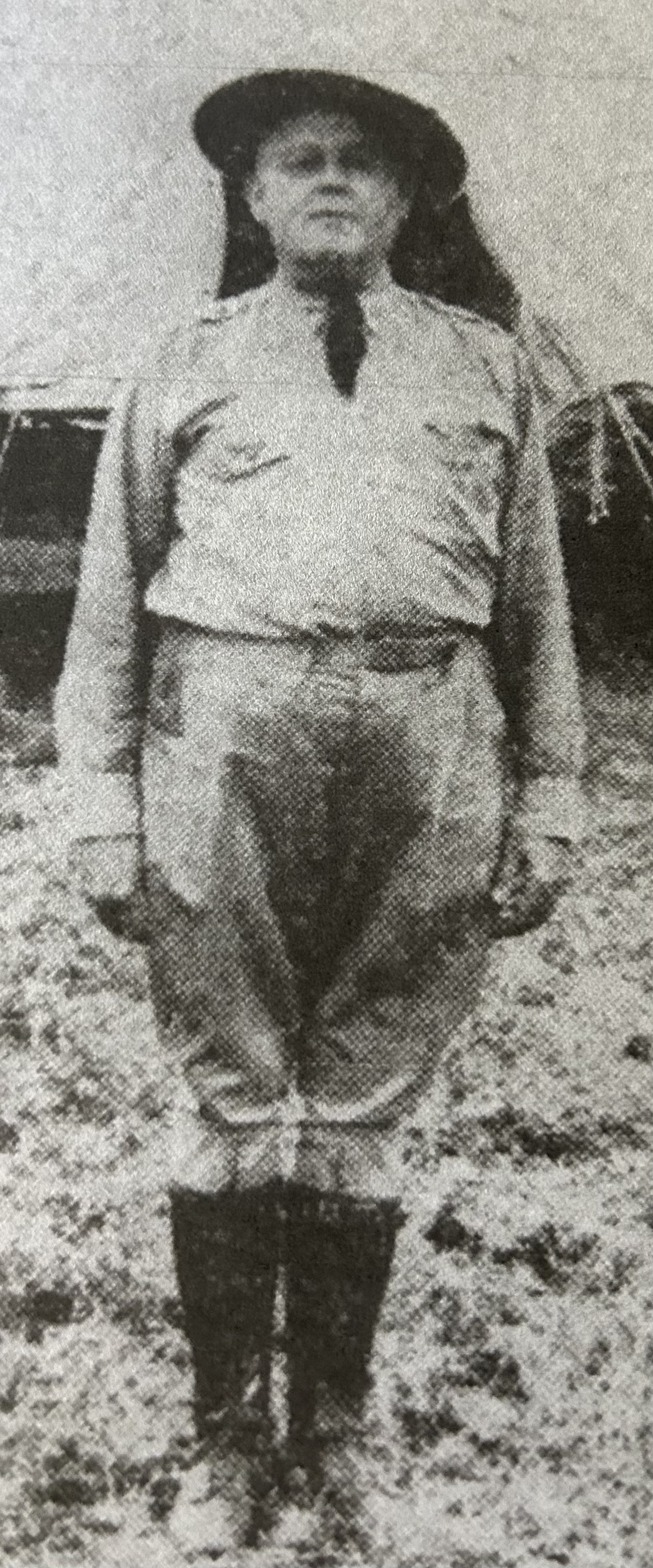
Colonel Smith in 1938

Awaiting many of them was the First World War, which had broken out across the Atlantic two-and-a-half years earlier. Smith would have a role in France as commander of a 28th Division rail unit, the 103rd Ammunition Train. He would go on to become the first commander of the Pennsylvania National Guard’s 213th Coast Artillery Regiment (Anti-Aircraft), descendant of the 4th Regiment.

Born in Easton, Smith had joined the Guard in 1898 after the battleship USS Maine blew up in the harbor at Havana, Cuba, a cause of the war with Spain. He retired as a colonel in 1938 and died two years later in Allentown, revered as an outstanding citizen. The former reporter, editor and publisher was 66.

My main source for this blog is the 213th Regiment booklet Mexican Expedition 1916-1917: History of the Allentown and Bethlehem National Guard, compiled in 2013 by retired Lieutenant Colonel Charles G. Huch. It has contemporary accounts from The Morning Call and the South Bethlehem Globe, and photos from Volume 5 of The 28th Division: Pennsylvania’s Guard in the World War, published in 1923. I’m using some of those photos here, with their original captions in quotes.

Charles G. Huch

Huch was a 1952 graduate of Lehigh University, an Army veteran of the Korean War and a longtime Bethlehem Steel employee. He died on the last day of 2020 at age 92.

Alpha Company medic recalls Vietnam ‘mutiny’

One of the most controversial episodes of the Vietnam War was the reported mutiny of U.S. troops in the summer of 1969. It involved soldiers from the Americal Division’s 196th Light Infantry Brigade.

Fred Sanders is interviewed by a CBS News crew about an Associated Press report that soldiers in his unit refused to obey an order.
(Courtesy of Fred Sanders)

Over the last dozen years, I’ve had contact with several GIs who had direct knowledge of the incident — battalion commander Bobby Bacon, trooper James Dieli and artillery officer Alan Freeman — and wrote blogs about what they told me.

Now I have another, Fred Sanders. He was a medic with Alpha Company, 3rd Battalion, 21st Infantry Regiment – the unit involved.

“There were five guys. It was a very unfortunate thing that was not a mutiny,” said Sanders, who is 78 and lives in South Carolina. He told me that in media interviews at the time, “I gave them a good report so they wouldn’t say that the men did anything that was less than honorable.”

The trouble started when the battalion commander, Lieutenant Colonel Eli Howard, sent the company to the Americal base at Chu Lai for a stand-down. The men got into a brawl with another unit.

“Colonel Howard blamed the entire company. He said if they want to fight, I’m going to put them out there and let them fight.”

Alpha Company got orders to clear North Vietnamese Army troops from bunkers and trenches in the Song Chang Valley, about thirty miles south of Da Nang. The troops had deadly encounters with the enemy, who were at the base of a ridge.

Sanders was an Army medic in Vietnam until his tour ended in March 1970.

“We lost about half of our men killed in action or wounded,” said Sanders, who was in the 1st Platoon.

At one point, arrangements were made to evacuate a freelance photographer, Ollie Noonan, who was with them. A helicopter carrying Howard and others arrived August 19 to take him aboard and bring him to LZ Center, site of the battalion command bunker.

“I was the last person who spoke with Ollie before he got on Howard’s helicopter,” Sanders said. “He said, ‘Doc, take it easy. Be careful.’ I said, ‘Ollie, we’re in a very bad place here.’

“Ollie slapped me on the back and ran out to get on the helicopter. I went to the edge of the clearing and made hand signs repeatedly to Colonel Howard and the chopper crew not to try to fly over the knoll ahead, but to return the way they came in. I stood watching Howard with his arm over the pilot’s shoulder, pointing toward the knoll and repeatedly gesturing.

“I knew if he went that direction, he was going to get shot down. There was a .50-caliber gun somewhere on that hill that he would be flying directly over. Howard wanted to go that way because there was small-arms fire in the opposite direction. The small-arms fire was a better risk than going over the .50-caliber position.”

The chopper was shot down over the hill and crashed in a ball of fire, killing Noonan, Howard and the six others aboard.

“That was a very tragic moment,” Sanders said.

Three days later, Alpha Company got orders to make what Sanders calls “a very bad move” – walk the ridge line and go downhill toward the NVA position.

As they moved down the hill, they unwittingly approached an enemy spider hole. Someone in the hole opened fire. A friend of Sanders’ from Oklahoma, Sergeant Derwin Pitts, was hit. He lay helpless and groaning.

“I was 5-6 feet from him, trying to figure how I could pull him back. He was in an exposed position. I knew if I crawled there, they’d kill me also.”

Sanders knew he couldn’t leave Pitts there. Just then, Private First Class Ray Barker came up and said, ‘Doc, you’re not going to do it,’ and crawled past Sanders. Immediately he, too, was shot. Both he and Pitts were dead.

A man off to Sanders’ right was shot and suffered a sucking chest wound. Sanders tended to him. He and two others knelt beside the man and prayed for him as they waited for a medevac.

They were in a small clearing on the ridge line. The helicopter came and took the wounded man, rising straight up. Sanders turned and tripped over a fallen tree. “Where’d that come from?”

One of the men with him answered, “Doc, didn’t you see that?” A rocket-propelled grenade had been fired at the helicopter as they were loading the man onto it. The RPG missed and felled the tree, which landed just a few feet away.

By August 25, after five days of fighting, the company was down to half of the 95 troopers who had come to the valley, Vietnam War writer Keith William Nolan wrote in his 1987 book Death Valley. Eight men had been killed.

The new battalion commander ordered Lieutenant Eugene Shurtz Jr. to lead his men down into the valley to recover their dead, including the bodies from the helicopter crash. Shurtz was new to the unit.

“I am sorry, sir, but my men refused to go – we cannot move out,” Shurtz radioed Lieutenant Colonel Bobby Bacon at the battalion command post, according to a dispatch filed by Peter Arnett and Horst Faas of The Associated Press.

“Repeat that, please,” Bacon said. “Have you told them what it means to disobey orders under fire?”

“I think they understand,” the lieutenant replied, “but some of them simply had enough – they are broken. There are boys here who have only 90 days left in Vietnam. They want to come home in one piece.”

Bacon told Shurtz to leave the unwilling men on the hill and “move to the objective.” He then ordered his executive officer and a sergeant to fly in and give the men “a pep talk and a kick in the butt.”

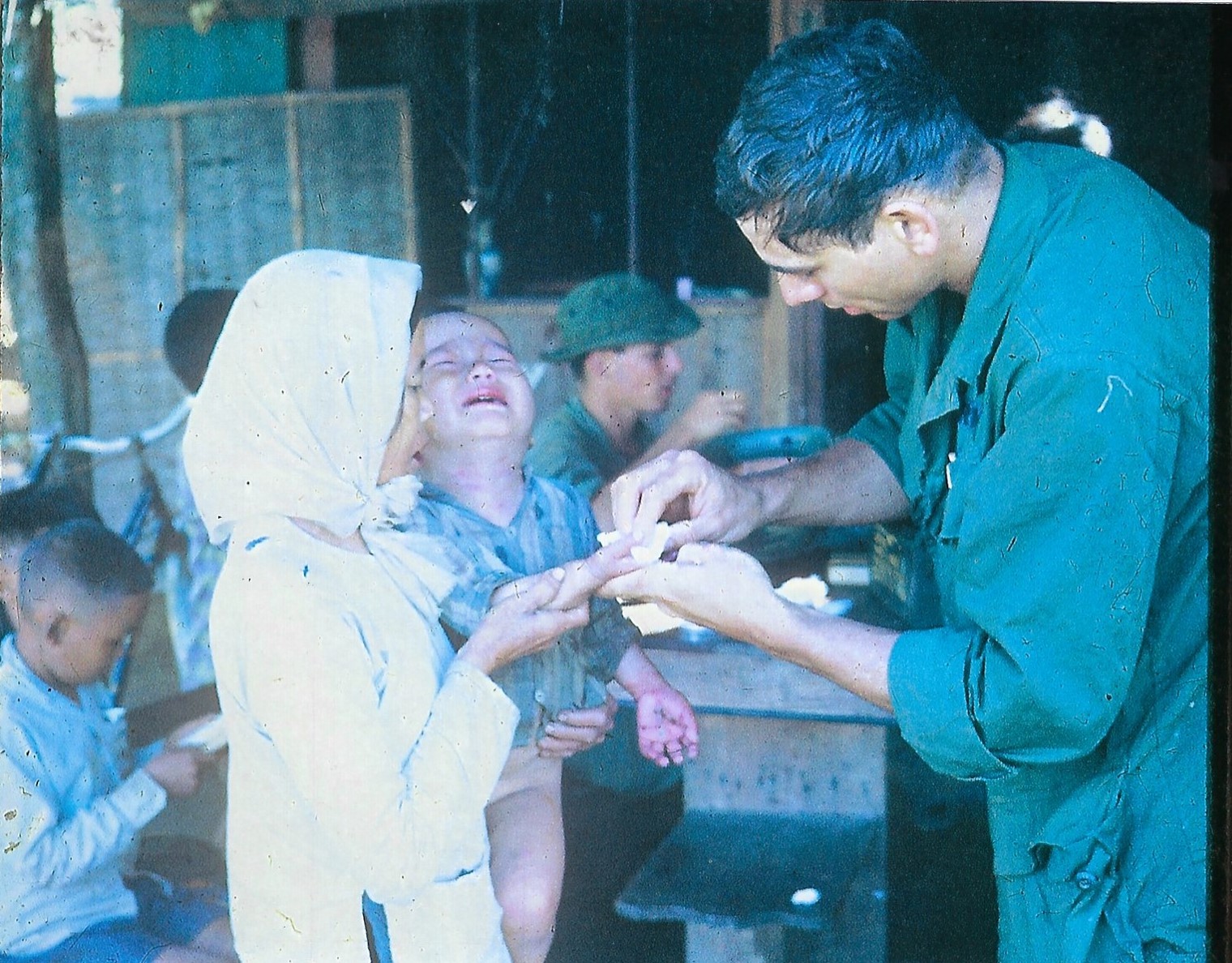
Sanders treats a child with a skin infection at a Vietnamese hamlet.

Sanders remembered that five GIs balked at walking down to the foot of the ridge.

“I walked around and talked to the fellas. They were very distressed and run-down. I told them: I’m with you. I’m your medic.”

He said they were afraid they’d be sitting ducks for the North Vietnamese. It seemed like suicide. But none of them said they weren’t going to go, according to Sanders. No one wanted to be court-martialed. They just didn’t want to do something stupid and get themselves killed.

“They were bargaining for time to see if they could negotiate going another way, a different maneuver.”

When Sergeant Okey Blankenship arrived from battalion headquarters, “The guys were saying: I hope you don’t think we don’t want to go. We just don’t want to be killed for no sensible reason.”

Blankenship told them, “You’re soldiers. You’ve got to do what you’ve got to do. Brace up and carry on.”

When the sergeant finished his talk, everyone was quiet, Sanders said. The men started packing up their gear, getting ready to move out. As it turned out, the NVA were no longer at the base of the ridge. They had withdrawn from the area.

Faas and Arnett’s report landed atop Page 1 of the next day’s New York Times under the headline, “Told to move again on 6th deadly day, Company A refuses.”

Sanders said he was interviewed by the Times, Newsweek, Time magazine and CBS. “I would not say anything to discredit the unit,” he told me. “I was aware that news outfits can slant the news.”