Tag Archives: military

‘Finally I came to the question I dreaded to ask’

During World War II, Max Snider provided the gasoline for tank commander George S. Patton’s army in Europe. Twenty-six years ago, the freelance writer and retired associate dean of Lehigh University’s College of Business and Economics sent me this story he wrote. It’s about his role in clearing a soldier’s marriage after the war had been won.

Colonel Max Snider of the Allentown (Pa.) Army Reserve Officers School on his retirement from teaching there in 1966
(Newspapers.com)

In about mid-September 1945, I found in Army mail brought to my battalion headquarters in Liege, Belgium, orders that the Army had appointed me to interview a young Belgian woman living with her mother, a widow, on a small farm a few miles outside Liege. An American soldier had requested the required Army permission to marry the daughter. These orders demanded that I fill out an elaborate questionnaire, designed by some Army personnel type, and make a mandatory decision as to whether I would recommend approval or disapproval of the marriage. The soldier’s Army record was detailed. He was 21 years old and had served as a private first class infantry rifleman who landed on D-Day in Normandy at Utah Beach, fought his way through the campaigns of Normandy, Northern France, Ardennes (Battle of the Bulge), Rhineland and Germany and somehow managed to suffer only two minor wounds. I marveled at the awesome control of our Army over this soldier — to intrude into the most intensely private and personal issue of approving or denying his marriage.

At this time, I was a 30-year-old lieutenant colonel in command of a battalion headquarters. I had served in the headquarters of General Patton’s 3rd Army in charge of gasoline through the campaigns of Normandy, Northern France and Rhineland. It was my job to travel by jeep from the 3rd Army headquarters to as near the front lines as we dared to set up gasoline dumps and supervise their operation. The United Nations had won the war in Europe and in Japan. We waited impatiently to return home. The horrors of the war were still fresh in my mind. In my nightmares, I re-enacted them — the ancient stone houses of Sainte-Mere-Eglise in Normandy that had housed many generations of French families reduced to rubble, the wan and hungry children, the dead soldiers and the dying soldier crying for his mother in an Army hospital during my 10-day confinement there in Nancy, France.

The Army furnished me with a staff car and driver and a translator who could speak the French dialect of the Belgian Walloons and turn it into heavily French-accented English. The translator, skinny, poker-faced with a cadaverous complexion, smoked a huge pipe almost as big as a saxophone. He had stuffed his pipe with a minimal amount of tobacco, still in short supply in Belgium after the war, but if you judged from the odor of his pipe, the biggest portion in his pipe bowl was dead leaves. I dreaded this whole operation, especially asking all the personal questions. One of them even asked the bride-to-be whether she was pregnant.

Our driver drove us to a modest cottage in the center of four or five acres of farmland. A basket of apples and two pumpkins rested just outside the front door. A light rain had stopped, and the sun came out just as an apron-clad and apprehensive farm wife answered the door. The translator told me that she was expecting us and knew why we came.

In an effort to ease the tension, I remarked, “I’m glad you turned off the rain for us.” She managed a feeble smile and introduced her equally fearful daughter, a beautiful young woman dressed in a simple blue dress accenting her blue eyes. My voluminous instructions had told me she was 18 years old. Her innocent and shy demeanor left me ill at ease when I thought of the questions I must ask her.

During the long process of questioning, slowed by the necessity to use French, both mother and daughter sat nervously on the edges of their chairs. I learned both of the young people grew up on farms and that they planned to live with the soldier’s parents temporarily on a large farm in Iowa — the translator pronounced it “E-oh-wah” — until they had their own house.

Finally I came to the question I dreaded to ask: Is the soldier’s fiancee pregnant? I instructed the translator to ask the young woman to step out of the house until he told her to return. When she was gone, in an atmosphere thick with suspense, I posed the question to the mother. She shook her head vigorously in the negative. When the bride-to-be returned with a mystified expression on her face, she immediately asked her mother what the question was. The translator, in a stage whisper, relayed their conversation to my ear. After the mother told her the issue was whether or not she was pregnant, both women burst into laughter and shook their heads to indicate “no.” Then the mother, who suddenly seemed more relaxed, more talkative and all smiles, described how much the couple loved each other and how happy they were together.

“If you could see them together,” she said, “you would know they are very much in love.”

Snider earned four battle stars in the European Theater.
(Newspapers.com)

“I will strongly recommend approval of this marriage,” I told the mother and daughter. They laughed and embraced, and the daughter began to cry.

Reluctantly, I told them that a higher Army headquarters could overrule my approval.

“When will we hear the final outcome?” the mother asked.

“From my experience in this Army,” I replied, “it is not noted for speed in its paperwork.”

After the pleasant ending of the conversation, I left in high spirits indeed. In a world that had started two ghastly world wars only 25 years apart, this brave soldier could look forward to peace with his beautiful wife. During the drive back to Liege, I fantasized about this couple who would live on that big farm in Iowa. Their children would be bilingual, learning French from their mother and English from their father, and, of course, some of them would be blue-eyed like their mother.

The End

Snider stood out in both the military and education. An Illinois native, he earned master’s degrees in advertising/marketing and business administration. From the Army’s Reserve Officer Training Corps, he became a second lieutenant of cavalry in 1936. In Europe with Lieutenant General Patton’s headquarters, he rose up the ranks from first lieutenant to colonel. Three decades of service in the Reserve followed. At Lehigh University for 34 years, he was a professor and dean and co-wrote four books. Later, as a freelancer, he wrote his memoirs. He lived in rural Durham Township, Bucks County, where he died in 2012 at age 97. You can read his obituary here.

Snider sent me his “marriage approval” story in 1999 while I was working at The Morning Call of Allentown. When I retired, it came home with me along with other war stories that were offered to the newspaper but not published.

On the Home Front, for those on the Fighting Fronts

In 1944, The Berwyn Post was in its second year of publication.

It is a Page 1 roll call of 1944 casualties.

Army Air Corps Sergeant Maurice Houston, 30, son of a First World War officer, was killed in action August 12 in Indonesia. Private John McKelvey, 24, married with a toddler son, was killed on Saipan. Private First Class Edwin Benner, 19, was killed February 16 on the Anzio beachhead.

Marine Private First Class James Newman was wounded July 21 on Guam. Army Private First Class James D’Innocenzo, 22, was wounded July 26 in France. Army Corporal Angelo DiMarino of Devon, whose family and mine had a connection broken by a terrible accident, was slightly wounded in France on August 3 while in a convoy strafed by German planes.

Those casualties appear in the September 1944 issue of The Berwyn Post, a monthly tabloid published on Philadelphia’s Main Line “by Berwyn men and women on the Home Front for the Berwyn men and women on the Fighting Fronts.” The masthead notes the paper went to all graduates and students of Tredyffrin-Easttown High School in the service, by arrangement with the Paoli-Berwyn-Malvern Rotary Club. If you were in the military and a Berwyn resident or T-E grad, your subscription was free. Others in the service and civilians got the paper for a small price.

My dad graduated from Tredyffrin-Easttown in 1944 and went on to join the Coast Guard. But I’m not sure that’s how I happen to have this slightly torn eight-page issue of The Post. Still, when I found it in my file cabinet a few weeks ago, I couldn’t put it down. You can see how popular it must have been. Main Line servicemen and women all over the world were getting news from home about people they knew. They saw photos of hometown buildings and street scenes. They could read about the high school’s sports teams. They could turn to The Chaplain’s Corner for inspiration from the likes of Methodist minister Henry F. Hamer Jr., who wrote that “faith is the most precious of our possessions” and gave advice on how to keep it. On the front page, they learned what was most compelling: Who among them would not return?

The inside pages are full of chatty columns. A Mailbag takes up more than two full pages. In one typical letter, Army Corporal Norman L. Duncan writes from France: “Seems kind of tough to be in a country where most of the people are trying to be friendly and you can’t ever hold a conversation with them due to not being able to speak or understand their language. However, we are kept too busy to have any time to mingle with them. Let me tell you this sleeping in a ‘foxhole’ isn’t at all what it’s cracked up to be, especially if it is pouring rain. Food was rough for a while but is getting better every day and I don’t imagine it is going to be too tough.”

The paper printed excerpts from a letter James Newman, the Marine wounded on Guam, wrote to his mom: “[W]e descended from the transports via cargo nets into the Higgins boats and shoved off for the beach. We were the guests at this party and the host gave us a warm welcome — in fact, as hot as Hades.

“We hit the beach with mortars popping all around us, and I don’t know how we managed to dodge them and start our individual jobs. I was up with the infantry for about a week and I saw plenty of the sights that I’ve heard so much about since this war started. The infantry — honest to goodness — is the best there is, they are real artists when it comes to exterminating Japs. I saw them knock out three Nip tanks in one day and it is amazing how they all work together, calm, collected and with precision adjustment.”

This item on Larry B. Mercer ran on Page 2 of the September 1944 issue of The Berwyn Post. In the Navy, an ARM2 is an aviation radioman second class.

Navy flyer Larry B. Mercer of Berwyn got a Commendation Ribbon for “meritorious and efficient performance of duty as air gunner of a dive bomber in an attack on enemy shipping in Rabaul Harbor, New Britain Island, on Nov. 11, 1943.”

The Post ran a picture of him and the complete text of his citation. Part of it states “Mercer, by maintaining a heavy and accurate fire from his gun against large numbers of enemy fighter planes, assisted materially in repelling their assault against the bomber formations.” The four-paragraph story adds Mercer was awarded a Purple Heart for wounds suffered at Tarawa and that he was now in California awaiting his next assignment.

The Post masthead lists its editors as the Rev. Elbert Ross, William W. Eadie, Charles T. Smith, Theodore Lamborn Jr. and Joseph Kelly. In bringing the war home, and home to those in the war, they served their community well.

Angelo DiMarino, the wounded Army corporal I mentioned above, was an older brother of John DiMarino, who was engaged to my aunt Josephine Venditta of Malvern. John was killed in a B-24 training accident on April 5, 1944. I wrote about him in my December 2, 2021, blog “How a WWII bomber crash in Colorado hit home.”

A V-J Day event brings World War II vets together

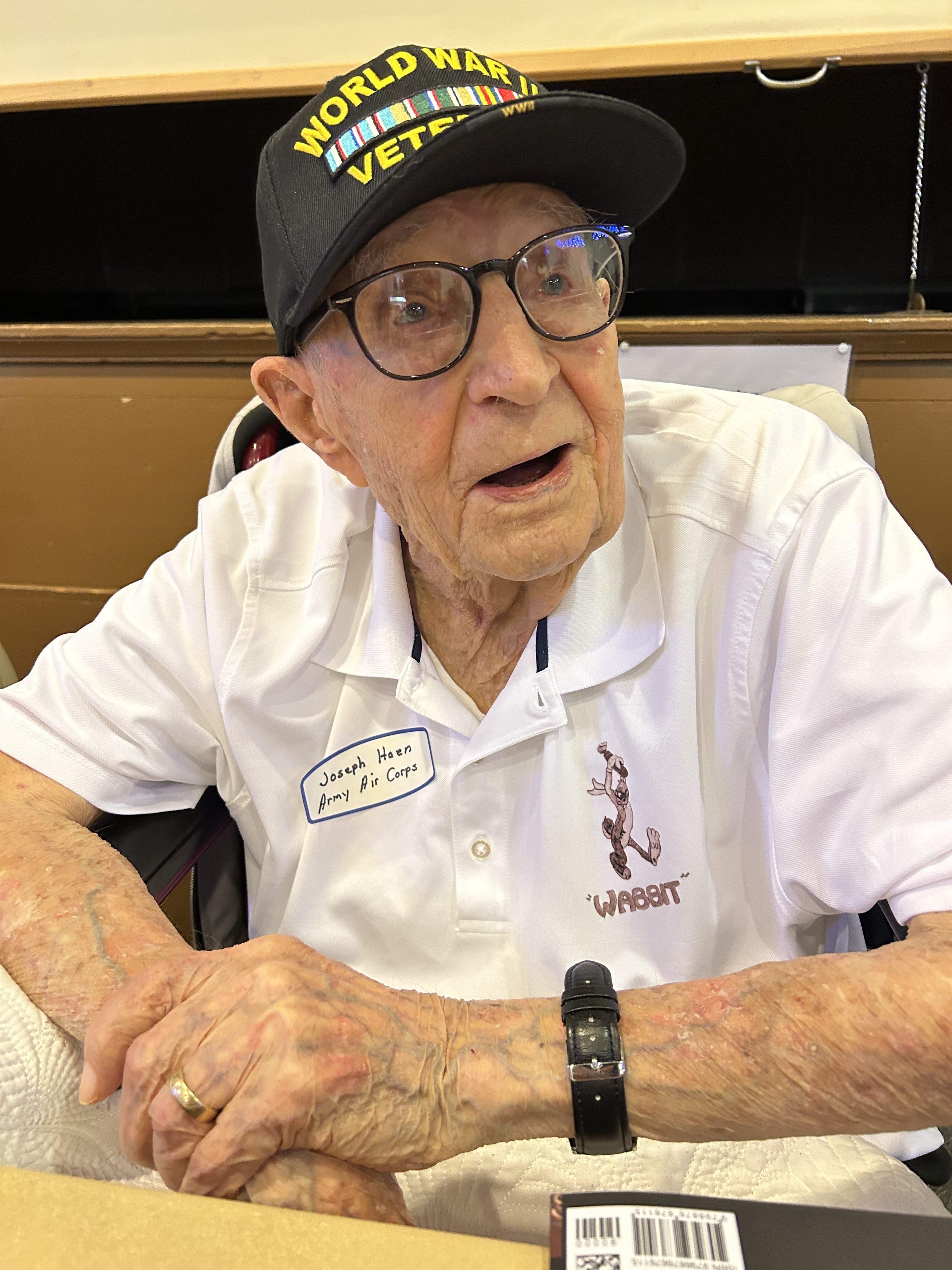
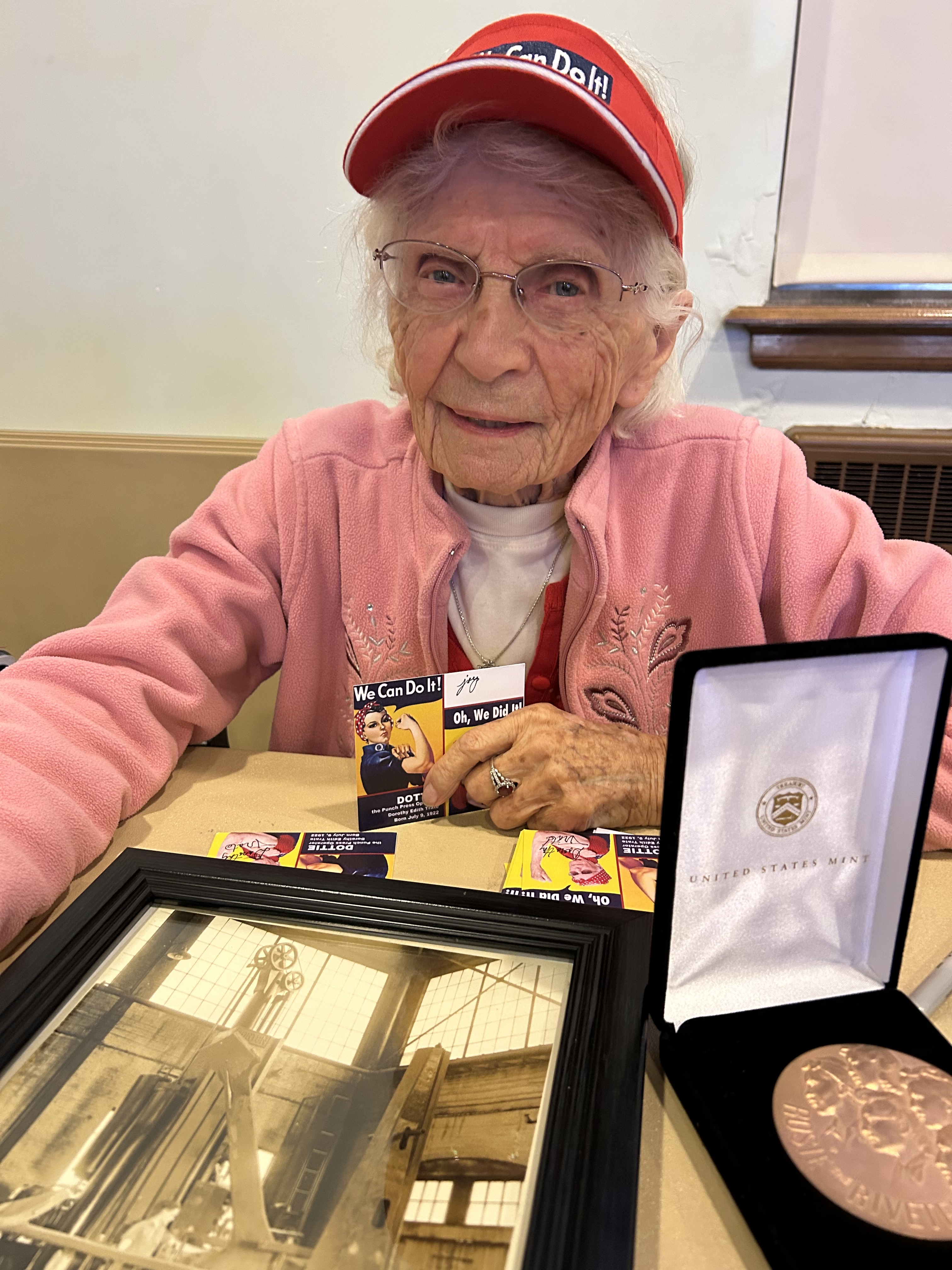
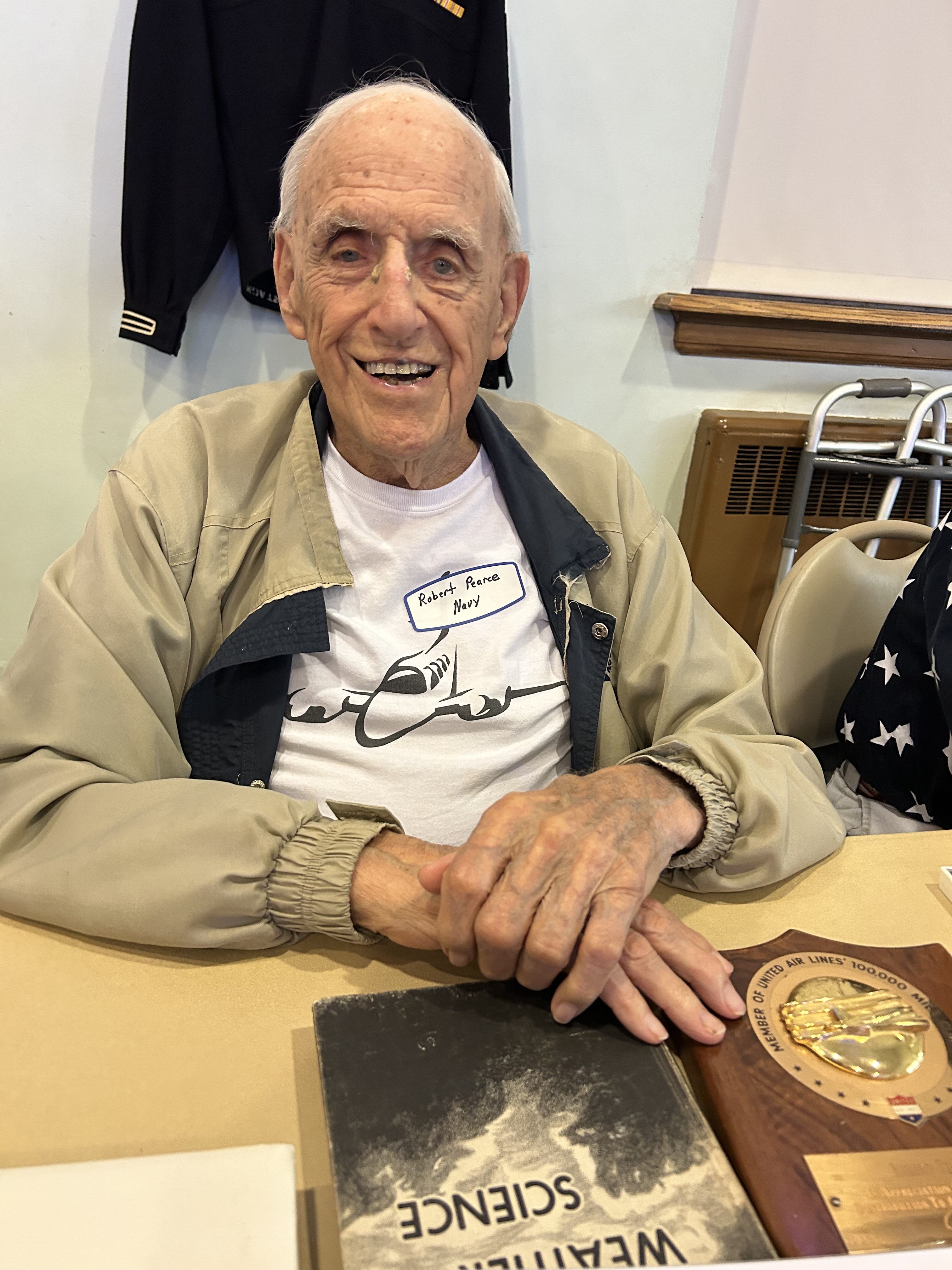
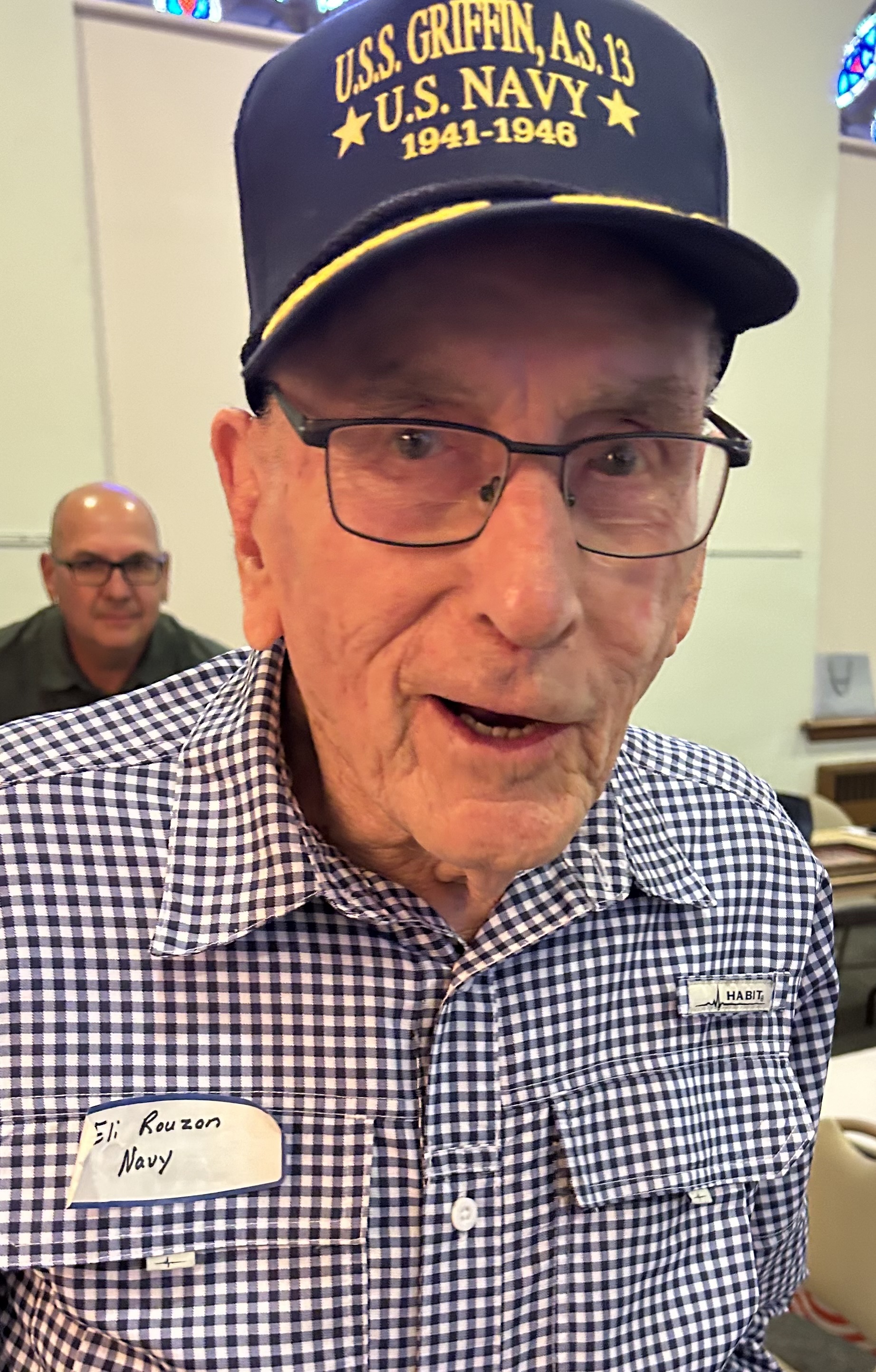
Pennsylvania World War II veterans, standing from left: Harry Bean (Army), Russell Sattazahn (Army), Frank Stellar (Army), Milton Ripple (Navy), Eli Rauzon (Navy) and Jacob Vanino (Army). Seated from left: Edward Conrad (Navy), Stanley Isenberg (Army Air Corps), Joseph Haenn (Army Air Corps), Rubino Degenhart (Army), Dorothy Trate (‘Rosie the Riveter’), William Balabanow (Merchant Marines), James Determan (Army), Edward Czechowski (Navy), and Robert Pearce (Navy).

It was a stirring sight. Fourteen World War II veterans and a “Rosie the Riveter,” all around a hundred years old and beyond, including one gentleman of 108, were gathered last Friday at a church hall in Emmaus, Pennsylvania. The event marked the 80th anniversary of V-J Day, August 15, 1945, which celebrated the end of fighting against Japan.

Besides newspaper and TV coverage, dozens of people had come to meet and talk with these last survivors of the Greatest Generation. Only about 66,000 of the 16 million Americans who served in the war are still living. About 3,900 are Pennsylvanians.

My friend Meta Binder of Lehigh Valley Chapter 55 of the Battle of the Bulge Association had organized this salute at St. John’s Lutheran Church. The group’s president, another good friend, Steve Savage, had flown up from his new home in Florida to be there. Most of the honored guests had been gathered by 21-year-old Albright College student Tyler Boland, who has interviewed hundreds of World War II veterans so their stories will live on.

The vets were entertained with songs and dancing from the 1940s. A 10-year-old boy, James Papalia, who has written several books about a kid’s journey through time to World War II battles, read from his work.

I didn’t manage to speak with all of the vets. Here are the ones with whom I had that honor:

Haenn

Joseph Haenn of Telford, Montgomery County, at 108 is the oldest World War II veteran in Pennsylvania. An assistant crew chief in the Army Air Corps, he worked on B-24 Liberators with the 8th Air Force’s 467th Bomb Group in England.

Determan

James Determan, 102, of Lititz, Lancaster County, served with the Americal Division’s 182nd Infantry Regiment at Leyte Gulf and Cebu in the Philippines. He carried a Browning automatic rifle and was awarded a Bronze Star.

Czechowski

Edward Czechowski, 100, from Reading, was a gunner on the destroyer USS Saufley in the Pacific, including Iwo Jima, Guam, Leyte Gulf and Okinawa. He received a Silver Star for blowing apart a kamikaze as the Japanese plane was about to hit his ship.

Sattazahn

Russell Sattazahn, 99, from Schaefferstown, Lebanon County, served with the 1st Infantry Division. In March 1945, he was severely wounded in Germany. He received two Bronze Stars and a Purple Heart.

Trate

Dorothy Trate, 103, from Narvon, Lancaster County, was a punch press operator at the Doehler-Jarvis plant in Pottstown, which built parts for warplanes.

Bean

Harry Bean, 99, from Norristown, was a bazooka operator with the 351st Infantry Regiment, 88th Infantry Division, who fought the Germans in Italy.

Pearce

Robert Pearce, 102, of Lower Macungie, Lehigh County, was a Navy weatherman with Fleet Air Wing 10 on Palawan in the Philippines. He went “typhoon hunting” in PB4Y-2 Privateers to gather weather data.

Rauzon

Eli Rauzon, 102, of Upper Macungie was a Navy electrical repairman on the submarine tender USS Griffin and worked on subs in Australia. He went on to serve in the Air Force during the Korean War and as a contractor for the Defense Department.

It was clear these and the other vets enjoyed getting the attention they richly deserve. As Meta Binder put it for The Morning Call of Allentown, “It is extremely important for their legacy to be preserved. … Let us never forget their sacrifices.”

WWII sailor: ‘Had I been taken into the Marines …’

William J. Holmes was born in Carbondale, in northeastern Pennsylvania.

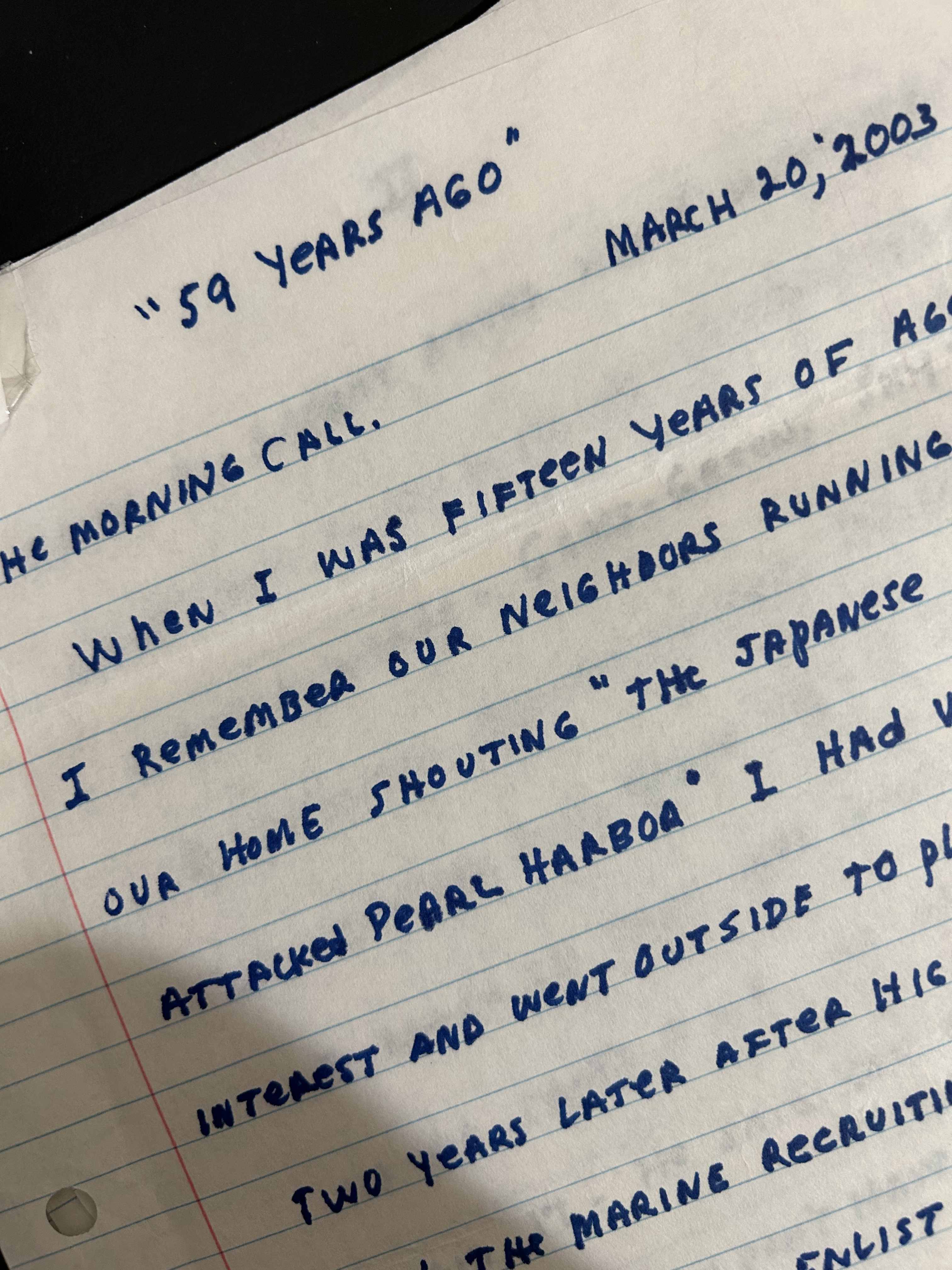
In 2003, William J. Holmes of Mertztown, Pennsylvania, wrote to The Morning Call of Allentown about his World War II service. His hand-printed, six-page letter landed on my desk. It wasn’t published, and I don’t remember calling him about it. When I retired more than a dozen years later, his letter was among the papers I took home. It turned up yesterday while I was going through my files. Here is what Holmes wrote:

When I was 15 years of age, I remember our neighbors running into our home shouting, “The Japanese have attacked Pearl Harbor.” I had very little interest and went outside to play.

Two years later, after high school, I visited the Marine recruiting office in Wilkes-Barre, Pa., to enlist, as my older brother, John, was already in the Pacific since 1941 with the 2nd Marine Division. I passed all the written tests and was asked to repeat after him immediately what came to my mind as he mentioned certain words — grass-green, sky-blue, bird-wing, hammer-board. He stopped after board and asked why I said board.

I asked if that was wrong. He replied, “No, no that’s fine.” He asked my age. I said 17. He said, “You are not 17 1/2? I told him you don’t have to be 17 1/2 to join, just 17. He said for the last month the age was raised, as too many were enlisted in the Marines and this was temporary. In anger, he said: “If you want to join something, join the Navy. They take anybody.” I immediately walked a few blocks to the post office and was surprised that I could join for two years. This was because I would be in a reserve status for two years or duration of the war.

I had boot training at Bainbridge, Md., and was shipped to Treasure Island, Calif., a few week later. We were told that we would be on our way within 72 hours. We all laughed at this, as we were getting ready for meal time at 5 p.m. … Shortly, a Marine officer flew into the barracks and said: “Pack your seabags and be ready to go.” Someone asked about our meal, and he said: “You will eat on the ship.” While going under the Golden Gate Bridge, an officer told us, “The next time you pass under that bridge, you will either cry or be choked up. (He was right.)

Our first stop was Pearl Harbor. We dropped off 200 women Marines. … Next stop Enewitok, then Saipan, Ulithi and then the Philippines. I was attached to a repair-and-supply outfit. … All damaged ships that could make it to our area were repaired. Our ship was a converted Merchant Marine cargo-carrying vessel that held oxygen and blood plasma. These supplies from the States were loaded aboard, and we made periodic runs to Okinawa and back.

When the atom bomb was dropped, and we realized we would shortly get going home, there was a point system for leaving. Who were there the longest, had the most battle stars?

While waiting for my points, a group of American civilians asked if any of us would like to be flown home right away with a 30-day leave and sign up for another year. This was for Bikini A-bomb tests. I do not know to this day why I didn’t sign, although a lot did. I believe to this day that, had I been taken into the Marines instead of the Navy and had signed the Bikini paper, I may not have gotten back.

Holmes went on to serve in the Korean War. In civilian life, he worked as a letter carrier, a security guard at Lehigh Valley Hospital and as a police officer in Macungie. When he retired in 1992, he was a security guard for Kraft Foods. He was married with two sons.

He died last April at age 97.

‘Words that reached every American heart’

Join me now for a look at a Life magazine printed six weeks after Pearl Harbor. The cover story of the January 19, 1942, issue, “North Atlantic Patrol,” was written by New York mural painter and nautical expert Griffith Baily Coale. The Navy had allowed him to sail on a U.S. destroyer escorting ships from Newfoundland to Iceland.

Another major piece dealt with President Franklin D. Roosevelt’s State of the Union address January 6. “Last week the President told the nation what it would take to win the war,” the story began. “The words he used, the figures he cited were enormous, staggering, beyond anything ever attempted by any nation on earth.”

At the time, Life was a large-format weekly that cost a dime, or $4.50 for a year’s subscription. The January 19 issue was 92 pages.

A quick aside: My Uncle Louie got the magazine and 26 other issues from a resident of an apartment complex in Malvern, Pennsylvania, where Louie did maintenance work. Louie was a proud World War II veteran – he’d been a ground crewman with the 8th Air Force in England – so he had a particular interest in periodicals from the early ’40s. After he died in 1996, Aunt Bert offered me the mags, the earliest of which is dated December 1, 1941, and the rest from 1942.

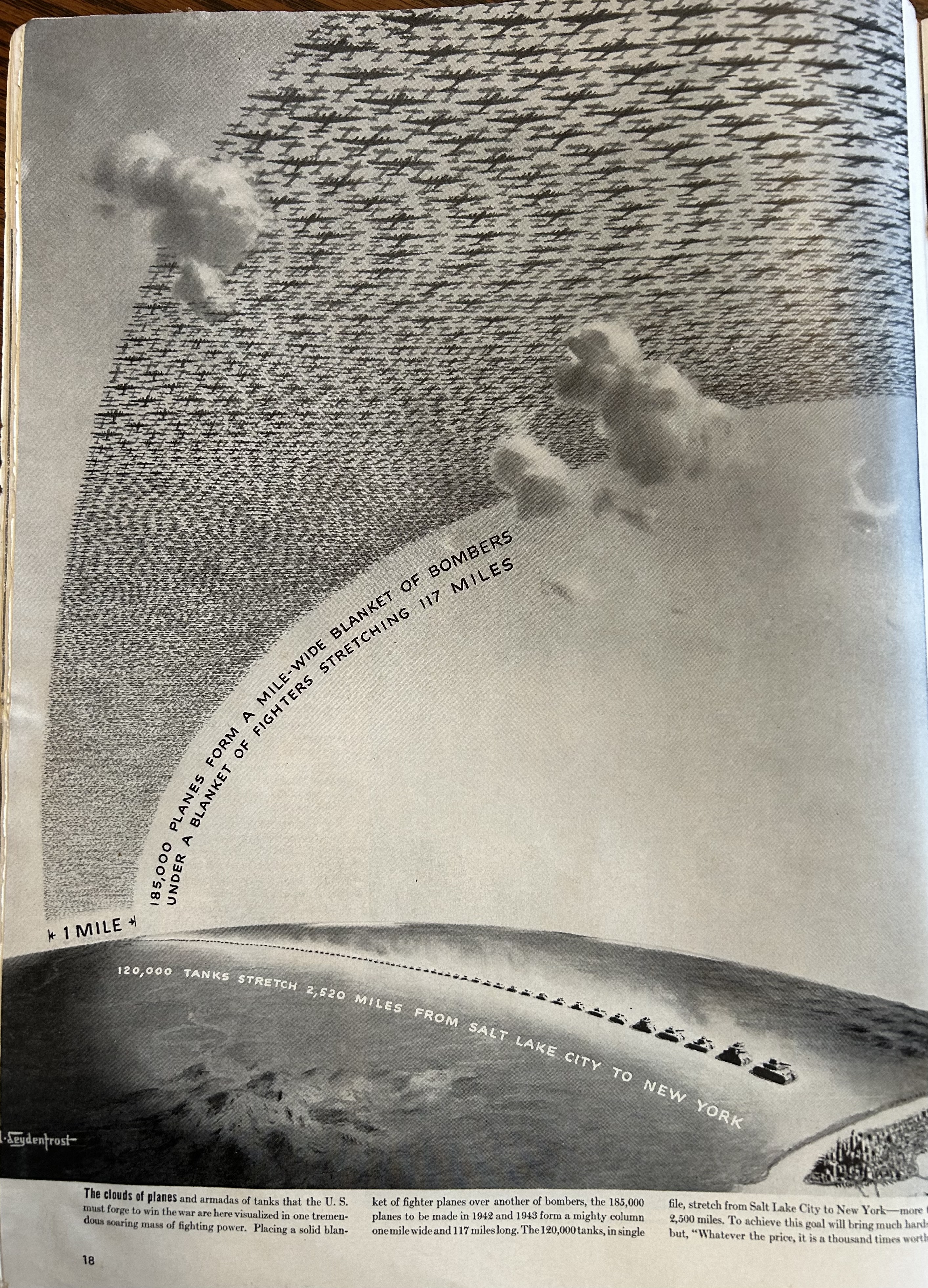
In his speech, FDR called for U.S. factories to build 60,000 planes, 45,000 tanks, 20,000 antiaircraft guns, 8 million tons of new shipping in 1942 alone. For 1943, the goal was 125,000 more planes, 75,000 more tanks, 35,000 more antiaircraft guns, 10 million more tons of ships.

“The cost – in blood, in sweat, in dollars – would be prodigious,” Life wrote. “For the average U.S. citizen, scarcely able to grasp the President’s vast figures, but willing to undertake anything that would mean the end of Hitler, the war was coming closer. From now on, except for the bare necessities of living, everything that Americans could make or earn must go toward winning the war.”

Life used full-page illustrations to give its readers an idea of the scope of U.S. war plans. The caption on one, shown above, reads: “The clouds of planes and armadas of tanks that the U.S. must forge to win the war are here visualized in one tremendous soaring mass of fighting power. Placing a solid blanket of fighter planes over another of bombers, the 185,000 planes to be made in 1942 and 1943 form a mighty column one mile wide and 117 miles long. The 120,000 tanks, in single file, stretch from Salt Lake City to New York – more than 2,500 miles.”

A dizzying, gray graphic crowded with tiny white specks takes up more than two-thirds of the facing page. It’s shown at left, with this line across the top: “There are 60,000 white dots in the square below, one for each of the airplanes that U.S. factories must produce during 1942.” If the same number of planes were lined up together, Life said, “they would blanket a field the size of Manhattan Island.”

The Life story, which carries no byline, continues:

This was the blueprint of victory that Americans had been eagerly waiting for ever since Pearl Harbor. The President followed it with words that reached every American heart. “We shall carry the attack to the enemy – we shall hit him and hit him again wherever and whenever we can reach him.” For the present, American armed forces will operate “in the Far East … on all the oceans … in the British Isles … in this hemisphere….” This was worldwide war. It would require not one new AEF [American Expeditionary Forces], but many.”

A full-page ad from the January 19, 1942, issue of Life: Oldsmobile touts its contribution to the war effort.

Roosevelt said the U.S. had to build 5,000 planes a month in 1942 and more than 10,000 a month the next year to give the Allies overwhelming superiority.

Life went on:

His figures were overwhelming, but they were not beyond the reach of a united, determined America. From government agencies, from scores of industrialists, from labor leaders, congressmen, editors and plain U.S. citizens came an immediate response: “We can do it; we will do it.”

They didn’t do it, not quite. By year’s end, 46,907 bombers, fighters and patrol craft had been built, or 78% of FDR’s goal. In 1943, the total was 84,853, or 68%.

Still, it was an awesome beginning.

 ‘Uncle Earl, you have never been forgotten’

Private Earl Seibert came home yesterday, May 25, 2024. He’d been gone for a long time.

A burial detail removes Private Earl Seibert’s casket from a carriage May 25 at Grandview Cemetery outside Allentown.

The mechanic from Allentown, Pennsylvania, died 82 years ago in a Japanese POW camp in the Philippines. He was buried there in a common grave.

His family knew he was missing and presumed dead. Not until World War II ended did they learn he had succumbed to diphtheria in 1942 at Cabanatuan Camp 1 on Luzon. He was 23. Early this year, the Defense Department announced his remains had been identified.

Seibert arrived at Philadelphia International Airport for a “dignified transfer” on May 21. Yesterday, the military and a throng of mourners paid tribute to him at Jordan United Church of Christ and Grandview Cemetery outside Allentown. I wrote about him in February, so I had a special interest in being there.

Private Earl Seibert of Headquarters Company, 803rd Engineer Aviation Battalion, attached to the Far East Air Force in the Philippines

In the fall of 1941, Seibert and six hometown buddies shipped out to Luzon with the Army’s 803rd Engineer Aviation Battalion to work on airfields. They were at Clark Field when the Japanese attacked Pearl Harbor and the Philippines. With the surrender in April 1942, they were among thousands of U.S. and Filipino troops taken on the Bataan Death March and held in squalid camps. Only three of the seven survived.

At the church service, Seibert’s niece Ginnie-Lee Henry shared a letter she wrote that begins “Dear Uncle Earl.” She told him that his father learned from the War Department in 1951 that his remains could not be recovered.

Both his parents and his sister – Henry’s mother – and then Henry herself “started to investigate what had happened to you.” It took many years. Henry found that when the prisoners couldn’t work or got sick, they were placed in housing the Americans called Barracks 0, so called because men had a zero chance of coming out alive.

“It is believed you were placed into Barracks 0 in the beginning of July 1942. Your personal belongings were taken by the Japanese guards, including your identification tag as a souvenir. The Army believes you died at 4 a.m. on July 27, 1942, having your death recorded on a condensed milk can label by another POW. You were one of twenty who died that day.”

Seibert’s cousin Tommy Sweeney, a private in the 20th Air Base Group, also was captured on Bataan. He died at the Cabanatuan camp June 23, 1942, of Vincent’s angina .

This carriage pulled by Percheron draft horses took Seibert’s casket from Jordan United Church of Christ to Grandview Cemetery.

The POWs were exhumed at war’s end and reburied in the Manila American Cemetery, where the “unknowns” lay in a common grave. Six years ago, Henry and other family members provided their DNA to the Defense POW/MIA Accounting Agency. Last summer, it identified one set of remains as those of Seibert.

At the church yesterday, a half-open casket contained Seibert’s remains, enfolded in an Army uniform. His medals were on display, including a Bronze Star for his role in the defense of Bataan and two Purple Hearts, one because he was wounded January 16, 1942, and the other because he died at the hands of the enemy.

The Missing Man Table with a single chair was on display. On top of it was a folded American flag, a Bible, a candle, an inverted glass, a red rose in a vase tied with a yellow ribbon, a slice of lemon and some salt. The lemon is a reminder of a POW/MIA’s bitter fate. The salt symbolizes the family’s tears.

The flag is lifted from Seibert’s casket to be folded and presented to his niece Ginnie-Lee Henry.

In times of sadness, there is comfort in ritual. I felt it.

Under the noontime sun, the casket rode to the cemetery two-and-a-half miles away in a horse-drawn carriage, to the clip-clop cadence of two Percherons’ hooves. A bugler played Taps. Riflemen fired three volleys in salute. We recited the 23rd Psalm aloud. With solemn respect, two soldiers lifted the American flag off the casket and folded it precisely. Another presented it to Henry as she sobbed. Three shell casings from the rifle salute were handed to her, symbolic of duty, honor, country.

“Welcome home, Uncle Earl,” Henry had written in her letter to him. “We remembered you. So did many others, too.”

A proper home for a fallen airman’s medals

Last of two parts

John Yanno of the 213th Regiment Museum in Allentown, Pennsylvania, shows newly arrived medals honoring Bob Riedy for his service with the Royal Canadian Air Force in World War II.

Robert Harvey Riedy, an American in the Royal Canadian Air Force, was killed March 18, 1942, on a training flight in England. The accident happened at Mount Farm in Oxfordshire, a Royal Air Force satellite base for No. 15 Operational Training Unit, which trained night bomber crews on the twin-engine Vickers Wellington.

Bob was in the cockpit of a Wellington Mk.1. If the records are accurate, he was in the right-hand seat for second pilots. Another RCAF sergeant was the captain in charge of the aircraft and sat in the pilot’s seat on the left. A gunner was aboard and would have been seated near the wing root.  

Wellington Mk.1 bombers

During takeoff at 1:25 p.m., the Wellington swung off the runway and clipped a twin-engine Lockheed Hudson bomber parked on the edge of the fire track, according to the RAF accident report. The Wellington rose vertically to 200 feet, stalled and plummeted to the ground. Riedy, who was twenty, and the captain/pilot died on impact. The gunner was seriously injured.

Captain/pilot Charles G. Wiley, age twenty-three and from Galt, Ontario, was blamed for the crash. The station commander noted the accident was due to “pilot inexperience and error of judgement.” The report explains: “Pilot contrary to training instructions failed to stop aircraft and line up runway prior to takeoff.”

Riedy’s burial card, part of his service record in Ottawa, Canada, shows he was interred March 21, 1942, at the Canadian Military Extension of England’s Brookwood Cemetery.
(National Archives of Canada)

Two days later, Bob’s parents in Allentown, Pennsylvania, received a telegram from Ottawa, Canada. According to The Morning Call, it said he was “killed in action.” They were expected to learn the details later from his commander. Bob was buried in England’s Brookwood Military Cemetery. The Allentown church he attended, St. Paul’s Lutheran, was filled to capacity for a memorial service.

A letter from Bob – the fourth his parents received from him after his death – arrived in mid-April and included a clipping from The Times of London. A photo showed him and five other grinning fliers with the headline, “They swept into battle against the Scharnhorst and the Gneisenau.” The caption said they were among the airmen who, in February 1942, tried to stop the two German battleships from steaming home from the French coast.

Photo from The Times of London shows Riedy (arrow) with fellow fliers. They reportedly joined in trying to keep two Scharnhorst-class battleships from reaching German ports in the Channel Dash of February 11-13, 1942. Riedy sent the clip to his parents. It ran in The Morning Call of Allentown on April 16, 1942.

No. 15 OTU was one of the units that provided Wellingtons for the so-called Channel Dash. But the records of crews and aircraft are sketchy, so I couldn’t confirm that Bob participated.

In 1992, to mark the fiftieth anniversary of Bob’s death, The Morning Call ran a story about him based on letters, interviews and contemporary newspaper coverage. If Bob’s parents knew how he was killed, they apparently didn’t tell the newspapers. One of his Allentown pals said he remembered hearing that Bob’s Hawker Hurricane fighter was shot down over the English Channel.

Intrigued, I wrote to Ottawa for Bob’s service record and to London for RAF records. Months later, the reporter who did the original story wrote a column on my findings – that Bob’s life ended in a training accident.  I went on to write blogs about Bob and even tried to find out what became of the gunner who survived the crash, Sergeant W.J.D. Carter of the RAF Volunteer Reserve. There was nothing more to say, or so I thought.

Last November, The Morning Call emailed that a caller named Bruce Hoch wanted to speak with me about Bob. When I phoned Bruce at his home in Seekonk, Massachusetts, I was amazed to learn he had two medals posthumously awarded to Bob and one given to his parents.

Bruce Hoch of Seekonk, Massachusetts, returned Riedy’s medals to Allentown.

Bruce wanted to find a suitable home for the medals in Bob’s hometown. But how did he come to have them?

In the early 1940s, Bruce’s parents lived next door to Bob’s on Jackson Street in Allentown, and the couples were friends. Bruce’s father was just a few years older than Bob and didn’t know him. After Bob was killed, Russell and Mildred Hoch moved elsewhere in the city, with Bruce a toddler at the time. The Hochs remained friends with Harvey and Eda Riedy.

“My father used to go fishing with Harvey all the time,” Bruce said. “I think the friendship between them was somewhat due to [my father’s] being close to Robert’s age. … As I got older, I used to go with my father and Harvey fishing.”

Bruce’s parents ended up buying a home on South 10th Street in Allentown. When Eva died in 1968, Harvey came to live with the Hochs. He died the next year.

“When Harvey passed, what possessions he had at our house were left with my parents,” Bruce said. “My father gave Robert’s medals to me at the time. I was probably in my twenties. That’s how I came into possession of them, and they’ve been with me probably close to 50 years.”

Yanno mounted Riedy’s medals in this shadow box and set it atop the 213th Regiment Museum’s World War II display case. They are (from left) the War Medal 1939-1945; the Memorial Cross, given to Bob’s parents; and the Canadian Volunteer Service Medal.
(Photo courtesy of John Yanno)

Bruce’s job in a company of inventory specialists took him from Allentown to Hazleton and Lancaster, and then to Nashua, New Hampshire. He moved on, starting a small business in Seekonk.

“The medals stayed with me,” he said. “Every now and then, when Memorial Day would come around, it would work on my mind a little bit, because I’m seventy-two now, and if something happens to me, I don’t know what would happen with these medals.

“I didn’t want them to just fall into someone’s hands that are going to turn around and sell them or whatever. I wanted them to be somewhere where they would mean something to somebody, where people would be able to see them and read about them.”

Bruce saw a story I’d written about Bob online and called The Morning Call to reach me. I put him in touch with John Yanno of the 213th Regiment Museum at Allentown’s Charles C. Curtis Armory. The museum supports the 213th Regional Support Group, a National Guard unit, by maintaining a gallery of artifacts dating to the Civil War. The 213th Regiment is known as the “First Defenders,” so named by President Abraham Lincoln when he asked for soldiers to help defend the capital.

“We have displays from many of the wars that the United States was involved in and would be honored to add Bob’s medals to our collection,” John emailed Bruce.

When the three medals arrived, John found them in “great condition.” Two had been awarded posthumously to Bob — the War Medal 1939-1945, awarded by the United Kingdom to all full-time personnel of the Armed Forces and Merchant Marines, and the Canadian Volunteer Service Medal. The other is the Memorial Cross, given to his parents because their son died on active duty in the Canadian Forces.

The medals are now on display in the 213th Regiment Museum.

“I’m very, very happy to have gotten them down there,” Bruce said. “They’re back home where they really, truly belong.”