Here’s another World War II story, untold until now. The writer was China-Burma-India veteran Fred C. Wasem of Jim Thorpe and Bethlehem, Pennsylvania.
—
On March 12, 1943, at age 19, I was inducted into the Army. I went to Atlantic City for basic training in the Army Air Forces and was billeted at the old Hotel Brighton. Our hotel was judged the best marching outfit in Atlantic City. We won the honor of having the Glenn Miller Orchestra play at dinner every evening for a week.
After six weeks, I was sent to South Dakota State College, where I took a course in Army law to become an Adjutant General secretary.
We were up at 5 o’clock in the morning, a half-hour to wash, make your bed and ready the room, exercise for half an hour, one hour for breakfast, a half-hour to one’s self, fall out and march to your respective classes. From 7:30 until noon were classes and lectures. Lunch was from noon until 1 o’clock. Classes then continued until 3:30, with compulsory close-order drill until 4:30. From then until 7 o’clock, you would eat and do what you wanted. Compulsory study began at 7 o’clock and ended at 9. Lights out was 10 o’clock.
This was five-and-a-half days a week. The school lasted three months. I lost a week of schooling by being hospitalized. [Wasem didn’t say whether he was ill or injured.] I had a very difficult time trying to catch up and did not succeed. I completed the course but did not graduate.
I joined the 1066th Quartermaster Company, 12th Air Service Group at Biggs Field in El Paso, Texas. After a two-month stay, we went to Albuquerque, New Mexico, and then to Camp Anza in Riverside, California. This was an embarkation camp for overseas. We stayed for two weeks and did nothing but loaf. Our company had 76 men and five officers; a WAC company had 75 girls and three officers. We had a wiz ding of a beer party.
We then went to our ship, the USS Hermitage, an Italian luxury liner which was scuttled in Cuba and made into a troopship which could accommodate 7,000 troops. We left Los Angeles on November 10, 1943, for Bombay, India.
With nothing to do but loaf, I went to the troop office and inquired about a job with the shipfitters. Being a plumber, I had a sailor as a helper who wanted to learn the trade. We repaired all sorts of leaks in the toilet rooms.
The ship’s engine broke down. While we were in for repair on the island of Bora Bora, my company had to do KP. It was so hot that the steel-plated deck in the kitchen burned your feet. I jumped ship for a swim.
We landed December 11 at Perth, Australia, and at Bombay 15 days later. I was put on detached service to await the arrival of our cargo ship. Our group consisted of 24 men and one officer. We stayed in Bombay about a month, then boarded a passenger train bound for Calcutta. We had only wooden seats to sit and sleep on. I joined my outfit outside Calcutta in a tent camp.
We were caught up in a monkey migration. Thousands of the animals covered everything in their wake. Very noisy and a big nuisance. It lasted about a day. Also, there were red-headed vultures perched in trees. When you would walk in the open area with your mess kit, after going through the food line, they would swoop down and try to steal your kit. You had to bend over and hide under a tree.
We left this camp via a narrow-gauge railroad for somewhere in Assam and experienced many delays. The worst was that the engineer put the train into a siding and went home to his family for about three days. We ran out of our food and had to eat British hard crackers, along with bananas we picked from the trees.
Upon arrival at a railroad yard, we drove two days to an airfield and boarded a C-46 for Kunming, China. Eight of us were put on detached service with the remaining elements of the old Flying Tigers until July 31, 1944. We then were transferred into the 1151st Quartermaster Company, 68th Air Service Group.
In Kunming, we worked in a warehouse very close to the airport. I was the NCO in charge of salvageable material such as clothing, bedding and office furniture.
Claire Chennault (AviationHistory.com)
One day, the major in charge brought a brigadier general into the office. The general was introduced to me. His name was Hood. I had to do a job for him on Major General Claire Chennault‘s private airplane. I had to upholster a fighter pilot’s seat which was being installed in the airplane for the general’s dog. I had the job done with old olive-drab blankets. General Hood was so well-pleased with the work that we became friends. He loafed at my office many times and smoked cigars with he. He brought me beer from India when there wasn’t any to be found.
We had two Chinese orphan boys tending to our barracks. They cleaned and mopped, made our beds, sent our dirty wash to be washed and dried, then picked it up for us. We had a sit-down mess hall, and the house boys acted as waiters. Breakfast always consisted of eggs, hotcakes or french toast, juice and coffee. Lunch and dinner were chicken or water buffalo, boiled vegetables, rice, bread and coffee. I lost about 30 pounds in two years.
We left Kunming for Luliang Airfield. I was put in charge of wholesale PX supplies. It took a lot of paperwork for ordering, inventory and allotting of supplies based on each company’s morning reports for all the outfits we served. This job paid extra, over and above my T/4 rank and overseas pay. It added up to a master sergeant’s base pay of $135.
A volunteer job was added to my regular job. It was a grave registration detail. We were called out all hours of the day and night to recover the bodies of the dead flyers and others. After the bodies were identified, we tagged and boxed them, then transported them by truck to Kunming, where they were placed in above-ground vaults.
We left Luliang in November 1945 via a C-54 for Calcutta and stayed in a camp for about two weeks until a ship came to take us home. The General J.R. Brooke arrived. We went by way of Ceylon [now Sri Lanka], up through the Red Sea, stopped in Egypt, then through the Suez Canal and into the Mediterranean. I saw the Italian boot in the distance, the Rock of Gibraltar. When we arrived in New York on January 3, 1946, the ships in the harbor sounded their foghorns and the fire boats put up a display of water, welcoming us home.
I went by train to Camp Kilmer, New Jersey, then to Indiantown Gap, Pennsylvania, where I was discharged. The Army gave me $1.50 for bus fare home to Mauch Chunk [now Jim Thorpe].
Two years, nine months and 26 days since I left home.
—
Wasem had his own plumbing and heating business in Jim Thorpe and later worked for Bethlehem Steel. He was a Lions Club president, local unit commander of the China-Burma-India Veterans Association and president of the Allentown United Veterans of Wars. He died on his 85th birthday in 2008. You can read his obituary here.
In 1944, The Berwyn Post was in its second year of publication.
It is a Page 1 roll call of 1944 casualties.
Army Air Corps Sergeant Maurice Houston, 30, son of a First World War officer, was killed in action August 12 in Indonesia. Private John McKelvey, 24, married with a toddler son, was killed on Saipan. Private First Class Edwin Benner, 19, was killed February 16 on the Anzio beachhead.
Marine Private First Class James Newman was wounded July 21 on Guam. Army Private First Class James D’Innocenzo, 22, was wounded July 26 in France. Army Corporal Angelo DiMarino of Devon, whose family and mine had a connection broken by a terrible accident, was slightly wounded in France on August 3 while in a convoy strafed by German planes.
Those casualties appear in the September 1944 issue of The Berwyn Post, a monthly tabloid published on Philadelphia’s Main Line “by Berwyn men and women on the Home Front for the Berwyn men and women on the Fighting Fronts.” The masthead notes the paper went to all graduates and students of Tredyffrin-Easttown High School in the service, by arrangement with the Paoli-Berwyn-Malvern Rotary Club. If you were in the military and a Berwyn resident or T-E grad, your subscription was free. Others in the service and civilians got the paper for a small price.
My dad graduated from Tredyffrin-Easttown in 1944 and went on to join the Coast Guard. But I’m not sure that’s how I happen to have this slightly torn eight-page issue of The Post. Still, when I found it in my file cabinet a few weeks ago, I couldn’t put it down. You can see how popular it must have been. Main Line servicemen and women all over the world were getting news from home about people they knew. They saw photos of hometown buildings and street scenes. They could read about the high school’s sports teams. They could turn to The Chaplain’s Corner for inspiration from the likes of Methodist minister Henry F. Hamer Jr., who wrote that “faith is the most precious of our possessions” and gave advice on how to keep it. On the front page, they learned what was most compelling: Who among them would not return?
The inside pages are full of chatty columns. A Mailbag takes up more than two full pages. In one typical letter, Army Corporal Norman L. Duncan writes from France: “Seems kind of tough to be in a country where most of the people are trying to be friendly and you can’t ever hold a conversation with them due to not being able to speak or understand their language. However, we are kept too busy to have any time to mingle with them. Let me tell you this sleeping in a ‘foxhole’ isn’t at all what it’s cracked up to be, especially if it is pouring rain. Food was rough for a while but is getting better every day and I don’t imagine it is going to be too tough.”
The paper printed excerpts from a letter James Newman, the Marine wounded on Guam, wrote to his mom: “[W]e descended from the transports via cargo nets into the Higgins boats and shoved off for the beach. We were the guests at this party and the host gave us a warm welcome — in fact, as hot as Hades.
“We hit the beach with mortars popping all around us, and I don’t know how we managed to dodge them and start our individual jobs. I was up with the infantry for about a week and I saw plenty of the sights that I’ve heard so much about since this war started. The infantry — honest to goodness — is the best there is, they are real artists when it comes to exterminating Japs. I saw them knock out three Nip tanks in one day and it is amazing how they all work together, calm, collected and with precision adjustment.”
This item on Larry B. Mercer ran on Page 2 of the September 1944 issue of The Berwyn Post. In the Navy, an ARM2 is an aviation radioman second class.
Navy flyer Larry B. Mercer of Berwyn got a Commendation Ribbon for “meritorious and efficient performance of duty as air gunner of a dive bomber in an attack on enemy shipping in Rabaul Harbor, New Britain Island, on Nov. 11, 1943.”
The Post ran a picture of him and the complete text of his citation. Part of it states “Mercer, by maintaining a heavy and accurate fire from his gun against large numbers of enemy fighter planes, assisted materially in repelling their assault against the bomber formations.” The four-paragraph story adds Mercer was awarded a Purple Heart for wounds suffered at Tarawa and that he was now in California awaiting his next assignment.
The Post masthead lists its editors as the Rev. Elbert Ross, William W. Eadie, Charles T. Smith, Theodore Lamborn Jr. and Joseph Kelly. In bringing the war home, and home to those in the war, they served their community well.
Angelo DiMarino, the wounded Army corporal I mentioned above, was an older brother of John DiMarino, who was engaged to my aunt Josephine Venditta of Malvern. John was killed in a B-24 training accident on April 5, 1944. I wrote about him in my December 2, 2021, blog “How a WWII bomber crash in Colorado hit home.”
Robert O.A. Wolfe was called to service as an American Red Cross field director in 1942. He had been a newspaper reporter in Allentown, Pennsylvania, for 13 years. (Bill Wolfe)
Newspaper reporter Bob Wolfe was an American Red Cross field director with the Marines in the Pacific during World War II. Among his chores, he provided softball and volleyball gear, set up boxing bouts and entertained island natives with boogie-woogie records. A shrapnel wound earned him a Purple Heart, for which he was eligible because he worked for the military.
An athlete, he had started at The Morning Call of Allentown as a sportswriter in 1929 while still in school. According to a chatty column in the paper that December, he “has his arm out of the sling again after having broken it recently for the seventh time.” At Allentown High School, which he graduated from in 1930, he was a football lineman and standout swimmer.
His work with the Red Cross dated to 1931, when he passed the nonprofit’s first-aid course and became a member of its Life Saving Corps. A head injury he suffered while swimming at a local park that year dogged him for many months. He was admitted twice to the University of Pennsylvania Hospital in Philadelphia. On top of that, a lightning strike shocked him while he was walking home from a ballgame, landing him in an Allentown hospital for about a week.
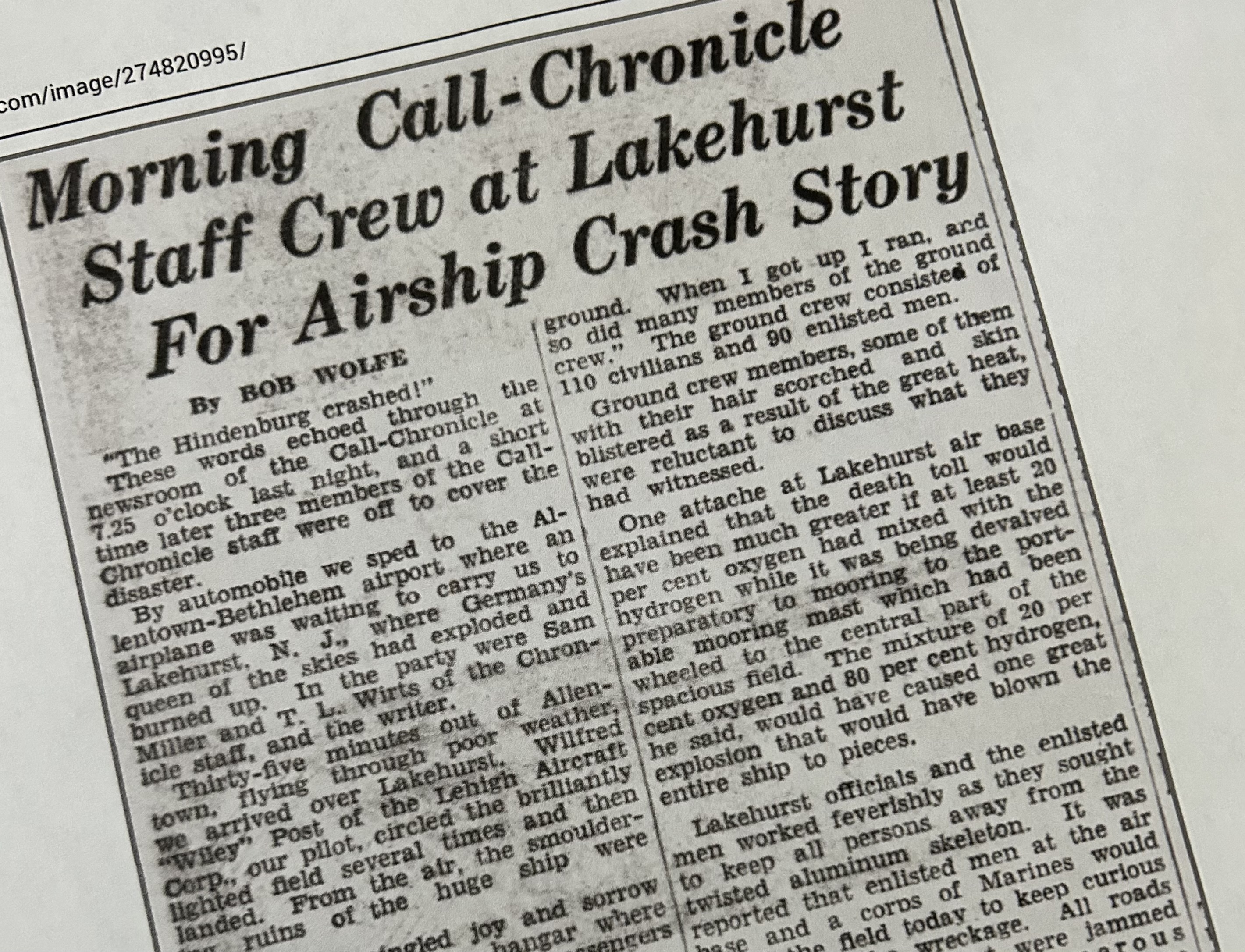
Wolfe’s May 7, 1937, article about the Hindenburg disaster (Newspapers.com)
As a newshound, he sped to Lakehurst, New Jersey, in 1937 to cover the Hindenburg disaster. “Scenes of mingled joy and sorrow were common in the hangar where relatives of some of the passengers and persons who were to have embarked on the return trip at 10 o’clock last night were gathered,” he wrote on May 7. “Pieces of ribboned fabric, which floated to the ground after the two explosions in the air, were guarded closely by enlisted men at the hangar.”
Thirty years old, married and the father of a 3-year-old boy, Wolfe took Red Cross training in Washington, D.C., in 1942. When he came home from overseas two years later, he wrote a report for the service organization that describes an aspect of the war unfamiliar to many of us. Here is his entire report, which took up 14 typewritten pages:
—
STATEMENT BY Robert O.A. Wolfe American Red Cross Field Director of Allentown, Pennsylvania on his return from the MARSHALL ISLANDS, where he served with the United States Marines
The American Red Cross Washington, D.C. Wednesday, July 12, 1944
I was with Marine Aircraft Group 31, originally attached to the 3rd Marine Air Wing at Cherry Point, North Carolina.
Whimsical certificate pronouncing Wolfe a ‘shellback’ for crossing the Equator on October 10, 1943 (Bill Wolfe)
When the group arrived in the South Pacific, it was detached from the 3rd Air Wing and became a part of the 4th. Just before we left Wallis Island, which is about 300 miles south of Funafuti, Colonel C.R. Freeman, group commander, called in the Red Cross man — myself — and wanted to know how much money was available for the purpose of creating a unit PX [post exchange]. I explained that so much money was in my revolving fund, and he asked if it were possible to advance sufficient cash finances for the purchase of supplies, including 100 crates of cigarettes. This money was advanced to him on the signature of his PX officer, Captain George Cruze, a Californian.
While we were preparing to embark from Wallis to go into the Marshalls, the supplies were picked up at Funafuti, put aboard one of the transports which was to take us into the new campaign as a small part of a huge fleet. That was the Marshall Campaign.
Colonel Freeman approached me on approximately the 15th of January. Prior to embarking at Wallis, I purchased and made ready for distribution aboard the transports two crates of playing cards, each crate containing 427 decks. The voyage from Wallis to Makin Island in the Gilberts, where we were to rendezvous with the fleet, was uneventful except for a tropical storm which tossed the ships around like corks in an open sea. The playing cards mentioned before were put to use practically 24 hours a day, with some of the Marines playing games around the clock. They’d sit down at 10 in the morning, and they’d still be playing at 10 the next morning.
When we left Makin to go into the vaunted Japanese waters of the Marshall Islands, we had strong seapower escorting us, as well as air coverage. It was a sight that millions would pay fabulous fees to see when we sailed into the waters of Roi-Namur at the northern tip of Kwajalein Atoll, where hundreds of ships were lying off shore awaiting their part in the big battle. There were more carriers than you could count on your hands, battleships were numerous, there were plenty of destroyers and, in fact, every type of warship which goes to make up our powerful Task Force 58.
Wolfe in the Pacific: ‘I have been able to give our men everything they could desire.’ (Bill Wolfe)
The Marines went ashore on Roi on the 1st of February after the atoll had been plastered by sea and air power, and in four days’ time both Roi and Namur were secured, with the exception of the few snipers who holed up in the drainage system which skirted the runways and revetments on Roi. The drainage systems were concrete, about 18 inches wide, about 14 inches deep, and had openings about 2 inches wide with concrete slabs thrown across the top. In these drains, Japanese snipers would stick a rifle through one of the openings and take potshots at Marines or Seabees who were working on the runways. The last of these snipers were killed about a week after the battle itself ended.
On the island of Roi, a fire which started during a bombing early in the morning on February 12th destroyed vast quantities of supplies and gear, but fortunately most of my recreation supplies arrived a few days later in fairly good shape. These supplies comprised practically the only recreation gear on both islands and were put to good use and brought a great deal of pleasure to Marines and Navy personnel during their off hours.
Among the supplies were softball gear, volleyballs and nets, footballs, diving glasses, a large quantity of small games, including acey-deucey, dominoes, checkers, chess, bingo and dartboards. Also among the supplies were 800 songbooks, which included both popular and old-time songs which the men sang with much gusto during the evening hours when there was little else to do. They were the official Army-Navy songbooks.
With the softball gear available, a number of leagues were soon organized, and there probably were more softball games played on Roi landing strips in one week than in a medium-sized city in an entire summer. Softball was played as early as the 14th of February, which was exactly two weeks after the initial landings on Roi. That can be considered as remarkable and another sign of the ingenuity of American fighting men when it is taken into consideration that the islands were nothing more than a pile of rubble after the battles were ended.
A dispatch from Wolfe in The Morning Call of March 8, 1944 (Newspapers.com)
The softball leagues were organized principally by Lieutenant (j.g.) John R. Burrington, USNR [Navy Reserve], and an alumnus of North Dakota University with the class of 1938 and recreation officer for ACORN 21, and myself. Lieutenant Burrington handled all the volleyball.
The first boxing in the Marshalls was a result of a challenge issued to Captain Eben Hardy, USMCR [Marine Corps Reserve], of New Orleans, an alumnus of Tulane, and myself, by the athletic and recreation officer of the USS Curtis, which was lying at anchor in the lagoon at Kwajalein Island on the lower end of Kwajalein Atoll. The USS Curtis is a seaplane tender and served as the flagship of Admiral Hoover, the military governor of the Marshall Islands.
With the challenge at hand, I approached Lieutenant Burrington on the idea of running a Roi-Namur Golden Glove Boxing Tournament to select a team to oppose the Curtis boxers. The idea was put into a memorandum and sent to Captain E.C. Ewen, USN, island commander and a former football player at the Naval Academy at Annapolis. Captain Ewen gave his hearty approval to the idea and was a driving influence in the successful tournament which quickly got underway. The brunt of the work in arranging for the tournament was carried by Lieutenant Hugh Gallernau of Chicago, former Stanford football great and a member of the Chicago Bears for two seasons prior to his enlistment in the Marines, and Lieutenant Burrington and myself. Commander Chapline, an old-timer in aviation and commander of the ACORN 21 unit, also gave great support to the movement and was in a ringside seat the night of the semifinals, when it was announced that he would be relieved of his command and sent to another station to take a new command.
The first-round bouts were conducted on a sand spit being filled in between the islands of Roi and Namur, and the only discomfort suffered by the spectators was the occasional rustle at their feet by the large rats which make the island their home. The rats are almost as big as cats.
The semifinal bouts and the final bouts were staged on a ring set up at the end of a runway on Roi, and although a heavy rain broke during the semifinals, no[t] one of the men left their seats, and the bouts continued as though a brilliant moon were shining. The boxing gloves used in the tournament were “bummed” from the Army at Kwajalein Island. Kwajalein Island was spared of air raids and their supplies were large in comparison with our meager quantity.
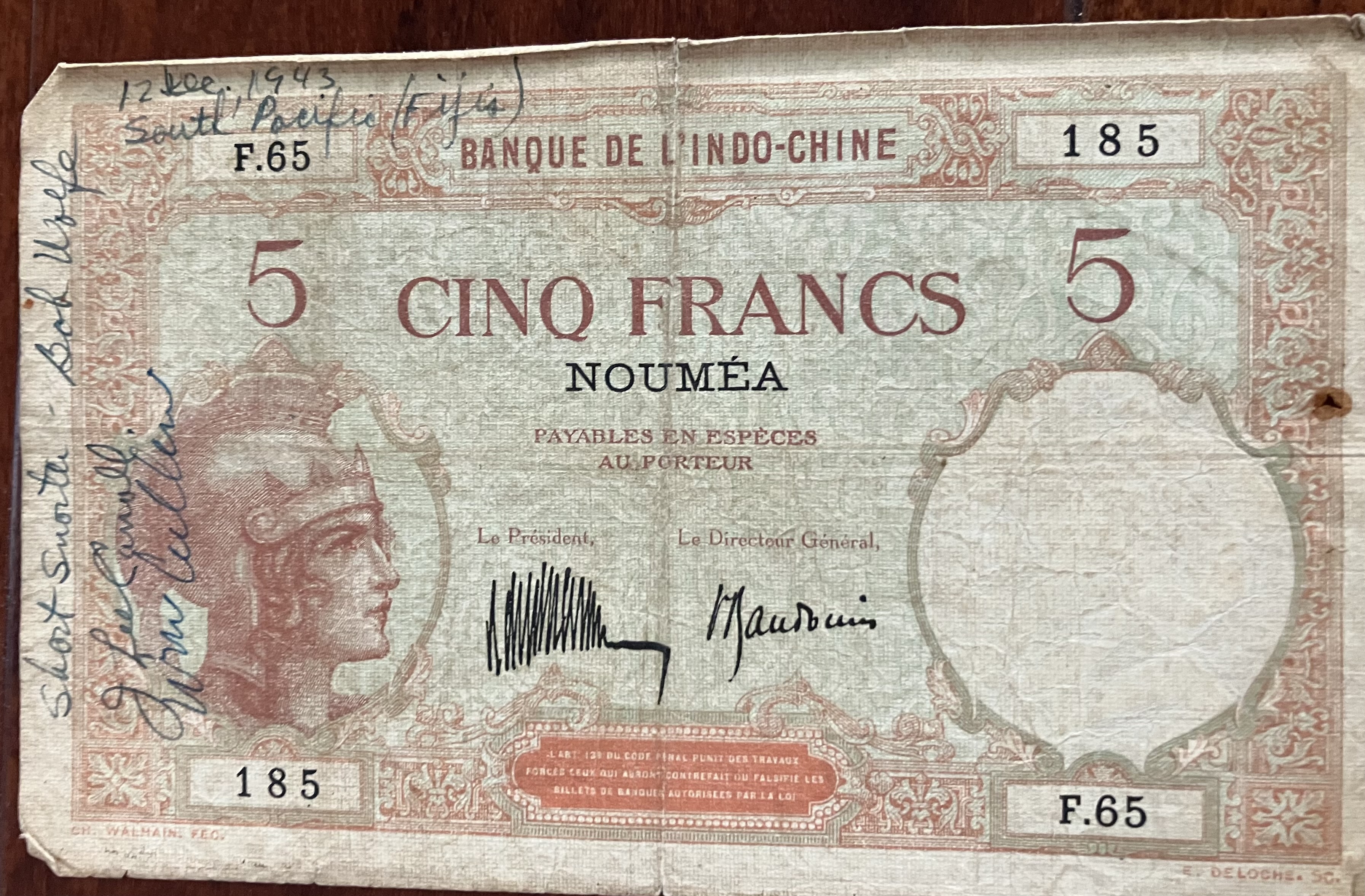
This short snorter was signed by Wolfe on December 12, 1943. Two other men also signed it. The Bank of Indochina bill is from the French territory of New Caledonia. Short snorters were banknotes signed by servicemen overseas and kept as souvenirs of their travels. (Bill Wolfe)
Kwajalein Island is just 45 miles south of Roi and forms the extreme northern tip of the atoll.
The gloves were brought into Roi by one of the Navy attack planes which made the return run in about half an hour. When you consider they have to take off, put down on the deck, pick up the gloves and be off again, you will see that half an hour is not much time to make the run.
Lieutenant Robert McAllister, USMCR, of Los Angeles flew me to Kwajalein in an SBD, a Dauntless dive bomber, to pick up the gloves. Four sets of gloves were used up in the tournament, and in the training program which preceded the bouts, approximately a dozen sets of used gloves were used, which had been secured from ships at anchor off Roi and also from the salvaged supplies after the bombing of Roi itself.
The boxing at Roi-Namur was the first in the Marshalls, and in view of the fact that the Japanese engage in jujitsu and judo instead of the American sport of boxing, it is believed that the Roi-Namur tournament was the first boxing in the Marshalls in many years.
Softball was introduced to the Marshallese natives by the Red Cross when I took to their small island just south of Namur two softballs, one bat, two pick handles and a dozen asbestos hand gloves. The natives knew nothing at all of softball or baseball, but they readily grasped the idea of the game when I spent an afternoon with them on an expansive beach at their island. The natives were quartered on Anton Island, which was less than 100 yards square.
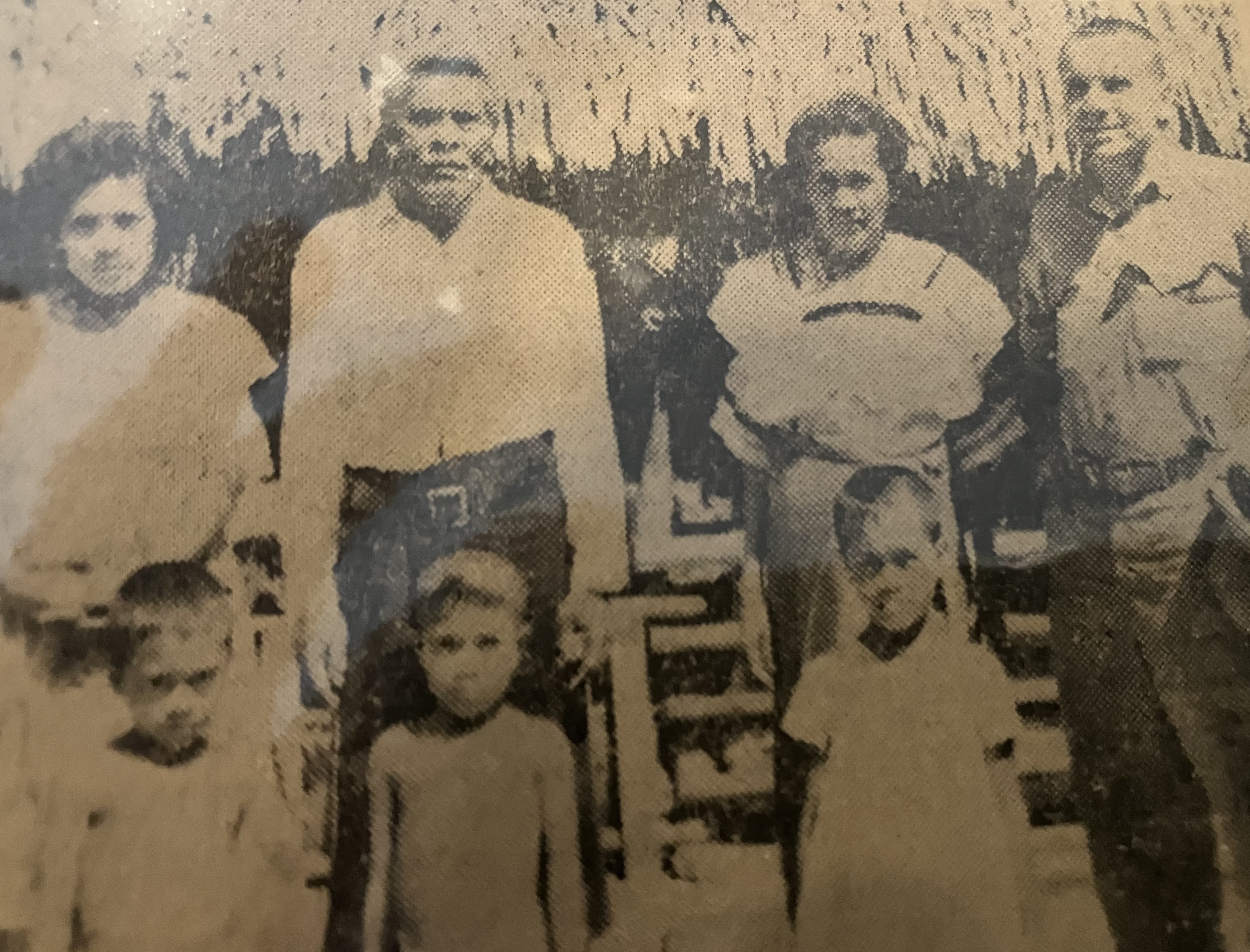
Wolfe with Chief Nakoma and his family on Pago Pago, American Samoa (Bill Wolfe)
In addition to the softball gear, I gave them a volleyball and a net, an old phonograph which had been beaten up in the bombing but was repaired by some Seabees, and some boogie-woogie records. The records were played for the first time one moonlit evening on the beach, where all of the natives gathered at the command of their leader. The women wore Mother Hubbards, and the men were attired in whatever clothing they were able to gather or beg from the servicemen. Some of the men wore shirts, while others were stripped to the waist.
The boogie-woogie records gave the natives a great laugh, and it was amusing to our small group of whites that after each record was played, they would all shout “OK” and they would clap vigorously.
In return for the phonograph music, the natives sang some of their native songs in beautiful harmony and rhythm. I often wished that I had a recording machine to record their music.
The Marshallese natives are very religious and are 100% Christians, principally Baptists. They had a native Baptist preacher there. He was a man about 70 years of age.
The only Marshallese native I came in contact with who was able to speak fluent English was a young man who had been educated at a college on the West Coast of the United States. His name is Laamanelli, and he is the leader of the group.
The natives, during the bombardment which preceded the battle, had worked their way from Roi and Namur, where the heavy shellings were concentrated, to small islands down the atoll. Eventually, the natives were rounded up by Lieutenant Collyer, USNR, civil affairs representative at Roi. The natives, deprived of their source of food when the shellings and bombings destroyed most of the coconut trees as well as the rice which had been stored on the islands, had to be subsisted by the Navy. The male members of the family would work on the various islands, helping to clear the debris and also to move supplies, and in this manner worked off their board.
Wolfe’s duffel bag with the names of places where he had been (Bill Wolfe)
The Marshallese are a healthy-looking type of people. They are of medium build, and the women have long, coarse, black hair. They all go barefooted. The men keep their hair fairly close-cropped, and when working in the sun, they always keep their heads covered with a turban-like cloth.
Lieutenant Collyer made the native women very happy one day when he distributed among them necklaces, bracelets, rings, hair ornaments and earrings. Although purchased at a five-and-10 in the States before leaving this country, they might just as well have been priceless jewels, as far as the natives were concerned. I doubt whether I have ever seen a happier group of people than those women were the day Lieutenant Collyer distributed these things. Lieutenant Collyer, after calling the women together, explained that the jewelry was a token of thanks for what the male members of the families had done so far, and also for the laundry which the women were doing for some of the officers. By the way, they launder by pounding the clothing against a piece of coral rock in brackish water.
There were only about a dozen service people who actually mingled with the natives. Parties of native men were transported each morning by landing craft from their island to Roi or Namur for the purpose of doing cleanup work and also helping transport supplies around the islands.
Laamanelli, the leader, explained in Marshallese language that the American Red Cross was a neutral agency operating with troops in battle, and he told the natives that their recreation supplies and the phonograph and records were a gift from the Red Cross field director who landed with the Marines on Roi. This little speech by Laamanelli brought a cheer and great hand-clapping.
How Wolfe appeared in Allentown High School’s 1930 yearbook, the Comus (Allentown Public Library)
Laamanelli knew a little about the Red Cross but was surprised to know that the American Red Cross was sending men with the troops into the battle zones. He said that the Japanese, as long as they were in the Marshalls, never had Red Cross representatives with them.
The phonograph was set up on a gasoline drum on the white, sandy beach which fronted on the lagoon. The natives squatted in a semicircle around the phonograph, and to their backs were a few small lean-to’s which provided their shelter and also some coconut and pandanus trees. There was also some undergrowth which gave the island a typical tropical setting.
The phonograph was first played as the natives faced the setting sun. The sun set over the stacks of some of the powerful warships which were at anchor in the lagoon, and as it slipped farther beyond the horizon, it left a brilliant red glare in the sky, which Laamanelli said indicated another hot day for the morrow. The tide was receding at the time, and as the waves rolled down the sloping beach, there was a rhythmic pounding of the surf.
At his tent in the Marshall Islands, April 9, 1944 (Bill Wolfe)
To the northwest, the ocean side of the island was being pounded by high breakers which rolled over the coral reef which circles the entire atoll. The natives were quiet as the phonograph beat out the boogie-woogie, with the exception of occasional laughing by some of the younger folks and the women. The men were as sober as church deacons, and it was only after the record had played through that the men would holler “OK” and then clap and shout.
Laamanelli is a much larger man than the average Marshallese and stands about 5 feet 11 inches. He is a well-built man of about 40 years of age, and his leadership among the natives in his section was passed on to him by his father. Laamanelli is a keen-thinking man and has his natives always under control and at the tips of his fingers. He knows everything that is going on and knows where everybody is.
There are only 8,000 Marshallese in all the Marshalls. Laamanelli is the leader of the natives around Roi and Namur, and they might total only 300.
The Marshallese natives are recognized as among the best navigators in the world, and before the Americans landed, they did considerable fishing both in the ocean and in the lagoon, principally for the ulua, barracuda, and a type of tuna which abound in the waters around Roi and Namur.
Laamanelli wore a pair of GI trousers and a white shirt, apparently given to him by some Navy man. He was barefooted and at times wore shell-rimmed glasses.
July 12, 1937, announcement in The Morning Call of Wolfe’s upcoming marriage to Elsie E. Heilman, a stenographer and ‘prominent member of Catasauqua’s younger set’ (Newspapers.com)
The Japanese provided rice and tinned fish to augment their supplies of fresh fish, coconuts and pandanus.
The natives were on Anton Island temporarily, having been driven from their natural habitats by the invasion, and no doubt by now they have been installed in more permanent living quarters. Their quarters were built out of odds and ends of wood, and the temporary lean-to’s on Anton were constructed out of K-ration boxes with palm fronds woven to form a waterproof roof. The way they do that is really quite ingenious.
Following the phonograph concert, Laamanelli extended his personal thanks to both Lieutenant Collyer and myself, and he expressed the hope that we would return soon with more music. The second trip we made back to the island, we took some Benny Goodman, Bing Crosby and other popular music along, as well as the “Marines’ Hymn,” “Anchors Aweigh,” and the national anthem. The phonograph was left to the natives for their entertainment.
It should be explained that the phonograph had been severely damaged in a bombing and was considered a total loss until one of the energetic and ingenious Seabees went to work on it and put it in operation again.
The needle shortage became serious at one time, but the natives sharpened their supply of needles with coral stone and seemed to encounter no difficulty in keeping the machine in operation.
Lieutenant Collyer, a small garrison of Marines and myself were present that night, and following the concert we opened up some fruit juices and some boxes of K-rations and had a little party among ourselves. The natives seemed to enjoy their little bill-of-fare, which consisted of tinned fish and coffee which they prepared themselves with the brackish water. They had American coffee. Approximately 150 natives were present at the concert; all but a few were there. The old folks were in their beds. There were no babies there; the youngest child was about 4 years old.
Laamanelli pointed to the Red Cross insignia on my collar during his little talk to the natives, in which he explained the Red Cross and the work it was doing there.
Incidentally, the concert took place three weeks after the landing.
—
Back home, Robert Owen Andrew Wolfe lectured about his Red Cross experience in the Pacific. He was secretary of the Allentown Chamber of Commerce, worked for Western Electric in public relations and in 1962 edited Allentown’s bicentennial commemorative book. He was president of Wiley House, which helped children with emotional problems, and served on the Allentown YMCA board and as president of the Catasauqua School Board.
Washington Post cartoonist LeBaron Coakley celebrated Wolfe’s role in introducing softball to the people of the Marshall Islands. (Bill Wolfe)
He and his wife, Elsie, had two sons and a daughter and lived in North Catasauqua. He died in 2004 at age 91.
Fifteen years ago, his younger son Bill sent the 1944 Red Cross report to me at The Morning Call with a note, “I hope you find it as interesting as our family does.” I spoke with Bill, read the paper and tucked it into a file of prospective stories. It stayed there. When I retired, I brought the file home.
A few weeks ago, I came across the report and called Bill about posting it on my blog. He sent me images from an album his mom kept, along with photos of some keepsakes, and mentioned something I hadn’t read anywhere — that his dad was treated at Walter Reed General Hospital for elephantiasis he had contracted overseas.
“In the field of combat,” Bob Wolfe wrote for The Morning Call in 1944, “the Red Cross is called upon to do a thousand-and-one-things — among them the tough job of trying to keep a program of recreation and entertainment going under the most adverse conditions. There is also plenty of work to be done in field hospitals, where wounded are treated before being taken to base hospitals.
“And we can’t forget the job of teaming up with the chaplains as a sort of ‘wailing post’ for homesick boys and boys who have become bomb-happy.”
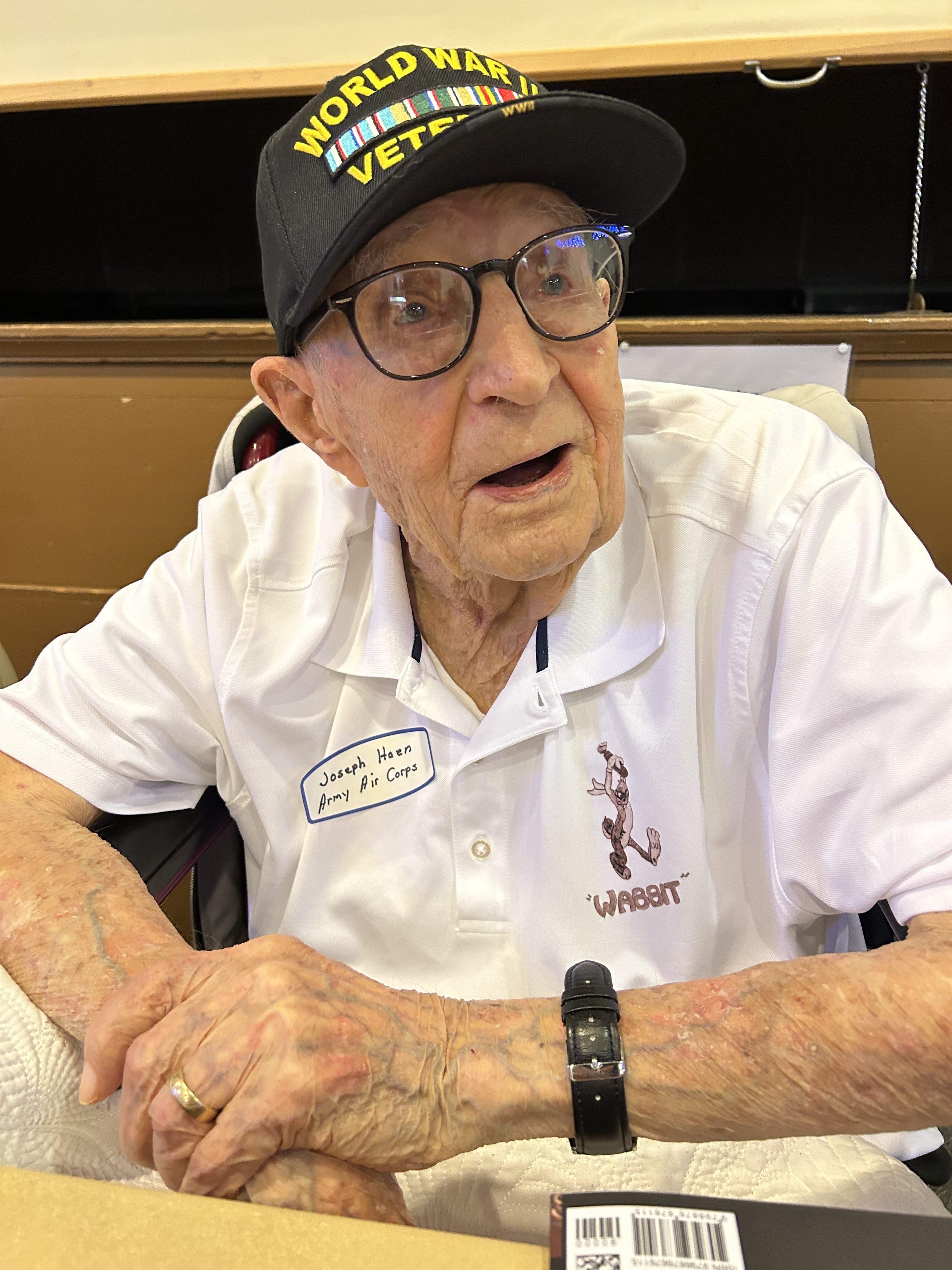
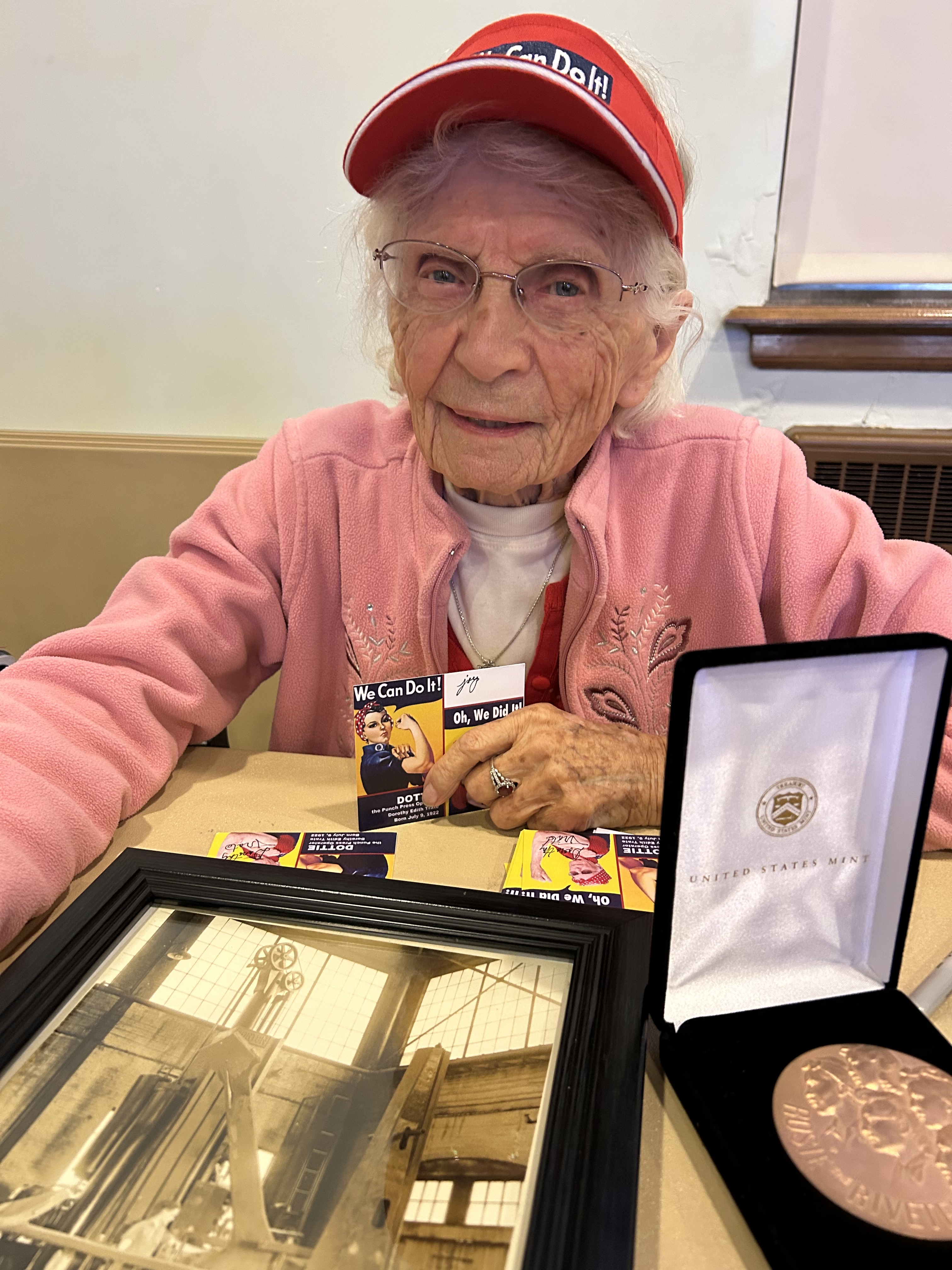
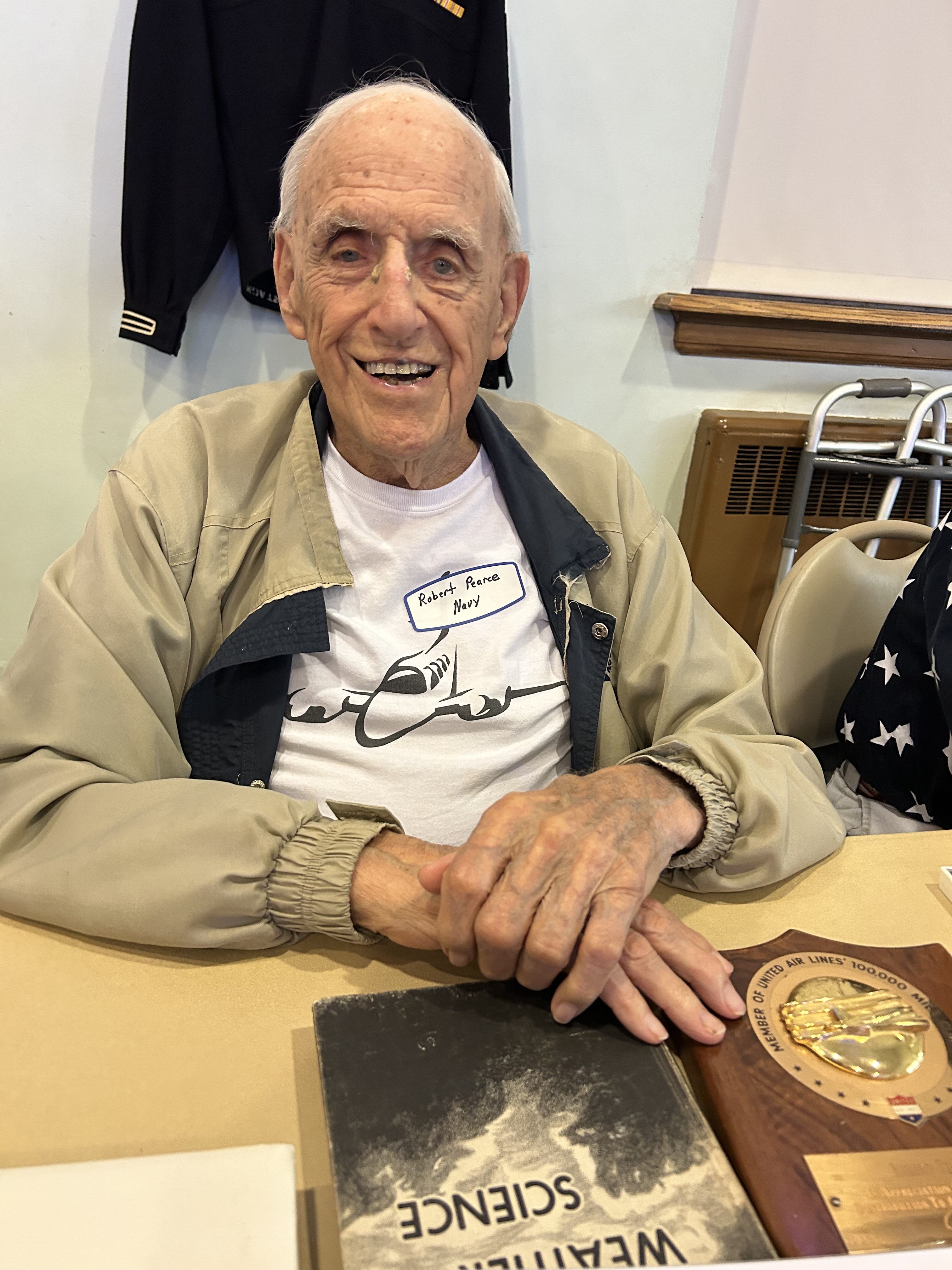
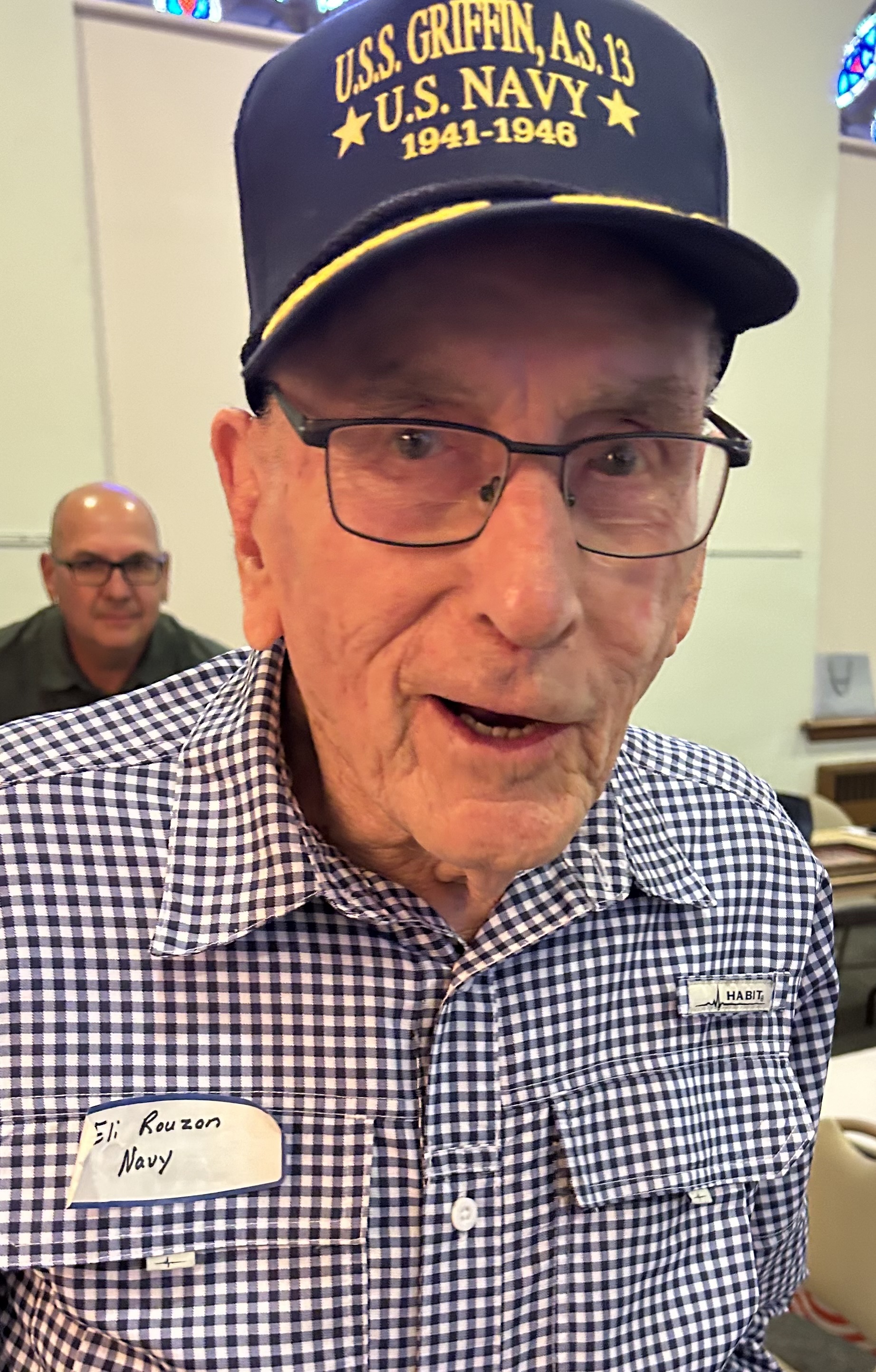
Pennsylvania World War II veterans, standing from left: Harry Bean (Army), Russell Sattazahn (Army), Frank Stellar (Army), Milton Ripple (Navy), Eli Rauzon (Navy) and Jacob Vanino (Army). Seated from left: Edward Conrad (Navy), Stanley Isenberg (Army Air Corps), Joseph Haenn (Army Air Corps), Rubino Degenhart (Army), Dorothy Trate (‘Rosie the Riveter’), William Balabanow (Merchant Marines), James Determan (Army), Edward Czechowski (Navy), and Robert Pearce (Navy).
—
It was a stirring sight. Fourteen World War II veterans and a “Rosie the Riveter,” all around a hundred years old and beyond, including one gentleman of 108, were gathered last Friday at a church hall in Emmaus, Pennsylvania. The event marked the 80th anniversary of V-J Day, August 15, 1945, which celebrated the end of fighting against Japan.
Besides newspaper and TV coverage, dozens of people had come to meet and talk with these last survivors of the Greatest Generation. Only about 66,000 of the 16 million Americans who served in the war are still living. About 3,900 are Pennsylvanians.
My friend Meta Binder of Lehigh Valley Chapter 55 of the Battle of the Bulge Association had organized this salute at St. John’s Lutheran Church. The group’s president, another good friend, Steve Savage, had flown up from his new home in Florida to be there. Most of the honored guests had been gathered by 21-year-old Albright College student Tyler Boland, who has interviewed hundreds of World War II veterans so their stories will live on.
The vets were entertained with songs and dancing from the 1940s. A 10-year-old boy, James Papalia, who has written several books about a kid’s journey through time to World War II battles, read from his work.
I didn’t manage to speak with all of the vets. Here are the ones with whom I had that honor:
Haenn
Joseph Haenn of Telford, Montgomery County, at 108 is the oldest World War II veteran in Pennsylvania. An assistant crew chief in the Army Air Corps, he worked on B-24 Liberators with the 8th Air Force’s 467th Bomb Group in England.
Determan
James Determan, 102, of Lititz, Lancaster County, served with the Americal Division’s 182nd Infantry Regiment at Leyte Gulf and Cebu in the Philippines. He carried a Browning automatic rifle and was awarded a Bronze Star.
Czechowski
Edward Czechowski, 100, from Reading, was a gunner on the destroyer USS Saufley in the Pacific, including Iwo Jima, Guam, Leyte Gulf and Okinawa. He received a Silver Star for blowing apart a kamikaze as the Japanese plane was about to hit his ship.
Sattazahn
Russell Sattazahn, 99, from Schaefferstown, Lebanon County, served with the 1st Infantry Division. In March 1945, he was severely wounded in Germany. He received two Bronze Stars and a Purple Heart.
Trate
Dorothy Trate, 103, from Narvon, Lancaster County, was a punch press operator at the Doehler-Jarvis plant in Pottstown, which built parts for warplanes.
Bean
Harry Bean, 99, from Norristown, was a bazooka operator with the 351st Infantry Regiment, 88th Infantry Division, who fought the Germans in Italy.
Pearce
Robert Pearce, 102, of Lower Macungie, Lehigh County, was a Navy weatherman with Fleet Air Wing 10 on Palawan in the Philippines. He went “typhoon hunting” in PB4Y-2 Privateers to gather weather data.
Rauzon
Eli Rauzon, 102, of Upper Macungie was a Navy electrical repairman on the submarine tender USS Griffin and worked on subs in Australia. He went on to serve in the Air Force during the Korean War and as a contractor for the Defense Department.
It was clear these and the other vets enjoyed getting the attention they richly deserve. As Meta Binder put it for The Morning Call of Allentown, “It is extremely important for their legacy to be preserved. … Let us never forget their sacrifices.”
William J. Holmes was born in Carbondale, in northeastern Pennsylvania.
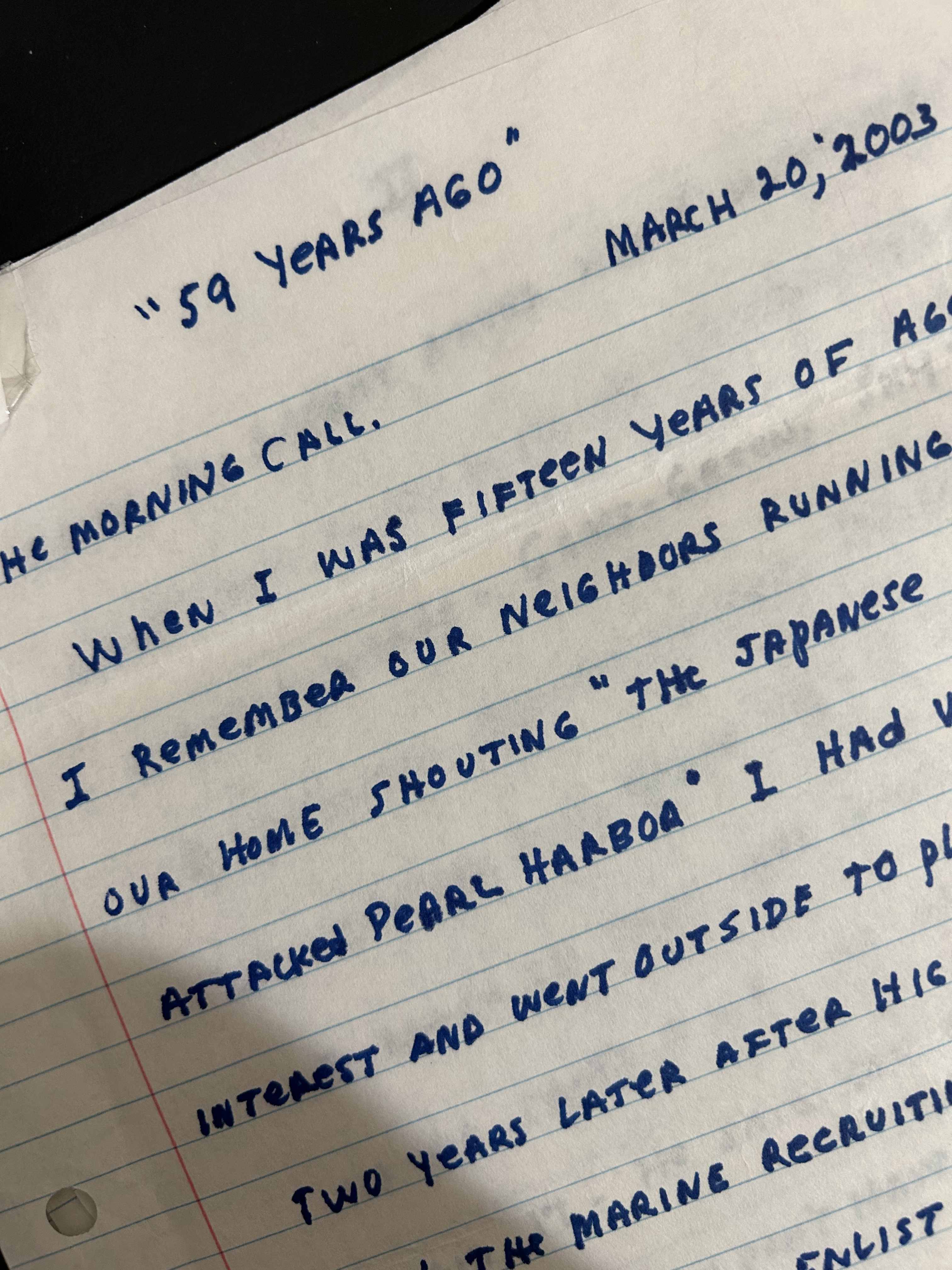
In 2003, William J. Holmes of Mertztown, Pennsylvania, wrote to The Morning Call of Allentown about his World War II service. His hand-printed, six-page letter landed on my desk.Itwasn’t published, and I don’t remember calling him about it.When I retired more than a dozen years later, his letter was among the papers I took home. It turned up yesterday while I was going through my files. Here is what Holmes wrote:
—
When I was 15 years of age, I remember our neighbors running into our home shouting, “The Japanese have attacked Pearl Harbor.” I had very little interest and went outside to play.
Two years later, after high school, I visited the Marine recruiting office in Wilkes-Barre, Pa., to enlist, as my older brother, John, was already in the Pacific since 1941 with the 2nd Marine Division. I passed all the written tests and was asked to repeat after him immediately what came to my mind as he mentioned certain words — grass-green, sky-blue, bird-wing, hammer-board. He stopped after board and asked why I said board.
I asked if that was wrong. He replied, “No, no that’s fine.” He asked my age. I said 17. He said, “You are not 17 1/2? I told him you don’t have to be 17 1/2 to join, just 17. He said for the last month the age was raised, as too many were enlisted in the Marines and this was temporary. In anger, he said: “If you want to join something, join the Navy. They take anybody.” I immediately walked a few blocks to the post office and was surprised that I could join for two years. This was because I would be in a reserve status for two years or duration of the war.
I had boot training at Bainbridge, Md., and was shipped to Treasure Island, Calif., a few week later. We were told that we would be on our way within 72 hours. We all laughed at this, as we were getting ready for meal time at 5 p.m. … Shortly, a Marine officer flew into the barracks and said: “Pack your seabags and be ready to go.” Someone asked about our meal, and he said: “You will eat on the ship.” While going under the Golden Gate Bridge, an officer told us, “The next time you pass under that bridge, you will either cry or be choked up. (He was right.)
Our first stop was Pearl Harbor. We dropped off 200 women Marines. … Next stop Enewitok, then Saipan, Ulithi and then the Philippines. I was attached to a repair-and-supply outfit. … All damaged ships that could make it to our area were repaired. Our ship was a converted Merchant Marine cargo-carrying vessel that held oxygen and blood plasma. These supplies from the States were loaded aboard, and we made periodic runs to Okinawa and back.
When the atom bomb was dropped, and we realized we would shortly get going home, there was a point system for leaving. Who were there the longest, had the most battle stars?
While waiting for my points, a group of American civilians asked if any of us would like to be flown home right away with a 30-day leave and sign up for another year. This was for Bikini A-bomb tests. I do not know to this day why I didn’t sign, although a lot did. I believe to this day that, had I been taken into the Marines instead of the Navy and had signed the Bikini paper, I may not have gotten back.
—
Holmes went on to serve in the Korean War. In civilian life, he worked as a letter carrier, a security guard at Lehigh Valley Hospital and as a police officer in Macungie. When he retired in 1992, he was a security guard for Kraft Foods. He was married with two sons.
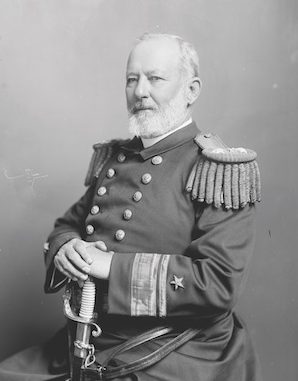
Rear Admiral Bancroft Gherardi of the U.S. Navy (IAVMuseum.org)
There was the Revolution and the War of 1812. But did you know we almost came to blows with Great Britain yet again?
Over a border in South America?
The Venezuelan crisis of 1895 is hardly mentioned anymore, but at the time, it was Page 1 news around the world. American newshounds wrote of a looming war with Britain. Speaking to the press, a famous U.S. admiral piped up that the first step should be to whip Canada.
The blow-up stemmed from a boundary dispute between Venezuela and the neighboring British colony of British Guiana, today’s Guyana. For decades, the Venezuelans argued that Britain claimed too much of their land. An 1835 survey commissioned by the British led to a boundary that gave Guiana an additional 30,000 square miles. It was called the Schomburgk Line after its surveyor. When gold was found in the disputed area, Britain snatched even more territory.
Robert Schomburgk (history.state.gov)
Fuming over these land grabs, Venezuela asked the U.S. for help and pointed to the Monroe Doctrine. That’s the U.S. policy that warned European powers against meddling in the Americas. If they did, it could be considered a hostile act.
Venezuelans wanted the U.S. to sponsor arbitration or use force against the Brits, but neither happened. Years passed before Washington flexed its muscle.
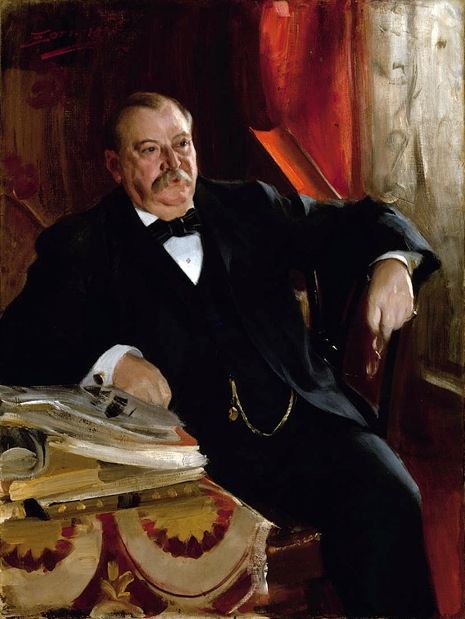
In 1895, invoking the Monroe Doctrine, newly appointed U.S. Secretary of State Richard Olney sent a strongly worded note to British Prime Minister and Foreign Secretary Lord Salisbury, demanding that the British submit the boundary dispute to arbitration. Salisbury’s response was that the Monroe Doctrine had no validity as international law. The United States found that response unacceptable, and in December 1895, President Grover Cleveland asked Congress for authorization to appoint a boundary commission, proposing that the commission’s findings be enforced “by every means.” Congress passed the measure unanimously, and talk of war with Great Britain began to circulate in the U.S. press.
If it came to war, how could the U.S. win?
A high-ranking Navy veteran of the Civil War spoke up. He was retired Rear Admiral Bancroft Gherardi, hailed as “the most prominent Italian-American naval officer of the 19th century.” A reporter interviewed him at his home in Stratford, Connecticut.
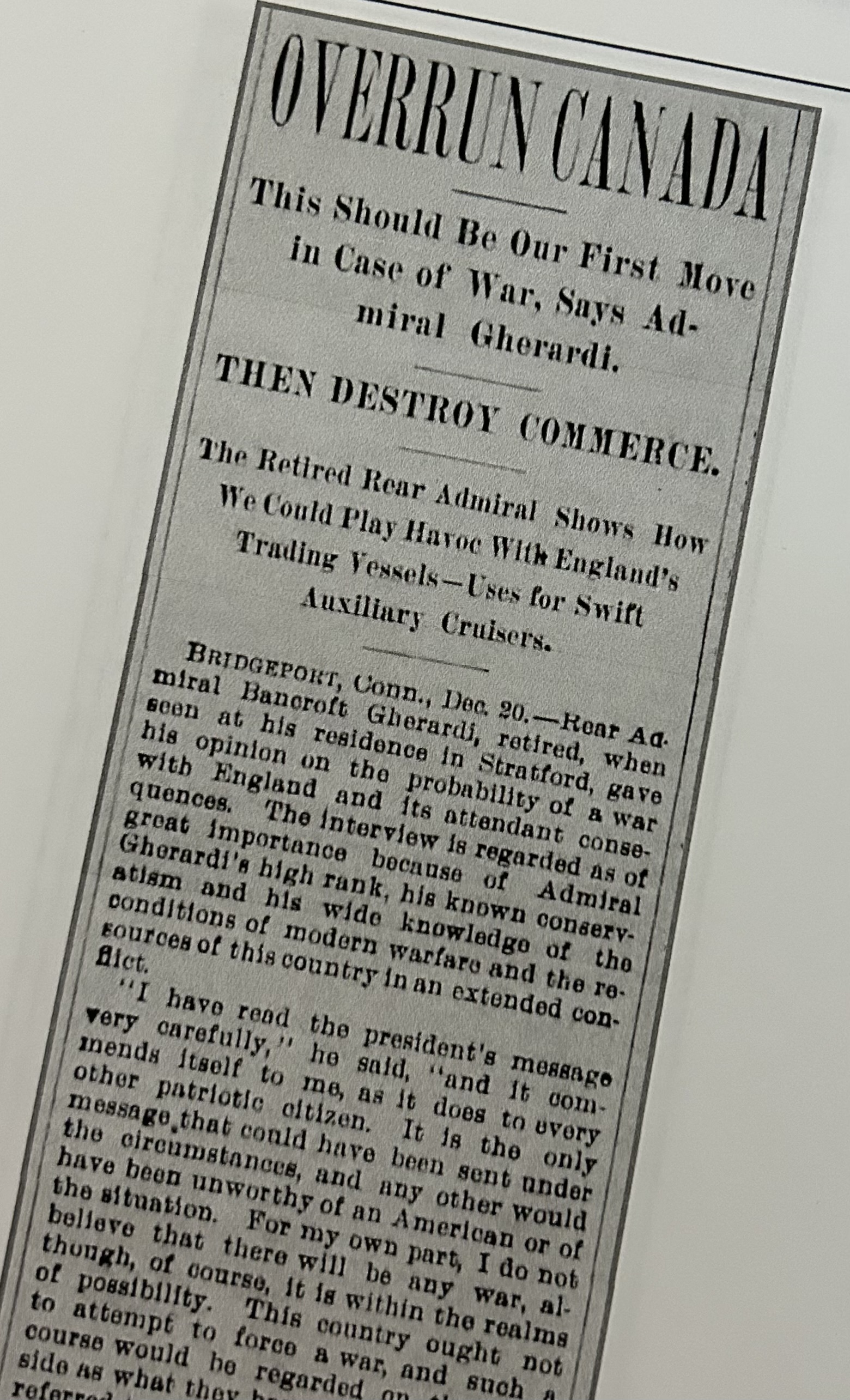
Gherardi interview in the December 20, 1895, edition of The Buffalo News (Newspapers.com)
“Our first act in the event of war ought to be to overrun Canada,” Gherardi said, “and then throw upon the seas every possible commerce destroyer that we can muster.”
U.S. cruisers would disrupt British trade, he said, and bring London to its knees.
But invading our neighbors to the north, a dominion of the British Empire, and tangling with British merchant vessels probably wouldn’t be necessary, Gherardi said. After all, war with Britain was unlikely.
“I think England’s trade interests will forbid it. She is dependent upon all the world for her raw material, and of this she gets enormous supplies from us. She simply could not live if her markets were cut off from her.”
The widely read interview with Gherardi didn’t have anything more on Canada. In a separate story, a fellow rear admiral named Oscar F. Stanton added a little:
“In case of war, our coast defenses need to be put in better order. As commerce destroyers, our navy could be of great effect, but the long range of coast would expose many cities to an enemy’s guns and with little protection. Canada — oh yes, we could take Canada, and hold it too; our torpedo boats and rams could be utilized to protect American ports and shipping, and more of the former could be speedily built if necessary.”
When U.S. politician and railroad lawyer Chauncey M. Depew said Canada would be easy pickings, The Globe newspaper of London fired back: “The overwhelming naval strength of England would enable her to pour troops into Canada at any sight of danger. Small warships could be sent to the lakes, and Chicago, Detroit and Buffalo would be utterly at their mercy.”
Does Americans’ picking on Canada sound familiar? It should, since the current occupant of the White House has talked about making it the 51st state.
—
Admiral Gherardi was right that there would be no war, as tensions eased. The State Department’s “Milestones” column summarizes what happened:
Great Britain, under pressure in South Africa with the Boers and managing an empire that spanned the globe, could ill afford another conflict. Lord Salisbury’s government submitted the dispute to the American boundary commission and said nothing else of the Monroe Doctrine. Venezuela enthusiastically submitted to arbitration, certain that the commission would decide in its favor. However, when the commission finally rendered a decision on October 3, 1899, it directed that the border follow the Schomburgk Line. Although a rejection of Great Britain’s increasingly extravagant claims, the ruling preserved the 1835 demarcation. Disappointed, the Venezuelans quietly ratified the commission’s finding.
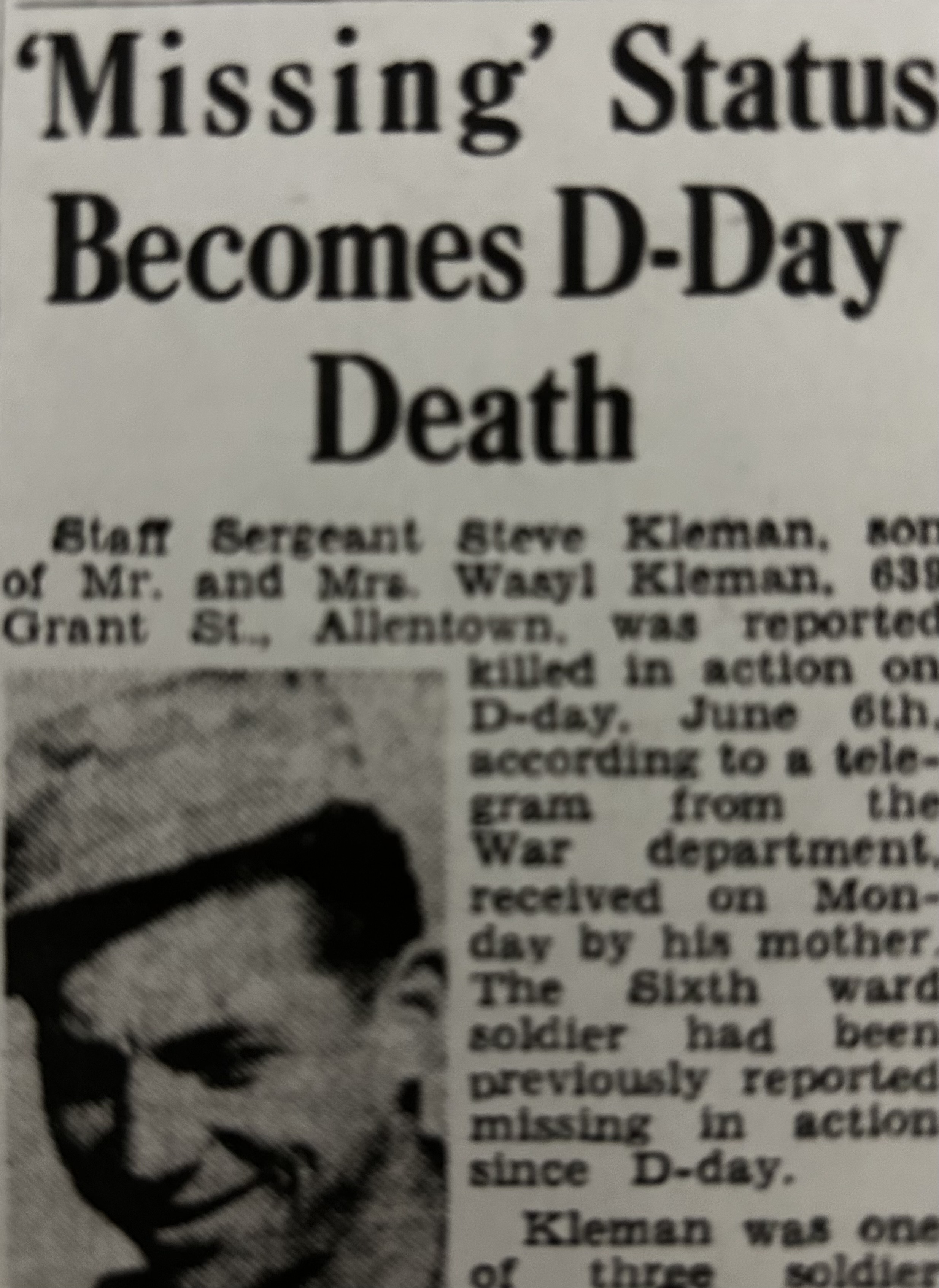
In civilian life, Steve Kleman machined parts for Mack trucks in his hometown of Allentown, Pennsylvania. Transformed into a soldier for World War II, he helped lead a unit of combat engineers onto Omaha Beach early on D-Day, the epic invasion of Nazi-occupied France on June 6, 1944.
“The landings were made under heavy mortar, artillery, and machine gun fire inasmuch as no infantry had preceded the landing of the engineers on Dog Green and part of Dog White beach.”
That’s from the after action report of the 121st Engineer Combat Battalion, 29th Infantry Division.
Staff Sergeant Kleman and the 40 other men of the battalion’s 2nd Platoon, Company B, neared the Normandy beach in an LCM, a landing craft mechanized, about 6 a.m. Each engineer carried satchel charges of TNT, a Bangalore torpedo, a rifle and full field pack. Melvin B. Farrell, who was on the craft, described what happened:
About 200 yards out, our LCM floundered, nosed up on a hidden sandbar and stuck fast. The operator seesawed back and forth, but she wouldn’t give. The machine gun fire rattling off the sides set up such a din of noise you could hardly think. The operator threw the ramp down and yelled, “Hit it!”
I was the third man out. We three wheeled left and jumped off the side of the ramp. Machine gun fire was now raking the inside of the LCM, and a high percentage of our men were killed before they could get out.
Melvin B. Farrell (6juin1944.com)
When the first three of us jumped, we landed in a shell hole, and what with all the luggage, we had plummeted to the bottom like a rock. We walked along the bottom until we climbed out of the hole. It seemed an eternity before we reached the surface. We were then on the barren sand, but there was another stretch of water between us and the beach. This stretch contained a maze of tank traps, mines and every object the Krauts could plant to thwart a landing attempt.
It all seemed unreal, a sort of dreaming while awake, men were screaming and dying all around me. I’ve often wondered if all the men prayed as fervently as I did.
The engineers’ immediate job was to blow up a masonry wall so tanks could get through.
Farrell made his way around tripwires attached to a Tellermine and blew a 20-foot gap in a tangled mess of barbed wire. He reached the wall, threw his satchel charges onto it and crawled to safety just before the explosion. As he and others huddled behind the wall’s wreckage, he looked toward the water where the first wave of infantry was about to land and saw his sergeant, Steve Kleman.
—
Kleman was the third of four children born to immigrants from Austrian Galicia. His parents, Wasyl Kleman and Anna Bujar, were married in 1915 in Allentown. Steve had a sister, Stella, and brothers Walter and Joseph. The family lived in the 6th Ward, between the Jordan Creek and Lehigh River. For much of his life in the city, Wasyl was a sweeper in a Mack Trucks machine shop.
Steve Kleman belonged to Boys Haven, which sought to steer kids away from delinquency, “to teach young people properly in their social hours, thereby acquiring the knowledge of what is the right and safe thing for young boys to do.” A 1944 story in The Morning Call says he attended Allentown High School, but I couldn’t find any mention of him in old school yearbooks.
In 1938, when he was 18, Kleman toiled out west for the Civilian Conservation Corps. At 6 feet and 185 pounds, he was suitably built for the work.
The Army called him in March 1942 while he was a turret lathe operator at Mack. Training followed at Camp Blanding, Florida. He left for England via Camp Kilmer, New Jersey, in the fall of 1943 and wrote to his parents that he arrived on October 12. The buildup for the Normandy invasion was underway. Kleman had seven months to get ready.
His brothers were in the war as well. Joseph was an Army private in Europe and Walter a Navy seaman on the aircraft carrier Ticonderoga in the Pacific. Both would survive.
A landing craft carries U.S. troops to Omaha Beach on June 6, 1944.
At 1 a.m. June 6 aboard a ship in the English Channel, according to Farrell’s account, the engineers were rousted and had breakfast of toast and coffee. A half-hour later, they began boarding the landing craft for transport to the beach. The channel was exceedingly rough.
“Waves would throw the LCM up out of the water, and it would slam down with a bone-breaking jar. Every man jack of us were so seasick we had regurgitated on ourselves and everyone around us by 5 a.m.”
Farrell got safely ashore despite a torrent of German machine gun fire. He and other engineers succeeded in blowing up the masonry wall, about four feet high and four feet thick.
“At this time our initial mission was completed, so we huddled behind the ragged remnants of the wall we had just blown. I turned my gaze toward the coming infantry and saw my sergeant, Steve Kleman, not 40 yards from me. He was sitting down, had been hit through both hips. I tried four times to get out to him to drag him in. Each time I left cover, a hail of machine gun fire would drive me back. By this time he had been hit so many times, it was hopeless.”
The battalion’s after action report notes: “It is estimated that 50% of this initial force were casualties, and 75% of the equipment was lost.”
—
July 26, 1944, story in The Morning Call of Allentown (Newspapers.com)
Within two weeks, Kleman’s parents got a telegram from the War Department saying he had been missing in action since D-Day. A follow-up telegram near the end of July reported he was killed June 6. His parents received their 24-year-old son’s last letter four days after his death.
St. Mary’s Ukrainian Orthodox Church, where his family worshiped and his father helped lead a war bonds drive, held a memorial Mass for Kleman on July 30.
In 1948, his remains were brought home. Military honors greeted him at a service led by Veterans of Foreign Wars Post 13 of Greater Allentown, and another Mass was said for him at St. Mary’s. He now lies in the parish cemetery.
Lieutenant Commander Edward N. Little after Fukuoka Camp 17 was liberated in September 1945 (National Archives)
An American naval officer and former POW was court-martialed after World War II on charges he collaborated with the Japanese. More than two dozen witnesses spoke against Lieutenant Commander Edward N. Little. One prison camp survivor, a soldier from Pennsylvania’s coal country, gave off-the-record testimony that wasn’t part of the trial. I’m going to share it with you.
Little was the highest-ranking Navy officer at Fukuoka Camp 17 on Japan’s Kyushu Island. He was in charge of the prisoners’ mess hall.
Fellow ex-prisoners said Little ate more than his share of food from Red Cross parcels, threw away edible rice as a punishment, deprived POWs of meals, beat a U.S. Army corporal and ordered the beating of another, reported four prisoners to the Japanese for stealing or selling food, two of whom were killed.
An online National Archives post gives a thorough account of Little’s case, detailing the charges against him, how he defended himself, and what became of him. It was written in 2018 by archives technician William Green. You can read it here.
Green’s source was the court-martial record of Little’s 1947 trial, which takes up 2,066 pages. I have it on a compact disc, which I got many years ago from the Department of the Navy’s Office of the Judge Advocate General. I’d been working on a story about POW Joseph L. Szczepanski, an Army Air Corps sergeant and onetime amateur boxer from Nanticoke who served in the Philippines.
Joe Szczepanski handles a canister of chemicals on Oahu, Hawaii, in 1938. At the time, he was serving with Company A, 1st Separate Chemical Warfare Systems Battalion.
Szczepanski, a clerk at Nichols Field outside Manila, was taken prisoner in April 1942 and walked in the Bataan Death March. He was held at Cabanatuan Camp 1 on Luzon and then at Fukuoka, where he was forced to work in a coal mine near Omuta. I wrote about him for The Morning Call of Allentown in 2009 and again in 2020, after his son Rick went to Japan to see where his father had been enslaved.
It was at Fukuoka that Sergeant Szczepanski came to revile Lieutenant Commander Little.
Later as a free man, Szczepanski testified for the War Crimes Office of the War Department about Japanese atrocities and mistreatment of prisoners. He was interviewed on April 1, 1947, in Larksville, Pennsylvania, near his hometown, by Special Agent Don B. Berntson of the Counter Intelligence Corps.
After Szczepanski died in 2005, Rick wrote to the National Personnel Records Center in St. Louis for his dad’s military file. He was surprised to get the report of Joe’s war-crimes testimony, in which he told of his own horrific experiences and complained bitterly about Little.
But Joe Szczepanski wouldn’t go on the record about the Navy officer, so Berntson wrote a separate, confidential report on which he listed Szczepanski as “reliable.” He noted Szczepanski thought Little had been tried and convicted “for his treason-like actions.” In fact, Little’s court-martial had begun in January 1947 and was still underway in Washington, D.C., at the time Berntson interviewed Szczepanski.
Szczepanski in 1946 at Valley Forge General Hospital after surgery on his broken nose. He spent 18 months recuperating from illnesses and injuries he suffered as a POW. The other man is unidentified.
Here is Berntson’s report:
CONFIDENTIAL War Department Counter Intelligence Corps Scranton, Pennsylvania 1 April 1947 Subject: Collaboration with Japanese during World War II by Navy Lieut. LITTLE, USN.
Summary of Information:
During war crime testimony of Sgt. JOSEPH L. SZCZEPANSKI … he related how at Fukuoka POW Camp No. 17, Japan, a U.S. Naval Lieutenant by the name of LITTLE had collaborated with the enemy, thus costing the lives of two American soldiers and causing severe beatings to a number of other American soldiers in order to make his own position with the Japanese solid and luxurious. SZCZEPANSKI stated that he did not want his name mentioned in connection with Lt. LITTLE’s criminal deeds and that he did not want it to become part of his regular testimony on conditions at Fukuoka Camp No. 17. He stated that he believes that Lt. LITTLE was court-martialed by the U.S. Navy at Brooklyn, N.Y., and that he was sentenced to twenty years in prison for his treason-like actions during the war.
The 1947 report on Szczepanski’s off-the-record testimony against Little
SZCZEPANSKI related how a pugilistic soldier from the 4th U.S. Marines, called “Jimmy the Greek” PAVLOCKAS, of either Detroit or Chicago, had never gotten along very well with Lt. LITTLE because of Lt. LITTLE’s being a “general bully” [who] considered no one’s welfare except his own and that of the Japanese. In November 1943, Jimmy the Greek was apprehended by Lt. LITTLE while trading his rice for cigarettes. He was in a group of soldiers doing the same thing, but Lt. LITTLE singled him out of the group, and rather than to take him before Major JOHN [R.] MAMEROW, USAAF (now of March Field, California), he took him to the Japanese camp commander who ordered PAVLOCKAS to a dungeon in 22- to 24-degree temperatures, clad in only pants and shirt and fed a half cup of rice and one cup of water per day. Thirty-nine days later PAVLOCKAS died of hunger and exposure.
SZCZEPANSKI related how an American soldier, NOAH C. HURD, had stolen food from the Red Cross warehouse due to the fact that the Japanese did not distribute it anyway. He was apprehended by LITTLE about June 1944 and subsequently taken to the Japanese camp commander, KEN YURI, who personally tried HURD and personally beheaded him with a samurai sword in the presence of a Lt. PERKINS, a Lt. CHRISTY, and a Lt. [Owen W.] ROMAINE of the U.S. Army. LITTLE was also responsible for the beating death of a U.S. Army Corporal KNIGHT following his stealing rice. He was beaten to death in a Jap guard house by guards and by the then-camp commander of Fukuoka No. 17, Captain ISAO FUKIHARA.
LITTLE also threatened death to Corporal SAMUEL SHULMAN, AAF, of New York City when he took offense at remarks made by LITTLE on one occasion.
My 2009 story about Szczepanski in The Morning Call of Allentown. It was based on interviews with his son Rick.
LITTLE was also responsible for the starving of an American soldier by the name of MONTOYA, believed to be from New Mexico, when he had received a stolen jacket from someone.
LITTLE had also reputedly told the Japanese that a half-bowl of rice was sufficient for the American soldiers when Major MAMEROW had attempted to have the Japanese increase the rations instead of to lessen them. LITTLE also took the initiative to prohibit smoking in the mess hall by U.S. Army personnel.
It is believed that LITTLE is a native of California and that his wife is a native of Brooklyn, N.Y.
Corporal JACK KUCHNER, of the Bronx, N.Y.C., can corroborate this aforementioned report together with the aforementioned U.S. Army officers and noncommissioned officers listed herein. Capt. HOWARD HEWLETT, U.S. Army Medical Corps, can also corroborate this testimony.
Don B. Berntson Special Agent Counter Intelligence Corps
The report misspells the names of Schulman, Fukuhara, Kei Yuri, Charles P. Christie and James G. Pavlakos, a Marine corporal. … Hurd’s correct name was Noah C. Heard. An Army corporal, he was beaten and killed in May 1944. Accounts of his execution differed. Some POWs said he was bayoneted to death, while Szczepanski and others said he was beheaded. … It’s not clear whether Szczepanski is referring to Benjamin or Horacio Montoya. Both brothers were at the Fukuoka camp and survived. … William N. Knight, an Army private, was starved and beaten to death. … Howard Hewlett appears to have been Thomas H. Hewlett. … Little was from Monrovia, California. … USAAF stands for U.S. Army Air Forces.
—
Szczepanski wasn’t alone in his hostility toward Little. In the court-martial, 31 witnesses testified against the commander. Among them was Schulman, an Army technical sergeant, who told the nine Navy officers hearing the case:
Entries in Szczepanski’s diary after he was freed from Fukuoka Camp 17 in Japan. He had been shipped there in July 1943 after more than a year at Cabanatuan Camp 1 on Luzon. The Fukuoka camp was liberated on September 2, 1945.
“Mr. Little was in charge of the mess hall. He had — and he wielded — a mighty stick. He had the full cooperation of the Japanese behind him. He can get just about anything he wanted from the Japanese. The Japanese liked Mr. Little, because they sure saved him a lot of guards and a lot of work, and the men were scared of Mr. Little because they knew that if they went against Mr. Little, he could cause trouble for them.
“Every man hated him in that camp. There wasn’t a one that didn’t hate him, including myself.”
Little and 42 others testified on his behalf. The defense argued he had not broken Navy regulations, which call for punishment “of any person in the Navy who refuses or fails to use his utmost exertions to detect, apprehend, and bring to punishment all offenders, or to aid all persons appointed for that purpose.” So, the argument went, Little had a duty to report offenders.
In June 1947, after five months of trial, he was found not guilty of the three charges against him — conduct unbecoming an officer and a gentleman, maltreatment of a person subject to his orders, and conduct to the prejudice of good order and discipline – plus 22 additional specifications.
—
As a POW, Szczepanski suffered from dry beriberi, dysentery, malaria, parasites in his blood, a hernia, a broken nose, a busted jaw with loss of teeth, and a broken instep from purposely crushing his foot with a chunk of coal to get out of work in the Omuta mine. Decades of mental and emotional stress followed.
He made a career of teaching Spanish at Bethlehem Catholic High School and died at 86.
“Dad never really got over what took place in the prison camps, until in the mid-1980s he finally let go,” Rick Szczepanski told me. “It didn’t bother him anymore.”
Here’s how that came about: At the Holocaust program 15 years ago, I interviewed a Dachau liberator, Don Burdick, on the auditorium stage. I had written about him for The Morning Call. Now I was invited back to join in commemorating the Jewish victims of Nazi Germany 80 years after its defeat. My wife came with me.
And here’s what I said:
Don in 1944 at home on furlough in Carbondale, Pa.
—
I knew Don Burdick from lunches of the Battle of the Bulge veterans. I’d go there to meet the vets, hear their stories and write about them. Don always wore a jacket and tie to these meetings and, in his rich, full voice, said the opening prayer.
His story was compelling. He was among the U.S. troops surrounded by the Germans at Bastogne. He was among the first Americans to enter Dachau. He took pictures there that he kept for always.
On the advice of The Morning Call’s editor, I split up Don’s story. His account of the Bulge ran during the battle’s anniversary in December 2008. His photos of the dead ran the following April with my story about his Dachau experience.
A photo Don took at Dachau in April 1945. He used a Voigtlander 35mm camera he had picked up in Germany.
It was in April 1945 that Don’s unit – a field artillery observation battalion – reached the camp near Munich. He was 21, a private first class. He carried a German camera he had picked up along the way.
The following is from the transcript of my interviews with him:
There was a noxious odor in the air. I said, “Smells like something rotten.”
Coming into Dachau, the closer you got, the stronger the odor was. It was putrid. As we were coming down this particular road, there were piles of bodies like you would stack lumber. The Germans had put quicklime on them to burn up the flesh. … The smell and sight of decaying bodies was gut-wrenching. I was sick to my stomach for days after that.
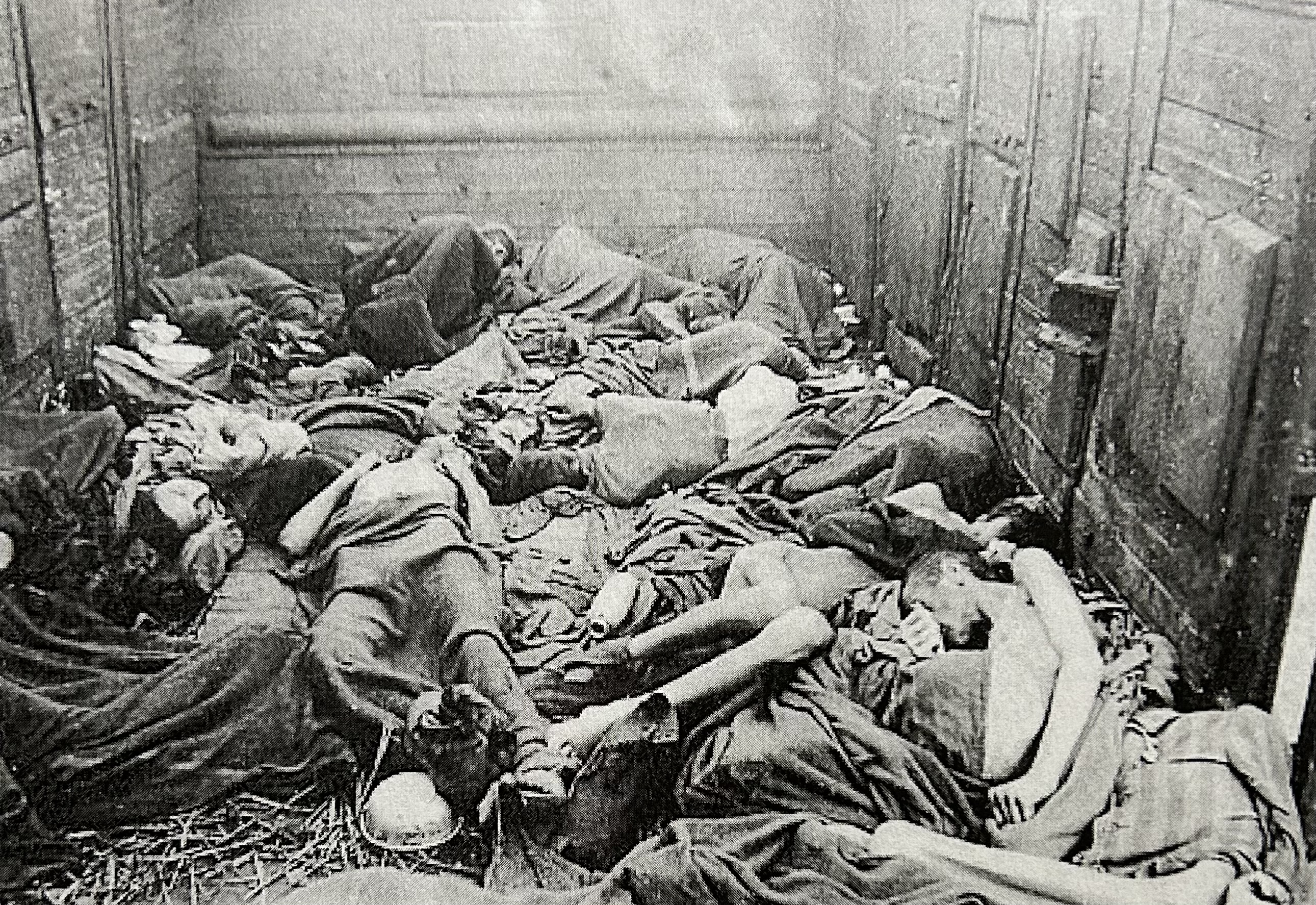
Don’s photo of U.S. Army troops inspecting rail cars holding the dead at Dachau
There were people clinging to the fences. They were emaciated, hardly covered with clothes. One building we looked at, we could see bodies piled like a pyramid. A guy said, “The only way we’re going to get them out is to bulldoze the building.”
I was so disgusted at what I was seeing. For me to explain this to somebody else, I felt the best way to do this was to take pictures. … When I developed the pictures, I knew that I had my evidence that I could support the fact that this was an atrocity, that it was a concentration camp, and I could verify what I had seen.
—
Reader response was immediate. It was in line with Don’s commitment to get the word out to as many people as possible.
The second of two parts of Don’s Battle of the Bulge story in December 2008: He was with Battery B, 16th Field Artillery Observation Battalion.
An English as a Second Language teacher at Allen High School said his students were reading the diary of Anne Frank and he’d be using Don’s story in his class. He wrote: “I think it would be a very enriching experience for these students to see how the Holocaust impacted and still does impact people, even within this community.”
When I passed this message on to Don, he offered to visit the class.
An English teacher at Northeast Middle School in Bethlehem asked if Don would speak to her eighth-graders. She wanted to prepare them for a visit from Auschwitz survivor Julius Jacobs. She wrote: “There’s no better way to help our students connect with history and truly understand it than hearing it firsthand.”
Yes, Don spoke to her classes. And in 2010, with me at his side, he spoke here for the Holocaust remembrance.
As a former teacher, Don aced these appearances. He had a presence and a keen ability to communicate. I’m glad I met him, became his friend and helped get his Dachau story out.
My April 2009 story about Don’s experience at Dachau. It included photos he took at the Nazi camp.
He had been at the camp for just one day, a soldier passing through early on. The gaunt survivors, he noted, weren’t being cared for. He didn’t see any medics while he was there. The suffering and death troubled him for a lifetime.
“I couldn’t believe that the human race could annihilate people in this atrocious way,” he said. “I had no idea the Germans would go to the length they did at Dachau.”
Don died eight years ago at his home in Forks Township. He was 93. His witness to the Holocaust will live on.
Louie Venditti’s home movies from June 1969, when his son Nicky was about to leave for the Vietnam War
My cousin Nicky, 20 years old, is home on leave in Malvern, Pennsylvania. He wears the wings he has just earned as an Army helicopter pilot and is bound for Vietnam. It’s June 1969.
Uncle Louie, an Army Air Corps ground crewman in England during World War II, is immensely proud of his son. He takes Nicky, in his uniform, to the VFW and American Legion posts to meet his buddies. He snaps photos of Nicky and shoots film of him with his home-movie camera.
Nicky is embarrassed but goes along with the fuss to make his dad happy. All the while, he is terrified of going to the war. He insists to his closest friends that he won’t be coming back alive.
—
Over the years, I’ve posted photos of Nicky taken during his 23 days of leave. Now for the first time, I’m showing video from the home movies Louie shot on three reels of 8-millimeter film. More than soundless images of a soldier, they are a snippet of ’60s small-town America.
The first image you’ll see is Nicky smiling at the camera from a picnic table outside his home. The young man wearing sunglasses is Nicky’s stepbrother, Joe Gray. The two other men are friends of the family. The woman is my Aunt Bert, Nicky’s stepmom. She and Nicky were close. The hip-swiveler is Uncle Louie, a rascal and lots of fun. The young woman with Nicky is his fiance, 18-year-old Terri Pezick. The other couple in the yard is my cousin Mike Beam and his wife, Monica. The pea-green car going down the street is Nicky’s ’68 Camaro SS. Finally, the husky guy with sideburns is Nicky’s best pal in Malvern, Charley Boehmler.
Uncle Louie with Nicky at home in Malvern, Pennsylvania, in the last days before Nicky’s departure. (They spelled their last name, Venditti, differently from mine.)
The night before Nicky left for Vietnam, Charley told him that he shouldn’t worry about getting killed. “You’re always lucky,” he said.
—
Warrant Officer Nicholas L. Venditti arrived in Vietnam on the Fourth of July 1969. Six days later, as part of his Americal Division orientation on the U.S. base at Chu Lai, he was in a class on grenade safety when the instructor unwittingly let loose a live grenade. Nicky lost his left leg below the knee. He died July 15 in Chu Lai’s 312th Evacuation Hospital, on a bluff above the South China Sea. He had survived only 11 days in Vietnam.
Uncle Louie died of heart failure in 1996 at age 72. Aunt Bert found the home movies in a shoe box in the attic and gave them to me. She once asked Louie about them, and he had said only, “I’m never going to look at those.”
Terri Pezick honored Nicky’s request that she live happily if he didn’t return. She married and had two sons. Charley Boehmler died of cancer in 1999, when he was 50. Aunt Bert died in 2006 at 81.



















 David Venditta