
(IAVMuseum.org)
There was the Revolution and the War of 1812. But did you know we almost came to blows with Great Britain yet again?
Over a border in South America?
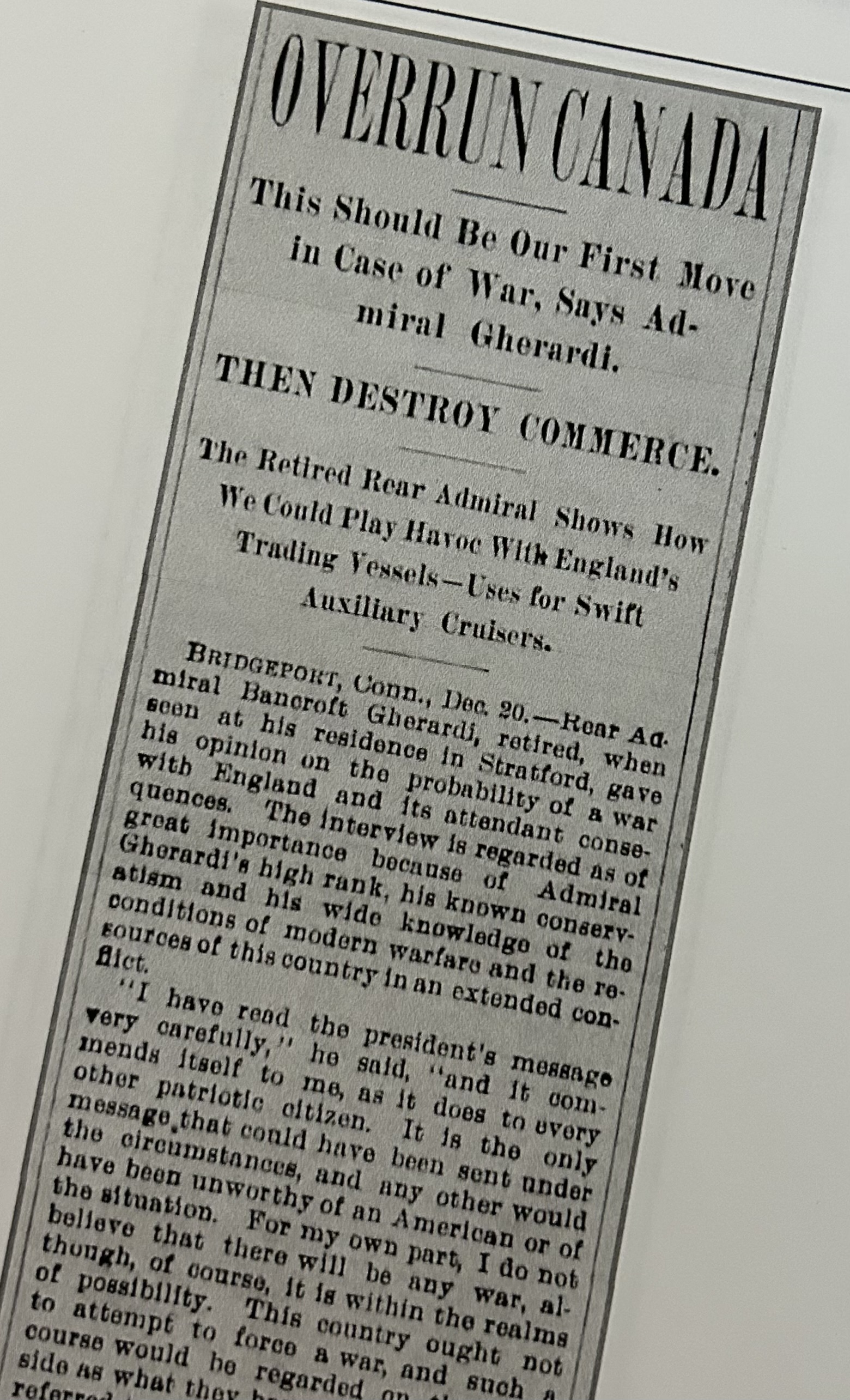
The Venezuelan crisis of 1895 is hardly mentioned anymore, but at the time, it was Page 1 news around the world. American newshounds wrote of a looming war with Britain. Speaking to the press, a famous U.S. admiral piped up that the first step should be to whip Canada.
The blow-up stemmed from a boundary dispute between Venezuela and the neighboring British colony of British Guiana, today’s Guyana. For decades, the Venezuelans argued that Britain claimed too much of their land. An 1835 survey commissioned by the British led to a boundary that gave Guiana an additional 30,000 square miles. It was called the Schomburgk Line after its surveyor. When gold was found in the disputed area, Britain snatched even more territory.

(history.state.gov)
Fuming over these land grabs, Venezuela asked the U.S. for help and pointed to the Monroe Doctrine. That’s the U.S. policy that warned European powers against meddling in the Americas. If they did, it could be considered a hostile act.
Venezuelans wanted the U.S. to sponsor arbitration or use force against the Brits, but neither happened. Years passed before Washington flexed its muscle.
This from the U.S. State Department’s “Milestones in the History of U.S. Foreign Relations”:
(npg.si.edu)
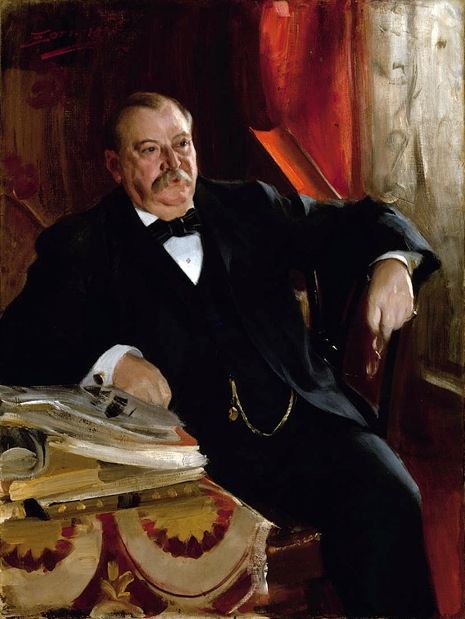
In 1895, invoking the Monroe Doctrine, newly appointed U.S. Secretary of State Richard Olney sent a strongly worded note to British Prime Minister and Foreign Secretary Lord Salisbury, demanding that the British submit the boundary dispute to arbitration. Salisbury’s response was that the Monroe Doctrine had no validity as international law. The United States found that response unacceptable, and in December 1895, President Grover Cleveland asked Congress for authorization to appoint a boundary commission, proposing that the commission’s findings be enforced “by every means.” Congress passed the measure unanimously, and talk of war with Great Britain began to circulate in the U.S. press.
If it came to war, how could the U.S. win?
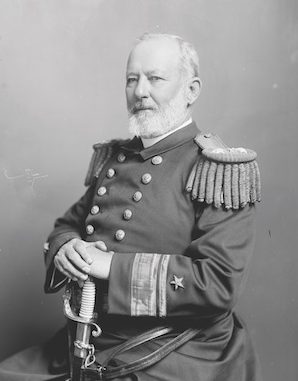
A high-ranking Navy veteran of the Civil War spoke up. He was retired Rear Admiral Bancroft Gherardi, hailed as “the most prominent Italian-American naval officer of the 19th century.” A reporter interviewed him at his home in Stratford, Connecticut.
(Newspapers.com)
“Our first act in the event of war ought to be to overrun Canada,” Gherardi said, “and then throw upon the seas every possible commerce destroyer that we can muster.”
U.S. cruisers would disrupt British trade, he said, and bring London to its knees.
But invading our neighbors to the north, a dominion of the British Empire, and tangling with British merchant vessels probably wouldn’t be necessary, Gherardi said. After all, war with Britain was unlikely.
“I think England’s trade interests will forbid it. She is dependent upon all the world for her raw material, and of this she gets enormous supplies from us. She simply could not live if her markets were cut off from her.”
The widely read interview with Gherardi didn’t have anything more on Canada. In a separate story, a fellow rear admiral named Oscar F. Stanton added a little:
“In case of war, our coast defenses need to be put in better order. As commerce destroyers, our navy could be of great effect, but the long range of coast would expose many cities to an enemy’s guns and with little protection. Canada — oh yes, we could take Canada, and hold it too; our torpedo boats and rams could be utilized to protect American ports and shipping, and more of the former could be speedily built if necessary.”
When U.S. politician and railroad lawyer Chauncey M. Depew said Canada would be easy pickings, The Globe newspaper of London fired back: “The overwhelming naval strength of England would enable her to pour troops into Canada at any sight of danger. Small warships could be sent to the lakes, and Chicago, Detroit and Buffalo would be utterly at their mercy.”
Does Americans’ picking on Canada sound familiar? It should, since the current occupant of the White House has talked about making it the 51st state.
—
Admiral Gherardi was right that there would be no war, as tensions eased. The State Department’s “Milestones” column summarizes what happened:
Great Britain, under pressure in South Africa with the Boers and managing an empire that spanned the globe, could ill afford another conflict. Lord Salisbury’s government submitted the dispute to the American boundary commission and said nothing else of the Monroe Doctrine. Venezuela enthusiastically submitted to arbitration, certain that the commission would decide in its favor. However, when the commission finally rendered a decision on October 3, 1899, it directed that the border follow the Schomburgk Line. Although a rejection of Great Britain’s increasingly extravagant claims, the ruling preserved the 1835 demarcation. Disappointed, the Venezuelans quietly ratified the commission’s finding.
 David Venditta