Tag Archives: France

Rest in peace: 102-year-old D-Day survivor

World War II veteran Dick Schermerhorn in 2013
(The Morning Call)

Dick Schermerhorn was a 22-year-old Army corporal when he hit Utah Beach on D-Day. Originally from upstate New York, he moved to Allentown, Pennsylvania, after the war.

A dozen years ago, I interviewed him for an “in their own words” story about his experience on June 6, 1944, with the 531st Engineer Shore Regiment. Last Tuesday, Schermerhorn died at age 102. Again, I wrote about him for The Morning Call.

In tribute, here are excerpts from my initial interview with him in May 2013:

We had been in Plymouth [England]. We didn’t train there, but that’s where we were billeted. There was a town called Slapton Sands that was evacuated completely. We used to go a few miles out in the Channel and make a practice landing on this town. Somewhere I have a prayer book from the Church of England, and it has “Slapton Sands” on it.

D-Day, as far as you could see, there was all kinds of ships. As we got close to Normandy beach, we went down these rope ladders into the landing craft. It was still dark. We were packed in there like sardines. There must’ve been 35-40 of us. Anybody tells you they’re not scared, there’s something wrong with them. There was a medical officer on the landing craft with me, and I happened to turn around and look at him, and his face was as white as a sheet.

The main object of the 531st was to establish a beachhead. In other words, our thrust was not to make a landing and push the Germans and keep moving. We were there to make it easier for troops that were coming in. We had heavy equipment, we had ducks [amphibious trucks], we had different kinds of plows. We had Bangalore torpedoes to blow up entanglements.

We had impregnated clothing to prevent poison gas. We had a gas mask. We had to carry these heavy M-1s – I would’ve preferred a carbine, much lighter. I had a mine detector, it was waterproofed. It picked up every bolt, screw, nut.

[When the ramp went down,] some guys were hit. The water was up to our necks. I was in pretty good shape, so I could handle it. We were getting fired on, but not to the extent of our buddies on Omaha [Beach]. You could see bullets hitting the water. It was machine-gun fire. There were some dead in the water.

We were getting artillery fire. Every once in a while a Messerschmitt or some other plane would come in.

I can remember the first dead person I saw as I got to the beach. It shook me up. I looked at his dog tag and he was from New York State. His leg was off and he was still alive. He was in shock. There was no question he didn’t survive, because there were no medics around.

I ran in about 20 yards. We got in there and tried to get assembled, a group of us. The 4th Division was with us. We worked with them. As they were pushing the [German] troops back, we were trying to establish a landing place. Our job was to work minefields.

We lucked out on Utah. On Omaha, they had that cliff, and we didn’t have that. [But] it was dangerous. The Germans had been there so long, they had such a long time to work at this. They had the shoe mine. If you stepped on it, it would take the top of your foot off. Then they had mines that would explode waist-high and throw off ball bearings.

This fella from Clearfield, out past State College, he was my buddy. He was a mine detector too. We’d take turns. One guy would sweep and the other guy probes. When you get a reading, you’re still holding onto your mine detector, and the other guy has a bayonet, and he’d be digging to find out what it was.

Once in a while, you’d hear a ping as somebody was shooting at you.

You don’t always dig a mine out. If it was a tank mine, they had a handle on them. We would fasten something on the handle and pull the mine out. Ninety-nine times out of a hundred, nothing would happen. You got back a ways, because if it was booby-trapped, it would go off.

Practically in the beginning, we were sweeping this area. My buddy saw this paratrooper laying there dead. He said, “Dick, get that knife for me.” So I’m trying to get this off his belt, and I happened to turn my head, and I saw [Brigadier General Teddy Roosevelt Jr.] I could see the one star on his helmet and I got up quick, because he could accuse you of going through a guy’s pocket.  He was all alone like he was out for a Sunday walk.
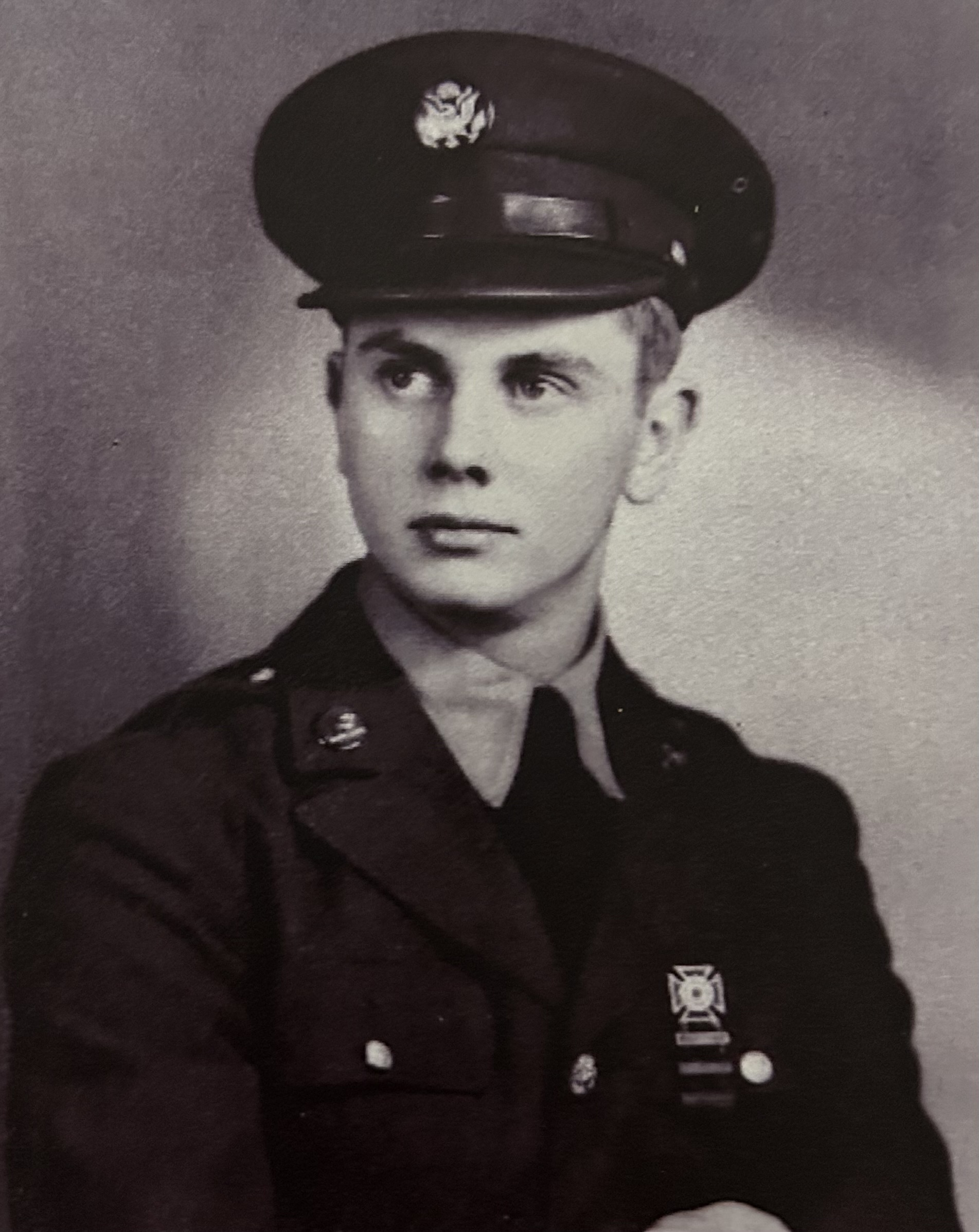
Schermerhorn was an amphibious engineer with the 531st Engineer Shore Regiment and later served with the 279th Combat Engineer Battalion.

Snipers were shooting. There was a wall along there and you could hear the bullets hitting the wall. And Roosevelt come up and he says, “You finding many mines, men?” I said, “No sir, not at this point.” Then he says, “Dammit, I thought there’d be millions of them.” There were, but we weren’t into the thick of them yet.

Last time I saw Roosevelt, frogmen were blowing up obstacles the Germans had in the water to prevent boats from coming in. The frogmen put up a purple flare when they had a charge, and you were supposed to hit the deck. This one time, lying prone, I look up and here’s Roosevelt standing there looking around, and he only wore his helmet liner.

I ended up clearing about a hundred mines on D-Day. When it got dark, we dug foxholes inland a little.

We had other duties, handling supplies. A lot of equipment was coming in. [In early August] when the tanks started coming in, we had pulled 24-hour duty without any rest, and we were sitting, three or four of us, and we were smoking, and [Lieutenant General George S. Patton] said, “Don’t you know there’s a war on?” He called us a bunch of old women. He said he was going to report us, but he never did.

We had a lot of trouble after D-Day, Navy guys coming looking for souvenirs, and they picked up stuff, and the Germans had a lot of stuff booby-trapped. Some of the guys got wounded or killed. Sometimes we had to go in a minefield to get them. At that time, there was no real action on the beach because the enemy had been pushed back. Our infantry and tanks had moved inland.

I was [on Utah Beach] about two months. Then I was transferred to the 279th Combat Engineers. There was three of us, the only veterans in the outfit. We went all the way into France, we went into Aachen – one of the first towns into Germany – Remagen area, Rhineland and all across northern Germany. Our task was to work with different infantry divisions with mines, explosives.

There are a lot of rivers in Germany, and one of our jobs was you had an assault boat and two engineers, one in front and one in the back, maybe 10 or 12 infantrymen in, and you’d go back and forth at night. And you’d let them off, and you’d come back. Of course the Germans were on the other side. We did that all the way across [Germany].

The last river we came to was the Elbe. We were stationed on the west bank and we stayed there until the war ended. Then we had a big problem.

See, the Russians were going to take Berlin, and the Germans knew this, and they were smart enough to know that things were over for them, and we had all these [Nazi] troops coming. They knew the American lines were to the west. We didn’t know what to do with them all. They wanted to give up. In time, it was taken care of, because they were put in prison camps.

Then we met up with the Russians, the wildest bunch of guys you ever saw.
A soldiers’ carol from Christmas film rings true

If you haven’t seen the French film Joyeux Noël, which came out 19 years ago and was nominated for an Oscar, now’s a good time. It’s a fictionalized account of the First World War’s unofficial Christmas truce of 1914, when troops paused their fighting along parts of the Western Front and met in no-man’s land for short-lived good fellowship. French, British, Belgian and German soldiers participated.

There’s a Christmas Eve scene in the film in which Scots start singing in their trench, within earshot of the Germans. The tune, a Scottish carol written for the movie and titled “L’Hymne des Fraternisés/I’m Dreaming of Home,” touched a multitude of hearts. Two years later, it was sung when Queen Elizabeth II rededicated the Canadian National Vimy Memorial in France. More than 15,000 visitors heard it, a crowd size not seen there since the memorial’s unveiling in 1936.

The ceremony marked the 90th anniversary of the Battle of Vimy Ridge, in which Canadians fought Germans on a hill a hundred miles north of Paris. By the end of those four days in April 1917, the Canadians had forced the enemy to pull back. Their success came at a cost of nearly 3,600 killed and some 7,000 wounded. For our neighbors to the north, the hard-won victory at Vimy Ridge remains a source of great pride.

The carol that helped commemorate the place on April 9, 2007, still resonates. A YouTube video of the performance has been viewed several hundred thousand times. Produced by the Canadian Broadcasting Corporation, it’s my favorite version of “I’m Dreaming of Home,” other than what’s in the film, so I’ve shared the link with friends over the years. My Australian pen pal Jennie observed: “The music is soothing. The expressions on the faces of the veterans suggest hard memories. And the singers and musicians look like they feel the sadness. It is a very moving tribute.”

Now, finally, I’m sharing the video here with you.

The soloist is Inuit singer Susan Aglukark, an Officer of the Order of Canada. With her is the Canadian Forces Band and the Confederation Centre of the Arts Youth Chorus from Charlottetown, capital of Prince Edward Island.

The song was composed by Philippe Rombi, with these lyrics by Lori Barth and Gary Lewis:

I hear the mountain birds
The sound of rivers singing
A song I’ve often heard
It flows through me now
So clear and so loud
I stand where I am
And forever I’m dreaming of home
I feel so alone, I’m dreaming of home


It’s carried in the air
The breeze of early morning
I see the land so fair
My heart opens wide
There’s sadness inside
I stand where I am
And forever I’m dreaming of home
I feel so alone, I’m dreaming of home


This is no foreign sky
I see no foreign light
But far away am I
From some peaceful land
I’m longing to stand
A hand in my hand …
Forever I’m dreaming of home
I feel so alone, I’m dreaming of home.

As the singing at the Vimy Memorial ends, a quartet of French Mirage jets thunders overhead.

Best wishes for the holidays and peace in the new year.

A records search, a doughboy’s journey home

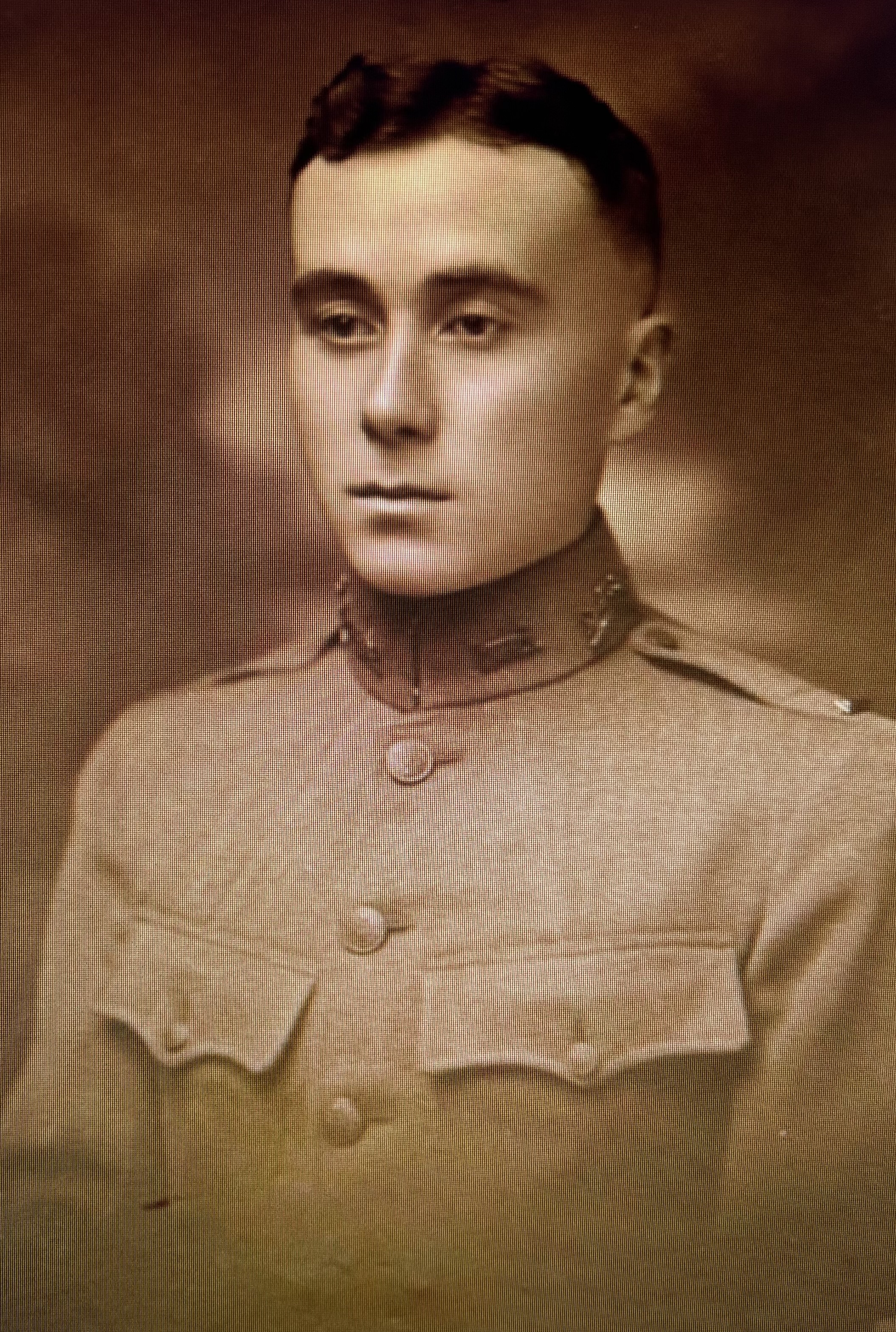
Howard Lee Strohl was killed August 9, 1918, during the Battle of Fismes and Fismette in the Marne department of northeastern France.

You might remember my blogs last year about an Army officer from Bethlehem, Pennsylvania, who was killed in the First World War.

There’s more to tell about 2nd Lieutenant Howard Lee Strohl.

I had pieced together his story with the help of his great-niece, a unit history, the National Guard armory in Allentown, Ancestry.com, and contemporary accounts on Newspapers.com, one of which had the text of a letter he wrote home from France.

What I didn’t have was Strohl’s official military personnel file. It wasn’t at the National Archives’ National Personnel Records Center in St. Louis. “If the record were here on July 12, 1973,” said the message from an archives technician, “it would have been in the area that suffered the most damage in the fire on that date and may have been destroyed.”

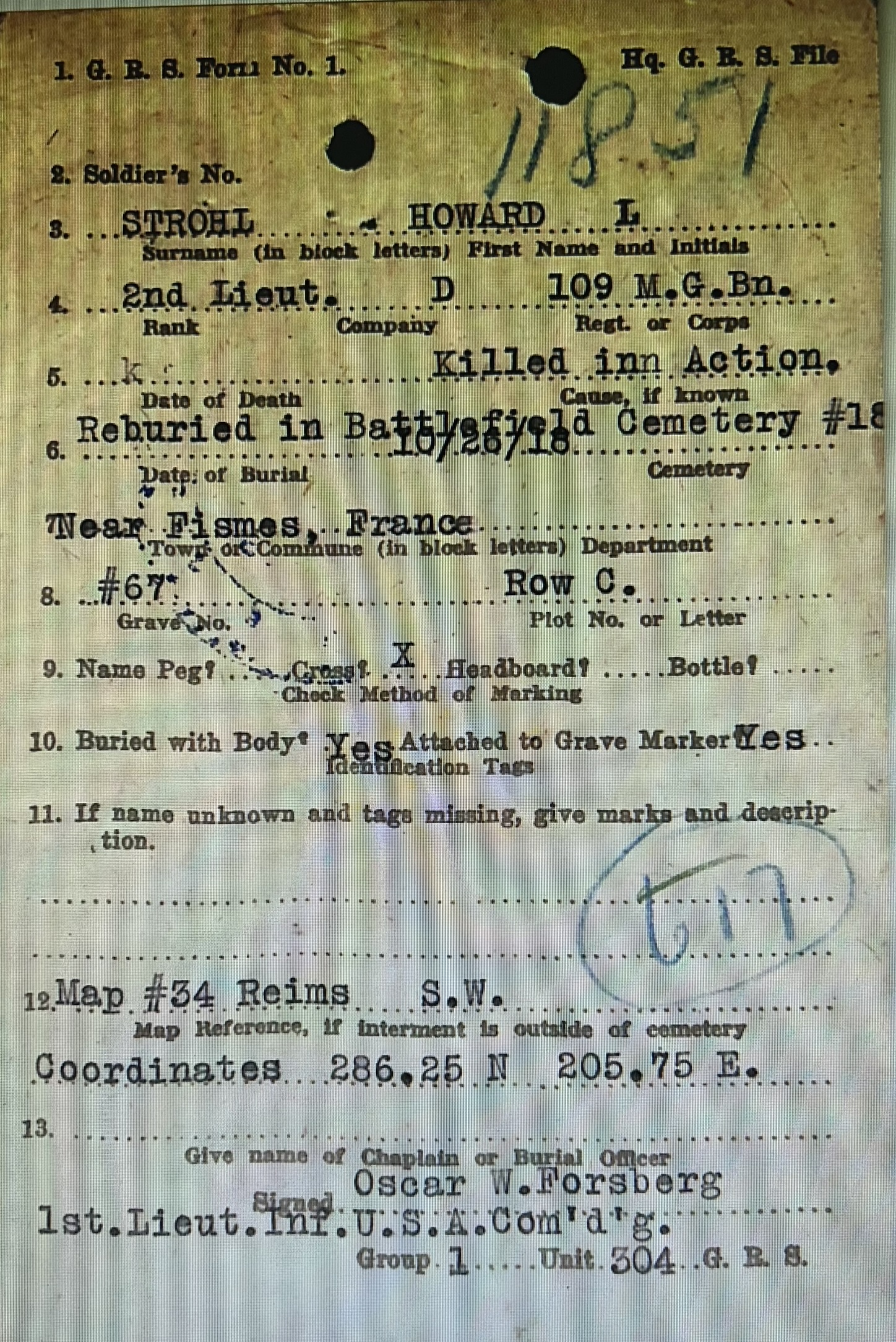
A card from Lieutenant Strohl’s burial case file
(National Archives at St. Louis)

But she opened another door, saying a casualty file held by the Army might have information I wanted. She suggested I write to the Army Human Resources Command’s Casualty & Memorial Affairs Operations Division at Fort Knox, Kentucky.

So in May 2023, I mailed my request with as much detail on Strohl as I could muster. Four months later, an email arrived from a tech at the National Archives at St. Louis: “We have located Howard L. Strohl’s burial case file as requested.” It turned out Human Resources Command doesn’t have World War I-era burial case files, so Fort Knox forwarded my inquiry to St. Louis.

I got directions on how to pay electronically using the U.S. Treasury’s Pay.gov service and did it right away. The cost was $28.80. “Please allow time for the scanning and uploading process to be completed,” the archives tech said. “Our staff is minimal and all requested records need to be digitized and redacted prior to delivery, so we are looking at a much longer turnaround than is typical.”

Six months passed. I gave the tech a nudge in an email. She wrote back promptly that I’d be getting the record in the next several days. Sure enough, an email arrived with a link to a PDF scan of the file.

Of its thirty-eight pages on the disposition of Strohl’s remains, the last one interested me the most. It’s an account of his final moments, given after the war by a sergeant who had been with him.

Strohl’s dog tag from his grave in the American cemetery at Fismes, France
(National Archives at St. Louis)

Strohl and Sergeant Claflin L. Bowman were in Company D, 109th Machine Gun Battalion, part of the 28th Infantry Division. In early August 1918, they were among the doughboys battling German troops along the Vesle River at Fismes, a village in the Champagne-Ardenne region of northeastern France.

“The carnage was awful,” a unit historian would write, “and it was our 28th Division which successfully withstood the attack, at a fearful loss.”

Bowman said Strohl fell about 2:30 p.m. August 9 – a day after the 109th got into the fight. He told an officer asking about the circumstances of Strohl’s death:

Just before the Lieut. was hit I was with him in the cellar of a house which was on the street leading from the city hall to the Vesle River. Lieut. Strohl left the building for the purpose of securing information but was hit by the fragments of a shell just as he reached the street. He was wounded in the chest and in the thigh. Lieut. Strohl[’s] wounds were dressed at once but he died without regaining consciousness. He is buried in the yard at the hospital at Fismes.

Howard and Ada after their October 31, 1917, wedding

Six days earlier, Strohl had written to an aunt and uncle in Allentown about seeing “all the grim horrors of warfare.” If he hadn’t been killed, he would have received an order the next day to return to the States for further training.

He was twenty-three. Back home in the Lehigh Valley, he left a wife, who had given birth to their son after he departed for France.

His remains were removed from the hospital yard and reburied two weeks before the Armistice in American Battle Area Cemetery 617 at Fismes. It was Grave 67, Row C, marked with a cross.

Sergeant Bowman, of Myerstown, Pennsylvania, was interviewed in February 1919. The officer who took his statement, 2nd Lieutenant Charles C. Curtis, went on to become a major general in the National Guard and command its 28th Infantry Division. Allentown’s National Guard armory, home of the 213th Regional Support Group, bears his name.

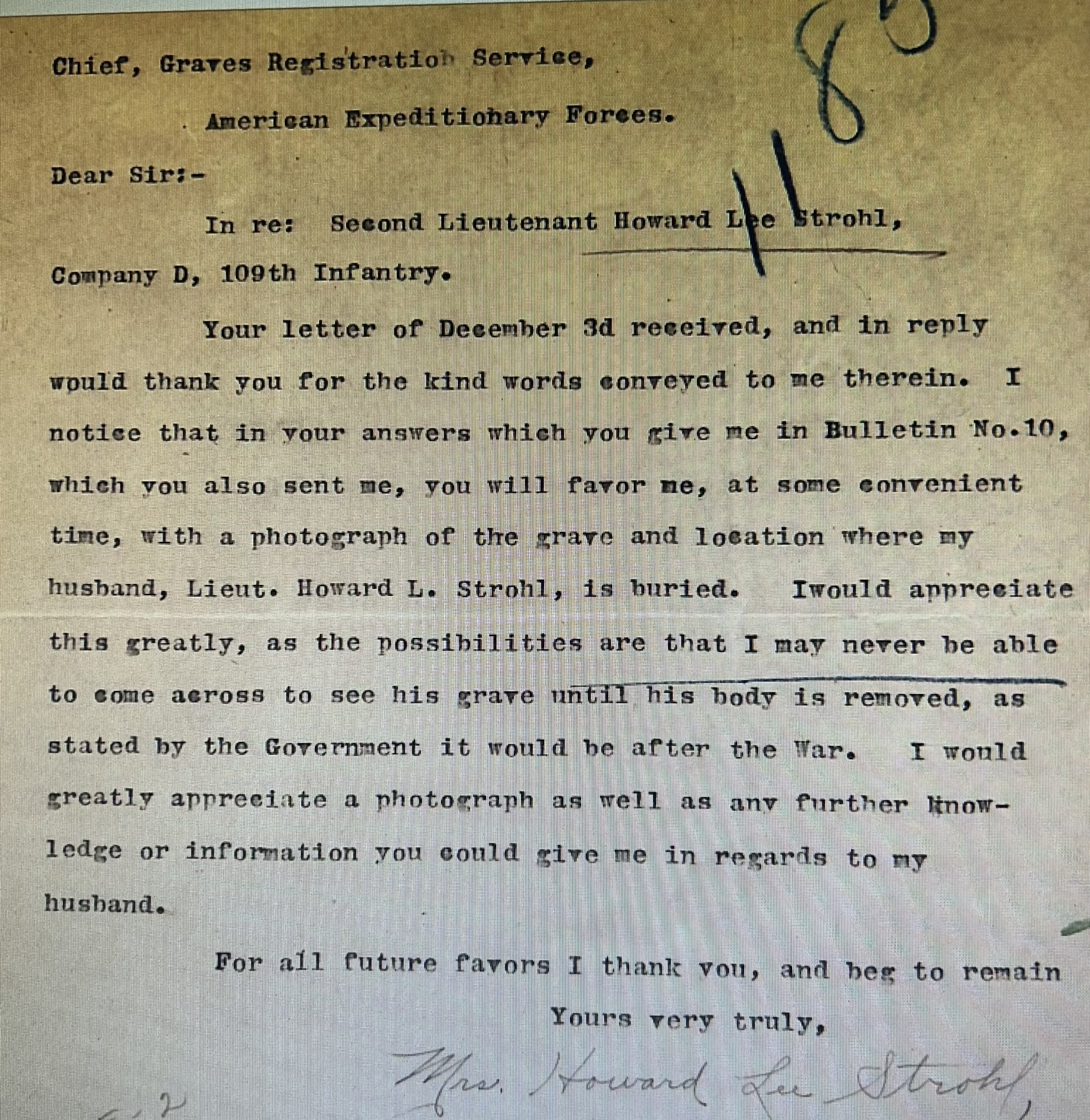
A January 1919 letter from Ada Strohl asking the American Expeditionary Forces about her husband’s grave
(National Archives at St. Louis)

Strohl’s burial case file shows the military’s care in dealing with his family and bringing his remains home. It’s clear the war dead of more than a hundred years ago were honored and their kin treated with respect just as they are today.

Both Strohl’s widow, Ada, and father, William, asked the Army for information about his remains. William Strohl wrote to the Adjutant General’s Office in Washington in April 1919:

Howard’s father, William Levinus Strohl

Having been informed that the Government intends to remove and send home the bodies of the American soldiers, and being deeply interested in this move on account of having lost my son, Lieut. Howard L. Strohl, 109th Machine Gun Bat. on last Aug. 9th, I will kindly ask you to forward me any information you may have concerning such action.

The office responded with the War Department’s policy and said, “In due time, you will be asked for information relative to your wishes in the matter of the disposition of the remains of your son.”

William Strohl’s letter to the Adjutant General’s Office
(National Archives at St. Louis)

According to the policy, the nearest next of kin – in this case, Ada – could choose to have the body returned to any address in the United States, interred in the National Cemetery at Arlington, Virginia, or any other national cemetery, or left in Europe. The government would pay the full cost for the transfer of bodies.

Ada asked that her husband’s remains be brought to her in Hellertown. But she remarried in 1920 before that could happen, and as a result no longer qualified as his nearest next of kin. That was now her toddler son, Howard R., with Bethlehem National Bank as his guardian. The bank wanted Strohl’s body delivered to his father in Bethlehem.

In April 1921, the Graves Registration Service of the American Expeditionary Forces removed Lieutenant Strohl’s remains from the American cemetery at Fismes. They were placed in a casket and delivered by rail to the port at Antwerp, Belgium.

Bethlehem National Bank telegram to Hoboken, New Jersey, correcting the Bethlehem street number for the shipping of Strohl’s remains
(National Archives at St. Louis)

The Army ship Wheaton, built by Bethlehem Steel, carried Strohl across the Atlantic. On June 11, the transport docked at Pier 42 in Hoboken, New Jersey. From there, the Lehigh Valley Railroad took him home to Bethlehem. He was laid to rest, finally, in Towamensing Cemetery.