
Tag Archives: Dachau

‘Piles of bodies like you would stack lumber’

World War II veteran Don Burdick, a witness to the Holocaust, at home in Forks Township, Pa., in December 2008
(Harry Fisher/The Morning Call)

The Jewish Federation of the Lehigh Valley last week marked Yom HaShoah, a remembrance of the six million Jews murdered in the Holocaust. It was held at the Jewish Community Center in Allentown, and I was one of the speakers.

Here’s how that came about: At the Holocaust program 15 years ago, I interviewed a Dachau liberator, Don Burdick, on the auditorium stage. I had written about him for The Morning Call. Now I was invited back to join in commemorating the Jewish victims of Nazi Germany 80 years after its defeat. My wife came with me.

And here’s what I said:

Don in 1944 at home on furlough in Carbondale, Pa.

I knew Don Burdick from lunches of the Battle of the Bulge veterans. I’d go there to meet the vets, hear their stories and write about them. Don always wore a jacket and tie to these meetings and, in his rich, full voice, said the opening prayer.

His story was compelling. He was among the U.S. troops surrounded by the Germans at Bastogne. He was among the first Americans to enter Dachau. He took pictures there that he kept for always.

On the advice of The Morning Call’s editor, I split up Don’s story. His account of the Bulge ran during the battle’s anniversary in December 2008. His photos of the dead ran the following April with my story about his Dachau experience.   
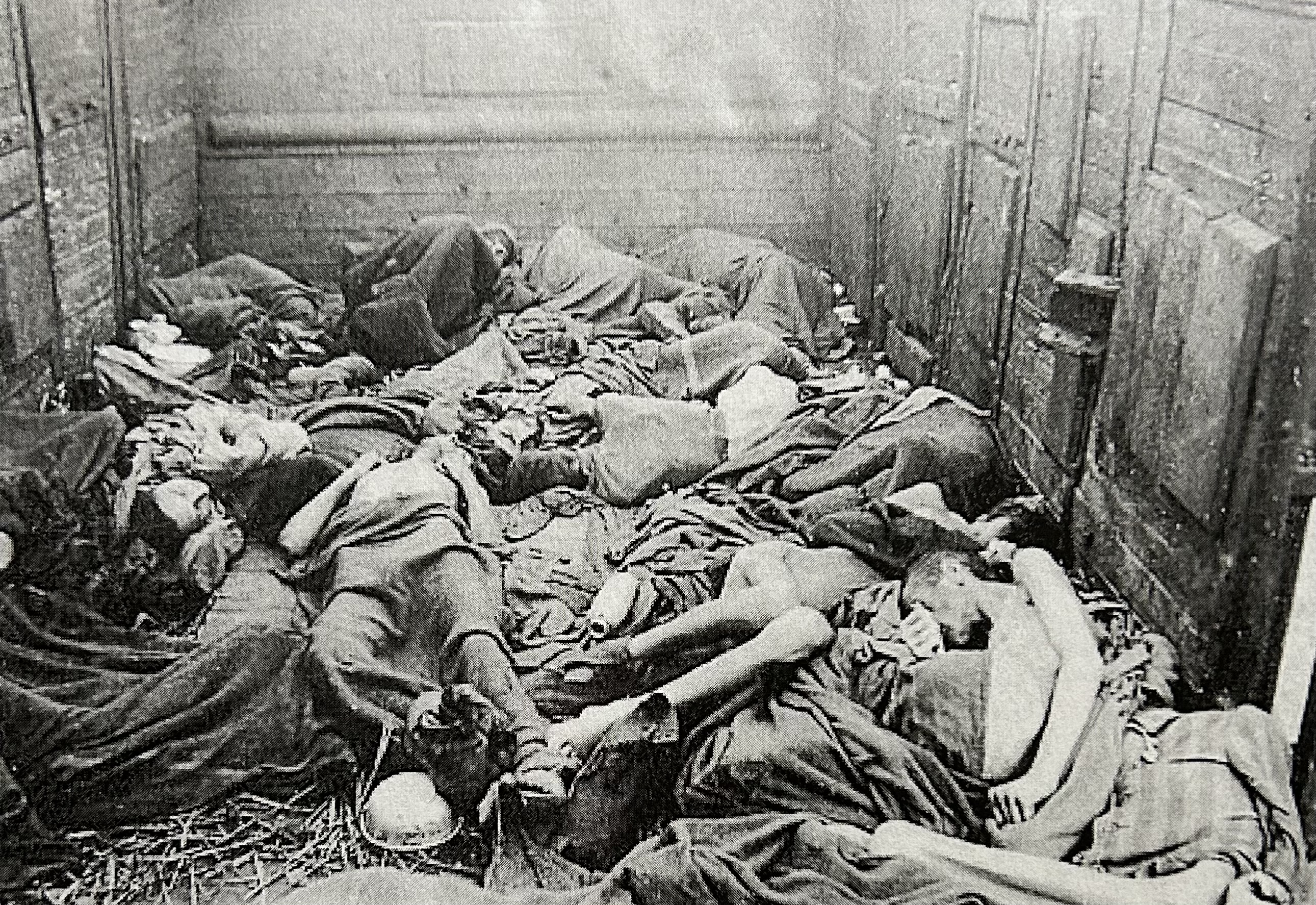
A photo Don took at Dachau in April 1945. He used a Voigtlander 35mm camera he had picked up in Germany.

It was in April 1945 that Don’s unit – a field artillery observation battalion – reached the camp near Munich. He was 21, a private first class. He carried a German camera he had picked up along the way.

The following is from the transcript of my interviews with him:

There was a noxious odor in the air. I said, “Smells like something rotten.”

Coming into Dachau, the closer you got, the stronger the odor was. It was putrid. As we were coming down this particular road, there were piles of bodies like you would stack lumber. The Germans had put quicklime on them to burn up the flesh. … The smell and sight of decaying bodies was gut-wrenching. I was sick to my stomach for days after that.

Don’s photo of U.S. Army troops inspecting rail cars holding the dead at Dachau

There were people clinging to the fences. They were emaciated, hardly covered with clothes. One building we looked at, we could see bodies piled like a pyramid. A guy said, “The only way we’re going to get them out is to bulldoze the building.”

I was so disgusted at what I was seeing. For me to explain this to somebody else, I felt the best way to do this was to take pictures. … When I developed the pictures, I knew that I had my evidence that I could support the fact that this was an atrocity, that it was a concentration camp, and I could verify what I had seen.

Reader response was immediate. It was in line with Don’s commitment to get the word out to as many people as possible.

The second of two parts of Don’s Battle of the Bulge story in December 2008: He was with Battery B, 16th Field Artillery Observation Battalion.

An English as a Second Language teacher at Allen High School said his students were reading the diary of Anne Frank and he’d be using Don’s story in his class. He wrote: “I think it would be a very enriching experience for these students to see how the Holocaust impacted and still does impact people, even within this community.”

When I passed this message on to Don, he offered to visit the class.

An English teacher at Northeast Middle School in Bethlehem asked if Don would speak to her eighth-graders. She wanted to prepare them for a visit from Auschwitz survivor Julius Jacobs. She wrote: “There’s no better way to help our students connect with history and truly understand it than hearing it firsthand.”

Yes, Don spoke to her classes. And in 2010, with me at his side, he spoke here for the Holocaust remembrance.

As a former teacher, Don aced these appearances. He had a presence and a keen ability to communicate. I’m glad I met him, became his friend and helped get his Dachau story out.

My April 2009 story about Don’s experience at Dachau. It included photos he took at the Nazi camp.

He had been at the camp for just one day, a soldier passing through early on. The gaunt survivors, he noted, weren’t being cared for. He didn’t see any medics while he was there. The suffering and death troubled him for a lifetime.

“I couldn’t believe that the human race could annihilate people in this atrocious way,” he said. “I had no idea the Germans would go to the length they did at Dachau.”

Don died eight years ago at his home in Forks Township. He was 93. His witness to the Holocaust will live on.

Bringing Out the Horrors of the Dachau Death Camp

Donald Burdick was a pre-med student at the University of Scranton when the Army drafted him during World War II. In July 1944, the private first class landed in northern France with a field artillery observation battalion. Five months later, on Dec. 16, his unit was in Luxembourg when the Germans attacked and the Battle of the Bulge began. At 84, Don shared his experiences holding out during the siege of Bastogne with the Morning Call readers in a column in my series,  War Stories: In Their Own Words.

US Army jeep at the gates of Dachau, 1945

US Army jeep at the gates of Dachau, 1945

In that interview Don also showed me some photographs he had taken when his unit was sent to Dachau in the spring to liberate that concentration camp from the Nazis. He had had these pictures for more than sixty years and had never shown them to a soul. On my final interview, Morning Call photographer Harry Fisher not only photographed and videoed Don, he also photographed Don’s Dachau photos so we could post them on The Morning Call website and run them in the paper.

Back in the newsroom, the executive editor examined the photos in her office with a deputy managing editor, who told me we could run the pictures but not with the Bastogne story. That would be forcing them into the paper, she said, without the proper context. She didn’t want them “shoehorned” into a story about Bastogne that only mentioned Dachau in passing. The executive editor suggested that the following April, about the time of Holocaust Remembrance Day, I write a separate story about Don’s experience at Dachau, and it would run with some of the photos.

That was the plan, and it worked out exactly like that. Harry Fisher and I spent more time with Don at his home in the spring of 2009. The executive editor reviewed the grisly photos and OK’d the use of several inside the paper, with the story’s runover.

Prisoners wave at troops at the liberation of Dachau, 1945

Prisoners wave at troops during the liberation of Dachau, 1945

And that’s the way it went. The story ran on Page 1 on Sunday, April 19, 2009, with the pictures inside. The story featured a box telling readers that April 20 was Holocaust Remembrance Day. The Jewish Federation of the Lehigh Valley holds a program at the Jewish Community Center in Allentown to commemorate the event each year. Not only were the photos in the paper, they were also online at The Morning Call with a two-minute video Harry had shot of Don talking about his day at Dachau.

Response to the story was electric. A year went by. Shari Spark, head of the Holocaust Resource Center at the Jewish Federation, called me looking for Don. She wanted to contact him to see if he’d speak at the 2010 Holocaust Remembrance Day program. I gave her Don’s phone number.

Two weeks later, she called me again with an idea. She had been impressed with how articulate Don was when they had spoken together in his living room. I knew what she was talking about: Don is a natural raconteur and from decades of teaching high school science could get the point across concisely.  Shari wondered if Don’s presentation would be more effective if it would take the form of a casual interview. The interviewer would have to be someone Don felt comfortable with.

I could see it coming. Shari asked me: Would you consider doing it? I had to get permission from my supervisor, who had no problem with my participation in the event. Shari spent three hours with Don and me one day, going over the material. The interview during the ceremony could last only a half-hour and I had to cover everything we discussed over many hours of interviews. I used a notebook to record the important points and listed them in order. I brought them to the ceremony to be sure my questions structured Don’s story. I kept my questions open-ended, giving him room for spontaneity and illumination. I never interrupted him, waiting until it was clear he had said what he wanted to say. Sure enough, Don sustained a powerful, emotional delivery. The audience gave him a standing ovation.

After the ceremony, people lingered and talked. They shared their own stories and asked Don more questions. Just as Shari predicted, he had connected with them.