Tag Archives: Chu Lai

PR lessons a colonel learned from Vietnam ‘mutiny’

Robert C. Bacon, then a captain, on the June 12, 1964, cover of Life. In the photo taken by British journalist Larry Burrows, Bacon leads South Vietnamese soldiers in the Mekong Delta. In 2001, he sent the image to me with this note: “Thanks for taking your time and energy to honor your fallen cousin. He and the others are all heroes in my mind — as ever your friend Bobby Bacon.”

Thirty years ago, while trying to find out how my cousin Nicky died in Vietnam, I struck up a friendship with a retired Army colonel who figured in the story. He also had been caught up in a deeply controversial episode of the war and had much to say about how the military handled bad publicity. It’s an issue that resonates today.

Robert C. Bacon of Columbia, South Carolina, was a West Point graduate who served two tours in Vietnam, the first in 1963-64 as an adviser to a South Vietnamese battalion, a role that put him on the cover of Life magazine. In the second, from 1969-70, he briefly headed a unit that provided training and orientation for troops newly arrived at Chu Lai, the Americal Division base along the South China Sea.

Nicky, a 20-year-old Army helicopter pilot, was among the soldiers who landed there in July 1969. On his sixth day in Vietnam, he was trucked to a firebase called LZ Bayonet for a class on grenade safety. The sergeant/instructor, in a gimmick to get the men’s attention, unwittingly tossed a live grenade onto the floor. Nicky lost a leg from the blast and died five days later, on July 15, at Chu Lai’s 312th Evacuation Hospital. Back home in Malvern, Pennsylvania, his parents received a bereavement letter from Bacon, commandant of the 23rd Adjutant General Replacement Company, the Americal Combat Center.

Except that they didn’t, really.

Bacon graduated from Peacock Military Academy, a college prep school in San Antonio, Texas, with the Class of 1951.
(Kadet Yearbook)

I’d hoped Bacon could help me understand what happened in the classroom but was in for a disappointment. When I first spoke with him in 1996, he said didn’t join the replacement company until five days after Nicky died. He refused to sign the letter that was dropped on his desk, because the “horrible, unfortunate accident” didn’t happen “on my watch” and he had no first-hand knowledge of it. Someone signed the letter for him.

If he had been in charge earlier, Bacon said, he would have halted the grenade-tossing routine as too dangerous.

“It is still hard to believe the attention-getting stunt the sergeant used,” he wrote to me. “One of the best attention-getters was to say at the start of the class, ‘Probably either you or the man sitting next to you will be killed or wounded during your tour. If you pay attention, it might not be you.'”

Lieutenant Colonel Bacon went on to lead the 3rd Battalion, 21st Infantry of the 196th Light Infantry Brigade and earned a Silver Star for gallantry. His name appeared in news accounts around the world after troops under his command reportedly mutinied in the Song Chang Valley near Da Nang. He reassigned the inexperienced lieutenant whose men were involved, saying at the time that he “wasn’t satisfied with the progress the company was making.” Pointedly, he always maintained there had been no mutiny.

Warrant Officer Nicholas L. Venditti, my cousin, at home on leave a few weeks before he died in Vietnam

My story on Nicky’s fate, two decades in the making, would become a book. I stayed in touch with Bacon almost until his death eight years ago, giving him updates on my research and further questioning him as more information came to light. He encouraged me in phone calls and in cards and letters he signed “Bobby,” and invited me to visit him, which I was never able to do. He eagerly shared letters, articles and other remembrances of his Army experience, in particular those concerning the so-called mutiny of Alpha Company in August 1969.

***

The Pentagon’s evasive posture over the blasting of alleged drug-runners’ boats in the Caribbean and eastern Pacific sent me thumbing through my thick folder on Bacon. One of the items he’d sent me was a term paper he wrote for the Army War College in Carlisle, Pennsylvania, in 1973 while pursuing a master’s degree. The paper was for a communications class. In it, he cites the “mutiny” episode as a case study in botched public relations.

His advice to the Army hierarchy on what to do when bad news breaks? Come clean, and do it promptly.

Before you read Bacon’s paper below, I’ll show you the 1969 news story in The New York Times that rankled him for the rest of his days. It ran at the top of Page 1 on a Tuesday and was written by Associated Press staffers Horst Faas and Peter Arnett, both of whom had won Pulitzer Prizes for their coverage of the war — Faas in 1965 for his combat photography, and Arnett in 1966 for his reporting. Bacon protested that the story was unfair; they responded respectfully that it was “absolutely fair.” Here is the complete article, followed by the writers’ letter to Bacon addressing his complaint:
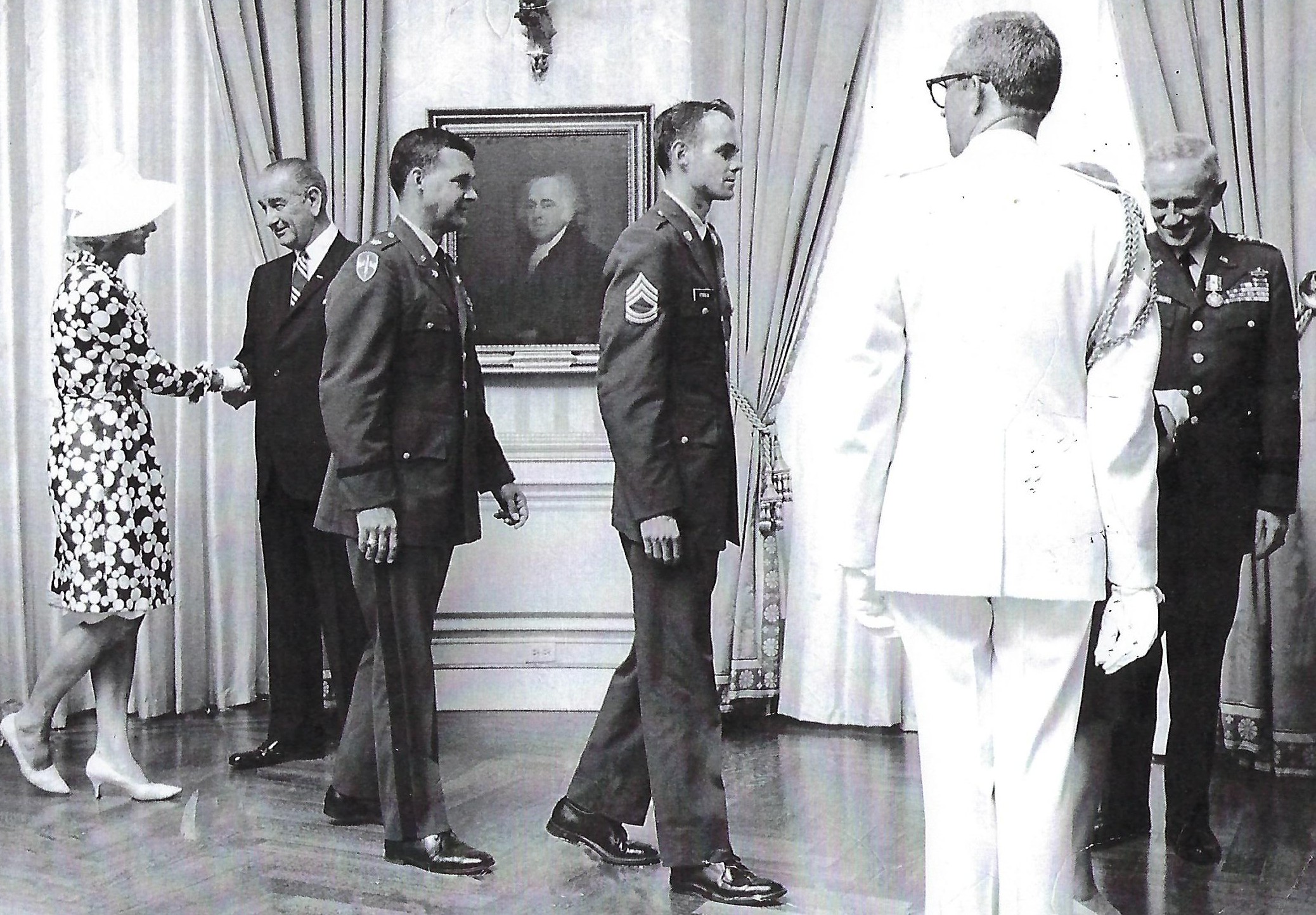
Bacon passes in front of President Lyndon B. Johnson in this 1960s White House photo taken during a ceremony for a Medal of Honor recipient. At the time, Bacon was protocol officer for the Army’s chief of staff.

Told to Move Again
On 6th Deathly Day,
Company A Refuses

The following dispatch is by Horst Faas and Peter Arnett of The Associated Press.

SONGCHANG VALLEY, South Vietnam, Aug. 25 — “I am sorry, sir, but my men refused to go — we cannot move out,” Lieut. Eugene Shurtz Jr. reported to his battalion commander over a crackling field telephone.

Company A of the 196th Light Infantry Brigade’s battle-worn Third Battalion had been ordered at dawn yesterday, to move once more down the jungled rocky slope of Nuilon Mountain into a labyrinth of North Vietnamese bunkers and trench lines 31 miles south of Da Nang.

For five days the company had obeyed orders to make this push. Each time it had been thrown back by invisible enemy forces, which waited through bombs and artillery shells for the Americans to come close, then picked them off.

Colonel Lost in Crash

The battalion commander, Lieut. Col. Robert C. Bacon, had been waiting impatiently for Company A to move out. Colonel Bacon had taken over the battalion after Lieut. Col. Eli P. Howard was killed in a helicopter crash with seven others. Since the crash Tuesday the battalion had been trying to get to the wreckage.

Yesterday morning Colonel Bacon was leading three of his companies in the assault. He paled as Lieutenant Shurtz told him that the soldiers of Company A would not follow orders.

Bacon’s copy of AP’s ‘mutiny’ story

“Repeat that, please,” the colonel said without raising his voice. “Have you told them what it means to disobey orders under fire?”

“I think they understand,” the lieutenant replied, “but some of them simply had enough — they are broken. There are boys here who have only 90 days left in Vietnam. They want to go home in one piece. The situation is psychic here.”

“Are you talking about enlisted men, or are the N.C.O.’s also involved?” the colonel asked.

“That’s the difficulty here,” Lieutenant Shurtz said. “We’ve got a leadership problem. Most of our squad and platoon leaders have been killed or wounded.”

At one point in the fight, Company A was down to 60 men, half of its assigned combat strength.

Bunkers Believed Empty

The colonel told Lieutenant Shurtz: “Go talk to them again and tell them that to the best of our knowledge the bunkers are now empty — the enemy has withdrawn. The mission of A company today is to recover their dead. They have no reason to be afraid. Please take a hand count of how many really do not want to go.”

The lieutenant came back a few minutes later: “They won’t go, colonel, and I did not ask for the hand count because I am afraid that they all stick together even though some might prefer to go.”

The colonel told him: “Leave these men on the hill and take your C.P. element and move to the objective.”

The lieutenant said he was preparing to move his command post and asked: “What do we do with the ammunition supplies? Shall we destroy them?”

“Leave it with them,” the colonel ordered.

Little Comforts Missing

Then Colonel Bacon told his executive officer, Maj. Richard Waite, and one of his Vietnam veterans, Sgt. Okey Blankenship, to fly from the battalion base across the valley to talk with Company A.

“Give them a pep talk and a kick in the butt,” he said.

They found the men exhausted in the tall, blackened elephant grass, their uniforms ripped and caked with dirt.

“One of them was crying,” Sergeant Blankenship said.

The soldiers told why they would not move. “It poured out of them,” the sergeant said.

They said they were sick of the endless battling in torrid heat, the constant danger of sudden firefights by day and the mortar fire and enemy probing at night. They said that they had not had enough sleep and that they were being pushed too hard. They had not had any mail or hot food. They had not had any of the little comforts that made the war endurable.

Helicopters brought in the basic needs — ammunition, food and water — at a tremendous risk under heavy enemy ground fire. But the men believed that they were in danger of annihilation and would go no farther.

Major Waite and Sergeant Blankenship listened to the soldiers, most of them a generation younger, draftees 19 and 20 years old.

Sergeant Blankenship, a quick-tempered man, began arguing.

“One of them yelled to me that his company had suffered too much and that it should not have to go on,” Sergeant Blankenship said. “I answered him that another company was down to 15 men still on the move — and I lied to him — and he asked me, ‘Why did they do it?’ “

“Maybe they have got something a little more than what you have got,” the sergeant replied.

“Don’t call us cowards, we are not cowards,” the soldier howled, running toward Sergeant Blankenship, fists up.

Sergeant Blankenship turned and walked down the ridge line to the company commander.

The sergeant looked back and saw that the men of Company A were stirring. They picked up their rifles, fell into a loose formation and followed him down the cratered slope.

***

Bacon complained about the story to Arnett and Faas. He sent me a copy of their response. Here it is:

Faas and Arnett’s response to Bacon

The Associated Press
P.O. Box 702
Saigon

August 26, 1969

Lt. Colonel Robert C. Bacon
Commander, 3rd Battalion, 21st Infantry
196th Light Infantry Brigade

Dear Colonel Bacon,

Enclosed for your information is the story we did on “A” Company last weekend.

We hear that some kind of investigation has been ordered into this story, and we truly hope that this has not inconvenienced you, or interfered with your business of getting on with the war.

We feel the story was absolutely fair, and on reading it, I believe you and the others will agree. War is a very human experience, and we seek to portray this human side just as much as we do the statistics. Just as you and your officers have as your duty to fight the war to the best of your abilities, we have the duty to report it. The story of “A” Company was as moving a piece as we have written out of the war, and we tried very hard to emphasize your own coolness during the crisis, and the ability of Major Waite and SFC Blankenship in convincing the men on the hill to go back into the fight.

You and your men were very kind to us both, and to all the other AP people who visited you during a very trying period. We hope you don’t feel we have “betrayed” you. On the contrary, we feel that the “Gimlets” are as fine a bunch of men in the whole war, and that the story of “A” company bore that out.

Sincerely,
Peter Arnett & Horst Faas

***

Here is Bacon’s Army War College paper:

MUTINY IN COMPANY A — FACT OR FICTION
A CASE STUDY IN PUBLIC RELATIONS

By Robert C. Bacon
March 1973

Bacon’s Army War College term paper, written for a communications class at nearby Shippensburg State College, now a university.

For most Americans, 26 August 1969 started as a typical hot summer Tuesday … that is until they had their first cup of coffee and opened their morning newspaper. It was at that moment that many were startled and stunned by headlines such as “Company A Refuses to Go,” or “Weary Viet GIs Defy Orders.” Their shock was warranted, for this appeared to be the first large-scale combat refusal by U.S. soldiers in over seven years of participation in the war. The message was not confined to the United States, as was pointed out by David Lawrence in his article in U.S. News & World Report titled “What’s Become of Voluntary Censorship?”

“… [T]he dispatch which revealed that American troops were engaged in a mutiny was promptly spread around the world. The North Vietnamese officials read it, and so did the leaders in Moscow and Peking. The impression was conveyed that the United States had on its hands an incipient rebellion in the ranks of its armed services. Broadcasts by Viet Cong radio hailed the news and predicted more such incidents would follow.”

Others felt that the alleged incident was having a profound impact on President Nixon. For example, in The New York Times of 27 August, James Reston in a commentary entitled “A Whiff of Mutiny” inferred that the president now had to consider a revolt by all the military men in Vietnam. Similar inferences were undoubtedly drawn by enemy negotiators at Paris who were undoubtedly encouraged to postpone any concessions toward a peaceful resolution of the war.

Since the incident took place several years ago, the entire initial article by Horst Faas and Peter Arnett is repeated on the following page as it appeared in The New York Times of 26 August 1969.

In the next few days following the release of the article, nothing was done on the part of the Army to refute or explain had had actually happened. The complete vacuum of press releases by the Army undoubtedly occurred because:

— The article came as a complete surprise and had not been anticipated even by those members of the Army directly involved in the incident.

— The Army, for a period of three days, closed the gates of communication to other members of the press corps who were trying to dig deeper into the story.

Thus, two cardinal rules of good public relations were violated:

— Anticipate adverse publicity as it is developing and be prepared to react.

— After an incident occurs, maximum disclosure with minimum delay should be the standard.

Why wasn’t the story anticipated? Principally it was because I, as the battalion commander, did not view it in the same light as the two reporters. To me, the entire unit, including Company A, had fought a magnificent and courageous battle over a period of six days against very tough opposition. Company A had hesitated to get into battle for a period of about 55 minutes only because their inexperienced and battle-weary company commander had failed to give them a direct order to do so. Accordingly two days before the article had appeared in the news, I had relieved the company commander and praised the soldiers in Company A. At the time, I would have thought it was incredible that anyone could have inferred that the entire company had been cowardly and refused to fight.

Bacon points to his medals for a story about him that ran May 26, 2011, in South Carolina’s Fort Jackson Leader. He was stationed at the fort from 1976-83 and retired from the Army in 1985. Susanne Kappler took the photo and wrote the article after Bacon appeared at a Retiree Appreciation Days event.

Further, it was anticipated that any stories by Mr. Faas and Mr. Arnett would be centered around the combat actions of the battalion as well as the recovery of their compatriot, Mr. Oliver Noonan, [a freelance photographer for The Boston Globe] who had been shot down in a helicopter in the early phase of the battle. Further, neither Mr. Arnett nor Mr. Faas had ever been with Company A or any of its members during any part of the operation. They were quite congenial when they departed — asked no questions about Company A and appeared only interested in verifying their account of the operation. This initial assessment of what they might write appeared to be substantiated by articles in the Times on 24 and 25 August. In these articles, the battle and the recovery of Mr. Noonan were well-covered in detail, and it was not until 26 August [that] the balloon burst.

In reflection, perhaps the single most important reason I did not anticipate or expect an article of this nature was my previous experiences long ago with Mr. Faas and other members of the press corps. Perhaps I might have been more wary had the information officer or someone else clued me in on the subtle change and pressures on the press corps since my previous assignment in Vietnam.

On my first tour in 1963-64, there were few Americans in the field, and it was not uncommon to have a member of the media tag along on an operation. The first correspondent I recall encountering was Mr. Larry Burrows, who was killed about two years ago [in 1971] when his Vietnamese helicopter was shot down over Laos. Larry was courageous, professional, attended his own needs in the field and was a pleasure to be around. In June of 1964, he took a picture of me that ended up on the cover of Life magazine, and in the same issue was some very objective reporting on atrocities by both the Viet Cong and South Vietnamese soldiers. Horst Faas was a lot like Larry and got his job done with a minimum interference with the operation. His photographic skills and moving dialogue graced many newspapers in those days. Particularly impressive was a story he did on the Viet Cong bombing of a floating Chinese restaurant in Saigon. Once, I asked why he didn’t use any Japanese cameras and fondly recall his reply in a thick German accent — “One thing about a Leica, it always works.”

In those days, the press corps in Saigon was primarily composed of tested, experienced, responsible, mature combat correspondents. While I might not have liked what they had to say in some articles, it was normally always objectively reported and well-documented. Later, with the surge of U.S. units, younger, less experienced correspondents flooded into Saigon. These [Y]oung Turks knew where the action was, and some would go to any extreme to sensationalize to get that all important byline on the front page of major newspapers. Some of the most stirring accounts of battles were written by some of these men who never got out of Saigon. Their reports were strictly based on what they had picked up at the daily press conference, spiced up with information they had picked up at the local bars. These grandstand plays by the [Y]oung Turks undoubtedly put extreme pressure on some of the older correspondents to sensationalize. Unfortunately, I was unaware of this metamorphosis in the press corps. Hence, without benefit of a pre-brief by the information officer, I considered Horst Faas to be as responsible, objective and mature as in our early encounters. I should have suspected he had changed when, after being out in the field for about six hours, I had to give him half a canteen of water.

As protocol officer for General Harold Johnson, the Army chief of staff in 1968, Bacon helped organize the funeral of Senator Robert F. Kennedy. The next year, he had the same role under General William Westmoreland for the funeral of former President Dwight D. Eisenhower.

Well, this leads to perhaps the most important rule in public relations:

— Know your reporter/advisory [sic].

Some will be experienced, sympathetic, objective and responsible. Others will quote you out of context, distort the facts or maybe even sensationalize. Forewarned is fore-armed. Always get your public affairs/information officer to give a pre-brief so that you will be prepared for the challenge.

In this particular incident, I was taken completely by surprise. Mr. Faas and Mr. Arnett must have known they were sitting on a gold mine and felt the same sense of euphoria as an addict that mainlines for the first time.

When the story broke, we couldn’t believe it and were in a momentary state of shock. We quickly recovered and wanted to set the record straight, and even without any public relations background, realized that time was critical and any impact to contradict or explain the situation had to be done quickly. The communication to explain what had transpired was in our hands.

— The company did not fail to obey an order. They were never given an order. When an order was given, the entire unit had moved out.

— The article was written as a first-hand account, yet neither Mr. Faas or Mr. Arnett was ever with the unit and had not talked with a single soldier in Company A.

— The hesitation lasted about 55 minutes, and the company was still in the field doing a good job.

Other points could be mentioned, but the big problem, for some unexplainable reason, was a blockout [sic] imposed on the media for two days. Why the Army didn’t follow a policy of maximum exposure with minimum delay still astounds me.

The location of my unit was, as they say in Army jargon, out in the boonies. The only way we could be reached was by helicopter. When the reporters finally arrived, we told the story as honestly as possible and invited them out to see Company A, which was still in the field.

The following are some quotes from articles that appeared some time after the incident, which if released in a timely manner might have overcome some of the adverse publicity of the original article.

In Newsweek, 8 September, in a commentary titled “The Alpha Incident”: “… [T]he article a gross injustice to all concerned.”

In Pittsburgh Press, 2 September 1969, in an interview with Specialist 4 Curtis, a member of Company A: “We never at any time said we wouldn’t go down the hill. … When Lieutenant Shurtz gave us a direct order, we started moving.”

In Time, 8 September 1969, in an article “Incident in Song Chang Valley”: “Neither Faas or Arnett saw or spoke to anyone in Alpha first hand. … [T]heir report that nearly all the soldiers of A Company broke was plainly exaggerated.”

In Detroit News, 2 September 1969: “Captain Bligh would have sniffed with a Charles Laughton disdain had anyone suggested to him the incident … was mutiny, which is how some commentators have described it.”

In Waterville, Maine Morning Sentinel, 13 September 1969, interview with [Private First Class] Batchelder, A Company, who lived in Dexter, Maine: “Please let the people know that this company is not chicken. We lost half our company and were exhausted from five days of fighting. … There was no mutiny, and to say otherwise is a disgrace.”

While there is no way of knowing the impact of these articles, we could certainly conclude that it was somewhat less than if they had been dispatched in a timely manner. At least this would have caused the public to look at other facets of the issue. Perhaps then they might have come to the conclusion that no one relishes the thought of going into battle. That the soldiers in Company A were tired and frightened and hesitated on going into battle primarily because their company commander could not meet the awesome challenge of ordering them to do so. Finally, they might have concluded, as I did, that Company A was a very courageous company that overcame their infectious fear and accomplished their mission in a truly outstanding manner.

It is not the purpose of this paper to be overly critical of Mr. Faas or Mr. Arnett. They both were undoubtedly under pressure to get a big story whenever they could. Had they bothered to check more deeply prior to publishing the story, they too might have come up with a different version. Their story was based on what they overheard on the radio and a conversation with a sergeant [Blankenship] who I had sent out to Company A. Considering their sources, the article could be classified as object [sic], albeit not in-depth, reporting. Certainly the letter they dispatched to me, on the following page, would indicate their sincerity.

To me, there is a contradiction between the actual article and the last sentence in the letter. I cannot see how the article as written would lead the public to believe that the Gimlets (my battalion) were “as fine a bunch of men in the whole war, and the story of A Company bore that out.[“] However, admittedly I too am looking at the article in a nonobjective and parochial manner.

Well, the chapter is closed on this episode, but to me there were some worthwhile lessons.

— Always try to find out the background of a reporter that will visit you or your unit.

— Anticipate and look for not only the good news, but also the bad news. This should be done on a continuing basis and not just when a reporter is visiting you.

— When a story breaks, be prepared to react. The reaction should be honest and factual. It should be a maximum disclosure and given rapidly. The public knows that no one is perfect, especially an organization as large as an army. While there may be some initial embarrassment, it will quickly fade away. Any attempt to cover up or distort the facts will only draw more attention to the issue, and as we all know, the truth will eventually be brought to light.

***

I’ve written several blogs about the episode from soldiers who were there. One was an interview with Alpha Company medic Fred Sanders. Another was an account by artillery officer Alan Freeman, and another by company “grunt” James Dieli. All maintained there had been no mutiny.

Bacon lived to see my book on my cousin, Warrant Officer Nicholas L. Venditti, which was titled Tragedy at Chu Lai and published by McFarland & Co. in 2016. The next year, Bacon died from cancer at 83. Here is his obituary.

He had once written: “I know your book is a labor of love, but you have probably gotten much more out of your efforts than just a book.

“I am sorry I’m a little sketchy on the details, but what I did tell you is 100% true. Thankfully because of the grace of God, many of the bad experiences, injuries, etc. are hidden deeply in our brains. For example, it is difficult to remember the pain of a serious injury. Were it otherwise, I think more of us would have gone mad.”


A grieving dad refused to watch this home movie

Louie Venditti’s home movies from June 1969, when his son Nicky was about to leave for the Vietnam War

My cousin Nicky, 20 years old, is home on leave in Malvern, Pennsylvania. He wears the wings he has just earned as an Army helicopter pilot and is bound for Vietnam. It’s June 1969.

Uncle Louie, an Army Air Corps ground crewman in England during World War II, is immensely proud of his son. He takes Nicky, in his uniform, to the VFW and American Legion posts to meet his buddies. He snaps photos of Nicky and shoots film of him with his home-movie camera.

Nicky is embarrassed but goes along with the fuss to make his dad happy. All the while, he is terrified of going to the war. He insists to his closest friends that he won’t be coming back alive.

Over the years, I’ve posted photos of Nicky taken during his 23 days of leave. Now for the first time, I’m showing video from the home movies Louie shot on three reels of 8-millimeter film. More than soundless images of a soldier, they are a snippet of ’60s small-town America.

The first image you’ll see is Nicky smiling at the camera from a picnic table outside his home. The young man wearing sunglasses is Nicky’s stepbrother, Joe Gray. The two other men are friends of the family. The woman is my Aunt Bert, Nicky’s stepmom. She and Nicky were close. The hip-swiveler is Uncle Louie, a rascal and lots of fun. The young woman with Nicky is his fiance, 18-year-old Terri Pezick. The other couple in the yard is my cousin Mike Beam and his wife, Monica. The pea-green car going down the street is Nicky’s ’68 Camaro SS. Finally, the husky guy with sideburns is Nicky’s best pal in Malvern, Charley Boehmler.

Uncle Louie with Nicky at home in Malvern, Pennsylvania, in the last days before Nicky’s departure. (They spelled their last name, Venditti, differently from mine.)

The night before Nicky left for Vietnam, Charley told him that he shouldn’t worry about getting killed. “You’re always lucky,” he said.

Warrant Officer Nicholas L. Venditti arrived in Vietnam on the Fourth of July 1969. Six days later, as part of his Americal Division orientation on the U.S. base at Chu Lai, he was in a class on grenade safety when the instructor unwittingly let loose a live grenade. Nicky lost his left leg below the knee. He died July 15 in Chu Lai’s 312th Evacuation Hospital, on a bluff above the South China Sea. He had survived only 11 days in Vietnam.

Uncle Louie died of heart failure in 1996 at age 72. Aunt Bert found the home movies in a shoe box in the attic and gave them to me. She once asked Louie about them, and he had said only, “I’m never going to look at those.”

Terri Pezick honored Nicky’s request that she live happily if he didn’t return. She married and had two sons. Charley Boehmler died of cancer in 1999, when he was 50. Aunt Bert died in 2006 at 81.

‘I would heal you, but you have never asked’

Americal Division combat medic Fred Sanders during his 1969-70 tour of duty in Vietnam

“As a noncombatant combat medic, I experienced seeing much suffering, ruthless cruelty and tragedy in Vietnam,” Fred Sanders wrote to me. “For those who have experienced or witnessed traumatic events in their lives, I would counsel: Do not nurse your pain. It will only prolong the suffering and make your life more difficult.” 

Sanders is 78 and lives near Columbia, South Carolina. He was with the Americal Division unit involved in the reported mutiny of U.S. troops in 1969. Last year, I blogged his account of “the very unfortunate thing that was not a mutiny.” Today, I’m sharing more of his Vietnam story, as he has told it to me.

I became a medic because I was a conscientious objector. I did not want to kill. I was well read on world affairs, politics. I saw then what people now recognize as the truth of what happened in Vietnam.

But this didn’t figure in my C.O. position. I felt it best to serve as a noncombatant on religious grounds. I belonged to a Baptist church, and the Southern Baptist Convention recognized my personal convictions as a C.O. My best choice was to try to save as many lives as I could.

I was a student at the University of South Carolina, interested in getting a degree in biology. I stayed out one summer to work for the state engineer’s office to make money to get back into college. But I didn’t get back in the first semester because I missed signing up.

A draft board member heard I stayed out a semester, and they pulled my name to be drafted. I said I’d like to register as a C.O. I wasn’t trying to get out of the Army. I said I’d go as a medic.

The head of the draft board got angry. He said, “You’re gonna put a black mark on Aiken County’s history.” I said I’m not asking for alternative service like Mennonite friends of mine. I’ll do the best I can if you let me serve in a medical capacity and try to bring some of these young men home alive.

Sanders today. He holds Native American, Scots-Irish and German heritage.

“I had a lot of experience dealing with people dying,” Sanders said of his year in the northernmost U.S. military zone of South Vietnam. He was 23, 24 years old while serving with Alpha Company, 3rd Battalion, 21st Infantry Regiment. “They called me an old guy.”

In the Song Chang Valley south of Da Nang, a friend of his, Sergeant Derwin Pitts, was shot as they walked down a hill toward the enemy. He lay groaning about six feet away, his position exposed. Sanders tried to figure how he could reach him without also being shot. Just then, Private First Class Ray Barker called him off, saying, “Doc, you’re not gonna do it.” He crawled past Sanders toward Pitts and was immediately killed. Pitts also died where he lay.

Another time, a young man was hit by a fragment from an antipersonnel artillery round. “That metal had severed his throat. He was hemorrhaging in his mouth, and I had to try and clear his airway but was unsuccessful. I was sucking blood out of his throat. There was nothing I could do to save him.”

Some men had self-inflicted wounds, “which I suspected of stemming from fear of being killed.” One shot himself in the foot. On another occasion, Sanders had just spoken with a man who was cleaning his M16 and heard a shot fired. “I ran to him and found his leg hanging only by skin. He said that the trigger caught on a root. He had expressed fear of being killed when walking point on patrol. He insisted that [the shooting] was an accident.”

Atrocities happened, and Sanders witnessed a few. He was with a platoon when they came across an old Vietnamese woman carrying a bundle of ruled notebooks and about $20 in Vietnamese money. She lived in a little grass shack with two children about 10-11 years old. The platoon leader, a lieutenant, called battalion commander Eli Howard and asked what to do with her. “I don’t want any prisoners,” Howard said. “All I want is body count.” The lieutenant said, “OK, sir,” and turned to the men. “All right, fellas, I need somebody to get rid of this woman.”

Beside a Kit Carson scout, Sanders holds a rusty French sub-machine gun a Vietnamese woman used against an American patrol. She was shot and killed. Kit Carson scouts were enemy fighters who defected to the South and worked for U.S. military units.

What! Sanders thought. You’re going to execute her? That’s a war crime! What had she done?

“Somebody do it,” the lieutenant repeated. There were at least 10 men standing around. Everyone looked at one another, said nothing, then looked down at the ground. One soldier finally spoke up. “I’ll do it,” he said. Everyone stood back.

The two children were with the woman. She was hugging them. The soldier put his rifle to her head, fired and killed her. The children screamed and ran off into the jungle. Sanders said two men from the platoon went into the bush, perhaps to pursue them. He heard that members of a nearby platoon chased down the children and killed them to make sure there weren’t any witnesses.

“Nobody wants to remember this,” Sanders said. “It left a lot of bitterness with some of us. There was certainly no military value in it.”

Did Sanders speak up about what happened?

I was thinking I can’t say anything because it would put me in a very bad position. I’d had a long experience with taking an unpopular stand, though not with this platoon.

When I was attached to another company earlier, one day a helicopter came and in and they said, “We’re taking you back to LZ Center,” the battalion command post. They told me privately that someone reported “there’s a plot to shoot you during a firefight. Some of these guys want you out of the company, because they don’t appreciate you giving out little Bible tracts in Vietnamese to the people. They resent you. We’re getting you out of here for your own safety.”

When I was in Taipei, Taiwan, I bought a very nice professional camera. I was at the canteen at Chu Lai [the Americal Division base], standing at the counter, and there were some guys at a table and they started talking to me, and when I turned to them, they sent somebody around to my other side where my camera was, and he stole it. They were afraid I might take pictures of something that might get them in trouble. But I never considered doing anything to besmirch my men or the unit in general.

Sanders said no one reported the old woman’s murder to the higher-ups.

Sanders of A Company, 3rd Battalion, 21st Infantry Regiment, 196th Light Infantry Brigade

We dared not go that far with it. I didn’t think at the time that the leadership culture would want it uncovered. That was bad publicity. It would expose the brigade to public scrutiny at a time when mixed public sentiments were influencing conduct of the war.

Also, for my own safety, I had to be careful. I was quite aware of the environment I was in. I’m here with a group of men. I don’t know what their life was. They could’ve been gangbangers before they got drafted.

Sanders said that on a previous occasion while the platoon was on patrol, a soldier shot an old man leaning against a betel nut tree near a cluster of huts, blowing the top of his head off. “What did you do that for?” Sanders asked him. “I panicked. I saw that man, and I didn’t know what to do.” After that, Sanders kept an eye on him and asked him now and then how he was doing, thinking he might be shaken by what he’d done.

“To the best of my remembrance, he was the same guy who shot this woman.”

After killing her, he asked Sanders: “Doc, do you think maybe you could write me up and get me out of the field? I don’t feel like I’m doing too good.”

“I filed a medical recommendation to remove him from field duty as possibly having combat-readiness issues. … I don’t know what became of him,” Sanders said.

Recently, a friend who’d been in the platoon told Sanders that the soldier “admitted to some of us” he shot the woman to get out of the field – a revelation that shocked Sanders. The soldier wanted to manipulate the medic into writing a recommendation that he wasn’t stable and should be removed from field duty.

Sanders said the lieutenant who asked for a volunteer to execute the old woman once allowed several of his men to rape a Vietnamese girl. Sanders was with the platoon and didn’t see the assaults but was aware of them. He described the girl as pretty and nicely dressed for someone in the jungle. The lieutenant, he told me, “was totally unwilling to take charge of his men.”

I was with another company one time, and we had walked into a hamlet, and this guy said, “All these people are V.C. [Viet Cong], and he started shooting. He killed men, women and children – 12 or 14 people. Everybody was in shock, but everybody kept their mouths shut, because all of these guys [I’m with] have arms, and you just don’t want to cross anybody, because people can be very dangerous and there aren’t any rules, unless a commander intervenes. Six weeks after that man killed all those people in that tiny hamlet, one of the guys came to me and said, “Doc, he got justice. He got what he asked for.” He had been shot and killed in a firefight.

Once, Sanders was riding in a helicopter with a prisoner and a soldier who carried a Bowie knife and was known to kill detainees. “First thing I know, he shoved the detainee out of the helicopter and said, ‘Oh, he slipped and fell.’”

“It was a great challenge to me to go through all this.”

How did Sanders keep his head?

Sanders tends to a Vietnamese child with a skin infection.

I read 24 books in the field, every time we had a break and we were not in danger. Reading is good medicine. It put me in another place.

My faith in God sustained me.

I maintained friendships with as many people as I could.

For some years after I came back, PTSD really hit me. My wife would go to bed and I’d sit in the kitchen and cry, remembering all the suffering and death that I had witnessed.

One night as I was sitting there, my wife said, “Why don’t you come to bed?” I said I’d be there soon, and she fell asleep. I heard a voice in my head: “I would heal you, but you have never asked.” I said, “Huh, what?” I realized it was the voice of God speaking to me in my mind. I was so moved and humbled and asked forgiveness. I said, “Lord, heal my memory.”

From that day on, I never again sat up in the kitchen at night crying. I’m able to sleep.

I still have dreams of being in evasive tactics in Vietnam but never seeing anything violent. One night I dreamed I was in an underground bunker with the North Vietnamese, and I saw their life in the bunker, and I’m watching all these North Vietnamese walking around. When I woke up the next morning, I said: My goodness that was real! But it didn’t disturb me.

I have had healing of my memories.

A Vietnam-bound pilot trainee worries he’ll fail

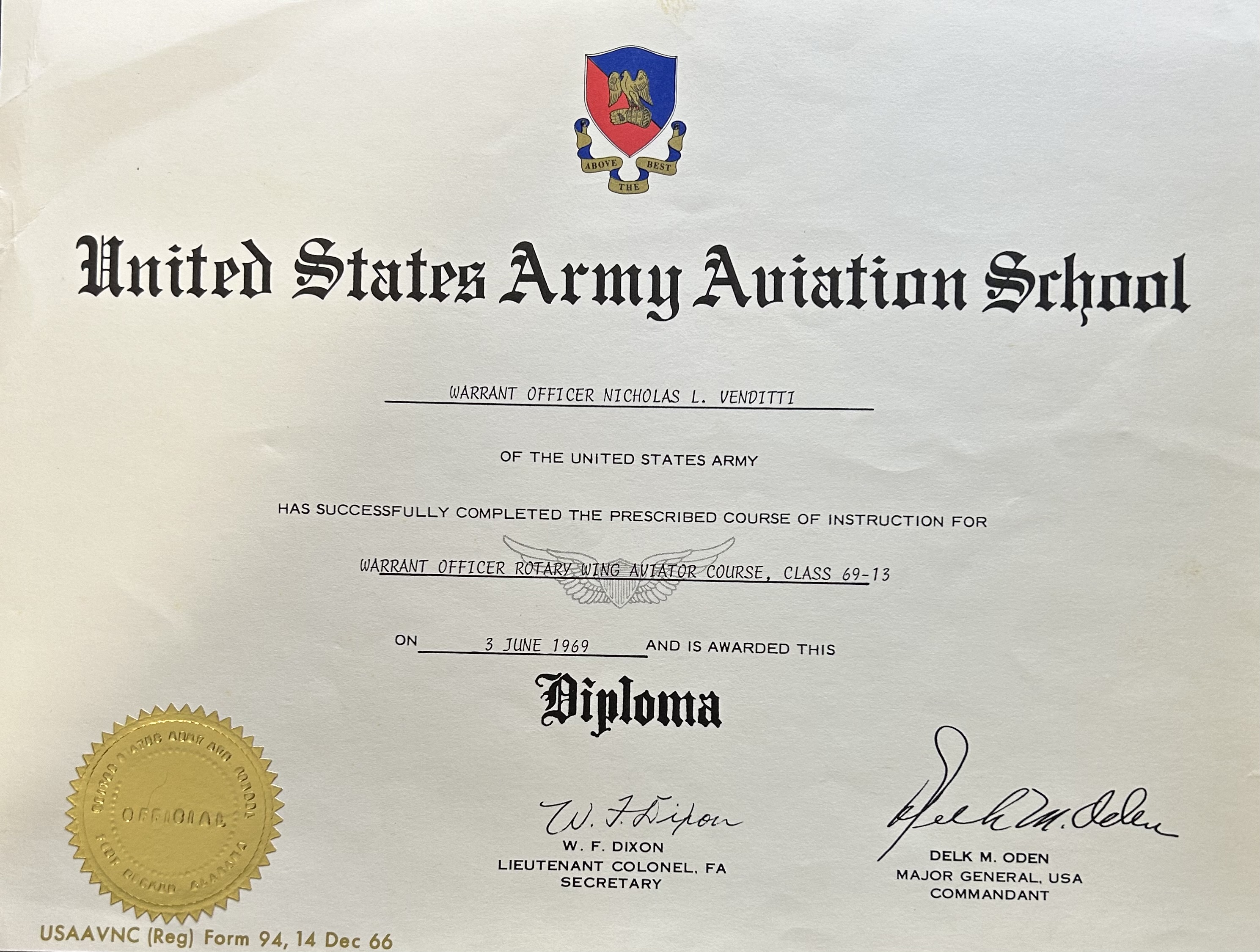
Nicky Venditti (center) with pals Skip Smith (left) and Tony Viall after they won their wings June 3, 1969, at Fort Rucker, Alabama, home of the Army Aviation School.

Ten years before my cousin Nicky joined the Army, his parents divorced.  Both remarried and continued to live in or near his hometown of Malvern, Pennsylvania.

I wrote in an earlier blog about the letters Nicky sent his dad, Louie Venditti, and stepmom, Bert, from Vietnam. I had the originals, now archived at the Center for American War Letters. (Louie and an older brother spelled their last name with an “i” at the end. My dad and the other siblings ended it with an “a.”)

Today I’m sharing letters Nicky sent his mother, Sally Pusey — I have copies of them — and one he sent our cousin Mike Beam, who gave me the original in 1997.

From Fort Polk, Louisiana, where Nicky was completing boot camp, he wrote to Sally and his stepsister, Bonnie Pusey. The daughter of John Pusey, Bonnie was four years younger than Nicky, who turned 20 in November 1968.

August 25, 1968

Dear Bonnie & Mom,

Nicky (foreground) in the Fort Polk graduation book, August 1968. At right is Billy Vachon, whose fate was tied to Nicky’s.

Well here is the letter I promised you. I know, it’s about time, right? Well maybe I’ll be home in a week or so, I hope. Just keep your fingers crossed, OK?…

Well it is hot as h— down here. You can barely stand it about noon time. It’s not like Penna. at all. They work us hard all day and a work day in the Army is about sixteen hours!

Did you lose your freckles yet, foam mouth? I’m only kidding you like I used to always do. You’re a cute girl.

Well I gotta go wash my clothes. I’ll see you in about ten days (I hope). Take care and tell everyone I said hello, OK? Bye!

Love,
Nicky

He went on to Army Primary Helicopter School at Fort Wolters, Texas, and wrote this undated letter in which he asked about his girlfriend and future fiance, Terri Pezick:

Sally with baby Nicky, 1948

Dear Mom,

I got your letter today. It sure was nice of you to send me that check. But there is nowhere at all where I can cash it. We are restricted to company area and will be for about two months! So I’m sending it back. It was sweet of you though. You’re the only one who has sent me money for a month. But remember, Mom, if you need it, don’t send it.

Well I start flying in one week if I can cut the cake at school this week. We are having weather this week and it is very hard to learn. Last semester, half of the class failed it!!

I just bumped my head on my locker about ten minutes ago. I was stooping and got up, but I forgot I left the door open. It just about knocked me out. That’s the worst thing that has ever happened to me here. Ha!

Nicky with Terri Pezick

So Terri is being good. Well I sure don’t get as many letters from her as I used to. That’s the breaks! I’ll take care of everything Christmas. I’m giving her an engagement ring Christmas (I think). I think I’ve been going with her long enough now. And I think she is the one. Wonder how much a good one will cost. I don’t know yet when I’m getting married. It all depends on when and how my future career goes. Especially here at school. And on her!

How’s John doing? Tell him after I get back from Viet Nam, we’ll fly up the mountains. And that’s a promise if I can make it through this school!

Well write again, Mom. And take care of yourself. Don’t work too hard. If you ever get in a jam and need money and can’t work or get it, write me and I’ll see what I can do, OK?

Take care and write soon,
Love, Nicky

P.S. The nuns at Immaculata are praying for me, so I’ll make it!

Nicky’s training at Fort Wolters ended January 31, 1969. He was off to Army Aviation School at Fort Rucker, Alabama, where he learned to fly Hueys. He wrote this letter to our cousin Mike, a Marine reservist in aircraft maintenance who would be getting married the following May:

First page of Nicky’s February 1969 letter to our cousin Mike Beam. Nicky’s dad and my dad, Carmine, were brothers. Mike is a son of their sister Josephine.

Feb. 25, 1969

Dear Mike,

I got your letter the other [day] and decided I’d better write you one. When am I going to get my bars? Well I’ll probably never get them. This stuff is so hard and I’m so dumb, I’ll probably get kicked out. If I do make it, I’ll get them around June 7th.

If you think I’m becoming an alcoholic, well you’re right. That’s all I do here is drink. There’s nothing else to do. I was thinking about buying a car. I doubt it though because I’ll be in Nam by July. …

No, I don’t get much shooting in. In fact, none at all yet. I get to shoot that .270 [Winchester] of yours when I get home though. Maybe I’ll get a hog [groundhog]? That’s if you don’t kill them all by then….

Maybe one of these days I’ll get home again. I almost forgot what it looks like!! I might sneak home for a weekend. It will cost me like hell, but at least I’ll get to come home.

Well it’s 7:00 now. Bedtime in three hours, up at 4:30. At 6:45 I’m in the air, trying to learn how to fly those damn instruments. I doubt if I’ll ever learn. So write back when you get a chance. Tell your future wife I said hello.

Nick

In an undated letter from Fort Rucker, he wrote:

Nicky’s stepdad John Pusey, mom Sally and brother L.B. at their home in Malvern, 1998

Dear Mom,

This place down here is driving me crazy. It’s twice as hard as I thought it would be. We are on VOR, ADF, radio navigation, etc. now. But I doubt if you know what I’m talking about. Don’t feel alone. I don’t either. We fly from 7:00 to 12:00 noon, then have classes from 1:30 till 5:30. What do you think of that schedule? Ugh! Hard as hell!

Well if I didn’t make it, at least I can say I tried, right?…

Well I’ll write again as soon as I can. Take care. I hope to see you all before I either finish or get kicked out. So take care and tell everyone I said hello.

Love,
Nicky

(VOR stands for very high frequency omnidirectional range. ADF stands for automatic direction finder.)

In another letter from Fort Rucker, on March 5, 1969, he wrote to his mom:

Did you get the picture of the instrument panel? I’ll bet you can tell me what everything is and just how it works too, can’t you? Well if you can, maybe you can show me!!! … You know the longer I’m here, the more I wonder whether I want to be an Army pilot or not. I don’t think I’ll get a kick out of signing up for three more years, plus flying around while someone shoots at me. But I went twenty-four weeks now, so I might as well finish. That’s if I can make it. We start advanced instruments Monday. That is going to be real hard. I only have twelve weeks left. Then a leave, then away again for a year. …

The place is so dull. I’m still thinking about buying a car, but that costs money. I ordered my dress blue officer’s uniform a few days ago. You should see it. Man, is it sharp.

It’s about 2:00 now. I guess about 4:30 I’ll go drink some beer. That’s when the WOC Lounge opens up. That’s all there is to do around here – drink….

Love,
Nicky

(WOC stands for warrant officer candidate. And Nicky did come up with the money for a car, a pea green 1968 Camaro SS.)

Postcard Nicky sent his mom from Japan on July 4, 1969, on his way to South Vietnam’s Cam Ranh Bay

On a postcard dated July 4, 1969, he told his mother that “I just arrived in Japan. We have an hour stop here before we leave for Nam. I’ll send you my address as soon as I can. So take care, I’ll write soon.”

He sent his last letter to Sally while going through a week-long orientation on the Americal Division base at Chu Lai.

July 7, 1969

Dear Mom,

How is everything at home? Fine I hope. Everything is fine here. It’s hot as hell, but what can you do.

I got assigned to the Americal Division near Chu Lai. That’s in the northern part of South Vietnam. I don’t have a mailing address yet because I’m not at my permanent unit. So don’t use the address on the envelope to mail me letters or I’ll never get them, OK? Remember, don’t use the return address on the front. I’ll send you my mailing address as soon as I can.

Mom, this place is lousy. I can’t even see why we are here because Viet Nam isn’t worth a nickel. But I guess they know why we are here.

So how is everyone at home? Tell John I was asking about him….

Well I’m going to sign off for now so I can mail this before the mail goes out. Don’t worry about me, I’m fine. Take care, I’ll write again soon.

Love,
Nicky

LZ Bayonet in 1969: The building behind these two GI’s is where an accidental grenade blast fatally injured Nicky and Billy Vachon, and wounded Tony Viall and a fourth helicopter pilot, Tom Sled. All knew one another and were sitting at the same table. Nicky and Billy died in the ICU at Chu Lai’s 312th Evacuation Hospital. One other soldier died from the blast, an engineer named Tim Williams, who was killed instantly.

Three days later, on July 10, Nicky and a few dozen other new arrivals were in a class on grenade safety at LZ Bayonet, just off the Chu Lai base. The instructor, a sergeant, unwittingly set off a live grenade. Critically injured, Nicky was flown by helicopter to a nearby surgical hospital, where his left leg was amputated below the knee. He was moved to the intensive care unit at Chu Lai’s evacuation hospital, where he died at 4:15 p.m. July 15.

Letters from Vietnam: an Army flyer’s last words

Warrant Officer Nicholas L. Venditti at home on leave in June 1969

Fifty-five years ago, my cousin Nicky died in Vietnam.

The Army helicopter pilot had been in the country for just 11 days. In that time, he penned three letters to his parents, my Aunt Bert and Uncle Louie, back home in Malvern, Pennsylvania.

Louie was one of my dad’s older brothers, a World War II veteran who had driven firetrucks for the 8th Air Force’s 479th Fighter Group in England. Bert was Nicky’s stepmom.

Nicky planned to marry his hometown girlfriend Terri Pezick. A car enthusiast, he owned a 1968 Camaro SS.

He wrote first from Cam Ranh Bay after a commercial flight from Seattle. His best friend Tony Viall, from Rossville, Georgia, would be arriving soon. They had met in boot camp at Fort Polk, Louisiana, and gone through flight training together at Fort Wolters, Texas, and Fort Rucker, Alabama.

The three letters Nicky sent his parents Louie and Bert Venditti in the days after he arrived in Vietnam

Nicky’s letter was dated July 5, 1969.

Dear Bert and Dad,

Well I arrived in this wonderful place called Viet Nam yesterday at three. There is fourteen hours difference between here and Seattle, Washington. I still don’t know where I’m going. Besides, I’m by myself and that’s plenty of help.

It was about 100 degrees yesterday. I still can’t believe I’m here. But when I look around, I get more assured I am!! … A warrant officer who was here for R&R told us it was good to see some new guys come in. He’s been here three months.

Louie Venditti in the Army Air Forces during World War II

I guess they’ll ship me out tonight between 12:00 and 8:00 in the morning. I haven’t seen Viall since I left Seattle. But he should get here before I leave.

Oh I’m at Cam Rahn Bay replacement center right now. It’s about 150 miles from Saigon. It’s probably the safest place in Viet Nam. Too bad I can’t get stationed here. Tell Terri not to write till I send her my address.

Well I have to go to the PX and snack bar now. Later on I’ll go drink some beer for you, Pops!! So take care. I’ll write and let you know my address. OK? See you in 363 days.

Bye!!
Nicky

P.S. Don’t pick up too many women in that Camaro.

A C-130 transport plane took Nicky north to the huge U.S. coastal base at Chu Lai, headquarters of the Americal Division. He was starting a week of orientation when he wrote home on July 6.

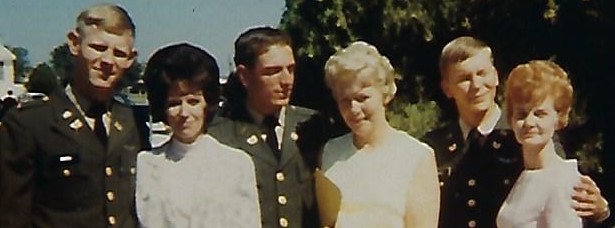
Nicky (center) with stepmom Bert and pals Skip Smith (left) with his mom, Elsie, and Tony Viall with his mom, Jewell, on June 3, 1969, at Fort Rucker graduation

Dear Dad,

I’m sitting at the combat center at Chu Lai. I’ll be here for about six days before I’m shipped out to my unit. I am assigned to the Americal Division in the northern (I Corps) portion of South Viet Nam. There are choppers and Air Force jets flying all over the place here.

I’m sorry this is a little sloppy, Dad, but it’s hotter than hell here. It makes Fort Polk seem air conditioned.

Well I’ll let you in on the situation up here, Dad. It’s not too good. There used to be only companies of V.C. [Viet Cong] around here, but now there are regiments and divisions of them. The lieutenant who briefed us said they expect an offensive, but do not know when. … That’s all I can let you know for now. Besides I wouldn’t tell you anymore anyway, because you’ll worry your head off.

How are my women and my car doing? You know you have to take care of both of them till I get home. If Terri needs anything, get it for her. OK?

Well I have to go eat, Dad. Take care and I’ll send my address as soon as I can. Take care, Dad, and don’t worry about me.

Take care,

Nicky

Nicky with Terri Pezick

The danger Nicky faced in the I Corps zone wasn’t from the Viet Cong but the North Vietnamese Army. He wrote on July 7:

Dear Dad,

… Well, Dad, last night all hell broke loose. I was sleeping at about 3:00 in the morning when the mortars started coming in. I heard the first two rounds hit and saw everyone run like hell. So I rolled over in bed and after a while the alert siren blew [so] I decided I’d better find a bunker. You would of laughed if you saw Viall. He jumped out of bed, fell out the door, and low crawled to the bunker. That was the fastest I ever saw Viall move.

I forgot to tell you I met him at Cam Rahn Bay and he came up here [to] Chu Lai with me. But when we leave here, we’ll get separated for sure. …

So take care. I’ll send you my mailing address as soon as I can. See you in 361 days (I think).

Take care and tell everyone I said hello.

Bye!

Nicky

He would not live to write again.

On July 10, as part of their orientation, Nicky, Tony and a few dozen others were trucked off the base to a landing zone called Bayonet. They sat at tables in a plywood building for a lecture on grenade safety. But the sergeant who taught the class made a terrible mistake. Intending to see how the men would react, he unwittingly tossed a live grenade among them instead of a dud.

Nicky (in foreground) with Billy Vachon (right) at Fort Polk, 1968

The blast killed one soldier instantly and mortally wounded Nicky and his friend Billy Vachon from South Portland, Maine, a fellow helicopter pilot. Nicky lost his left leg below the knee. Tony and a dozen others were seriously hurt. The Army said it was an accident.

Five days later, on July 15, 1969, Warrant Officer Nicholas L. Venditti – his surname was spelled differently from mine — died in the intensive care unit at Chu Lai’s 312th Evacuation Hospital.  He was 20 years old. Billy, in the same ICU, followed him two days later.

I wrote about Nicky in my book Tragedy at Chu Lai, published in 2016 by McFarland & Co. Aunt Bert and Uncle Louie had given me his three original letters from Vietnam in 1995. The lined pages in blue ink have remained in a filing cabinet in my home office. But as Nicky’s last words on paper, a personal record of his brief service, they deserve more than just being tucked away for my eyes only.

Some of Nicky’s Army gear kept in my home
(Chuck Zovko photo)


So in tribute to Nicky, and with permission from his brother, L.B., I’m sending them to the Center for American War Letters at Chapman University in Orange, California. There, they will be read, preserved and promoted as part of “an irreplaceable record of the sacrifices made by military personnel and their families.”

Books for the Vietnam War reader

If you want to write about the Vietnam War, you need to read about it.

But there’s so much material out there, where do you start?

Go right to Vietnam: A History by former Time, Life and Washington Post Southeast Asia correspondent Stanley Karnow. Published in 1983 as a companion to the PBS series “Vietnam: A Television History,” it’s a sweeping narrative of American involvement in Vietnam.

A close second is A Bright Shining Lie: John Paul Vann and America in Vietnam by Neil Sheehan, a Vietnam War correspondent for UPI and The New York Times. The Pulitzer Prize-winner from 1988 tells the story of an Army lieutenant colonel who at first challenged, then embraced, how America was fighting the war. This book will help you see why we lost it.

Two books made up my early reading of the Vietnam War: Ron Kovics’ Born on the Fourth of July, from 1976 (later made into a movie), and Michael Herr’s Dispatches, from 1977. I was a year out of college when my dad recommended Dispatches, saying it was powerful enough to give him nightmares.

Waiting for medivac helicopter, Long Khanh Province, 1966

Waiting for helicopter to evacuate a fallen soldier, Long Khanh Province, 1966

To understand infantry combat in Vietnam, read We Were Soldiers Once … and Young, by Lt. Gen. Harold G. Moore (retired) and Joseph L. Galloway. This 1992 book, also made into a movie, is the story about the men of the 7th Cavalry who in 1965 fought the North Vietnamese in the Ia Drang Valley.

A must book for writers is Stolen Valor: How the Vietnam Generation was Robbed of its Heroes and its History by B.G. Burkett and Glenna Whitley, published in 1998. Burkett, a Vietnam veteran, and Whitley expose phony heroes and show how Vietnam vets have been unfairly demonized. The book gives a valuable lesson in getting military documents under the Freedom of Information Act.

I also recommend Dear America: Letters Home from Vietnam, originally published in 1985 by The New York Vietnam Veterans Memorial Commission. Kurt Vonnegut called this collection of letters and poems “the sad and beautiful countermelody of truth.”

In fiction, there’s Tim O’Brien’s The Things They Carried, first published in 1990. Interestingly for me, O’Brien served with the Army’s Americal Division, the more common name of the 23rd Infantry Division, in Vietnam in 1969. My cousin Nicky Venditti, an Army helicopter pilot who is the subject of my book, Quiet Man Rising: A Soldier’s Life and Death in Vietnam, was also assigned to the Americal Division and was also in Vietnam in 1969. Nicky, however, only survived eleven days.

Two books that deal with the Americal Division helped me with my story about Nicky. One is Maj. Gen. Lloyd B. Ramsey, U.S. Army Retired: A Memoir, from 2006. Ramsey was the commander of the Americal Division at the time Nicky was on the Americal’s base at Chu Lai. My wife, Mary, and I visited the general at his home in McLean, Virginia, in 1998, and I have had numerous phone interviews with him.

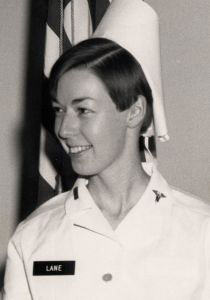
Sharon Lane, Army nurse killed by enemy fire, 1969

1st Lt. Sharon Lane

The other book is Hostile Fire: The Life and Death of First Lieutenant Sharon Lane, written by Philip Bigler and published in 1996. Sharon Lane was a nurse at the evac hospital at Chu Lai. She was killed in a North Vietnamese rocket attack in June 1969 and was to be the only American servicewoman killed by enemy fire in the war.

Sharon’s replacement at the evac hospital was the subject of my last blog, Lynn O’Malley Bedics, who in July 1969 tended to Nicky as he lay dying after an Army instructor unwittingly detonated a grenade.

Reading these books about the Vietnam era has helped me connect the people I meet who were there with the events that dominated the headlines. Talking with Gen. Ramsey and Lynn O’Malley Bedics and reading of their experiences gave me the material I needed to fill out Nicky’s story.

Making an Improbable Connection

Researching veterans’ stories is always rewarding, but sometimes you’ll come across information that will knock your socks off.

Consider this: The Army nurse who tended to my cousin Nicky as he lay dying in an evacuation hospital in Vietnam four decades ago lives in my neighborhood. I found out about her one day when my project to write a book about Nicky and my work on veterans stories for The Morning Call collided.

Nicky Venditti at home, June 1969

Nicky Venditti at home, June 1969

It happened in 1998, after I had begun researching Nicky’s life and death as an Army helicopter pilot in the Vietnam War. That year, the success of Steven Spielberg’s film Saving Private Ryan spurred aging veterans to talk about their experiences, many for the first time. We at The Call in Allentown, Pennsylvania, planned a special section for Veterans Day 1998 called War Stories, and I was the editor.

One reporter was to write 10 short articles based on interviews with veterans of World War II and the Korean and Vietnam wars. I told the reporter, Ron Devlin, to include a woman who had been a front-line nurse.

“I got a great nurse,” Ron got back to me. “Here in town.”

She had served in Vietnam, he said. Immediately I asked him where and when.

“Chu Lai,” Ron said, “1969.”

The time and place were a match for Nicky, who died July 15, 1969, five days after an Army instructor unwittingly detonated a grenade in a class for new arrivals.

Tending the Wounded, 1969, Chu Lai

Tending the Wounded, 1969, Chu Lai

In the three years I had been following Nicky’s path, I had never spoken with any nurses who worked in the evac hospital where he died. Had this one been there?

Her name was Lynn Bedics, and she was the nurse manager at the Allentown Veterans Affairs Outpatient Clinic. Within minutes, I called her and she said yes, she was in the intensive care unit at the 312th/91st Evac Hospital in July 1969, but she didn’t remember Nicky’s name, Venditti. Still, the ICU only had about 15 patients at any given time, so she had probably seen him.

Lynn agreed to meet with me.

I didn’t know at the time that I already had files linking Lynn to Nicky. I had asked the National Personnel Records Center in St. Louis to send me copies of any paperwork pertaining to Nicky’s care at the 27th Surgical Hospital, where his left leg was amputated below the knee, and the 312th/91st Evac, where he hung on to life for a few days. In response, I got nearly 50 pages of clinical records from both Chu Lai hospitals and studied them.

Now I scoured the records again for nurses’ names and saw two blood transfusion forms with the signature “L. O’Malley, 2LT ANC.” That was 2nd Lt. Lynn O’Malley of the Army Nurse Corps. O’Malley was Lynn’s maiden name, something I knew because Ron included it in his story about her, which noted she was 22 and single in 1969. The records show Lynn gave Nicky 500 milliliters of whole blood at 4 a.m. on July 14. She “hung” an additional 500 milliliters for him at 6:15 a.m.

Nicky died the next day.

army nurse, vietnam

Lynn Bedics, Vietnam, 1969

When I met with Lynn in April 1999, I showed her the forms proving she had ministered to Nicky. It was a bonding moment for both of us, even though she still didn’t remember Nicky and didn’t recognize him from pictures.

Today Lynn is retired from the government. She still lives a five-minute walk from my home in west Allentown. We’ve had lunch together, we see each other at the Farmers Market and exchange e-mail and phone calls. She knows many of the vets I’ve interviewed for my Morning Call series War Stories: In Their Own Words, and even steered me to one. And she looks forward to publication of my book about Nicky, Quiet Man Rising: A Soldier’s Life and Death in Vietnam.

Lynn’s connection to both Nicky in Vietnam and me in Allentown was improbable but didn’t happen on its own. The pieces had to be put together. In the end, it was a lesson in the importance of listening closely, examining the right documents and paying attention to detail.

Lessons I Learned from Pat Tillman’s Story

After reading Jon Krakauer’s Where Men Win Glory: The Odyssey of Pat Tillman, I couldn’t help but compare the story of the NFL player killed by friendly fire in Afghanistan to what happened to my cousin Nicky Venditti in Vietnam 35 years earlier.

– Tillman was a famous athlete. Nicky was athletic, too, but hardly known outside his hometown of Malvern, Pennsylvania. Still, they both felt a duty to serve their country in wartime, and both enlisted in the Army – Tillman to be an elite Ranger, Nicky to become a helicopter pilot.

– The military clearly knew how Tillman died in 2004; the evidence all pointed to gunfire coming from his own platoon, near the Pakistan border.

In Nicky’s case, the Army couldn’t determine how an instructor at the Americal Division base at Chu Lai happened to toss a live grenade in his classroom. For lack of evidence, the brass ended up calling the 1969 explosion that killed Nicky, Billy Vachon and Tim Williams an accident. But it might not have been friendly fire. It might have been the work of a Viet Cong saboteur, as the instructor himself now suggests. We will never know.

– There were cries of cover-up in both cases. Ranger leaders stupidly withheld the details of Tillman’s death, leading his family and the American public to believe he was gunned down by the enemy.

After the deaths of Nicky, Billy and Tim at Chu Lai, some soldiers complained that the truth of what happened wouldn’t come out. There was an investigation, but in years of searching I’ve never been able to find any paperwork on it. In the immediate aftermath, the families were told little more than that a grenade had gone off by accident in a classroom.

– A big difference between the two incidents was how Tillman’s family responded to the news of his death. They would not rest until they learned the details surrounding his fatal shooting. Ultimately, after pressing the government relentlessly to come clean, they got some satisfaction.

Nicky’s parents and those of Billy Vachon and Tim Williams did not seek the details of what happened to their boys or question the Army at all about it. They accepted the word that was handed down to them.

Perhaps that has something to do with who they were: the generation that fought World War II — and still did not doubt the military, even during the unpopular war in Vietnam.

But it was something else, too, that was more basic: To Nicky’s parents, it didn’t matter how he died, only that he was gone.

What happened to Tillman and Nicky didn’t diminish their sacrifice, no matter how you classify their deaths. They both stood up for their country in its time of need, and died for it.