Tag Archives: Bataan Death March

 ‘Uncle Earl, you have never been forgotten’

Private Earl Seibert came home yesterday, May 25, 2024. He’d been gone for a long time.

A burial detail removes Private Earl Seibert’s casket from a carriage May 25 at Grandview Cemetery outside Allentown.

The mechanic from Allentown, Pennsylvania, died 82 years ago in a Japanese POW camp in the Philippines. He was buried there in a common grave.

His family knew he was missing and presumed dead. Not until World War II ended did they learn he had succumbed to diphtheria in 1942 at Cabanatuan Camp 1 on Luzon. He was 23. Early this year, the Defense Department announced his remains had been identified.

Seibert arrived at Philadelphia International Airport for a “dignified transfer” on May 21. Yesterday, the military and a throng of mourners paid tribute to him at Jordan United Church of Christ and Grandview Cemetery outside Allentown. I wrote about him in February, so I had a special interest in being there.

Private Earl Seibert of Headquarters Company, 803rd Engineer Aviation Battalion, attached to the Far East Air Force in the Philippines

In the fall of 1941, Seibert and six hometown buddies shipped out to Luzon with the Army’s 803rd Engineer Aviation Battalion to work on airfields. They were at Clark Field when the Japanese attacked Pearl Harbor and the Philippines. With the surrender in April 1942, they were among thousands of U.S. and Filipino troops taken on the Bataan Death March and held in squalid camps. Only three of the seven survived.

At the church service, Seibert’s niece Ginnie-Lee Henry shared a letter she wrote that begins “Dear Uncle Earl.” She told him that his father learned from the War Department in 1951 that his remains could not be recovered.

Both his parents and his sister – Henry’s mother – and then Henry herself “started to investigate what had happened to you.” It took many years. Henry found that when the prisoners couldn’t work or got sick, they were placed in housing the Americans called Barracks 0, so called because men had a zero chance of coming out alive.

“It is believed you were placed into Barracks 0 in the beginning of July 1942. Your personal belongings were taken by the Japanese guards, including your identification tag as a souvenir. The Army believes you died at 4 a.m. on July 27, 1942, having your death recorded on a condensed milk can label by another POW. You were one of twenty who died that day.”

Seibert’s cousin Tommy Sweeney, a private in the 20th Air Base Group, also was captured on Bataan. He died at the Cabanatuan camp June 23, 1942, of Vincent’s angina .

This carriage pulled by Percheron draft horses took Seibert’s casket from Jordan United Church of Christ to Grandview Cemetery.

The POWs were exhumed at war’s end and reburied in the Manila American Cemetery, where the “unknowns” lay in a common grave. Six years ago, Henry and other family members provided their DNA to the Defense POW/MIA Accounting Agency. Last summer, it identified one set of remains as those of Seibert.

At the church yesterday, a half-open casket contained Seibert’s remains, enfolded in an Army uniform. His medals were on display, including a Bronze Star for his role in the defense of Bataan and two Purple Hearts, one because he was wounded January 16, 1942, and the other because he died at the hands of the enemy.

The Missing Man Table with a single chair was on display. On top of it was a folded American flag, a Bible, a candle, an inverted glass, a red rose in a vase tied with a yellow ribbon, a slice of lemon and some salt. The lemon is a reminder of a POW/MIA’s bitter fate. The salt symbolizes the family’s tears.

The flag is lifted from Seibert’s casket to be folded and presented to his niece Ginnie-Lee Henry.

In times of sadness, there is comfort in ritual. I felt it.

Under the noontime sun, the casket rode to the cemetery two-and-a-half miles away in a horse-drawn carriage, to the clip-clop cadence of two Percherons’ hooves. A bugler played Taps. Riflemen fired three volleys in salute. We recited the 23rd Psalm aloud. With solemn respect, two soldiers lifted the American flag off the casket and folded it precisely. Another presented it to Henry as she sobbed. Three shell casings from the rifle salute were handed to her, symbolic of duty, honor, country.

“Welcome home, Uncle Earl,” Henry had written in her letter to him. “We remembered you. So did many others, too.”

Veterans Live On In Their War Stories

They buried Ernie Leh with his 1st Infantry Division pin.

At the service last week in Schnecksville, Pennsylvania, the Rev. Robert D. Machamer Jr. read aloud from the story I wrote about Ernie six years ago as part of my series in The Morning Call newspaper, War Stories: In Their Own Words. He read not just a few lines, but the top third of the article. It was about Ernie’s landing at Omaha Beach on D-Day, June 6, 1944.

The minister, a friend of Ernie’s, was taken by an occurrence on the beach that would have been humorous if the situation hadn’t been so grave:

“On my way up the slope, I had to relieve myself. I stopped and went behind a rock about 5 or 6 feet high. Others passed me and went on ahead. I remember seeing a major and some enlisted men pass by. Just as they got over the next rise, a shell exploded right in their midst, getting all of them. That, I thought, might have been me if I had not stopped to urinate. The brief delay had saved my life.”

Soldiers on their way to France, June 6, 1944

Soldiers on their way to France, June 6, 1944

Machamer paused and said with a smile that you had to figure Ernie was meant to survive.

As he went on with the story, which I’d put together from Ernie’s own writings and my interviews with him, I thought about the enduring value of recording veterans’ stories, how important they are to family and friends and not least of all, posterity.

By special arrangement, my stories in The Morning Call have permanent homes in the National World War II Museum in New Orleans and the Library of Congress’ Veterans History Project.

Some of my subjects were recommended to me by sons and daughters of World War II veterans whose dads were in poor health. Their children felt they had limited time left and asked me to get their stories down. It’s an appeal I find hard to resist.

Two such interviewees were Earl Metz and Earl Schantzenbach. I worked on them without delay. Their stories ran in March 2003 in the days after the Iraq war began. Metz, who had been a combat engineer in Europe, lived for two more years. Schantzenbach, an infantryman who was awarded the Silver Star for gallantry, died just five weeks after his story appeared. But their stories will live on.

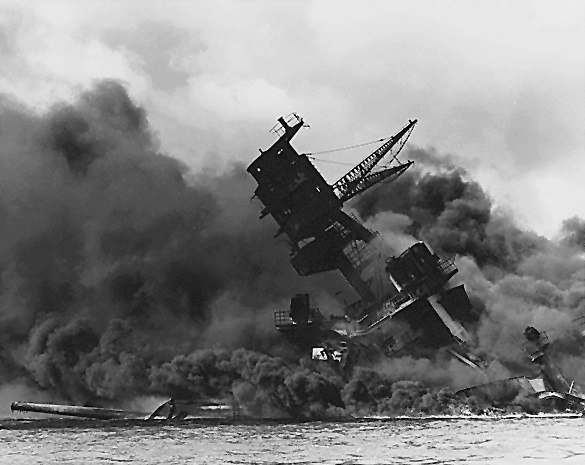
USS Arizona sunk at Pearl Harbor, December 7, 1941

USS Arizona sunk at Pearl Harbor, December 7, 1941

A Pearl Harbor survivor who agreed to talk with me did not live to see his tale in print. John Minnich’s heart gave out several days after my second interview with him. His family gave me permission to run the story as a tribute to him, and it appeared on the Pearl Harbor anniversary on Dec. 7, 2001. I sometimes wonder if he didn’t sense the end was near.

Veterans themselves embrace the idea that their stories will live after them. Most memorable to me was Joe Poster, who endured the Bataan Death March and more than three years as a prisoner of the Japanese. As his health failed in the months after his story appeared, I heard him tell people on more than one occasion, “That story is in the Library of Congress.” His two-part account is at  http://www.mcall.com/news/warstories/all-josephposter1,0,2658608.story and http://www.mcall.com/news/warstories/all-josephposter2,0,2724145.story.

State Representative Jennifer Mann of  Allentown contributes to the perception of permanence. When my war story subjects are constituents of hers, Rep. Mann sends them laminated copies of the articles with a note thanking them for their service to the country. This helps veterans see that people beyond family and friends are grateful for what they’ve done.

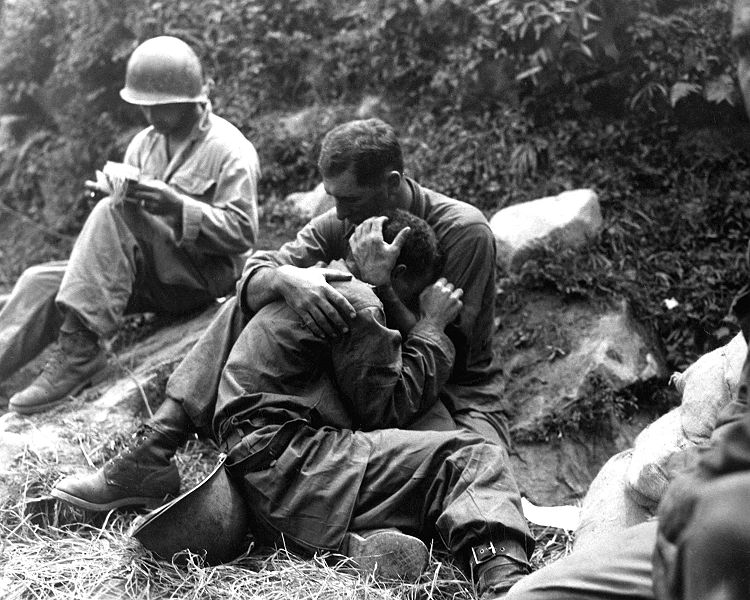
Korean War Fallen Soldier, August 28, 1950

Korean War Fallen Soldier, August 28, 1950

Even in obituaries, families have noted their loved ones were featured in the series. When nurse Cecilia Sulkowski died in 2008, the reference to my work read in part: “On July 5, 2002, Cecilia was featured in a lengthy article with photos in The Morning Call titled ‘Mending broken spirits, shattered bodies in Korea.’ In the article, she describes her Army experience which included setting up the first-ever Mobile Army Surgical Hospital during the first six months of the Korean War… Her vivid descriptions and sharp memory made this story mesmerizing.”

At veterans’ funerals, my stories have appeared among photos and other memorabilia for mourners to see. This is more than gratifying. That’s because beyond the thanks of veterans themselves and their families and friends, writing veterans’ stories is meaningful and lasting. It not only preserves legacies for generations to come, it contributes to our understanding of history.

That’s partly what I aim for in my book about my cousin Nicky Venditti, an Army helicopter pilot who answered his country’s call. In QUIET MAN RISING: A Soldier’s Life and Death in Vietnam. In this book which took me many years to write, I also give voice to a young man whose story – like the stories of countless other veterans – would otherwise lie with him in the grave, untold and unappreciated.

I can’t let that happen.