Louie Venditti’s home movies from June 1969, when his son Nicky was about to leave for the Vietnam War
My cousin Nicky, 20 years old, is home on leave in Malvern, Pennsylvania. He wears the wings he has just earned as an Army helicopter pilot and is bound for Vietnam. It’s June 1969.
Uncle Louie, an Army Air Corps ground crewman in England during World War II, is immensely proud of his son. He takes Nicky, in his uniform, to the VFW and American Legion posts to meet his buddies. He snaps photos of Nicky and shoots film of him with his home-movie camera.
Nicky is embarrassed but goes along with the fuss to make his dad happy. All the while, he is terrified of going to the war. He insists to his closest friends that he won’t be coming back alive.
—
Over the years, I’ve posted photos of Nicky taken during his 23 days of leave. Now for the first time, I’m showing video from the home movies Louie shot on three reels of 8-millimeter film. More than soundless images of a soldier, they are a snippet of ’60s small-town America.
The first image you’ll see is Nicky smiling at the camera from a picnic table outside his home. The young man wearing sunglasses is Nicky’s stepbrother, Joe Gray. The two other men are friends of the family. The woman is my Aunt Bert, Nicky’s stepmom. She and Nicky were close. The hip-swiveler is Uncle Louie, a rascal and lots of fun. The young woman with Nicky is his fiance, 18-year-old Terri Pezick. The other couple in the yard is my cousin Mike Beam and his wife, Monica. The pea-green car going down the street is Nicky’s ’68 Camaro SS. Finally, the husky guy with sideburns is Nicky’s best pal in Malvern, Charley Boehmler.
Uncle Louie with Nicky at home in Malvern, Pennsylvania, in the last days before Nicky’s departure. (They spelled their last name, Venditti, differently from mine.)
The night before Nicky left for Vietnam, Charley told him that he shouldn’t worry about getting killed. “You’re always lucky,” he said.
—
Warrant Officer Nicholas L. Venditti arrived in Vietnam on the Fourth of July 1969. Six days later, as part of his Americal Division orientation on the U.S. base at Chu Lai, he was in a class on grenade safety when the instructor unwittingly let loose a live grenade. Nicky lost his left leg below the knee. He died July 15 in Chu Lai’s 312th Evacuation Hospital, on a bluff above the South China Sea. He had survived only 11 days in Vietnam.
Uncle Louie died of heart failure in 1996 at age 72. Aunt Bert found the home movies in a shoe box in the attic and gave them to me. She once asked Louie about them, and he had said only, “I’m never going to look at those.”
Terri Pezick honored Nicky’s request that she live happily if he didn’t return. She married and had two sons. Charley Boehmler died of cancer in 1999, when he was 50. Aunt Bert died in 2006 at 81.
Americal Division combat medic Fred Sanders during his 1969-70 tour of duty in Vietnam
“As a noncombatant combat medic, I experienced seeing much suffering, ruthless cruelty and tragedy in Vietnam,” Fred Sanders wrote to me. “For those who have experienced or witnessed traumatic events in their lives, I would counsel: Do not nurse your pain. It will only prolong the suffering and make your life more difficult.”
Sanders is 78 and lives near Columbia, South Carolina. He was with the Americal Division unit involved in the reported mutiny of U.S. troops in 1969. Last year, I blogged his account of “the very unfortunate thing that was not a mutiny.” Today, I’m sharing more of his Vietnam story, as he has told it to me.
I became a medic because I was a conscientious objector. I did not want to kill. I was well read on world affairs, politics. I saw then what people now recognize as the truth of what happened in Vietnam.
But this didn’t figure in my C.O. position. I felt it best to serve as a noncombatant on religious grounds. I belonged to a Baptist church, and the Southern Baptist Convention recognized my personal convictions as a C.O. My best choice was to try to save as many lives as I could.
I was a student at the University of South Carolina, interested in getting a degree in biology.Istayed out one summer to work for the state engineer’s office to make money to get back into college. But I didn’t get back in the first semester because I missed signing up.
A draft board member heard I stayed out a semester, and they pulled my name to be drafted. I said I’d like to register as a C.O. I wasn’t trying to get out of the Army. I said I’d go as a medic.
The head of the draft board got angry. He said, “You’re gonna put a black mark on Aiken County’s history.” I said I’m not asking for alternative service like Mennonite friends of mine. I’ll do the best I can if you let me serve in a medical capacity and try to bring some of these young men home alive.
—
Sanders today. He holds Native American, Scots-Irish and German heritage.
“I had a lot of experience dealing with people dying,” Sanders said of his year in the northernmost U.S. military zone of South Vietnam. He was 23, 24 years old while serving with Alpha Company, 3rd Battalion, 21st Infantry Regiment. “They called me an old guy.”
In the Song Chang Valley south of Da Nang, a friend of his, Sergeant Derwin Pitts, was shot as they walked down a hill toward the enemy. He lay groaning about six feet away, his position exposed. Sanders tried to figure how he could reach him without also being shot. Just then, Private First Class Ray Barker called him off, saying, “Doc, you’re not gonna do it.” He crawled past Sanders toward Pitts and was immediately killed. Pitts also died where he lay.
Another time, a young man was hit by a fragment from an antipersonnel artillery round. “That metal had severed his throat. He was hemorrhaging in his mouth, and I had to try and clear his airway but was unsuccessful. I was sucking blood out of his throat. There was nothing I could do to save him.”
Some men had self-inflicted wounds, “which I suspected of stemming from fear of being killed.” One shot himself in the foot. On another occasion, Sanders had just spoken with a man who was cleaning his M16 and heard a shot fired. “I ran to him and found his leg hanging only by skin. He said that the trigger caught on a root. He had expressed fear of being killed when walking point on patrol. He insisted that [the shooting] was an accident.”
Atrocities happened, and Sanders witnessed a few. He was with a platoon when they came across an old Vietnamese woman carrying a bundle of ruled notebooks and about $20 in Vietnamese money. She lived in a little grass shack with two children about 10-11 years old. The platoon leader, a lieutenant, called battalion commander Eli Howard and asked what to do with her. “I don’t want any prisoners,” Howard said. “All I want is body count.” The lieutenant said, “OK, sir,” and turned to the men. “All right, fellas, I need somebody to get rid of this woman.”
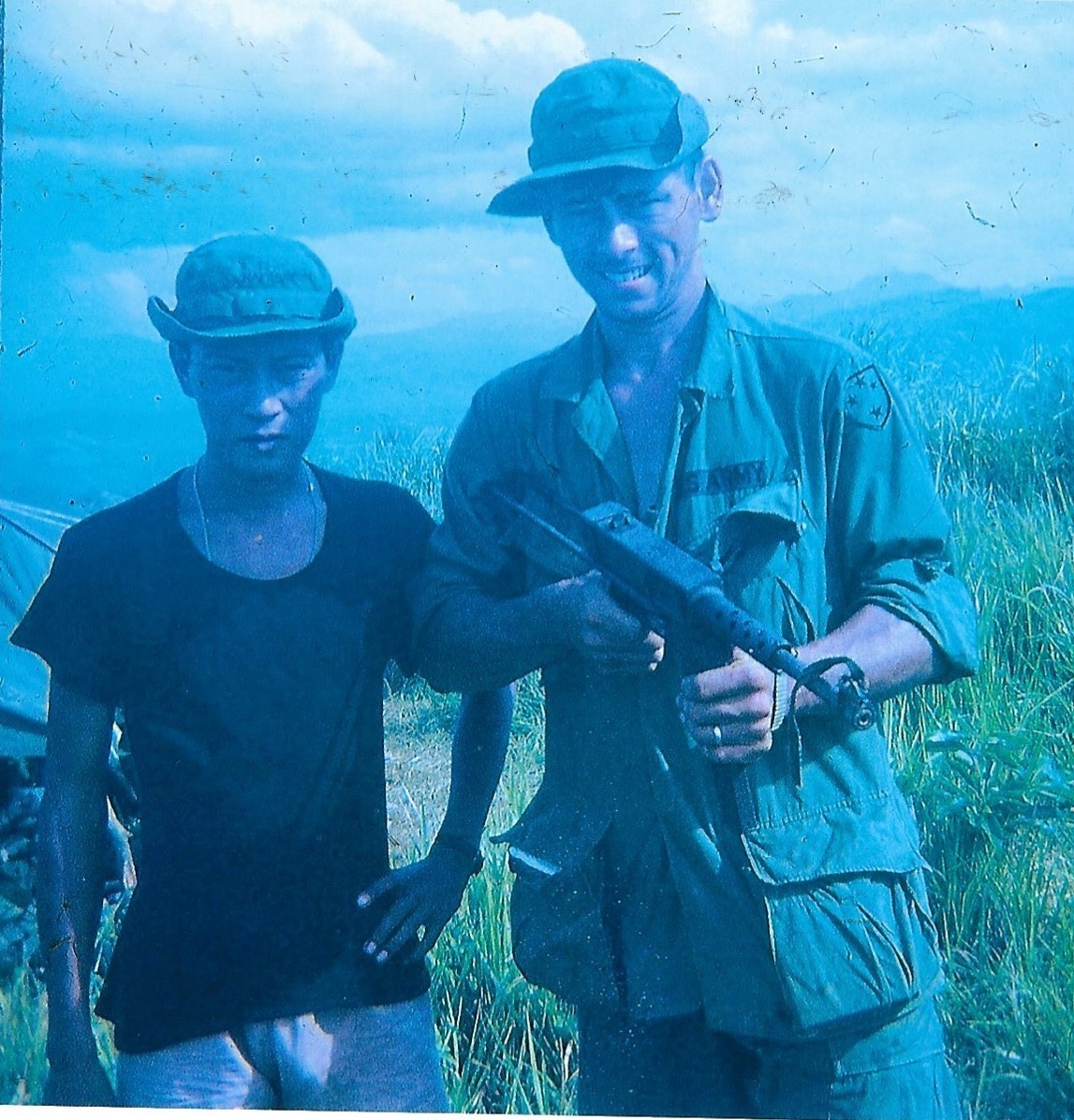
Beside a Kit Carson scout, Sanders holds a rusty French sub-machine gun a Vietnamese woman used against an American patrol. She was shot and killed. Kit Carson scouts were enemy fighters who defected to the South and worked for U.S. military units.
What! Sanders thought. You’re going to execute her? That’s a war crime! What had she done?
“Somebody do it,” the lieutenant repeated. There were at least 10 men standing around. Everyone looked at one another, said nothing, then looked down at the ground. One soldier finally spoke up. “I’ll do it,” he said. Everyone stood back.
The two children were with the woman. She was hugging them. The soldier put his rifle to her head, fired and killed her. The children screamed and ran off into the jungle. Sanders said two men from the platoon went into the bush, perhaps to pursue them. He heard that members of a nearby platoon chased down the children and killed them to make sure there weren’t any witnesses.
“Nobody wants to remember this,” Sanders said. “It left a lot of bitterness with some of us. There was certainly no military value in it.”
Did Sanders speak up about what happened?
I was thinking I can’t say anything because it would put me in a very bad position. I’d had a long experience with taking an unpopular stand, though not with this platoon.
When I was attached to another company earlier, one day a helicopter came and in and they said, “We’re taking you back to LZ Center,” the battalion command post. They told me privately that someone reported “there’s a plot to shoot you during a firefight. Some of these guys want you out of the company, because they don’t appreciate you giving out little Bible tracts in Vietnamese to the people. They resent you. We’re getting you out of here for your own safety.”
When I was in Taipei, Taiwan, I bought a very nice professional camera. I was at the canteen at Chu Lai [the Americal Division base], standing at the counter, and there were some guys at a table and they started talking to me, and when I turned to them, they sent somebody around to my other side where my camera was, and he stole it. They were afraid I might take pictures of something that might get them in trouble.But I never considered doing anything to besmirch my men or the unit in general.
Sanders said no one reported the old woman’s murder to the higher-ups.
Sanders of A Company, 3rd Battalion, 21st Infantry Regiment, 196th Light Infantry Brigade
We dared not go that far with it. I didn’t think at the time that the leadership culture would want it uncovered. That was bad publicity. It would expose the brigade to public scrutiny at a time when mixed public sentiments were influencing conduct of the war.
Also, for my own safety, I had to be careful. I was quite aware of the environment I was in. I’m here with a group of men. I don’t know what their life was. They could’ve been gangbangers before they got drafted.
Sanders said that on a previous occasion while the platoon was on patrol, a soldier shot an old man leaning against a betel nut tree near a cluster of huts, blowing the top of his head off. “What did you do that for?” Sanders asked him. “I panicked. I saw that man, and I didn’t know what to do.” After that, Sanders kept an eye on him and asked him now and then how he was doing, thinking he might be shaken by what he’d done.
“To the best of my remembrance, he was the same guy who shot this woman.”
After killing her, he asked Sanders: “Doc, do you think maybe you could write me up and get me out of the field? I don’t feel like I’m doing too good.”
“I filed a medical recommendation to remove him from field duty as possibly having combat-readiness issues. … I don’t know what became of him,” Sanders said.
Recently, a friend who’d been in the platoon told Sanders that the soldier “admitted to some of us” he shot the woman to get out of the field – a revelation that shocked Sanders. The soldier wanted to manipulate the medic into writing a recommendation that he wasn’t stable and should be removed from field duty.
—
Sanders said the lieutenant who asked for a volunteer to execute the old woman once allowed several of his men to rape a Vietnamese girl. Sanders was with the platoon and didn’t see the assaults but was aware of them. He described the girl as pretty and nicely dressed for someone in the jungle. The lieutenant, he told me, “was totally unwilling to take charge of his men.”
I was with another company one time, and we had walked into a hamlet, and this guy said, “All these people are V.C. [Viet Cong], and he started shooting. He killed men, women and children – 12 or 14 people. Everybody was in shock, but everybody kept their mouths shut, because all of these guys [I’m with] have arms, and you just don’t want to cross anybody, because people can be very dangerous and there aren’t any rules, unless a commander intervenes. Six weeks after that man killed all those people in that tiny hamlet, one of the guys came to me and said, “Doc, he got justice. He got what he asked for.” He had been shot and killed in a firefight.
Once, Sanders was riding in a helicopter with a prisoner and a soldier who carried a Bowie knife and was known to kill detainees. “First thing I know, he shoved the detainee out of the helicopter and said, ‘Oh, he slipped and fell.’”
“It was a great challenge to me to go through all this.”
—
How did Sanders keep his head?
Sanders tends to a Vietnamese child with a skin infection.
I read 24 books in the field, every time we had a break and we were not in danger. Reading is good medicine. It put me in another place.
My faith in God sustained me.
I maintained friendships with as many people as I could.
For some years after I came back, PTSD really hit me. My wife would go to bed and I’d sit in the kitchen and cry, remembering all the suffering and death that I had witnessed.
One night as I was sitting there, my wife said, “Why don’t you come to bed?” I said I’d be there soon, and she fell asleep. I heard a voice in my head: “I would heal you, but you have never asked.” I said, “Huh, what?” I realized it was the voice of God speaking to me in my mind. I was so moved and humbled and asked forgiveness. I said, “Lord, heal my memory.”
From that day on, I never again sat up in the kitchen at night crying. I’m able to sleep.
I still have dreams of being in evasive tactics in Vietnam but never seeing anything violent. One night I dreamed I was in an underground bunker with the North Vietnamese, and I saw their life in the bunker, and I’m watching all these North Vietnamese walking around. When I woke up the next morning, I said: My goodness that was real! But it didn’t disturb me.
Warrant Officer Nicholas L. Venditti at home on leave in June 1969
Fifty-five years ago, my cousin Nicky died in Vietnam.
The Army helicopter pilot had been in the country for just 11 days. In that time, he penned three letters to his parents, my Aunt Bert and Uncle Louie, back home in Malvern, Pennsylvania.
Louie was one of my dad’s older brothers, a World War II veteran who had driven firetrucks for the 8th Air Force’s 479th Fighter Group in England. Bert was Nicky’s stepmom.
Nicky planned to marry his hometown girlfriend Terri Pezick. A car enthusiast, he owned a 1968 Camaro SS.
He wrote first from Cam Ranh Bay after a commercial flight from Seattle. His best friend Tony Viall, from Rossville, Georgia, would be arriving soon. They had met in boot camp at Fort Polk, Louisiana, and gone through flight training together at Fort Wolters, Texas, and Fort Rucker, Alabama.
The three letters Nicky sent his parents Louie and Bert Venditti in the days after he arrived in Vietnam
Nicky’s letter was dated July 5, 1969.
Dear Bert and Dad,
Well I arrived in this wonderful place called Viet Nam yesterday at three. There is fourteen hours difference between here and Seattle, Washington. I still don’t know where I’m going. Besides, I’m by myself and that’s plenty of help.
It was about 100 degrees yesterday. I still can’t believe I’m here. But when I look around, I get more assured I am!! … A warrant officer who was here for R&R told us it was good to see some new guys come in. He’s been here three months.
Louie Venditti in the Army Air Forces during World War II
I guess they’ll ship me out tonight between 12:00 and 8:00 in the morning. I haven’t seen Viall since I left Seattle. But he should get here before I leave.
Oh I’m at Cam Rahn Bay replacement center right now. It’s about 150 miles from Saigon. It’s probably the safest place in Viet Nam. Too bad I can’t get stationed here. Tell Terri not to write till I send her my address.
Well I have to go to the PX and snack bar now. Later on I’ll go drink some beer for you, Pops!! So take care. I’ll write and let you know my address. OK? See you in 363 days.
Bye!! Nicky
P.S. Don’t pick up too many women in that Camaro.
A C-130 transport plane took Nicky north to the huge U.S. coastal base at Chu Lai, headquarters of the Americal Division. He was starting a week of orientation when he wrote home on July 6.
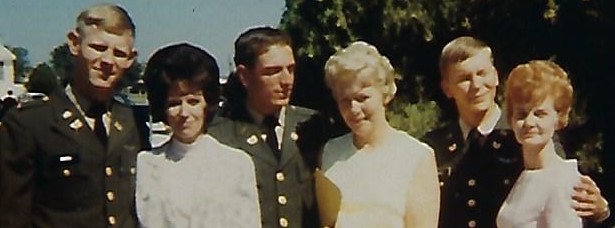
Nicky (center) with stepmom Bert and pals Skip Smith (left) with his mom, Elsie, and Tony Viall with his mom, Jewell, on June 3, 1969, at Fort Rucker graduation
Dear Dad,
I’m sitting at the combat center at Chu Lai. I’ll be here for about six days before I’m shipped out to my unit. I am assigned to the Americal Division in the northern (I Corps) portion of South Viet Nam. There are choppers and Air Force jets flying all over the place here.
I’m sorry this is a little sloppy, Dad, but it’s hotter than hell here. It makes Fort Polk seem air conditioned.
Well I’ll let you in on the situation up here, Dad. It’s not too good. There used to be only companies of V.C. [Viet Cong] around here, but now there are regiments and divisions of them. The lieutenant who briefed us said they expect an offensive, but do not know when. … That’s all I can let you know for now. Besides I wouldn’t tell you anymore anyway, because you’ll worry your head off.
How are my women and my car doing? You know you have to take care of both of them till I get home. If Terri needs anything, get it for her. OK?
Well I have to go eat, Dad. Take care and I’ll send my address as soon as I can. Take care, Dad, and don’t worry about me.
Take care,
Nicky
Nicky with Terri Pezick
The danger Nicky faced in the I Corps zone wasn’t from the Viet Cong but the North Vietnamese Army. He wrote on July 7:
Dear Dad,
… Well, Dad, last night all hell broke loose. I was sleeping at about 3:00 in the morning when the mortars started coming in. I heard the first two rounds hit and saw everyone run like hell. So I rolled over in bed and after a while the alert siren blew [so] I decided I’d better find a bunker. You would of laughed if you saw Viall. He jumped out of bed, fell out the door, and low crawled to the bunker. That was the fastest I ever saw Viall move.
I forgot to tell you I met him at Cam Rahn Bay and he came up here [to] Chu Lai with me. But when we leave here, we’ll get separated for sure. …
So take care. I’ll send you my mailing address as soon as I can. See you in 361 days (I think).
Take care and tell everyone I said hello.
Bye!
Nicky
He would not live to write again.
On July 10, as part of their orientation, Nicky, Tony and a few dozen others were trucked off the base to a landing zone called Bayonet. They sat at tables in a plywood building for a lecture on grenade safety. But the sergeant who taught the class made a terrible mistake. Intending to see how the men would react, he unwittingly tossed a live grenade among them instead of a dud.
Nicky (in foreground) with Billy Vachon (right) at Fort Polk, 1968
The blast killed one soldier instantly and mortally wounded Nicky and his friend Billy Vachon from South Portland, Maine, a fellow helicopter pilot. Nicky lost his left leg below the knee. Tony and a dozen others were seriously hurt. The Army said it was an accident.
Five days later, on July 15, 1969, Warrant Officer Nicholas L. Venditti – his surname was spelled differently from mine — died in the intensive care unit at Chu Lai’s 312th Evacuation Hospital. He was 20 years old. Billy, in the same ICU, followed him two days later.
I wrote about Nicky in my book Tragedy at Chu Lai, published in 2016 by McFarland & Co. Aunt Bert and Uncle Louie had given me his three original letters from Vietnam in 1995. The lined pages in blue ink have remained in a filing cabinet in my home office. But as Nicky’s last words on paper, a personal record of his brief service, they deserve more than just being tucked away for my eyes only.
Some of Nicky’s Army gear kept in my home (Chuck Zovko photo)
So in tribute to Nicky, and with permission from his brother, L.B., I’m sending them to the Center for American War Letters at Chapman University in Orange, California. There, they will be read, preserved and promoted as part of “an irreplaceable record of the sacrifices made by military personnel and their families.”







 David Venditta