An army is caught up in a struggle against guerrillas behind the lines. Out of patience, its troops target nearby villages to hunt down the fighting men they harbor.
Alexander the Great
Vietnam, you say?
In this case, it was Central Asia in the 4th Century B.C.
The army’s commander was the Macedonian king Alexander the Great, leading 30,000 men. His march of conquest was slowed by guerrillas in Sogdia, an ancient Iranian civilization in present-day Uzbekistan and Tajikistan.
Alexander had ended Persian control of the region, but Sogdians found life was harder now. The king’s troops were stealing rice, looting flocks, seizing horses, and punishing natives who stood in their way. Nomad skirmishers on horseback fired up the natives with talk of resistance, and nearby Bactrians joined the cause. In 329 B.C., with this widening challenge to his authority, Alexander turned his men loose on rebellious villages. Thousands of local fighters were slaughtered.
Another rebellion broke out behind the Sognia lines. Scythian nomads were attacking Alexander’s garrison in Samarkand. He sent 2,000 mercenaries there in a failed bid to break the siege, keeping the great bulk of his force in a settlement he was building on the Jaxartes River. From the opposite bank of the river, angry Scythians taunted Alexander. He decided to shut them up.
The Macedonian troops frightened their foes with arrow-shooting catapults and crossed the river to press the attack. They were up against Scythian horsemen who felt they had a surefire way to victory: Encircle the enemy at a gallop, shooting arrows as they passed.
Like a scene in a Wild West movie.
Robin Lane Fox
Alexander knew the tactic and outmaneuvered the Scythians, as British historian Robin Lane Fox wrote in his 1973 book Alexander the Great. First, Alexander lured the Scythians into battle “with a deceptively weak advance force; then, as they tried to encircle, he moved up his main cavalry and light-armed infantry and charged on his own terms.”
The Scythians lost a thousand men. The rest fled into the hills, Alexander on their heels for eight miles. When he got sick from drinking bad water, he called off the chase.
—
Raiding villages that harbored guerrillas. Letting arrows fly while circling the enemy on horseback. Even over the course of 2,000 years, some ways of war hadn’t changed.
It’s the spring of 1916, and there’s talk of war with Mexico. National Guard troops leave Pennsylvania to protect the border. One of their officers is the city editor of The Morning Callin Allentown, who aims to keep the folks back home informed. Captain Clarence J. Smith, quartermaster of the 4th Infantry Regiment, sends stories about how the soldiers geared up for duty and managed camp life in the west Texas desert.
The Guard call-up stemmed from a March 1916 raid on Columbus, New Mexico, by Mexican bandits under Pancho Villa that left 17 Americans dead. President Woodrow Wilson ordered a punitive expedition led by Brigadier General “Black Jack” Pershing and sent more than 100,000 Guardsmen to the border. They included three companies from Allentown and neighboring Bethlehem that were part of the 4th Regiment, 7th Division. (It was reorganized as the 28th Division in 1917.)
The assembly point for the Pennsylvanians was an old cavalry site 32 miles east of Harrisburg called Mount Gretna. Smith wrote his first dispatch after the Lehigh Valley companies and the 4th Hospital Corps arrived there on Saturday, June 24.
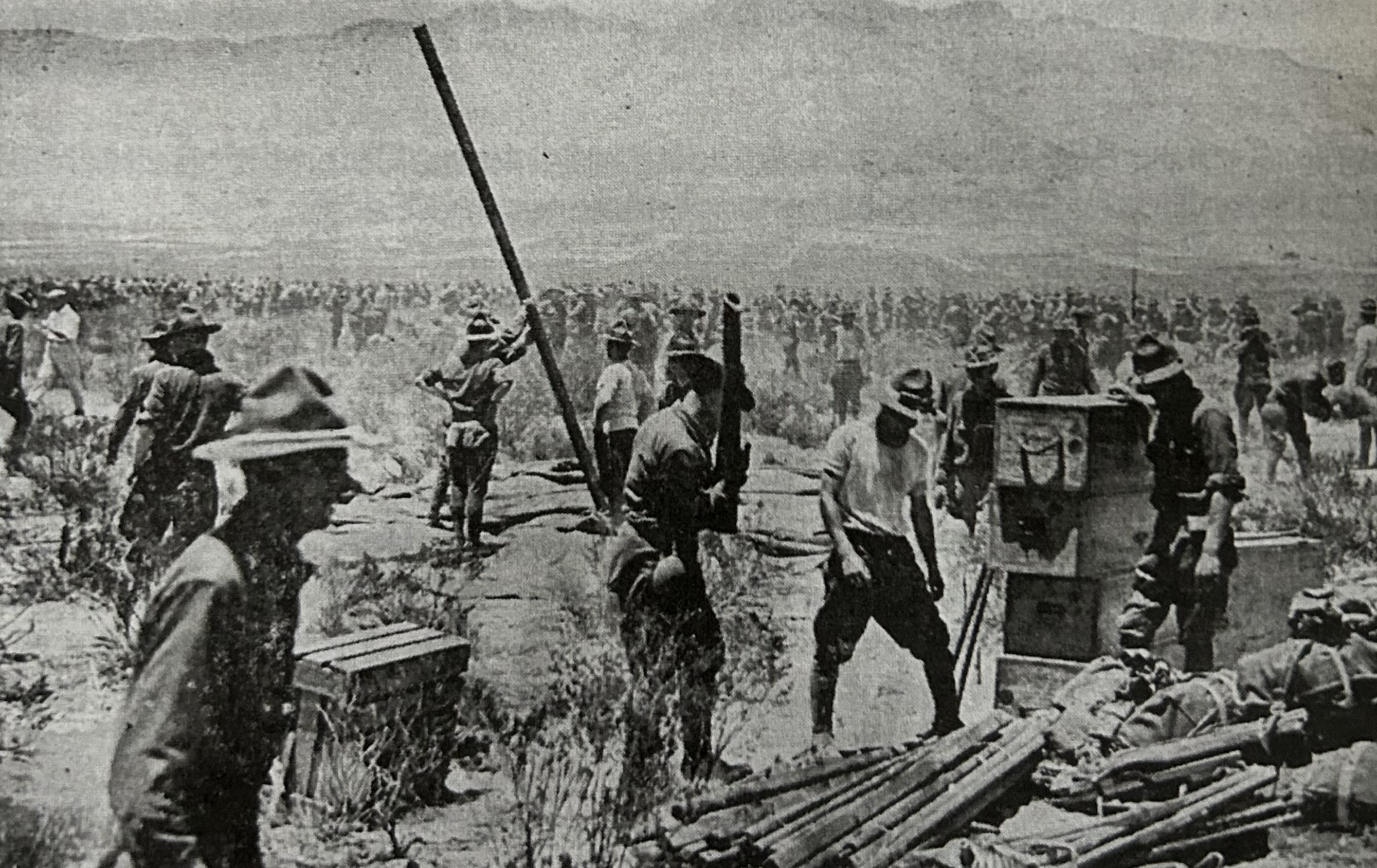
“Arriving at Camp Stewart”: Pennsylvania Guardsmen set up camp outside El Paso, Texas.
The first night in camp … was one that would test the mettle of the most active soldiers. This regiment arrived in camp under a hot June sun and spent the afternoon on Saturday going to work at housekeeping. A total absence of horses and mules necessitated the men carrying all baggage from the troop train, and it was a tired bunch of soldiers, half in khaki and half in civilian dress, that turned in to sleep. …
The spirit of the men in camp in the last few days in the face of absence of clothing, blankets, etc., with its soggy tents and muddy fields, is most commendable, and every detail for duty is responded to with alacrity.
Several days later, Smith wrote:
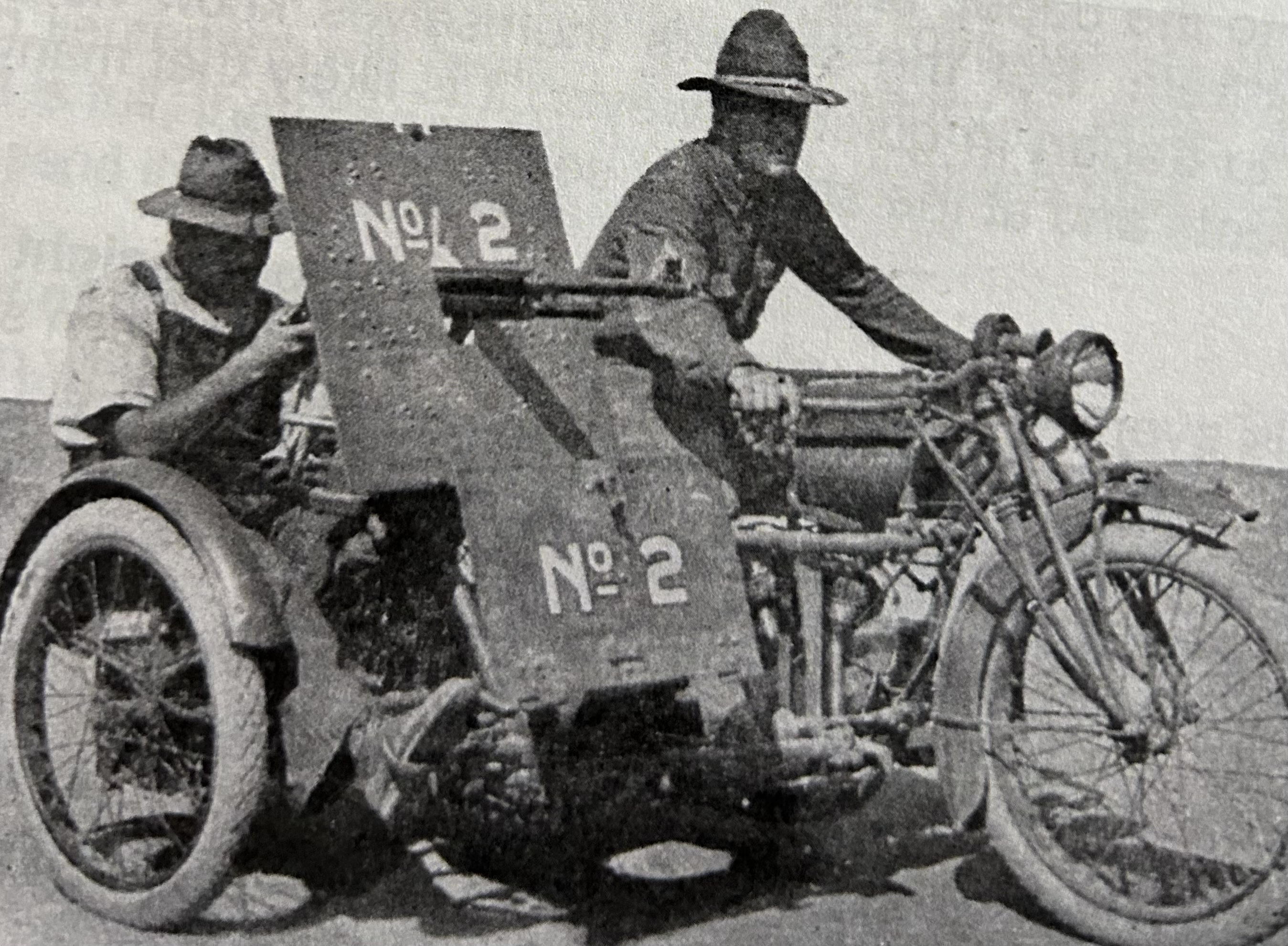
“Machine gun motorcycle”
Orders were received at noon by the medical officers, and immediately all were at the hospital to rush vaccination of the men and the inoculation against typhoid fever. … All of the men stood this ordeal with fortitude. …
Much of the time Sunday and Monday was occupied with putting the camp into the best sanitary condition, and it fell to the lot of many a “rookie” newly enlisted man to wield a pick and shovel while other details swung an axe so that the cooks might have the sort of fires that would ensure meals on time.
The mess tents being in use as sleeping quarters for the new men, the members of the regiment line up for mess with their meat pans and tin cups, taking his turn in front of the cooks and receiving the share of the mess.
Everyone is ready when meal time comes, and when the cooks call out “Come and get it,” there are no laggards. The men eat their meals seated about on the sod, and a heartier bunch of appetites it would be hard to find. The ration issue is excellent, and the men are being fed well.
Ignatz Gresser
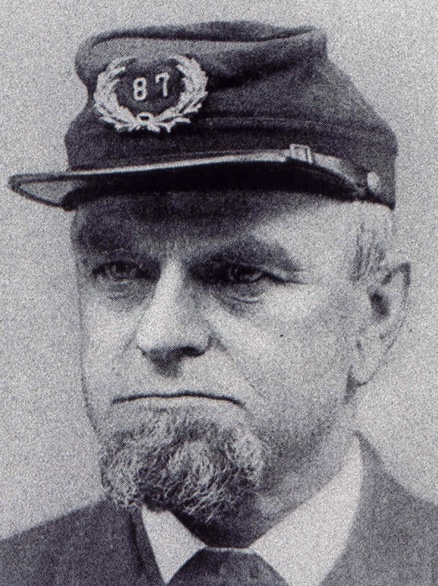
On Saturday, July 8, the men of the 4th Regiment left for El Paso, the Texas town on the Rio Grande. Before boarding the train, as they were drawn up in company formation at their Mount Gretna campsite, a Civil War hero arrived to see them off.
This was Ignatz Gresser, a German immigrant, Allentown shoemaker and Medal of Honor recipient for bravery during the 1862 Battle of Antietam. After serving in the Allen Rifles, a “First Defenders” company, he signed up as a corporal in Company D, 128th Pennsylvania Infantry. He got the medal for carrying a wounded comrade from the field while exposed to Confederate fire. The soldier he saved, Corporal William Sowden, went on to become a Pennsylvania congressman and saw that Gresser received the honor.
The Guardsmen gave Gresser, 80, an ovation.
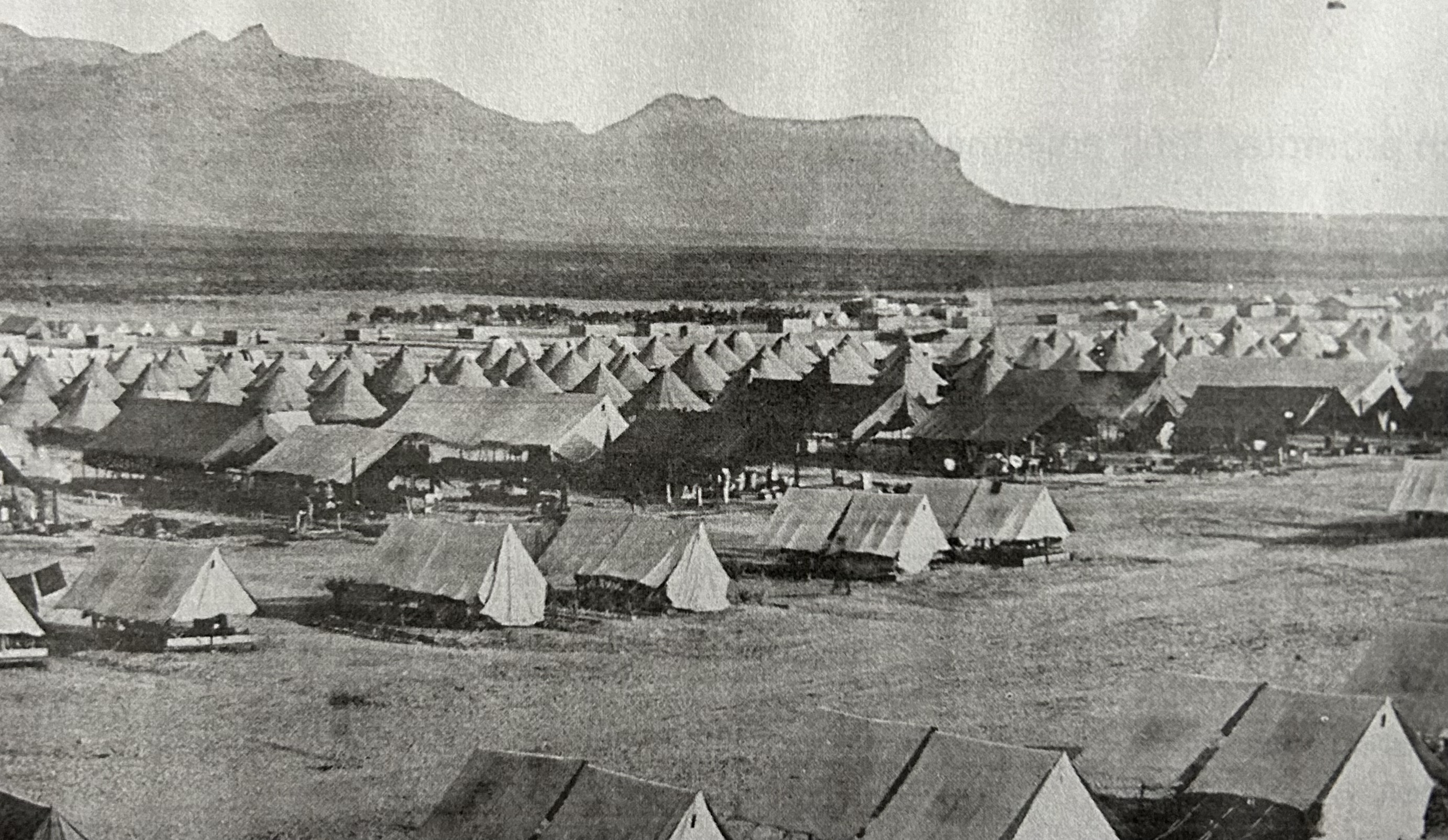
At Camp Stewart in the desert on the edge of El Paso, the men of the 4th Regiment slept in tents, drilled and marched. Smith wrote for his newspaper in mid-July:
“Drivers in training near Camp Stewart”
The arrival in camp at 10:30 o’clock Monday night of Harry A. Hall of Company B and Lieutenant Robert A. Barber of Company D with two batches of recruits furnished a lively diversion in the two companies. …There were hearty handshakes and congratulations. …
With the arrival of the recruits, Company B has 111 men in camp and Company D, 103. Several other companies of the regiment have their full quota of 150 men. Easton, Lancaster and Pottsville and others are much nearer the 150 mark than Allentown, though it must be remembered that Allentown has two companies in the regiment, while the other cities excepting Reading have but one company. …
Camp Stewart at El Paso, 1916. The Franklin Mountains are in the background.
The men of the regiment who have not been detailed on special duty handling the supplies, helping the cooks, etc., have been put to drill under the noncoms and are rapidly picking up the rudiments of what all here are beginning to realize is an exact science. … The handling of supplies is a slow job with the few horses and heavy roads for the motor trucks to plow through.
In mid-September, a Morning Call story probably penned by Smith noted “each day’s program is bringing to the men more of the real soldier’s life in the way of being schooled to withstand the rigors of the march and how to take care of one’s self in the field. Monday, the men of the 3rd Brigade, composed of the 4th, 6th and 8th regiments, hiked off into the desert for a dozen miles equipped for field service and accompanied by the wagon trains. Many men were compelled to fall out of the line due to the heat and fatigue, and were brought back to camp in the escort wagons.”
“On the march”
Months passed without trouble from across the Rio Grande. But on Christmas Day 1916, a tremendous gale hit, “driving the sand before it with a velocity that cut the face like a whiplash and tearing tent after tent from its fastenings and scattering the personal effects of the soldiers broadcast,” according to another Morning Call report probably written by Smith. It was the worst storm the troops faced.
Two weeks later, the Guardsmen pulled out of El Paso and headed north to be mustered out of service.
“Not since the Allentown troops returned from the Spanish-American War in 1898 was there such a demonstration in this city as yesterday, when the local companies of the 4th Regiment returned from Texas, where they had been for nearly seven months,” the paper crowed on January 15, 1917. “Bands played, flags waved, and the crowds cheered as the soldiers marched up Hamilton Street to Twelfth.”
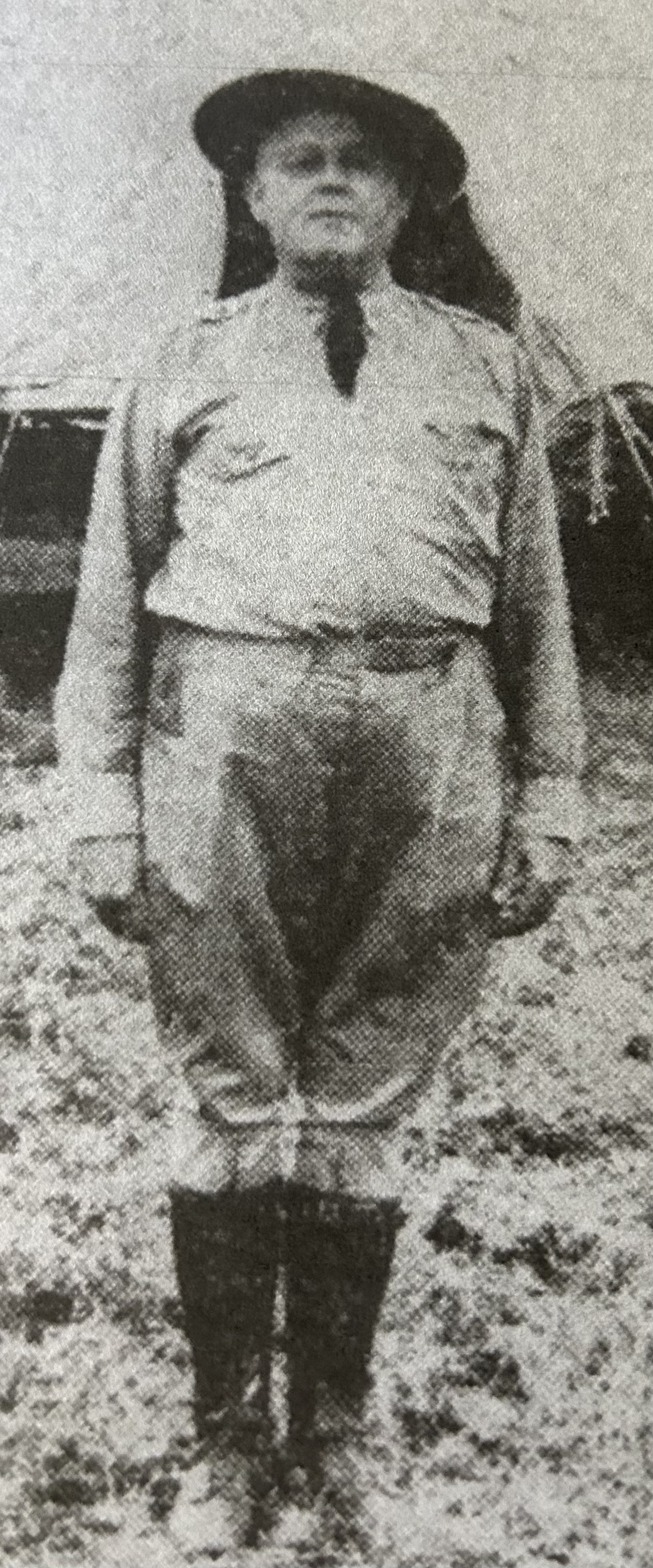
Colonel Smith in 1938
Awaiting many of them was the First World War, which had broken out across the Atlantic two-and-a-half years earlier. Smith would have a role in France as commander of a 28th Division rail unit, the 103rd Ammunition Train. He would go on to become the first commander of the Pennsylvania National Guard’s 213th Coast Artillery Regiment (Anti-Aircraft), descendant of the 4th Regiment.
Born in Easton, Smith had joined the Guard in 1898 after the battleship USS Maine blew up in the harbor at Havana, Cuba, a cause of the war with Spain. He retired as a colonel in 1938 and died two years later in Allentown, revered as an outstanding citizen. The former reporter, editor and publisher was 66.
My main source for this blog is the 213th Regiment booklet Mexican Expedition 1916-1917: History of the Allentown and Bethlehem National Guard, compiled in 2013 by retired Lieutenant Colonel Charles G. Huch. It has contemporary accounts from The Morning Call and the South Bethlehem Globe, and photos from Volume 5 of The28th Division: Pennsylvania’s Guard in the World War, published in 1923. I’m using some of those photos here, with their original captions in quotes.
Charles G. Huch
Huch was a 1952 graduate of Lehigh University, an Army veteran of the Korean War and a longtime Bethlehem Steel employee. He died on the last day of 2020 at age 92.
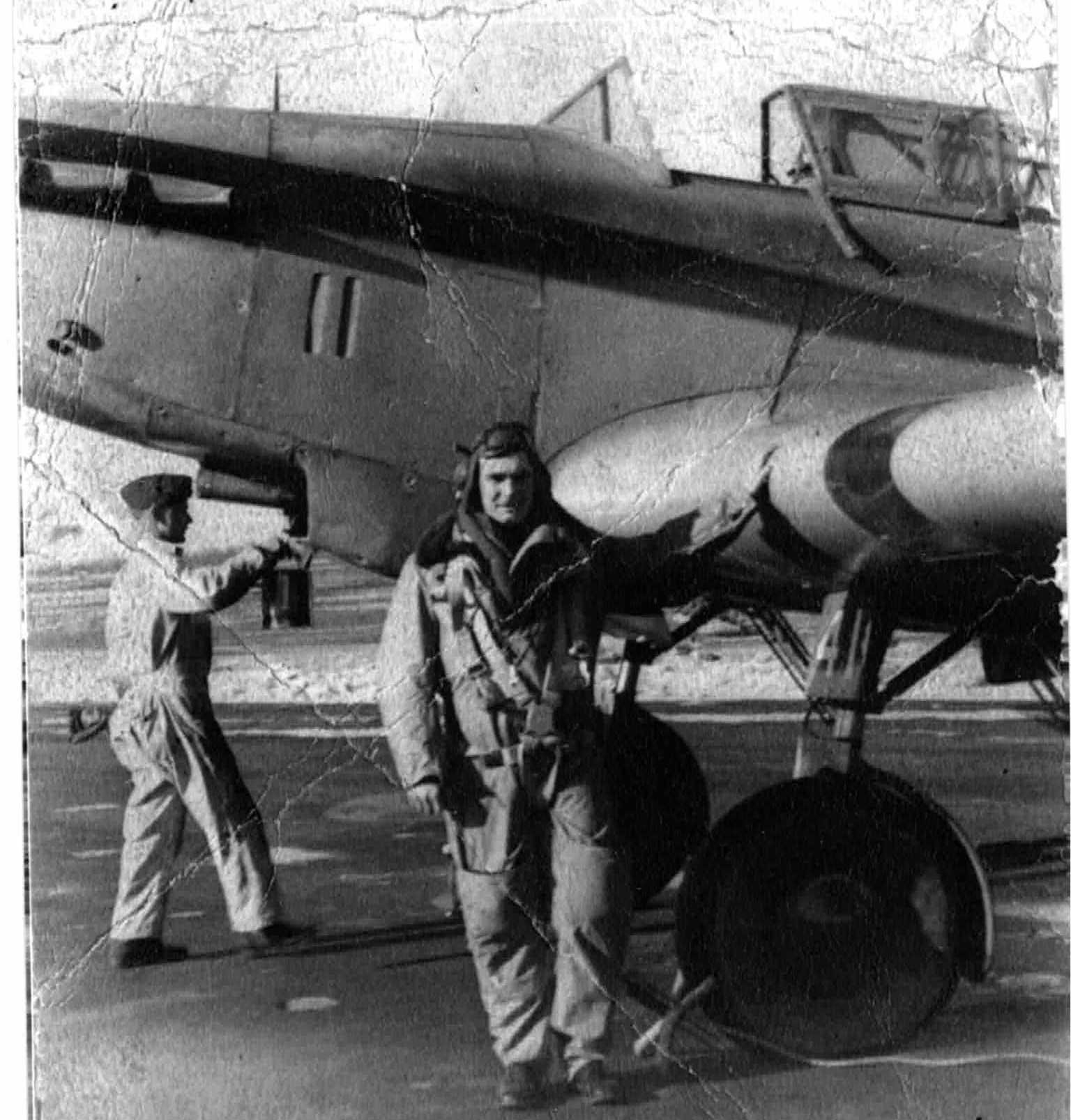
John G. Hudock in front of a Fairey Battle bomber while training in Canada, 1940 (Corinne Hudock Cazer)
Sometimes it can take years to have a story cover all of the bases.
Since 2000, I’ve been writing about a young pilot from Allentown, Pennsylvania, who was killed while serving with the Royal Canadian Air Force in World War II.
Robert H. Riedy, 20, died on a training flight in England in 1942. My most recent piece about him was a two-part blog in January after his medals were returned to his hometown.
I didn’t know of any other flyers from Allentown who fought under the Canadian flag and lost their lives, and didn’t look into it. But last fall I learned that Riedy was only part of the story I had been telling. He was not alone.
Chris Dickon, an author and former reporter who won awards as a public radio and television producer, put me on to John G. Hudock.
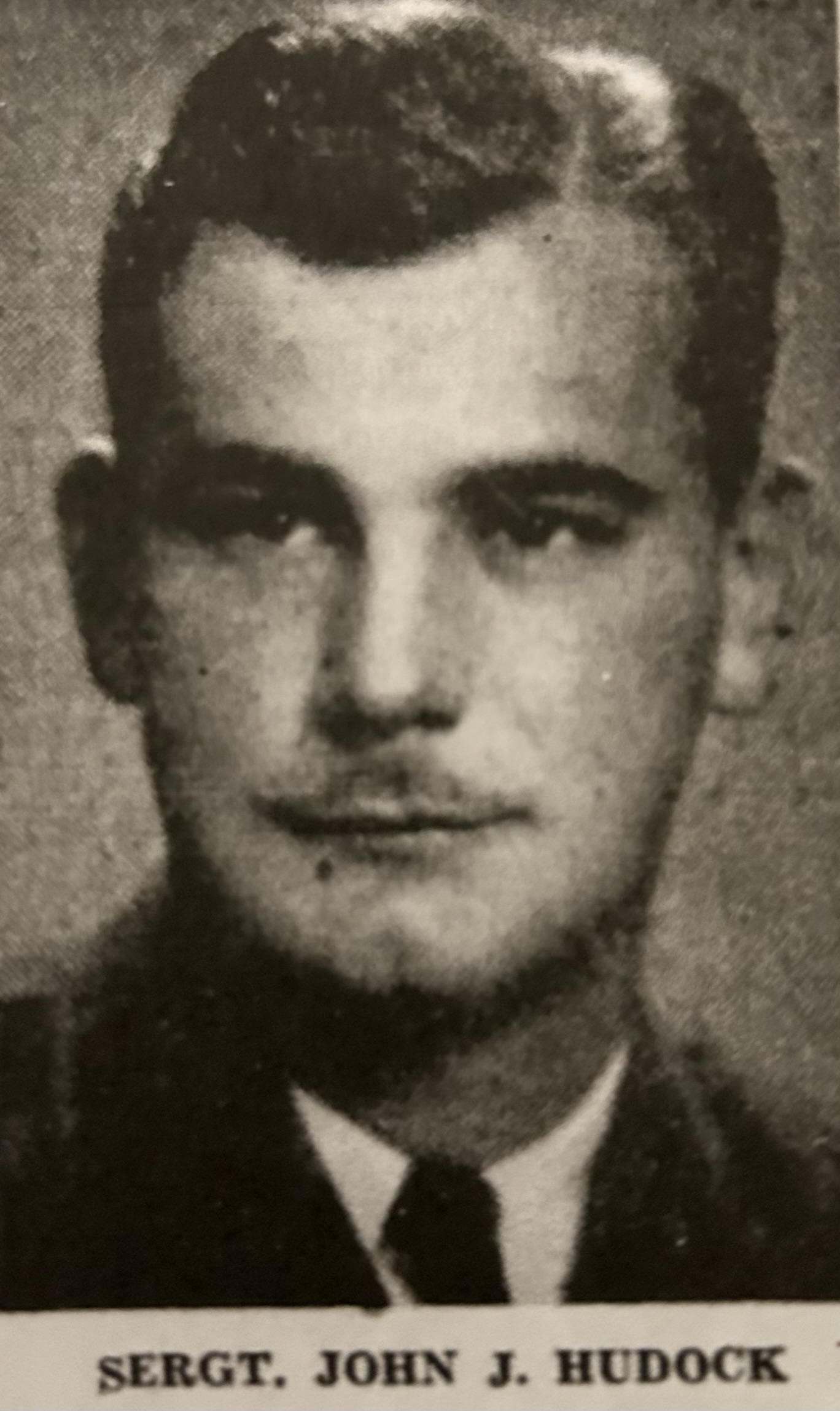
An Allentown High School graduate, Hudock was the navigator on a bomber that crashed in the North Sea, cause unknown, after a night mission to Hamburg in 1942. His body was never recovered.
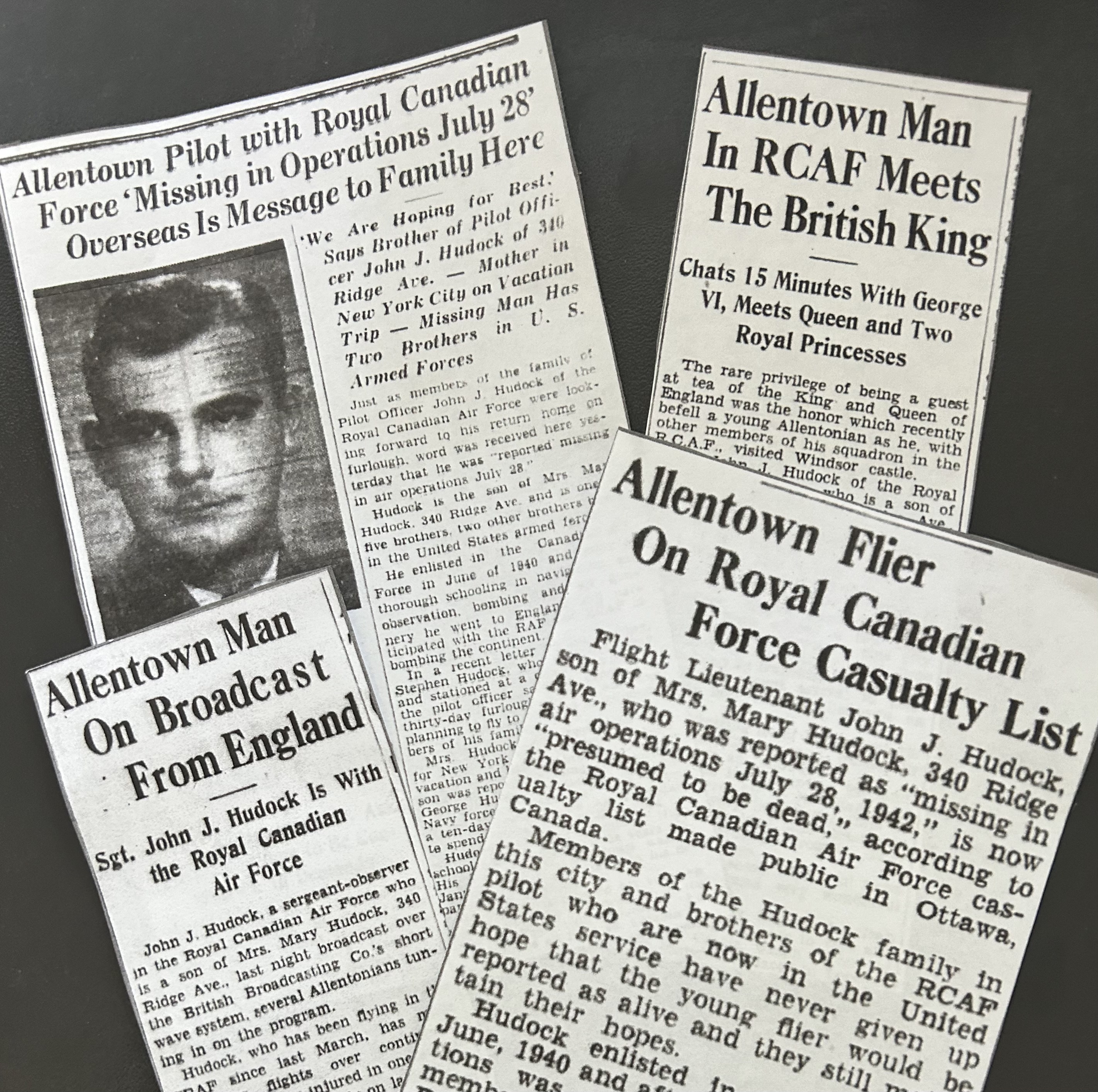
I decided to write about him for my former employer, The Morning Call of Allentown. It was a good fit because the paper followed his service during the war and published several letters he sent home. They included breathless accounts of having tea with England’s king and queen, and of a harrowing raid on Nazi Germany.
Much of what I learned about Hudock came from his 72-page RCAF personnel file maintained online by the Government of Canada. I had help from Ancestry.com, Newspapers.com, the U.K. National Archives, researcher Kenneth Woolley III at the Allentown Public Library, and two Hudock nieces in upstate New York.
Along the way, I found out the war claimed a third RCAF flyer from Allentown, 21-year-old George G.J. Hower.
Hudock is on his mother Mary’s lap in this family portrait circa 1920. Others are (back row, from left) Emma, Mary and Anna; (front row) George, their father John, Joseph (seated in front) and Steve (behind Joseph). A son, John, died as a child in 1916 from a ruptured appendix. Another son, Charles, was not yet born when this picture was taken. (Corinne Hudock Cazer)
My story on Hudock ran in The Morning Call last week in two parts. (If you’re not a subscriber, you can read it online for $1.) To pull it together, I created a timeline of his life and service.
Timelines are a handy way of nailing the narrative. And you can have more detail than you’d put in an article for general readership. That’s the case with this one I did for Hudock:
1918
May 19: John George Hudock is born in the coal town of Lansford, Pennsylvania, the eighth of nine children of Slovakian immigrants John and Mary Hudock.
1923
The Hudocks move about 40 miles south to Allentown, into a brick row house on Ridge Avenue near Gordon Street and the Lehigh River. They worship at St. John the Baptist Slovak Catholic Church on Front Street.
1924
John Hudock starts attending St. John’s grammar school.
1931
September 3: His father, John C. Hudock, dies at 66. He is buried at St. John the Baptist Church Cemetery.
1932
Hudock’s graduation portrait in Allentown High School’s 1936 yearbook, the Comus
Hudock attends Central Junior High.
1933
He starts at Allentown High School, where he’s in the commercial curriculum and plays football for three years.
1936
June 23: Hudock graduates from Allentown High.
1936-38
He works as a lifeguard, chauffeur and for his brother George as a plumber’s helper.
1937
He has an operation on his left knee that leaves a scar.
Hudock played tackle on the Allentown High School football team. In this photo from the 1936 yearbook, the Comus, he is crouching second from right.
1938
Hudock works as a stenographer/secretary at explosives maker Trojan Powder, leaves because of “broken engagement.” He moves to New York City.
1938-39
He lives in the 5000 block of Broadway in Bronx and manages the oyster bar at the Midston House club hotel at 38th Street and Madison Avenue in Manhattan.
1939
He leaves Midston House because of an opportunity to “own business,” becomes a concessionaire at Van Cortlandt Pharmacy in Bronx.
September 1: World War II begins with the German invasion of Poland.
1940
May 10: Nazis invade France, Belgium, Luxembourg and the Netherlands.
May 22: At age 22, Hudock enlists in the Royal Canadian Air Force at Recruitment Centre in Ottawa. He is 6 feet tall, weighs 177 pounds.
June 20: He gets “movement order” by rail from Ottawa to No. 1 Manning Depot, Toronto. He’s in RCAF under the British Commonwealth Air Training Plan.
December 21: Promoted to sergeant, he reports to No. 1 Air Navigation School in Rivers, Manitoba, for advanced training.
1941
January 20: He completes advanced training in Manitoba.
January 28 to mid-February: On leave, he visits family and friends in Allentown.
February 20: He reports to Embarkation Station Debert in Nova Scotia, and will ship out to England from Halifax.
March 11: His overseas service begins.
March 24: In England, he’s at No. 3 Personnel Reception Centre, Uxbridge.
March: He has tea with King George VI and Queen Elizabeth at Windsor Castle with 23 others from his “flight,” a squadron subdivision. The king offers him a cigarette and lights it for him. Princesses Elizabeth and Margaret Rose ask him many questions about New York City.
April 7: Attached to Britain’s Royal Air Force, he arrives at No. 11 Operational Training Unit, part of No. 6 Group Bomber Command, at RAF Bassingbourn for night bomber aircrew training.
Vickers Wellington Mk III
April 15: The Morning Call prints Hudock’s letter to his mother about having tea with the king and queen.
June 29: He’s assigned to No. 9 Squadron at RAF Honington, Suffolk, on Vickers Wellington bombers.
August 14:The Morning Call in Allentown prints a letter from Hudock recounting an air raid on Germany, his 10th combat mission.
September 1: Hudock is promoted to flight sergeant, a step up from sergeant.
September 18: He’s admitted to a Gloucester hospital. His fiancée, Doris Connolly of Toronto, later tells the Toronto Star he had a flying accident.
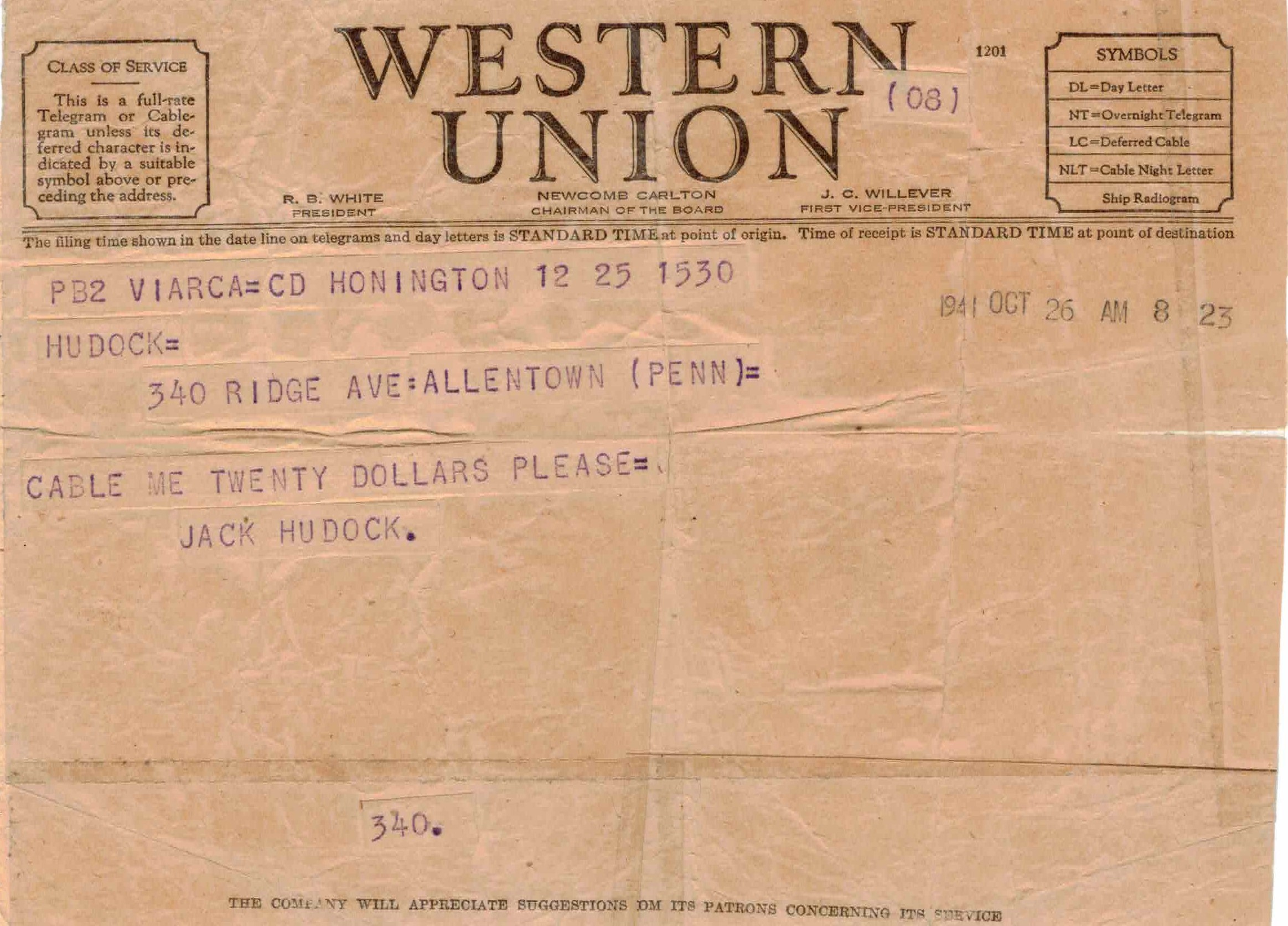
While at the RAF Honington bomber station in Suffolk, Hudock asks his family for $20 in an October 26, 1941, telegram. (Corinne Hudock Cazer)
October 16: Hudock returns to duty.
October 17: Over BBC’s American Eagle radio program in London, he tells his family he’d been injured and is now out of the hospital, asks them to send cigarettes.
1942
February 24: In its “RCAF Notes” column, the Toronto Star reports Hudock’s promotion to flight sergeant and says he was injured in a flying accident. The paper’s source was “his fiancé, Miss D. Connolly of Toronto.”
March: Hudock is on the BBC program again, but reception in Allentown is poor and he can’t be heard distinctly.
Riedy
March 18: Robert H. Riedy, a 1938 Allentown High School graduate and RCAF pilot, is killed when his Wellington crashes moments after takeoff on a practice flight at Mount Farm in Oxfordshire.
Hower
March 23: George G.J. Hower of Allentown dies in a mid-air collision during an RCAF gunnery exercise involving Fairey Battle bombers at Dafoe, Saskatchewan. He was training to be a wireless operator/gunner.
May 13: Hudock is commissioned a pilot/officer. (The rank doesn’t mean he was trained to fly a plane.)
June 29: He’s promoted to flight lieutenant and posted to No. 156 Squadron at RAF Alconbury, 65 miles north of London.
July 4: Mary Hudock is greeted by her son on the American Eagle radio program, the third time he’s on it. “I’ve just finished one lot of operations and I hope I’ll soon get a rest,” he says.
July 28: Hudock is the navigator aboard a Wellington Mk III, serial number BJ840, that takes off from Alconbury at 11:01 p.m. as part of a 256-plane bombing raid targeting Hamburg. His Wellington has a crew of six and carries a 4,000-pound bomb.
July 29: Hudock’s plane fails to return to base.
July 30: Mary Hudock leaves Allentown for a short vacation in New York City.
July 31: The family learns Flight Lieutenant Hudock, 24, is “missing in air operations.”
August 1: Canada’s Air Council, the RCAF’s governing body, says in a letter to Mary Hudock that on July 28-29, her son was the navigator on a Wellington “which carried out an attack on Hamburg on that night. The last wireless message received from the aircraft was at 3:10 a.m. when it was on the return journey and was from a position calculated to have been approximately 50 miles north of the Frisian Islands [in the North Sea].”
Hudock clips from The Morning Call
August 16: An airman whose body had washed ashore is buried in Kirkeby (St. Clemens) Churchyard on the Danish island of Romo, off the west coast of the Jutland peninsula. He is later identified as Flight Sergeant John T. Bray of the Royal Australian Air Force, the Wellington’s co-pilot.
Hudock and four others from the bomber – Wing Commander Herbert L. Price, the pilot and recipient of a Distinguished Flying Cross; Sergeant John Duthie, the wireless operator; and Sergeants William D. Evans and Michael W. Walsh, the gunners – are still missing. Their plane had crashed in the North Sea off Denmark, cause unknown.
1943
Hudock (above) and screen idol Errol Flynn. Hudock’s nieces Carol Cirincione and Corinne Cazer happily cite the resemblance.
February 21: In a letter to the RCAF, Mary Hudock says she “will not give up hope … until some definite word of his being dead is received.”
March 27: An RCAF telegram informs Mary Hudock that her son is presumed dead.
April 3:TheMorning Call reports Hudock is “presumed to be dead,” citing RCAF casualty list made public in Ottawa.
April 10: A Requiem Mass for Hudock is celebrated in St. John the Baptist Church in Allentown.
1946
May 14: An RCAF records officer sends Operational Wings and Certificate to Mary Hudock “in recognition of the gallant services rendered by your son, Flight Lieutenant J. Hudock.”
1952
The grave of Hudock’s parents, Mary and John, in the cemetery at St. John the Baptist Slovak Catholic Church, Allentown. The stone has their name as Hudak.
June 6: RCAF casualties officer writes to Mary Hudock, saying “it must be regretfully accepted and officially recorded that [Hudock] does not have a known grave.”
1957
March 10: Mary Hudock dies in Allentown at 71. She is buried beside her husband in St. John the Baptist Church Cemetery.
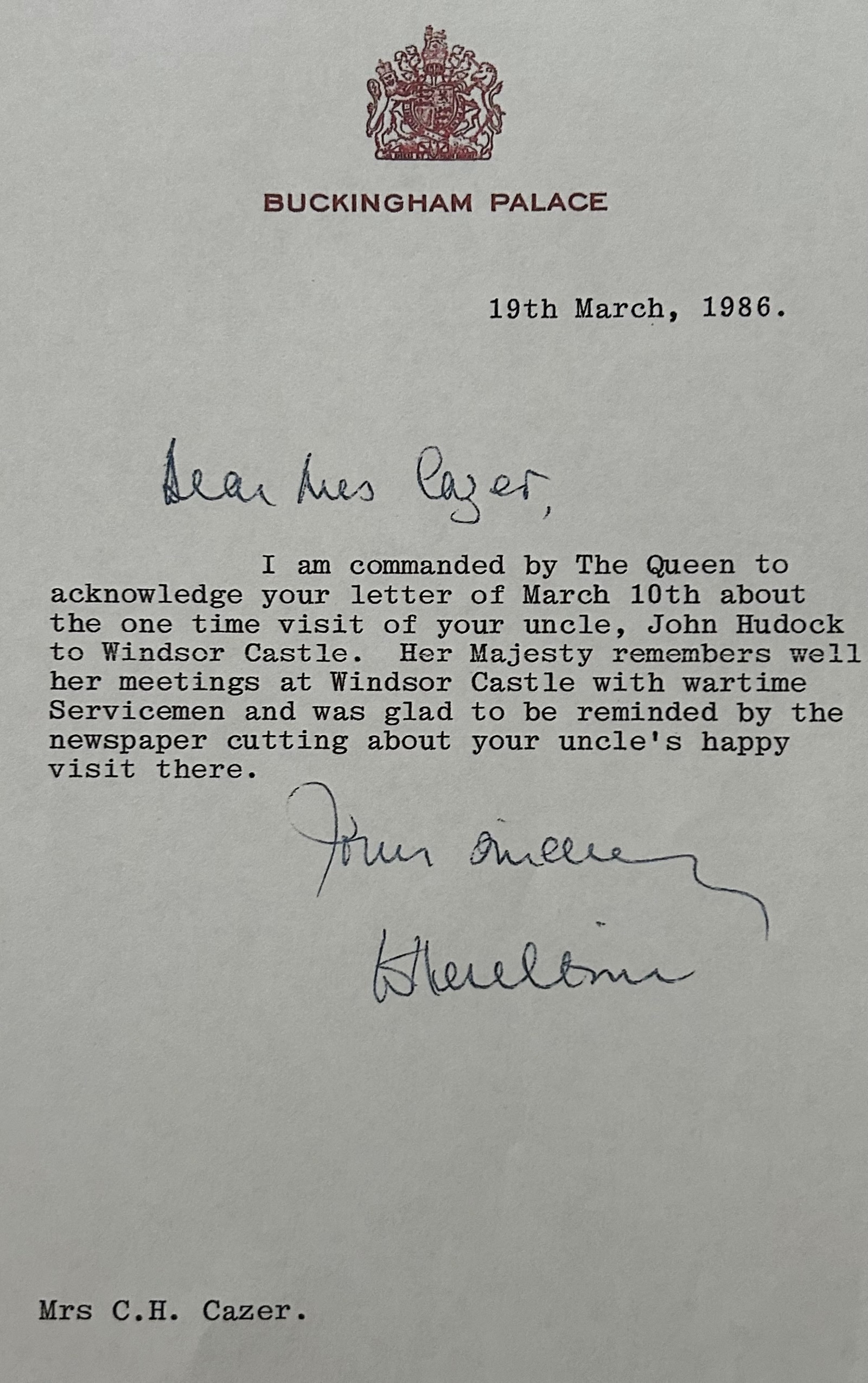
Buckingham Palace responds to Corinne Cazer’s letter about her Uncle John. (Corinne Hudock Cazer)
1986
March 10: Hudock’s niece Corinne Cazer writes to Queen Elizabeth II, enclosing a Morning Call clip about Hudock’s visit to Windsor Castle in 1941 and asking if she remembered meeting him.
March 19: Buckingham Palace replies: “Her Majesty remembers well her meetings at Windsor Castle with wartime servicemen and was glad to be reminded by the newspaper cutting about your uncle’s happy visit there.”
Warrant Officer Nicholas L. Venditti at home on leave in June 1969
Fifty-five years ago, my cousin Nicky died in Vietnam.
The Army helicopter pilot had been in the country for just 11 days. In that time, he penned three letters to his parents, my Aunt Bert and Uncle Louie, back home in Malvern, Pennsylvania.
Louie was one of my dad’s older brothers, a World War II veteran who had driven firetrucks for the 8th Air Force’s 479th Fighter Group in England. Bert was Nicky’s stepmom.
Nicky planned to marry his hometown girlfriend Terri Pezick. A car enthusiast, he owned a 1968 Camaro SS.
He wrote first from Cam Ranh Bay after a commercial flight from Seattle. His best friend Tony Viall, from Rossville, Georgia, would be arriving soon. They had met in boot camp at Fort Polk, Louisiana, and gone through flight training together at Fort Wolters, Texas, and Fort Rucker, Alabama.
The three letters Nicky sent his parents Louie and Bert Venditti in the days after he arrived in Vietnam
Nicky’s letter was dated July 5, 1969.
Dear Bert and Dad,
Well I arrived in this wonderful place called Viet Nam yesterday at three. There is fourteen hours difference between here and Seattle, Washington. I still don’t know where I’m going. Besides, I’m by myself and that’s plenty of help.
It was about 100 degrees yesterday. I still can’t believe I’m here. But when I look around, I get more assured I am!! … A warrant officer who was here for R&R told us it was good to see some new guys come in. He’s been here three months.
Louie Venditti in the Army Air Forces during World War II
I guess they’ll ship me out tonight between 12:00 and 8:00 in the morning. I haven’t seen Viall since I left Seattle. But he should get here before I leave.
Oh I’m at Cam Rahn Bay replacement center right now. It’s about 150 miles from Saigon. It’s probably the safest place in Viet Nam. Too bad I can’t get stationed here. Tell Terri not to write till I send her my address.
Well I have to go to the PX and snack bar now. Later on I’ll go drink some beer for you, Pops!! So take care. I’ll write and let you know my address. OK? See you in 363 days.
Bye!! Nicky
P.S. Don’t pick up too many women in that Camaro.
A C-130 transport plane took Nicky north to the huge U.S. coastal base at Chu Lai, headquarters of the Americal Division. He was starting a week of orientation when he wrote home on July 6.
Nicky (center) with stepmom Bert and pals Skip Smith (left) with his mom, Elsie, and Tony Viall with his mom, Jewell, on June 3, 1969, at Fort Rucker graduation
Dear Dad,
I’m sitting at the combat center at Chu Lai. I’ll be here for about six days before I’m shipped out to my unit. I am assigned to the Americal Division in the northern (I Corps) portion of South Viet Nam. There are choppers and Air Force jets flying all over the place here.
I’m sorry this is a little sloppy, Dad, but it’s hotter than hell here. It makes Fort Polk seem air conditioned.
Well I’ll let you in on the situation up here, Dad. It’s not too good. There used to be only companies of V.C. [Viet Cong] around here, but now there are regiments and divisions of them. The lieutenant who briefed us said they expect an offensive, but do not know when. … That’s all I can let you know for now. Besides I wouldn’t tell you anymore anyway, because you’ll worry your head off.
How are my women and my car doing? You know you have to take care of both of them till I get home. If Terri needs anything, get it for her. OK?
Well I have to go eat, Dad. Take care and I’ll send my address as soon as I can. Take care, Dad, and don’t worry about me.
Take care,
Nicky
Nicky with Terri Pezick
The danger Nicky faced in the I Corps zone wasn’t from the Viet Cong but the North Vietnamese Army. He wrote on July 7:
Dear Dad,
… Well, Dad, last night all hell broke loose. I was sleeping at about 3:00 in the morning when the mortars started coming in. I heard the first two rounds hit and saw everyone run like hell. So I rolled over in bed and after a while the alert siren blew [so] I decided I’d better find a bunker. You would of laughed if you saw Viall. He jumped out of bed, fell out the door, and low crawled to the bunker. That was the fastest I ever saw Viall move.
I forgot to tell you I met him at Cam Rahn Bay and he came up here [to] Chu Lai with me. But when we leave here, we’ll get separated for sure. …
So take care. I’ll send you my mailing address as soon as I can. See you in 361 days (I think).
Take care and tell everyone I said hello.
Bye!
Nicky
He would not live to write again.
On July 10, as part of their orientation, Nicky, Tony and a few dozen others were trucked off the base to a landing zone called Bayonet. They sat at tables in a plywood building for a lecture on grenade safety. But the sergeant who taught the class made a terrible mistake. Intending to see how the men would react, he unwittingly tossed a live grenade among them instead of a dud.
Nicky (in foreground) with Billy Vachon (right) at Fort Polk, 1968
The blast killed one soldier instantly and mortally wounded Nicky and his friend Billy Vachon from South Portland, Maine, a fellow helicopter pilot. Nicky lost his left leg below the knee. Tony and a dozen others were seriously hurt. The Army said it was an accident.
Five days later, on July 15, 1969, Warrant Officer Nicholas L. Venditti – his surname was spelled differently from mine — died in the intensive care unit at Chu Lai’s 312th Evacuation Hospital. He was 20 years old. Billy, in the same ICU, followed him two days later.
I wrote about Nicky in my book Tragedy at Chu Lai, published in 2016 by McFarland & Co. Aunt Bert and Uncle Louie had given me his three original letters from Vietnam in 1995. The lined pages in blue ink have remained in a filing cabinet in my home office. But as Nicky’s last words on paper, a personal record of his brief service, they deserve more than just being tucked away for my eyes only.
Some of Nicky’s Army gear kept in my home (Chuck Zovko photo)
So in tribute to Nicky, and with permission from his brother, L.B., I’m sending them to the Center for American War Letters at Chapman University in Orange, California. There, they will be read, preserved and promoted as part of “an irreplaceable record of the sacrifices made by military personnel and their families.”
One of the most controversial episodes of the Vietnam War was the reported mutiny of U.S. troops in the summer of 1969. It involved soldiers from the Americal Division’s 196th Light Infantry Brigade.
Fred Sanders is interviewed by a CBS News crew about an Associated Press report that soldiers in his unit refused to obey an order. (Courtesy of Fred Sanders)
Over the last dozen years, I’ve had contact with several GIs who had direct knowledge of the incident — battalion commander Bobby Bacon, trooper James Dieli and artillery officer Alan Freeman — and wrote blogs about what they told me.
Now I have another, Fred Sanders. He was a medic with Alpha Company, 3rd Battalion, 21st Infantry Regiment – the unit involved.
“There were five guys. It was a very unfortunate thing that was not a mutiny,” said Sanders, who is 78 and lives in South Carolina. He told me that in media interviews at the time, “I gave them a good report so they wouldn’t say that the men did anything that was less than honorable.”
The trouble started when the battalion commander, Lieutenant Colonel Eli Howard, sent the company to the Americal base at Chu Lai for a stand-down. The men got into a brawl with another unit.
“Colonel Howard blamed the entire company. He said if they want to fight, I’m going to put them out there and let them fight.”
Alpha Company got orders to clear North Vietnamese Army troops from bunkers and trenches in the Song Chang Valley, about thirty miles south of Da Nang. The troops had deadly encounters with the enemy, who were at the base of a ridge.
Sanders was an Army medic in Vietnam until his tour ended in March 1970.
“We lost about half of our men killed in action or wounded,” said Sanders, who was in the 1st Platoon.
At one point, arrangements were made to evacuate a freelance photographer, Ollie Noonan, who was with them. A helicopter carrying Howard and others arrived August 19 to take him aboard and bring him to LZ Center, site of the battalion command bunker.
“I was the last person who spoke with Ollie before he got on Howard’s helicopter,” Sanders said. “He said, ‘Doc, take it easy. Be careful.’ I said, ‘Ollie, we’re in a very bad place here.’
“Ollie slapped me on the back and ran out to get on the helicopter. I went to the edge of the clearing and made hand signs repeatedly to Colonel Howard and the chopper crew not to try to fly over the knoll ahead, but to return the way they came in. I stood watching Howard with his arm over the pilot’s shoulder, pointing toward the knoll and repeatedly gesturing.
“I knew if he went that direction, he was going to get shot down. There was a .50-caliber gun somewhere on that hill that he would be flying directly over. Howard wanted to go that way because there was small-arms fire in the opposite direction. The small-arms fire was a better risk than going over the .50-caliber position.”
The chopper was shot down over the hill and crashed in a ball of fire, killing Noonan, Howard and the six others aboard.
“That was a very tragic moment,” Sanders said.
Three days later, Alpha Company got orders to make what Sanders calls “a very bad move” – walk the ridge line and go downhill toward the NVA position.
As they moved down the hill, they unwittingly approached an enemy spider hole. Someone in the hole opened fire. A friend of Sanders’ from Oklahoma, Sergeant Derwin Pitts, was hit. He lay helpless and groaning.
“I was 5-6 feet from him, trying to figure how I could pull him back. He was in an exposed position. I knew if I crawled there, they’d kill me also.”
Sanders knew he couldn’t leave Pitts there. Just then, Private First Class Ray Barker came up and said, ‘Doc, you’re not going to do it,’ and crawled past Sanders. Immediately he, too, was shot. Both he and Pitts were dead.
A man off to Sanders’ right was shot and suffered a sucking chest wound. Sanders tended to him. He and two others knelt beside the man and prayed for him as they waited for a medevac.
They were in a small clearing on the ridge line. The helicopter came and took the wounded man, rising straight up. Sanders turned and tripped over a fallen tree. “Where’d that come from?”
One of the men with him answered, “Doc, didn’t you see that?” A rocket-propelled grenade had been fired at the helicopter as they were loading the man onto it. The RPG missed and felled the tree, which landed just a few feet away.
By August 25, after five days of fighting, the company was down to half of the 95 troopers who had come to the valley, Vietnam War writer Keith William Nolan wrote in his 1987 book Death Valley. Eight men had been killed.
The new battalion commander ordered Lieutenant Eugene Shurtz Jr. to lead his men down into the valley to recover their dead, including the bodies from the helicopter crash. Shurtz was new to the unit.
“I am sorry, sir, but my men refused to go – we cannot move out,” Shurtz radioed Lieutenant Colonel Bobby Bacon at the battalion command post, according to a dispatch filed by Peter Arnett and Horst Faas of The Associated Press.
“Repeat that, please,” Bacon said. “Have you told them what it means to disobey orders under fire?”
“I think they understand,” the lieutenant replied, “but some of them simply had enough – they are broken. There are boys here who have only 90 days left in Vietnam. They want to come home in one piece.”
Bacon told Shurtz to leave the unwilling men on the hill and “move to the objective.” He then ordered his executive officer and a sergeant to fly in and give the men “a pep talk and a kick in the butt.”
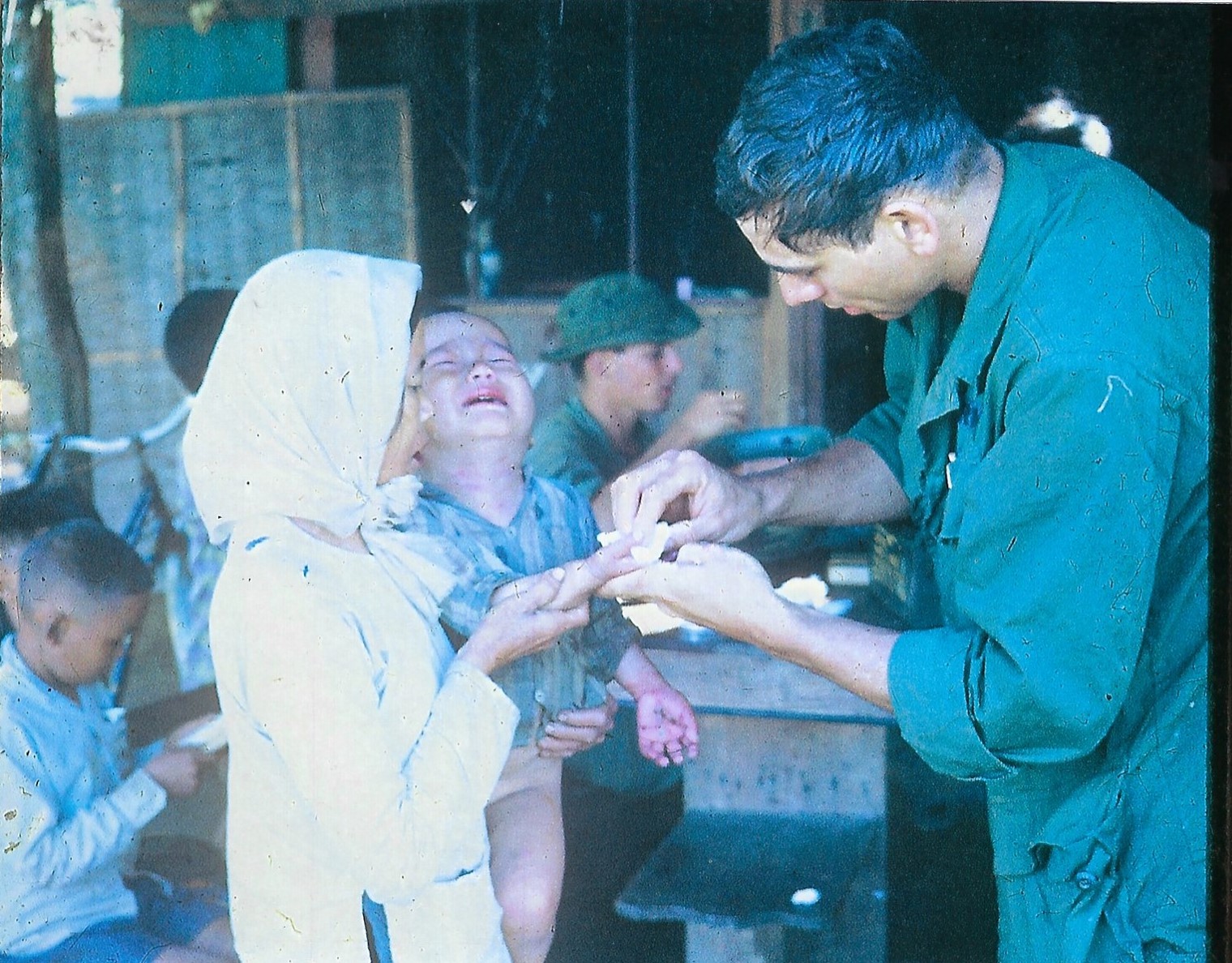
Sanders treats a child with a skin infection at a Vietnamese hamlet.
Sanders remembered that five GIs balked at walking down to the foot of the ridge.
“I walked around and talked to the fellas. They were very distressed and run-down. I told them: I’m with you. I’m your medic.”
He said they were afraid they’d be sitting ducks for the North Vietnamese. It seemed like suicide. But none of them said they weren’t going to go, according to Sanders. No one wanted to be court-martialed. They just didn’t want to do something stupid and get themselves killed.
“They were bargaining for time to see if they could negotiate going another way, a different maneuver.”
When Sergeant Okey Blankenship arrived from battalion headquarters, “The guys were saying: I hope you don’t think we don’t want to go. We just don’t want to be killed for no sensible reason.”
Blankenship told them, “You’re soldiers. You’ve got to do what you’ve got to do. Brace up and carry on.”
When the sergeant finished his talk, everyone was quiet, Sanders said. The men started packing up their gear, getting ready to move out. As it turned out, the NVA were no longer at the base of the ridge. They had withdrawn from the area.
Faas and Arnett’s report landed atop Page 1 of the next day’s New York Times under the headline, “Told to move again on 6th deadly day, Company A refuses.”
Sanders said he was interviewed by the Times, Newsweek, Time magazine and CBS. “I would not say anything to discredit the unit,” he told me. “I was aware that news outfits can slant the news.”
Matt Gutman (third from left) and pals from the LST-553 on a Japanese boat on Leyte Island at the end of World War II. They were assigned to disarm enemy troops there and on two other islands. ‘We had the Japanese break up all their rifles and load everything onto their large, wooden boats.’ The stash was taken out to sea and dumped.
A 99-year-old World War II veteran here in Allentown, Pennsylvania, is among vets going to France this week for the 80th anniversary of D-Day.
Matt Gutman is well-known in the Lehigh Valley veterans community. He rides in parades and speaks in schools and elsewhere about his service in the Navy.
I’ve known him for years. As a volunteer Veterans Affairs driver, I once gave him a ride to the VA hospital sixty miles away in Wilkes-Barre. I’ve taken him to picnics held to honor vets. Two years ago, I interviewed him for an “in their own words” war story in The Morning Call and wrote a blog about the first time he crossed the Equator.
On Friday, the newspaper ran my story about his upcoming journey to the beaches where the Allies landed June 6, 1944, against a hail of German gunfire.
Matt will be one of eight vets the Tennessee nonprofit Forever Young Veterans is taking to Normandy for seven days, all expenses paid. He’s the only one who didn’t fight in Europe, but in the Pacific, where he had a berth on a landing ship, tank, the LST-553. As the coxswain on one of its two Higgins boats – the same type of landing craft used in the Normandy invasion — he ferried troops to Japanese-held islands. Forever Young wanted him along to represent the Pacific Theater. Matt said he’s excited about what he’ll learn. It’s his first trip to France.
Each of the vets is going with a companion. Matt’s will be his eldest son, Mike, who lives in Florida and was the Air Force crew chief of an F-4E Phantom jet in the Vietnam War.
Before my story about the trip ran last week, my wife and I visited Matt. We chatted in his apartment, where I was struck by two photos on the wall – images I must have overlooked in previous visits. Matt told us about them and gave me the OK to use both in this blog.
A Gutman family portrait that Matt thinks was taken in 1936 shows (back row, from left) Louis, who was in the Army; Christina; Edmund; Veronica; Joseph, in the Navy; and (front, from left) their father, Mathias, a blacksmith employed at the Allentown Iron Works; Matt; Francis; and their mother, the former Veronica Gomboz.
One is a family portrait Matt believes was taken in 1936, when he was 11. The other is a candid shot showing him and six other LST-553 crew members standing on a Japanese boat on Leyte Island in the Philippines. It was 1945, the war was over, and they were assigned to disarm Japanese troops – a job that brought Matt a prized possession, an officer’s sword.
The photos reflect the American story. Matt’s parents were immigrants from Yugoslavia, the part that is now Slovenia. His father was a blacksmith. Matt and his pals on the LST were young men who, like millions of others, took up the fight when their country called.
When I asked about his siblings in the family portrait, Matt shook his head. Everyone but him is gone. Among the sailors, it’s likely he is the only one still living. He keeps these two pictures on the wall among others he values. For an old salt, they’re a reminder of home and far away, of peacetime and war, of family and friends he had long ago.
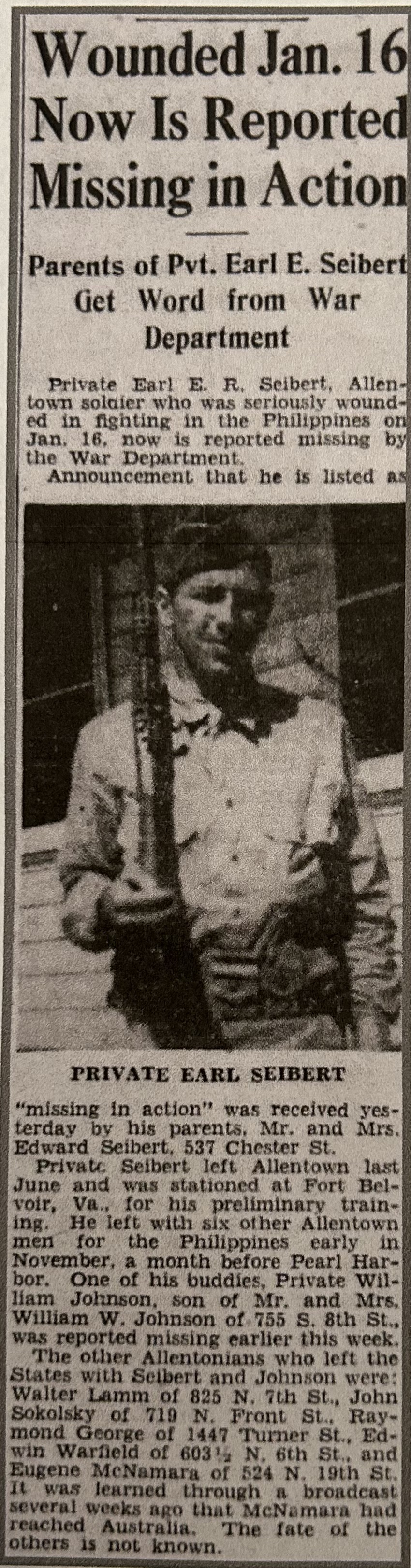
Private Earl Seibert came home yesterday, May 25, 2024. He’d been gone for a long time.
A burial detail removes Private Earl Seibert’s casket from a carriage May 25 at Grandview Cemetery outside Allentown.
The mechanic from Allentown, Pennsylvania, died 82 years ago in a Japanese POW camp in the Philippines. He was buried there in a common grave.
His family knew he was missing and presumed dead. Not until World War II ended did they learn he had succumbed to diphtheria in 1942 at Cabanatuan Camp 1 on Luzon. He was 23. Early this year, the Defense Department announced his remains had been identified.
Private Earl Seibert of Headquarters Company, 803rd Engineer Aviation Battalion, attached to the Far East Air Force in the Philippines
In the fall of 1941, Seibert and six hometown buddies shipped out to Luzon with the Army’s 803rd Engineer Aviation Battalion to work on airfields. They were at Clark Field when the Japanese attacked Pearl Harbor and the Philippines. With the surrender in April 1942, they were among thousands of U.S. and Filipino troops taken on the Bataan Death March and held in squalid camps. Only three of the seven survived.
At the church service, Seibert’s niece Ginnie-Lee Henry shared a letter she wrote that begins “Dear Uncle Earl.” She told him that his father learned from the War Department in 1951 that his remains could not be recovered.
Both his parents and his sister – Henry’s mother – and then Henry herself “started to investigate what had happened to you.” It took many years. Henry found that when the prisoners couldn’t work or got sick, they were placed in housing the Americans called Barracks 0, so called because men had a zero chance of coming out alive.
“It is believed you were placed into Barracks 0 in the beginning of July 1942. Your personal belongings were taken by the Japanese guards, including your identification tag as a souvenir. The Army believes you died at 4 a.m. on July 27, 1942, having your death recorded on a condensed milk can label by another POW. You were one of twenty who died that day.”
Seibert’s cousin Tommy Sweeney, a private in the 20th Air Base Group, also was captured on Bataan. He died at the Cabanatuan camp June 23, 1942, of Vincent’s angina .
This carriage pulled by Percheron draft horses took Seibert’s casket from Jordan United Church of Christ to Grandview Cemetery.
The POWs were exhumed at war’s end and reburied in the Manila American Cemetery, where the “unknowns” lay in a common grave. Six years ago, Henry and other family members provided their DNA to the Defense POW/MIA Accounting Agency. Last summer, it identified one set of remains as those of Seibert.
At the church yesterday, a half-open casket contained Seibert’s remains, enfolded in an Army uniform. His medals were on display, including a Bronze Star for his role in the defense of Bataan and two Purple Hearts, one because he was wounded January 16, 1942, and the other because he died at the hands of the enemy.
The Missing Man Table with a single chair was on display. On top of it was a folded American flag, a Bible, a candle, an inverted glass, a red rose in a vase tied with a yellow ribbon, a slice of lemon and some salt. The lemon is a reminder of a POW/MIA’s bitter fate. The salt symbolizes the family’s tears.
The flag is lifted from Seibert’s casket to be folded and presented to his niece Ginnie-Lee Henry.
In times of sadness, there is comfort in ritual. I felt it.
Under the noontime sun, the casket rode to the cemetery two-and-a-half miles away in a horse-drawn carriage, to the clip-clop cadence of two Percherons’ hooves. A bugler played Taps. Riflemen fired three volleys in salute. We recited the 23rd Psalm aloud. With solemn respect, two soldiers lifted the American flag off the casket and folded it precisely. Another presented it to Henry as she sobbed. Three shell casings from the rifle salute were handed to her, symbolic of duty, honor, country.
“Welcome home, Uncle Earl,” Henry had written in her letter to him. “We remembered you. So did many others, too.”
The Magnolia Sadies, a vintage dance troupe, smooch Navy veteran Matt Gutman, 99, on May 8 in Macungie.
Pennsylvania is home to about 7,000 World War II veterans, all in their 90s or older. Eleven of them were honored yesterday, May 8, with a picnic that included 1940s singing and dancing at Macungie Memorial Park near Allentown.
I knew a few of the men and spoke with all of them, and came away grateful for their sacrifice and courage.
The occasion was the seventy-ninth anniversary of Nazi Germany’s surrender, called V-E Day for “victory in Europe.” Japan’s surrender four months later, on September 2, 1945, ended the war and was called V-J Day, for “victory over Japan.”
Here are the men, great patriots all, who attended the event presented by the Lehigh Valley Chapter of the Battle of the Bulge Association:
ARMY
Ridyard
Herb Ridyard, 98, of Elizabethtown, with the 94th Infantry Division in the Battle of the Bulge
Bokeko
Angelo Bokeko, 101, of Lower Macungie, with the 13th Armored Division in Europe and a recipient of two Bronze Stars
MARINE CORPS
LaSota
Walter LaSota, 98, of Reading, a rifleman with the 6th Marine Division who earned two Purple Hearts on Okinawa
MERCHANT MARINE
Balabanow
Bill Balabanow, 98, of Lancaster, a radio operator on cargo ships who had thirty-three years of sea duty
Cinfici
Lou Cinfici, 95, of Reading, an engineman on a seagoing tugboat who later served in the Navy in the Korean and Vietnam wars
NAVY
Conrad
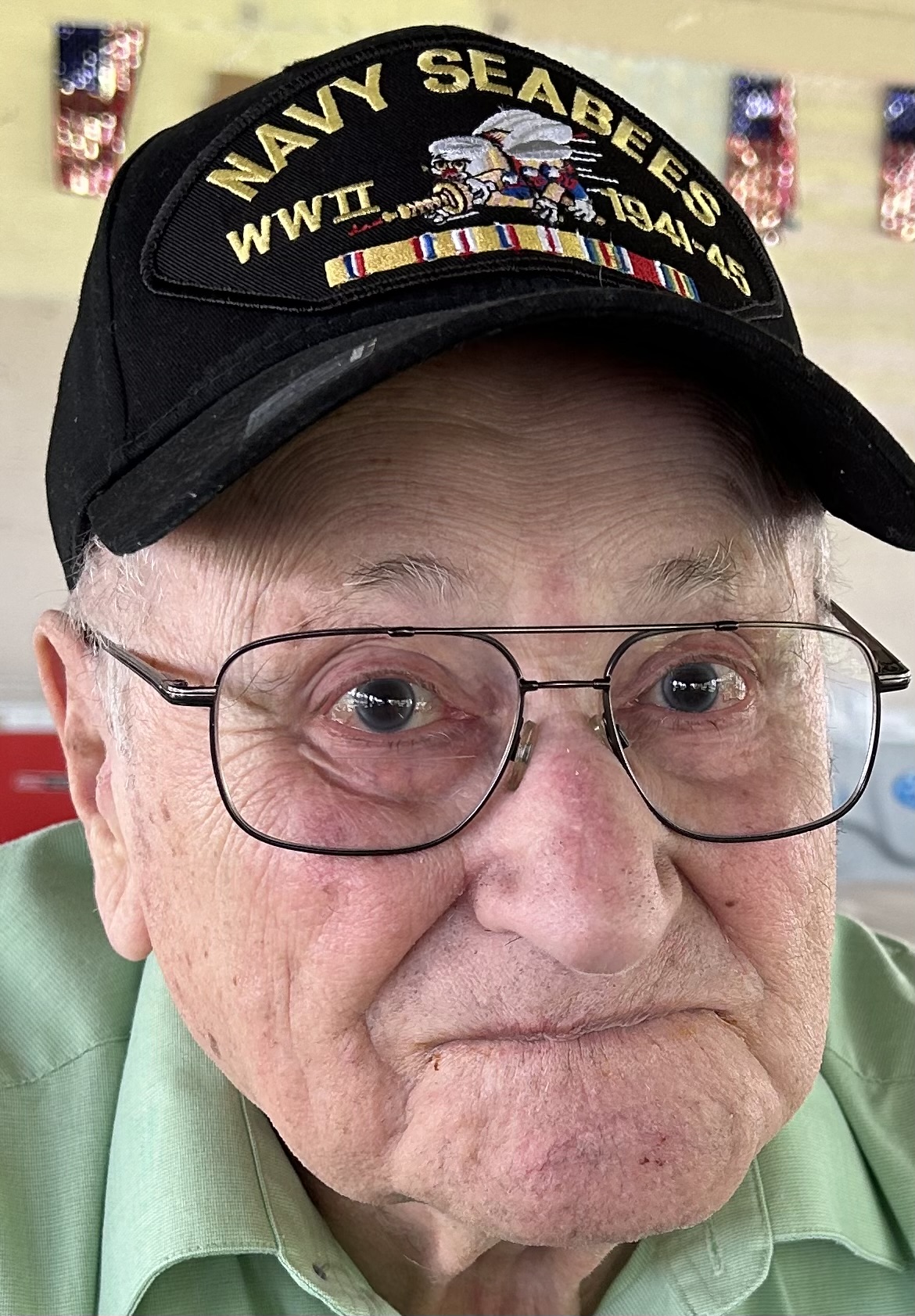
Ed Conrad, 97, of Fleetwood, a Seabee on Okinawa
Czechowski
Ed Czechowski, 99, of Reading, a gunner on the destroyer Saufley in the Pacific
Gutman
Matt Gutman, 99, of Allentown, a Higgins boat coxswain on a landing ship, tank (LST) in the Pacific
Ongaro
John Ongaro, 98, of Allentown, a crewman on an Atlantic freighter
Pearce
Bob Pearce, 101, of Emmaus, an aviation weather specialist in the Philippines
Stabley
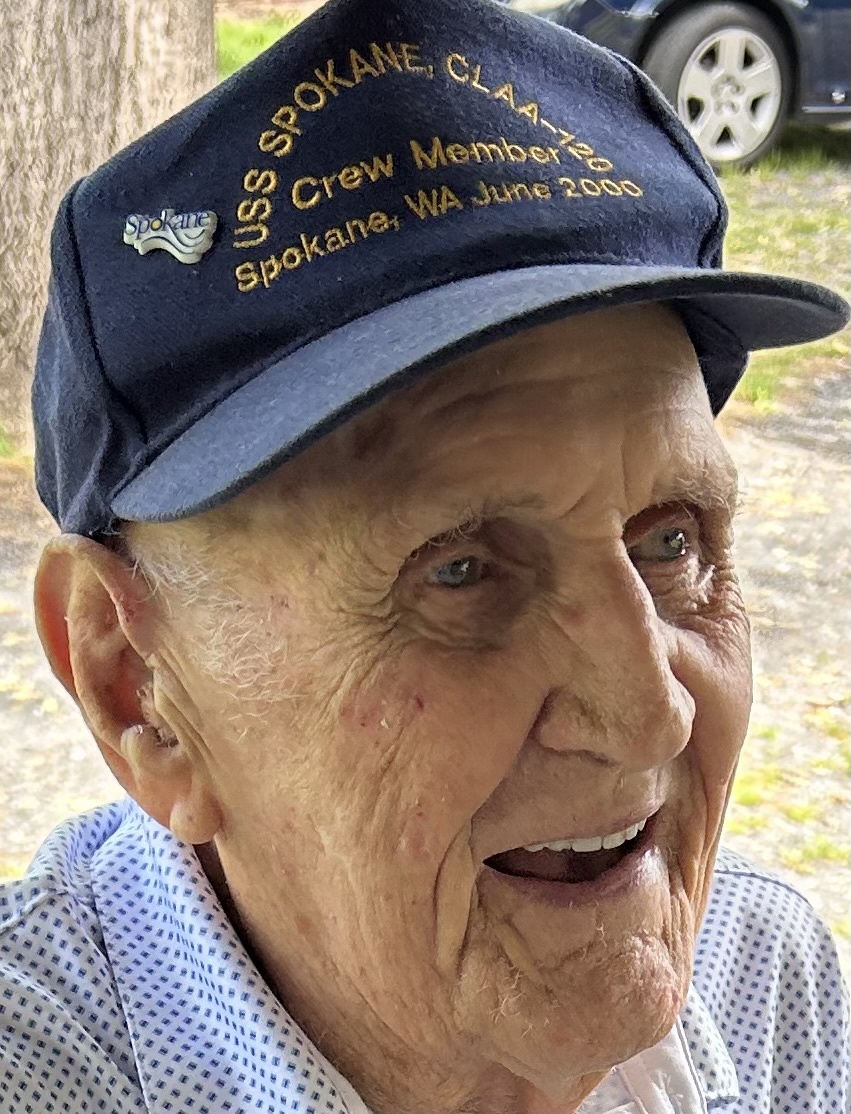
Jere Stabley, 97, of Lancaster, a baker on the light cruiser Spokane
Gutman, whom I interviewed for The Morning Call in 2022, and Balabanow are bound for Normandy next month for ceremonies marking the eightieth anniversary of D-Day, June 6, 1944.
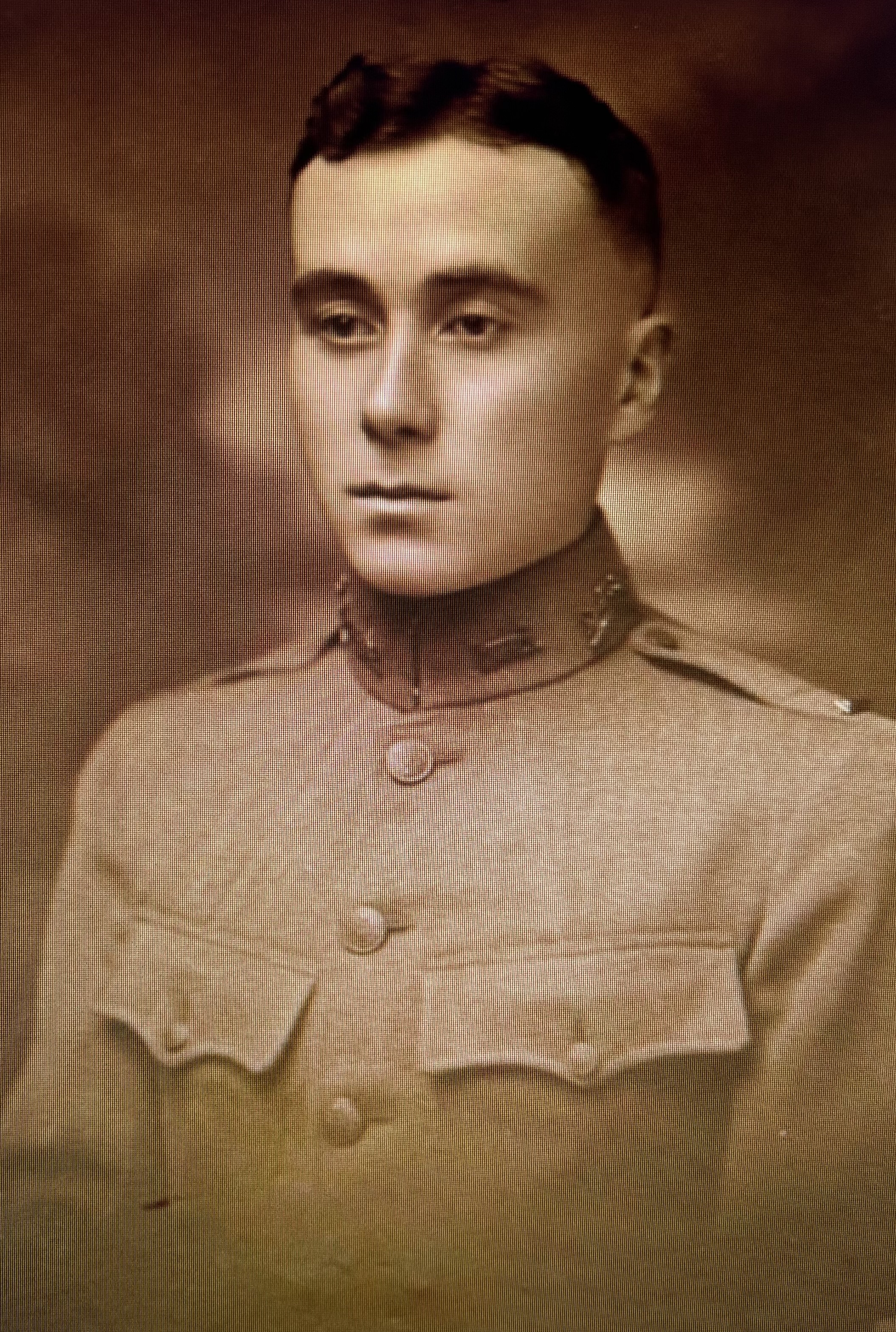
Howard Lee Strohl was killed August 9, 1918, during the Battle of Fismes and Fismette in the Marne department of northeastern France.
You might remember my blogs last year about an Army officer from Bethlehem, Pennsylvania, who was killed in the First World War.
There’s more to tell about 2nd Lieutenant Howard Lee Strohl.
I had pieced together his story with the help of his great-niece, a unit history, the National Guard armory in Allentown, Ancestry.com, and contemporary accounts on Newspapers.com, one of which had the text of a letter he wrote home from France.
What I didn’t have was Strohl’s official military personnel file. It wasn’t at the National Archives’ National Personnel Records Center in St. Louis. “If the record were here on July 12, 1973,” said the message from an archives technician, “it would have been in the area that suffered the most damage in the fire on that date and may have been destroyed.”
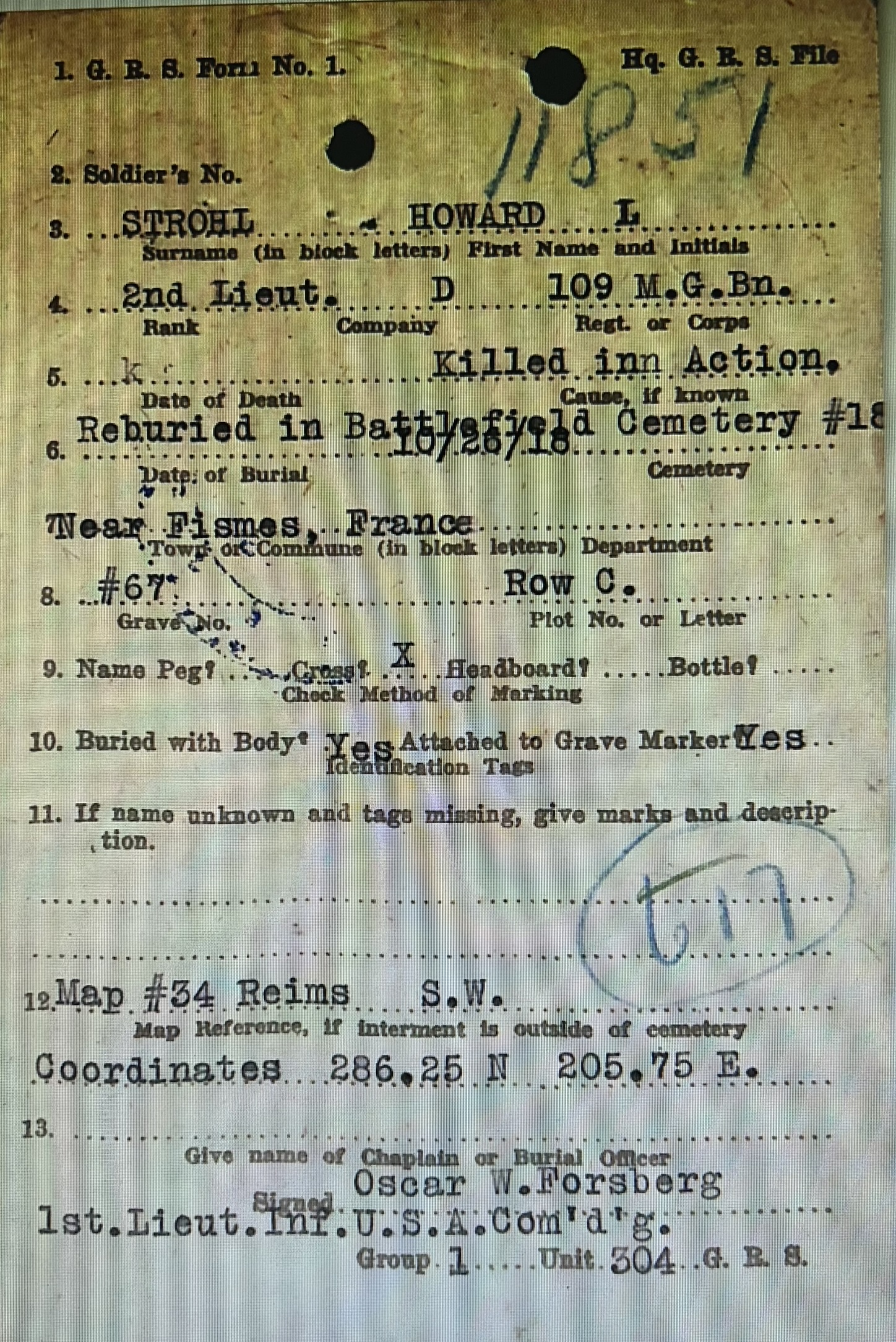
A card from Lieutenant Strohl’s burial case file (National Archives at St. Louis)
But she opened another door, saying a casualty file held by the Army might have information I wanted. She suggested I write to the Army Human Resources Command’s Casualty & Memorial Affairs Operations Division at Fort Knox, Kentucky.
So in May 2023, I mailed my request with as much detail on Strohl as I could muster. Four months later, an email arrived from a tech at the National Archives at St. Louis: “We have located Howard L. Strohl’s burial case file as requested.” It turned out Human Resources Command doesn’t have World War I-era burial case files, so Fort Knox forwarded my inquiry to St. Louis.
I got directions on how to pay electronically using the U.S. Treasury’s Pay.gov service and did it right away. The cost was $28.80. “Please allow time for the scanning and uploading process to be completed,” the archives tech said. “Our staff is minimal and all requested records need to be digitized and redacted prior to delivery, so we are looking at a much longer turnaround than is typical.”
Six months passed. I gave the tech a nudge in an email. She wrote back promptly that I’d be getting the record in the next several days. Sure enough, an email arrived with a link to a PDF scan of the file.
Of its thirty-eight pages on the disposition of Strohl’s remains, the last one interested me the most. It’s an account of his final moments, given after the war by a sergeant who had been with him.
Strohl’s dog tag from his grave in the American cemetery at Fismes, France (National Archives at St. Louis)
“The carnage was awful,” a unit historian would write, “and it was our 28th Division which successfully withstood the attack, at a fearful loss.”
Bowman said Strohl fell about 2:30 p.m. August 9 – a day after the 109th got into the fight. He told an officer asking about the circumstances of Strohl’s death:
Just before the Lieut. was hit I was with him in the cellar of a house which was on the street leading from the city hall to the Vesle River. Lieut. Strohl left the building for the purpose of securing information but was hit by the fragments of a shell just as he reached the street. He was wounded in the chest and in the thigh. Lieut. Strohl[’s] wounds were dressed at once but he died without regaining consciousness. He is buried in the yard at the hospital at Fismes.
Howard and Ada after their October 31, 1917, wedding
Six days earlier, Strohl had written to an aunt and uncle in Allentown about seeing “all the grim horrors of warfare.” If he hadn’t been killed, he would have received an order the next day to return to the States for further training.
He was twenty-three. Back home in the Lehigh Valley, he left a wife, who had given birth to their son after he departed for France.
His remains were removed from the hospital yard and reburied two weeks before the Armistice in American Battle Area Cemetery 617 at Fismes. It was Grave 67, Row C, marked with a cross.
Sergeant Bowman, of Myerstown, Pennsylvania, was interviewed in February 1919. The officer who took his statement, 2nd Lieutenant Charles C. Curtis, went on to become a major general in the National Guard and command its 28th Infantry Division. Allentown’s National Guard armory, home of the 213th Regional Support Group, bears his name.
—
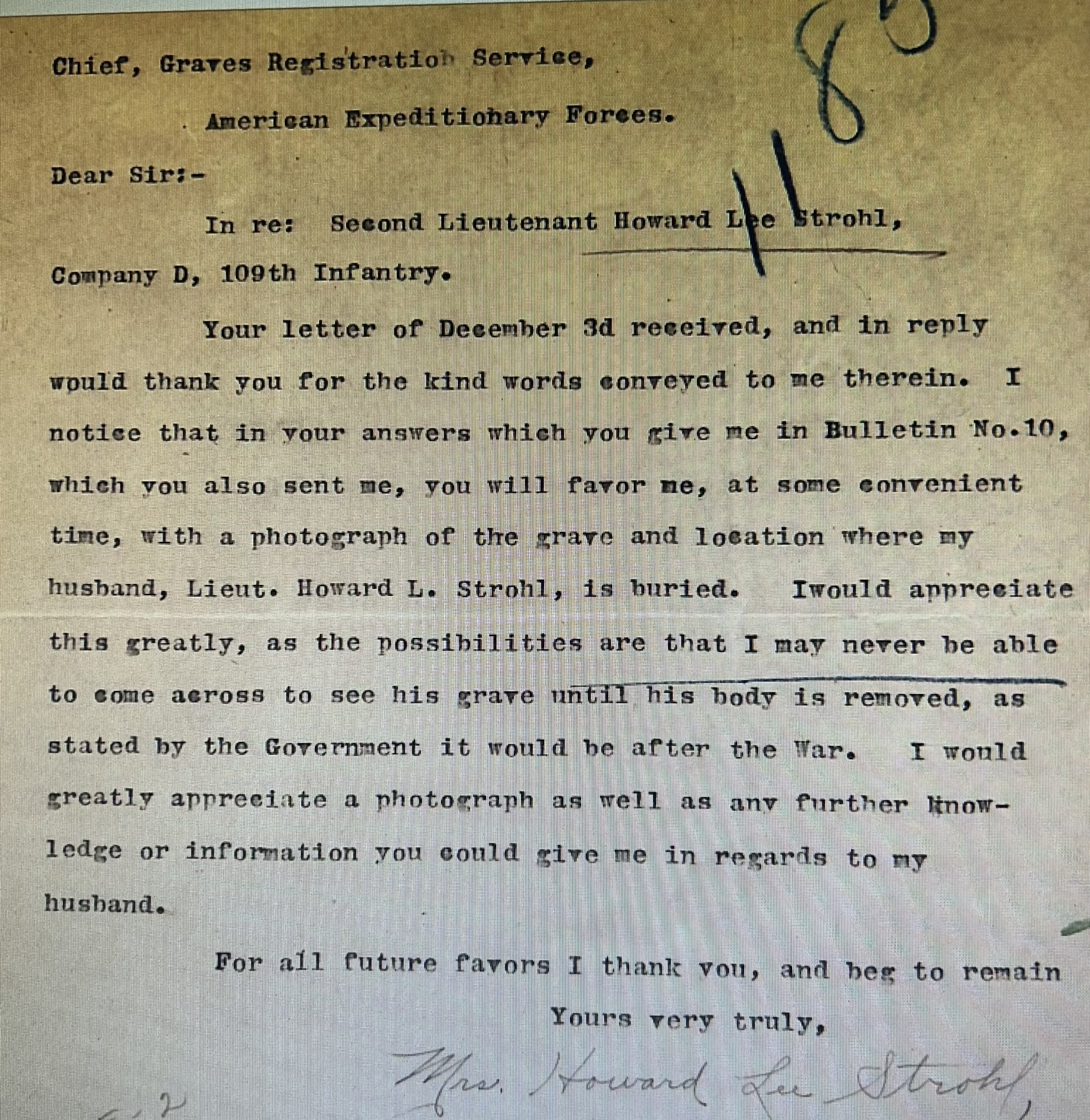
A January 1919 letter from Ada Strohl asking the American Expeditionary Forces about her husband’s grave (National Archives at St. Louis)
Strohl’s burial case file shows the military’s care in dealing with his family and bringing his remains home. It’s clear the war dead of more than a hundred years ago were honored and their kin treated with respect just as they are today.
Both Strohl’s widow, Ada, and father, William, asked the Army for information about his remains. William Strohl wrote to the Adjutant General’s Office in Washington in April 1919:
Howard’s father, William Levinus Strohl
Having been informed that the Government intends to remove and send home the bodies of the American soldiers, and being deeply interested in this move on account of having lost my son, Lieut. Howard L. Strohl, 109th Machine Gun Bat. on last Aug. 9th, I will kindly ask you to forward me any information you may have concerning such action.
The office responded with the War Department’s policy and said, “In due time, you will be asked for information relative to your wishes in the matter of the disposition of the remains of your son.”
William Strohl’s letter to the Adjutant General’s Office (National Archives at St. Louis)
According to the policy, the nearest next of kin – in this case, Ada – could choose to have the body returned to any address in the United States, interred in the National Cemetery at Arlington, Virginia, or any other national cemetery, or left in Europe. The government would pay the full cost for the transfer of bodies.
Ada asked that her husband’s remains be brought to her in Hellertown. But she remarried in 1920 before that could happen, and as a result no longer qualified as his nearest next of kin. That was now her toddler son, Howard R., with Bethlehem National Bank as his guardian. The bank wanted Strohl’s body delivered to his father in Bethlehem.
In April 1921, the Graves Registration Service of the American Expeditionary Forces removed Lieutenant Strohl’s remains from the American cemetery at Fismes. They were placed in a casket and delivered by rail to the port at Antwerp, Belgium.
Bethlehem National Bank telegram to Hoboken, New Jersey, correcting the Bethlehem street number for the shipping of Strohl’s remains (National Archives at St. Louis)
The Army ship Wheaton, built by Bethlehem Steel, carried Strohl across the Atlantic. On June 11, the transport docked at Pier 42 in Hoboken, New Jersey. From there, the Lehigh Valley Railroad took him home to Bethlehem. He was laid to rest, finally, in Towamensing Cemetery.
Private Earl Seibert died eighty-two years ago at a prison camp in the Philippines and was buried there. When the Defense Department announced last month that his remains have been identified, I reached for my filing cabinet.
In 2002, I interviewed a veteran who had much in common with Seibert– eastern Pennsylvania hometowns, service in the same Army unit, the Bataan Death March and a camp where more than 2,500 POWs died. The difference was that Joe Poster was spared.
—
Seibert was among seven men from Allentown who shipped out to the Philippines in the fall of 1941. Along with thousands of other U.S. and Filipino troops, they were taken prisoner the following spring, several months after Japanese forces invaded the islands. Ahead of them was the Death March and horrific captivity. Only three would survive.
Soldiers from Allentown (crouching, from left) John Sokalsky, Raymond George and Eugene McNamara; (standing, from left) William Johnson, Walter Lamm, Earl Seibert and Edwin Warfield. All belonged to the 803rd Engineer Battalion. The photo ran December 29, 1941, in their hometown paper, The Morning Call. (Newspapers.com)
In December 1941, just days after the Japanese landed, The Morning Call of Allentown ran a photo of the seven men – Seibert, Eugene McNamara, Edwin Warfield, John Sokalsky, Raymond George, William Johnson and Walter Lamm. Citing a letter from McNamara dated November 29, the paper said they were together at Fort Stotsenburg/Clark Field, about fifty miles from Manila.
Before his Army service, Seibert was a mechanic at Hoffman Bros. auto salvage. He and the six others were inducted in June 1941 and got basic military engineer training at Fort Belvoir, Virginia. Assigned to the 803rd Engineer Aviation Battalion, they arrived on Luzon in October and were attached to the Far East Air Force. Their job was building airfields.
An update in The Morning Call of May 30, 1942 (Newspapers.com)
Seibert, of Headquarters Company, was badly wounded January 16, 1942, as the Americans and Filipinos fought to defend the Bataan peninsula. There were no details on his injuries.
After the Allies surrendered April 9, most of the men in the 803rd’s three companies on Bataan – a fourth company was on Corregidor — walked from Mariveles to San Fernando on the Death March, according to Good Outfit: The 803rd Engineer Battalion and the Defense of the Philippines, 1941-1942, by Paul W. Ropp. They were taken by train to Capas for internment at nearby Camp O’Donnell. Many of the engineers left the camp to toil for their captors in the mountains of northern Luzon. After a few months, they were marched to Cabanatuan Camp 1 , where disease, malnutrition and maltreatment took a dreadful toll.
Seibert, age twenty-three, died of diphtheria at Cabanatuan on July 27, 1942. He was buried in a common grave at the camp cemetery. His parents didn’t learn of his death until three years later, after Japan’s surrender.
Ropp’s 559-page history of the battalion lists what happened to its members. Here’s what the book says about the six other soldiers from Allentown, all of them members of Company B:
Lamm
— Private Walter Lamm survived the war. He left Cabanatuan in September 1942, was transported on the hell shipTottori Maru to Korea and then to a POW camp in Mukden, Manchuria. (He died in 2008 at age eighty-nine.)
Warfield
— Private First Class Edwin Warfield survived the war. He was taken from Cabanatuan in July 1944, transported on the hell ship Sehiiko Maru and held captive near Osaka, Japan. (He was eighty-six when he died in 2000.)
Sokalsky
— Private First Class John Sokalsky survived the war. He was taken from Cabanatuan, transported on the Tottori Maru and taken to Mukden in October 1944. (He died in 1984 at age sixty-eight.)
— Private Raymond George, twenty-four, died in the Cabanatuan hospital August 27, 1942, of dysentery. He had been wounded in action April 8. (Warfield helped bury him.)
Johnson
— Private William Johnson, twenty-eight, died April 15, 1942, of a fractured skull during the Death March. He might have been murdered near Balanga. According to a November 1945 story in The Morning Call, Warfield told Johnson’s parents their son collapsed during the march and was carried away, never to be seen again.
—
Poster in photo taken September 8, 1945, after he was liberated from Mukden camp
Word that Seibert died at Cabanatuan and his remains have been identified took me back to an interview I did for The Morning Call twenty-two years ago. Joe Poster grew up in Pottstown and served in Company B of the 803rd. He went on the Death March and the work detail in the mountains. At Cabanatuan, he once helped bury the dead. Sent to Manchuria, he almost died of nephritis at the Mukden camp.
“I can’t say how I made it,” Poster told me. “I lived day to day. I was scared all the time. I thought maybe tomorrow those Japanese will kill me. I never knew whether they were going to murder us or not. That’s the way it was for three-and-a-half years, even till the last day.”
When I arrived at his home for one of our interview sessions, he yelled that I was making him remember “all this stuff.” He was still haunted and couldn’t sleep.
He died in 2003, a year after my story ran. He was eighty-three.


























 David Venditta