Louie Venditti’s home movies from June 1969, when his son Nicky was about to leave for the Vietnam War
My cousin Nicky, 20 years old, is home on leave in Malvern, Pennsylvania. He wears the wings he has just earned as an Army helicopter pilot and is bound for Vietnam. It’s June 1969.
Uncle Louie, an Army Air Corps ground crewman in England during World War II, is immensely proud of his son. He takes Nicky, in his uniform, to the VFW and American Legion posts to meet his buddies. He snaps photos of Nicky and shoots film of him with his home-movie camera.
Nicky is embarrassed but goes along with the fuss to make his dad happy. All the while, he is terrified of going to the war. He insists to his closest friends that he won’t be coming back alive.
—
Over the years, I’ve posted photos of Nicky taken during his 23 days of leave. Now for the first time, I’m showing video from the home movies Louie shot on three reels of 8-millimeter film. More than soundless images of a soldier, they are a snippet of ’60s small-town America.
The first image you’ll see is Nicky smiling at the camera from a picnic table outside his home. The young man wearing sunglasses is Nicky’s stepbrother, Joe Gray. The two other men are friends of the family. The woman is my Aunt Bert, Nicky’s stepmom. She and Nicky were close. The hip-swiveler is Uncle Louie, a rascal and lots of fun. The young woman with Nicky is his fiance, 18-year-old Terri Pezick. The other couple in the yard is my cousin Mike Beam and his wife, Monica. The pea-green car going down the street is Nicky’s ’68 Camaro SS. Finally, the husky guy with sideburns is Nicky’s best pal in Malvern, Charley Boehmler.
Uncle Louie with Nicky at home in Malvern, Pennsylvania, in the last days before Nicky’s departure. (They spelled their last name, Venditti, differently from mine.)
The night before Nicky left for Vietnam, Charley told him that he shouldn’t worry about getting killed. “You’re always lucky,” he said.
—
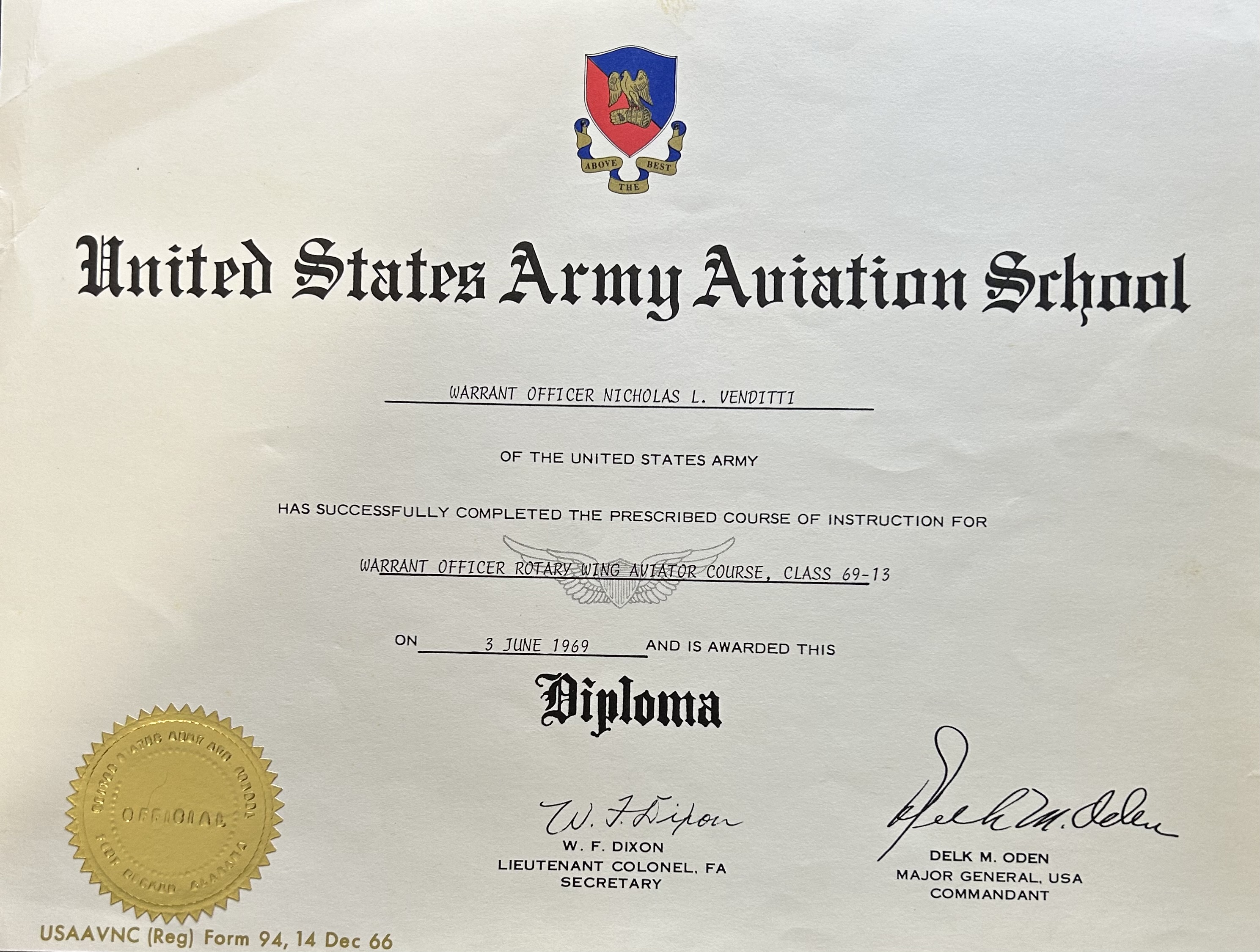
Warrant Officer Nicholas L. Venditti arrived in Vietnam on the Fourth of July 1969. Six days later, as part of his Americal Division orientation on the U.S. base at Chu Lai, he was in a class on grenade safety when the instructor unwittingly let loose a live grenade. Nicky lost his left leg below the knee. He died July 15 in Chu Lai’s 312th Evacuation Hospital, on a bluff above the South China Sea. He had survived only 11 days in Vietnam.
Uncle Louie died of heart failure in 1996 at age 72. Aunt Bert found the home movies in a shoe box in the attic and gave them to me. She once asked Louie about them, and he had said only, “I’m never going to look at those.”
Terri Pezick honored Nicky’s request that she live happily if he didn’t return. She married and had two sons. Charley Boehmler died of cancer in 1999, when he was 50. Aunt Bert died in 2006 at 81.
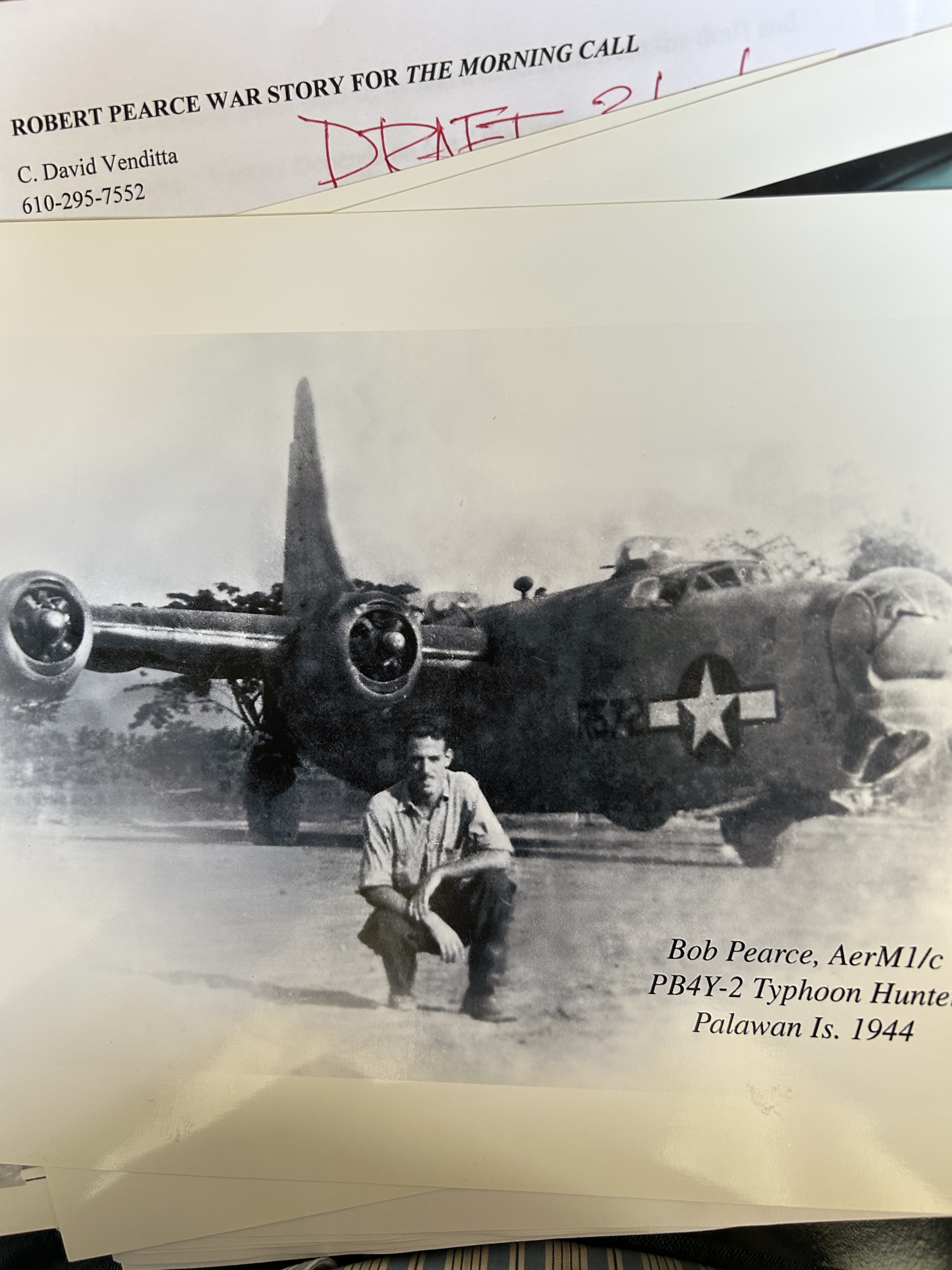
Robert Pearce, a Navy aerographer’s mate first class, in front of a PB4Y-2 Privateer used for ‘typhoon hunting’ in the Pacific, 1945. Pearce went on some of those missions.
Over the last few weeks, I’ve been interviewing a 102-year-old World War II veteran about his experiences as a Navy weatherman in the Philippines.
Robert Pearce grew up in Philadelphia and has lived in Lehigh County since the war. He is a former pilot and an organist who worked nearly five decades for Allen Organ Company. I had material that helped me put together his story — a memoir he wrote for his grandchildren a dozen years ago and a video of a talk he gave in 2023 for the Lehigh Valley Veterans History Project, which I attended.
My two-part “in their own words” war story is running in The Morning Call of Allentown. Part 1 appeared online March 19, and Part 2 the next day. It’s running in print this week.
I want to share with you an anecdote Pearce told me that isn’t in the story. It’s gruesome but reflects the reality of life on Palawan, which until early 1945 was occupied by the Japanese. The island is etched in World War II history as the place where, on December 14, 1944, Japanese troops executed 139 American POWs. It happened near the town of Puerto Princesa, where the enemy had an airfield.
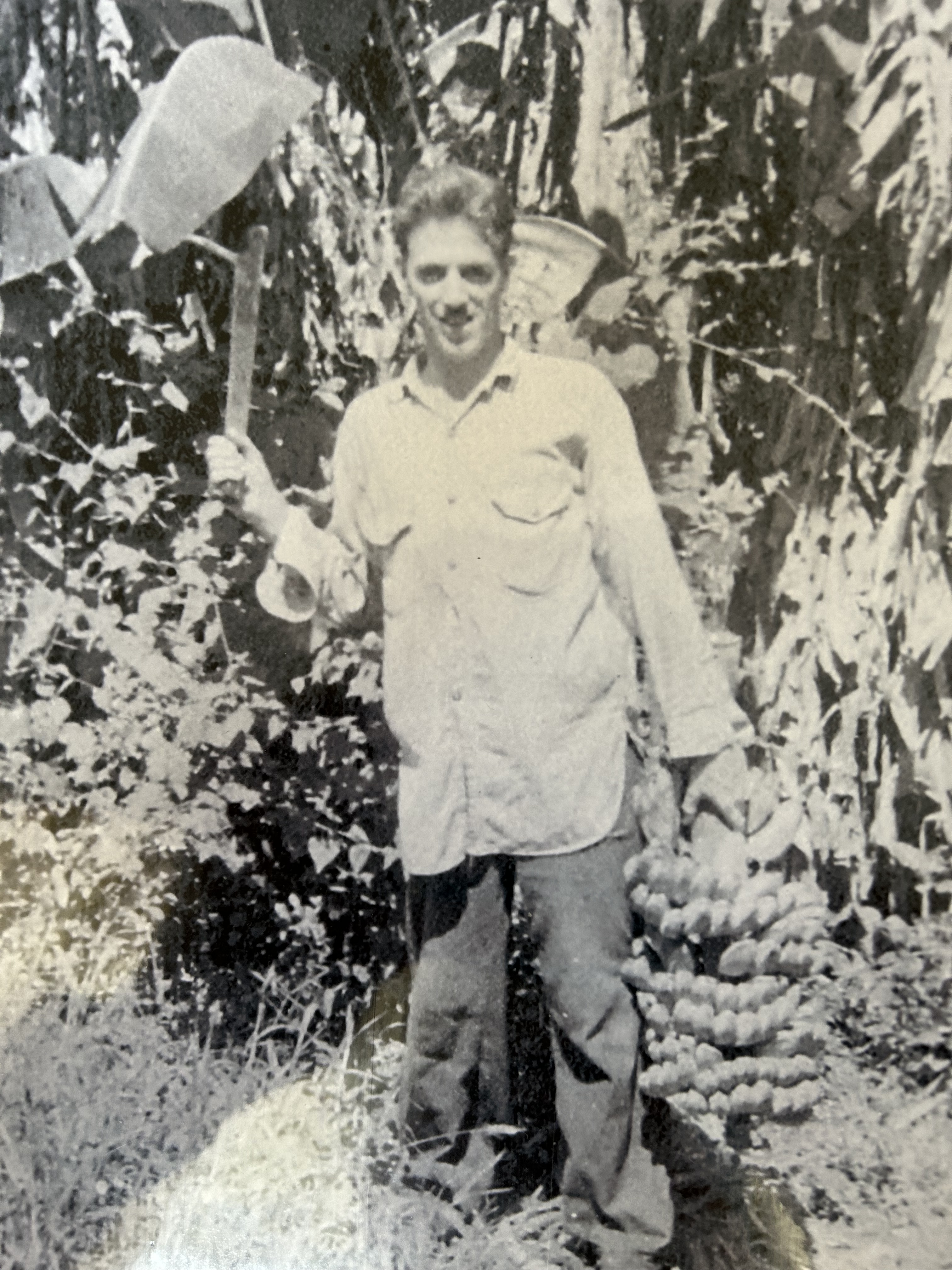
Pearce with a bolo knife and batch of bananas on Palawan
U.S. planes bombed the town for four months. Then at the end of February 1945, part of the Army’s 41st Infantry Division landed there and captured the airfield. The Puerto Princesa strip was rebuilt and used by the 13th Air Force Fighter Command until war’s end.
Pearce’s Navy unit, Fleet Air Wing 10, arrived in mid-April. It was tasked with conducting patrol plane operations against shipping in the South China Sea and along the Indochina coast. An aerographer’s mate first class, Pearce ran a weather office of six enlisted men. Their officer was Art Lund, a leading singer with the Benny Goodman Orchestra. Pearce and Lund would fly out to ships at sea, where Lund would entertain the men as Pearce accompanied him on the organ.
Pearce remembered episodes of horror at Puerto Princesa — fatal plane crashes on the airfield and, far more disturbing, Filipino revenge on the Japanese.
Pearce, 102, at his home in Lower Macungie Township on February 28, 2025
“The natives were primitive,” Pearce said. “They loved us because we were helping to ferret out the hated Japanese soldiers who were hiding out on the north side. Their thing was to capture one, chop his head off and proudly carry it by the hair through our camp. This time it was in front of the chapel while I was talking to the chaplain and some others. The chaplain shouted, “I want every man down on his knees!” He did not address the Filipino, and let him pass.
“Hatred of the Japanese was fueled by the fact that when they had the island, rape and killing were common.”
—
A search of Pearce’s name on Newspapers.com turned up a gem.
Pearce was a 19-year-old Navy trainee at Bainbridge, Maryland, at the end of 1942. He wrote a song that was performed by the boot camp’s stage band. He wasn’t married but wrote the lyrics as if he were a husband and father.
I’d love to be at home for Christmas, But it’s my duty to be here. When the snow is drifting on your window, I’ll be thinking of you, dear.
I’d love to see our kids at Christmas, Watch them tripping down the stair, See them picking up each toy I sent them, I can just picture them there.
I don’t like to talk about the war. It seems that’s all one ever hears. We all know what we’re fighting for: A home that’s safe through the years.
I’d love to be at home for Christmas At the end of ’43. But my darling you must not expect us Till we march home in victory.
In the first days of 1943, the Associated Press reported on a flurry of songs being written by sailors at Bainbridge Naval Training Center. It ran in newspapers across the country. “Embryo tars write songs at Bainbridge” was the headline in the Anderson Herald of Indiana. The subhead was: “Musicians are affected by the newness of mushroom camp on Susquehanna.”
Of Pearce, AP writer James E. Hague wrote:
“The Bainbridge charm worked even more quickly on Robert Pearce, ex-organist from Philadelphia. A week after his arrival, he wrote words and music — while on cleaning detail — for the top song of the Bainbridge ‘Hit Parade’ — ‘I’d Love to Be Home for Christmas.’
“If sailors could whistle while they work, its easy-to-whistle melody would be chirped by half the sailors at the station. And its popularity shows no signs of flagging.”
Pearce didn’t know about the story until I showed him the clip. He was delighted.
Americal Division combat medic Fred Sanders during his 1969-70 tour of duty in Vietnam
“As a noncombatant combat medic, I experienced seeing much suffering, ruthless cruelty and tragedy in Vietnam,” Fred Sanders wrote to me. “For those who have experienced or witnessed traumatic events in their lives, I would counsel: Do not nurse your pain. It will only prolong the suffering and make your life more difficult.”
Sanders is 78 and lives near Columbia, South Carolina. He was with the Americal Division unit involved in the reported mutiny of U.S. troops in 1969. Last year, I blogged his account of “the very unfortunate thing that was not a mutiny.” Today, I’m sharing more of his Vietnam story, as he has told it to me.
I became a medic because I was a conscientious objector. I did not want to kill. I was well read on world affairs, politics. I saw then what people now recognize as the truth of what happened in Vietnam.
But this didn’t figure in my C.O. position. I felt it best to serve as a noncombatant on religious grounds. I belonged to a Baptist church, and the Southern Baptist Convention recognized my personal convictions as a C.O. My best choice was to try to save as many lives as I could.
I was a student at the University of South Carolina, interested in getting a degree in biology.Istayed out one summer to work for the state engineer’s office to make money to get back into college. But I didn’t get back in the first semester because I missed signing up.
A draft board member heard I stayed out a semester, and they pulled my name to be drafted. I said I’d like to register as a C.O. I wasn’t trying to get out of the Army. I said I’d go as a medic.
The head of the draft board got angry. He said, “You’re gonna put a black mark on Aiken County’s history.” I said I’m not asking for alternative service like Mennonite friends of mine. I’ll do the best I can if you let me serve in a medical capacity and try to bring some of these young men home alive.
—
Sanders today. He holds Native American, Scots-Irish and German heritage.
“I had a lot of experience dealing with people dying,” Sanders said of his year in the northernmost U.S. military zone of South Vietnam. He was 23, 24 years old while serving with Alpha Company, 3rd Battalion, 21st Infantry Regiment. “They called me an old guy.”
In the Song Chang Valley south of Da Nang, a friend of his, Sergeant Derwin Pitts, was shot as they walked down a hill toward the enemy. He lay groaning about six feet away, his position exposed. Sanders tried to figure how he could reach him without also being shot. Just then, Private First Class Ray Barker called him off, saying, “Doc, you’re not gonna do it.” He crawled past Sanders toward Pitts and was immediately killed. Pitts also died where he lay.
Another time, a young man was hit by a fragment from an antipersonnel artillery round. “That metal had severed his throat. He was hemorrhaging in his mouth, and I had to try and clear his airway but was unsuccessful. I was sucking blood out of his throat. There was nothing I could do to save him.”
Some men had self-inflicted wounds, “which I suspected of stemming from fear of being killed.” One shot himself in the foot. On another occasion, Sanders had just spoken with a man who was cleaning his M16 and heard a shot fired. “I ran to him and found his leg hanging only by skin. He said that the trigger caught on a root. He had expressed fear of being killed when walking point on patrol. He insisted that [the shooting] was an accident.”
Atrocities happened, and Sanders witnessed a few. He was with a platoon when they came across an old Vietnamese woman carrying a bundle of ruled notebooks and about $20 in Vietnamese money. She lived in a little grass shack with two children about 10-11 years old. The platoon leader, a lieutenant, called battalion commander Eli Howard and asked what to do with her. “I don’t want any prisoners,” Howard said. “All I want is body count.” The lieutenant said, “OK, sir,” and turned to the men. “All right, fellas, I need somebody to get rid of this woman.”
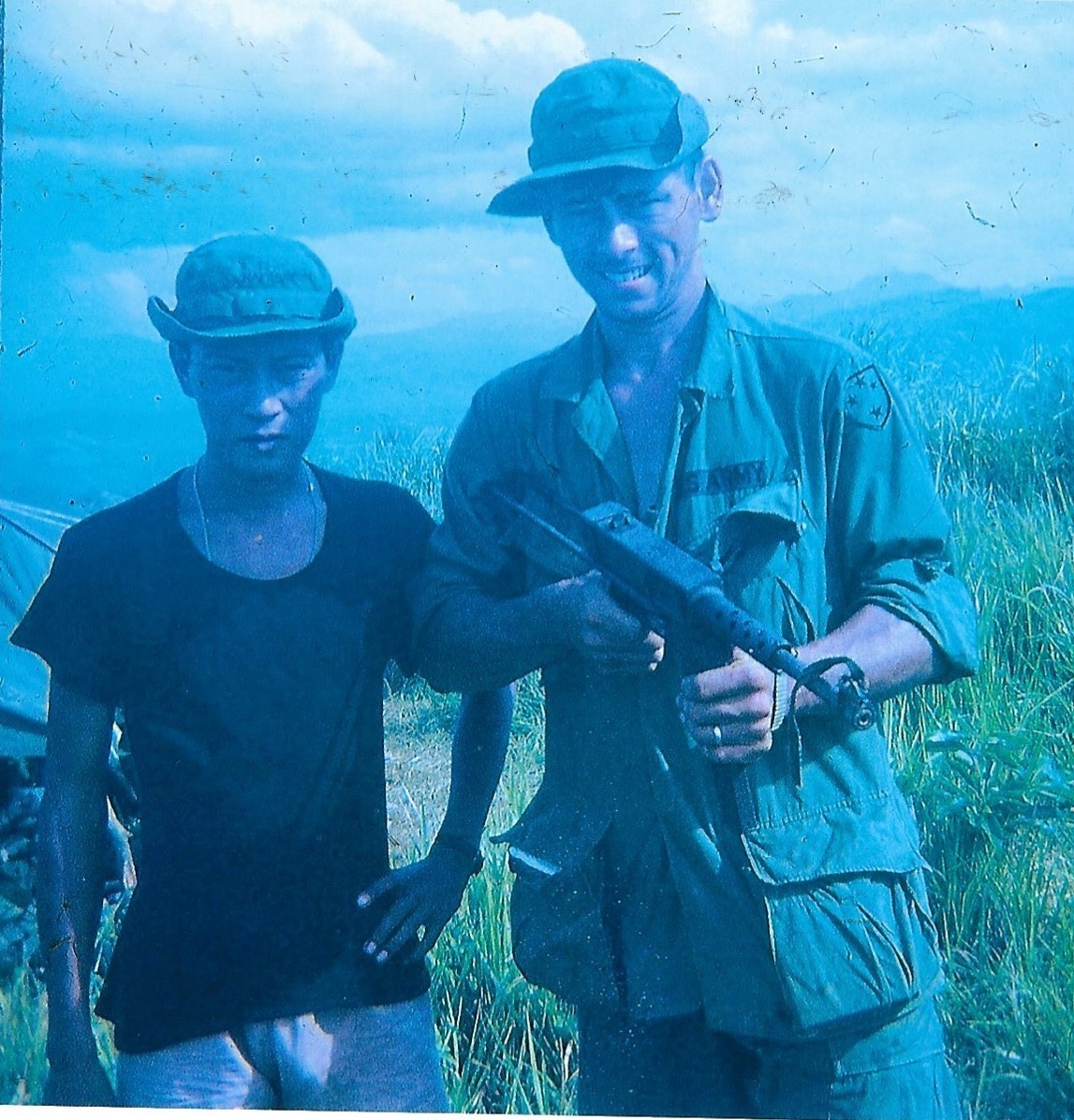
Beside a Kit Carson scout, Sanders holds a rusty French sub-machine gun a Vietnamese woman used against an American patrol. She was shot and killed. Kit Carson scouts were enemy fighters who defected to the South and worked for U.S. military units.
What! Sanders thought. You’re going to execute her? That’s a war crime! What had she done?
“Somebody do it,” the lieutenant repeated. There were at least 10 men standing around. Everyone looked at one another, said nothing, then looked down at the ground. One soldier finally spoke up. “I’ll do it,” he said. Everyone stood back.
The two children were with the woman. She was hugging them. The soldier put his rifle to her head, fired and killed her. The children screamed and ran off into the jungle. Sanders said two men from the platoon went into the bush, perhaps to pursue them. He heard that members of a nearby platoon chased down the children and killed them to make sure there weren’t any witnesses.
“Nobody wants to remember this,” Sanders said. “It left a lot of bitterness with some of us. There was certainly no military value in it.”
Did Sanders speak up about what happened?
I was thinking I can’t say anything because it would put me in a very bad position. I’d had a long experience with taking an unpopular stand, though not with this platoon.
When I was attached to another company earlier, one day a helicopter came and in and they said, “We’re taking you back to LZ Center,” the battalion command post. They told me privately that someone reported “there’s a plot to shoot you during a firefight. Some of these guys want you out of the company, because they don’t appreciate you giving out little Bible tracts in Vietnamese to the people. They resent you. We’re getting you out of here for your own safety.”
When I was in Taipei, Taiwan, I bought a very nice professional camera. I was at the canteen at Chu Lai [the Americal Division base], standing at the counter, and there were some guys at a table and they started talking to me, and when I turned to them, they sent somebody around to my other side where my camera was, and he stole it. They were afraid I might take pictures of something that might get them in trouble.But I never considered doing anything to besmirch my men or the unit in general.
Sanders said no one reported the old woman’s murder to the higher-ups.
Sanders of A Company, 3rd Battalion, 21st Infantry Regiment, 196th Light Infantry Brigade
We dared not go that far with it. I didn’t think at the time that the leadership culture would want it uncovered. That was bad publicity. It would expose the brigade to public scrutiny at a time when mixed public sentiments were influencing conduct of the war.
Also, for my own safety, I had to be careful. I was quite aware of the environment I was in. I’m here with a group of men. I don’t know what their life was. They could’ve been gangbangers before they got drafted.
Sanders said that on a previous occasion while the platoon was on patrol, a soldier shot an old man leaning against a betel nut tree near a cluster of huts, blowing the top of his head off. “What did you do that for?” Sanders asked him. “I panicked. I saw that man, and I didn’t know what to do.” After that, Sanders kept an eye on him and asked him now and then how he was doing, thinking he might be shaken by what he’d done.
“To the best of my remembrance, he was the same guy who shot this woman.”
After killing her, he asked Sanders: “Doc, do you think maybe you could write me up and get me out of the field? I don’t feel like I’m doing too good.”
“I filed a medical recommendation to remove him from field duty as possibly having combat-readiness issues. … I don’t know what became of him,” Sanders said.
Recently, a friend who’d been in the platoon told Sanders that the soldier “admitted to some of us” he shot the woman to get out of the field – a revelation that shocked Sanders. The soldier wanted to manipulate the medic into writing a recommendation that he wasn’t stable and should be removed from field duty.
—
Sanders said the lieutenant who asked for a volunteer to execute the old woman once allowed several of his men to rape a Vietnamese girl. Sanders was with the platoon and didn’t see the assaults but was aware of them. He described the girl as pretty and nicely dressed for someone in the jungle. The lieutenant, he told me, “was totally unwilling to take charge of his men.”
I was with another company one time, and we had walked into a hamlet, and this guy said, “All these people are V.C. [Viet Cong], and he started shooting. He killed men, women and children – 12 or 14 people. Everybody was in shock, but everybody kept their mouths shut, because all of these guys [I’m with] have arms, and you just don’t want to cross anybody, because people can be very dangerous and there aren’t any rules, unless a commander intervenes. Six weeks after that man killed all those people in that tiny hamlet, one of the guys came to me and said, “Doc, he got justice. He got what he asked for.” He had been shot and killed in a firefight.
Once, Sanders was riding in a helicopter with a prisoner and a soldier who carried a Bowie knife and was known to kill detainees. “First thing I know, he shoved the detainee out of the helicopter and said, ‘Oh, he slipped and fell.’”
“It was a great challenge to me to go through all this.”
—
How did Sanders keep his head?
Sanders tends to a Vietnamese child with a skin infection.
I read 24 books in the field, every time we had a break and we were not in danger. Reading is good medicine. It put me in another place.
My faith in God sustained me.
I maintained friendships with as many people as I could.
For some years after I came back, PTSD really hit me. My wife would go to bed and I’d sit in the kitchen and cry, remembering all the suffering and death that I had witnessed.
One night as I was sitting there, my wife said, “Why don’t you come to bed?” I said I’d be there soon, and she fell asleep. I heard a voice in my head: “I would heal you, but you have never asked.” I said, “Huh, what?” I realized it was the voice of God speaking to me in my mind. I was so moved and humbled and asked forgiveness. I said, “Lord, heal my memory.”
From that day on, I never again sat up in the kitchen at night crying. I’m able to sleep.
I still have dreams of being in evasive tactics in Vietnam but never seeing anything violent. One night I dreamed I was in an underground bunker with the North Vietnamese, and I saw their life in the bunker, and I’m watching all these North Vietnamese walking around. When I woke up the next morning, I said: My goodness that was real! But it didn’t disturb me.
World War II veteran Dick Schermerhorn in 2013 (The Morning Call)
Dick Schermerhorn was a 22-year-old Army corporal when he hit Utah Beach on D-Day. Originally from upstate New York, he moved to Allentown, Pennsylvania, after the war.
A dozen years ago, I interviewed him for an “in their own words” story about his experience on June 6, 1944, with the 531st Engineer Shore Regiment. Last Tuesday, Schermerhorn died at age 102. Again, I wrote about him for The Morning Call.
In tribute, here are excerpts from my initial interview with him in May 2013:
—
We had been in Plymouth [England]. We didn’t train there, but that’s where we were billeted. There was a town called Slapton Sands that was evacuated completely. We used to go a few miles out in the Channel and make a practice landing on this town. Somewhere I have a prayer book from the Church of England, and it has “Slapton Sands” on it.
D-Day, as far as you could see, there was all kinds of ships. As we got close to Normandy beach, we went down these rope ladders into the landing craft. It was still dark. We were packed in there like sardines. There must’ve been 35-40 of us. Anybody tells you they’re not scared, there’s something wrong with them. There was a medical officer on the landing craft with me, and I happened to turn around and look at him, and his face was as white as a sheet.
The main object of the 531st was to establish a beachhead. In other words, our thrust was not to make a landing and push the Germans and keep moving. We were there to make it easier for troops that were coming in. We had heavy equipment, we had ducks [amphibious trucks], we had different kinds of plows. We had Bangalore torpedoes to blow up entanglements.
We had impregnated clothing to prevent poison gas. We had a gas mask. We had to carry these heavy M-1s – I would’ve preferred a carbine, much lighter. I had a mine detector, it was waterproofed. It picked up every bolt, screw, nut.
[When the ramp went down,] some guys were hit. The water was up to our necks. I was in pretty good shape, so I could handle it. We were getting fired on, but not to the extent of our buddies on Omaha [Beach]. You could see bullets hitting the water. It was machine-gun fire. There were some dead in the water.
We were getting artillery fire. Every once in a while a Messerschmitt or some other plane would come in.
I can remember the first dead person I saw as I got to the beach. It shook me up. I looked at his dog tag and he was from New York State. His leg was off and he was still alive. He was in shock. There was no question he didn’t survive, because there were no medics around.
I ran in about 20 yards. We got in there and tried to get assembled, a group of us. The 4th Division was with us. We worked with them. As they were pushing the [German] troops back, we were trying to establish a landing place. Our job was to work minefields.
We lucked out on Utah. On Omaha, they had that cliff, and we didn’t have that. [But] it was dangerous. The Germans had been there so long, they had such a long time to work at this. They had the shoe mine. If you stepped on it, it would take the top of your foot off. Then they had mines that would explode waist-high and throw off ball bearings.
This fella from Clearfield, out past State College, he was my buddy. He was a mine detector too. We’d take turns. One guy would sweep and the other guy probes. When you get a reading, you’re still holding onto your mine detector, and the other guy has a bayonet, and he’d be digging to find out what it was.
Once in a while, you’d hear a ping as somebody was shooting at you.
You don’t always dig a mine out. If it was a tank mine, they had a handle on them. We would fasten something on the handle and pull the mine out. Ninety-nine times out of a hundred, nothing would happen. You got back a ways, because if it was booby-trapped, it would go off.
Practically in the beginning, we were sweeping this area. My buddy saw this paratrooper laying there dead. He said, “Dick, get that knife for me.” So I’m trying to get this off his belt, and I happened to turn my head, and I saw [Brigadier General Teddy Roosevelt Jr.] I could see the one star on his helmet and I got up quick, because he could accuse you of going through a guy’s pocket. He was all alone like he was out for a Sunday walk.
Schermerhorn was an amphibious engineer with the 531st Engineer Shore Regiment and later served with the 279th Combat Engineer Battalion.
Snipers were shooting. There was a wall along there and you could hear the bullets hitting the wall. And Roosevelt come up and he says, “You finding many mines, men?” I said, “No sir, not at this point.” Then he says, “Dammit, I thought there’d be millions of them.” There were, but we weren’t into the thick of them yet.
Last time I saw Roosevelt, frogmen were blowing up obstacles the Germans had in the water to prevent boats from coming in. The frogmen put up a purple flare when they had a charge, and you were supposed to hit the deck. This one time, lying prone, I look up and here’s Roosevelt standing there looking around, and he only wore his helmet liner.
I ended up clearing about a hundred mines on D-Day. When it got dark, we dug foxholes inland a little.
We had other duties, handling supplies. A lot of equipment was coming in. [In early August] when the tanks started coming in, we had pulled 24-hour duty without any rest, and we were sitting, three or four of us, and we were smoking, and [Lieutenant General George S. Patton] said, “Don’t you know there’s a war on?” He called us a bunch of old women. He said he was going to report us, but he never did.
We had a lot of trouble after D-Day, Navy guys coming looking for souvenirs, and they picked up stuff, and the Germans had a lot of stuff booby-trapped. Some of the guys got wounded or killed. Sometimes we had to go in a minefield to get them. At that time, there was no real action on the beach because the enemy had been pushed back. Our infantry and tanks had moved inland.
I was [on Utah Beach] about two months. Then I was transferred to the 279th Combat Engineers. There was three of us, the only veterans in the outfit. We went all the way into France, we went into Aachen – one of the first towns into Germany – Remagen area, Rhineland and all across northern Germany. Our task was to work with different infantry divisions with mines, explosives.
There are a lot of rivers in Germany, and one of our jobs was you had an assault boat and two engineers, one in front and one in the back, maybe 10 or 12 infantrymen in, and you’d go back and forth at night. And you’d let them off, and you’d come back. Of course the Germans were on the other side. We did that all the way across [Germany].
The last river we came to was the Elbe. We were stationed on the west bank and we stayed there until the war ended. Then we had a big problem.
See, the Russians were going to take Berlin, and the Germans knew this, and they were smart enough to know that things were over for them, and we had all these [Nazi] troops coming. They knew the American lines were to the west. We didn’t know what to do with them all. They wanted to give up. In time, it was taken care of, because they were put in prison camps.
Then we met up with the Russians, the wildest bunch of guys you ever saw.
Join me now for a look at a Life magazine printed six weeks after Pearl Harbor. The cover story of the January 19, 1942, issue, “North Atlantic Patrol,” was written by New York mural painter and nautical expert Griffith Baily Coale. The Navy had allowed him to sail on a U.S. destroyer escorting ships from Newfoundland to Iceland.
Another major piece dealt with President Franklin D. Roosevelt’s State of the Union address January 6. “Last week the President told the nation what it would take to win the war,” the story began. “The words he used, the figures he cited were enormous, staggering, beyond anything ever attempted by any nation on earth.”
At the time, Life was a large-format weekly that cost a dime, or $4.50 for a year’s subscription. The January 19 issue was 92 pages.
A quick aside: My Uncle Louie got the magazine and 26 other issues from a resident of an apartment complex in Malvern, Pennsylvania, where Louie did maintenance work. Louie was a proud World War II veteran – he’d been a ground crewman with the 8th Air Force in England – so he had a particular interest in periodicals from the early ’40s. After he died in 1996, Aunt Bert offered me the mags, the earliest of which is dated December 1, 1941, and the rest from 1942.
In his speech, FDR called for U.S. factories to build 60,000 planes, 45,000 tanks, 20,000 antiaircraft guns, 8 million tons of new shipping in 1942 alone. For 1943, the goal was 125,000 more planes, 75,000 more tanks, 35,000 more antiaircraft guns, 10 million more tons of ships.
“The cost – in blood, in sweat, in dollars – would be prodigious,” Life wrote. “For the average U.S. citizen, scarcely able to grasp the President’s vast figures, but willing to undertake anything that would mean the end of Hitler, the war was coming closer. From now on, except for the bare necessities of living, everything that Americans could make or earn must go toward winning the war.”
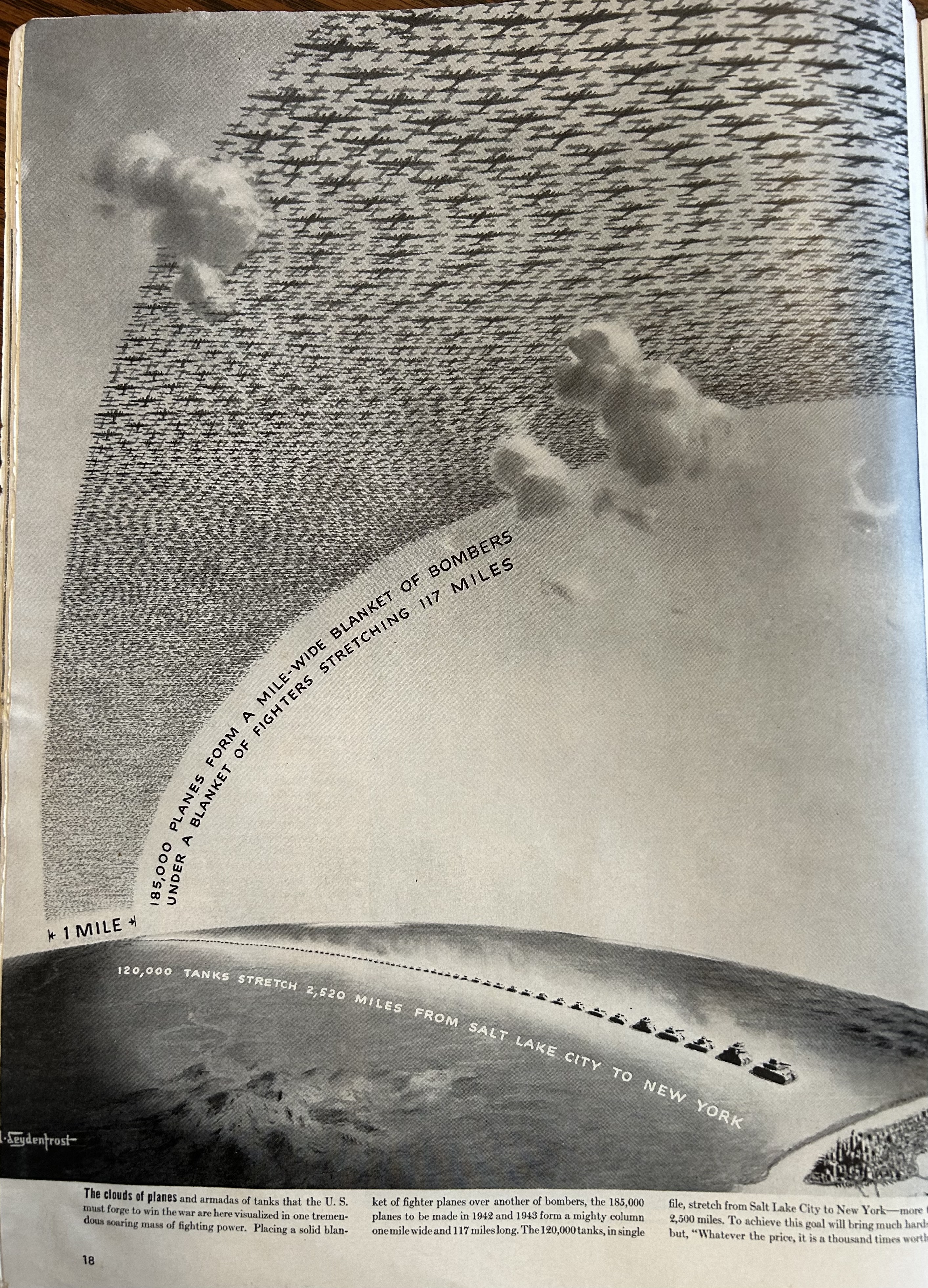
Life used full-page illustrations to give its readers an idea of the scope of U.S. war plans. The caption on one, shown above, reads: “The clouds of planes and armadas of tanks that the U.S. must forge to win the war are here visualized in one tremendous soaring mass of fighting power. Placing a solid blanket of fighter planes over another of bombers, the 185,000 planes to be made in 1942 and 1943 form a mighty column one mile wide and 117 miles long. The 120,000 tanks, in single file, stretch from Salt Lake City to New York – more than 2,500 miles.”
A dizzying, gray graphic crowded with tiny white specks takes up more than two-thirds of the facing page. It’s shown at left, with this line across the top: “There are 60,000 white dots in the square below, one for each of the airplanes that U.S. factories must produce during 1942.” If the same number of planes were lined up together, Life said, “they would blanket a field the size of Manhattan Island.”
The Life story, which carries no byline, continues:
This was the blueprint of victory that Americans had been eagerly waiting for ever since Pearl Harbor. The President followed it with words that reached every American heart. “We shall carry the attack to the enemy –we shall hit him and hit him again wherever and whenever we can reach him.” For the present, American armed forces will operate “in the Far East … on all the oceans … in the British Isles … in this hemisphere….” This was worldwide war. It would require not one new AEF [American Expeditionary Forces], but many.”
A full-page ad from the January 19, 1942, issue of Life: Oldsmobile touts its contribution to the war effort.
Roosevelt said the U.S. had to build 5,000 planes a month in 1942 and more than 10,000 a month the next year to give the Allies overwhelming superiority.
Life went on:
His figures were overwhelming, but they were not beyond the reach of a united, determined America. From government agencies, from scores of industrialists, from labor leaders, congressmen, editors and plain U.S. citizens came an immediate response: “We can do it; we will do it.”
They didn’t do it, not quite. By year’s end, 46,907 bombers, fighters and patrol craft had been built, or 78% of FDR’s goal. In 1943, the total was 84,853, or 68%.
If you haven’t seen the French film Joyeux Noël, which came out 19 years ago and was nominated for an Oscar, now’s a good time. It’s a fictionalized account of the First World War’s unofficial Christmas truce of 1914, when troops paused their fighting along parts of the Western Front and met in no-man’s land for short-lived good fellowship. French, British, Belgian and German soldiers participated.
There’s a Christmas Eve scene in the film in which Scots start singing in their trench, within earshot of the Germans. The tune, a Scottish carol written for the movie and titled “L’Hymne des Fraternisés/I’m Dreaming of Home,” touched a multitude of hearts. Two years later, it was sung when Queen Elizabeth II rededicated the Canadian National Vimy Memorial in France. More than 15,000 visitors heard it, a crowd size not seen there since the memorial’s unveiling in 1936.
The ceremony marked the 90th anniversary of the Battle of Vimy Ridge, in which Canadians fought Germans on a hill a hundred miles north of Paris. By the end of those four days in April 1917, the Canadians had forced the enemy to pull back. Their success came at a cost of nearly 3,600 killed and some 7,000 wounded. For our neighbors to the north, the hard-won victory at Vimy Ridge remains a source of great pride.
The carol that helped commemorate the place on April 9, 2007, still resonates. A YouTube video of the performance has been viewed several hundred thousand times. Produced by the Canadian Broadcasting Corporation, it’s my favorite version of “I’m Dreaming of Home,” other than what’s in the film, so I’ve shared the link with friends over the years. My Australian pen pal Jennie observed: “The music is soothing. The expressions on the faces of the veterans suggest hard memories. And the singers and musicians look like they feel the sadness. It is a very moving tribute.”
Now, finally, I’m sharing the video here with you.
The soloist is Inuit singer Susan Aglukark, an Officer of the Order of Canada. With her is the Canadian Forces Band and the Confederation Centre of the Arts Youth Chorus from Charlottetown, capital of Prince Edward Island.
I hear the mountain birds The sound of rivers singing A song I’ve often heard It flows through me now So clear and so loud I stand where I am And forever I’m dreaming of home I feel so alone, I’m dreaming of home
It’s carried in the air The breeze of early morning I see the land so fair My heart opens wide There’s sadness inside I stand where I am And forever I’m dreaming of home I feel so alone, I’m dreaming of home
This is no foreign sky I see no foreign light But far away am I From some peaceful land I’m longing to stand A hand in my hand … Forever I’m dreaming of home I feel so alone, I’m dreaming of home.
As the singing at the Vimy Memorial ends, a quartet of French Mirage jets thunders overhead.
Best wishes for the holidays and peace in the new year.
On this 83rd anniversary of the Japanese attack on Pearl Harbor, I’d like you to meet the Pearl Harbor survivors I’ve known and written about. All 13 of these servicemen lived in Pennsylvania, and all, sorry to say, are gone. Here’s my salute to them:
—
Jim Murdy lived in Allentown. He died in 2018. (Morning Call, 1999)
Navy electrician Jim Murdy was aboard the light cruiser Helena on December 7, 1941. The Helena was tied up alongside the minelayer Oglala in Pearl Harbor’s repair dock. Just before 8 a.m., an aerial torpedo passed underneath the Oglala and hit the Helena’s forward engine room. General quarters sounded, and Murdy hurried to his repair-party station. “What happened?” he asked an officer running past. “You damn fool, we’re being bombed by the Japanese!” “We are?” Murdy asked. “What the hell did we do to them?” After the attack, the captain addressed his crew. Here’s how Murdy remembered it: “The Helena‘s old man took the horn and announced, ‘Gentlemen, we had a rough time today. We had 35 men killed, and there’s 105 men put in the hospital, and there’s a number of those who are not going to survive. This is probably going to be a long war. And the one thing I will tell you is: Make your every move count. We will win! But make your every move count!'” From my interview with Murdy in the December 7, 1999, Morning Call of Allentown, Pennsylvania
John Minnich lived in Richmond Township, Berks County. He died in 2001, five days after I interviewed him. (Morning Call, 2001)
John Minnich was a truck driver with the Hawaiian Air Force at Wheeler Field. Explosions woke him. Dive bombers had hit the fighter base, and Zeros were screaming in. “About 50 of us from the transportation department started running across a field toward a little woods. We were like a pack of dogs, all scared and bunched together. I could see the Japanese pilots as their planes dived down and machine-gunned us. … The roar [of the Zeros] went right through me like an electric shock.” From my interview with Minnich in the December 7, 2001, Morning Call
Paul Moyer lived in Richland Township, Bucks County. He died in 2011. (Morning Call, 2002)
Paul Moyer was a private first class with the Army’s 21st Infantry Regiment at Schofield Barracks. After breakfast, he and two others left for a work detail that was to start at 8 a.m., but turned back when several Japanese planes flew overhead. “We stood there and watched them like idiots, until we saw the black smoke coming up from Wheeler Field. … We loaded up and got out of there, went to the Eucalyptus Forest to get ready for any kind of raid they might pull on us. A couple of days after the attack, we went to secure Kolekole Pass so the Japanese wouldn’t land troops at the big beach in back of it. … My dad received a telegram that I’d been killed in the Japanese attack. He didn’t know the truth for three months.” From my interview with Moyer in the December 7, 2002, Morning Call
Joe Moore lived in Allentown. He died in 2013. (Morning Call, 2005)
Joe Moore was a corporal and master gunner with the 98th Coast Artillery Regiment (Antiaircraft) at Upper Schofield, up a mountainside from the main Schofield barracks. “This one plane that had dropped his stuff at Wheeler came whoopin’ by with his machine guns running. He was low, just off the ground, strafing the area between our barracks and the one next door. You could see the dirt flying. … I was in the barracks when the island shook like it was having an earthquake. From the force of the jolting, I had a pretty good idea what had happened: A battleship was blowing up. Later that day, everybody knew what had happened to the USS Arizona.” From my interview with Moore in the December 7, 2005, Morning Call
Clifford Ryerson lived in Tannersville, Monroe County. He died in 2009. (Morning Call, 2006)
Clifford Ryerson was the navigator on the auxiliary minesweeper Tern, undergoing maintenance at the Navy’s 1010 dock across from Ford Island and Battleship Row. On December 7, Chief Quartermaster Ryerson and another sailor had the 4 to 8 a.m. watch. When the attack started, Ryerson saw planes flying “quite low” to torpedo the battleships. He fired at the enemy with the .45-caliber handgun he carried on his overnight watch. The Tern’s machine gunners opened up on an incoming plane. It crashed near the Officers Club – one of the 29 aircraft the Japanese lost that day. From my interview with Ryerson and his son and daughterin the December 7, 2006, Morning Call
Warren Peters lived in Catasauqua. He died in 2011. (Morning Call, 2008)
Warren Peters was a private first class in the Army’s 15th Coast Artillery at Fort Weaver, at the western entrance to Pearl Harbor. “There was an outfit right near us, and they had 3-inch antiaircraft guns. They were making all kinds of racket, and we were moaning the blues and all that: ‘Oh, it’s a Sunday morning, give us a break!’ That night, long after the attack, all of the men were at their guns. Several planes dropped flares to see where the landing fields were. “And when they did that, one big umbrella of fire went up from our antiaircraft guns — everybody firing at the planes from different angles. … Our gunners shot them all down. They were our own planes.” From my interview with Peters in theDecember 7, 2008, Morning Call
Alfred Taglang lived in Allentown. He died in 2011. (Morning Call, 2009)
Alfred Taglang was an Army supply sergeant in a Coast Artillery gun battery at Fort Kamehameha near the Hickam Field bomber base and Pearl Harbor. After shooting hoops that Sunday morning, he and a friend headed for 8 a.m. Mass. The attack began just as they got to the church. Low-flying enemy planes fired at the pair as they raced back to their quarters. “I saw dirt flying up from the bullets hitting the ground maybe 10 yards away.” He hurried to his 90-millimeter gun at Battery C. “My job was handing shells to the guy who loaded them into the gun. … We waited for our ammunition to come so we could join in the fight. Waited and waited and waited. … Our shells never arrived.” From my interview with Taglang in the December 7, 2009, Morning Call
Burdell Hontz lived in Bangor. He died in 2016. (Morning Call, 2010)
Burdell Hontz was an Army Air Corps corporal who worked in the message center of a B-17 bomber unit, the 11th Bombardment Group, at Hickam Field. He spoke of a friendly fire episode that happened after the Japanese attack got underway. “There was a group of fresh B-17s coming in from California. I could see them coming in for a landing, and these guys with rifles were shooting at them, and I yelled, ‘What the hell are you doing? Can’t you see they’re our planes?’ ” When Hontz had gotten up that morning, he decided to make his bed before going to breakfast, a task he didn’t ordinarily do. A bomb landed on the mess hall, killing 35 men. “I tell people I could have been a statistic, too, if I’d gone to breakfast. Thank God, I was making my bed.” From my interview with Hontz in the December 7, 2010, Morning Call
World War II radar men (from left) Joe Lockard, Bob McKenney and Dick Schimmel. Lockard lived in Lower Paxton Township, Dauphin County, and died in 2012. McKenney lived in Allentown. He died in 2013. Schimmel also lived in Allentown. He died last February. (Morning Call, 2011)
Joe Lockard, Bob McKenney and Dick Schimmel all were in the Army Signal Corps Aircraft Warning Service on Oahu. Privates Lockard and McKenney worked at the Opana mobile radar station on the island’s northern tip. McKenney said he and Lockard “were the only experienced so-called crew chiefs there.” Schimmel, a private first class, was a plotter and switchboard operator at Fort Shafter, where an information center linked the island’s five radar sites.
Lockard
Lockard lost a coin toss to McKenney and had to supervise the early shift at Opana. At 7:02 a.m., he and his partner, George Elliott, saw “a huge echo” on the oscilloscope, 136 miles out and closing fast. In a call that would put Lockard in the history books, he told Air Corps Lieutenant Kermit Tyler at the info center “we had never seen anything like this on radar, and that it obviously had to be planes.” Tyler said, “Don’t worry about it.”
McKenney
Schimmel
Switchboard operator Joseph McDonald, feeling uneasy about what he had heard from the Opana site, went to the tent he shared with Schimmel, woke him and said, “Hey Shim, the Japs are coming.” Schimmel asked him to explain. “We were sitting there talking for a while,” Schimmel told me, “and all of a sudden BOOM! Here we thought the Navy was having a sham battle. Where we were situated, on a high plateau, we could look over and see Pearl Harbor. We ran out of the tent. We’d see a plane dive, hear an explosion and see smoke.” He and McDonald got up on the mess hall roof for a better view, then got their gear and ran to the info center to man the switchboard and plotting board.
Up north, the truck carrying Lockard and Elliott back to camp at Kawailoa passed one taking McKenney and others to Opana. “They were waving and shouting at us,” Lockard said, “but we couldn’t understand what they were saying. … When we got to Kawailoa, they told us we had been attacked. We knew immediately that what we had seen were those planes.” From my story in the Sunday, December 4, 2011, Morning Call
Bob Kroner lived in Hanover Township, Northampton County. He died in 2016. ( Morning Call, 2012)
Bob Kroner was a staff sergeant in the Army Signal Corps who led a team of cipherers in the Hickam Field control center. “We ran across the street to this building where three or four guys were working. … There were a lot of bombs dropping all around us. The guys were sending an SOS [by radio telegraph]. The message was in plain English: ‘SOS: Japs attacking Oahu.’ I sat down and started sending the SOS with the other guys. We kept sending it and sending it and sending it, hoping it would be picked up by the right people. All of a sudden, a bomb hit close to where I was. … Somebody yelled ‘Gas!’” Kroner hid in a back room, but there wasn’t any gas. He went back to sending the SOS. From my interview with Kroner in the December 7, 2012, Morning Call
Gary Runey lived in Emmaus. He died in 2018. (Morning Call, 2015)
Gary Runey was an Army Air Corps future pilot stationed at Wheeler Field, where he taxied and maintained P-36 and P-40 fighters. He went to mechanic school at Hickam Field and was later moved to a tent area on the base’s perimeter. After guard duty until 6 a.m. December 7, he went to sleep and didn’t awake until the battleship Arizona blew up. “Three Zeros came to attack us. They were low down on the ground, maybe 20 feet up, going maybe 135 miles an hour and strafing. One went by, I could actually see the pilot clearly in his goggles.” No one was hurt, Runey said. Hours later, he saw a big truck on the access road to Hickam. “It was piled with bodies that they were taking out to a mortuary. It was pretty gruesome.” From my interview with Runey in the December 7, 2015, Morning Call
While wandering around Europe many years ago, I met a fellow lone traveler at a drizzly train station in Bavaria — an Australian named Jennie.
Two strangers, we rode together to Innsbruck, Austria, and strolled along the Inn River. We met for breakfast the next morning, and after exchanging addresses, said goodbye and went our separate ways.
We haven’t seen or spoken with each other since that day in October 1983 but have stayed in touch through letters and email. Last week she sent me a link to a music video featuring the Australian country singer Lee Kernaghan. The song is called “Spirit of the Anzacs,” the title track of his chart-topping 2015 album about duty, sacrifice and courage.
It’s a spirit, Jennie says, that seems to be needed now.
Kernaghan’s inspiration came from the Australian War Memorial, where he saw letters written by servicemen and women as far back as the Gallipoli campaign of the First World War. Here, I’m sharing his video tribute to the men and women of the Australian and New Zealand Army Corps. I hope it will touch your heart as it did mine.
World War II veteran Matt Gutman died last Thursday, November 7, at his apartment in Allentown, Pennsylvania. He was 99. I wrote a story about his passing for my old employer, The Morning Call. For you, I’m sharing a partial transcript of my August 18, 2022, interview with him. Here, he tells about joining the Navy in 1943 and heading for the fight against Japan.
I didn’t want to be trapped in the Army or Marines.
When I was in junior high school, my brother who was in the Navy gave me one of these sea caps, and I used to wear it to school. I sort of liked the Navy because, first of all, I wanted to have good, warm chow and a bunk to sleep in, not a mud hole. … And that’s why I chose the Navy.
I enlisted at the Navy recruiting station in Allentown. … I wanted to go into the Seabees originally, [so] I talked to the chief Seabee, and he says, “What’s your occupation? What did you do?” I said, “No, I just come out of high school. I had basic electric.” He said, “Look, son, go next door. Talk to the Navy recruiter. We can’t be teaching you. We want people that are already trained.” So then I went next door to the chief of the Navy, and he enlisted me.
Then I went to Sampson, New York, for seven weeks of basic training. There was 106 of us. We trained together, marched together, ate together, everything together as a unit, and then, of course, graduated and then were given a seven-day leave to go and visit our parents, our friends. After seven days, we had to report back to Sampson for fleet assignment.
Gutman left Allentown High School in 1943 to sign up, and served in the Naval Amphibious Forces.
They sent me with a group of others by train down to Camp Bradford, Virginia, for amphibious training. First of all, I didn’t know what it would entail. … I knew it was land and sea. This was something new. When we got down there, they showed us all the different types of ships they used for invading an island, went over every one of them. They also told us about what to expect on those ships, and they told us these ships were made only to invade an island. That’s why they called them amphibious. They carried troops and tanks to invade an island.
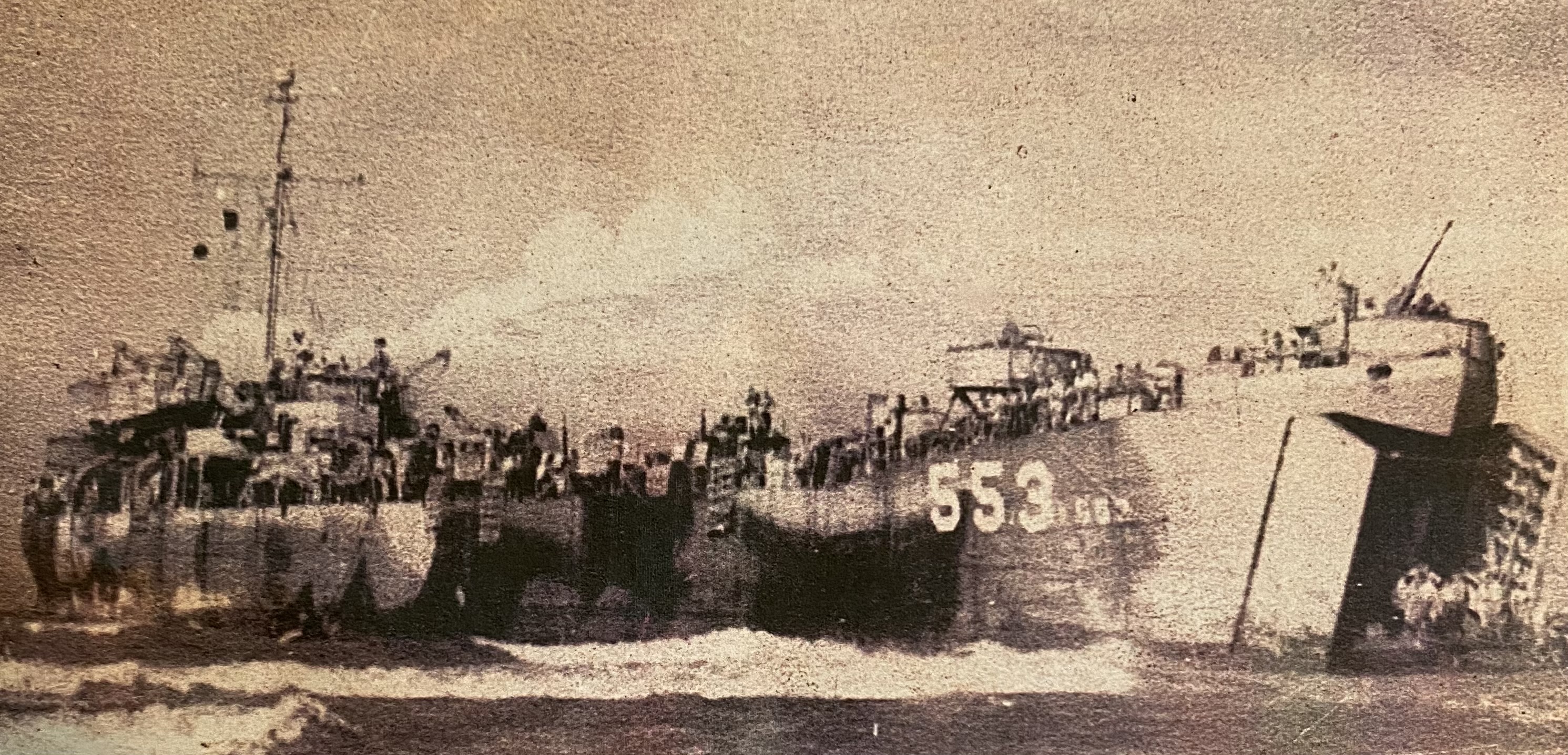
That was the main purpose of the ship that I was assigned on. It was called a landing ship, tank, an LST, and they were all numbered. They never had no names. Mine was 553. I was with it all through the war. It was camouflaged brown and green. You know why? Because when we boarded that ship in Evansville, Indiana, where it was built, we seen that ship was all in tropical colors. Tropical! We knew right then and there that ship was going to be assigned to the Pacific Theater, not European, because once that ship beaches, it blends with the foliage on that island.
They taught me how to operate the Higgins boat, and I was in charge of the Higgins boat on our ship when we made the landings. I was a seaman first class then. I don’t know why I was picked, but they came and asked me if I’d like to do that, and I said, “Why not? I’m in the Navy, I’ll do what I can.” And I operated that landing craft all through my landings in the Pacific. …
Gutman’s LST, a landing ship, tank
After they trained me, I went to San Pedro [in Los Angeles] and Hawaii, I used that boat a lot to take people to shore, back and forth. So I was trained all along with it, you know what I mean? It only had one propeller. You had to watch the wind and currents. Well anyway, they trained me pretty well.
We only had two Higgins boats on our ship, one to starboard and one on the port side. I had the one on the port side. [As coxswain] I was in the stern. I always had to watch where I was going. These Marines and Army men we had in there, they’re all hunkered down. I had to see where I’m going, you know. I had to stand because I wanted to see where I was going, because the bow doors were up pretty high. It had a diesel engine, very noisy, and it always smelled awful. But we were young guys, we could take it. We were all young, full of piss and vinegar, and no brains.
Getting smooched by The Magnolia Sadies, a vintage dance troupe, on May 8 at a V-E Day picnic honoring World War II veterans in Macungie Memorial Park
They shipped a crew of us to Evansville, Indiana, where we picked up our ship. It was built there, right alongside the Ohio River. We boarded that ship in April 1944. The skipper took her down the Ohio River, the Mississippi River to New Orleans. That’s when the ship was commissioned. We stayed in New Orleans for four days, taking on supplies – water, fuel. Then we headed back down the Mississippi to the Gulf of Mexico.
While in the gulf, the skipper put the ship through what is called a shakedown cruise. A shakedown cruise consists of testing all the components of that ship – the navigation equipment, all the guns were working properly, checking out the fire system we had, the fire hoses, check everything to see that that ship was ready for combat. From there we went to Panama City, Florida, where they taught us how to distinguish all types of shipboard fires we might encounter in combat. We were there about four days.
From there, we went to Gulfport, Mississippi. We were there to pick up creosote pilings. They were large logs, about 18 foot long and 2 foot wide. We wondered, what the hell is this gonna be? They loaded them on our tank deck. We went through the gulf and the Panama Canal with about seven other LST’s. And we we went up along the coast to San Diego, 108 men and eight officers. … We enjoyed liberty there. We were there maybe three or four days. We took on more supplies. We also took on a contingent of Seabees.
We left San Diego with a fleet of ships going due west. The skipper was on the P.A. system and he said, “We are now heading for Pearl Harbor.”
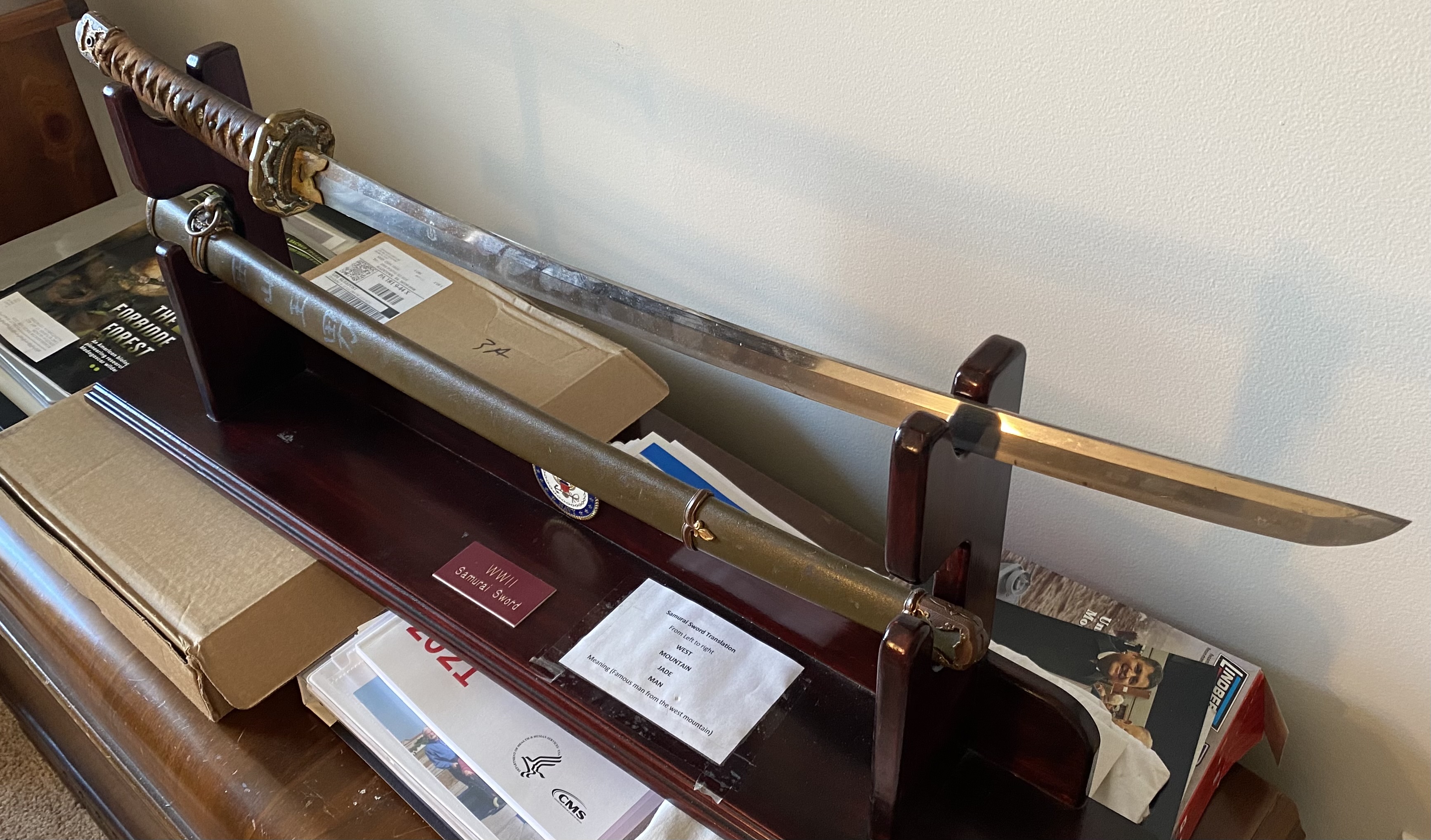
A sword and scabbard Gutman took from a Japanese officer after the surrender. ‘Sir, you will not need this any longer,’ he told the man while helping to disarm enemy troops on a Pacific island.
When we entered Pearl Harbor, we could still see a lot of the destruction that took place when they [the Japanese] bombed that harbor. We then found out that these creosote pilings, along with the Seabees, were brought there to repair the docks and ships that were destroyed in the bombings. We were there maybe about a week. We enjoyed liberty. A lot of guys got drunk, got pie-eyed. I think I had a couple of beers. We had a lot of fun. I guess the skipper wanted us to have fun.
We knew from there, God only knows where we’re gonna go.
In September 1944, Gutman landed Marines on Peleliu in his Higgins boat under fire. He went on to take troops ashore at four sites in the Philippines and at Okinawa. At war’s end, he and some others on his LST volunteered to sweep pressure mines that U.S. planes had dropped in Japanese harbors. For “the personal danger involved,” he was awarded a Navy Commendation Medal. Back home, he had active duty in the Reserve as an instructor and recruiter, retiring in 1967 as a chief petty officer.
He was more than a distinguished veteran and the subject of several stories I wrote for the newspaper over the past few years. He was my friend.
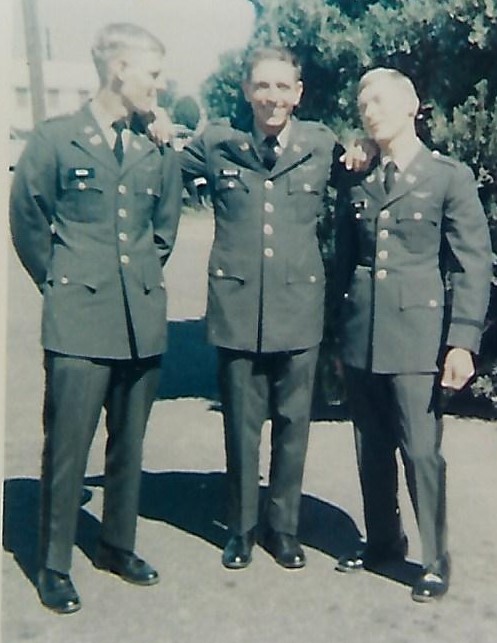
Nicky Venditti (center) with pals Skip Smith (left) and Tony Viall after they won their wings June 3, 1969, at Fort Rucker, Alabama, home of the Army Aviation School.
Ten years before my cousin Nicky joined the Army, his parents divorced. Both remarried and continued to live in or near his hometown of Malvern, Pennsylvania.
I wrote in an earlier blog about the letters Nicky sent his dad, Louie Venditti, and stepmom, Bert, from Vietnam. I had the originals, now archived at the Center for American War Letters. (Louie and an older brother spelled their last name with an “i” at the end. My dad and the other siblings ended it with an “a.”)
Today I’m sharing letters Nicky sent his mother, Sally Pusey — I have copies of them — and one he sent our cousin Mike Beam, who gave me the original in 1997.
From Fort Polk, Louisiana, where Nicky was completing boot camp, he wrote to Sally and his stepsister, Bonnie Pusey. The daughter of John Pusey, Bonnie was four years younger than Nicky, who turned 20 in November 1968.
August 25, 1968
Dear Bonnie & Mom,
Nicky (foreground) in the Fort Polk graduation book, August 1968. At right is Billy Vachon, whose fate was tied to Nicky’s.
Well here is the letter I promised you. I know, it’s about time, right? Well maybe I’ll be home in a week or so, I hope. Just keep your fingers crossed, OK?…
Well it is hot as h— down here. You can barely stand it about noon time. It’s not like Penna. at all. They work us hard all day and a work day in the Army is about sixteen hours!
Did you lose your freckles yet, foam mouth? I’m only kidding you like I used to always do. You’re a cute girl.
Well I gotta go wash my clothes. I’ll see you in about ten days (I hope). Take care and tell everyone I said hello, OK? Bye!
Love, Nicky
—
He went on to Army Primary Helicopter School at Fort Wolters, Texas, and wrote this undated letter in which he asked about his girlfriend and future fiance, Terri Pezick:
Sally with baby Nicky, 1948
Dear Mom,
I got your letter today. It sure was nice of you to send me that check. But there is nowhere at all where I can cash it. We are restricted to company area and will be for about two months! So I’m sending it back. It was sweet of you though. You’re the only one who has sent me money for a month. But remember, Mom, if you need it, don’t send it.
Well I start flying in one week if I can cut the cake at school this week. We are having weather this week and it is very hard to learn. Last semester, half of the class failed it!!
I just bumped my head on my locker about ten minutes ago. I was stooping and got up, but I forgot I left the door open. It just about knocked me out. That’s the worst thing that has ever happened to me here. Ha!
Nicky with Terri Pezick
So Terri is being good. Well I sure don’t get as many letters from her as I used to. That’s the breaks! I’ll take care of everything Christmas. I’m giving her an engagement ring Christmas (I think). I think I’ve been going with her long enough now. And I think she is the one. Wonder how much a good one will cost. I don’t know yet when I’m getting married. It all depends on when and how my future career goes. Especially here at school. And on her!
How’s John doing? Tell him after I get back from Viet Nam, we’ll fly up the mountains. And that’s a promise if I can make it through this school!
Well write again, Mom. And take care of yourself. Don’t work too hard. If you ever get in a jam and need money and can’t work or get it, write me and I’ll see what I can do, OK?
Take care and write soon, Love, Nicky
P.S. The nuns at Immaculata are praying for me, so I’ll make it!
—
Nicky’s training at Fort Wolters ended January 31, 1969. He was off to Army Aviation School at Fort Rucker, Alabama, where he learned to fly Hueys. He wrote this letter to our cousin Mike, a Marine reservist in aircraft maintenance who would be getting married the following May:
First page of Nicky’s February 1969 letter to our cousin Mike Beam. Nicky’s dad and my dad, Carmine, were brothers. Mike is a son of their sister Josephine.
Feb. 25, 1969
Dear Mike,
I got your letter the other [day] and decided I’d better write you one. When am I going to get my bars? Well I’ll probably never get them. This stuff is so hard and I’m so dumb, I’ll probably get kicked out. If I do make it, I’ll get them around June 7th. …
If you think I’m becoming an alcoholic, well you’re right. That’s all I do here is drink. There’s nothing else to do. I was thinking about buying a car. I doubt it though because I’ll be in Nam by July. …
No, I don’t get much shooting in. In fact, none at all yet. I get to shoot that .270 [Winchester] of yours when I get home though. Maybe I’ll get a hog [groundhog]? That’s if you don’t kill them all by then….
Maybe one of these days I’ll get home again. I almost forgot what it looks like!! I might sneak home for a weekend. It will cost me like hell, but at least I’ll get to come home.
Well it’s 7:00 now. Bedtime in three hours, up at 4:30. At 6:45 I’m in the air, trying to learn how to fly those damn instruments. I doubt if I’ll ever learn. So write back when you get a chance. Tell your future wife I said hello.
Nick
—
In an undated letter from Fort Rucker, he wrote:
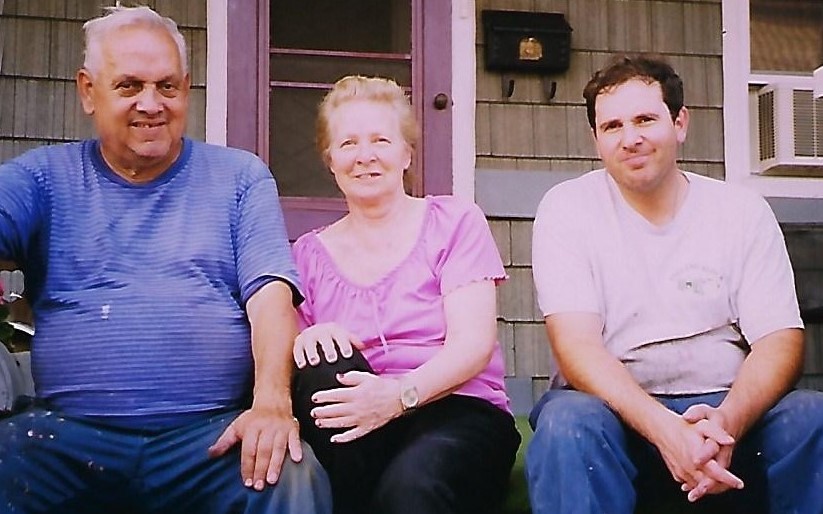
Nicky’s stepdad John Pusey, mom Sally and brother L.B. at their home in Malvern, 1998
Dear Mom,
This place down here is driving me crazy. It’s twice as hard as I thought it would be. We are on VOR, ADF, radio navigation, etc. now. But I doubt if you know what I’m talking about. Don’t feel alone. I don’t either. We fly from 7:00 to 12:00 noon, then have classes from 1:30 till 5:30. What do you think of that schedule? Ugh! Hard as hell!
Well if I didn’t make it, at least I can say I tried, right?…
Well I’ll write again as soon as I can. Take care. I hope to see you all before I either finish or get kicked out. So take care and tell everyone I said hello.
Love, Nicky
(VOR stands for very high frequency omnidirectional range. ADF stands for automatic direction finder.)
—
In another letter from Fort Rucker, on March 5, 1969, he wrote to his mom:
Did you get the picture of the instrument panel? I’ll bet you can tell me what everything is and just how it works too, can’t you? Well if you can, maybe you can show me!!! … You know the longer I’m here, the more I wonder whether I want to be an Army pilot or not. I don’t think I’ll get a kick out of signing up for three more years, plus flying around while someone shoots at me. But I went twenty-four weeks now, so I might as well finish. That’s if I can make it. We start advanced instruments Monday. That is going to be real hard. I only have twelve weeks left. Then a leave, then away again for a year. …
The place is so dull. I’m still thinking about buying a car, but that costs money. I ordered my dress blue officer’s uniform a few days ago. You should see it. Man, is it sharp.
It’s about 2:00 now. I guess about 4:30 I’ll go drink some beer. That’s when the WOC Lounge opens up. That’s all there is to do around here – drink….
Love, Nicky
(WOC stands for warrant officer candidate. And Nicky did come up with the money for a car, a pea green 1968 Camaro SS.)
—
Postcard Nicky sent his mom from Japan on July 4, 1969, on his way to South Vietnam’s Cam Ranh Bay
On a postcard dated July 4, 1969, he told his mother that “I just arrived in Japan. We have an hour stop here before we leave for Nam. I’ll send you my address as soon as I can. So take care, I’ll write soon.”
—
He sent his last letter to Sally while going through a week-long orientation on the Americal Division base at Chu Lai.
July 7, 1969
Dear Mom,
How is everything at home? Fine I hope. Everything is fine here. It’s hot as hell, but what can you do.
I got assigned to the Americal Division near Chu Lai. That’s in the northern part of South Vietnam. I don’t have a mailing address yet because I’m not at my permanent unit. So don’t use the address on the envelope to mail me letters or I’ll never get them, OK? Remember, don’t use the return address on the front. I’ll send you my mailing address as soon as I can.
Mom, this place is lousy. I can’t even see why we are here because Viet Nam isn’t worth a nickel. But I guess they know why we are here.
So how is everyone at home? Tell John I was asking about him….
Well I’m going to sign off for now so I can mail this before the mail goes out. Don’t worry about me, I’m fine. Take care, I’ll write again soon.
Love, Nicky
—
LZ Bayonet in 1969: The building behind these two GI’s is where an accidental grenade blast fatally injured Nicky and Billy Vachon, and wounded Tony Viall and a fourth helicopter pilot, Tom Sled. All knew one another and were sitting at the same table. Nicky and Billy died in the ICU at Chu Lai’s 312th Evacuation Hospital. One other soldier died from the blast, an engineer named Tim Williams, who was killed instantly.
Three days later, on July 10, Nicky and a few dozen other new arrivals were in a class on grenade safety at LZ Bayonet, just off the Chu Lai base. The instructor, a sergeant, unwittingly set off a live grenade. Critically injured, Nicky was flown by helicopter to a nearby surgical hospital, where his left leg was amputated below the knee. He was moved to the intensive care unit at Chu Lai’s evacuation hospital, where he died at 4:15 p.m. July 15.



























 David Venditta