One Marine’s story that will never die

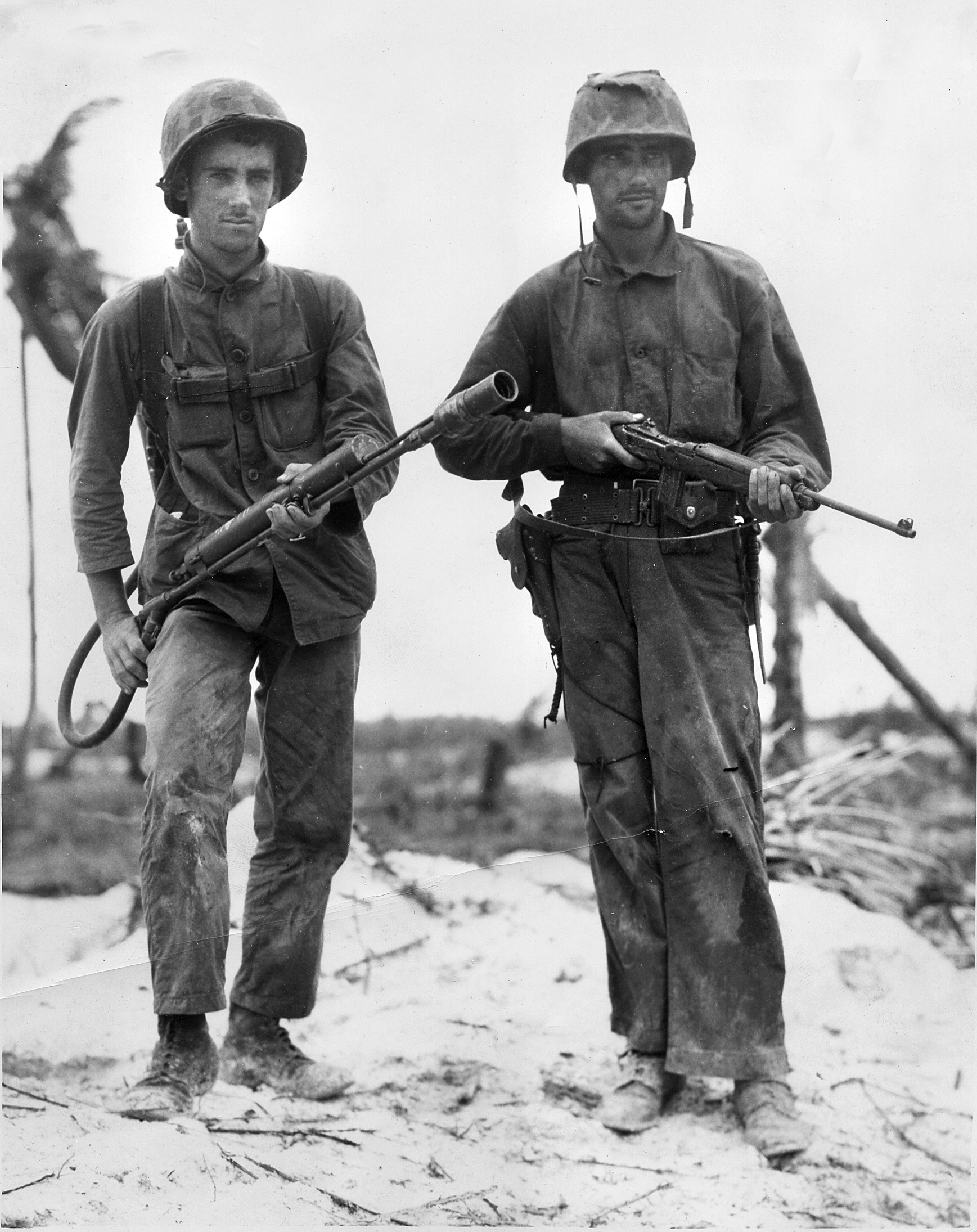
Marine Pfc. Stanley A. Parks (left), with Randolph Peters

Marine Pfc. Stanley A. Parks, then of Allentown, holds a flamethrower on Peleliu. Randolph Peters carries a .30-caliber carbine.

Everyone from the folks at the Library of Congress Veterans History Project to the National World War II Museum will tell you how important it is to get a veteran’s story before it’s too late.

That point was driven home last Friday at the memorial service for Stanley A. Parks of Emmaus, a Marine Corps veteran who wielded a flamethrower against the Japanese on Peleliu and Okinawa. Stan died Dec. 19, five weeks after my story on his World War II experiences ran in The Morning Call.   

When family and friends entered Bethany United Methodist Church in Wescosville to celebrate Stan’s life, one of the mementos they saw was a framed portrait of him that Morning Call photographer Harry Fisher had taken. It had appeared on Page 1 with the Veterans Day story. In the photo, Stan is wearing his Marine jacket and cap, and holding a bugle he had taken from a dead Japanese soldier on Peleliu.

Harry’s photo on display was a reminder that getting Stan’s story into the newspaper and online had been the right thing to do.

It almost didn’t happen.

I found out about Stan last April from his brother Don in Allentown, who told me a little about him in a letter. He enclosed some old newspaper clippings about Stan’s exploits in the Pacific, including a photo of 18-year-old Pfc. Parks holding a flamethrower on the beach at Peleliu. There was also a column done 15 years ago by The Morning Call’s Jim Kelly, who wrote about Stan and his three brothers who fought in the war.

“It would be a great interview, I assure you,” Don wrote.

I believed him. For one thing, few World War II Marines had opened up to me. Most didn’t want to bring back the terrible memories. If Stan were willing to talk, I could get a rare, personal insight into the bloody trial of island fighting – something millions of TV viewers had seen dramatized on the HBO series “The Pacific.”    

By coincidence, a month after I heard from Don Parks, I got an e-mail from one of Stan’s neighbors. He, too, recommended I do a story on Stan.

I told Don I’d like to interview his brother for Veterans Day, Nov. 11, more than six months away. It was a gamble, given that the youngest WWII vets are in their mid 80s. But Stan was doing all right. In September, when I was ready to start interviewing him, Don told me the bad news: His brother had just been diagnosed with Stage 4 esophageal cancer and might not want to talk now.

Had I blown my chance?

No, Stan did want to talk. We met the first time on Sept. 24 at his home. I got his story on my Sony digital recorder. Three days later he was in the hospital for a stay that lasted two-and-a-half weeks. On Oct. 8, I called him in his Lehigh Valley Hospital room and wished him a happy 85th birthday.

We met again at his home on Oct. 21, and Harry joined us to take still photos and re-interview Stan on video.

We’ve been shooting video for the War Stories: In Their Own Words series for years. It’s an online extra for readers. They can get on The Morning Call’s website and read the story, and also, with the click of a mouse, see and hear the vet talking about his experiences for several minutes. I’ve blogged before that the video re-interviews have been a great tool for me, like magic, because the vets often say things in front of a camera that they didn’t tell me earlier, or in a way that improves the story.

The Web is useful for another reason. I had to cut Stan’s story for the print version because of space limitations, but the longer account, with more anecdotes, was posted on the Internet, where story length isn’t an issue. As with all the tales in my series, Stan’s has a permanent home on the site. You can read it at http://articles.mcall.com/2010-11-10/news/mc-veterans-day-war-story-parks-20101110_1_machine-gun-peleliu-foxhole Harry’s 2-minute, 15-second video, which includes historic photos, is on the War Stories home page at http://www.mcall.com/news/local/warstories/

A week after the photo and video shoot, I stopped by Stan’s home and dropped off photos he had lent me to get scanned in at the paper, including the shot of him with the flamethrower on Peleliu. It was the last time I saw him. I did go to his house again, on Nov. 11 when his story ran, to drop off a few dozen extra papers. He and his wife, Barbara, weren’t home. I left the papers on the porch.

Harry and I were shocked to hear of Stan’s death so soon after we had spent time with him. He had seemed OK then. But his condition had deteriorated rapidly.

At the memorial service, his family showed Harry’s video. I’m guessing about 200 people watched it on the church’s big screen. Later, in his eulogy, Pastor Jim Brashear said seeing the video gave him goose bumps. God, he noted, uses people like Stan to give us our freedom.

We all bowed our heads as the pastor said a prayer. One of the blessings he thanked God for was the video, an enduring testament to Stan’s service in the war.

I have often felt affirmation for our work in recording veterans’ stories. As I sat in the church Friday and a bagpiper played the “Marines’ Hymn,” I felt it yet again – intimately. Stan is gone, but his story will live on. Harry and I had done a meaningful service not only for this proud Marine’s family and friends, but for future generations.

Two sailors’ links to Makin Island and the Lehigh Valley

Linda Handley and Hank Kudzik

Linda Handley, command master chief of the USS Makin Island, and World War II submariner Hank Kudzik aboard the ship on Dec. 2, 2010, in San Diego.

It’s always a treat to see people making connections. One of those gratifying link-ups involved a World War II veteran I wrote about last year.

Picture this: A submariner from Bethlehem participates in a dangerous mission against the Japanese. Sixty-seven years later, the Navy commissions a new ship and names it after the mission. A woman from Allentown has a leadership position aboard the ship. A year later, when she retires from the Navy, she has the old sailor from the Lehigh Valley as her guest at the ceremony.

The submariner is Hank Kudzik, now 86 and living in Allen Township. He served aboard the USS Nautilus in the Battle of Midway and on the August 1942 raid against Japanese-held Makin Island in the Pacific’s Gilbert Islands.

In October 2009, Kudzik was an honored guest at the commissioning of the amphibious assault ship USS Makin Island in San Diego. He was the only Nautilus crewman present, but he was joined by six Marine veterans who were on the Makin Island raid under Lt. Col. Evans Carlson. (In 1943, Hollywood made a movie about the raid, “Gung Ho!” starring Randolph Scott.) Kudzik met Linda Handley, an enlisted officer on the Makin Island.

Soon after the commissioning, I got a call from Hank’s daughter Renae Behrens, who told me about her dad’s service and his trip to San Diego. I got in touch with Hank and started interviewing him at his home. I hadn’t done a submariner’s story since 1999, when I wrote about Robert Holden of Whitehall Township, who served on the USS Finback, which rescued future President George H.W. Bush when his Avenger torpedo bomber was shot down. http://www.mcall.com/news/warstories/all-robertholden,0,2164204.story

My story on Hank ran in April 2010 to mark the 110th anniversary of the submarine force. Here’s the link:  http://www.mcall.com/news/local/all-5kudzik.7185625apr05,0,7508994.story

Linda, the command master chief of the USS Makin Island, was a 1975 graduate of Allen High School and her parents live in Lehigh Township. One day she came to visit Hank and invited him to her retirement ceremony. He gladly accepted. The event was held on board the ship Dec. 2 in San Diego. A short item I wrote about it appeared in The Morning Call last Friday, with a photo of Linda.

It was Hank’s second visit to the ship named after the fiery mission he had participated in.

“They’re getting to know me out there,” he said last week. “They treat me pretty good.”

Hank will be the speaker at the next meeting of the Lehigh Valley Veterans History Project Roundtable.  That’s at 7 p.m. Thursday, Jan. 27, at the Lehigh County Senior Center, 1633 Elm St., Allentown.  For more info: http://www.lvveteranshistory.org/

A friend in the RAF: ‘Without the Yanks, we had no chance’

Basil Moslin of Manchester, England, who served in the Royal Air Force Bomber Command

I’d like to tell you about a friend of mine, a World War II veteran I never met, never spoke with, never wrote about – until now.

Basil Moslin first got in touch with me in August 2001. He was writing from his home in Manchester, England. During the war, he served with the Royal Air Force Bomber Command.

I had placed a query in the Intercom, the magazine of the Aircrew Association of British war veterans, seeking information about an Allentown flier in the Royal Canadian Air Force who was killed in a training accident in England in 1942.

Basil had been based near where the accident happened, and suggested I try an RAF station that he knew had computerized records.

“I am a life member of Bomber Command, so if I can help in any other direction, let me know,” Basil wrote. “This is my first letter on the computer, and I have enjoyed having a go.”

He got pretty good on the computer.

That first snail-mailed letter opened a rich correspondence between us that lasted almost a decade. In dozens of chatty letters, he told me about his family and his cat, about playing badminton to keep fit and teaching piano and playing it in clubs and hotels.

He wrote about the RAF and sent copies of the Bomber Command Association newsletter. He harped about political foibles in his homeland, supported the U.S. war on terror and answered my questions about his life – he made his living in the insurance business. He asked about my wife and stepdaughters and signed his letters, “Cheers for now — Bas.”

In return, I sent him copies of articles in my series War Stories: In Their Own Words that runs in The Morning Call. I call them clips; he called them “cuttings.” He’d comment on the stories in his next letter — always marveling at “the Yanks” I interviewed and once calling me a “clever bugger” — and then pass the cuttings on to his friends.

“I love to hear things concerning the war,” he wrote to me. “I was stationed with your boys for some time…. I really enjoyed being with the Yanks in those days. We used to have doughnuts and coffee in Antwerp for nine francs. Never tasted anything as good since.”       

Basil worked in the building trade before he was called to duty at age 19 and joined the RAF. But a physical impairment kept him from flying. The circumstance led him to meet the girl he would marry, Esme, who was in the Women’s Auxiliary Air Force.

“I joined the RAF in 1942. When Singapore fell, and losing so many men, they just rushed recruits in. I was called and told to report as wireless operator, without a proper medical. However, when things settled down, we had first-class medical, and they found a perforated eardrum and that was curtains. I was remustered as clerk, but it paid off in meeting my good lady. She was a wireless operator at the camp of the Enigma secret establishment, Bletchley Park. It was so hush-hush, I was stationed next door and didn’t know it was there.”

When I asked Basil if I could write about him, he declined. He didn’t want to talk at length about his war memories.

“I would love to tell you about my service life, but I find it too upsetting. Such lovely young men. One handsome pal of mine starved to death in Japan. Another was blown to bits on the battleship Hood…. One excellent navigator went down in the North Sea in a Lancaster – no known grave…. I lost a fine friend called up at the same time as myself, out to Singapore, died on the railway. … Please excuse me, I’m filling up. I can’t help being a softy.”

He always gave credit to the Americans for their role in the Allied effort.

“I tell everyone: Without the Yanks, we had no chance. We would have lost the war.”

And he told me this little story about the Battle of the Bulge that showed British confidence in the American fighting man:

“When I was in Belgium in ’44, the phone rang to say: ‘Get everyone out. The Germans have broken through in the Ardennes.’ Well, after changing my underpants, another phone call said, ‘Get back, the army are on the job,’ meaning you guys again!”

Last summer I got a letter from Basil’s daughter, Susan, who lives in Italy but was writing from Manchester. Her father suffered a stroke in July, and he was in the hospital and about to start physiotherapy. I wrote him a long letter but never heard back.

Susan e-mailed me last week to say her dad died Dec. 24, three days after doctors discovered a large tumor in his lung. He was 88.

Like many World War II veterans, Basil had mourned the friends he lost but always felt a great sense of accomplishment about the defeat of Germany and Japan.

“Although I lost most of my pals,” he wrote to me once, “I was proud to have been part of the conflict. Didn’t we do well!”

Where war stories and Bethlehem Steel meet

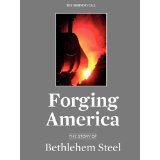
The Morning Call's narrative history of Bethlehem Steel

 One of my favorite chapters in Forging America: The Story of Bethlehem Steel is the one about the company’s tremendous role in World War II. As project editor and one of the writers for The Morning Call book, I was able to weave in the experience I gained from my series, War Stories: In Their Own Words.

Thousands of World War II veterans had worked for the steel giant in south Bethlehem. I focused on one of them, John C. Umlauf. He came from Schuylkill County, graduated from Muhlenberg College in Allentown and worked in Steel’s press forge shop with his brother in 1940. They made 18-inch-thick armor plate and 40-foot-long gun jackets for warships.

After America entered the war, Umlauf joined the Navy and became an officer. On D-Day, he helped command a gunboat that fired on the German defenses on Utah Beach. http://www.mcall.com/news/warstories/all-johnumlauf,0,632655.story

He was 84 when I interviewed him early in 2003 at his home in west Allentown for a story that would run on the D-Day anniversary that year. At the same time, I was working on Forging America, which would come out as a tabloid insert in a Sunday paper at the end of the year, marking Bethlehem Steel’s collapse after nearly a century of steelmaking.

Umlauf’s intimate connection with both “The Steel” and World War II made him a good fit for Forging America. (You can order the book at https://secure.mcallcommunity.com/store/pages/steel.php) He helped put a human face on the work done by the nation’s top military contractor.

What we didn’t have for the tabloid version that came out in December 2003 was a Bethlehem Steel employee who would go off to war and come into contact with a Steel product he had helped make. In the paperback version now available, we have such a man.

A. Richard Metzger of Essex, Conn., contacted me in 2004. As a Steel employee in 1941, he worked on air-flask forgings for submarine torpedoes. He became a foreman in the Bethlehem shop where air flasks were tempered – and given a number. In the war, he served on a submarine that fired torpedoes while on patrol in the South China Sea.

“Upon review of the records which accompanied each torpedo,” I quote Metzger in the Steel book, “I found to my surprise that I had in fact helped to heat-treat some of the air flasks.” 

Sad to say, both veterans are gone. Umlauf died in 2007. Metzger died last September.             

Linked by grief, we stay in touch

Billy Vachon

Billy Vachon

Here’s one of the rewards of pursuing a story to ensure a veteran is remembered: new friends. And the holidays have a way of reconnecting you with them.

At Christmas my wife, Mary, and I got a card from Louise Vachon (pronounced VASH-ahn) in Portland, Maine, and last week I called her. Louise and I had been out of touch for maybe half a year. We hadn’t seen each other in a decade.

Her son, Billy Vachon, died with my cousin Nicky Venditti in the Vietnam War.

We got to know Louise and her family after I began looking into Nicky’s death. Nicky and Billy were friends. They had gone through all of their Army training together – boot camp and both schools for helicopter pilots — and went to Vietnam together in the summer of 1969.

During their first week on the Americal Division base at Chu Lai, they were sitting together at an orientation lecture on grenade safety when the instructor tossed what was supposed to be an inert grenade. For reasons that remain a mystery, it was live. It exploded under the table where Nicky and Billy sat, gravely wounding them and instantly killing another soldier. Five days later, Nicky died in the 312th/91st Evacuation Hospital at Chu Lai. Billy was in the same intensive care unit and followed him two days later.

Billy was 21 and left behind a wife and 3-year-old daughter.

“He was a good pilot and a natural-born leader,” said one warrant officer who trained with him. “He took to the military real good, and he made it known he was interested in the Army as a career. His mannerisms, attitude, self-confidence, they all said: Stick with me, I know what’s going on.”

Mary and I visited the Vachon family in 1998 and again a year-and-a-half later, staying in Billy’s old room. I was glad I could give them specifics about his death, details they had never known because they had never gotten a full explanation from the Army.

We felt warmed by the Vachons’ embrace.

Louise’s husband, a World War II combat veteran, died months after our first trip to Portland. Louise, a gracious and loving woman, is now in her mid 80s. On the phone last week, she filled me in on the Vachons’ comings and goings.

I promised her that Mary and I will be back in Portland someday to deliver Quiet Man Rising: A Soldier’s Life and Death in Vietnam after it’s published. That’s my book about Nicky. http://www.davidvenditta.com/

It is also Billy’s story.

Farewell to nine honorable men

Eighty-six men and women have been featured in The Morning Call series War Stories: In Their Own Words, since I started it in 1999. More than a third of them are now deceased.

As 2010 comes to a close, I say goodbye to the men who died this year – old warriors who now belong to the ages. I will miss them.

Earl “Lee” Leaser, B-17 pilot, Army Air Forces, World War II
http://www.mcall.com/news/warstories/all-earlleaser,0,2607912.story

Julius Barkis, Army medic, World War II
http://www.mcall.com/news/warstories/all-juliusbarkis,0,7079420.story

Ernest P. Leh, Army infantryman, World War II
http://www.mcall.com/news/warstories/all-ernestleh,0,255488.story

Jared S. “Jerry” Webre, Navy cargo pilot, World War II
http://www.mcall.com/news/warstories/all-jaredwebre,0,3984163.story

Aleck H. Jensen, B-29 navigator-bombardier, Army Air Forces, World War II
http://www.mcall.com/news/warstories/all-aleckjensen,0,1739883.story

Graydon “Woody” Woods, Army infantryman, World War II
http://www.mcall.com/news/warstories/all-graydon-woods,0,771857.story

Stanley A. Parks, Marine Corps flamethrower, World War II
http://articles.mcall.com/2010-11-10/news/mc-veterans-day-war-story-parks-20101110_1_machine-gun-peleliu-foxhole

Gene Salay, Army infantryman and POW, Korean War
http://www.mcall.com/news/warstories/all-genesalay,0,6228449.story

Donald F. Mack, Navy, survivor of USS Indianapolis, World War II
http://www.mcall.com/news/local/mc-mack-indianapolis-sharks-20100729-20,0,6229377.story

Stanley’s story ran on Veterans Day, Nov. 11. Just days before I started interviewing him, he was diagnosed with throat cancer. He died Dec. 19.

Gene died in the summer, and his widow, Ellie, followed him on Dec. 19.

Don, whose story ran this July 30 on the 65th anniversary of the Indianapolis’ sinking, died Dec. 28.

I am grateful for having gotten to know these veterans and for the opportunity to get their stories into the newspaper. Their accounts of what they experienced will live not only in the archives of The Morning Call and on its website, but also at the Library of Congress in Washington, D.C., and the National World War II Museum in New Orleans, which accept copies of my work for their archives.

May these nine men, and the others who have died since I wrote about them, rest in peace.

The winter soldiers: 1776-77 and 1944-45

Battle of the Bulge in Belgium

Pfc. Frank Vukasin of the 331st Infantry Regiment, 83rd Division, reloads his rifle near Houffalize, Belgium, on Jan. 15, 1945

You step out of your warm home and curse the biting cold. Welcome to December.

Now imagine that instead of a cozy place to stay, you have to spend your nights in a hole in the ground with icy water in the bottom. You’re always cold and hungry, and you’re lucky if you get a hot meal.

You have to march for hours through the snow. You’re carrying a weapon that you have to keep clean and ready to fire in freezing temperatures. You live for each moment, because the enemy is up ahead, determined to kill you.

From my interviews with war veterans, I’ve come to appreciate the trial of having to fight the weather as well as the enemy. My series in The Morning Call, War Stories: In Their Own Words, has featured more than a dozen members of the Lehigh Valley chapter of the Veterans of the Battle of the Bulge.

So when I step outside and shiver, I often think of Jack Davis, Bo Pacala, Ray Christman, Lou Vargo, Evangeline Coeyman, the late Julius Barkis and the many thousands of other World War II vets who were caught in the German offensive that began Dec. 16, 1944.

We can never thank them enough for their sacrifice in the frozen forests of Belgium, Luxembourg and France. Why not tell the survivors yourself, as Mario Andretti did this fall? The Bulge vets meet for lunch the third Tuesday of every month at The Terrace restaurant in Walnutport. Visitors are welcome. Andretti, who was a child in Italy during the war, showed his gratitude by coming to one of the meetings and shaking hands with every veteran.

The cold spell also has me looking back 234 years to another of America’s wars, the Revolution. Years ago I read The Winter Soldiers: The Battles for Trenton and Princeton, by Richard M. Ketchum, a narrative history published in 1973. It was so absorbing that I drove down to Washington Crossing on Christmas week and stood along the Delaware at the spot where Gen. Washington led his hard-pressed army across the river. I closed my eyes and heard the voices of 1776.

Thomas Paine nailed it in The Crisis when he wrote about the times that try men’s souls. “The summer soldier and the sunshine patriot will, in this crisis, shrink from the service of his country; but he that stands it now deserves the love and thanks of man and woman.”

QUIZ ANSWERS

Here are the answers to my It’s a Wonderful Life World War II quiz last week:
1: Bert the cop was wounded and got the Silver Star in (c) North Africa.
2: Ernie the cab driver (b) parachuted into France.
3. Gower and Uncle Billy (d) sold war bonds.
4. Potter the banker (c) headed the draft board.
5. George Bailey couldn’t serve in the military because (a) he couldn’t hear out of one ear.
6. Sam Wainwright made a fortune in (c) plastic hoods for planes.
7. Harry Bailey (c) shot down 15 enemy planes, two as they were about to crash into a transport full of soldiers.
8. Mary Bailey, George’s wife, (c) ran the USO.
9. Mary’s brother Marty helped capture (c) the Remagen bridge.
10.  Ma Bailey and Mrs. Hatch (c) joined the Red Cross and sewed.

“It’s a Wonderful Life” World War II quiz

Ward Bond and James Stewart in "It's a Wonderful Life"

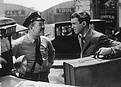
Ward Bond as Bert the cop (left) and James Stewart as George Bailey in "It's a Wonderful Life"

You know that World War II plays a pivotal role in the holiday classic It’s a Wonderful Life. If Uncle Billy hadn’t been so excited about Harry Bailey’s getting the Medal of Honor, he wouldn’t have unwittingly wrapped $8,000 of building and loan money into Potter’s newspaper. That set up the crisis that brought the angel Clarence to help George Bailey.

There’s a scene in the 1946 film in which Joseph, the angel briefing Clarence on George’s life, tells how the folks of Bedford Falls contributed to the war effort. I’ve come up with a quiz on that. The answers will be in next week’s blog. No Googling! Here goes:

1. Bert the cop was wounded and got the Silver Star in which campaign?
(a)  Philippines
(b)  Italy
(c)  North Africa
(d)  Iceland

2. Ernie the cab driver went to Europe and:
(a)   landed on Omaha Beach on D-Day
(b)  parachuted into France
(c)  surrendered to the Germans at Bastogne
(d)  bailed out of a burning B-17 bomber

3. Mr. Gower and Uncle Billy worked on the home front:
(a)  supervising scrap metal drives
(b)  collecting rubber
(c)   swindling war widows
(d)  selling war bonds

4. Potter the banker used his authority in the town to:
(a)  enforce rationing
(b)  hound air raid wardens
(c)   head the draft board
(d)  audit the USO’s tangled finances

5. George Bailey couldn’t serve in the military because:
(a)  He couldn’t hear out of one ear.
(b)  He was brain-injured from the time Gower slapped him around in the drug store.
(c)  As head of the building and loan, he was in a job critical to the war effort.
(d)  He didn’t want to leave Bedford Falls.

6. Sam Wainwright made a fortune in:
(a)  chocolate for troop rations
(b)  nylon for parachutes
(c)  plastic hoods for planes
(d)  the black market for gas rationing

7. Navy flier Harry Bailey, the Medal of Honor recipient, shot down how many enemy planes?
(a)  Eight, one as it was about to dive into an aircraft carrier with famed correspondent Ernie Pyle aboard
(b)  Ten as they were about to drop bombs on a Bob Hope USO show
(c)  Fifteen, two as they were about to crash into a transport full of U.S. soldiers
(d)  Just one, but it was carrying Adm. Yamomoto, the architect of the Pearl Harbor attack

8. Mary, George’s wife, did her part by:
(a)  Going off to work as Sam Wainwright’s secretary
(b)  Working at the library
(c)  Running the USO
(d)  Scanning the sky for enemy planes

9. Mary’s brother Marty helped capture:
(a)  a German U-boat
(b)  Mussolini
(c)  the Remagen bridge
(d)  a rogue American scientist building a secret weapon for the Nazis

10. Ma Bailey and Mrs. Hatch:
(a)  sang and danced at the USO
(b)  hoarded ration coupons
(c)  joined the Red Cross and sewed
(d)  badgered Potter

They were shot at, and still talk about it

B-17 bomber over Germany

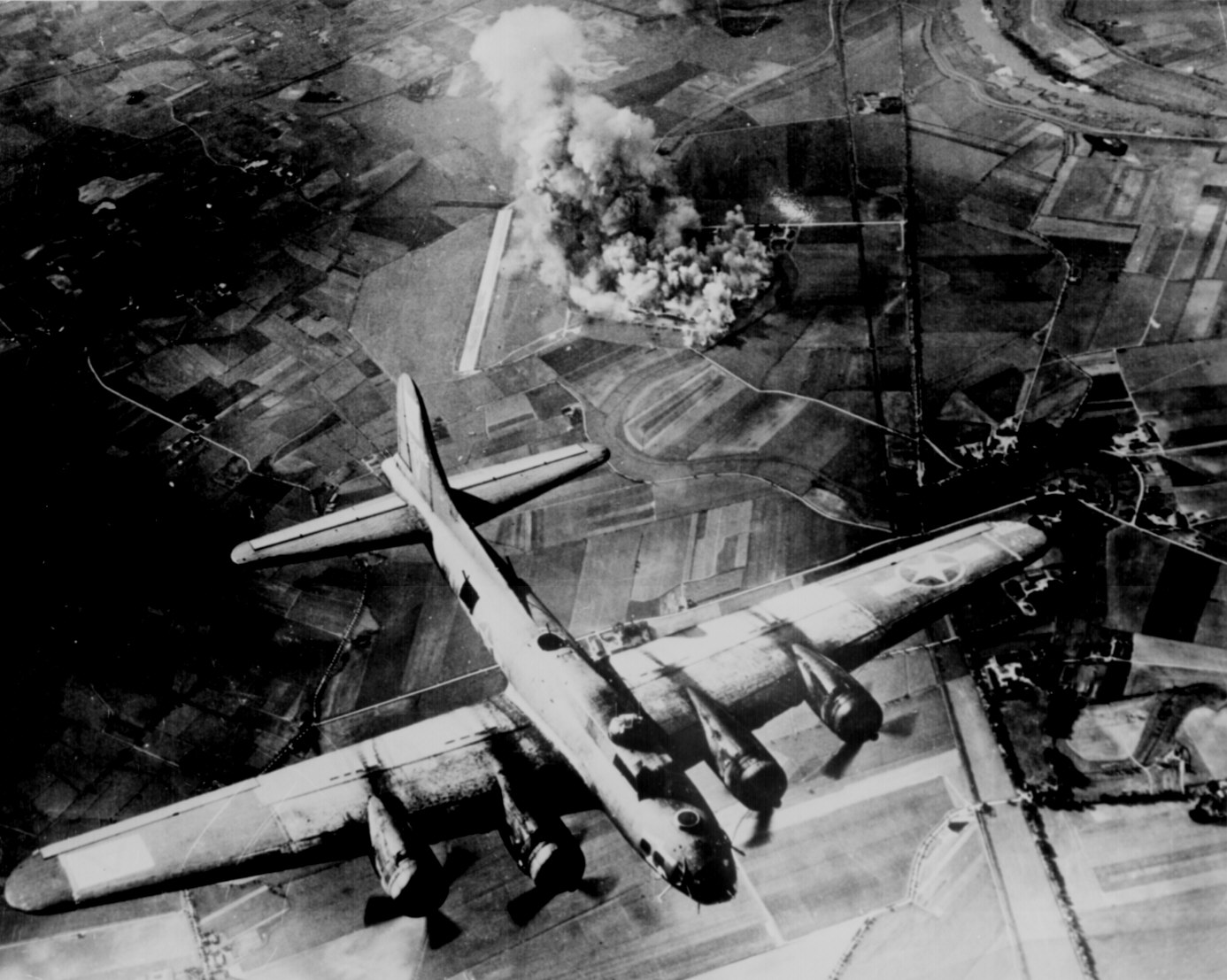
An 8th Air Force B-17 on raid over Focke Wulf plant in Germany, 1943.

I’ve written about a couple of World War II veterans groups that continue to have regular meetings – the Lehigh Valley Chapter of the Veterans of the Battle of the Bulge, who meet the third Tuesday of every month at The Terrace restaurant in Walnutport, and the Lehigh Valley Chapter of the U.S. Submarine Veterans of World War II, who meet quarterly at the City View Diner in Whitehall.

Last week I finally got around to another group, called I Was Shot At, whose members are Army Air Force veterans of World War II and meet the first Thursday of every month at the City View. These are guys who flew on B-17 Flying Fortresses, B-24 Liberators, B-26 Marauders, P-51 Mustangs, P-47 Thunderbolts, even C-47 Gooney Birds. Their group has been around since 1991, so what’s my excuse for not going earlier?

They meet for breakfast.  They’re being served by 9 a.m. That’s asking a lot for an old newshound who works at night. But after I was invited by a fellow member of Calvary Moravian Church in Allentown, Milton Fett, and Calvin Frantz of Allentown, both from bomber units, I forced myself to get up and out of the house, got to the diner, sat with a dozen ex-airmen in their 80s and beyond and enjoyed a few stories, as well as coffee and a short stack of pancakes.

Calvin lent me a folder two-and-a-half inches thick that serves as the official record of I Was Shot At, or IWSA. It has a roster of more than 150 men, many of whom have since “earned their eternal wings.” It also has copies, carefully preserved, of newspaper, magazine and newsletter stories about the group and the war as it was fought in the air.

It was good to see my employer, The Morning Call, has had a bunch of stories about IWSA and its individual members over the years, from the likes of writers Jim Kelly, Stan Schaffer, Frank Whelan and Paul Carpenter. There’s even one I did in 2003 — Frank Speer’s account of his experiences as a P-51 fighter pilot in Europe, headlined “I could feel the bullets hitting my plane.”  http://www.mcall.com/news/warstories/all-frankspeer,0,2668864.story Speer has written three books, Wingman, The Debden Warbirds and One Down, One Dead.

Looking down the roster, I saw familiar names: the late Sam Benscoter, a B-24 bombardier/navigator, and the late Ed Glowka, a P-47 pilot, worked in The Morning Call newsroom many years ago; I never met them but knew of them. There’s B-17 pilot Lee Leaser, whom I interviewed in 1999 http://www.mcall.com/news/warstories/all-earlleaser,0,2607912.story. He died this year. Bob Reichard, a B-24 bombardier in WWII, told me his Korean War story in 1999 http://www.mcall.com/news/warstories/all-robertreichard,0,6303383.story. A prolific chronicler of his experiences, Bob wrote a book, One Soldier’s Story, and has a website, http://www.456thbombgroup.org/reichard.html. He and I have stayed in touch.

My friend Wendall Phillips, a C-47 radio operator, is on the list. He was a POW of the Germans and later served in the China-Burma-India Theater, where he was taken prisoner by the Japanese. Chris Showalter served with the Flying Tigers in China and painted the shark’s mouths on the fighter planes. He told me his story in 2008.   http://www.mcall.com/news/warstories/all-chrisshowalter,0,2301120.story

Regular attendance at the IWSA breakfasts has fallen off over the years. But you can still hear fascinating stories from the dozen or so onetime fliers who show up. So come join them sometime for an hour-and-a-half of fellowship, and shake hands with history.

It’s worth getting up for.

Thrown off a bus in Georgia, 1944

WAC recruitment poster, WWII

A Women's Army Corps recruitment poster

Last week I wrote about my one of my dad’s older brothers, Uncle Frank, a medic in World War II. He served first in Panama and then at Mason General Hospital on Long Island, where he met a medical technician in the Women’s Army Corps who would become his wife.

She was Florence Prebe, known as “Dutchy.”

One of her experiences in the Army reflects a dark side of wartime America: virulent racism in the Deep South.   

Dutchy, who grew up in the Fishtown section of Philadelphia, got her nickname during the Depression, when her family spent a summer at a Lancaster County vegetable farm that her father’s family owned. When she returned to school in the city, someone told her, “You talk funny.” She said, “Yeah, I was in Dutch country.” People started calling her Dutchy.

She dropped out of school in the ninth grade, and at the time of the Japanese attack on Pearl Harbor was a 21-year-old working for a Philadelphia company that made tins for aviation fuel. When America declared war, she quit her job and joined what was then the Women’s Army Auxiliary Corps. In January 1944, a train carried her and 200 other young women to Fort Oglethorpe in northern Georgia for training.

Aunt Dutchy

This is my Aunt Dutchy. An Army portrait is forever lost.

On her first leave, she rode a packed bus, wearing her uniform and sitting up front next to a man. A black woman about eight months pregnant got on with a little girl. Dutchy got up and offered the woman her seat, saying, “You can sit here.” The bus driver immediately pulled over to the curb and stopped.

“Get off the bus, you white bitch,” the driver said. Dutchy looked around, wondering who the white bitch was, and quickly realized the driver was talking to her. “You don’t offer a front seat to any nigger  on my bus,” he scolded her. “You can get off or I’ll throw you off.”

She got off, stung by the applause that broke out among the white riders.