A little bone to pick with a major book

Nothing To Envy and Demick

This National Book Award finalist quotes from my interview with Korean War vet Gene Salay.

While I was picking out veggies at the Allentown Farmers Market several weeks ago, a friend came up to me and said a book that her book club was reading mentioned The Morning Call and me. We’re in the chapter notes at the end, she said.

The book, Nothing to Envy: Ordinary Lives in North Korea, by Barbara Demick has real literary heft. The Wall Street Journal called it “deeply moving,” The New York Review of Books said it’s “A tour de force of meticulous reporting,” and it was a finalist for the National Book Award.

First published in 2009, it came out in paperback last year. I bought a copy at Barnes & Noble after opening to the notes for Chapter 2 and seeing that Demick had quoted from my 2003 interview with Korean War veteran Gene Salay, which ran in my “War Stories in Their Own Words” series.

This is terrific, I thought. An award-winning journalist who’s the Beijing bureau chief of the Los Angeles Times – which like The Morning Call is owned by the Tribune Co. – had found a piece of my work that she believed would help illuminate her story. I guessed that she discovered it at http://www.mcall.com/news/local/warstories/, where all of the stories in my 12-year-old series are posted.

The passage she quoted from is Gene’s account of an attack by Chinese troops on July 13, 1953, on a hill near the village of Kumhwa. http://www.mcall.com/news/all-genesalay,0,1701380.story

Attributing the words to “a U.S. soldier” in the text, she has Gene saying the soldiers would see the “hills and valleys come alive with thousands of enemy soldiers.”

Oh yeah, I remember that line.

She goes on with him saying, “We were incredulous. It was like a scene unfolding in a motion picture.”

Yep, that was Gene.

I read on that it had been raining steadily for a week at Kumhwa and the hills “streamed with blood and water.”

Yeah, that was … no wait. I don’t remember Gene saying that.

I checked the story and that fragment isn’t in there. Gene does say later in his account that there were “pools of blood everywhere … and the blood flowed down the hill into a ditch and ran along the roadside.” But nowhere does he say, poetically, that the hills “streamed with blood and water.” Maybe they did, but Gene didn’t put it into those exact words.

So what, you say?

Well, it’s not true to Gene’s account, for one thing, and he’s not around to make an issue of it because he died last year. For another, the author points out in the chapter notes that the interview is my work.

It is, and it’s being misrepresented.

I got onto the website for the book, www.nothingtoenvy.com, and sent Demick a note on Oct. 19. I’m hoping to hear from her.


“The War of the Worlds” vs. Allentown

Every Halloween I get into our pile of vinyl records at home, pick out my favorite interplanetary war story and put it on the turntable.

“We know now that in the early years of the 20th century, this world was being watched closely by intelligences greater than man’s, yet as mortal as his own,” Orson Welles gravely intones.

It is Oct. 30, 1938. Welles and his Mercury Theatre on the Air are putting on a radio play over the Columbia Broadcasting System that scads of terrified listeners across the country will believe is the real thing – an invasion from Mars. (Not my mom, who as a 10-year-old tuning in knew it was fake and enjoyed it.)

Yep, I’m talking about the live dramatization of H.G. Wells’ The War of the Worlds.

Nowhere else can you hear artillery fire that sounds like a toilet flushing, an alien craft emitting a sound like someone unscrewing the lid on a jar, or – hang on for this one:  “Allentown” mispronounced.

Seriously.

The set-up is cool beyond measure. You’re listening to music on your  favorite station and an announcer cuts in with a special bulletin. A metal cylinder from outer space has plunged onto a farm in (mythical) Grover’s Mill, N.J., and lies half-buried in a pit. Noted astronomer Richard Pearson, played by Welles, gets there in half an hour from Princeton, 11 miles away. A creature emerges from the machine and uses a “heat ray” to turn dozens of onlookers to toast, including the breathless radio reporter giving his on-the-scene account. Pearson escapes.

The alien ship goes on to annihilate 7,000 troops, burning them to cinders or crushing them under its metal feet.

Here’s where we get back to Allentown.

A somber radio reporter in a studio says it’s clear that the “strange beings who landed in the Jersey farmland tonight are the vanguard of an invading army from the planet Mars.” They control “the middle section of New Jersey” and have cut the state in two. Communication lines are down from Pennsylvania to the Atlantic. “Railroad tracks are torn and service from New York to Philadelphia discontinued, except routing some of the trains through Allentown and Phoenixville. Highways to the north, south and west are clogged with frantic human traffic.”

Except the reporter doesn’t say “Allentown.” He says “Allen-tun.”

Cracks me up.

You know the rest of the story. The Martians pop up all over the country, destroying all in their path. Professor Pearson wanders the ravaged land. Ultimately, earth-borne bacteria kill off the invaders. Life returns.

While the Martians are running amok, a lone radio operator tries to make contact with a fellow human being: “Isn’t there anyone on the air? Isn’t there anyone on the air? Isn’t there anyone?”

Nope.

It’s Halloween.


Surprises from searching for military records

The government can work in strange ways when you’re trying to get information from military archives. Here’s a couple of examples:

In September 2007, I wanted the complete records from the general court-martial of a U.S. Navy lieutenant who got into trouble in World War II. His name was Edward Neal Little, and he was a prisoner of war at Fukuoka Camp 17 at Kyushu, Japan, from August 1943 to September 1945. His fellow prisoners accused him of cultivating the favor of his captors by being the camp informer. As a result of his reports to the Japanese, they said, several American POWs were murdered. After a 97-day secret court-martial in 1947 at the U.S. Naval Gun Factory in Washington, D.C., Little was acquitted of all charges.

I was working on a story about another Fukuoka prisoner, Joe Szczepanski of the Wilkes-Barre area. He hadn’t testified in the case, though he knew Little from the camp and disliked him intensely. Still, I wanted to see if Joe’s name came up in testimony.

My letter asking for the transcript under the Freedom of Information Act went to the Department of the Navy, Office of the Judge Advocate General, Criminal Law Division at the Washington Navy Yard in D.C. Ten days later, on Sept. 21, 2007, I got a response saying Little’s record consisted of 2,066 pages. The first 100 pages would be made available without charge, but copies of the remaining pages, at 15 cents a page, would cost $294.90.

Whoa, way too much! I spoke with my boss at The Morning Call and we opted for a different tack. We’d see if the newspaper’s reporter in Washington could go to the Navy Yard and page through the record, looking for Joe’s name. The Navy was OK with that, but our busy reporter in the capital couldn’t schedule the time to get over there. It wasn’t a terrible setback. The info might enrich my story but wasn’t critical to it. So I dropped my pursuit of the record.

Fifteen months later, in December 2008, surprise! A package from the Navy landed in my mail slot at work, marked certified mail. In it was a CD of the complete court-martial record of Edward Neal Little, all 2,066 pages.

It knocked me for a loop. I hadn’t asked for the CD. The Navy hadn’t told me the transcript was available on a disc and hadn’t alerted me that I’d be getting one. It came out of the blue, and at no cost.

When I did a search of the transcript, I got no hits on Joe Szczepanski’s name.

My story, about how the late soldier’s son Rick of East Allen Township was tracking down the horrors his father faced as a POW, ran on April 12, 2009. Here’s a link to it: http://articles.mcall.com/2009-04-12/news/4351315_1_father-coal-mine-pow-camps

More recently, I was looking for the military records of my mother-in-law’s father, Robert Burns Dees, who served in the 4th Texas Volunteer Infantry during the Spanish-American War. I printed out the form from the website of the National Personnel Records Center, http://www.archives.gov/st-louis/military-personnel/  followed the directions on where to send it and mailed it last April.

In May I got a letter from the National Personnel Records Center in St. Louis. It said the info I was seeking wasn’t at the center, and my request was being forwarded to the National Archives and Records Administration, Old Military and Civil Records, in Washington.

Huh? That’s where I’d mailed the form – to the National Archives in Washington, not to the records center in St. Louis. Beats me how it got rerouted, but that’s the government for you.

By the way, I’m still waiting on that request.


Learning from the Terry Calandra case

There’s a lesson in the story of disgraced Vietnam veteran Terry Calandra, who admitted last week in federal court that he lied about earning prestigious medals in the Army 42 years ago.

Documents don’t always tell the truth.

Terry, who grew up in the Easton area and now lives in Belvidere, N.J., earned three Purple Hearts while serving with the 9th Infantry Division in Vietnam from January to July 1969. But he did not earn the Silver Star for gallantry, the Distinguished Service Cross for extraordinary heroism and two additional Purple Hearts, as he had long claimed.

He fooled folks for a dozen years by faking documents, prosecutors said.

If you’re a reporter, it’s always prudent to check a veteran’s paperwork before you write a story about the person, especially if he or she claims to have earned high honors. But that’s not enough, as Ed Offley points out in his 2001 book, Pen & Sword: A Journalist’s Guide to Covering the Military. (There’s an excerpt online at http://www.concernedjournalists.org/spotting-phony-war-hero-or-pow.) You also need to compare the vet’s documentation to what’s in the military archives.

That work by the Army turned out to be Terry’s undoing.

He said he got the Silver Star for diving on a grenade to save a fellow soldier, a story he made up. In trying to have the medal upgraded to a Medal of Honor, he submitted doctored paperwork to then-U.S. Sen. Arlen Specter, who in July 2008 forwarded Terry’s request to the Army. The vetting process being what it is for the nation’s highest military honor, Terry was inviting close scrutiny.

Five months later, the Army Times reported investigators had found discrepancies in Terry’s service record: The general orders and citations for the Silver Star and Distinguished Service Cross didn’t match records at the National Archives and Records Administration. (Here’s the link to Brendan McGarry’s Army Times story of Dec. 15, 2008: http://www.armytimes.com/news/2008/12/army_calandra_121508w/)
“I’m going to stand on my military record,” Terry told the newspaper.

He couldn’t, though. His case culminated Oct. 11 in Philadelphia with his guilty plea to making false statements in relation to military honors. In return, he got a year’s probation and a $500 fine.

I know Terry from the times he attended meetings of the Lehigh Valley Veterans of the Battle of the Bulge. He and I chatted on several occasions about my cousin Nicky Venditti, an Army helicopter pilot who also went to Vietnam in 1969 but was dead in 11 days. Terry’s friendliness and apparent sincerity no doubt helped him win the aid of lawmakers, people in veterans’ organizations and members of the community in his quest for the Medal of Honor.

Those earnest people might not have suspected fraud because records-fudging by a soldier can be difficult to spot. Besides, you want to believe that the guy is giving you the straight story.

You want to believe that of anyone who serves the country in the military.

“The presumption is honesty and integrity,” Vietnam vet B.G. Burkett said in Stolen Valor, the 1998 book he co-wrote with Glenna Whitley. http://www.stolenvalor.com/  “Who would steal the valor of men who fought and often died for those medals?”

The 12 Apostles of the National Guard

You might have heard about veterans groups like I Was Shot At, made up of fliers from World War II and the Korean War. But I was reminded recently that vets don’t need to have fought in a war to establish a bond that last for decades.

Richard Ackerman of Northampton told me about his group of former National Guardsmen and how they continue to celebrate their friendship.

“It all started back in the ’50s,” he wrote, “when a bunch of fellows from the Lehigh Valley joined the Pennsylvania Army National Guard, 213th Regiment, Battery C, located in Bethlehem. At that time the group was anti-aircraft.

“The non-coms had a slush fund of money to be spent. It was decided to have a dinner, which was at the original Village Inn on Tilghman Street in Allentown.
We had 12 individuals at that meeting [in 1962], and we still had monies left from our slush fund, and it was suggested that every year we meet for the camaraderie and fellowship.”

Richard sent me a list of the 12 Apostles, as they called themselves. Besides himself, the ex-Guard members were Dennis Casciano, who died in 1991; Joseph Deutsch (died in 2000); Charles Hettenbach; Martin Lynn (died in 2007); Loyal McCarty (died in 1995); Joseph Nemeth; William Oplinger (died in 2002); Charles Schultz; Emil Schwartz; Michael Vidumsky; and Donald Williams.

Though their ranks have thinned, they have been true to the commitment they made to themselves almost half a century ago. In August, six of the seven surviving Apostles attended their 49th reunion.


Another round under way at the roundtable

The Lehigh Valley Veterans History Project Roundtable resumed its monthly meetings Thursday night after a summer break, and I had a rare opportunity to go. The meetings, on the last Thursday of each month at 7 p.m. at the Lehigh County Senior Center in Allentown, are held while I’m working, but
this time I got to escape my desk at The Morning Call because I was on company business. I was at the senior center to promote my book, War Stories in Their
Own Words
, just published by the newspaper.

The place was packed with more than 130 people, including several of the veterans in my book – Evangeline Coeyman, Hank Kudzik and Levi Borger. (You can order the book, a collection of personal accounts from 1999 to the present, from The Morning Call at https://secure.mcallcommunity.com/store/pages/war-stories.php)

District Attorney James B. Martin and his executive aide, Debbie Garlicki, were there to drum up interest in a new initiative in the DA’s office, the Lehigh County
Veterans’ Mentor Program. The voluntary program, which I’ve blogged about
before, offers veterans caught up in the criminal justice system an opportunity
to speak with a vet who has “been there,” according to a brochure. The mentor
acts as an advocate and ally and helps the vet navigate the criminal justice
system and life issues. Mentors are trained volunteers who serve or have served
in the U.S. military. Honorably discharged vets currently charged with a crime can apply for a mentor.

The main speaker for the night, 86-year-old World War II vet Matt Gutman, had
addressed the roundtable before about his experiences in the Navy aboard an
LST, or landing ship tank, and was back because he’d done so well his first
time. You had to marvel when he talked about surviving five typhoons as well as
the Japanese.

Roundtable leaders Mike Sewards, Paul Fiske and Dick Musselman are passionate about hearing and preserving veterans’ stories for posterity. It’s the driving force as well behind my 12-year-old series in The Morning Call, “War
Stories: In Their Own Words.” I was reminded of the importance of our work
when I opened the newspaper Sunday and saw that another one of my interviewees is gone – Pearl Harbor survivor Warren G.H. Peters of Catasauqua, who died Thursday at age 90. Here’s the link to my story on him, which ran on Dec. 7, 2008: http://www.mcall.com/news/all-warrenpeters120708,0,6625997.story “Pete” amazed me because he had saved so many souvenirs, even a menu from a favorite restaurant in Honolulu.

The roundtable’s next meeting is Thursday, Oct. 27. Its speaker will be Marine Cpl. Robert Toth, who served in Iraq and Afghanistan. I won’t get to hear him because I’ll be working, but I hope you consider going. We don’t hear enough from 21st century veterans. For more info, here’s the roundtable’s website:
www.lvveteranshistory.org

A flag for Woody

Flag raised for Woody Woods at Union and West End Cemetery, Allentown, Pa.

A new flag is raised in honor of the late Woody Woods at Union and West End Cemetery, Allentown, Pa.

It was a task that Woody Woods took on because he had a sense of honor and duty.

About every three years, the World War II veteran fetched a new American flag to fly over Allentown’s Union and West End Cemetery, the second-largest burial ground of Civil War veterans in Pennsylvania, with 724, and the resting place of five veterans of the Revolution.

The cemetery needed Woody this month. Hurricane Irene and Tropical Storm Lee had swept through the Lehigh Valley and left the flag atop the 40-foot pole along 12th Street in tatters. Ordinarily, Woody would have made sure the Stars and Stripes was replaced.

But someone else would have to do the job for him. Woody, who called Schnecksville his home, died last November.

On Saturday morning, members of the cemetery association and
Woody’s buddies in Lehigh Valley Chapter 190, Military Order of the Purple
Heart, stood at attention as association President Everette Carr raised a crisp
new flag in Woody’s honor. The flag, 5 feet by 8 feet, flew over the Capitol in
Washington, D.C., on Sept. 10.

In front of the pole was a heart-shaped purple wreath with a photo of Woody that MOPH Commander Mike Mescavage took three years ago at Niagara Falls, where Woody was attending his Army unit reunion. Woody, whose given name was Graydon, is grinning and holding a wine glass he had drained of its contents.

He was fortunate to live as long as he did, 91 years. While serving with the 112th Infantry Regiment, 28th Infantry Division, he was badly wounded in November 1944 in the Huertgen Forest along the Belgian-German border. I interviewed him and the story ran in The Morning Call on Veterans Day, Nov. 11, 2009. Here’s the link: http://www.mcall.com/news/all-graydon-woods,0,5730339.story

While we were working on his story and after its publication, we ate several times at his favorite hangout, the Schnecksville Diner. He was a popular guy there. After he died, the newspaper’s Veterans Day edition with his picture large on the front page was posted behind the cashier.

The event Saturday drew only about a dozen people to the West End section of the 19.6-acre cemetery that saw its first burial, in the Union portion, in 1854. Mike and fellow MOPH members Joe Motil, Chuck Jackson, Lenny Moore and Bud Dillon – looking sharp in their blue caps, white shirts and blue ties — saluted as the new flag went up. So did Rich Hudzinski of the Lehigh Valley Military Affairs Council and cemetery association members Don and Janet Hagenauer, Charles Canning and Gerry Haas.

One of the attendees was Sarah Pardekooper, a patient service assistant for the last six years at the Allentown Veterans Affairs Clinic. She knew Woody because he was there almost every Monday with other Purple Heart members serving coffee and doughnuts.

“Everybody knew who Woody was,” she said after the ceremony. “He always made everybody smile.”

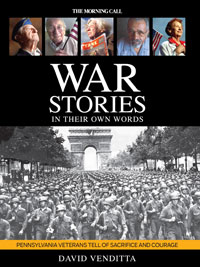
War Stories In Their Own Words: the book

War Stories In Their Own Words

"War Stories In Their Own Words," a collection of nearly three dozen first-person accounts, is now on sale.

For years people have been telling me that my interviews with war vets published in The Morning Call of Allentown, Pa., should go into a book.

It’s happened.

War Stories in Their Own Words: Pennsylvania Veterans Tell of Sacrifice and Courage went on sale Sept. 15. You can order it on the newspaper’s website at https://secure.mcallcommunity.com/store/pages/war-stories.php or by calling 610-508-1517. The price is $14.95.

The book has a soft cover and 176 pages. It contains first-person accounts from the World War I era, World War II, the Cold War, the Korean War and the Vietnam War – all interviews I’ve done since the series War Stories: In Their Own Words began running in The Morning Call in 1999.

The stories appear with photos of the vets taken by the newspaper’s photographers, the vets’ own pictures of themselves in wartime, maps and
epilogues on the veterans’ post-war years.

There are 34 veterans in the book, about a third of all the interviews that have appeared in the series. It wasn’t easy choosing whose story to include – I like all of them. But generally we wanted to represent each of the major American wars of the 20th century, and to have a mix.

So they aren’t all blood-and-guts. One of the vets was a clerk on Eisenhower’s staff. Another was a Navy cargo pilot in the Pacific who didn’t have to contend with Japanese fire. One woman was an Army nurse who tended to the Chinese building the Ledo Road in Burma.

The enemy is represented as well, by a man who was born in Pennsylvania, taken by his mother to Austria while a baby and drafted into the Germany army as a teen. He talks about his service in an anti-tank battalion on the Eastern Front and in Italy, where he was machine-gunned in the legs.

Of the veterans in the book, 15 have since died – nearly half of the total. That is in a span of only a dozen years, pointing up the need to have war veterans tell their stories before they go to the grave. We need to know what they saw and did. Future generations will want to know as well.

That’s what this book is about. I hope you like it.


Steering you right on the new GI Bill

We all know how helpful it is to have information at your fingertips. That’s particularly true if you’re a veteran trying to make your way through the maze
of complicated rules and regulations the government puts out.

I recently heard from someone who put together a list of resources to end your
headaches over the new GI Bill that went into effect in August. She’s Mallory Lynch, and she created http://www.affordableonlinecolleges.org/, a website dedicated to providing students with the information and tools they need to find the best, most affordable online college programs.

She posted a blog titled “25 Informative Resources about the GI Bill and its
Educational Benefits.” Here’s the link, http://www.affordableonlinecolleges.org/25-informative-resources-about-the-gi-bill-and-its-educational-benefits/. The list includes the U.S. Department of Veterans Affairs website and many other sites, blogs and articles that address the new GI Bill 2.0.

President Obama signed the bill into law in January. Called the Post-9/11 Veterans Education Assistance Improvement Act (GI Bill 2.0), it streamlines the GI Bill mainly by doing away with the state-by-state tuition and fee rates, according to military.com. “However, the law also adds some complicating
factors, like an annual cap which only applies to private schools and new
housing stipend limits based on the number of classes a student takes each term,” a story on the military site adds.

Mallory’s list is a handy starting point to help you get a handle on the changes in GI Bill 2.0. She gives the links for websites and summarizes what you’ll find when the pages come up on your screen. Check it out. She’s done her homework.

Afghan war then and now, and a fallen guardsman

The main reason for a Pennsylvania Army National Guard ceremony Friday in Allentown was to salute volunteer soldiers from another era – the First Defenders, the state’s militiamen of 150 years ago who responded to President Abraham Lincoln’s call to defend Washington at the outset of the Civil War.

But there was also a heartfelt nod to a local volunteer of the 21st century who lost
his life eight years ago in the Afghanistan war. For me, the ceremony brought back the early days of the “war on terror,” just as we’re getting ready to mark the catastrophic event that started it.

First were speeches of tribute to the First Defenders, five companies of Pennsylvanians that included the Allen Infantry from Allentown
who hurried to the nation’s capital in April 1861. The crowd of about 125 at
the Curtis Armory heard from politicians – U.S. Rep. Charlie Dent, Lehigh County Executive Don Cunningham and Allentown Mayor Ed Pawlowski – and from National Guard brass – Col. Glenn Nissley, commander of the Allentown-based 213th Area Support Group; and Maj. Gen. James Joseph, assistant adjutant general-Army, Pennsylvania National Guard.

The guardsmen then honored one of their – the late Sgt. Christopher Geiger, who died of a heart attack in 2003 while serving with the Headquarters Company of the 213th in Afghanistan. Geiger, who was 38 and from the Kreidersville section of Northampton County’s Allen Township, died while sleeping in his tent at Bagram Air Base, about 30 miles north of Kabul.  He had been in Afghanistan only two weeks out of what was to be a more-than-one-year deployment for his non-combat unit, which was assigned to run base operations at four locations, one in Uzbekistan.

Geiger had spent that day, July 9, happily escorting young Afghan boys along Disney Drive at Bagram. He was to guard the kids as they pulled weeds, just as all locals who work on the military base are under armed watch, wrote reporter Wendy Solomon of The Morning Call, who was with the 213th Support Group for six weeks. A photo taken by Maj. Pamela McGaha on the day Geiger died was on display in the armory. It shows the big bear of a man in desert camouflage, sunglasses on, standing with two grinning Afghan boys hauling bags of weeds. The photo ran on The Morning Call’s front page the next day, with Wendy’s story about Geiger’s death.

At the armory, about 125 guardsmen, politicians, members of the Honorary First Defenders patriotic organization and others saw the unveiling of a portrait of Geiger and its presentation to his parents, Patricia and George Geiger. (I know George from his days at The Morning Call, when he was a sports copy editor.) The painting, by JoAnne Seifert of Springfield Township, Bucks County, shows Geiger in desert camouflage uniform with a cap. His family members were visibly moved.

Later, I looked up Wendy’s dispatches from Afghanistan, which took me back to an earlier time in the global fight against terror, when most of the action was in Iraq. We were led to believe that, with the Taliban already handily routed, the
threat in Afghanistan had been defused, though our forces were still in hot pursuit of Osama bin Laden. In one story from July 2003, Wendy – who has since left the newspaper — reported that a rocket that landed on Bagram Air Base’s perimeter was the first attack on the American military post in three months. It caused no injuries or damage.

How different Afghanistan is today, as we near the 10th anniversary of the 9/11 terrorist attacks. The 19,000-member Pennsylvania National Guard knows firsthand that it is a far more violent place. In July, three soldiers with the
131st Transportation Company were killed by a roadside bomb outside Bagram. That brought the number of Pennsylvania guardsmen killed in action in Afghanistan to seven – out of 39 deaths overall since Sept. 11, 2001.

In the last decade, more than 6,000 Americans who have taken up the fight worldwide are dead. That number will surely grow. We can only hope their sacrifice is worth it.