20 miles from bin Laden, and not knowing it

“We all have moments we look back upon and shudder because we had no idea how much danger we were in.”

That’s the start of a message I got Saturday from my friend Steve Lester. We went to Downingtown High School in eastern Pennsylvania in the early 1970s, and he joined the Army as a musician, a guitarist. We’ve stayed in touch.

In 2006, he and some 20 other members of the 10th Mountain Division Band from Fort Drum, N.Y., spent about six weeks in Muzaffarabad, Pakistan. Osama bin Laden was holed up only about 20 miles away, in Abbottabad. He had reportedly been there since the year before. Last year, Navy SEALs hunted him down in his hideaway.

While Steve was still overseas, he wrote an article that was published in The Morning Call through his connection to me. It was titled “Confessions of an Army guitarist: How a musician pulled guard duty in Pakistan.”

Here is his story of how he got to Muzaffarabad, as he told it over the weekend in the emailed message from his home in Lake Placid, N.Y.:

“The first step occurred on the night of Feb. 5, 2006, when about 350 10th Mountain Division soldiers herded into the terminal at FortDrum’s expansive Wheeler-Sack Army Airfield bound for Afghanistan.

“Winter had arrived late that year to this remote outpost about 30 miles from the Canadian border above Syracuse. The day before had been another unseasonably warm one as few people wore so much as a windbreaker. On this night, however, a cold front was sweeping through, bringing the bitter wind off Lake Ontario along with the season’s first measurable snow.

“The division’s senior non-commissioned officer, Command Sgt. Maj. Ralph Borja, gave a rousing speech speckled with threatening language about no sex or booze once you get there, or else. Then the division commander, Maj. Gen. Benjamin C. Freakley, gave a similar speech but with no threatening language.

“Within minutes all the 350 soldiers secured their M-16 rifles and personal carry-on baggage as they headed for the terminal door amid a roar of excited chatter.

“Freakley and Borja stood in the chilly vestibule and shook every soldier’s hand as they departed the terminal for that endless walk out on the cold, blustery flight line to the long stairway-on-wheels leading to the relative warmth and sanctity of the hatch near the back of the chartered civilian jumbo jet, where they would spend the next 17 to 18 hours en route to Kyrgyzstan, the plane’s final stop.

“As the guitar player for the 10th Mountain Division Band at the time, in my final full year in the Army at age 51, I was one of those soldiers. Although I was just a staff sergeant, the commanding general and command sergeant major both recognized me as we exchanged broad smiles and warm hand shakes.

“Our flight stopped in Shannon,Ireland, for fuel in the dead of night when the small terminal was virtually empty.  We left our weapons on the plane and spent about 45 minutes lounging and stretching.

“Upon being summoned to re-board, we walked down a glass-enclosed hallway to the boarding gate as a commercial flight discharged its civilian passengers into the glass-enclosed hallway next to us. I don’t know where their flight originated from, but they all cheered us through the glass walls as we passed each other.

“Our plane stopped again at a U.S.airbase in Incirlik, Turkey, for a longer stop in a much smaller terminal where the plane changed crews in addition to taking on more fuel for the final push across the Caspian Sea to Manas International Airport in the former Soviet republic of Kyrgyzstan.

“Our version of retrieving checked baggage in the wintry darkness took the form of roaming through piles of duffel bags that were brought to us on pallets by forklifts. Your objective after finding your duffel bags was to find a warm tent where you could lie back on a bunk bed until your final flight was called.

“I climbed into the top bunk next to the tent’s heater above the entrance where it felt good to lie back and stretch out after having spent most of the previous 18 hours in a cramped airline seat. The intermittent action of the heater had me sweating one moment and shivering the next.

“One of our sergeants first class, a percussionist, had been to drill sergeant school and conducted himself with a bluster and swagger that our battalion sergeant major liked.

“When word came down through the chain of command that the division had to send a security detail to Pakistan because of a visit by President George W. Bush, the band got the call through this sergeant major’s influence.

“Some of us shimmered with glee at the thought of walking alongside the president with M-16s locked and loaded, ready to blast anybody who threatened our commander-in-chief. We got bumped to the top of the priority list for a flight to Bagram Air Base and had to be ready to go when the call came. (The nine guys and one female who went to Islamabad to guard Air Force One did not see the president. He was only there for one or two nights.)

“As I remember it, the call came in the middle of the night to board a bus for an Army C-130 transport plane. The division command wanted to make sure there were no repeat broadcasts on CNN of anybody getting off a plane in Afghanistan carrying a pink teddy bear and otherwise looking like anything other than The World’s Most Intimidating Fighting Machine.

“So we piled up our duffel bags onto a pallet, then piled ourselves two to a seat onto a pseudo-school bus wearing full ‘battle rattle’ with helmets and flak jackets while holding weapons and carry-on luggage on our laps. The cold dark bus full of silent, weary-eyed soldiers crawled its way from the small compound through a security checkpoint and onto the flight line where it stopped and waited before turning back and saying, in effect, ‘Never mind.’

“Eventually we found our way onto a daytime flight to Bagram, where less than a week later we became the first unit in the battalion to convoy out the gate into the populace — in full battle rattle with weapons and live ammo.

“We had been told that the Pakistanis were none-too-comfortable with U.S. soldiers in their midst for fear of our turning Pakistan into another Iraq. So before we could leave for there we had to learn how to shoot a weapon small enough to stuff into the back of our pants – gangster-style — while on patrol and thus conceal them from view.

“Our convoy of armored Humvees and trucks with machine gun turrets was to take us out to a desert weapons range. We had been told to ignore the children in the outlying village because they liked to give U.S. soldiers the thumbs up, which was said to be a gesture similar to a U.S. middle finger.

“Our first sergeant, the highest ranking non-commissioned officer in the band, had an easy-going southern gentlemanly manner about him — except when he got upset. He was a known taker of antidepressants, and you never knew whether he was going to behave as if he were on his meds or off them.

“Earlier in his career, while serving as the first sergeant of The Fort Lee Army Band near Richmond, Va., he’d had the unfortunate task of looking into the residence of one of his soldiers who had mysteriously not reported for work, only to discover that the soldier had died in his home of natural causes.

“Now, as he was about to lead a convoy of soldiers out the gate of the safe confines of Bagram Air Base into the land of the Taliban, the last thing he wanted was to have to inform another family of one of his soldiers that the soldier had died. It was an off-the-meds day for the first sergeant.

“We rolled out the gate, the Afghan children lined the village street giving us a thumbs up, and the rest of the day went without incident. We shot up our 9 mm ammo supply aiming at nothing in particular.

“A few days later 20 of us boarded a transport plane bound for Islamabad. The plane took off, circled around, and came right back down. The crew said it had a problem with the hydraulics and couldn’t fly.

“A day or so later we were on another flight that made it the whole way. But instead of having a forklift carry our duffel bags from the plane on a pallet on a wintry night, we carried our duffel bags, one in each hand, along with a backpack, a 9 mm pistol and an M-16 nobody was supposed to know about some 200 yards off the flight line to a grove of trees on a summer-like day.

“At roughly 145 pounds dripping wet, I must have been hauling three-fourths of my body weight. At 51, I was definitely too old for this kind of work.

“An attractive female liaison from the embassy met us and told us to hang tight in the tree grove until our helicopters arrived, which they did in short order. And, once again, we gathered up all our gear in full battle rattle and hiked 200 yards to the choppers where, as on a C-130, you use your Army-issue ear plugs, close your eyes and zone out until you arrive.

“One member of the chopper crew, however, had to have a conversation with one of our guys, which you could only do shouting at the top of your voice.

“WHAT UNIT YOU GUYS FROM?”
“THE BAND.”
“THE WHAT?”
“THE BAND.”
“THE WHAT?”
“THE BAND,” he said, this time mimicking playing a trombone.
THE BAND?!”
“YEAH.”
“HOLY MOTHER F—!!!”

By this time our mission had become twofold. Pakistan had been hit by a 7.6-magnitude earthquake on Oct. 8 that killed more than 80,000 and left about 3.5 million homeless, mainly in Pakistan-controlled Kashmir and parts of northwest Khyber Pakhtunkhwa.

“Our first stop was in Muzaffarabad, the epicenter of the quake where the Army had set up the 212th Mobile Army Surgical Hospital (MASH) on Oct. 22. A platoon from the European command had been pulling security there and following our progress in arriving to relieve them. As our first plane took off from Bagram, they rejoiced proclaiming, ‘The 10th Mountain Division is on its way!’

“Then, after our plane turned right around and landed with its hydraulic problems, it was, ‘The 10th Mountain Division is not on its way!’

“A few days later: ‘The 10th Mountain Division is on its way again! We’d better look good and squared away for these guys because they’re supposed to be pretty hardcore!’

“Upon our arrival it was, ‘Yup, we’re the band all right.’

“Our first mission was to pull security at the MASH, where every day Pakistani earthquake victims, and even non-earthquake victims, would gather under a crude bus stop-style shelter outside the hospital gate. We would wait until about a dozen people had gathered and then file them in one at a time.

“We searched every person for weapons, including the women who were led to a tarp draped over makeshift supports off to the side where female soldiers searched them in private. From what little I could see, no women had a problem with being frisked. However, one man, the husband I presume, demonstrated considerable anxiety over his wife’s being led away to the tarp. He tried to follow and would not let her out of his sight. A male soldier had to gently stand in his way.

“I frisked my share of men before gathering up a few lines of people and, using my new two-word Urdu vocabulary, led them into the MASH. The young Pakistani boys found this all very exciting and offered me as much help as possible. After receiving treatment, each citizen received a package of food to leave with. The young boys found this very exciting also.

“The Army turned the MASH over to the Pakistanis in mid-February after it had treated more than 20,000 patients. The 212th was the last of the Army MASH units dating to World War I before the Army switched over to what it calls the Combat Support Hospital, or CASH.”

“By this time I and nine others had ridden up a narrow, partially washed-away mountain pass alongside a raging river with no guard rail to the Muzaffarabad airport with its small terminal and 3,000-foot airstrip. This would be our home for about the next five weeks. An international fleet of helicopters spent the days, weather permitting, ferrying relief supplies to Kashmir earthquake victims.

“The Pakistani military (“Pak-Mil”) lined the perimeter of the airfield with sandbagged bunkers and automatic weapons. A platoon of petroleum specialists from Fort Lee,Va., meanwhile, had set up a fuel depot for the helicopters.

“Their continued mission involved monitoring the quality of the fuel being delivered by private contractors via what we called ‘jingle trucks,’ or colorfully painted tanker trucks with coins attached to short chains dangling from the bumpers. We were brought there to provide added security for the petroleum platoon.

“In addition to patrolling on foot, we spent the next five weeks or so patrolling in three-passenger Polaris ATVs, vehicles that we soon discovered could go from zero to 40 in about three-tenths of a second.

“For the first few days, we were hell on wheels zipping up and down next to the landing strip until a very tall Pakistani soldier – very politely – asked us to ‘go slow,’ which we did from then on.”

    

Tribute to a newsroom librarian

In my writing about war veterans, I’ve always felt relief when a researcher helped me. Researchers can get accurate information or steer you in the right direction, even in this age of Google.

At The Morning Call over the years, newsroom librarian Ruth Burns backed me up countless times. She was my right hand in 2002 when I worked on a two-part series about Bataan Death March survivor Joe Poster, making sure I got the history right.

She would always help my colleagues or me when we needed resources or fact-checking. Beyond that, she was a really neat person and fun to be with.

We in the newsroom learned last week that Ruth had died at age 68. A Lehigh County deputy coroner pronounced her dead of natural causes at 4:35 p.m. Jan. 2 in her residence on Lehigh Parkway East, Allentown. She hadn’t been working at the paper for several years. We knew she had health problems.

Ruth and I had made a good team. In early 2004, she came to my desk and asked me if I knew there was a World War II Medal of Honor recipient living on the edge of our circulation area.

His name was Alton W. Knappenberger. He had gotten the medal for extraordinary heroism against the Germans in Italy, soon after the Anzio landings.

As I recall, Ruth had come across some old clippings about him, looked him up and found him still living. He was in eastern Berks County, near Boyertown. She had his address and phone number, and passed the info to me.

Her tip led to a long story I wrote about “Knappie” for the Memorial Day 2004 edition of The Morning Call. I think it was 110 column inches. I had spent hours interviewing him in his trailer in the woods. He had been a quiet country boy, a reluctant hero, and was not a big talker.

Knappenberger died four years later, at age 84, and was buried at Arlington National Cemetery. My piece on him is posted on Arlington’s website, http://www.arlingtoncemetery.net/awkappenberger.htm

It’s the most personally satisfying story I’ve ever done.

I owe that to Ruth. It wouldn’t have happened without her.

Battle of the Bulge veterans toast the new year

For the last six years, Morris Metz has invited family members and fellow World War II veterans to his home for a New Year’s toast.

It’s a tradition for Battle of the Bulge survivors, he says, to raise a glass at 3 p.m. for the more than 19,000 British and American troops who died in the fighting from Dec. 16, 1944, to Jan. 25, 1945, in the Ardennes Forest of Belgium, Luxembourg and Germany.

Morris is president of the Bulge veterans’ Lehigh Valley chapter. This is the first year I could make it to one of his events.

My wife, Mary, and I showed up 20 minutes before the toast and joined several dozen guests at the beautifully restored 19th century farmhouse Morris and his wife, Dot, own on the line between Forks and Plainfield townships. The couple’s son, Doug, and daughter, Debbie, were there, as well as grandchildren and a great-grandson.

Mary got to meet some of my friends – Ray and Irene Christman, John and Linda Caponigro, Harold Kist, Mark and Jean Kistler, Lou Vargo and Minotte Chatfield. (I’ve done stories on Ray Christman, John Caponigro and Vargo.)

David Colley, author of Safely Rest and other WWII books, was there with his wife, Mary, a photographer.

Jack Davis, who died last year and is in my War Stories book with Christman and Vargo – was represented by daughters Sharon Davis and Janet Kobler. (Janet’s painting of Morris at a military cemetery in Europe hangs on a wall. Her father and Morris were close friends.)

When the clock chimed three times, we raised our glasses for those in the Bulge who sacrificed their lives or have since died. It was a somber moment for the vets around us, who had lost 11 comrades in the last year.

Still, this New Year’s Day was a happy time for these men in their late 80s and beyond, evident in their crinkly smiles. The Greatest Generation yet lives, and will go on.

A proud leader of veterans is gone

Word of Vincent B. Vicari’s death on Dec. 5 was announced at the Christmas party of the Lehigh Valley chapter, Veterans of the Battle of the Bulge. He had been a member.

I knew Vinny, but not well. Our paths crossed at veterans’ events, where he was always front and center. Plus, he had a physical connection with my in-laws, who lived in Bethlehem Township: Their back yards met. My wife, Mary, described him as expressive and high-energy.

Vinny, who was 92, was never a subject of my series “War Stories: In Their Own Words” in The Morning Call. I did consider interviewing him, but our archives contained a flurry of stories about him, so I passed.

During the Bulge, Vinny was an officer in the Army’s 101st Airborne Division and an aide to Gen. Anthony C. McAuliffe, who famously responded to a German surrender ultimatum at Bastogne, Belgium, on Dec. 22, 1944: “Nuts.”

The stretch of Route 33 between Route 22 and Interstate 78 is named after McAuliffe as a result of Vinny’s efforts.

The veterans’ community will miss his proud leadership.

This year also saw the deaths of several World War II veterans whose stories ran in my series: fighter pilot Frank Speer, March 1; Army medic Jack Davis, May 12; sailor Horace Rehrig, May 21; Pearl Harbor survivor Warren Peters, Sept. 29; Alfred Taglang, another Pearl Harbor survivor, June 12; and bomber pilot Harry Yoder, May 8.

Speer, Davis, Rehrig and Yoder are in my book, War Stories: In Their Own Words.

I counted them all among my friends. They are gone but not forgotten.


Books I’d like to see under the tree

Rin Tin Tin

The book about the silent film star

Two new books are on my Christmas wish list, even though I already have enough unread books on my home-office shelves to keep me busy until I croak.

One of the new ones is Rin Tin Tin: The Life and the Legend by Susan Orlean. It tells the story of the German shepherd pup who was found in battle-scarred France’s Meuse Valley during World War I by an American corporal and went on to become a silent film legend.

I’ve seen Rin Tin Tin movies and remember thinking, this dog is fantastic! As a kid, I watched the 1950s TV show The Adventures of Rin Tin Tin. Now I can get to know all about him. Plus, I’m a sucker for animal tales. Remember Dewey: The Small-Town Library Cat Who Touched the World? Yep, couldn’t put it down.

A review in The Christian Science Monitor that I clipped calls Orlean’s book “an eloquent, powerful inquiry into ‘how we create heroes and what we want from them’ and about what endures in our culture.” Here’s the link to the review: http://www.csmonitor.com/Books/Book-Reviews/2011/0927/Rin-Tin-Tin-The-Life-and-the-Legend

The other new book is What It Is Like to Go to War, in which Vietnam War vet Karl Marlantes wrestles with the idea of killing and urges his fellow veterans to talk openly about their experiences as a way to heal. Non-veterans like me can read this work and appreciate the impact of combat on a person’s soul.

Again, what I know about this book comes from the Monitor, and you can read the review at http://www.csmonitor.com/Books/Book-Reviews/2011/0926/What-It-Is-Like-to-Go-to-War.

A bum rap for Pearl Harbor radar man Joe Lockard

When I was working on my story for The Morning Call about the Allentown reunion of Joe Lockard and two other Pearl Harbor radar men, one of my references was Gordon W. Prange’s monumental book At Dawn We Slept.

Prange made a critical comment about Lockard that doesn’t sit right with me.

Lockard and a new member of the Aircraft Warning Service, George Elliott, were working at the Opana mobile radar station on the northern tip of Oahu on Dec. 7, 1941, when their oscilloscope showed a huge blip rapidly approaching. They called in to the information center at Fort Shafter, which linked the five radar sites across the island, and reported what they were seeing.

After Elliott spoke with switchboard operator Joseph McDonald, Lockard spoke with the only officer on duty, Lt. Kermit Tyler. Lockard, a Williamsport native who’s now 89 and living near Harrisburg, told me: “I tried to convey my excitement that we had never seen anything like this on radar, and that it obviously had to be planes.”

Tyler’s answer: “Don’t worry about it.”

He couldn’t imagine that the blip was showing enemy aircraft, Prange wrote. Tyler believed the Opana radar had picked up a flight of B-17 bombers due in from the mainland.

Prange faulted Lockard. He said the private made “one big mistake” by not  saying the sighting showed more than 50 planes. If he had, Prange wrote, Tyler would have realized the planes being tracked were not B-17s, because more than 50 of the bombers would have been a large chunk of the U.S. inventory of B-17s, an unlikely scenario.

Prange’s massive work was authoritative. He researched Pearl Harbor for 37 years before his book was published posthumously in 1981. Last year, his criticism of Lockard re-emerged in The New York Times obituary for Tyler, who died at age 96.

So I pressed Lockard on his reaction to the blip. He said he “didn’t have any idea how many planes” it represented, only that he “had never seen any kind of response on the equipment that was so large.”

In other words, in his phone chat with Tyler, Lockard didn’t say what he didn’t know.

Let’s forget about the numbers. Even if Lockard knew there were more than 50 planes and failed to mention that, it’s not fair to pin this rap on him.

Though only 19 and a private, he was a trained radar man. He checked the equipment when he first saw the unusual blip and found the gear working properly.

From what I’ve read, Tyler didn’t ask him outright: “How many planes do you think are out there?” Instead, he just dismissed the sighting.

If you were in Tyler’s place, wouldn’t you be concerned if someone were telling you in an urgent voice that the scope had never lit up like this before? Wouldn’t that make you uneasy?

It gave McDonald, the switchboard operator, a chill. The private from Lackawanna County went back to his tent and woke up his buddy Dick Schimmel from Allentown, saying: “Hey Shim, the Japs are coming.” Minutes later, Japanese bombs started falling on the harbor.

You have to wonder why Tyler didn’t make the same connection. With the radar unable to tell friend from foe, how could he be sure those planes on the Opana scope were our own bombers? That’s the bottom line, don’t you think? How could he be sure?

He couldn’t.

Despite what Prange had to say, there’s no case against Lockard.

‘Join the Army! I’m in the Army!’

Frank Venditta

Frank Venditta

There’s a Pearl Harbor story in my family. It came from my uncle Frank Venditta, one of my dad’s older brothers.

In 1941, Frank was drafted into the Army and hustled into a medical battalion. He got training as a medic and went to Fort Dix, New Jersey, where he worked in a hospital and lived in a tent.

On Sunday, Dec. 7, he was home in Malvern, Pennsylvania, on leave and due back at Fort Dix that night. He had become engaged to a newly graduated nurse named Pauline Edwards, and they were cruising around West Chester in his 1935 Chevy. He wasn’t wearing his uniform and didn’t have a radio in his car. When he took Pauline to where she was staying, someone commented about joining the Army in light of what had happened.

“Join the Army!” Frank said. “I’m in the Army. What happened?”

The Japanese attacked the U.S. naval base at Pearl Harbor in Hawaii.

“Oh, shit.”

Frank Venditta with Eleanor Venditta

This undated family photo shows Frank Venditta, in his Army uniform, with his niece Eleanor Venditta. The daughter of Frank and my dad’s oldest brother, Jimmy, she was nine years old when he died May 1, 1934, in a crash in Newtown Square, Pennsylvania. According to family lore, the other driver was drunk. Uncle Frank died in 2002. Eleanor died the next year.

He went home and got into his uniform. Rushing through Philadelphia, he ran a red light and a cop stopped him and asked, “Where are you going in a hurry?”

“I’ve got to get to Fort Dix!” Frank said, and the officer saw his uniform and waved him on.

The last night Frank was home after the war started, his brother Louie and friend George Beam drove him back to Dix.

“There was a bunch of guys from around Pittsburgh, another bunch from the New York area, another bunch from the Pocono area, and some from around here, all living in tents.

“Jesus Christ, you never saw such parties going on. I had brought a lot of stuff from home — wine and pizzas. In those days, no one knew what pizza was except Italians. Other people would look at you when you ate the goddamn thing. Kids from New York brought salamis and shit like that. Christ we had a helluva ball that night.

“Next day we were shipping out. So George and Louie, they joined the party. Then when they went home, they ran out of gas the other side of Paoli.  They couldn’t get gas, so they put kerosene in that car. God, those guys were something.”

From Fort Dix in early January 1942, the troops went by rail to New Orleans, where they boarded a ship. “They packed us in, under the water line, and threw the bulkheads down at nighttime. We didn’t know where the hell we were going. There were [German] submarines where you went out from the Mississippi. It was all murky out there.

“The next morning, I was out on deck, cruising, man I was cruising and thinking, oh, this was great. In about thirty minutes, I was sick. You never saw a sicker person in all your life. Somebody stole some oranges for me, and no sooner did I eat them than I threw up. Oh, Jesus Christ!”

After twenty-two days, they arrived at the Panama Canal Zone. Washington was concerned that the enemy would try to bomb the canal.

Frank spent twenty-eight months in Panama. He came home in the spring of 1944 and was reassigned to Mason General Hospital on Long Island, a surgical-medical-psychiatric center where patients included German and Italian prisoners of war with mental problems.

What became of his engagement to the nurse, Pauline Edwards?

“She went to England, I got a ‘Dear Frank’ letter from her, and she came home impregnated.”

Uncle Frank told me this story in 1998. He died four years later at age 83.

Marveling at what a veteran leaves behind


Carmine Venditta in the Coast Guard

Carmine Venditta in the Coast Guard

It’s fascinating to look over the wartime flotsam of a departed sailor’s life, especially if he was close to you.

In the foreword to my book War Stories in Their Own Words, published in September by The Morning Call, I mention my dad, a Coast Guardsman in World War II.

When he completed the 24-week radio operator course in Atlantic City, he had a choice of postings. He wanted to go where it was warm, so he volunteered for Argencia. But Argencia is not Argentina. Argencia is a port in Newfoundland. Dad spent the rest of 1945 shivering in the North Atlantic, collecting weather data off Greenland and Iceland.

My point was, that’s the only war story my dad told me. I never asked him about his experiences in the Coast Guard. By the time I was interested, it was too late. He had slipped into the fog of Alzheimer’s.

But Dad did leave behind his service paperwork, including his discharge papers, which I copied and keep in a thick file. They show he served on two Tacoma-class patrol frigates out of Naval Operating Base 103, Argencia – PF-57 Sheboygan and PF-58 Abilene. His rank was radioman second class when he left the service in May 1946 just before his 19th birthday. I also have his pea coat.

One of the papers Dad kept was the exam for radioman second class, 25 questions like this one: “What are parallel trimmer condensers mounted on the main tuning condensers of a receiver adjusted for during alignment?” Yikes. He also had the 1943 hard-cover book Always Ready: The Story of the United States Coast Guard, which is stamped “USS Sheboygan,” suggesting he got it from the ship.

But not everything he kept was dry material. One printed, unofficial certificate points to the camaraderie shared by men of the sea:

BALLOONUS PATROLUS
Certificate of Rugged Duty
Now Hear This:
By the gods Hymir and Indra,
Know all you present that Venditta, Carmine, has completely knocked himself out on at least two Weather Patrols aboard the USS Sheboygan. He was there, and he went back.
Upon presentation of this Certificate, he is hereby entitled to discuss the weather at length.
This document may also serve as proof, for the above named man only, for all sea stories told to unbelievers.

It’s signed by the commanding officer, whose name is illegible.

The certificate has an ink drawing of a ship being tossed about in a bad storm, with dark clouds spewing wind and lightning. The drawing alone is enough to make my stomach queasy.

Dad kept that fun paper with his war documents for many years, until his death in 2004. It meant something to him, but what, exactly?

I’ll never know the story behind it.

The Doolittle raiders flew in what?


WW II 365 Days

"World War II 365 Days" from the Library of Congress

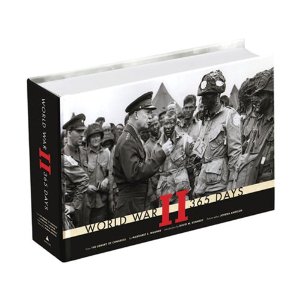
I have a stunning World War II book that I got when it was published in 2009. It’s a hard-cover Library of Congress edition 2.25 inches thick called World War II 365 Days by Margaret E. Wagner.

Beautifully written, it puts the complex global war in perspective and includes reproductions of photos, drawings, maps and cartoons that you don’t usually see.

Every now and then, I read a few pages, but now that I’m near the end, I’m surprised that the Library of Congress put out a book with some glaring errors. I’m not talking about misspellings. I’m talking about flat-out having stuff wrong.

A blurb under January 28 has the Battle of the Bulge ending on that date in 1944. The Bulge didn’t start until the end of 1944. The correct date is January 28, 1945.

The text for a page on the Japanese execution of Allied fliers says the Doolittle raid on Tokyo was carried out by “American B-17s.” Ouch! The raiders flew B-25 Mitchells, not Flying Fortresses. It’s all the more unnerving because the info is correct elsewhere in the book.

An item on the Battle of the Bulge has the U.S. 101st Airborne Division being surrounded by German forces in the village of Bastogne, Luxembourg. Bastogne is in Belgium.

About a year ago, I wrote to the publisher, Harry N. Abrams Inc. of New York, to point out the boo-boos but never heard back.

OK, so I’m talking about less than a handful of mistakes that caught my eye, but if you’re going to publish a book that you tout as authoritative, you’d better have copy editors paying attention to every little detail.


Grandpa’s worst enemy in the war with Spain


Robert B. Dees in mid-1950s

Robert Burns Dees in the mid-1950s

The military service file of my wife’s grandfather came in the mail last week, nine days after I ordered it online from the National Archives in Washington, D.C. It is a reminder of the debilitating role disease can play in the armed ranks.

To my mother-in-law, 89-year-old Naomi Schleicher, her father had always been in good health. He never talked about the trouble that laid him low while he served in Texas during the Spanish-American War. She was surprised to learn that her dad, Robert Burns Dees, had been very sick for weeks in 1898.

Dees was a private in Company L, 4th Texas Volunteer Infantry, at Camp Mosby, San  Antonio – a unit that never went overseas. His file, which is 17 pages, shows that as a 21-year-old he was hospitalized in September 1898 with “malarial fever.”

The Arkansas native, who was single and listed his occupation as “farmer,” had been in the Army less than three months. He was granted three furloughs, which he spent recovering at the home of his married sister, Linda Armstrong, in Thornton, Texas, more than 200 miles northeast of San Antonio.

In his first request for a furlough, he wrote from the hospital at Camp Tom Ball, Houston, on Sept. 27: “My reasons are that I have been very sick here in the hospital for the last 19 days and am still unfit for military duty.” He signed the letter: “Your most obedient servant, Robert B. Dees.”

A civilian doctor in Thornton described Dees in a letter to his company
commander, Capt. S.W. Parish, as “very sick with bilious-intermittent fever.”

Pvt. Dees was mustered out, along with the rest of the 4th Texas, in March 1899. He worked for a Texas rancher and married his daughter. The couple moved to California and had eight children, Naomi being the seventh.

Dees lived into his mid-80s, never again becoming as sick as he had been in the service of his country. I got his file for $25 by ordering it from this National Archives eservices site: https://eservices.archives.gov/orderonline/start.swe?SWECmd=Start&SWEHo=eservices.archives.gov