How to know a slain soldier you never knew

A man is writing a book about a relative he didn’t know who was killed in Vietnam, according to a newspaper story last week.

Me? Well yeah, that fits what I’m doing, but this is about someone else – a 23-year-old who’s pursuing a master’s degree in history. The student, Joe Gilch from Gloucester Township, N.J., is writing about an uncle with the help of a Rutgers University history prof.

Joe’s uncle, Jimmy Gilch, was killed in Vietnam when he was 20 years old, the same age as my cousin Nicky Venditti when he died in the war. The similarity ends there. Jimmy was an infantryman, while Nicky was a helicopter pilot. Jimmy was outside Cu Chi, while Nicky was at Chu Lai. Jimmy died in 1966 when his personnel carrier was bombed; Nicky died in 1969, days after arriving in Vietnam, in what the Army said was a training accident involving a grenade.

Joe got interested in his uncle as a child, when his grandmother read him letters that Jimmy had sent to friends and relatives – and he had written a lot of them, more than 80. I got interested in writing about Nicky when I learned in 1994 that the records show he wasn’t killed by the enemy. I’d always thought he’d died as a result of rocket attack, a story that went around at the time.

At Rutgers, Joe teamed up with professor Michael Adas, who’s 69 and has written about war. He provides the historical context while Joe writes about his uncle. It’s very much a Vietnam War story – Jimmy had been in Vietnam five months when he was killed — while my story about Nicky is less so, because Nicky’s tour lasted a mere 12 days.

Still, Joe and I face a common challenge. He told The Philadelphia Inquirer: “How am I going to write a story about a man that I never knew?”

The answer is: You get to know him.

I was 15 when Nicky died, and all I remember about him is that he said “hi” to me once. Over the years, I’ve been reading his letters, studying pictures of him, walking around his hometown of Malvern, Pa., following his short path in Vietnam, collecting documents and talking with everyone I can find who knew him, both at home and in the Army. My notes and transcribed interviews fill a filing cabinet.

So, Joe, you do the reporting and you’ll get to know your uncle as I’ve gotten to know Nicky.


Pennsylvania’s men of valor in Korea

A few weeks ago I wrote about Pennsylvanians who were awarded the Medal of Honor for their bravery in World War II.

Let’s move on to the Korean War.

There were five, according to Pennsylvania magazine, and all received the nation’s highest military honor posthumously.

Here they are:

Army Pfc. Melvin L. Brown of Mahaffey, Clearfield County; Company D, 8th Engineer Combat Battalion; killed Sept. 5, 1950, near Kasan, Korea

Army Capt. Reginald B. Desiderio of Clairton, Washington County; Company E, 27th Infantry Regiment, 25th Infantry Division; killed Nov. 27, 1950, near Ipsok, Korea

Army Sgt. Donn F. Porter of Sewickley, Beaver County; Company G, 14th Infantry Regiment, 25th Infantry Division; killed Sept. 7, 1952, near Mundung-ni, Korea

Marine 2nd Lt. Robert Dale Reem of Lancaster; Company H, 3nd Battalion, 7th Marines, 1st Marine Division; killed Nov. 6, 1950, near Chinhung-ni, Korea

Army Cpl. Clifton D. Speicher of Gray, Lycoming County; Company F, 223rd Infantry Regiment, 40th Infantry Division; killed June 14, 1952, near Minarigol, Korea

You can read the citations for all of them on the Congressional Medal of Honor Society website, www.cmohs.org. Go there, and prepare to be moved to tears.


Scrap the Stolen Valor Act

Back in 1999, I was editing a story about a Vietnam War vet for a special section in The Morning Call and a flag went up. The guy was making some claims about his own heroism. It didn’t sit right. I went to see him, and his claims got even wilder. When I asked to see proof that he was in Vietnam, he couldn’t produce it. The story never got in the paper. I’m sure it wasn’t true.

I bring this up because the U.S. Supreme Court recently heard arguments on whether the Stolen Valor Act is constitutional. The law, which Congress passed in 2005, during the height of the Iraq and Afghanistan wars, makes it a crime to falsely claim that you’ve won military honors.

A federal appeals court in San Francisco ruled the law violates the right to free speech. An appeals court in Denver upheld it, saying the First Amendment doesn’t always protect false statements. That’s the Obama administration’s take: that the law specifically protects the system of military honors Gen. George Washington put in place during the Revolution.

As awful as it is for someone to puff himself up by claiming he was awarded a Medal of Honor or other high decoration, I can’t get past the idea that we’re making criminals out of people for something they said. It doesn’t make sense that in this country, you can go to prison for lying – as reprehensible as the lie is. Better to expose the faker and hold him up to public disgrace.

The appeals court in San Francisco had this good suggestion: “Preserving the valor of military decorations is unquestionably an appropriate and worthy governmental objective that Congress may achieve through, for example, publicizing the names of legitimate recipients.”

Some lawmakers have jumped on that, criticizing the Defense Department for not having a searchable database of medal recipients. One Pentagon official responded that there’s a benefit to that, but is it worth the cost?

Even without a central database of medal recipients, there are online resources you can use to check on someone’s claims to bravery. There’s the Congressional Medal of Honor site, http://www.cmohs.org/recipient-archive.php, and the Military Times Hall of Valor site, http://militarytimes.com/citations-medals-awards/.

And if you want a big picture, read Stolen Valor: How the Vietnam Generation Was Robbed of its Heroes and its History, a 1998 book by B.G. Burkett and Glenna Whitley. It’s a shocker.

We already have a federal law that bars folks from wearing military medals they didn’t earn. That’s something you’d do, not say. We should leave it at that and get the government out of the business of identifying and prosecuting liars. I say overturn the Stolen Valor Act.

Where devotion to country flourishes

I’m always awed by the patriotism of older Americans, especially at veterans events.

On Saturday, at the annual banquet of Lehigh Valley Chapter 190, Military Order of the Purple Heart, I looked around during the playing of taps and saw aging warriors in their service caps, some in their 90s, standing as straight as they could and saluting. Earlier they stood for the Pledge of Allegiance and sang “God Bless America.”

Old-fashioned? Yeah, I guess so. Corny? No.

I’ve been going to the Purple Heart banquets in Fullerton since 2003, missing only one for a family wedding. Naturally, there was a more robust crowd back then, many of them World War II vets who were still doing all right health-wise. But there are far fewer now.

Some of the chapter’s members became subjects of my series “War Stories: In Their Own Words,” among them Woody Woods, Charlie Kowalchuk and Whitey Eschbach, who have since died. Others, like Joe Motil, are still going strong. Joe is 93 and still works on the Williams Township farmland he grew up on.

The backbone of the Purple Heart chapter now is a core of Korean and Vietnam War vets. They seem no less passionate about their country than the World War II guys.

In a nod to frailty, the banquet’s program focused on benefits available to survivors of veterans. The speaker was Dale Derr, director of veterans affairs in Berks County, where 800 veterans die each year. He said most survivors don’t know what benefits they’re entitled to, and told how the feds, the state and counties can help.

Groups like the Purple Heart chapter provide vets and their families a venue for camaraderie and purpose. For an outsider like me, it’s inspiring to witness their spirit and devotion to country.

Introducing “War Stories,” the Kindle edition

War Stories

"War Stories" is now available as an e-book.

If shameless self-promotion burns your grits, read no further.

I’m here this week to hawk the new Kindle edition of my book War Stories: In Their Own Words, available on Amazon.com for $9.99.

Thanks to digital technology, now you can read an e-book with all 34 stories of Pennsylvanians from the World War I era, World War II, the Cold War, and the Korean and Vietnam wars. It’s auto-delivered wirelessly, Amazon says, with all the same photos that appear in the print version.

If you missed it, the book came out in print last September, published by my employer, The Morning Call of Allentown. You can still buy the paperback edition from the newspaper for $14.95.

I can get you to the digital version a couple of ways. Go to the Call‘s website, www.themorningcall.com, and in the upper right, click on Store, then on War Stories Kindle Edition. That will take you to the Amazon page.

You can get to the Amazon page directly with this link: http://www.amazon.com/War-Stories-Their-Words-ebook/dp/B007C5P9AW/ref=sr_1_2?ie=UTF8&qid=1330322467&sr=8-2

I hope you like War Stories in this digital format.


Our last link to the Great War vanishes

With World War II veterans in their late 80s and beyond, it’s hard to believe that until the last year a few vets of the First World War were still around.

This month its last known survivor  died – 110-year-old Briton Florence Green, who signed up with the new Women’s Royal Air Force in September 1918 and served two months on active duty before the Armistice. Her job was waiting on tables in the officers’ mess at Narborough Airfield and RAF Marham, Norfolk.

In 2011 we lost the last known combat vet of the war, Claude Choules, who was born in Britain and died in Australia, and the last known American non-combat vet, Frank Buckles of West Virginia.

With Florence gone, so is all modern memory of the Great War, which broke out almost a hundred years ago.

Isn’t it amazing that it hung on for so long?

For the ages: Medal of Honor holders from WWII

Alton W. Knappenberger

Alton W. Knappenberger

A friend recently handed me a few pages from Pennsylvania magazine, dated August 1992, about the state’s Medal of Honor recipients from World War II.

Of 35 Pennsylvanians who got the nation’s highest military award for bravery, 20 received it posthumously. As of the publication date, four were still living in the state and four were living elsewhere.

I wondered if any of them survives to this day, so I did a quick Google search. The answer is no: All are gone.

One of the eight was Alton W. Knappenberger, a Coopersburg native I interviewed in 2004 at his home near Boyertown. He died in 2008. My story on him appears on the Arlington National Cemetery website at http://www.arlingtoncemetery.net/awkappenberger.htm.

Three of the others listed as living in the state were Gino J. Merli of Peckville, who died in 2002; Leonard A. Funk Jr. of McKeesport, who died in November 1992; James M. Burt of Wyomissing, who moved to Pennsylvania after the war and died in 2006.

Four were from the state but living elsewhere: Mitchell Paige and John J. Tominac were in California — Paige died in 2003 and Tominac in 1998; Freeman V. Horner was living in Georgia and died in 2005; and Jay Zeamer Jr. was living in Maine and died in 2007.

They belong to the ages, but their names and what they did will live forever.


A final salute to an extraordinary WWII soldier

Dick Richards

Dick Richards at Fort Benning, Ga., on April 30, 1942

The war veterans I interview are in their 80s and beyond, so you’d think I’d get used to losing them. Nearly half of the three dozen vets in my book War Stories: In Their Own Words have died, and that was in a period of 12 years.

But it doesn’t get any easier, and that point was driven home yet again over the weekend.

Dick Richards, a World War II vet I first met with early in 2010, died about 6 p.m. Saturday (Feb. 4, 2012) in Easton Hospital. He was 95. I got the word later that night in a phone call from Morris Metz, president of the Lehigh Valley Chapter of the Veterans of the Battle of the Bulge, who had introduced me to Dick.

Dick’s longevity was all the more amazing when you consider what happened to him in the war. A soldier in the 99th Infantry Division, he crossed the Remagen bridge into Germany’s heartland in March 1945 and shortly afterward lost his jaw to an enemy shell. For two years and seven months, he was a patient at Valley Forge General Hospital, where doctors built him a new jaw. But they couldn’t give him teeth, so he could never again eat solid food.

For more than a year, Morris had politely pestered me about doing a story on Dick, and on a rainy spring day, March 29, 2010, took me to see him. Dick lived alone in the house he grew up in on Morgan Hill in Williams Township, with an orchard out back and a big, lovable dog name Ginger. His wife had died the year before. When Morris said I was there to do a story on him, Dick shot back, “My name’s not going to be in the paper, is it?” Morris laughed. I winced, concerned about whether he’d talk to me.

That didn’t turn out to be a problem. I ended up meeting with Dick many times, usually for two hours or so in the afternoons, with my digital recorder running. When the story was in shape to run in The Morning Call on Memorial Day, staff photographer Kevin Mingora shot nice portraits of Dick, who called Kevin “Mumbles” because he had trouble hearing him. Kevin still laughs about that.

Morris has told me that the story perked Dick up and boosted his pride. Here’s the link to it: http://www.mcall.com/news/all-dickrichards,0,6369554.story Dick started coming to Bulge vets luncheons, and I couldn’t keep him supplied with enough extra copies of his story to give to friends and family. Last October, after my War Stories book came out, he bought six copies for his children.

We continued to meet from time to time, just chatting in the afternoons in his living room. He liked to talk about growing vegetables and how much he enjoyed sharing them with friends, who always came back for more. One day he insisted I go home with some of his cucumbers.

In the summer of 2010, Morris, Bob Faro of the Lehigh Valley Military Affairs Council and I visited Dick on his 94th birthday, and I visited him on his 95th birthday last July.

A few weeks ago, Morris called me and said Dick had been moved to Manor Care nursing home in Easton and probably wouldn’t be going home. I went to see him on Jan. 23 and he chattered for an hour, just like old times. He seemed fine. But then a week later, he was admitted to the hospital, where he lay semi-conscious. When I called his room on Friday and spoke with his daughter Kathy, she said his condition was not good.

The next day was his last.

Dick had been a member of the Greatest Generation who had answered the call to arms and suffered a terrible, disfiguring wound, but said he would put on a uniform again if the nation needed him.

I’ve lost a friend who was the definition of courage. It hurts that he’s gone.

Touring WWI battlefields, the Michelin way

American troops in Michelin book, 1920

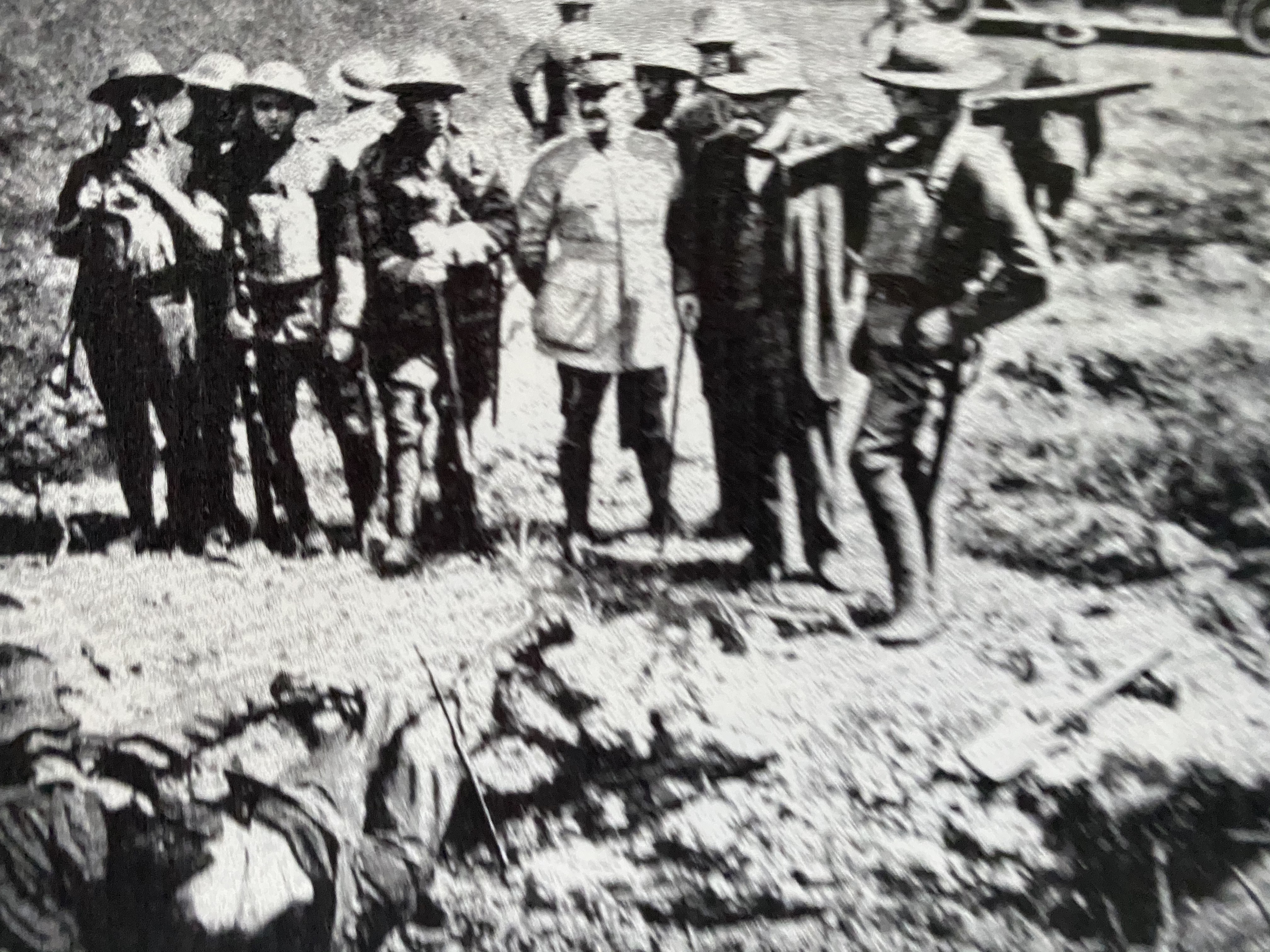
This photo appeared in Volume 1 of the Michelin Illustrated Guides to the Battlefields (1914-1918). The book title is “The Americans in the Great War: The Second Battle of the Marne.” The caption reads: “The French prime minister, M. Clemenceau, congratulating the American troops on the battlefield at Chateau-Thierry.” Clemenceau is second from the right. The photo is credited to the French illustrated weekly newspaper, L’Illustration, published in Paris.

The First World War was over but still an open wound in 1920 when the Michelin Tire Co. came out with a three-volume collection called The Americans in the Great War, with the header, Michelin Illustrated Guides to the Battlefields (1914-1918). Published by Michelin & Cie, Clermont-Ferrand, (France), it’s dedicated to “the Michelin workmen and employees who died gloriously for their country.” At the time, each volume cost $1.

The doughboys are heaped with praise in what is otherwise a dry recitation of the facts of the American engagement in France. “The Americans fought bravely,” it says. In the volume on the Meuse-Argonne battlefields, I read that the “splendid fighting spirit of the [U.S.] troops was remarked by all, and their fine comradeship, both on the firing line and at rest, won the widest possible admiration.”

I guess folks needed to hear that less than two years after the war ended, to help them come to terms with the sacrifices that had been made – the terrible losses of life, limb and sanity.

Touted as “A panoramic history and guide,” the books are sprinkled with photos that show generals, battlefields, towns and villages in ruin, but no graphic reminders of the staggering human carnage. There are maps showing the movement of armies and directions on how to tour the battlefields by car, as well as suggested itineraries.

The three volumes I have once belonged to Jack Davis of Easton, a World War II veteran whose account of his experience in the Battle of the Bulge is in my book War Stories: In Their Own Words. Jack died more than a year ago. His daughters gave his collection of several dozen military history books to the Lehigh Valley chapter of the Veterans of the Battle of the Bulge, of which he’d been a member. At the last meeting, those books were divvied up by lottery. As an associate member, I was lucky to get the Michelin books.

Jack’s copies appear to have been owned at some point by a Michelin agent. The title page of Volume 1 is stamped “C. Everett Hesselgrave, agent, 109 White Bldg., Seattle. Phone Main 289.” Hesselgrave signed the copy.

One of the most interesting aspects is the advertising – full-page ads with spare line drawings of cars and maps.

Here’s the text for one:

You don’t know what a
Good Road Map
is, if you haven’t used the
Michelin Map.
The tourist finds his way about easily in a town, if he has a plan giving the names of the streets.
He gets about with the same ease and certainty on the road, if he has a Michelin Map, because it gives the numbers of all the roads.

And here’s another:

The Michelin Wheel
BEST of all detachable wheels because the least complicated
Elegant: It embellishes even the finest coachwork.
Simple: It is detachable at the hub and fixed by six bolts only.
Strong: the only wheel which held out on all fronts during the war.
Practical: Can be replaced in 3 minutes by anybody and cleaned still quicker.

So, the books don’t just tell you about the American battles of World War I. They tell you about 1920.


Remembering an American flier in the RAF

Douglas MacGillvary Brown

Douglas MacGillvary Brown in the Lehigh University Class of 1941 yearbook

Some stories just keep coming around for another turn.

Almost 12 years ago, The Morning Call ran a story about Douglas MacGillvary Brown, a young American flier who left Bethlehem to fight for England before the U.S. entered World War II. He was killed before he got the chance.

The story was written by Kathy Lauer-Williams, with me as the editor. It told how Brown, a 21-year-old Lehigh University graduate, was on a Royal Air Force training flight on April 5, 1942, when his Spitfire Mk1 crashed into a mountain in North Wales.

The story’s peg – the reason Kathy wrote it – had to do with a woman who lovingly tended the pilot’s grave in the village of Tubney, England, for 45 years until she died.

Kathleen Barner was a stranger to Brown. She was married in Tubney’s St. Lawrence Church the day before he was buried, and made it her mission to keep the grass around his grave neatly mowed and the headstone clean. She often wondered about Brown, the only serviceman buried in the churchyard.

After Barner died in 1987, church member Briony Blackwell and others in the congregation wanted to learn all they could about Brown to honor Barner’s memory. Their search led to details of his life, how he came to fly for the RAF and what happened the day his plane hit North Wales’ Cwmbowydd Mountain.

Blackwell hoped to preserve Brown’s story with the church parish records. “It’s so tragic,” she told Kathy. “It’s sad that he died away from his country. In this way, we can help a brave man to be remembered.”

Kathy’s story ran on Page 1 on Sunday, April 2, 2000, to mark the 58th anniversary of Brown’s death. Here’s the link: http://www.mcall.com/news/all-tubneygraves,0,3008866.story. It was paired with a story I wrote about another American who flew for England and also died in a training accident in early 1942, Robert Riedy of Allentown.

We haven’t had anything about Brown in the paper since Kathy’s story. But that could soon change as a result of an email we got last week, informing us of another U.K. effort to remember Doug Brown.

The message was from Mel Thomas in Blaenau Ffestiniog, North Wales, who described himself as project leader of a “loose group of enthusiastic historians and archaeologists” who plan to put up a memorial plaque near the site where Brown’s plane crashed. He emailed The Morning Call because his group found a photo of Brown on the paper’s website.

When I asked Mel what this was all about, he said his group is cataloging “the history of a now derelict community in a hidden valley above our town – a valley called Cwmorthin.”

“Earliest settlement goes back to the 1500s and the last resident left in 1948. Part of its timeline involved a crash of a Hawker Hurricane flown by a Canadian pilot who was killed in the crash,” Mel wrote. “We decided to do a plaque in his memory and then realized that others had died near the town during the war. Hence the move now on to remember Doug.”

I asked Mel about the other deaths, and he wrote that a twin-engine Vickers Wellington Mk1c bomber hit a mountain coming back from a raid on the German U-boat pens at Lorient in Brittany, France.

“Five of the six crew were killed. The tail gunner survived when the turret detached on impact. When he came to with the rescuers around him, he presented his pistol, thinking he was in France because he could not understand their language. They were in fact speaking Welsh!

“He was in the local hospital for five weeks with a broken leg and bad bruising, getting daily visits from local schoolchildren.”

Mel said the plaque for Doug Brown will be placed at the starting point of a mountain bike course that’s under construction and expected to be completed by April. Watch The Morning Call, http://www.mcall.com/, for an update.