World War II in a weekend

Just spent three days hawking my War Stories book at the Mid-Atlantic Air Museum’s annual World War II Weekend at Reading Regional Airport. It was a blast.

D.J. Cleaver from The Morning Call’s marketing office and I had a table set up in the huge vendors hangar, which doubled as a swing band’s stage and dance floor Friday and Saturday nights. We were right on the edge, where the hangar’s door opens, so we could see the P-51 Mustang doing aerobatics, a P-40 Warhawk fighter chasing a Japanese replica Aicha Val dive bomber, and we saw and heard other warbirds in the sky: a Dauntless dive bomber, an Avenger torpedo bomber, a B-25 Mitchell, a B-17 Flying Fortress, a B-29 Superfortress. (If you had $1,495 handy, you could go for a 20-minute ride in the P-51, while just $450 would give you a half-hour ride in the B-17.) The roar of engines was so loud, you could hardly talk to the person next to you.

From our table, we could look out on the outdoor stage, which had entertainment like the Manhattan Dolls, a trio that mimics the Andrews Sisters – they were terrific — and Frank Cubillo, who sings Sinatra.

Clustered around us in the hangar were the Tuskegee Airmen from Philadelphia, an ex-newspaper man from the Bergen (N.J.) Record who was selling audio CDs of veterans telling their stories, a stand with pin-up girl calendars, with two women in saucy, 1940s garb who’d pose with you and sign your calendar, leaving a lipstick smudge on your birthday. D.J. and I got to be friends with Beth Miglio from Berwick, a young woman who had self-published a book of her late grandfather’s letters, Faith in a Foxhole: War Letters To Home. She was launching the sale with her mom, who appreciated the good coffee from a stand outside the hangar as much as I did.

Imagine manning a table from 8 a.m. to 5 p.m. three days in a row, trying to drum up sales. Yep, it could be tiresome. But there were so many interesting, and interested, folks to talk to. Some old vets told me their own stories, children of vets told me about their moms and dads. One man who had just lost his father, a C-47 pilot in the China-Burma-India Theater, spoke with me for a full hour through. He was alone and it seemed he needed a friend just then, so I didn’t cut him off. “I guess I’ll buy your book,” he said halfway through. Later, D.J. said I worked hard for that sale. OK, it was good that he bought the book, but it wouldn’t have mattered to me.

Occasionally there was a stunning connection: On Sunday I wore a USS Indianapolis cap my friend Steve Savage gave me. A re-enactor asked me what link I had to the heavy cruiser that had delivered atomic bomb parts, was sunk by a Japanese submarine and lost many of its crew to sharks. I said the cap was a gift after I did a story on an Indianapolis survivor, and he said, “Don Mack?” It was, indeed. It turns out Mack, who has since died, was the man’s friend and neighbor. Here’s the link to my 2010 story: http://www.mcall.com/news/local/mc-mack-indianapolis-sharks-20100729-20,0,6229377.story

Friends stopped at our table to chat. There was Mike Sewards of the Lehigh Valley Veterans History Project, looking for speakers, and Larry Miller of the National World War II Museum, there to interview vets.

The weather didn’t always cooperate. Friday was overcast all day and we got socked with heavy rain after 4 p.m. On Saturday afternoon, at 12:30, we got a big downpour, and hundreds of people packed into our hangar. D.J. and I scurried to clean off our table just before the rain blew in and drenched it. We got soaked as well. Out on the tarmac, we saw people huddled under the wings of planes, not much protection.

After we closed down Saturday, I wandered the grounds. Going through the German army re-enactors’ camp was a bit eerie: They had machine guns pointing at the path. I got up close to many of the aircraft, marveling at their size and ruggedness. And I did some buying of my own. A guy was selling hundreds of plastic model kits and offering two for the price of one. I bought two biplanes for my collection, a Curtiss Goshawk and a Stearman PT-17.

It was a fascinating weekend, and yep, we did fine selling my book War Stories: In Their Own Words, a collection of 34 of my interviews with vets over the last 13 years, representing the World War I era through Vietnam. By the way, here’s how to order it: https://secure.mcallcommunity.com/store/pages/war-stories.php

\
What Memorial Day stands for

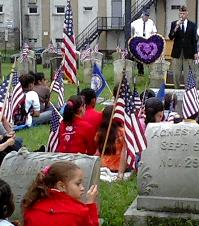
Cleveland Elementary School students at Purple Heart chapter’s Memorial Day ceremony in Union and West End Cemetery. Photo by Mary Louise Zakrewski

This is Memorial Day, and I’m thinking of my uncle Sam Venditta, who died of a World War II injury at age 31 five years after the war ended, and my cousin Nicky Venditti, a 20-year-old Army helicopter pilot who went to Vietnam in 1969 and was dead in 11 days.

The war dead – that’s what this holiday is about.

It’s interesting that over many years, the day has evolved to encompass more than that. Many ceremonies aren’t just about the fallen; they also embrace veterans and current servicemen and women. Unless memory fails me, that’s been in sharper focus since 9/11 and the wars in Iraq and Afghanistan. It’s as if we’re trying to make amends for the way we treated Vietnam vets in the 1960s and early ’70s.

One Memorial Day ceremony I attended in Allentown over the weekend, at Cedar Crest Bible Fellowship Church, warmly saluted veterans and service members, who had been especially invited. Hundreds of people applauded the vets as they stood while a band played the Army, Navy, Air Force, Coast Guard and Marine Corps themes, and a reception was held for them afterward. It was a patriotic outpouring of gratitude.

I’m not saying that’s wrong. Vets and those now serving certainly deserve our thanks. But we do have a day set aside for them — Veterans Day — and it’s easier for us to show our appreciation for them. They are among us. The dead aren’t here. We can’t speak with them and shake their hands and thank them for making the ultimate sacrifice. They can’t acknowledge the attention. They live only in memory.

Still, veterans groups who hold Memorial Day ceremonies are more on the mark. I was at a service Friday put on by a half-dozen members of Lehigh Valley Chapter 190, Military Order of the Purple Heart. It took place in front of the graves of Civil War veterans in Union and West End Cemetery in Allentown, where dozens of kids from Cleveland Elementary School sat in the grass and held small American flags.

A bell was rung to mark the passing of Purple Heart members in the past year – Edwin W. Geyer, Mark Lacina, Phillip J. Leshay and Dennis S. Sell. A wreath was placed in honor of the dead, and three World War II vets fired a rifle salute.

It was a solemn tribute to our war dead, and it fit the day.


The light shined by lost paperwork discovered

A few weeks ago I wrote about the nine Pennsylvanians who received the Medal of Honor for valor in the Vietnam War, and now there is a 10th – Army Spc. 4 Leslie H. Sabo Jr. of Ellwood City, which straddles Beaver and Lawrence counties.

He served with Company B, 3rd Battalion, 506th Infantry, 101st Airborne Division, and earned the medal the day he died, May 10, 1970, in Se San, Cambodia. His widow received it for him last week from President Obama, 42 years later. You can read the citation online at http://www.cmohs.org/featured-recipients.php.

I first read about Sabo in a Pittsburgh Post-Gazette story, http://www.post-gazette.com/stories/news/us/local-soldier-receives-medal-of-honor-42-years-after-dying-636217/ that not only recounts how Sabo was chosen to get the medal, but why he was getting it now.

It turns out a veteran going through Medal of Honor files in the National Archives in 1999 came across witness accounts that attested to Sabo’s extraordinary valor. That veteran, Alton “Tony” Mabb, then checked whether Sabo actually got the medal, and he hadn’t.

This was a case of lost paperwork that reminded me of my cousin Nicky Venditti, an Army helicopter pilot who died along with two other young men as a result of a grenade going off while they were in training at Chu Lai, Vietnam. I’ve been searching since the mid 1990s and haven’t found an incident report.

It makes you wonder how much from the Vietnam War is still unaccounted for, and how many service members from all American wars might not have received the credit they deserve.


My blown chance to present a WWII flier’s story

A down side to interviewing aging war veterans is that if you put one off, you might miss the opportunity completely.

That was the case with Carl Manone, a retired educator who was a Hellertown High School grad and a bombardier on a B-29 Superfortress during World War II.

A colleague at The Morning Call, columnist Bill White, put me on to Carl last summer. Bill had known Carl for years but hadn’t seen him in quite a while. Carl had emailed a story he wrote, three-and-a-half single-space pages.

His title was “Tokyo destroyed – 16.6 square miles incinerated in most horrific aerial bombardment in history: an introspective account by Carl Manone, pathfinder and lead bombardier on Crew 4001, Earthquake McGoon.”

Bill forwarded the account to me, suggesting it was a ready-made story for my Morning Call series, “War Stories: In Their Own Words.”

A few days later, Bill and I got a message from Carl that reflected the aim of many vets to get the facts right.

“Since sending you my B-29 article, I’ve been double-checking my grammar and data,” he emailed. “I’ve discovered a few errors – a major one being the weight of the plane. It should read 135,000 lbs. instead of 68,000.”

He attached a corrected copy.

I got back to Carl about a month later, saying a good time for his account to run in the newspaper would be March 9, 2012, which would be the 67th anniversary of the mission he wrote about. I asked if we could get together early in 2012.

Another month passed, and I didn’t hear back from him. Then on Nov. 19, I got an email from Carl’s wife, Dani, who said he had been hospitalized for eight weeks and was now in rehab.

“It’s a long road with lots of detours along the way,” she wrote. “But Carl is always a soldier at heart, so I’m hoping that he’ll keep marching on.”

The March anniversary passed and I didn’t hear from the Manones.

A few weeks ago I found out that Carl died March 14 at age 88. I had blown my chance to interview him about the daring low-level B-29 raid on Tokyo that he had helped lead as a 21-year-old first lieutenant in the Army Air Forces. An interview could have been weaved into his written account, complementing it.

Morning Call reporter Adam Clark wrote a story that ran May 8 saying that Carl was to be buried that day at Arlington National Cemetery.

Carl’s story need not be buried with him. I have it, and I can still get it into the newspaper so that readers can appreciate what he did on the B-29 nicknamed Earthquake McGoon and that there will be a permanent record of his experience.

That’s the least I can do to honor the memory of a flier whose decorations include two Distinguished Flying Crosses for heroism.


World War II tales of submarines

Veterans and their friends have given me more than an armful of books about war and the military over the years. One of the gifts I got this year was written by a Navy veteran from Allentown and printed by a military history publisher, indicating the author was a skilled writer.

The book is War in the Boats: My WWII Submarine Battles, by retired Capt. William J. Ruhe, published in 1994 by Brassey’s, now Potomac Books, with a foreword by Tom Clancy. Ruhe was a technical adviser for Clancy’s thriller The Hunt for Red October.

War in the Boats was based on a journal Ruhe kept, in which he wrote about eight patrols against the Japanese in the South Pacific. The Washington Times called it “The human side of submarine warfare…exciting reading.” He also wrote Slow Dance to Pearl Harbor: A Tin Can Ensign in Prewar America.

Even though I’ve been working at The Morning Call of Allentown for 28 years, I’d never heard of Ruhe. But a check of the newspaper’s archives showed we’d written about him in the mid 1990s, when he was living in McLean, Va.

Ruhe was the son of a longtime editor of The Morning Call, Percy Ruhe, and could sing and dance. At the University of Pittsburgh, which he attended, he once tap-danced with Gene Kelly. For years he sang in barbershop quartets. He wrote a song, “Take Her Down,” for the submarine service.

A 1939 Naval Academy graduate, Ruhe was a submarine captain in the war, skipper of the Sturgeon, and received three Silver Stars. He also served on other subs and on surface vessels. He went on to run the Naval Reserve Center in Allentown, edit Submarine Review and direct marine programs for submarine maker General Dynamics.

One of The Morning Call stories about Ruhe is his obituary. He died Nov. 4, 2003, at his home in McLean at age 88.

His War in the Boats book sits on the “need to read” pile on my desk, along with a submarine book someone gave me years ago, 1969’s Iron Coffins: A Personal Account of the German U-boat Battles of World War II, by former U-boat commander Herbert A. Werner.

A fitting tribute to Korean War veterans

The directors of Korea/Vietnam Memorial Inc. held a beautiful, heartfelt tribute to the Lehigh Valley’s Korean War veterans Sunday at Lehigh Carbon Community College. I’ve been to many such events over the years, but this was one of the most stirring.

Turnout was spectacular, causing a 40-minute delay in the start of the program as college President Don Snyder arranged to open up two partitions for more seating. Where the organizers had made seating available for as many as 277 people, and figured there’d be considerably fewer, more than 400 people showed up.

LCCC’s Schnecksville campus is the home of the U.S. Armed Forces Plaza, which commemorates those who served in all American wars, and the plaza’s Korea/Vietnam Memorial, which was dedicated in 2005.

The highlight Sunday centered on Army Col. David J. Clark, who heads the Defense Department’s 60th Anniversary of the Korean War Commemoration Committee. He spoke about remembering those who served and their sacrifices, and presented certificates to the Korean War veterans or their family members.

Standing ramrod-straight and showing great deference as he went out into the audience to deliver the papers, Clark was an exemplary ambassador from the Pentagon. To me, it was the most poignant part of the afternoon. Eighty-five vets were honored. Each name was announced to applause.

I was grateful to have a small role in the ceremony. Bob Wolfe of the Korea/Vietnam Memorial organization based in Fogelsville had invited me to speak briefly about my book, War Stories: In Their Own Words, and to offer copies for sale. I sat up front, facing the audience, with special honoree Jim Snyder Jr. beside me – he lost both of his legs to a mortar shell in South Korea.

Early in the program, I followed Don Snyder, state Rep. Gary Day and Sukwon Lee, representing the Korean American Association of the Lehigh Valley, to the lectern.

Here’s what I said:

In the mid ’90s I got interested in a cousin of mine who was killed in Vietnam. He was an Army helicopter pilot, 20 years old. He went to Vietnam in the summer of 1969, he was assigned to the Americal Division at Chu Lai, and he was dead in 11 days.

His name was Nicky, and I hardly knew him. I asked my uncles about him, and they ended up telling me about their own war experiences. Here I found I had a whole parade of uncles who had served in World War II and Korea in far-flung places – from the Aleutians to North Africa to Bora Bora. One of them died from a World War II injury five years after the war ended.

My dad was also in World War II, with the Coast Guard in the North Atlantic. But by the time I was interested in talking to him, it was too late. He had already drifted deep into the fog of Alzheimer’s.

My uncles, my dad, they were ordinary people who saw and did extraordinary things.

Thirteen years ago I began interviewing veterans like them for The Morning Call. Now there are about 90 stories in my series, War Stories: In Their Own Words. Last fall, the newspaper published a collection of my stories in a book of the same name. It’s 34 of my interviews with men and women from the World War I era, World War II, the Cold War, Korea and Vietnam.

I am not a veteran. So for me, this is about payback. It’s my way of saying to you: Thank you for serving our country.

During the reception after the ceremony, I looked for Col. Clark and shook his hand. I told him that the sincerity and respect he showed while presenting the certificates to the veterans or their relatives had brought tears to my eyes.

He replied, “It’s the least we can do for them.”

My sentiment exactly.


Pennsylvania’s men of valor in Vietnam

I’m getting back to my series on Pennsylvanians who have been awarded the Medal of Honor, and this week it’s the Vietnam War.

Nine Pennsylvania natives received the military’s highest award for valor, seven posthumously.  Of the two others, one survives.

You can look up their citations and more about them at http://www.cmohs.org/, the official website of the Congressional Medal of Honor Society.

Here they are in alphabetical order:

Army Cpl. Michael J. Crescenz of Philadelphia
Company A, 4th Battalion, 31st Infantry, 196th Light Infantry Brigade, Americal Division
Killed Nov. 20, 1968, in Hiep Duc Valley area

Marine Pfc. Ralph E. Dias of Shelocta, Indiana County
Company D, 1st Battalion, 7th Marines, 1st Marine Division
Killed Nov. 12, 1969, in Que Son Mountains

Army Sgt. David C. Dolby of Norristown, Montgomery County
Company B, 8th Battalion, 8th Cavalry, 1st Air Cavalry Division
Sept. 28, 1967, in South Vietnam
(He died Aug. 6, 2010.)

Army Staff Sgt. Glenn H. English Jr. of Altoona
Company E., 3rd Battalion, 173rd Airborne Brigade
Killed Sept. 7, 1970, in Phu My District

Marine Capt. James A. Graham of Wilkinsburg, Allegheny County
Company F, 2nd Battalion, 5th Marines, 1st Marine Division
Killed June 2, 1967, in South Vietnam

Army 2nd Lt. Walter J. Marm Jr. of Washington, Washington County
Company A, 1st Battalion, 7th Cavalry, 1st Air Cavalry Division
Nov. 14, 1965, in vicinity of Ia Drang Valley
(Marm is still living.)

Marine Cpl. William D. Morgan of Pittsburgh
Company H, 2nd Battalion, 9th Marines, 3rd Marine Division
Killed Feb. 25, 1969, in Quang Tri Province

Army Sgt.William D. Port of Petersburg, Huntingdon County
Company C, 5th Battalion, 7th Cavalry, 1st Air Cavalry Division
Killed Jan. 12, 1968, in Que Son Valley, Hiep Duc Province

Marine Lance Cpl. William R. Prom of Pittsburgh
Company I, 3rd Battalion, 3rd Marines, 3rd Marine Division
Killed Feb. 9, 1969, near An Hoa


Duncan Cameron, D-Day veteran, 1921-2012

Duncan Cameron

Duncan Cameron

E. Duncan Cameron of the 1st Infantry Division hit Omaha Beach on D-Day almost 12 hours after the first troops came ashore – and still faced hot German fire.  Three months later near Stolberg, Germany, mortar shrapnel almost cost him an arm.

Duncan, who grew up in Allentown and served in Company C of the 26th Infantry Regiment, died last week, three days after turning 91. It hit me hard when I happened to see his obituary at work Friday night while proofing a page for the next day’s issue of The Morning Call.

Yet another of my old friends is gone.

I interviewed Duncan for a D-Day anniversary story that ran in the newspaper on June 6, 2010.  Here’s the link: http://www.mcall.com/news/mc-e-duncan-cameron,0,757673.story As a separate item with the text, we reprinted a poem he wrote in his pocket diary a few days after the invasion, while in a foxhole amid Normandy’s hedgerows. It recounted his experience on June 6, 1944.

Duncan, who had been a college student before the Army drafted him in 1942, had a literary bent and continued to be a note and letter writer, as I found out. Last year his family invited me to his 90th birthday party – I wrote about it in a blog at the time — and a few days later I got a card from him: “Thank you so much for your visit on my birthday. It certainly brightened up an otherwise rainy day. I had great company and fun gifts and a yummy cake. Who could ask for more?”

But the letter from him that I will always treasure came a couple of weeks after his story ran. It was affirmation of the value of getting veterans’ stories out to the public.

“Last week was a busy one for me. I was answering questions regarding your article of my account covering the D-Day landing. I had many questions from family, friends, as well as a few strangers. They were all complimentary, and I had you to thank for that. You put it all together and kept it from falling apart.”

Books for the French and Indian War reader

Last week I went on about the French and Indian War. This week I’m giving you a reading list on the war, especially how it played out in Pennsylvania and the Lehigh Valley. Here are the books I recommend:

Crucible of War: The Seven Years’ War and the Fate of Empire in British North America, 1754-1766, by Fred Anderson

The Scratch of a Pen: 1763 and the Transformation of North America, by Colin Calloway

Facing East from Indian Country: A Native History of Early America, by Daniel K. Richter

King of the Delawares: Teedyuscung, 1700-1763, by Anthony F.C. Wallace

Into the American Woods: Negotiators on the Pennsylvania Frontier, by James H. Merrell

The Lenape-Delaware Indian Heritage: 10,000 B.C. to A.D. 2000, by Herbert C, Kraft

Breaking the Backcountry: the Seven Years’ War in Virginia and Pennsylvania, 1754-1765, by Matthew C. Ward

George Washington Remembers: Reflections on the French & Indian War, edited by Fred Anderson

Blooding at Great Meadows: Young George Washington and the Battle that Shaped the Man, by Alan Axelrod

Forts on the Pennsylvania Frontier: 1753-1758, by William A. Hunter

Juniata, River of Sorrows: One Man’s Journey into a River’s Tragic Past, by Dennis P. McIlnay

The Indian Wars of Pennsylvania, by C. Hale Sipe

The French and Indian War in Pennsylvania, 1753-1763: Fortification and Struggle during the War for Empire, by Louis M. Waddell and Bruce D. Bomberger

The Autobiography of Benjamin Franklin

Benjamin Franklin, by Carl Van Doren

General Benjamin Franklin: the Military Career of a Philosopher, by J. Bennett Nolan

A Frontier Village: Pre-Revolutionary Easton, by A.D. Chidsey Jr.

Bethlehem of Pennsylvania: The First Hundred Years, 1741-1841


Let’s go fight the French and the Indians

It’s not often that you get an invitation to the French and Indian War.

Well, I got one a few weeks ago in the mail at work. It’s not for any real fighting, of course. It’s for the French and Indian War Weekend at Old Bedford Village in Bedford County.

A unit/re-enactor application form was enclosed, asking me to put a check mark next to whether I was a British Regular, Colonial Provincial or Colonist, French Regular, French Malice (militia) or Woodland (Indian).

This is the first time I’ve gotten an invitation to the re-enactment, which shows how the war was fought in Pennsylvania and how people lived in the mid-18th century. I’m not a re-enactor of any battles, but getting the letter reminded me of the summer I experienced the F&I War at Bedford.

It was 2005, and The Morning Call was gearing up for a series on how the conflict, which raged from 1754-63, unfolded in the Lehigh Valley.

History writer Frank Whelan, photographer Patricia Hess and I spent a day at the Bedford encampment. We saw re-enactors playing the French and Indians nearly wipe out a force of Britons and Americans along a let’s-pretend Monongahela River, a stunning defeat for British Maj. Gen. Edward Braddock in 1755.

In the French camp, I stood alongside a powerfully built horse with a “Frenchman” sitting tall on its back and felt transported through time: I’m there. It’s 1755. This is the real thing.

The Morning Call’s three-day series on the F&I War ran more than a year later, on Thanksgiving weekend 2006, to mark the 250th anniversary of peace talks in Easton that helped determine the outcome of the war and secure North America for Britain. Linda Matys O’Connell and I did most of the writing. To this day, it’s one of my favorite projects, representing a year-and-a-half of work. Here’s one of the stories, my piece on the fighting in the Lehigh Valley: http://www.mcall.com/news/all-fi_mayhemnov26,0,5222127.story

Old Bedford Village’s re-enactment of the war is scheduled for Aug. 18 and 19. For more info:  http://www.oldbedfordvillage.com/