
A Pentagon database for war heroes since 2001

With the U.S. Supreme Court’s scrapping of the Stolen Valor Act, the Pentagon has set up a searchable database of medals recipients.

There have been databases you can search for military records, but none devoted to medals until now.

Go to the website http://valor.defense.gov/ and you can look up soldiers, sailors and airmen who have received medals for valor in the Iraq and Afghanistan wars. It was launched July 25 with the names of the 10 who got the Medal of Honor, but has since been expanded to include the Distinguished Service Cross, Navy Cross and Air Force Cross. These are the biggies.

Note this list, which is broken down by branch of service, is only for honors bestowed since 2001. Rich Hudzinski of the Lehigh Valley Military Affairs Council alerted me to the site and added, “I think pressure will eventually force inclusion of all wars, a massive undertaking.”

Eventually, hundreds who have gotten the Silver Star for gallantry will be added to the Iraq/Afghanistan database. When that’s complete, you’ll find one recipient from the Lehigh Valley, Army Capt. Mark T. Resh of Lowhill Township, Lehigh County. He received the Silver Star posthumously for heroism in the Iraq War.

Resh, 28, was with the 4th Battalion, 227th Aviation Regiment, 1st Air Cavalry Brigade, 1st Cavalry Division based at Fort Hood, Texas. He was killed Jan. 28, 2007, when his AH-64D Longbow Apache helicopter was shot down near An Najaf, 120 miles south of Baghdad.

His citation says in part: “Capt. Resh was dispatched to the city of An Najaf to assist and support coalition troops who had come in contact with enemy forces. Arriving support aircraft was attacked with heavy machine gun fire and rocket-propelled grenades and Capt. Resh placed his helicopter in the direct line of enemy fire so that another air crew that was under attack could maneuver out of danger. Over the next fifteen minutes he bravely flew in the face of intense enemy fire to support the coalition ground forces until his aircraft was struck and crashed, killing Capt. Resh.”

The Pentagon database will do more than help unmask fakers who claim medals for valor in Iraq and Afghanistan. It will help to ensure that Resh and others who have earned their honors will not be forgotten.
‘The things that hurt’

Last week one of my co-workers lent me two local newspapers from World War II that she and her husband found while rooting around in their basement. I went through them over the weekend, interested in seeing how they reflect the time.

One is the Evening Chronicle of Allentown dated Friday the 13th of November 1942, with the banner headline ALLIES CLOSING NORTH AFRICAN PINCERS and the deck head Tobruk Falls; Axis May Abandon Fight for Tunisia.

There were four other war stories on Page 1, including one about World War I flying ace Eddie Rickenbacker, whose plane ran out of gas over the Pacific Oct. 21 while he was on a mission for the war secretary. He was still missing, but there was hope for his rescue because the Navy had picked up one of the crew. (Rickenbacker, 52 at the time, was indeed rescued.)

At the bottom of the page were half a dozen briefs under the heading LATE WAR BULLETINS. The first, out of Paris, is a nod to wartime secrecy. It says only that “The Paris radio went off the air at 8 o’clock tonight, indicating that RAF bombers might be over France.”

The top of Page 2 has an item called the Daily Prayer in War Time. Inside stories are about Allentown’s disaster preparation, the arrest of a local draft dodger who had refused to report to a work camp for conscientious objectors, and the impending visit of a Women’s Army Auxiliary Corps recruiter.

The other paper is the four-page Surrender Extra of The Bethlehem Globe-Times, put out on Tuesday, Aug. 14, 1945, with the huge banner headline PEACE! WAR OVER – JAPAN QUITS.

You could celebrate the end of the war, but not by getting crocked. In the off-lead spot is a story about Pennsylvania Gov. Edward Martin’s proclaiming Victory Day and ordering the immediate closing of all state liquor stores and saloons “until further order.”

An editorial at the bottom of the page played on the emotions. It notes that the war had meant “hearts that were constantly sad and burdened. The empty places at the supper table, the lack of noise in the house, the missing shirts and shorts on the clothesline, the absent smile and laugh.”

“These were the things that hurt.”


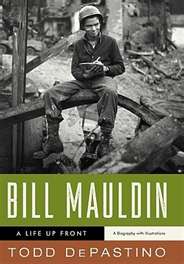
Bill Mauldin bio takes you up front

Bill Mauldin biography

Bill Mauldin biography

I have more books stashed at home than I will live to read, so I always get a sinking feeling when someone lends me one I don’t have. Inside I’m thinking, hoo boy, another book to read that I’d rather not.

That’s how I reacted this year when my friend Dick Musselman of the Lehigh Valley Veterans History Project handed me Bill Mauldin: A Life Up Front, a 2008 biography of the famed GI cartoonist by Todd DePastino. The author had signed it for Dick, with a nice message about Dick’s efforts at keeping veterans’ stories alive.

Dick told me DePastino is also passionate about preserving vets’ stories – he cofounded the Veterans Breakfast Club http://veteransbreakfastclub.com/ in Pittsburgh, where he lives – and that he was sending DePastino a copy of my book, War Stories: In Their Own Words, published last fall by The Morning Call. https://secure.mcallcommunity.com/store/pages/war-stories.php

Well, that softened me. So when I finished reading Susan Orlean’s Rin Tin Tin: The Life and the Legend, I decided to pick up Bill Mauldin, and if I didn’t care for it, I’d just skip through it and look at all the cartoons. It wasn’t a book I would’ve reached out to pick up, because I wasn’t really interested in knowing all about Mauldin.

I read every word.

DePastino tells the story of Mauldin’s life deftly and with great insight. He drives home the travails of the lowly foot soldiers in the mud and how Mauldin identified with them and reflected their highs and lows. In one section I particularly enjoyed, he runs through the tension between Mauldin and Audie Murphy as they were filming The Red Badge of Courage. It’s a wonderful tribute to the two-time Pulitzer Prize-winner.

I emailed DePastino last week and told him how much I liked his book. He sent me a gracious message the next day, asking how the writing was going on my book about my cousin who was killed in Vietnam. www.davidvenditta.com It turns out DePastino teaches a college course on the Vietnam War. He recommended The Father of All Things by Tom Bissell as a guide. (Oh geez, another book to read.)

That reminds me.  I have to return Bill Mauldin to Dick Musselman – and thank him.

Lee Marvin, Captain Kangaroo and Mr. Rogers

There’s so much stuff out on the Web, sometimes it’s hard to tell fact from fiction.

Occasionally folks send me a well-circulated email that starts “You never would have guessed” and purports to reveal the amazing war records of Lee Marvin, Bob Keeshan (Captain Kangaroo) and “wimpy little” Mr. Rogers of the PBS children’s show.

According to this message, which has had a long shelf life, Marvin was a Marine who won the Navy Cross on Iwo Jima. He told Johnny Carson on The Tonight Show he served under Keeshan, “the bravest man I ever knew.” Mr. Rogers “was a U.S. Navy SEAL combat-proven in Vietnam with over twenty-five confirmed kills to his name.”

The writer goes on to say the real heroes “are the ones you’d least suspect.”

His story appears to have amazed and impressed many readers. Several years ago, I heard a Marine veteran mention the Lee Marvin-Captain Kangaroo connection in a speech to a veterans group. He had accepted it as the truth.

Trouble is, it’s all a lot of hooey, to borrow a term from the World War II generation.

You can get the lowdown on myth-buster website snopes.com. Here’s the link to the page that explains the origin of the misinformation in detail and sets the record straight: http://www.snopes.com/military/celebrities/leemarvin.asp

As you’ll see, Marvin and Keeshan didn’t fight together on Iwo Jima. Marvin was a Marine, but he was wounded in the butt on Saipan. He didn’t participate in the Iwo Jima battle and didn’t receive a Navy Cross. Keeshan joined the Marine Corps too late to see any action in World War II. And Rogers never served in the military.

It goes back to this: Don’t believe everything you read on the Web. Make sure you use authoritative sources.


Coming full circle on a soldier’s death in Vietnam

July 15 was the 43rd anniversary of my cousin Nicky’s death in Vietnam.

It’s not a ring-dinger of an anniversary, not like the 25th or 50th, but I was aware it was approaching and woke up Sunday with Nicky on my mind.

I don’t know exactly why, but it might be because I’m nearing the end of a long project to tell Nicky’s story. My rewrite of what I hope will be a book is down to the last few chapters. If all goes as planned, this will be the year I finish the work – 18 years after I got started.

Nicky Venditti was five years older than I, one of many cousins, and I hardly knew him. I have images of only two occasions when we connected – once, when I was about 12 years old at a family picnic where he said hi and smiled at me, and another picnic a couple of years later when I saw him hugging his girlfriend and laughing on the eve of his departure for boot camp.

I was 15 when he was buried near his hometown of Malvern, Pa., and clueless about how he died just eleven days after arriving in Vietnam that summer of 1969. I’d always thought he was mortally wounded in a rocket attack, a story that went around.

It wasn’t the truth, far from it. In 1994 I learned that he was in a classroom during orientation for new arrivals when an Army instructor accidentally set off a grenade. In the last five days of Nicky’s life, surgeons cut off his shredded left leg below the knee. He died in an evacuation hospital at Chu Lai, home of the Americal Division.

The 20-year-old Army helicopter pilot never got a chance to fly in Vietnam. Two other soldiers also died from the grenade – Nicky’s friend and fellow pilot Billy Vachon from Portland, Maine, and Tim Williams of Rossford, Ohio, an equipment repairman.

In my search to get to know Nicky and understand what happened July 10, 1969, at an orientation building on a landing zone called Bayonet, I went to Vietnam to follow his path and traveled to Georgia, Tennessee, Maryland, Virginia, New York, Maine and California for interviews.

I finished writing in 2004, but it was nowhere good enough to get published. I had thrown in the kitchen sink, burdened the narrative with far too much detail, failed to see the arc of the story. I had to start over.

Now I almost have it.

Nicky will soon live again. That’s why this anniversary is notable.

For more: http://www.davidvenditta.com/

Stolen valor and the Terry Calandra case

Last week when I wrote about the U.S. Supreme Court’s decision to scrap the Stolen Valor Act, I didn’t mention the Terry Calandra case. That’s because even though Calandra bragged about his fictitious heroics in Vietnam, he wasn’t prosecuted under the 2006 law.

Calandra, who lives in Belvidere, N.J., pleaded guilty last fall to making false statements in relation to military honors.

So how is that different from the Stolen Valor Act, which made it a federal crime to lie about prized military honors?

Here’s what U.S. District Court documents in Calandra’s case say:

After he contacted then-U.S. Sen. Arlen Specter’s office for help in upgrading his bogus Silver Star medal to the Medal of Honor, the Army’s Military Awards Branch started checking his story and became suspicious of the documents he provided. The Army referred the matter to the FBI for possible violations under the Stolen Valor Act.

In October 2009 two FBI agents interviewed Calandra, who told them that during a battle on March 23, 1969, he grabbed a grenade that had been thrown into his company’s command post and shoved it into a pit. His body muffled the explosion, and he suffered extensive shrapnel wounds. He said he received the Silver Star for covering the grenade.

Three days later, in another interview with FBI agents, Calandra came clean. He said a clerk he had been drinking with gave him the medal and that after he got home in 1970, he created fake general orders in support of it. He had not been in the March 23 battle but had heard about it from his unit.

“Calandra told the agents that he fabricated this story because he liked how it felt to be a hero, that it boosted his ego, and was an addiction,” according to the court documents. “[He] liked how people treated him and talked to him when they found out what awards he had and he enjoyed telling his story.”

Over the years, people in the Lehigh Valley started telling him that his Silver Star should be upgraded to a Medal of Honor. He contacted Specter’s office about that in 2003.

That was his big mistake.

The feds ultimately charged him with one count of making false statements, saying he submitted fraudulent general orders and award certificates to Specter’s office, “within the jurisdiction of the U.S. Senate.”

In order words, he broke the law when he lied to a member of Congress.

He pleaded guilty and was sentenced to a year’s probation and a $500 fine. The maximum penalty he faced under that statute – Title 18, U.S. Code, Section 1001(a) — was five years in prison and a $250,000 fine.

Court documents don’t say why he wasn’t nailed under the Stolen Valor Act, which called for a lesser penalty of one year in prison and fines up to $100,000.

What made Calandra think he could get away with it?

Here’s what he told the FBI, according to the court documents:

“After being wounded in combat and coming home alive, Calandra thought that he could beat anything and that he had nothing to worry about. … [He] never worried about whether or not the general orders he fabricated were ever questioned. Calandra thought that the worst the Army would do would be to take away his awards and that he had faced a much worse enemy [in Vietnam] and lived.”

He was living the advice of many war veterans: Don’t sweat the small stuff. But in puffing himself up and dishonoring the real heroes — those who earned their medals for valor — he went too far. How sad that Calandra, who served the country in an unpopular war and legitimately received several Purple Hearts, felt that he needed further affirmation and stooped so low to get it.

Laying the Stolen Valor Act to rest

Cheers to the U.S. Supreme Court for shooting down the Stolen Valor Act.

The justices were right. It’s “contemptible” for someone to lie about receiving the Medal of Honor and other military awards, but it’s not a crime. That kind of talk is protected by the First Amendment, which allows freedom of speech and expression, even the offensive stuff.

No question Congress meant well when it passed the law. It wanted to punish fakers to keep the integrity of medals intact. We were in the middle of the Iraq and Afghanistan wars, and respect for military service was high.

But the scary thing about a law like the 2006 Stolen Valor Act is this: If lying about medals is against the law, what speech will the government try to regulate next?

A story about the high court’s ruling by Jesse J. Holland of The Associated Press quoted B.G. “Jug” Burkett, author of the 1998 book Stolen Valor. Burkett was aghast: “The Medal of Honor! The vast majority of the people who were awarded that were killed in action in the service of their country, and we can’t protect that decoration from disrespect?”

With no disrespect to Burkett — I have his shocking book and I’ve read every one of its 592 pages – I think he’s wrong on this. First of all, someone’s claim to have the Medal of Honor invites skepticism and is easy to check. In fact, anyone’s story that he’s a hero should go through the fact-checking mill.

Second, those heroes who died in the service of their country were upholding one of its key tenets – the freedom of speech that allows bums to brag about battlefield honors they never received.


Where a long career in Hollywood begins

This is going to be utter trivia, maybe of no value whatsoever, and you’ll probably think I’m off my nut and wonder why I don’t have better things to do with my time.

But I’m going ahead with it anyway because I never cease to be amazed at how we make connections.

Recently I read Susan Orlean’s terrific book Rin Tin Tin: The Life and the Legend http://susanorlean.com/books/rin-tin-tin.php. While I was in the thick of it, I bought DVDs of two Rin Tin Tin movies of the silent era, Where the North Begins (1923) and The Night Cry (1926).

I’d seen one of the first Rin Tin Tin films on TV several years ago, and remembered thinking: This dog is incredible! Now that I was marveling over the story of his life, I wanted to experience him again on the screen. I couldn’t get over that he had been rescued from a World War I battlefield in France and had grown up to become an icon.

Other than the extraordinary dog, I didn’t expect to see any familiar names associated with either film I’d bought. (Hey, this was the 1920s, just about gone from modern memory.) The directors and cast members are listed on the DVD cases, and I’ve never heard of any of them.

But in the opening credits of Where the North Begins, a name came up that I recognized instantly:

Lewis Milestone, the editor.

Doesn’t ring a bell? Two years later, he would direct his first film. In another two years he got his first Oscar. He got his second Oscar for directing one of the greatest anti-war films of all time, All Quiet on the Western Front, which also got the Academy Award for best picture of 1930.

Here’s the link to info on the movie on the Internet Movie Database: http://www.imdb.com/title/tt0020629/ And here’s the link to Milestone’s biography: http://www.imdb.com/name/nm0587277/bio

If you watch both Where the North Begins and All Quiet on the Western Front, you’d be amazed at the similarities in how scenes are filmed and cut to convey action and drama. I know I was.

Milestone went on to direct a number of other war films, including A Walk in the Sun (1945), which is one of my favorites; Halls of Montezuma (1950) and Pork Chop Hill (1959).

So OK, you think I’m nuts to be excited about this. I can’t help it.

It’s the idea that one of Hollywood’s stellar directors cut his teeth on a film starring one of the most famous hounds in history.


An old war movie brings two men together

I’m used to people of the same age group connecting as a result of an interview I did with a veteran. But it’s really something when the links cross generations. That happened last month.

Bill Berry was reading my Memorial Day “in their own words” war story on Bert Winzer and thought there was something familiar about it.

Hmmm. A commando unit of Canadians and Americans. An assault on a German-held mountaintop in Italy.

It sounded like a movie he had acted in as an extra about 45 years ago while a college student in Utah.

He kept reading, and when he got to the end, he knew it was true.

In the epilogue, I wrote that Bert’s unit, the 1st Special Service Force, had been memorialized in a 1968 movie, The Devil’s Brigade, starring William Holden, Cliff Robertson and Vince Edwards.

Berry, who lives in Bethlehem Township now but grew up in Sullivan County, was studying chemical engineering at Brigham Young University in Provo at the time the movie was being filmed at Corner Canyon and Jordan River.   He did some work as an extra, acting as an American soldier, and remembers being filmed in a scene where 1st Special Service Force men were prodding pack mules on a mountainside.

Bill called me and was eager to speak with Bert, who lives in Lower Macungie.

Bert had lent me a videotape of The Devil’s Brigade and I had watched it to get familiar with his story, which you can read here: http://www.mcall.com/news/local/mc-memorial-day-war-story-winzer-20120527,0,345070.story

I told Bert about Bill’s call, and Bert was tickled about it. The next day, Bill, who is 65, just happened to call the 89-year-old ex-commando while I was visiting him, and they had a nice chat.

Bill told me that his role as an extra in the movie had special significance for him. His father, Carl Berry, had been an extra in the silent World War I drama Wings, which won an Oscar for best picture.

How did he swing that?

Carl was serving in the Army at Fort Sam Houston in the mid 1920s while Wings was being filmed in Bexar County, Texas. Bill said his dad told of sexy Clara Bow, the female lead, putting a car in reverse by mistake and hitting a man on the set.

Bill ended his chat with Bert by suggesting they get together for a meal. I hope it happens. Who knows what other connection might crop up between the play soldier and the man who lived it.

A salute to the D-Day veterans

I couldn’t help but get teary-eyed June 6 as I looked at the nine D-Day veterans seated in front of me, all in their late 80s and beyond.

It was the picnic put on at Nazareth Boro Park by the Lehigh Valley chapter of the Veterans of the Battle of the Bulge to honor local men who had taken part in the great assault on Normandy 68 years ago.

There were Bulge veterans, World War II re-enactors, a TV crew from Channel 69, interested folks like me in the crowd.  Of the nine D-Day vets, I had done “in their own words” stories on seven of them, so most of the faces were familiar.

I introduced Bench Hartman, of the 101st Airborne Division, to Ralph Mann, of the 82nd Airborne. They had made the drop behind the beaches. And I got Joe Motil of the 4th Infantry Division to chat with Bob Gangewere of the 90th Division. They had both hit Utah Beach. Bob was the subject of my war story that day in The Morning Call. Here’s the link: http://www.mcall.com/news/local/mc-dday-veteran-gangewere-20120605,0,660028.story

The other D-Day vets at the picnic were Dr. John Hoch, a Navy helmsman/signalman on an LCT, or landing craft tank; Dr. David Beyerly of the 1st Infantry Division, who hit Omaha Beach; Nate Kline, a B-26 bombardier/navigator with the 323rd Bomb Group; the Rev. Ed McElduff, a Navy ensign aboard a landing ship tank, the LST 981; and Dick Schermerhorn of the 531st Engineer Shore Regiment.

Their backs and legs are no longer strong, their eyes don’t see so well and their ears can’t hear as they once did.

I had given Bench a ride to the picnic. When I picked him up at his home in Hokendauqua, he struggled walking to my car, settled into the seat and sighed.

“Don’t get old,” he quipped.