Happy 65th birthday, Nicky

Nicholas L. Venditti of Malvern, Pa., as a 19-year-old soldier at Fort Polk, La., in the summer of 1968.

Nicholas L. Venditti of Malvern, Pa., as a 19-year-old soldier at Fort Polk, La., in the summer of 1968.

If my cousin Nicky had survived Vietnam, it’s a fair bet that he’d still be alive today. He would have turned 65 on Tuesday.

That’s 45 years of a life unlived.

I can only guess how it would have turned out for him if he’d come home to Pennsylvania in 1970, after a one-year tour. He would have married his fiancée. They would have had children. He might have made a living as a pilot, having learned how to fly helicopters in the Army.

And maybe I would have gotten to know him better. As it was, I only remember that he said “hi” to me once at a family picnic and that I saw him at a party sending him off to boot camp. We came from a big Italian family that was close and got together often. Still, he was five years older than I and lived in another town.

Nicholas Louis Venditti had grown up fast. He was born Nov. 26, 1948, at Chester County Hospital, the son of Louis and Sally Gable Venditti. The family lived in the first block of East King Street in Malvern, but the marriage didn’t last. Louie left Sally when Nicky was a second-grader at Malvern Public School.

Nicky became a star pitcher in Little League with a daunting fastball. He went on to General Wayne Junior High and Great Valley High School, where he played some baseball. But mainly he spent his time pumping gas after school and on weekends so he could indulge his interests in guns and fast cars. He graduated from Great Valley in 1966 with no particular plans for his life.

He met Terri Pezick while working at the Sinclair station on King Street. They were engaged when Nicky left for Vietnam.

Besides pumping gas, he worked at plastic cup maker Plastomatic in Malvern. In 1967, he got the idea that he wanted to be a helicopter pilot in the Army, knowing he would almost certainly go to Vietnam. During World War II, his father had been a ground crewman with a fighter squadron of the 8th Air Force in England, and his stories might have influenced his son.

Nicky took a flight aptitude test in December 1967 and got the nod from the Army. He enlisted and had boot camp at Fort Polk, La., completing his training there in August 1968. He went on to the U.S. Army Primary Helicopter School at Fort Wolters, Texas, where he learned to fly helicopters.

In February 1969 he started Army Aviation School at Fort Rucker, Ala., and flew the UH-1 “Huey.” He won his wings June 3.

Now the newly minted warrant officer, with the rank of WO1, had orders sending him to Vietnam to join the 16th Combat Aviation Group, which was attached to the Americal Division at Chu Lai, in the northern part of South Vietnam.

He had a three-week leave at home in Malvern, then left for Vietnam from Washington State, arriving at Cam Ranh Bay on the Fourth of July, 1969. A C-130 transport plane took him up the coast to Chu Lai.

As a new arrival, part of his training was to attend a classroom lecture on grenade safety. On July 10, he and several dozen other replacements were trucked off the base to a landing zone called Bayonet, home of the Americal’s 198th Light Infantry Brigade and the site of a firing range and orientation building.

Nicky and three other warrant officers ambled into the building and sat at a table up front. The instructor, a sergeant in his early 20s, held up an M26 fragmentation grenade and talked about it. As part of his routine, he pulled the pin and tossed the grenade at the class. It was a gimmick to see how the new guys would react.

The grenade wasn’t supposed to be live, but it rolled under the table where Nicky was sitting and detonated. He lost his left leg below the knee and clung to life at Chu Lai’s 312th Evacuation Hospital. But at 4:15 a.m. July 15, his life ended. Two other soldiers also died from the blast, which the Army determined to be an accident.

Nicky had not been at the Americal Division base long enough to be assigned to an assault helicopter company. He had not even survived 11 days of his 365-day tour.

He came home to Malvern in a silver metal casket by way of Dover Air Force Base in Delaware. On July 28, 1969, he was laid to rest in Philadelphia Memorial Park, near his hometown. I was a clueless 15-year-old, standing with my family in the crowd by the grave.

Nicky will always be 20 years old. But just for today, I’m going to pretend he’s turning 65.

Happy birthday, Nicky.

‘Men, they want us to recover the bodies’

A year ago I wrote about one of the most controversial episodes of the Vietnam War – the reported mutiny of Americal Division troops in 1969, a story that ran at the top of Page 1 in The New York Times.

Now I have something to add to it, a fresh voice, a man who was among the “mutineers.”

The soldiers belonged to Company A, 3rd Battalion, 21st Infantry Regiment of the 196th Light Infantry Brigade. Their commander was Bobby Bacon, a lieutenant colonel who figures in the book I’m writing about my cousin Nicky Venditti.

Nicky was an Americal helicopter pilot who died 11 days into his tour of duty as a result of a training accident just off the division’s base at Chu Lai. That was in July 1969. Bobby’s name is on a condolence letter sent to Nicky’s dad. Here’s why: Before the colonel took command of the 3rd Battalion, he was briefly commandant of the 23rd Adjutant General Replacement Company, the unit that oversaw the training of new arrivals at Chu Lai.

Back in the 1990s, when I first got in touch with Bobby about Nicky’s fate, he told me about the so-called mutiny. He had taken command of 3rd Battalion because its previous commander, Lt. Col. Eli Howard, was killed Aug. 19, 1969, when his helicopter was shot down southwest of Da Nang.

Bobby was in charge when the battalion was trying to reach the wreckage. On Aug. 26, Horst Faas and Peter Arnett of The Associated Press reported that Company A had refused to go on. The story began:

SONGCHANG VALLEY, South Vietnam, Aug. 25 – “I am sorry, sir, but my men refused to go – we cannot move out,” Lt. Eugene Shurtz Jr. reported to his battalion commander over a crackling field telephone.

The company had been ordered to move down a rocky slope of Nui Lon Mountain into a labyrinth of North Vietnamese bunkers and trench lines. The soldiers had been making the push for five days, but each time they had been beaten back by the enemy.

“Repeat that, please,” the story quotes Bobby as saying. “Have you told them what it means to disobey orders under fire?”

“I think they understand,” the lieutenant replied, “but some of them simply had enough – they are broken. There are boys here who have only 90 days left in Vietnam. They want to come home in one piece.”

Bobby told him to leave the men on the hill and “move to the objective,” the story says. The colonel then told his executive officer and a sergeant to fly across the valley and give Company A “a pep talk and a kick in the butt.”

They found the men exhausted in the tall, blackened elephant grass, their uniforms ripped and caked with dirt…. The soldiers told why they would not move. “It poured out of them,” the sergeant said.

They said they were sick of the endless battling in torrid heat, the constant danger of sudden firefights by day and the mortar fire and enemy probing at night. They said they had not had enough sleep and that they were being pushed too hard. They had not had any mail or hot food. They had not had any of the little comforts that make war endurable.

The story goes on to say the sergeant, Okey Blankenship, argued with them, suggesting they lacked courage, then started walking down the ridge line. He turned around and saw that they were stirring. They got into a loose formation and followed him down the slope.

Bobby relieved Lt. Shurtz as commander of Company A. The Americal Division said five enlisted men had questioned Shurtz’s orders to move out, but that all five had finally gone with the rest of the company “and the company completed its mission.” No charges were filed and there was no formal investigation.

Meanwhile, Faas and Arnett’s dispatch shot around the world. The news, hailed by the Viet Cong, created the impression that President Nixon now had to contend with a revolt by the U.S. military in Vietnam.

James Dieli, who read my September 2012 blog, wrote to me recently and said that he had been with Company A when the alleged mutiny happened. I asked him to give me details. The following is an excerpt of his account:

“I arrived in South Vietnam Aug. 1, 1969, and after the usual orientation I was flown to the Americal Division headquarters in Chu Lai. After additional orientation I was assigned to Company A 3/21st Infantry of the 196th LIB, and flown out to LZ Center in the Central Highlands.

“After more orientation I was instructed to draw weapons and gear from the ammo bunker and wait for transport out to the company.

“Company A had come under heavy ground fire which you could observe from Center. The battle was very close just beyond the valley. If my sense of direction is correct, the action was on the west side of Center. This lasted for several days and I observed tons of bombs being dropped by our fighter jets and artillery from neighboring support elements.

“I then observed a chopper leave our base and hover over the battle for a brief moment and then fall from the sky in a ball of flames. I then learned that aboard were our sergeant major, one of our officers, [AP photographer] Oliver Noonan, and some enlisted men. I really could not understand the magnitude of this as it all seemed surreal to me at the time.

“I don’t remember the timeline exactly of the events, but a day or two later they finally were able to fly us out to the company. It was a very short trip to the mountain where Company A had pulled back to. While getting there, the chopper took light ground fire and then I realized for the first time this was the real thing.

“After spending a couple of nights in a foxhole, it was very apparent the enemy had not left the area because there were constant incoming rounds all night long, and during the day there was sporadic mortar firing at us.

“On the morning in question I was standing speaking to some of the men trying to learn and understand what to do and what to expect for the next year, when an officer approached and said, “Men, they want us to go back down and recover the bodies.”

“The response was that there was still enemy activity, and with half of our company either dead or wounded it would be nothing short of suicide. The officer then told us that the enemy activity had ceased and the area was clear. The response was that they didn’t believe that, and they would have no problem going back down as soon as they had some reinforcements.

“The officer then asked the men one by one if they all felt the same, and they all agreed that based on the last few days it would be nothing short of suicide. The officer then asked me, and my response was: I just arrived here. Some of these men are ready to go home and I will not disagree with them, after all I’m only here a few days and know absolutely nothing. What right do I have going against them?

“After another communication the officer approached the men again and said Command this time ordered us to move out, otherwise there would be no supply of food or ammo, and if we made our way back to the coast we would all be court-martialed.

“The men did not disobey because the second communication was the order, the first was not. We moved down the knoll with no resistance and recovered the bodies.

“Morale was very low within the ranks, but on the second day, Col. Bacon actually came out to the field and spent a couple of nights with us in foxholes and that brought moral up. These men went through hell and I believe all they wanted was a regrouping, food, and reinforcements. They did not disobey a direct order!”

Bobby Bacon had told me the same: The men of Company A did not disobey an order, because no order had been given. When it was, the entire unit moved out, he said.

Faas and Arnett stood by their story. They wrote to Bobby the day it ran and said it was “absolutely fair.” But as I blogged before, newspapers and news magazines did their own reporting and challenged the AP reporters’ version of events.

Why we need war stories

I had the terrific opportunity to be the speaker Oct. 14 at the 10th annual Iron Hill Charity Golf Open at the Club at Morgan Hill in Williams Township, near Easton. The event, sponsored by Petrucci Development and Iron Hill Construction Management, raised tens of thousands of dollars for the Lehigh Valley Military Affairs Council and the New Jersey National Guard Family Foundation. My talk came right before dinner, for an audience of 125. Here’s the text of my speech:

My dad used to tell this story about how, when he graduated from Coast Guard radio operator school during World War II, he had a choice of postings. He wanted to go where it was warm, so he volunteered for Argentia.

But Argentia is not Argentina. Argentia is a port in Newfoundland, and so he missed out on South America and instead spent 1945 in the North Atlantic on patrol frigates off Greenland and Iceland.

That’s the only story I know from Dad, because I never asked him about his experiences. What was I thinking? I know he never saw a shot fired in anger, but he still would have had stories to tell. By the 1990s, when I was finally interested, it was too late. He had slipped deep into the fog of Alzheimer’s. He died in a veterans home in 2004.

Like so many others, Dad had put on a uniform when the country called him and he did what had to be done. And when it was over, he came home and got on with his life.

When I was a kid, World War II was the stuff of movies. We went to the drive-in to see P.T. 109 and The Great Escape. But it was hard to connect heroic movie stars with people like my dad, people in real life.

Many years later, I got interested in my cousin Nicky, who was killed in Vietnam. When I asked my uncles about him, they not only told me about him, they told me their own stories. It was a revelation. Here I had a whole parade of uncles and even an aunt who had served all over the world — the Aleutian Islands, Panama, North Africa, England, the Pacific. One of them died of a war injury five years after the war ended.

That was Sam, my Uncle Sam. He would have violent seizures and just conk out and then come to. But nobody in my family could say how he got that way. A thick file I got from the VA had the answer.

Uncle Sam was with the Army Coast Artillery on Bora Bora island in the Pacific. He was on a demolition squad blasting coral 16 hours a day to build harbors. One day the seizures started. He was sent home and hospitalized. Doctors believed he’d had epilepsy and the repeated concussions from the blasting further damaged his brain.

Sam said he was afraid that someday he might pass out and not regain consciousness. And that’s exactly what happened one night in 1950. He came home from a ballgame in Philly, got into bed, cried out in the darkness and died. He was 32.

Mom says Uncle Sam was the nicest man you could ever meet, but I would never have that opportunity. He was gone before I was born.

My cousin Nicky who went to Vietnam, I hardly knew him. He was five years older, we came from a big Italian family, we lived in different towns.

He was a 20-year-old Army helicopter pilot when he went to Vietnam in the summer of 1969 and he was dead in 11 days.

His first week in Vietnam was orientation. He attended a classroom lecture on grenade safety. The instructor, as part of his routine, rolled a grenade at the class. It was a gimmick to see how the new guys would react. You have 5 seconds! The grenade was not supposed to be live. It went under the table where Nicky was sitting and went off. Nicky got it bad. He lost a leg, he hung on for a few days, and then he died at a hospital on the base.

In my research for a book about Nicky, I found the Army nurse who tended to him in his last days. I didn’t have to look far. She lives in my neighborhood in Allentown. She doesn’t remember Nicky or recognize his face. But she would have been close to him, might have touched him, might have whispered words of comfort.

So my cousin Nicky, my dad, my Uncle Sam, my other uncles, they were ordinary people who had seen and done extraordinary things, who had played a role on the world stage at critical times. Folks just like them are all around us – strangers on the street, neighbors down the block, our parents and grandparents.

And we’re losing them. Many are taking their stories with them to the grave, to be lost to the ages. You’ve seen the obituaries on any given day: So-and-so served honorably in the Army, Navy, Air Force or Marines in World War II or Korea or Vietnam. That’s it? That’s all there is?

Fourteen years ago, I made it my mission to interview veterans so their personal recollections could be preserved for future generations. I’ve done about a hundred of these stories of sacrifice and courage. They have a permanent home in the Library of Congress and the National World War II Museum as well as on The Morning Call’s website.

The Call published a collection of them in a book, War Stories in Their Own Words. Most are from the Second World War, but there are also stories from the World War I era, the Cold War, the Korean and Vietnam wars. To give you an idea of how important this work is, about half of the 34 veterans in the book are gone. One of them was Olaf Marthinson of Allentown, who took part in the hunt for Mexican rebel leader Pancho Villa in 1916. Olaf was 102 when I met with him.

A veteran in the book who is still living fought on the other side in World War II. Eddie Sakasitz was born in Nazareth, but while he was still a baby, his mother took him back to her native Austria. And while still a teenager, he was drafted into the German army. He served in an antitank battalion outside frozen Leningrad, on Crete and finally in Italy.

Eddie found the war in Italy much worse than being on the Eastern Front. Here’s what he said: “The American artillery and bombers made life for us almost impossible. … Our artillery would fire 20 to 25 shells at the American positions and get 20,000 shells in return.”

Riding a motorcycle one day, he was machine-gunned in the legs, and that was the end of the war for him. He’s 93 now. We had breakfast together last week, and he reminded me for the umpteenth time how grateful he is to have lived a full life.

Not all of the stories have blood and guts. Chris Showalter painted sharks’ mouths on fighter planes in China. Jerry Webre, who was a Navy cargo pilot, flew the tail section of the Hiroshima bomb across the Pacific. Bob Hutchings was a clerk for Eisenhower – he said his weapons were a typewriter and a pen.

Florence Michaels was an Army nurse on the Ledo Road in India and Burma. “You could hear the natives beating their drums,” she said. “The headhunters knew us, so they left us alone.”

The most heartrending stories, of course, are the ones about loss. Some veterans I spoke with were still deeply affected, even traumatized, by the killing that happened around them decades earlier.

Don Miller from Emmaus was a flight engineer on a B-17 bomber and couldn’t go on his crew’s 12th mission because he was sick.

“That day,” he said, “I lost my crew. I watched the sky as our squadron came back and didn’t see them. They were the one plane missing. They’d gone down over the target and all aboard were killed. It was one of the saddest days of my life.

“I should have been with them.”

A few years ago I took Don to see a B-17 that flew into Lehigh Valley International Airport. He gave me a tour of the inside. Afterward when I was driving him home, he said he’d been leery about accepting my invitation to see the plane. He was afraid that when he was in it, he would see the faces of his lost crewmates at their stations.

He did see them, he told me, but it wasn’t as bad as he thought it would be.

Dan Curatola from Bethlehem hit Omaha Beach on D-Day in the first wave. Think Saving Private Ryan. The night before, Dan was on a ship in the English Channel.

“We had nothing else to do,” he said, “so we played cards. About six of us were playing blackjack. Not a single one of those guys lived. One night I’m playing cards with them, and the next night they were all dead.”

When Dan reached the shore, a shell exploded and he hit the dirt. He tapped a corporal in front of him and said, “Boy, that was close, wasn’t it?” But the corporal didn’t answer. He was dead.

Dan went on: “I had seen dead men before, in Africa and Sicily. But some of the younger troops who hadn’t seen action just went out of their minds. You’d see them screaming and running the wrong way.”

The saddest story came from Horace Rehrig, who grew up in West Bowmanstown. He was on the carrier Ticonderoga when two kamikazes crashed into it. He found his cousin injured on the fantail and helped carry him down to sick bay. On the way he saw a familiar sailor lying on the floor of the hangar deck. It was his good friend Bob Selby. Horace got his cousin to the hospital area and ran back up to the hangar deck to Selby.

“He was really bleeding bad,” Horace told me. “His right arm was completely severed at the shoulder, blown off, but he was conscious. He looked like he was flash-burned from the thousand-pound bomb that exploded on the hangar deck. I quick took some packing and held it on his wound and put his head in my lap and tried to comfort him. ‘Hang in there, I’ll take care of you.’ He was crying, he kept saying, ‘I’ll never make it.’ I said, ‘Don’t talk like that. You’ll pull through this.’

“But I knew it was a critical wound – he had lost too much blood.

“I kept yelling for help, and finally we put Selby on a stretcher and got him down to sick bay. The doctors put him right on an operating table, and I stood there waiting. He had his knees up and was waving them back and forth.

“And then they just stopped.

“It just plays hell with you when you see stuff like that,” Horace said. “I felt so bad about it that I just can’t ever forget it.”

For the record, I am not a war buff or a World War II wannabe, nothing of the sort. And I am not a veteran. The closest I came was Vietnam, and our ground troops were pulling out of there the year I got out of high school. So for me this mission to preserve personal accounts, to convey the experience of war through the magic of storytelling, is all about payback.

It’s my way of saying what I never told my dad: Thank you for serving our country.

My big adventure in a B-17 Flying Fortress

The four-engine bomber looks big on the outside, but inside it’s cramped. That’s the first thing I noticed when I climbed into the fuselage of the Experimental Aircraft Association’s B-17G, Aluminum Overcast, at Lehigh Valley International Airport.

There’s not much wiggle room in there. In the war movies, you get the illusion of more space. But you have to stoop, squeeze and in some places crawl. It gave me a fresh appreciation for what it must have been like to go up in these Flying Fortresses in wartime.

Next thing I knew, a crew member was strapping me in on a bench beside one of the .50-caliber machine guns in the waist. For the first and perhaps only time, I was going for a ride in a restored World War II heavy bomber.

The crew member explained to me and the other visitors on board that if we felt nauseated during the flight, we should look out a window and focus on the horizon and the feeling would go away. If that didn’t help, he said, there were barf bags in the machine guns’ ammunition bin.

Given that I’m prone to motion sickness and hadn’t taken anything for it, I paid serious attention to these instructions.

My stomach wasn’t prepared for this flight because I wasn’t supposed to be on it.

Weeks earlier, Erik Chuss had spoken to me on behalf of the EAA folks. Erik, who’s a pilot and Forks Township supervisor dedicated to veterans, asked me at a meeting of the Lehigh Valley Veterans of the Battle of the Bulge if I knew any World War II vets who’d flown in B-17s. The EAA was looking for two to take for a free ride during a media flight Thursday, Sept. 26.

I knew two right off the bat – Don Miller of Upper Milford Township, near Emmaus, and Charley Hills of Allentown. I’d done an “in their own words” war story on Don for Veterans Day 2011, http://www.mcall.com/warstories. He’d been a flight engineer. I knew Charley because the onetime navigator heads the “I Was Shot At” club of former fliers.

Both Don and Charley, who are in their late 80s, told me that they’d like to go for the ride. Don hadn’t been up in a B-17 since the war; Charley had ridden in one a couple of times since then. I put them both in touch with Erik, and the EAA said they could ride in the Aluminum Overcast.

Erik said I could go up, too, but the 1 p.m. media flight collided with my work schedule at The Morning Call, where I’m a content editor. Instead, I arranged for the newspaper’s coverage. The reporter taking the flight would be JD Malone and the photographer, Mike Kubel.

I showed up at the airport as well, in part to see the plane up close, but also to say hello to Don and Charley. As we stood on the tarmac, Erik said a seat had opened up and I was welcome to go on the ride. I didn’t have to think about it and said, “OK, thanks, I’m going!”

Besides Don and Charley and the three of us from the paper, the riders included a crew from WFMZ Channel 69 and two other World War II veterans. The bomber taxied into position and then roared down the runway – and I mean roared, because those four Wright Cyclone engines are plenty loud.

I felt a tingle up my spine as the plane lifted off, and thought of the men who not only got airborne in these huge, lumbering Forts but got shot at as well.

When we were aloft, we got unstrapped and could make our way around. I put my hands on a .50-caliber, put one foot in front of another on the narrow catwalk over the bomb bay, saw Charley at the radio operator’s station, stood behind the pilot and co-pilot in the cockpit and looked out at the spinning props and the verdant Lehigh Valley a few thousand feet below.

I stepped down a small hatch behind the pilots, got on my hands and knees into the nose and gazed in awe out the plexiglass. That feeling of being out in front and exposed and seeing everything before you is unforgettable. There’s a scene at the beginning of the film The Best Years of Our Lives where the three returning veterans are chatting in the nose of a B-17. It’s quiet except for their voices. But the real thing is a lot different. You can’t have a casual conversation with those 1,200-horsepower engines thrumming.

During the half-hour we were up, I shot video with my smartphone, a Samsung Galaxy S4. The clip is posted with this blog. I’m grateful to a techie at the newspaper, Gene Ordway, who coincidentally is a skydiver and whose father is an aerobatic pilot. Gene edited and processed the video for me and helped me post it.

A crew member called to me that I had to get out of the nose because we were about to land. It was time to get strapped in again. I’d made it through the flight OK, didn’t got sick. It wasn’t until we were on the ground that I felt a little woozy.

Don Miller quipped that he got another mission in. I signed a copy of my book War Stories: In Their Own Words for Erik to give the crew.

The Aluminum Overcast was at LVIA for the weekend for people to inspect and ride. Erik told me later that he was amazed at the number of World War II veterans who showed up to see it and the stories they told.

It must have been special for them – to see and touch and hear a relic of their youth that held so many memories. I could only imagine.

No stopping veterans at Washington memorials

My friend Steve Savage of Allentown went to Washington, D.C., on Oct. 6 with a group from the Lehigh Valley Veterans History Project. Here is his report:

On a muggy and hazy morning, before dawn broke through the fog, 53 young and old men and women prepared for an adventure — their own version of D-Day, which some of these former soldiers had gone through once almost 70 years ago. All were headed to the nation’s capital to prove a point, yes, maybe, but mostly to pay homage to their fellow fallen comrades who had fought and died for their country, for their families, for their buddies, and for their future.

Led down the highway by a contingent of veterans on their flag-bearing motorcycles, they set out with high hopes and anticipation of what the day would hold for them. They all knew that their federal government had barricaded many of the memorials in Washington, D.C, but they were going.

For many of these veterans and civilians alike, this may be the last and maybe only time they would be able to look upon the memorials that were built for them, to honor them and the men and women they fought and died with. They were not going to allow government bureaucracy keep them from making this trip. It was owed to them. Now was the time to collect.

The bus pulled into the capital and drove into the scenic and hallowed grounds of Arlington Cemetery. Their destination was the Marine Corps Memorial, commonly known as the Iwo Jima statue. Here there was to be a special event, with a very special and honored woman.

As the veterans and their families stepped off the bus, each man and woman was handed a replica of the Stars and Stripes and asked to face west toward a large building just a short distance away. Every one of the 53 raised their arms and waved the flags as a very distinguished and local hero stepped out onto her balcony — Anna Mae Hays, who grew up in Allentown and became the first woman promoted to general in the armed forces. The sight of hometown friends saying “hello” made her day special, to say nothing of the emotion felt by the men and women standing in the shadow of the Iwo Jima statue, proudly waving their American flags to Gen. Hays.

After a short stop at the visitors center at Arlington Cemetery for a bag lunch, the Lehigh Valley group met up with a bus from the Lancaster area. The small caravan headed back through the streets of Washington toward the World War II Memorial. For most of these men, some over 95 years of age, this was their memorial. But they wanted to share it with all, veteran and civilian alike. This was for all those who respected and wanted to honor the fallen from World War II.

The Lehigh Valley Veterans History Project group walked up to the memorial and were met by barricades that simply read: “Because of the federal government shutdown, all national parks are closed.” They had all expected this, but they had come this far. Sixty some years ago, armies of the Axis powers had tried to stop them from moving forward. Needless to say, no small cardboard sign was going to stop them now. With a group of almost a hundred men and women behind them, the people who had organized the trip spoke to the park rangers on the other side of the barricades. One could almost see that the rangers understood the importance of allowing these veterans to enter this place of honor. With that, the small barricades were moved aside, and with many tourists and other veterans cheering and applauding behind them, the men and women from the Lehigh Valley and Lancaster, some with walkers and some with wheelchairs, entered into this inspiring memorial.

For many of these veterans, it would be the first and maybe the only time they would get to see their memorial. It did not have the names of their fallen comrades carved into the stone, but it did have the names of the many battles where they had fought and died so many years ago. You could tell it brought back many memories, some they shared with others, some they would probably never share.

After more than an hour of telling stories and getting lost in their thoughts, the veterans gathered together under the stone pillar marked with name of Pennsylvania. It was here they presented a red-, white- and blue-ribbon wreath to pay homage and respect to their fallen veterans. As if on cue, the World War II veterans and many of their friends broke into a chorus of “God Bless America.” The voices may not have all been in tune, but the emotion behind it was straight from deep in the heart of each and every man and woman there.

After one last photo of the entire group, the bus was loaded again for a short drive to the next stop at the Korea and Vietnam memorials. The men from the more recent wars needed to see their memorials too, but once again, there were barricades with the small cardboard signs. However, there was no stopping anyone at the gates. The crowds of thousands at the National Mall that day simply walked around the black metal barricades to pay their respects to the honored soldiers. Even with the federal shutdown, it seemed as if the rangers guarding the parks and memorials realized how much these statues and walls meant to so many people. No one stopped anyone. There were no angry crowds. No talk of politics. Just many men, women and children there to pay their respects to the honored, some fallen comrades, most of them men and women whose names they never knew.

The men and women from the Lehigh Valley Veterans History Project once more boarded their bus to head back home. To many of them, it may have brought them back to the days when they were heading home, for you knew they felt they had accomplished their own kind of mission this day. They had come down to the nation’s capital to pay their respects and honor their fellow Americans whom they had fought with so many years ago.

Their efforts gave them the memory of a lifetime. They were not going to let a little thing like a government shutdown keep them away. They deserved to see their memorials. We are all free Americans because of what they did. We owe them. We always will.

‘He got broke down and bad sick’

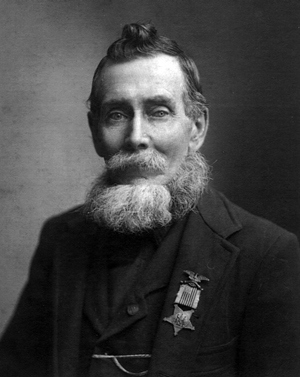
George D. Conn

George D. Conn, wearing his Grand Army of the Republic medal

You can connect with other folks like crazy on Facebook and Twitter, but there’s nothing like a family picnic.

Back in July, my wife, Mary, and I went with my mom to the annual Pierce/Cunningham get-together in Honey Brook, Pa. I’m a Venditta, so where do the Pierces and Cunninghams come in?

My mom’s mom, Clara, was a Pierce. Two of Clara’s older sisters married Cunningham brothers. (I’ve written about one of them on this blogsite: George F. Cunningham, who served with Company B, 14th Engineers in France during World War I.)

At one of these Sunday picnics years ago, Susie Cunningham put me on to a genealogy computer program called Personal Ancestral File. A dabbler, I still use Version 5.2 to record historical information on both sides of my family.

Susie and I are related through her husband, Glenn, a retired Marine colonel. Glenn’s dad was a first cousin of my mom’s.

During the July picnic, I met Susie and Glenn’s daughter Molly Reid, who is just as much of a genealogy enthusiast as her mom, if not more so. Incredibly, she’s going all the way back to the Middle Ages for family info. She has a how-to website for family historians, http://www.finddeeperroots.com.

I told Molly I’d done some research on one of our ancestors, George D. Conn, a Civil War veteran. George was my grandmother Clara’s maternal grandfather. I knew a little about him from research I did on his 175th Regiment Pennsylvania Volunteers at the Army Military History Institute library in Carlisle, Pa. But I didn’t have his pension records.

“Oh, I have those,” Molly said as if it were no big deal.

It turns out she’d made copies during a trip to the National Archives from her home outside Washington, D.C., at the end of 2012. Within a few weeks of the picnic, she mailed me a DVD with George’s pension file, which is 72 pages, along with his service record, which she knew I already had, but not on a disc.

George, who was from Oxford, Chester County, joined Company E of the 175th Regiment in the fall of 1862, at age 25. He was honorably discharged when his nine-month term of service expired in August 1863. He had never been wounded during his regiment’s tour of duty in North Carolina.

But what I didn’t know was what the war did to him, how it affected him after he came home. Thanks to Molly, I can tell that story.

In 1891, more than a quarter century after the war ended, George applied for pension benefits because of a diseased left eye. As part of the process, the federal government wanted to see sworn statements about what happened to him and about his current condition.

In his own statement, he said that at 53 he was “almost totally disabled.” Under “occupation,” he wrote “carpenter when able.”

While serving at Hill’s Point near Little Washington, N.C., on or about the last day of June 1863, George “incurred affection of left eye” and broke down from heavy marching and fording streams in rain, mud and storm, he said. He also grew deaf from cannonading at Fort Hill, N.C., in the early days of April 1863. He was treated at Harewood Hospital, Washington, D.C., from about July 7-16, 1863.

Four of his comrades from Company E stood up for him with sworn statements of their own, in what were called a Comrade’s Certificate of Disability signed by a notary public. Among them, nothing drove home the sacrifice of a soldier more than the handwritten statement from Jacob Miller of Oxford. It’s dated Feb. 17, 1891. Here it is, in part:

“George D. Conn while in the service and line of duty on board boat for five days before Fort Hill, N.C., during heavy cannonading incurred partial deafness about April 5, 1863. [T]hen again in the service and in line of duty at or near Hill’s Point a few miles from Little Washington, N.C., [he] incurred diseased eye and rheumatism and got broke down and bad sick about last of June 1863, [as a] result of fatigue and exposure. I saw him bathing [his] eye when it was terribly red and inflamed. [H]e was troubled with aches and pains.”

George was approved for a pension – $4 a month at first. It gradually increased over the years until he was getting $32 a month in 1918.

He was deaf and blind in the one eye when he died in 1923 at age 85.

A walk in the woods, to 259 years ago

Mary at a clearning near Jumonville Glen

Mary at a clearing near Jumonville Glen

Blogger at Jumonville Glen, Aug. 11, 2013

The blogger at Jumonville Glen, Aug. 11, 2013

You can’t just drive up to the place where the first shots of the French and Indian War were fired.

You have to park your car in a small lot that’s off a road that’s off another road from Route 40 in southwestern Pennsylvania’s Fayette County. A sign says you need to hike 250 yards on a trail into the woods, and that’s when you’ll come to a rock outcropping.

George Washington stood there early on the morning of May 28, 1754, along with fellow Virginians and friendly Indians. They were looking down on a camp of French soldiers when someone fired a shot that the English writer Horace Walpole said “set the world on fire.”

My wife, Mary, and I stood there too, on a Sunday afternoon in August.

This is Jumonville Glen, part of the Fort Necessity National Battlefield.

In 2006, I worked on a three-part series for The Morning Call about how the war was fought in the Lehigh Valley. A year earlier, as part of the research, I saw a reenactment of the 1755 Battle of the Monongahela at Old Bedford Village. But I had never been to Jumonville Glen.

After you’ve stood at the outcropping, you can continue down a trail that’s more difficult and reach the French camp. That’s where I’m standing in this picture, below the rocks. As you can see, there’s no one else around. We ran into maybe a half-dozen other folks in the glen. That’s all.

What a feeling to stand on the very spot where the real first world war began, to see what the young Washington had seen. It must have looked much the same in 1754.

Another trail takes you back to the parking lot. Unfortunately, we took a wrong turn onto a different trail and wound up lost for a while, a little unnerving. And by the time we emerged from the woods and got to our car, we needed to hit a restroom.

Fort Necessity, several miles away, took on a whole new meaning.

Boogie on the brig

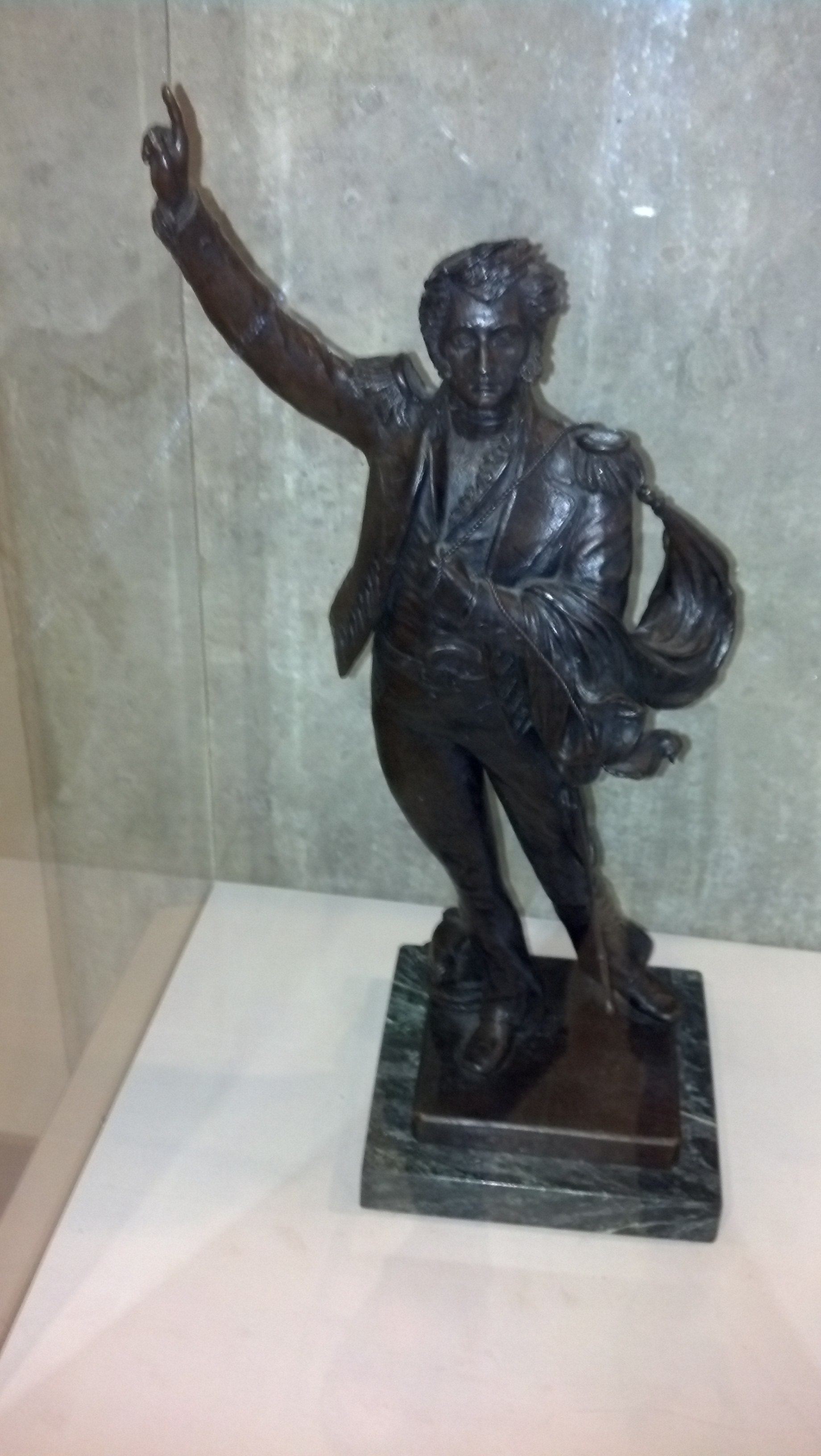
Commodore Perry

Commodore Perry looks ahead to the disco era.

We had just spent a couple of hours in the Erie Maritime Museum, immersed in the War of 1812. On our way out we bought a wooden Christmas tree decoration of the U.S. Brig Niagara – hey, it was cute – and were looking at some displays in the lobby when a statuette caught our attention.

In another time, Commodore Oliver Hazard Perry’s pose would have been inspiring and heroic, his hand thrust high and forward, index finger pointing in grand defiance of the British navy.

But my wife, Mary, and I saw a natty dresser caught in mid-motion on the disco dance floor, stayin’ alive a la John Travolta. I had to snap a photo so you could appreciate it.

“We have met the enemy,” the hero of the Battle of Lake Erie seems to be saying, “and they should be dancing, yeah!” (My stepdaughter Teresa, who hadn’t even been born when “Saturday Night Fever” hit theaters, came up with that line.)

Our trip to Erie came on the front end of a five-day loop around Pennsylvania that would also land us in Pittsburgh and at the French and Indian War sites to the south and east – Braddock’s grave, Jumonville Glen, and Fort Necessity.

We missed seeing the Brig Niagara in Erie because it was in Chicago. But just so you know, it’ll be back in Erie this week for a four-day festival of tall ships marking the 200th anniversary of Perry’s Sept. 10, 1813, naval victory over the Brits – a battle he won from the deck of the Niagara.

Sorry we’ll miss that. Beyond the spectacle of tall ships on Presque Isle Bay, there will be dozens of vendors, kids’ activities, a beer garden and live music – but probably nothing like disco duck.


A Pennsylvania farm boy badass in the American Army

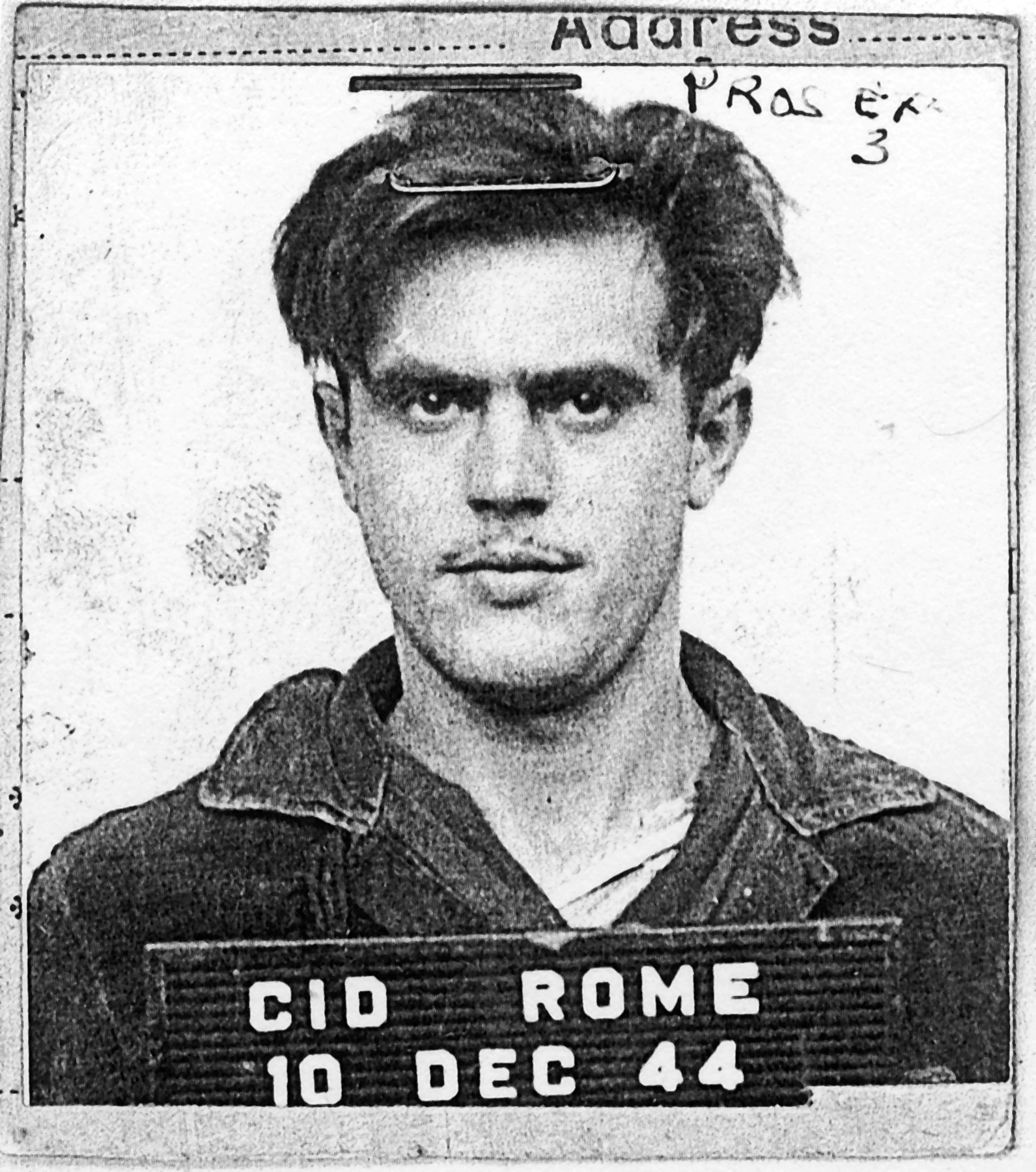
Werner E. Schmiedel

Werner E. Schmiedel of the Breinigsville section of Weisenberg Township, Lehigh County. This photo was a prosecution exhibit at his 1945 court-martial.

A caller last week told me she’d just read a new World War II book that contained a stunning tidbit of interest to us at The Morning Call.

The book is The Deserters by Charles Glass – I heard him interviewed on NPR — and in the introduction he has a paragraph about a mob of U.S. deserters called the Lane Gang who “terrorized the military and civilians alike in a crime spree of robbery, extortion and murder.” This was in 1944 in Europe. The gang’s leader was a 23-year-old, Robert  Lane.

But that was an alias, Glass says. This bad guy’s real name, he writes, was Werner Schmeidel, and he was from Allentown, Pa.

In my almost 30 years at The Call, I’d never heard of him. Who would’ve thought a Lehigh Valley resident in uniform had been a notorious criminal?

A search of the paper’s electronic archives, which go back to the mid 1980s, turned up nothing. I did manage to find him in an old clip file, but not under Schmeidel (Glass has the name misspelled) – he was Werner Schmiedel, and he wasn’t from Allentown exactly, but Breinigsville, a dozen miles west. If the clip-cutters had been diligent, the last time we wrote about him was in the spring of 1945 when he was hanged.

An online check of Army enlistment records in the National Archives’ archival databases also has the spelling as Schmiedel. They show that Werner E. Schmiedel lived in Lehigh County and enlisted in the Signal Corps in 1942.

Here’s the story that ran in the Evening Chronicle, one of The Call-Chronicle newspapers in Allentown, on March 28, 1945. There’s no byline or any indication of how the writer got the information, but it was probably combined with a wire service report. The war against Germany was still raging. Note how the paper connects Schmiedel to the Nazis in the very first line, as if a true American wouldn’t have committed such crimes:

Lehigh Soldier Sentenced
To Death for Murder in
Italian Wine Shop Robbery

German-born Werner E. Schmiedel, 22, ran away from a good home on his parents’ 50-acre farm, two miles west of Fogelsville, five years ago to enlist in the U.S. army at Fort Knox, Ky.

Yesterday, in GI uniform minus any insignia, Schmiedel stood un-manacled before a general court of eight Army officers in Rome and heard himself sentenced to hang for the murder of an elderly Italian during a wine shop robbery last Dec. 10 [1944].

His accomplice in the killing, James Adams, 23, of Oklahoma City, Okla., was given the same sentence.

Schmiedel’s parents … received the news of their son’s plight this morning with mixed feelings. They were unaware of what had happened yesterday in Rome until the news was broken to them by an Evening Chronicle reporter.

Mrs. Schmiedel, mother of 10 children, eight of them living, was told the story of the case as she stood with another son, [R.W.], 14, on the porch of their farmhouse.

The father heard the news during a lull in business at his store and meat market….

Mrs. Schmiedel had little to say about Werner, but recalled that he “…always wanted his own way.” The father, however, said the young soldier had caused the family a lot of grief. “He was hard to handle and when we didn’t hear from him for such a long time I thought he might be in trouble,” Schmiedel said.

The Schmiedels had their last letter from the son early in February, when Werner sent a V-mail letter to congratulate his mother on her birthday anniversary, Feb. 6. That was the first letter since Mother’s Day of last year.

Another son, …, has been in Burma two years and he writes regularly and sends gifts to the family. The parents are awaiting a gift he sent for their 25th wedding anniversary, which they celebrated St. Patrick’s Day. Werner forgot the anniversary; nor did he remember his mother’s birthday with a gift.

The robbery that ended with the killing of the Italian wine man netted Schmiedel and Adams little more than $15. both heard their sentences impassively yesterday after the court deliberated only 40 minutes at the conclusion of testimony in the general court-martial. The verdict was read by Col. Walter L. Medding of Memphis, Tenn.

Both youths, in unsworn statements that lasted less than a minute each, claimed they had been drinking and the gun in Schmiedel’s hand went off accidentally. Several witnesses testified the pair had been in the same wine shop, impersonating MPs, the night before the shooting.

In addition to the murder for which they were brought to trial, Army authorities have a long list of criminal acts perpetrated last autumn by the pair. They were listed as leaders of the infamous Lane gang, and Schmiedel was said to have used the name Robert   Lane, among other aliases. The two were characterized by the trial judge advocate as “small-time criminals.”

The time of execution cannot be announced until the two-day proceedings that ended yesterday have been reviewed by the judge advocate general’s office, which probably will take a month or six weeks.

Schmiedel and Adams virtually condemned themselves with their own testimony. It told how on the night of Oct. 10, they discovered they were “broke,” and, in Adams’ words, “We decided to go out and rob an Italian.”

Schmiedel’s parents were born in Germany; the father came to this country in 1923, shortly after Werner was born at Stollberg, and the mother followed a year later. Werner was brought to America at the age of two years by his grandmother, … who lives on the farm with her son and family.

Werner attended Ziegels church. He helped around the farm, but several months after his 17th birthday he ran away and enlisted in the Army.

He wrote home with no degree of regularity, and the last the family saw him was in December of 1943 when he was home on a furlough prior to going overseas.

Mr. and Mrs. Schmiedel said they “sensed some trouble” when they received a letter from the government’s Office of Dependency Benefits, Newark, N.J., a short time ago. It stated that because their son faced court-martial action, the application he had made for an allotment to his mother was being held up.

When the mother was told that her son was in trouble, she said: “Was he in that gang in Rome?” she said she had worried a lot about Werner, and felt that he would eventually get into serious trouble.

According to Army records, Schmiedel never made application for government insurance, and he delayed applying for a dependency allowance for his mother until after the holdup slaying.

The Schmiedel family has had more than its share of troubles in recent years. Mr. Schmiedel suffers from a stomach ailment, but has been able to manage the farm and also operate his store…. He is respected by a large clientele, which includes a number of public officials and some of the city’s most prominent families.

[R.W.], 14, lost his right leg just below the knee in an accident on the farm five years ago, and when a high wind storm unroofed the Schmiedel house in 1941, [a 13-year-old daughter] suffered a broken leg.

The father takes pride in the business he has built up at the store, but he said today he fears he will be forced to close soon because of the scarcity of some foods, principally meats.

The Schmiedels have 500 chickens and one goat on their farm, and within the next few days will start planting 2,500 peach and apple trees.

About Werner’s case, they don’t know what to do. The news came so suddenly, and without warning, and left them stunned. And although he has caused them a lot of grief, the family is hopeful that something can be done to save his life.

-30-

Me again. That wasn’t going to happen. The only other clip in the file is a three-paragraph AP story dated June 12, 1945, with the headline:

Army Deserter, Holdup
Leader Hanged in Rome

ROME – Werner E. Schmiedel, American Army deserter who, under the alias of Robert Lane, led a band of American and Canadian deserters in a wave of holdups in Rome and Naples last year, was hanged in the prison stockade at Axersa today.

Schmiedel, whose home was listed as Breinigsville, Pa., was convicted by special court-martial March 27 of murdering an Italian civilian during the holdup of a Rome restaurant.

Crimes by the Lane gang included the hijacking of the private car of Gen. Wladyslaw Anders, commander of the Polish Army Corps. The car was taken on the Rome-Naples highway from Anders’ chauffeur.

Read my story about Schmiedel that ran in the July 12, 2015, issue of The Morning Call:  http://www.mcall.com/news/local/mc-schmiedel-war-deserter-gangster-20150711-story.html#page=1

More recognition for Battle of Midway vet

Hank Kuczik

Hank Kudzik at the Battle of Midway Commemoration in Washington, D.C., on June 4, 2013.

A proud Battle of Midway veteran from the Lehigh Valley who’s been widely recognized in recent years has had another day in the limelight.

I’m talking about Hank Kudzik of Allen Township, a submariner who was aboard one of the fleet’s largest boats, the USS Nautilus, during the 1942 battle that turned the tide of the war against Japan.

Hank and his wife, Jacqueline, attended the 71st annual Battle of Midway Commemoration in Washington, D.C., on June 4. His daughter Wanda Frecks sent me photos, one of which appears here.

Naval District Washington marked the battle with a wreath-laying ceremony at the U.S. Navy Memorial. Hank was an honored guest. Afterward, he received a copy of the proclamation naming June 4 as “Battle of Midway Day,” signed by the chief of naval operations, Adm. Jonathan Greenert. A reception was held in the Navy Memorial for Hank and other Midway veterans.

Hank was 17 years old and on his first patrol when the battle took place. The Nautilus was strafed by enemy planes. It torpedoed the stricken Japanese carrier Soryu, then dived and was hammered by depth charges from a destroyer.

Last fall, Hank was saluted by the American Veterans Center, based in Arlington, Va. He was one of four veterans to receive the Audie Murphy Award for their roles at Midway. The presentation was made at the center’s 15th annual awards gala in the Renaissance Washington Hotel.

I did Hank’s story in 2010 as part of my series in The Morning Call “War Stories: In Their Own Words” and included it in my book of the same name, published by the newspaper the following year.

“I wanted to be safe,” Hank told me at the time, “so I picked the submarine.”