A home for Gene Salay’s Korean War medals

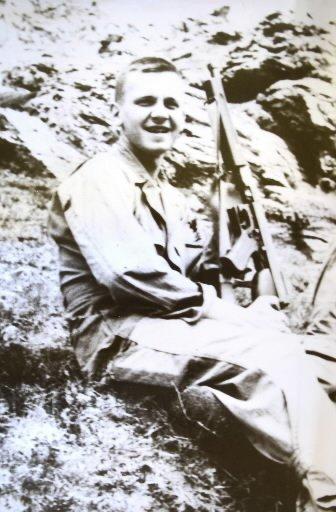
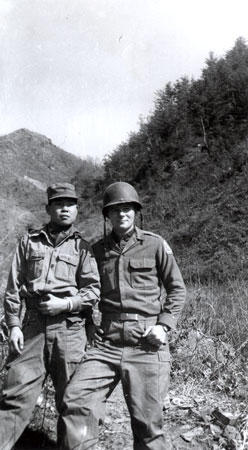
Army Pfc. Gene Salay  with a South Korean interpreter in 1953 near the North Korean border. The interpreter, Kim Yung Jo, was killed soon afterward in the Battle of the Kumsong River Salient.

Army Pfc. Gene Salay with a South Korean interpreter in 1953 near the North Korean border. The interpreter, Kim Yung Jo, was killed soon afterward in the Battle of the Kumsong River Salient, the fighting that led to Salay’s capture.

Korean War veteran Gene Salay, a wounded POW and longtime Lehigh County director of veterans affairs, died nearly four years ago. But he was remembered Sunday as Korea/Vietnam Memorial Inc. marked the ninth anniversary of its Armed Forces Plaza at Lehigh Carbon Community College.

There is a mystery behind this.

Gene was a charter member of KVM. At the ceremony, his sister Margaret Szabo presented his Purple Heart to the organization for safe-keeping. Marge, who was there with her husband, Joe, and daughter, Diane, gave the medal to KVM board member Ed Beson along with Gene’s POW and good conduct medals and his Combat Infantryman Badge.

Among those in the audience were 91-year-old Roderick Strohl, one of the “Band of Brothers” from World War II, and Lehigh County Judge Doug Reichley.

Since the KVM has no venue to display the medals, they were turned over to Andy Kelhart, curator of the 213th Regiment Museum in Allentown, who will keep them at the museum. Andy called Gene “a soldier’s soldier … very knowledgeable … and 1,000 percent for the veterans.”

Gene was shot and badly wounded in July 1953 when Chinese troops overran his unit’s position on a barren hill in northern South Korea. The 21-year-old Bethlehem native was captured and held in a POW camp in North Korea.

Kelhart said that when he asked Gene if he’d do it over again, he said, “I’d be more careful next time.” The bullet was still embedded near his heart when he died.

I got to know Gene in the mid-1990s while he was county VA director. He helped me get started with the research on my cousin Nicky, an Army helicopter pilot who went to Vietnam in the summer of 1969 and was dead in 11 days.

From time to time, I nudged Gene about telling me his Korean War experiences for my “War Stories: In Their Own Words” series in The Morning Call. He politely but firmly said “no” — until the spring of 2003. We spent many hours together working on the story. It ran July 27, 2003 to mark the 50th anniversary of the end of the fighting. You can read it at http://www.mcall.com/news/all-genesalay,0,1701380.story.

It’s also in my 2011 book War Stories in Their Own Words.

What’s the mystery?

Gene’s medals showed up at his sister Marge’s doorstep last November, delivered by the supervisory deputy of the Philadelphia Violent Crimes Fugitive Task Force, U.S. Department of Justice. Marge had received a letter in January 2013 from the U.S. Marshals Service, saying the medals would be turned over to her.

So, how did Gene’s medals end up in the Justice Department’s hands?

I’ll tell you when I nail this down.

No shortage of heroes at Philippsbourg

In a previous blog, I wrote about how rewarding it is when a veteran I’m interviewing mentions someone in particular, and I can find a record of that person. That made me think of the story I did in 2007 on World War II vet Charlie Kowalchuk.

Charlie, who grew up in Northampton County, and other soldiers in the 275th Infantry Regiment, 70th Infantry Division were coming down a ridge toward a road in Philippsbourg, France, near Germany’s Saar region. German tanks were coming up the road, firing at American tanks in the town. The Americans were retreating.

“We saw this little cluster of guys standing in the middle of the road,” Charlie said. “In front of them was a guy on his knees firing a machine gun. He was a scout for the artillery. He was busy shooting all over, strafing the German tanks and soldiers. He gave our guys enough time to back out of there.”

The scout Charlie had seen breaking up the German attack was George B. Turner, 45 years old, a native of Longview, Texas, who had moved to California. The private first class in the 499th Armored Field Artillery Battalion, 14th Armored Division, was awarded the Medal of Honor for his actions Jan. 3, 1945.

Turner died in 1963 in Encino, Calif. He was buried in Arlington National Cemetery.

There was no shortage of bravery in this campaign. A day earlier, Charlie earned a Silver Star. His citation reads: “For gallantry in action near Philippsbourg, France, on 2 Jan 1945. When his company was temporarily halted by low, grazing fire from an enemy machine gun. Sgt. Kowalchuk rose from a protected position and dashed 50 yards across open ground through a hail of hostile machine gun fire to a weeded area where he crawled another 50 yards to an advantageous position, only 10 yards from the enemy gun. Raising himself up and disregarding the stream of fire directed at him, he hurled a grenade into the enemy position, destroying the gun and its entire crew. His courage and devotion to duty enabled his company to complete its mission.”

Charlie also had a Bronze Star and two Purple Hearts. He died in 2009 after a battle with cancer. You can read his story at http://www.mcall.com/news/all-a1_5kowalchuk.6023108nov11,0,2354636.story

What one Marine’s death meant to the folks back home

Last week I wrote about a terrible Vietnam War training accident involving Marines outside Da Nang. There’s more to tell, and it has to do with the ripples caused by one life lost.

The accident happened March 28, 1967, while a Marine instructor was holding a class for a squad that would be clearing a minefield. He had an M16 mine he thought he had disarmed. It went off, killing 13 Marines. The only survivor in the class was the instructor, a staff sergeant.

I couldn’t imagine the anguish of the families. The accident was widely reported back in the States, topping The Associated Press wrap-up of the day’s war news and landing on Page 1 of newspapers across the country with headlines like “Mishap kills 13 Marines.”

Such loss of life early in 1967, well before Vietnam’s carnage reached its peak the following year, would have magnified the impact of the coverage. The AP and United Press International stories identified the Marines as belonging to the 7th Engineer Battalion, 1st Marine Division, surely filling the families of men in that unit with anxiety as they awaited word.

Using the dead Marines’ names, I searched Newspapers.com and found that one of the men was from a town in eastern Pennsylvania near where I grew up.

He was Lance Cpl. Stanley Davidheiser Jr., 20 years old, a 1965 graduate of Pottsgrove High School. The story April 4 in The Mercury of Pottstown had a banner headline on the front page: “Area Marine is killed by mine.” His family had heard about the accident in news reports and feared he was involved.

On April 3, two Marine officers came to tell his wife that apparently he was.

He had been a star athlete, with letters in football, wrestling and track. He had been in Vietnam less than two months.

The family told the newspaper that the Marine officers promised to return the next day with full details of his death. “From their remarks Monday, they led us to believe he was killed in the accident in the training class,” an aunt said.

What made the tragedy worse for the Davidheisers was that Stan’s wife was expecting their first child. He had been sending her messages on tape, telling her he was excited about becoming a father and looking forward to coming home and seeing the child.

His son was born less than three weeks after he was killed.

Did Marines, Army share lessons learned in Vietnam?

Nicky Venditti at home in Malvern, Pa.

My cousin Nicky at home in Malvern, Pa., several weeks before a training accident in Vietnam killed him.

My cousin Nicky was an Army helicopter pilot who went to Vietnam in the summer of 1969 and was dead in 11 days.

He was cut down July 10 while undergoing a week of orientation with the Americal Division at Chu Lai. He and about 40 other new arrivals attended a lecture on grenade safety at LZ Bayonet, just off the base.

The instructor, an Army sergeant, used an M26 fragmentation grenade he thought he had disarmed. He threw it onto the classroom floor to see how the replacements would react, and it detonated.

One soldier, Spec. 5 Timothy T. Williams of Toledo, Ohio, died instantly and dozens were hurt.

My cousin, Warrant Officer Nicholas L. Venditti of Malvern, Pa., and Warrant Officer Wilbur J. Vachon III of Portland, Maine, died of their wounds at Chu Lai’s 312th Evacuation Hospital within the week. Both had been with the 16th Combat Aviation Group.

The Army classified their deaths as an accident.

Two years earlier, on March 28, 1967, a similar training accident involved Marines based outside Da Nang. A Marine instructor using an M16 mine he thought he had rendered inert accidentally killed 13 Marines of the 7th Engineer Battalion, 1st Marine Division.

According to an investigation report, a lesson learned from the mine explosion was that live ordnance must never be used in training.

The Americal Division, activated in Vietnam about six months after the Marine deaths, came under the authority of the 3rd Marine Amphibious Force, which was in charge of I Corps, the northernmost military zone in South Vietnam.

At the time of my cousin’s death, the 3rd MAF’s commander was Lt. Gen. Herman Nickerson Jr. He had been commander of the 1st Marine Division when the fatal mine blast happened, and he saw the investigation report.

After the grenade accident at Chu Lai, the Americal Division commander, Maj. Gen. Lloyd B. Ramsey, called Nickerson to report it.

So, there was chain-of-command contact between the Army and Marines in I Corps.

Here’s what I don’t get: The Marines had learned not to use live ordnance in classes. And yet two years after the Marine tragedy, the Army repeated the mistake, wasting the lives of my 20-year-old cousin and two other young men.

Didn’t the Army and Marines talk to each other? To what extent did the services communicate and disseminate lessons learned? Can anyone tell me about information-sharing in Vietnam?

World War II soldier remembers a brave officer

Clifford A. Hahn

Clifford A. Hahn put on his old uniform for this photo taken in 1946 in Philadelphia.

In my interviews with war veterans, it’s terrific when the vet mentions a name of someone he saw or had contact with and I can find a record of that person. It’s especially rewarding when it turns out the person distinguished himself in uniform. Adding that nugget to the story kicks it up a notch.

That happened recently in my interviews with 91-year-old Clifford A. Hahn, a 7th Infantry Division veteran of World War II who fought in the Aleutian Islands of Alaska, the Marshall Islands and the Philippines and on Okinawa, and has three Purple Hearts.

Cliff was talking about the fighting on Leyte Island in the Philippines and mentioned dodging Japanese bullets with a Lt. Blue. “You remember his name?” I said. “Yes, he got killed a couple days later. He was a darn good guy.” “How do you spell it?” “Like the color, I think.”

Though Cliff didn’t remember the lieutenant’s first name, he did say that Blue was from North Carolina. I found a Daniel A. Blue from North Carolina in the National Archives’ database of Army enlistment records for World War II — more than 700 Blues were listed — and Googled the name. Second Lt. Daniel A. Blue in fact was highly decorated. He was posthumously awarded the Distinguished Service Cross, just below the Medal of Honor. Here’s what I found online:

Daniel A. Blue
Date of death: Killed in Action
Home of record: North Carolina
Status: KIA
SYNOPSIS: Second Lieutenant (Infantry) Daniel A. Blue (ASN: 0-1315901), United States Army, was awarded the Distinguished Service Cross (Posthumously) for extraordinary heroism in connection with military operations against an armed enemy, in action against enemy forces on 28 October 1944. Second Lieutenant Blue’s intrepid actions, personal bravery and zealous devotion to duty at the cost of his life, exemplify the highest traditions of the military forces of the United States and reflect great credit upon himself, his unit, and the United States Army.
General Orders: Headquarters, U.S. Army Forces-Pacific Ocean Areas, General Orders No. 52 (1945)
Action Date: 28-Oct-44
Service: Army
Rank: Second Lieutenant

I wasn’t done. A search of his name on Newspapers.com turned up this Associated Press story that appeared Nov. 30, 1944, under a one-column headline on Page 8 of The Robesonian of Lumberton, N.C.:

Lt. Daniel Blue
tricks Japs in
Leyte fighting

Laurinburg man pulled out and left 2 enemy battalions fighting each other in the dark.

By Spencer Davis
WITH SEVENTH DIVISION, LEYTE, P.I., Nov. 28 (AP) – An American patrol, caught at dusk by enemy machine-gun fire directly ahead and from the rear, moved to the sidelines and from a grassy knoll watched two parties of Japanese battle each other through the night.
Second Lt. Daniel A. Blue, Laurinburg, N.C., led a platoon of C Company of a Seventh Division infantry regiment over the rugged mountain trails skirting Mount Catmon on a five-day reconnaissance. His party saw 30 Japanese encamped across a riverbed.
The enemy also spotted Blue but instead of firing, waved to him. Blue, who is short, stocky, deeply tanned with a curly beard and mustache, figured he had been mistaken for a Japanese. He waved back, and beckoned the Japanese across the stream in hope of capturing some prisoners.
When the enemy patrol was in midstream, some of Blue’s men opened fire prematurely. In the resulting exchange, 25 Nipponese were killed. Five escaped.
It was nearly night when Blue’s platoon examined the bodies and dragged them to cover. As they did so, heavy machine-gun fire opened up on them. The spatter of a Japanese woodpecker [a Type 92 machine gun] sounded from the rear and Blue found himself fired on from both the front and the rear. He decided to withdraw.
The Americans swiftly filed upstream and out of danger on a hillside. But the Japanese machine-gun fire continued at a furious rate.
Obviously each enemy party thought the other was an American patrol. At daylight the firing stopped abruptly and the Japanese melted away into the jungle after burying their dead.
At one point there were 35 fresh shallow graves.

That’s the story, but there is a discrepancy. The AP account is dated Nov. 28. Blue was killed in action Oct. 28.

I wonder if there are any relatives of Daniel A. Blue who might see my story on Cliff that ran Jan. 26 in The Morning Call. Here’s the link: http://www.mcall.com/news/local/mc-war-story-clifford-hahn-20140125,0,4254154.story I know Cliff would be thrilled to hear from them.

German army soldier Edward Sakasitz, 1920-2013

Wartime photo of Eddie Sakasitz

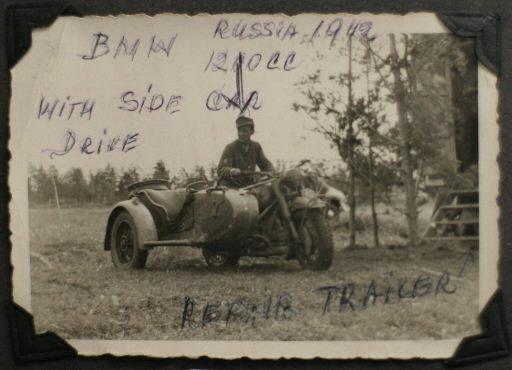
A wartime photo of Eddie Sakasitz from his album.

Eddie Sakasitz

Eddie Sakasitz as a German army soldier in World War II

The phone call came in the early days of 2007 from an old man who wanted to talk. Over the years I’d taken many such calls from war veterans, but this one was stunningly different.

Edward Sakasitz, of Northampton County, had been a U.S. citizen who was raised in Austria and served in the German army during World War II. In his mid-80s now, he was cheerful and said friends had suggested he tell his story to The Morning Call, and would I be interested in interviewing him.

Of course I was, so on Feb. 5 of that year I sat down with him at his home in Nazareth for the first time. His story ran in two parts, on March 4 and 5, and later I included it in my 2011 book, War Stories: In Their Own Words.

Eddie and I got to be friends. He and his wife, Catherine, and I would have breakfast from time to time at the Valley View Diner near Nazareth. And we would sit together at luncheon meetings of the Lehigh Valley Veterans of the Battle of the Bulge. Eddie had been invited to join the group after his account ran in the paper. He would call me if he couldn’t make it to a meeting. He was forever grateful that the American veterans had accepted him.

I saved every Christmas card he sent, every postcard he sent from the many trips back to his homeland that he and Catherine had taken.

Always eager to talk about his wartime experiences, Eddie would tell them over and over – always with the same details told excitedly in the exact same order and with a sense of wonder and amazement. The Wehrmacht soldiers had a saying, he liked to tell me with a laugh: We lost the First World War, we’ll win this one too. He explained that they couldn’t be defeatist, they couldn’t be heard saying they were going to lose the second war.

In 2008, after seeing my story on Eddie, German army re-enactors honored Eddie during the Mid-Atlantic Air Museum’s World War II Weekend at Reading Regional Airport. They gave him a glass-covered memory box containing medals, a service ribbon and an insignia patch for his rank. All replicas, the medals included one to signify he’d been wounded in battle and an Iron Cross for bravery.

Eddie’s health began to spiral last year. In early December I visited him at Easton Hospital and sensed it would be the last time I’d see him. It was. He died Dec. 30 at age 93. His family asked me to do a reading from Liturgy at his funeral Mass, which my wife, Mary, and I attended, and I was honored to oblige.

Eddie had lived a remarkable life. He had been incredibly lucky to survive World War II, and often reminded me of that. His story is so compelling, I’d like to summarize it here in a timeline. Here goes:

EDDIE SAKASITZ’S PATH

July 10, 1920: He’s born in Nazareth, Pa., but two months later his mother returns to the place of her birth, the Burgenland province of eastern Austria, to live on her father’s farm, taking baby Eddie along. Eddie’s father, older brother and three sisters remain in Nazareth.

1920-39: Eddie grows up in village of Fladnitz, Austria, 24 miles southeast of Graz. His mother dies when he is 12, and he is raised by her sister and works on her farm, also in Fladnitz.

1940: He serves in Reichsarbeitsdienst, a pre-military work service, and is drafted into German army, the Wehrmacht. He gets basic training at Bregenz am Bodensee, in Austria on Swiss border. He is a Gefreiter, or private, and later an Obergefreiter, private first class.

January 1941: His antitank battalion, Panzerjaeger Abteilung 85, part of the Wehrmacht’s 5th Gebirgs (Mountain) Division, leaves base near Zell am See in Austria’s Salzburg province. Unit heads east, goes through Graz and across Hungary, Romania, Bulgaria (through capital, Sofia) and Macedonia.

April 1941: He arrives in northern Greece, at town of Thessaloniki. His unit moves south, pursuing British and New Zealand troops, and reaches Athens. For a while, it’s based at village in Phaleron, south of Athens.

May 1941: The Panzerjaegers board a ship at Pireas, southeast of Athens, and arrive on Crete at Hania, in northern and western part of island. They move east along coast to port of Iraklio, in middle of island.

December 1941: Eddie’s unit leaves Crete and returns to Athens, then goes north through Macedonia and Yugoslavia. Ultimately, the “tank hunters” reach their Austrian base at Zell am See, where they regroup.

January 1942: They leave Zell am See by train and cross Czechoslovakia, Poland, Lithuania, Latvia and Estonia and enter Russia.

February 1942: The Panzerjaegers disembark at Krasnovardeisk, southeast of Leningrad (now St. Petersburg), and take Leningrad-Moscow highway to Volkhov, east of Leningrad and below Lake Ladoga. They move around in that area every few weeks.

September 1942: His unit battles Russians at village of Sinyavino.

January 1944: The Panzerjaegers board a train at Krasnoyeselo, south of Leningrad. After six-week train ride, they arrive at Frosinone, south of Rome. American bombardment drives them north to Pisa and across Po River to Verona. They go west through Brescia, Milan and Turin.

Nov. 29, 1944: Eddie is machine-gunned in legs, apparently by Canadian soldiers, while riding a motorcycle near Saluzzo, south of Turin. He is sent to a German field hospital near Turin.

December 1944: He is transferred to a hospital in Milan area. By April 1945, he can walk with crutches.

April 1945: He and other German wounded take a train from Milan to Switzerland, where they are interned as war ends. Near Lugano, a doctor removes damaged bone from Eddie’s left leg. Eddie is transferred to a Zurich hospital, where he stays for about a month. Then he is sent to Lyss and lives in barracks.

December 1945: He goes home to Austria by train and settles again in Fladnitz. He works as a diesel engine mechanic and also drives trucks and buses. In 1949, he moves to Ehrenhausen in Austria, near Yugoslavian border, where he meets and marries his first wife, Anna Roy.

August 1953: He is notified by American Embassy in Salzburg that he has been granted a passport after seeking one with the help of his father since 1947.

Nov. 26, 1953: After sailing from Naples on new but ill-fated liner Andrea Doria, he arrives on Thanksgiving Day in New York harbor, where he is greeted by his siblings. His father had recently died, so Eddie never met him. Eddie settles in Nazareth. Six months later, his wife and daughter Renata come from Austria to join him, but the child dies of an illness at age 5. Eddie works as a machinist at Easton Box Co. for many years, retiring in 1985. He and Anna have another daughter, Cindy.

Jan. 12, 1986: Anna dies.

April 9, 1989: Eddie marries Catherine Inhoff Wolf, whose husband had died.

Dec. 30, 2013: Eddie dies in St. Luke’s Hospice, Bethlehem, at age 93. He is buried in Holy Family Cemetery, Nazareth, on Jan. 3, 2014.

Navy archivist’s gesture a class act

Over the years I’ve sent copies of my war stories to libraries, museums and historical societies and didn’t always hear back.

That’s disappointing. You want to hear something like a thank you or we’ll be sure to include this in our research library or something like that.

But recently I had a terrific experience with the U.S. Navy Memorial Foundation in Washington, D.C.

First, the background:

For my “in their own words” Veterans Day war story in The Morning Call, I interviewed World War II Navy vet Bill Fritz of Bethlehem. He had served as an aviation ordnanceman in Brazil, arming twin-engine patrol bombers that hunted German submarines in the South Atlantic.

After the story ran on Nov. 11, I visited Bill to take him a batch of newspapers that had his story.

“Sure would be nice if the Navy Memorial got one,” he said.

Bill, who’s 91, is a plank owner of the memorial, meaning he’s an original member, and has a profile and photo of himself posted on the memorial’s Navy Log online.

I told him no problem, I’d send it, and I did that the next day. I included Bill’s address and phone number in case someone at the foundation wanted to contact him.

The very next week I got a letter from Navy Memorial Foundation archivist Robert C. Smith. It was a copy of a letter he’d sent to Bill about how pleased the Navy is to have his story. Smith said it’s been added to the Voices collection at the memorial’s Media Resource Center, which holds first-hand accounts of service.

“Yours is a fascinating one and sheds light on the essential wartime service of many who were in unusual and lesser-known areas,” Smith wrote.

He said he updated Bill’s Navy Log entry to show Fleet Air Wing 16, Belem, Brazil, as one of his duty stations. He even included a copy of the updated log, as well as a form Bill could use to list additional duty stations and awards he had received. And Smith said he’d like to use portions of Bill’s account to form a Memory page as part of his log entry.

Smith closed with: “Personally I enjoyed the opportunity to read about your service and to be able to add this account to our growing collection of historic materials.”

Wow, he really did it up right! Bill was touched and thrilled.

Now it was my turn. I emailed Smith to thank him for brightening a proud old sailor’s day.

I mentioned that my father and an uncle had been sailors during the war. My dad was a Coast Guard radio operator on patrol frigates in the North Atlantic, and my mom’s brother was a Navy aviation ordnanceman in the Aleutians. I sent the links to their pix and service info that I’d posted on the National World War II Memorial site: http://www.wwiimemorial.com/registry/search/pframe.asp?HonoreeID=2174327&popcount=1&tcount=1 for my dad, and http://www.wwiimemorial.com/registry/search/pframe.asp?HonoreeID=2233965&popcount=1&tcount=1 for my Uncle Walter.

Smith emailed back that his father had served on a Coast Guard cutter in the North Atlantic in 1942-43. He suggested I post Navy Logs on my dad and uncle at http://www.navylog.org.

I’ve submitted the info, but the logs aren’t up yet. The Navy has to vet them.

The Navy Log is a national registry of sea service with 638,000 records. You can search for a sailor by name or duty station, or enter info on someone’s service and add a photo. There’s no charge.

I didn’t know about this registry until now. It’s another good way to honor the memory of my dad and uncle, both of whom died in the last 10 years.

Pearl Harbor survivors’ stories are almost gone

Some folks have been asking why I didn’t have a story in The Morning Call for the 72nd anniversary of the Pearl Harbor attack. For years I’ve marked Dec. 7 by highlighting one survivor’s story, told in his own words.

Fact is, I’ve run out of survivors. There are only four known Pearl Harbor veterans still living in the Lehigh Valley – Bob Kroner, Dick Schimmel, Burdell Hontz and Jim Murdy – and I’ve done stories on all of them.

Murdy’s was the first, back in 1999. He was in the Navy, an electrician aboard the light cruiser USS Helena, which took an aerial torpedo from the Japanese. Schimmel’s story ran in 2007. He was an Army radar man, a switchboard operator and plotter at Fort Shafter. Hontz worked at the message center of a B-17 bomber group at Hickam Field; Kroner was in the Army Signal Corps – he had been Schimmel’s drill instructor — and led a team of cipherers at Hickam Field. All are now in their 90s.

I’ve done a total of a dozen interviews with Pearl Harbor survivors over the years, including my 2011 story on three Army radar men from Pennsylvania – Schimmel, Bob McKenney and Joe Lockard. It was Lockard who got a radar warning of incoming planes that was ignored. He died in 2012, and McKenney died last March.

Other Pearl Harbor survivors I’ve interviewed were John Minnich, who died of heart failure before his story ran in 2001; Clifford Ryerson, who died in 2009; Paul Moyer, Warren Peters and Alfred Taglang, all of whom died in 2011; and Joe Moore, who died in September – I saw him almost weekly because we went to the same church, Calvary Moravian in west Allentown.

So, as this generation passes, the Pearl Harbor attack no longer “lives in infamy” for most of us – the thrust of the story that ran in The Morning Call on Saturday in place of the interview I can no longer get.

Happy 65th birthday, Nicky

Nicholas L. Venditti of Malvern, Pa., as a 19-year-old soldier at Fort Polk, La., in the summer of 1968.

Nicholas L. Venditti of Malvern, Pa., as a 19-year-old soldier at Fort Polk, La., in the summer of 1968.

If my cousin Nicky had survived Vietnam, it’s a fair bet that he’d still be alive today. He would have turned 65 on Tuesday.

That’s 45 years of a life unlived.

I can only guess how it would have turned out for him if he’d come home to Pennsylvania in 1970, after a one-year tour. He would have married his fiancée. They would have had children. He might have made a living as a pilot, having learned how to fly helicopters in the Army.

And maybe I would have gotten to know him better. As it was, I only remember that he said “hi” to me once at a family picnic and that I saw him at a party sending him off to boot camp. We came from a big Italian family that was close and got together often. Still, he was five years older than I and lived in another town.

Nicholas Louis Venditti had grown up fast. He was born Nov. 26, 1948, at Chester County Hospital, the son of Louis and Sally Gable Venditti. The family lived in the first block of East King Street in Malvern, but the marriage didn’t last. Louie left Sally when Nicky was a second-grader at Malvern Public School.

Nicky became a star pitcher in Little League with a daunting fastball. He went on to General Wayne Junior High and Great Valley High School, where he played some baseball. But mainly he spent his time pumping gas after school and on weekends so he could indulge his interests in guns and fast cars. He graduated from Great Valley in 1966 with no particular plans for his life.

He met Terri Pezick while working at the Sinclair station on King Street. They were engaged when Nicky left for Vietnam.

Besides pumping gas, he worked at plastic cup maker Plastomatic in Malvern. In 1967, he got the idea that he wanted to be a helicopter pilot in the Army, knowing he would almost certainly go to Vietnam. During World War II, his father had been a ground crewman with a fighter squadron of the 8th Air Force in England, and his stories might have influenced his son.

Nicky took a flight aptitude test in December 1967 and got the nod from the Army. He enlisted and had boot camp at Fort Polk, La., completing his training there in August 1968. He went on to the U.S. Army Primary Helicopter School at Fort Wolters, Texas, where he learned to fly helicopters.

In February 1969 he started Army Aviation School at Fort Rucker, Ala., and flew the UH-1 “Huey.” He won his wings June 3.

Now the newly minted warrant officer, with the rank of WO1, had orders sending him to Vietnam to join the 16th Combat Aviation Group, which was attached to the Americal Division at Chu Lai, in the northern part of South Vietnam.

He had a three-week leave at home in Malvern, then left for Vietnam from Washington State, arriving at Cam Ranh Bay on the Fourth of July, 1969. A C-130 transport plane took him up the coast to Chu Lai.

As a new arrival, part of his training was to attend a classroom lecture on grenade safety. On July 10, he and several dozen other replacements were trucked off the base to a landing zone called Bayonet, home of the Americal’s 198th Light Infantry Brigade and the site of a firing range and orientation building.

Nicky and three other warrant officers ambled into the building and sat at a table up front. The instructor, a sergeant in his early 20s, held up an M26 fragmentation grenade and talked about it. As part of his routine, he pulled the pin and tossed the grenade at the class. It was a gimmick to see how the new guys would react.

The grenade wasn’t supposed to be live, but it rolled under the table where Nicky was sitting and detonated. He lost his left leg below the knee and clung to life at Chu Lai’s 312th Evacuation Hospital. But at 4:15 a.m. July 15, his life ended. Two other soldiers also died from the blast, which the Army determined to be an accident.

Nicky had not been at the Americal Division base long enough to be assigned to an assault helicopter company. He had not even survived 11 days of his 365-day tour.

He came home to Malvern in a silver metal casket by way of Dover Air Force Base in Delaware. On July 28, 1969, he was laid to rest in Philadelphia Memorial Park, near his hometown. I was a clueless 15-year-old, standing with my family in the crowd by the grave.

Nicky will always be 20 years old. But just for today, I’m going to pretend he’s turning 65.

Happy birthday, Nicky.

‘Men, they want us to recover the bodies’

A year ago I wrote about one of the most controversial episodes of the Vietnam War – the reported mutiny of Americal Division troops in 1969, a story that ran at the top of Page 1 in The New York Times.

Now I have something to add to it, a fresh voice, a man who was among the “mutineers.”

The soldiers belonged to Company A, 3rd Battalion, 21st Infantry Regiment of the 196th Light Infantry Brigade. Their commander was Bobby Bacon, a lieutenant colonel who figures in the book I’m writing about my cousin Nicky Venditti.

Nicky was an Americal helicopter pilot who died 11 days into his tour of duty as a result of a training accident just off the division’s base at Chu Lai. That was in July 1969. Bobby’s name is on a condolence letter sent to Nicky’s dad. Here’s why: Before the colonel took command of the 3rd Battalion, he was briefly commandant of the 23rd Adjutant General Replacement Company, the unit that oversaw the training of new arrivals at Chu Lai.

Back in the 1990s, when I first got in touch with Bobby about Nicky’s fate, he told me about the so-called mutiny. He had taken command of 3rd Battalion because its previous commander, Lt. Col. Eli Howard, was killed Aug. 19, 1969, when his helicopter was shot down southwest of Da Nang.

Bobby was in charge when the battalion was trying to reach the wreckage. On Aug. 26, Horst Faas and Peter Arnett of The Associated Press reported that Company A had refused to go on. The story began:

SONGCHANG VALLEY, South Vietnam, Aug. 25 – “I am sorry, sir, but my men refused to go – we cannot move out,” Lt. Eugene Shurtz Jr. reported to his battalion commander over a crackling field telephone.

The company had been ordered to move down a rocky slope of Nui Lon Mountain into a labyrinth of North Vietnamese bunkers and trench lines. The soldiers had been making the push for five days, but each time they had been beaten back by the enemy.

“Repeat that, please,” the story quotes Bobby as saying. “Have you told them what it means to disobey orders under fire?”

“I think they understand,” the lieutenant replied, “but some of them simply had enough – they are broken. There are boys here who have only 90 days left in Vietnam. They want to come home in one piece.”

Bobby told him to leave the men on the hill and “move to the objective,” the story says. The colonel then told his executive officer and a sergeant to fly across the valley and give Company A “a pep talk and a kick in the butt.”

They found the men exhausted in the tall, blackened elephant grass, their uniforms ripped and caked with dirt…. The soldiers told why they would not move. “It poured out of them,” the sergeant said.

They said they were sick of the endless battling in torrid heat, the constant danger of sudden firefights by day and the mortar fire and enemy probing at night. They said they had not had enough sleep and that they were being pushed too hard. They had not had any mail or hot food. They had not had any of the little comforts that make war endurable.

The story goes on to say the sergeant, Okey Blankenship, argued with them, suggesting they lacked courage, then started walking down the ridge line. He turned around and saw that they were stirring. They got into a loose formation and followed him down the slope.

Bobby relieved Lt. Shurtz as commander of Company A. The Americal Division said five enlisted men had questioned Shurtz’s orders to move out, but that all five had finally gone with the rest of the company “and the company completed its mission.” No charges were filed and there was no formal investigation.

Meanwhile, Faas and Arnett’s dispatch shot around the world. The news, hailed by the Viet Cong, created the impression that President Nixon now had to contend with a revolt by the U.S. military in Vietnam.

James Dieli, who read my September 2012 blog, wrote to me recently and said that he had been with Company A when the alleged mutiny happened. I asked him to give me details. The following is an excerpt of his account:

“I arrived in South Vietnam Aug. 1, 1969, and after the usual orientation I was flown to the Americal Division headquarters in Chu Lai. After additional orientation I was assigned to Company A 3/21st Infantry of the 196th LIB, and flown out to LZ Center in the Central Highlands.

“After more orientation I was instructed to draw weapons and gear from the ammo bunker and wait for transport out to the company.

“Company A had come under heavy ground fire which you could observe from Center. The battle was very close just beyond the valley. If my sense of direction is correct, the action was on the west side of Center. This lasted for several days and I observed tons of bombs being dropped by our fighter jets and artillery from neighboring support elements.

“I then observed a chopper leave our base and hover over the battle for a brief moment and then fall from the sky in a ball of flames. I then learned that aboard were our sergeant major, one of our officers, [AP photographer] Oliver Noonan, and some enlisted men. I really could not understand the magnitude of this as it all seemed surreal to me at the time.

“I don’t remember the timeline exactly of the events, but a day or two later they finally were able to fly us out to the company. It was a very short trip to the mountain where Company A had pulled back to. While getting there, the chopper took light ground fire and then I realized for the first time this was the real thing.

“After spending a couple of nights in a foxhole, it was very apparent the enemy had not left the area because there were constant incoming rounds all night long, and during the day there was sporadic mortar firing at us.

“On the morning in question I was standing speaking to some of the men trying to learn and understand what to do and what to expect for the next year, when an officer approached and said, “Men, they want us to go back down and recover the bodies.”

“The response was that there was still enemy activity, and with half of our company either dead or wounded it would be nothing short of suicide. The officer then told us that the enemy activity had ceased and the area was clear. The response was that they didn’t believe that, and they would have no problem going back down as soon as they had some reinforcements.

“The officer then asked the men one by one if they all felt the same, and they all agreed that based on the last few days it would be nothing short of suicide. The officer then asked me, and my response was: I just arrived here. Some of these men are ready to go home and I will not disagree with them, after all I’m only here a few days and know absolutely nothing. What right do I have going against them?

“After another communication the officer approached the men again and said Command this time ordered us to move out, otherwise there would be no supply of food or ammo, and if we made our way back to the coast we would all be court-martialed.

“The men did not disobey because the second communication was the order, the first was not. We moved down the knoll with no resistance and recovered the bodies.

“Morale was very low within the ranks, but on the second day, Col. Bacon actually came out to the field and spent a couple of nights with us in foxholes and that brought moral up. These men went through hell and I believe all they wanted was a regrouping, food, and reinforcements. They did not disobey a direct order!”

Bobby Bacon had told me the same: The men of Company A did not disobey an order, because no order had been given. When it was, the entire unit moved out, he said.

Faas and Arnett stood by their story. They wrote to Bobby the day it ran and said it was “absolutely fair.” But as I blogged before, newspapers and news magazines did their own reporting and challenged the AP reporters’ version of events.