Category Archives: World War II

‘We were full of piss and vinegar, and no brains’

Mathias Francis Gutman: 1925-2024

World War II veteran Matt Gutman died last Thursday, November 7, at his apartment in Allentown, Pennsylvania. He was 99. I wrote a story about his passing for my old employer, The Morning Call. For you, I’m sharing a partial transcript of my August 18, 2022, interview with him. Here, he tells about joining the Navy in 1943 and heading for the fight against Japan.

I didn’t want to be trapped in the Army or Marines.

When I was in junior high school, my brother who was in the Navy gave me one of these sea caps, and I used to wear it to school. I sort of liked the Navy because, first of all, I wanted to have good, warm chow and a bunk to sleep in, not a mud hole. … And that’s why I chose the Navy.

I enlisted at the Navy recruiting station in Allentown. … I wanted to go into the Seabees originally, [so] I talked to the chief Seabee, and he says, “What’s your occupation? What did you do?” I said, “No, I just come out of high school. I had basic electric.” He said, “Look, son, go next door. Talk to the Navy recruiter. We can’t be teaching you. We want people that are already trained.” So then I went next door to the chief of the Navy, and he enlisted me.

Then I went to Sampson, New York, for seven weeks of basic training. There was 106 of us. We trained together, marched together, ate together, everything together as a unit, and then, of course, graduated and then were given a seven-day leave to go and visit our parents, our friends. After seven days, we had to report back to Sampson for fleet assignment.

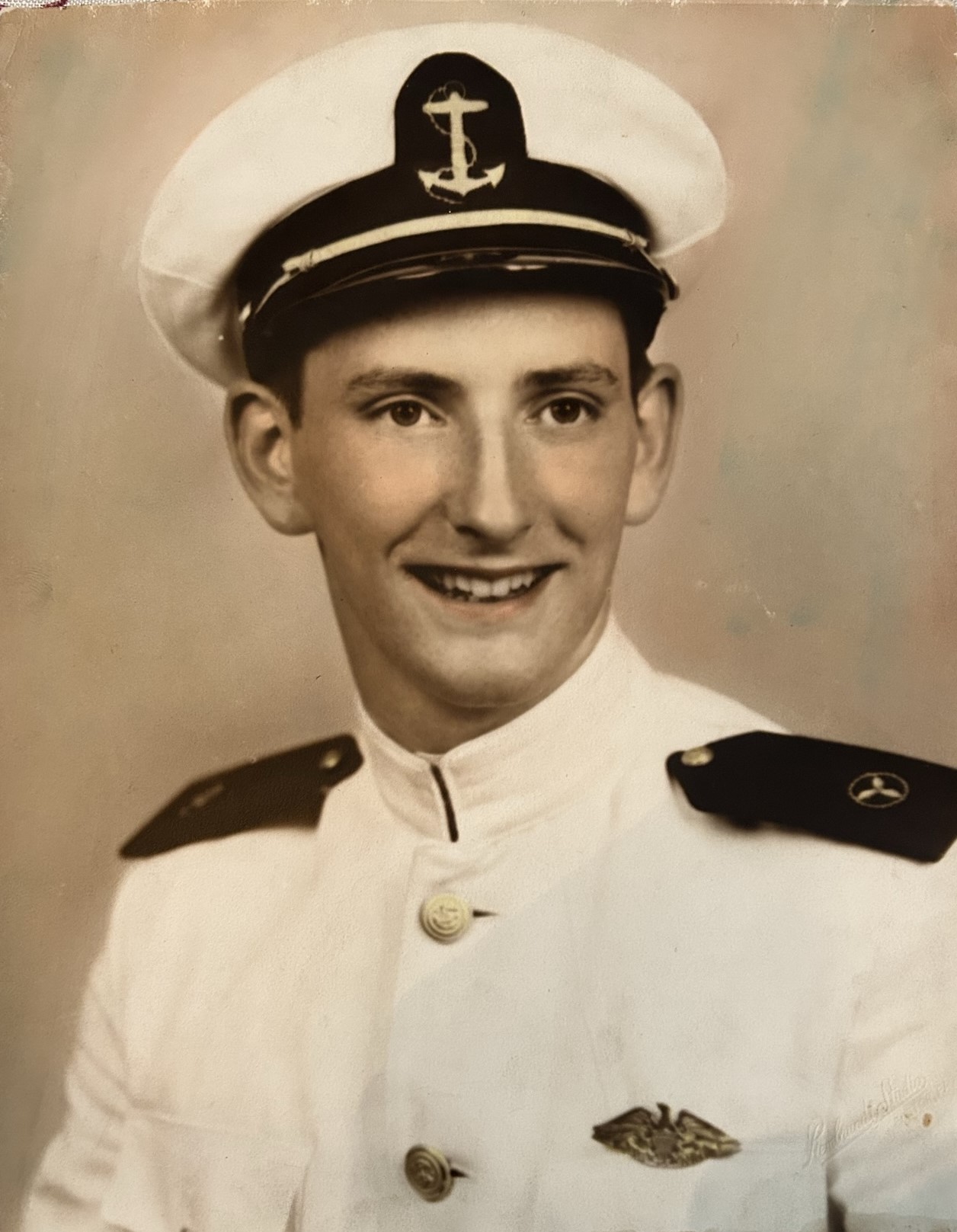
Gutman left Allentown High School in 1943 to sign up, and served in the Naval Amphibious Forces.

They sent me with a group of others by train down to Camp Bradford, Virginia, for amphibious training. First of all, I didn’t know what it would entail. … I knew it was land and sea. This was something new. When we got down there, they showed us all the different types of ships they used for invading an island, went over every one of them. They also told us about what to expect on those ships, and they told us these ships were made only to invade an island. That’s why they called them amphibious. They carried troops and tanks to invade an island.

That was the main purpose of the ship that I was assigned on. It was called a landing ship, tank, an LST, and they were all numbered. They never had no names. Mine was 553. I was with it all through the war. It was camouflaged brown and green. You know why? Because when we boarded that ship in Evansville, Indiana, where it was built, we seen that ship was all in tropical colors. Tropical! We knew right then and there that ship was going to be assigned to the Pacific Theater, not European, because once that ship beaches, it blends with the foliage on that island.

They taught me how to operate the Higgins boat, and I was in charge of the Higgins boat on our ship when we made the landings. I was a seaman first class then. I don’t know why I was picked, but they came and asked me if I’d like to do that, and I said, “Why not? I’m in the Navy, I’ll do what I can.” And I operated that landing craft all through my landings in the Pacific. …
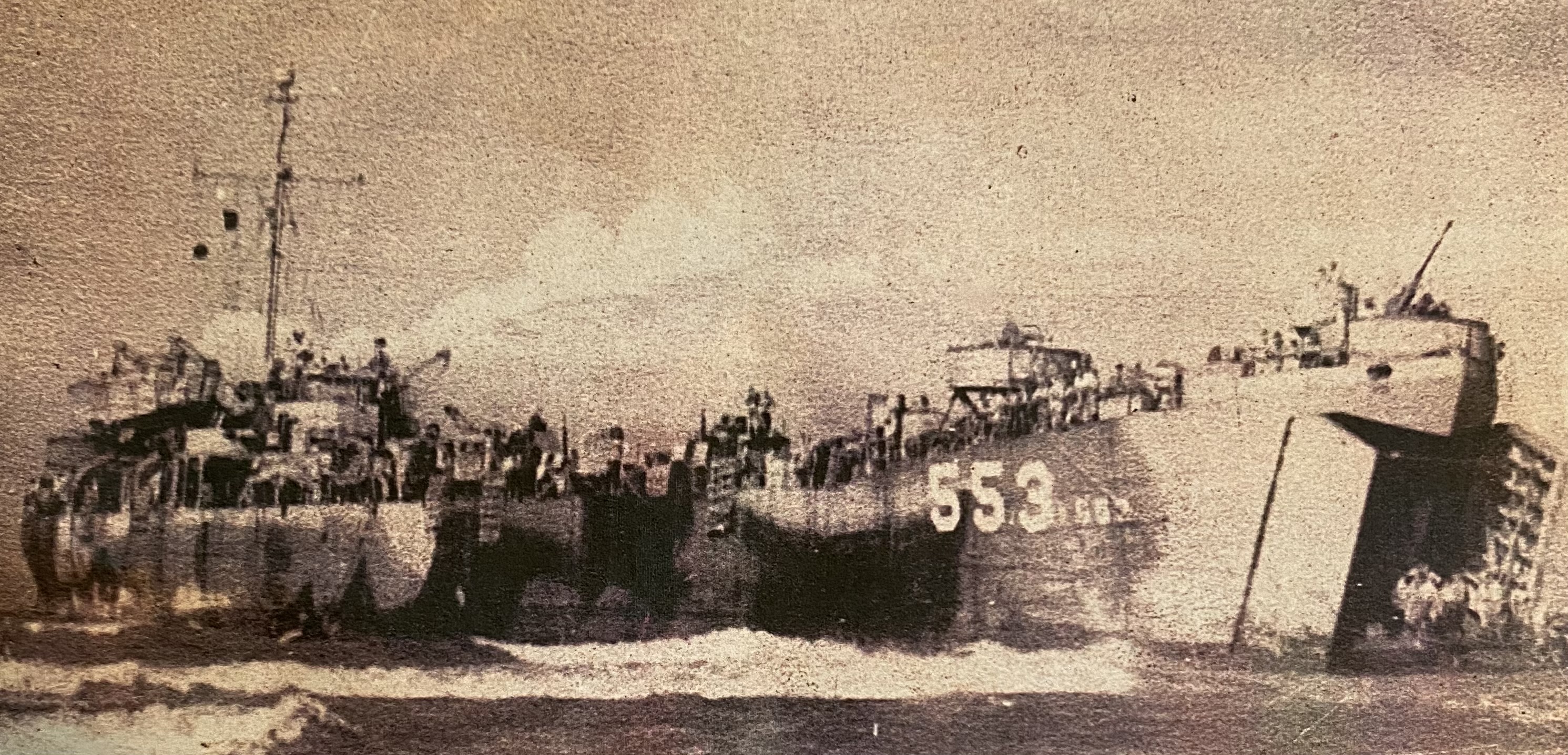
Gutman’s LST, a landing ship, tank

After they trained me, I went to San Pedro [in Los Angeles] and Hawaii, I used that boat a lot to take people to shore, back and forth. So I was trained all along with it, you know what I mean? It only had one propeller. You had to watch the wind and currents. Well anyway, they trained me pretty well.

We only had two Higgins boats on our ship, one to starboard and one on the port side. I had the one on the port side. [As coxswain] I was in the stern. I always had to watch where I was going. These Marines and Army men we had in there, they’re all hunkered down. I had to see where I’m going, you know. I had to stand because I wanted to see where I was going, because the bow doors were up pretty high. It had a diesel engine, very noisy, and it always smelled awful. But we were young guys, we could take it. We were all young, full of piss and vinegar, and no brains.

Getting smooched by The Magnolia Sadies, a vintage dance troupe, on May 8 at a V-E Day picnic honoring World War II veterans in Macungie Memorial Park

They shipped a crew of us to Evansville, Indiana, where we picked up our ship. It was built there, right alongside the Ohio River. We boarded that ship in April 1944. The skipper took her down the Ohio River, the Mississippi River to New Orleans. That’s when the ship was commissioned. We stayed in New Orleans for four days, taking on supplies – water, fuel. Then we headed back down the Mississippi to the Gulf of Mexico.

While in the gulf, the skipper put the ship through what is called a shakedown cruise. A shakedown cruise consists of testing all the components of that ship – the navigation equipment, all the guns were working properly, checking out the fire system we had, the fire hoses, check everything to see that that ship was ready for combat. From there we went to Panama City, Florida, where they taught us how to distinguish all types of shipboard fires we might encounter in combat. We were there about four days.

From there, we went to Gulfport, Mississippi. We were there to pick up creosote pilings. They were large logs, about 18 foot long and 2 foot wide. We wondered, what the hell is this gonna be? They loaded them on our tank deck. We went through the gulf and the Panama Canal with about seven other LST’s. And we we went up along the coast to San Diego, 108 men and eight officers. … We enjoyed liberty there. We were there maybe three or four days. We took on more supplies. We also took on a contingent of Seabees.

We left San Diego with a fleet of ships going due west. The skipper was on the P.A. system and he said, “We are now heading for Pearl Harbor.”
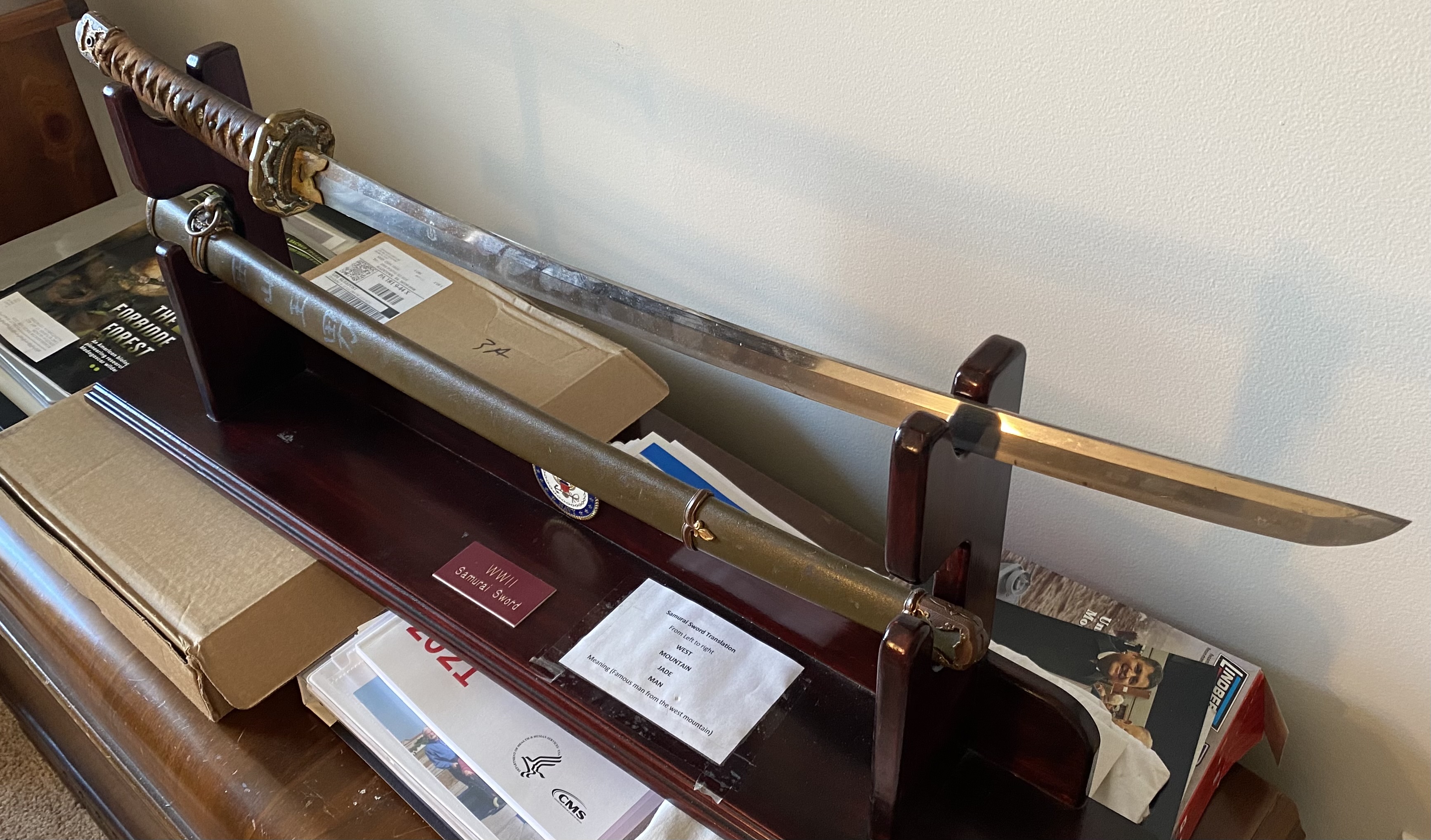
A sword and scabbard Gutman took from a Japanese officer after the surrender. ‘Sir, you will not need this any longer,’ he told the man while helping to disarm enemy troops on a Pacific island.

When we entered Pearl Harbor, we could still see a lot of the destruction that took place when they [the Japanese] bombed that harbor. We then found out that these creosote pilings, along with the Seabees, were brought there to repair the docks and ships that were destroyed in the bombings. We were there maybe about a week. We enjoyed liberty. A lot of guys got drunk, got pie-eyed. I think I had a couple of beers. We had a lot of fun. I guess the skipper wanted us to have fun.

We knew from there, God only knows where we’re gonna go.

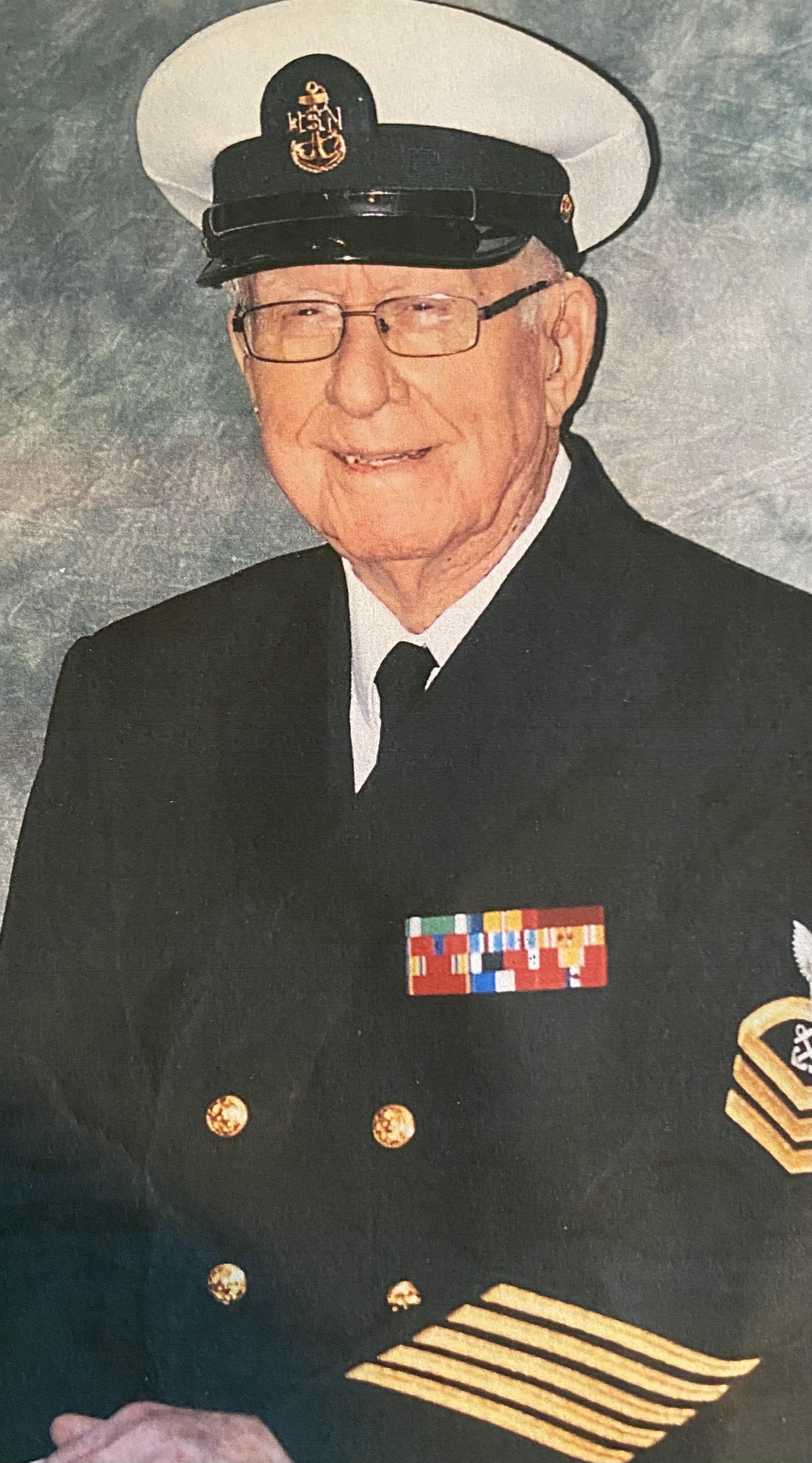
In September 1944, Gutman landed Marines on Peleliu in his Higgins boat under fire. He went on to take troops ashore at four sites in the Philippines and at Okinawa. At war’s end, he and some others on his LST volunteered to sweep pressure mines that U.S. planes had dropped in Japanese harbors. For “the personal danger involved,” he was awarded a Navy Commendation Medal. Back home, he had active duty in the Reserve as an instructor and recruiter, retiring in 1967 as a chief petty officer.

He was more than a distinguished veteran and the subject of several stories I wrote for the newspaper over the past few years. He was my friend.

Remembering a lost defender of Bataan

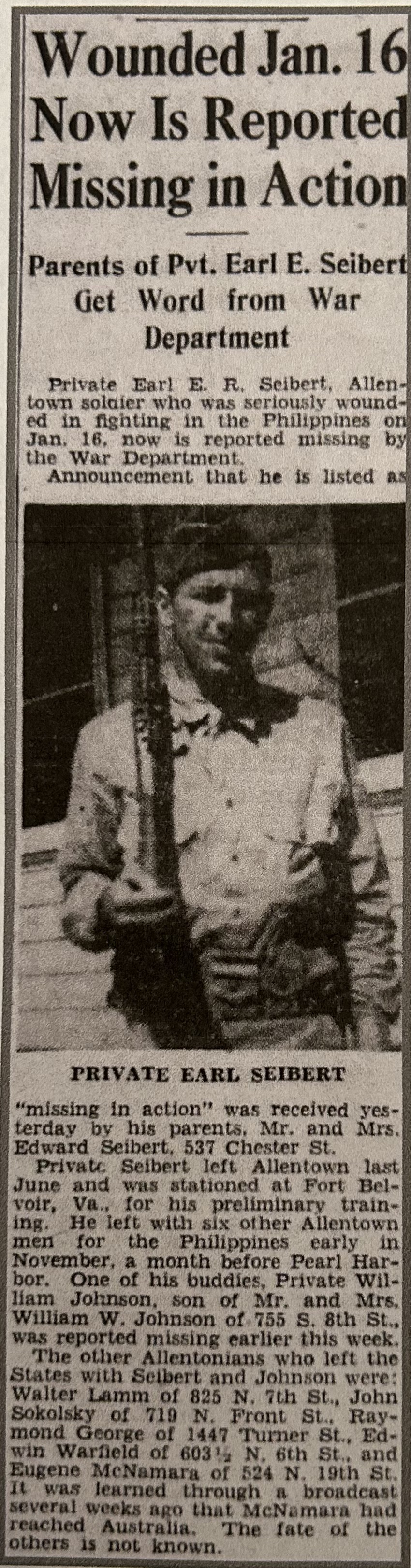
Private Earl Seibert of Headquarters Company, 803rd Engineer Aviation Battalion
(Newspapers.com)

Private Earl Seibert died eighty-two years ago at a prison camp in the Philippines and was buried there. When the Defense Department announced last month that his remains have been identified, I reached for my filing cabinet.

In 2002, I interviewed a veteran who had much in common with Seibert– eastern Pennsylvania hometowns, service in the same Army unit, the Bataan Death March and a camp where more than 2,500 POWs died. The difference was that Joe Poster was spared.

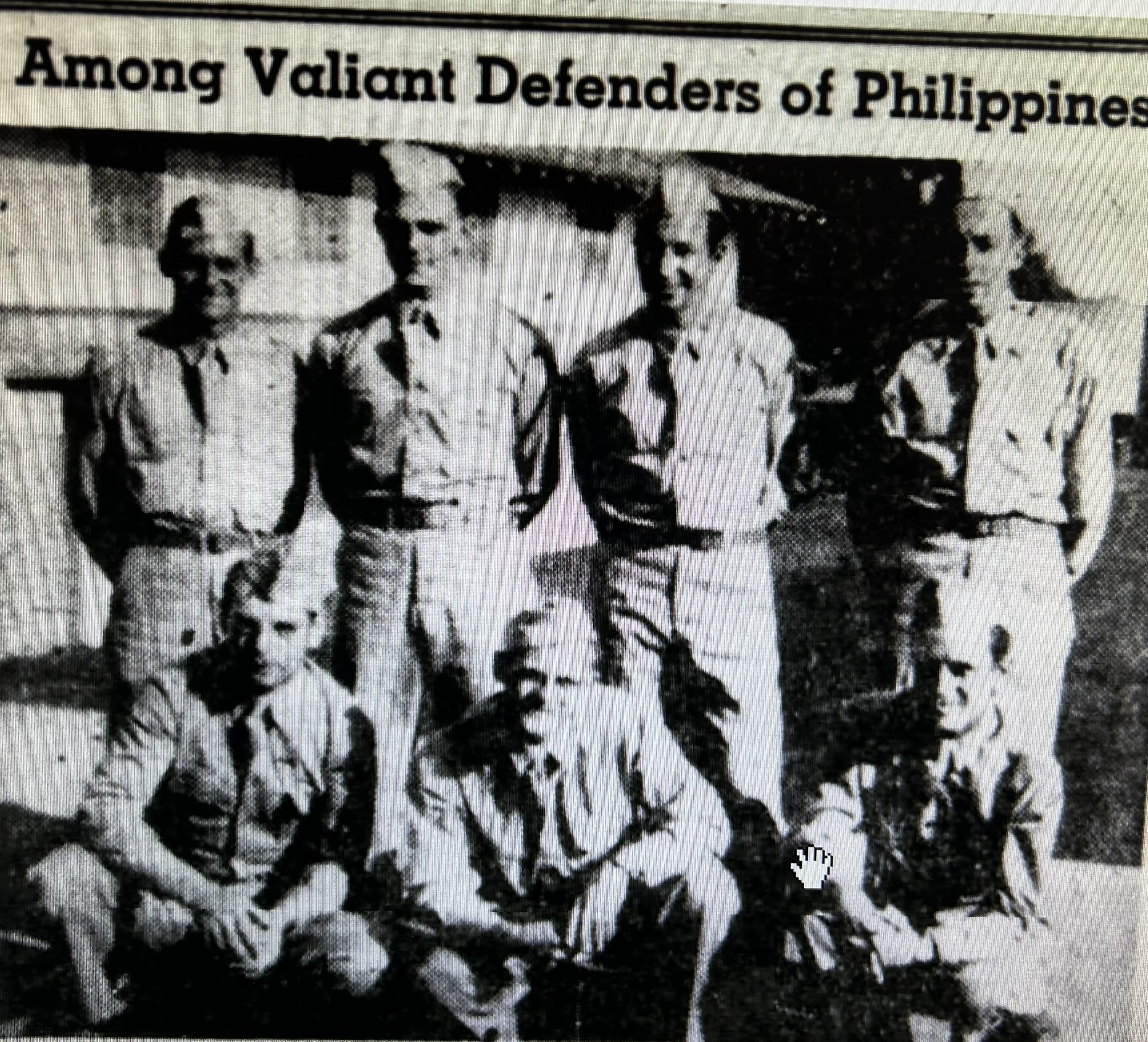
Seibert was among seven men from Allentown who shipped out to the Philippines in the fall of 1941. Along with thousands of other U.S. and Filipino troops, they were taken prisoner the following spring, several months after Japanese forces invaded the islands. Ahead of them was the Death March and horrific captivity. Only three would survive.

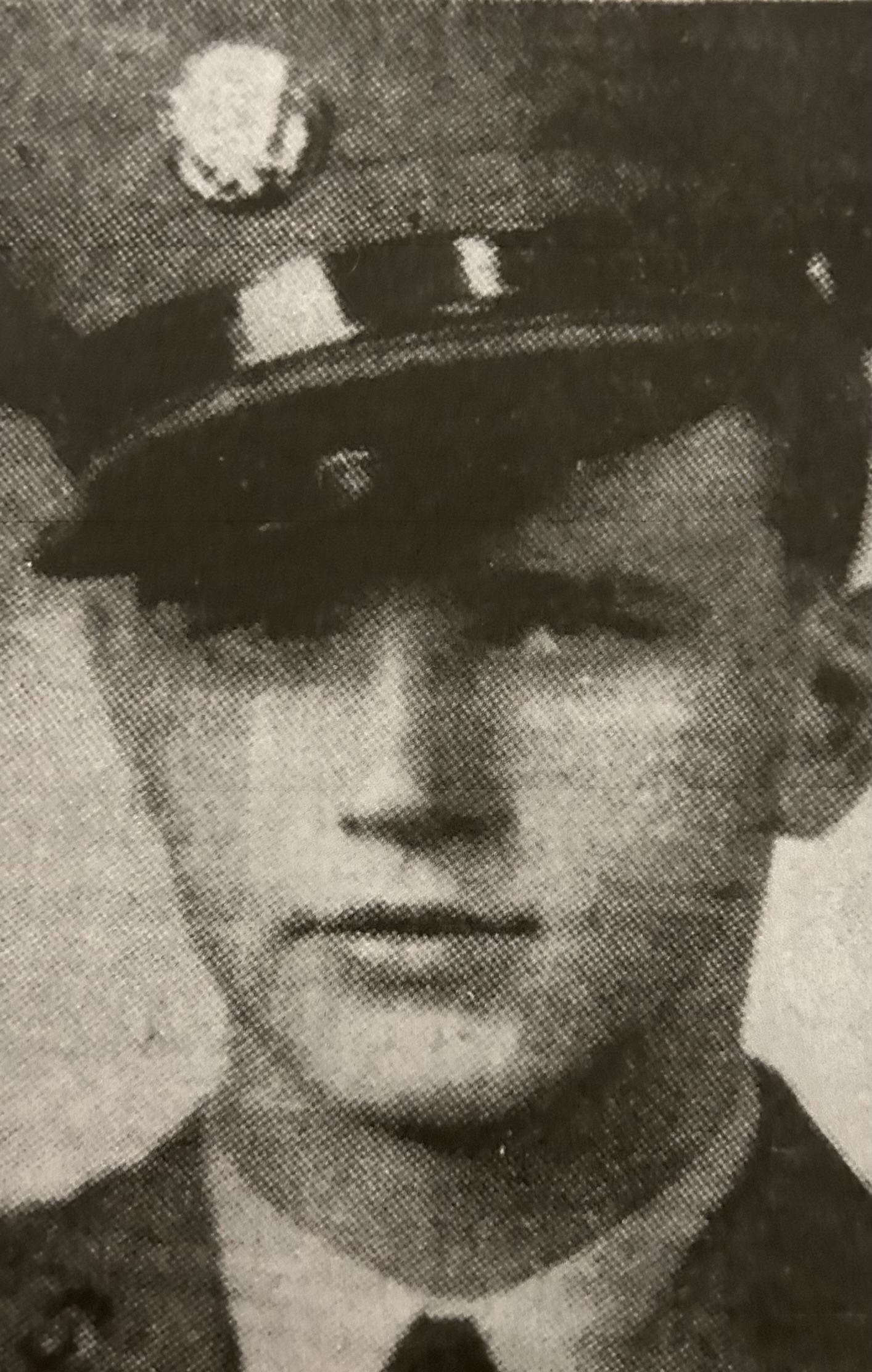
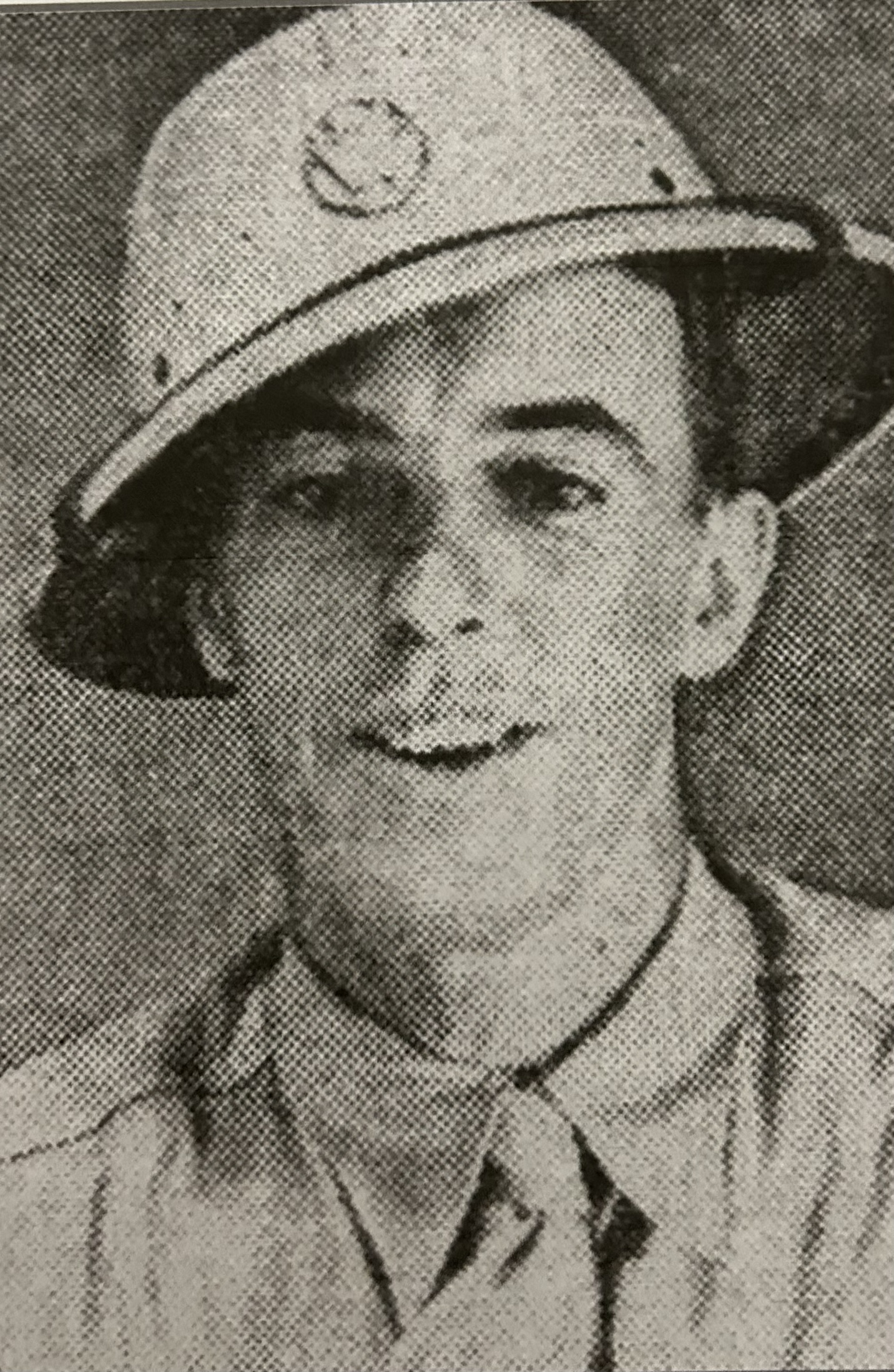
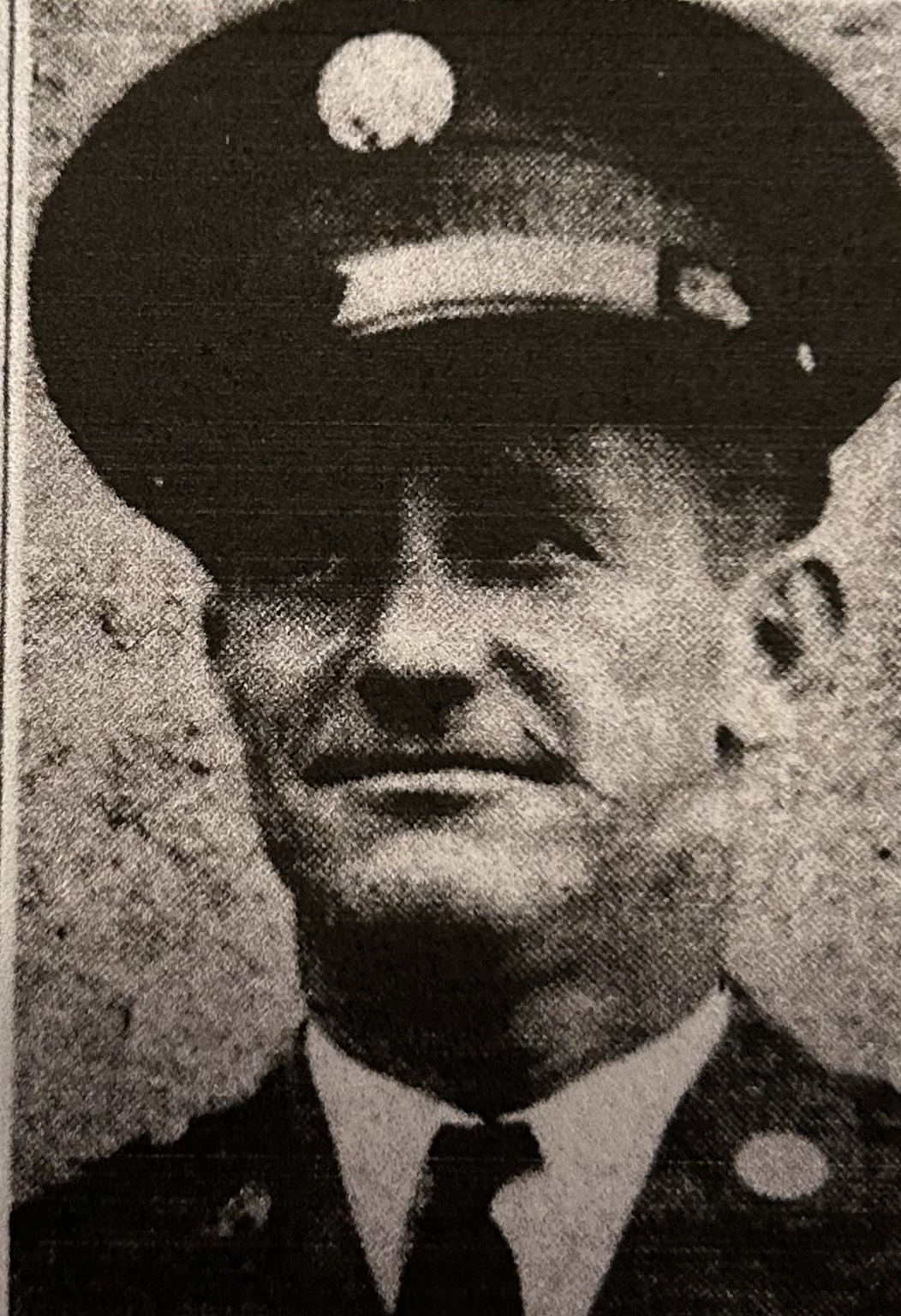
Soldiers from Allentown (crouching, from left) John Sokalsky, Raymond George and Eugene McNamara; (standing, from left) William Johnson, Walter Lamm, Earl Seibert and Edwin Warfield. All belonged to the 803rd Engineer Battalion. The photo ran December 29, 1941, in their hometown paper, The Morning Call.
(Newspapers.com)

In December 1941, just days after the Japanese landed, The Morning Call of Allentown ran a photo of the seven men – Seibert, Eugene McNamara, Edwin Warfield, John Sokalsky, Raymond George, William Johnson and Walter Lamm. Citing a letter from McNamara dated November 29, the paper said they were together at Fort Stotsenburg/Clark Field, about fifty miles from Manila.

Before his Army service, Seibert was a mechanic at Hoffman Bros. auto salvage. He and the six others were inducted in June 1941 and got basic military engineer training at Fort Belvoir, Virginia. Assigned to the 803rd Engineer Aviation Battalion, they arrived on Luzon in October and were attached to the Far East Air Force. Their job was building airfields.

An update in The Morning Call of May 30, 1942
(Newspapers.com)

Seibert, of Headquarters Company, was badly wounded January 16, 1942, as the Americans and Filipinos fought to defend the Bataan peninsula. There were no details on his injuries.

After the Allies surrendered April 9, most of the men in the 803rd’s three companies on Bataan – a fourth company was on Corregidor — walked from Mariveles to San Fernando on the Death March, according to Good Outfit: The 803rd Engineer Battalion and the Defense of the Philippines, 1941-1942, by Paul W. Ropp.  They were taken by train to Capas for internment at nearby Camp O’Donnell. Many of the engineers left the camp to toil for their captors in the mountains of northern Luzon. After a few months, they were marched to Cabanatuan Camp 1 , where disease, malnutrition and maltreatment took a dreadful toll.

Seibert, age twenty-three, died of diphtheria at Cabanatuan on July 27, 1942. He was buried in a common grave at the camp cemetery. His parents didn’t learn of his death until three years later, after Japan’s surrender.

Ropp’s 559-page history of the battalion lists what happened to its members. Here’s what the book says about the six other soldiers from Allentown, all of them members of Company B:

Lamm

— Private Walter Lamm survived the war. He left Cabanatuan in September 1942, was transported on the hell ship Tottori Maru to Korea and then to a POW camp in Mukden, Manchuria. (He died in 2008 at age eighty-nine.)

Warfield

— Private First Class Edwin Warfield survived the war. He was taken from Cabanatuan in July 1944, transported on the hell ship Sehiiko Maru and held captive near Osaka, Japan. (He was eighty-six when he died in 2000.)

Sokalsky

— Private First Class John Sokalsky survived the war. He was taken from Cabanatuan, transported on the Tottori Maru and taken to Mukden in October 1944. (He died in 1984 at age sixty-eight.)

— Private Eugene McNamara died May 1, 1942, at Camp O’Donnell of cerebral malaria and dysentery.

George

— Private Raymond George, twenty-four, died in the Cabanatuan hospital August 27, 1942, of dysentery. He had been wounded in action April 8. (Warfield helped bury him.)

Johnson

— Private William Johnson, twenty-eight, died April 15, 1942, of a fractured skull during the Death March. He might have been murdered near Balanga. According to a November 1945 story in The Morning Call, Warfield told Johnson’s parents their son collapsed during the march and was carried away, never to be seen again.

Poster in photo taken September 8, 1945, after he was liberated from Mukden camp

Word that Seibert died at Cabanatuan and his remains have been identified took me back to an interview I did for The Morning Call twenty-two years ago. Joe Poster grew up in Pottstown and served in Company B of the 803rd. He went on the Death March and the work detail in the mountains. At Cabanatuan, he once helped bury the dead. Sent to Manchuria, he almost died of nephritis at the Mukden camp.

“I can’t say how I made it,” Poster told me. “I lived day to day. I was scared all the time. I thought maybe tomorrow those Japanese will kill me. I never knew whether they were going to murder us or not. That’s the way it was for three-and-a-half years, even till the last day.”

Poster came home late in 1945. He got married, worked for Mack Trucks in Allentown and was a national commander of the American Defenders of Bataan and Corregidor.

When I arrived at his home for one of our interview sessions, he yelled that I was making him remember “all this stuff.” He was still haunted and couldn’t sleep.

He died in 2003, a year after my story ran. He was eighty-three.

A proper home for a fallen airman’s medals

Last of two parts

John Yanno of the 213th Regiment Museum in Allentown, Pennsylvania, shows newly arrived medals honoring Bob Riedy for his service with the Royal Canadian Air Force in World War II.

Robert Harvey Riedy, an American in the Royal Canadian Air Force, was killed March 18, 1942, on a training flight in England. The accident happened at Mount Farm in Oxfordshire, a Royal Air Force satellite base for No. 15 Operational Training Unit, which trained night bomber crews on the twin-engine Vickers Wellington.

Bob was in the cockpit of a Wellington Mk.1. If the records are accurate, he was in the right-hand seat for second pilots. Another RCAF sergeant was the captain in charge of the aircraft and sat in the pilot’s seat on the left. A gunner was aboard and would have been seated near the wing root.  

Wellington Mk.1 bombers

During takeoff at 1:25 p.m., the Wellington swung off the runway and clipped a twin-engine Lockheed Hudson bomber parked on the edge of the fire track, according to the RAF accident report. The Wellington rose vertically to 200 feet, stalled and plummeted to the ground. Riedy, who was twenty, and the captain/pilot died on impact. The gunner was seriously injured.

Captain/pilot Charles G. Wiley, age twenty-three and from Galt, Ontario, was blamed for the crash. The station commander noted the accident was due to “pilot inexperience and error of judgement.” The report explains: “Pilot contrary to training instructions failed to stop aircraft and line up runway prior to takeoff.”

Riedy’s burial card, part of his service record in Ottawa, Canada, shows he was interred March 21, 1942, at the Canadian Military Extension of England’s Brookwood Cemetery.
(National Archives of Canada)

Two days later, Bob’s parents in Allentown, Pennsylvania, received a telegram from Ottawa, Canada. According to The Morning Call, it said he was “killed in action.” They were expected to learn the details later from his commander. Bob was buried in England’s Brookwood Military Cemetery. The Allentown church he attended, St. Paul’s Lutheran, was filled to capacity for a memorial service.

A letter from Bob – the fourth his parents received from him after his death – arrived in mid-April and included a clipping from The Times of London. A photo showed him and five other grinning fliers with the headline, “They swept into battle against the Scharnhorst and the Gneisenau.” The caption said they were among the airmen who, in February 1942, tried to stop the two German battleships from steaming home from the French coast.

Photo from The Times of London shows Riedy (arrow) with fellow fliers. They reportedly joined in trying to keep two Scharnhorst-class battleships from reaching German ports in the Channel Dash of February 11-13, 1942. Riedy sent the clip to his parents. It ran in The Morning Call of Allentown on April 16, 1942.

No. 15 OTU was one of the units that provided Wellingtons for the so-called Channel Dash. But the records of crews and aircraft are sketchy, so I couldn’t confirm that Bob participated.

In 1992, to mark the fiftieth anniversary of Bob’s death, The Morning Call ran a story about him based on letters, interviews and contemporary newspaper coverage. If Bob’s parents knew how he was killed, they apparently didn’t tell the newspapers. One of his Allentown pals said he remembered hearing that Bob’s Hawker Hurricane fighter was shot down over the English Channel.

Intrigued, I wrote to Ottawa for Bob’s service record and to London for RAF records. Months later, the reporter who did the original story wrote a column on my findings – that Bob’s life ended in a training accident.  I went on to write blogs about Bob and even tried to find out what became of the gunner who survived the crash, Sergeant W.J.D. Carter of the RAF Volunteer Reserve. There was nothing more to say, or so I thought.

Last November, The Morning Call emailed that a caller named Bruce Hoch wanted to speak with me about Bob. When I phoned Bruce at his home in Seekonk, Massachusetts, I was amazed to learn he had two medals posthumously awarded to Bob and one given to his parents.

Bruce Hoch of Seekonk, Massachusetts, returned Riedy’s medals to Allentown.

Bruce wanted to find a suitable home for the medals in Bob’s hometown. But how did he come to have them?

In the early 1940s, Bruce’s parents lived next door to Bob’s on Jackson Street in Allentown, and the couples were friends. Bruce’s father was just a few years older than Bob and didn’t know him. After Bob was killed, Russell and Mildred Hoch moved elsewhere in the city, with Bruce a toddler at the time. The Hochs remained friends with Harvey and Eda Riedy.

“My father used to go fishing with Harvey all the time,” Bruce said. “I think the friendship between them was somewhat due to [my father’s] being close to Robert’s age. … As I got older, I used to go with my father and Harvey fishing.”

Bruce’s parents ended up buying a home on South 10th Street in Allentown. When Eva died in 1968, Harvey came to live with the Hochs. He died the next year.

“When Harvey passed, what possessions he had at our house were left with my parents,” Bruce said. “My father gave Robert’s medals to me at the time. I was probably in my twenties. That’s how I came into possession of them, and they’ve been with me probably close to 50 years.”

Yanno mounted Riedy’s medals in this shadow box and set it atop the 213th Regiment Museum’s World War II display case. They are (from left) the War Medal 1939-1945; the Memorial Cross, given to Bob’s parents; and the Canadian Volunteer Service Medal.
(Photo courtesy of John Yanno)

Bruce’s job in a company of inventory specialists took him from Allentown to Hazleton and Lancaster, and then to Nashua, New Hampshire. He moved on, starting a small business in Seekonk.

“The medals stayed with me,” he said. “Every now and then, when Memorial Day would come around, it would work on my mind a little bit, because I’m seventy-two now, and if something happens to me, I don’t know what would happen with these medals.

“I didn’t want them to just fall into someone’s hands that are going to turn around and sell them or whatever. I wanted them to be somewhere where they would mean something to somebody, where people would be able to see them and read about them.”

Bruce saw a story I’d written about Bob online and called The Morning Call to reach me. I put him in touch with John Yanno of the 213th Regiment Museum at Allentown’s Charles C. Curtis Armory. The museum supports the 213th Regional Support Group, a National Guard unit, by maintaining a gallery of artifacts dating to the Civil War. The 213th Regiment is known as the “First Defenders,” so named by President Abraham Lincoln when he asked for soldiers to help defend the capital.

“We have displays from many of the wars that the United States was involved in and would be honored to add Bob’s medals to our collection,” John emailed Bruce.

When the three medals arrived, John found them in “great condition.” Two had been awarded posthumously to Bob — the War Medal 1939-1945, awarded by the United Kingdom to all full-time personnel of the Armed Forces and Merchant Marines, and the Canadian Volunteer Service Medal. The other is the Memorial Cross, given to his parents because their son died on active duty in the Canadian Forces.

The medals are now on display in the 213th Regiment Museum.

“I’m very, very happy to have gotten them down there,” Bruce said. “They’re back home where they really, truly belong.”

RCAF pilot’s medals come home to Pennsylvania

First of two parts

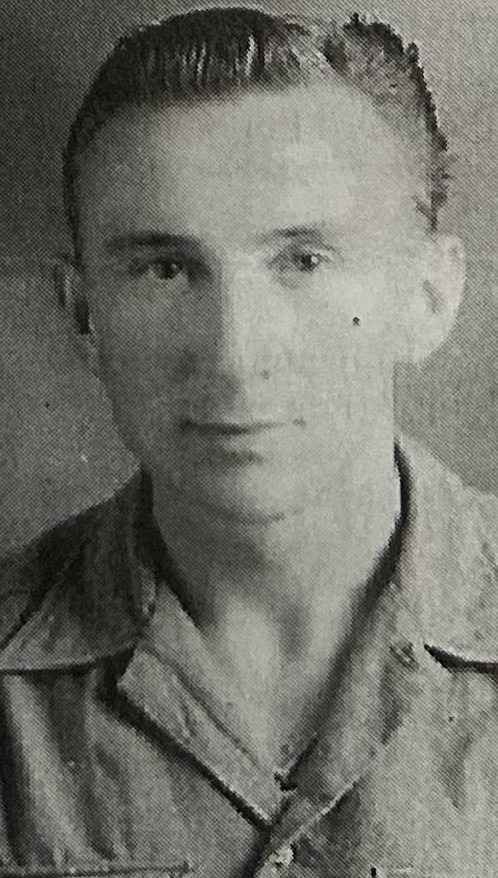
Sergeant-pilot Robert H. Riedy of Allentown, Pennsylvania, with the Royal Canadian Air Force in England, 1942

The last time I wrote about World War II flier Robert Harvey Riedy was seven years ago. Now someone wanted to talk to me about him. An editor at my former employer, The Morning Call of Allentown, Pennsylvania, emailed a transcription of a voicemail message. I didn’t recognize the man’s name. He left his phone number but didn’t say where he was calling from.

Riedy was a 1938 Allentown High School grad memorialized as the first serviceman from the city to die in Europe during the war. My file on him was more than 2 inches thick. What more was there to learn about him?

Bob Riedy was a YMCA summer camp leader and a swimmer, the only child of Harvey and Eva Riedy of Jackson Street near the Little Lehigh Creek. His dad was a cashier and freight agent for the Jersey Central and Reading railroads and a leader in the local Democratic Party.

Bob’s teachers and pals at Allentown High described him as brilliant. The yearbook says he “has good common sense and good judgment. … Because his mind is usually wandering around in the air, he is planning for a career in aviation.”

He graduated with honors at sixteen and followed through on his plan, studying aircraft maintenance at the Curtiss-Wright Technical Institute in Glendale, California. In April 1939, he made headlines across the country when he caught a ride home with a noted transport pilot, Frank Cordova, on a twin-engine Barkley Grow. Bob’s hometown newspaper crowed that he “contributed to the log of American aviation by being recorded as the first trans-continental hitchhiker through the clouds.”

Riedy in the 1938 Allentown High School yearbook, the Comus

After 14 months at Glendale, he found work at the Consolidated Aircraft Corp. in San Diego. Then in April 1940, he was hired as an aeronautical engineer at the Curtiss-Wright plant in Buffalo, New York, one of the largest airplane factories in the world, where he worked alongside college graduates.

Bob wrote to his parents from Toronto seven months later. He had quit his job and flouted U.S. neutrality by crossing the border to join the Dominion of Canada in the fight against the Nazis.

“I am in training with the Royal Canadian Air Force under the British Commonwealth Training Plan as a ‘special reserve,’ ” he wrote on December 13 from No. 1 Manning Depot. “After the completion of about eight to nine months’ training, I expect a commission as pilot-officer. … If they don’t give me a commission, I shall at least become a sergeant-pilot.”

His joining the RCAF hadn’t been “as sudden and impetuous as you may think,” he wrote to his buddy Charles Fegely in Allentown. “I had been contemplating it for some time. … For years I had cherished hopes of getting into the Royal Air Force. … This may sound a bit unpatriotic to you as it does to all my other friends, but … the RAF with its squadrons all over the world from Cairo to Singapore spells just a little more romance than ‘U.S. Army Air Corps.’ “

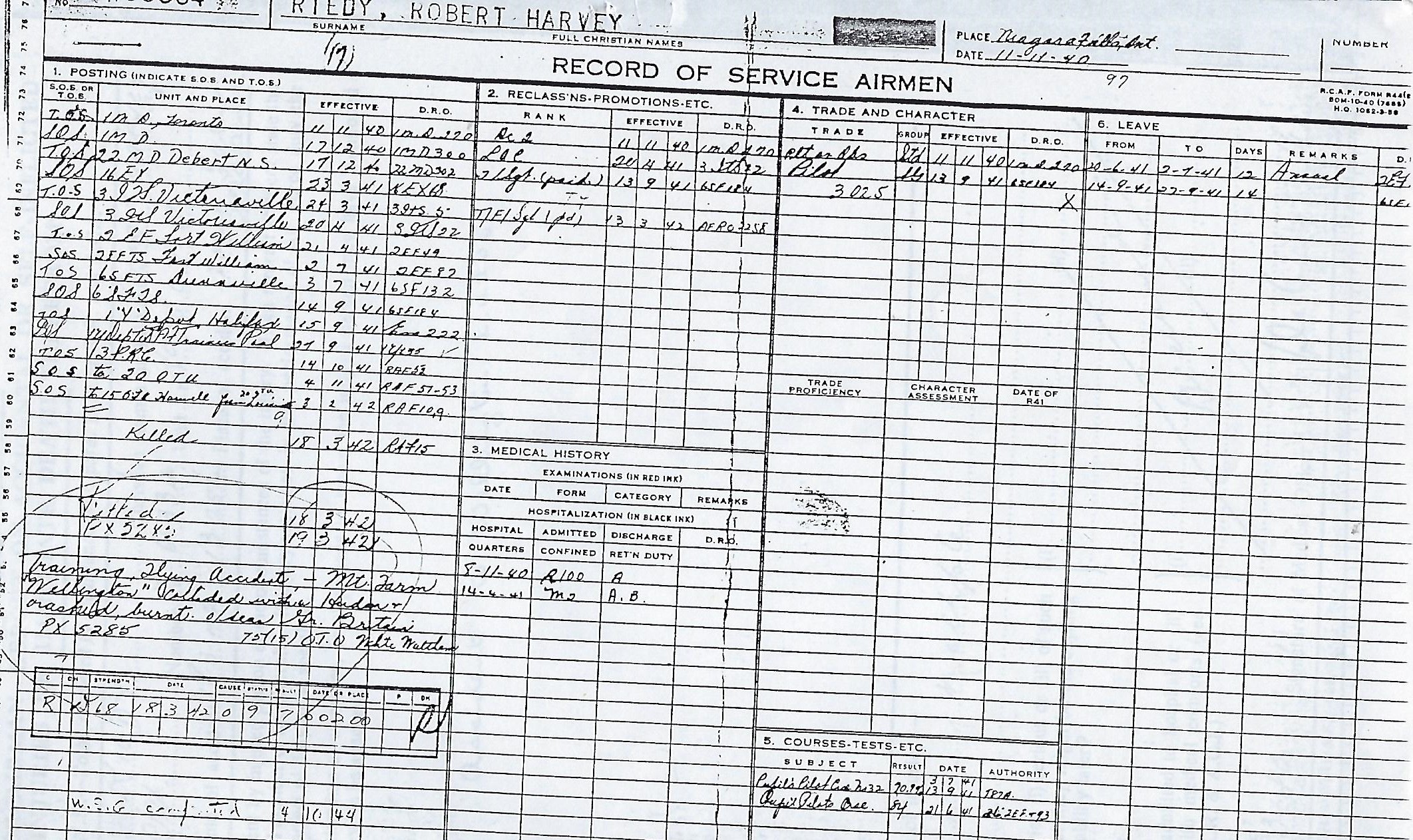
Riedy’s RCAF service record
(National Archives of Canada)

On December 17, 1940, he wired his parents that he was being transferred to Coastal Command and would be leaving the next day for RCAF Station Debert, Nova Scotia, a training site for pilots and aircrew from British Commonwealth nations.

 “I hope to become a writer someday,” Bob told The Morning Call when he was home for Christmas. “My experiences now should help me considerably.”

Returning to Canada, he took air navigation courses at No. 3 Initial Training School in Victoriaville, Quebec. After that, he was off to No. 2 Elementary Flying Training School at Fort William, Ontario, and then to No. 6 Service Flying Training School at Dunnville, Ontario.

Vickers Wellington Mk.1 bombers

In October 1941, Sergeant-Pilot Riedy ferried a bomber to England. “Arrived safe – having swell time,” he said in a cablegram to his parents. But in a letter to Charles Fegely, he made clear his disappointment: “In spite of the fact that I expected to fly fighters, they’ve stuck me on bombers.”

According to his RCAF service record, he was assigned to No. 20 Operational Training Unit at Lossiemouth, Scotland, which trained night bomber crews using the twin-engine Vickers Wellington. An OTU was the crews’ final training stage and included operational sorties.

On December 7, 1941, the day of the Pearl Harbor attack, Bob wrote to his YMCA friends at home that he had gotten out of flying bombers. “It was just like driving a truck, so I raised a stink – told them that my dad was a good friend of FDR and all that. It worked, and I’m being put back on fighters, which are a heck of a lot more fun.”

The Morning Call of March 21, 1942: Despite the headline, it’s unclear whether Riedy intended to seek a transfer to a U.S. unit. The story says “it is believed” that’s what he wanted, because he had asked his parents to send a copy of his birth certificate to the American authorities in London.

Bob’s service record doesn’t show him with a fighter unit. It has him remaining with No. 20 OTU until February 1942, when he was transferred to No. 15 OTU at RAF Harwell, which provided the same bomber training.

In his letter to his YMCA pals, Bob wrote about how grateful he was to the British servicewomen who kept him safe in the skies.

“Whenever the weather sets in and you get yourself lost (which is practically always with me) it’s invariably a woman control officer who gets you down in one piece and on the right side of the [English] channel. …

“Perhaps you think I’m eulogizing them too much, but when your life depends on them every time you take off, and when some 18-year-old girl, who is much more homesick than you are, fixes a jam in your guns in a hurried refuel – well, you want to let somebody hear about it.”

No British servicewoman or anyone else would be able to save him one day at an airfield near Oxford. He wouldn’t live to become a writer, but he wasn’t forgotten. Eighty-one years after Bob’s death, medals he earned were returned to his hometown for display in a place of honor. It happened after I called the man who wanted to talk to me about him.

COMING NEXT: A proper home for Riedy’s medals

A Christmas poem from a WWII merchant mariner

Cadet-Midshipman Frank Tone
(Courtesy of the Tone family)

Eighty years ago, a cadet from the U.S. Merchant Marine Academy named Frank Tone sent a Christmas poem from the Mediterranean to his parents in Easton, Pennsylvania. Eleven days later, he was killed aboard his Liberty ship during “little Pearl Harbor,” a Luftwaffe attack on the port of Bari, Italy.

Frank, a twenty-year-old engine cadet, was on the SS Samuel J. Tilden the night of December 2, 1943, when a bomb destroyed the engine room, where he was on watch. There was no body to recover.

Elsewhere in the harbor, Ju-88 bombers sank 17 Allied ships and killed more than 1,000 British and American servicemen and hundreds of civilians. The Liberty ship SS John Harvey exploded, killing all aboard and spreading deadly mustard gas in the air and water. No one was supposed to know about the chemical weapons cargo.

I wrote a two-part story about Frank that ran over the weekend in The Morning Call of Allentown, my old employer. His family provided a trove of material: old photos and original documents, including the Western Union telegram informing his parents he was missing in action, a “certificate of presumptive death” and several Victory Mail letters he wrote from the Mediterranean.

One of those letters to his family is intriguing. It was dated November 21, 1943, and included a two-stanza typewritten Christmas poem. Here it is:

Polish the star on the Christmas tree
And give it an extra sparkle for me
Then give it my share of your Christmas cheer
So we won’t feel so far apart this year.

Yes, I’m in the old world and you’re in the new
But “merry Christmas” can still ring true
For we’re winning the right to say again
“Peace on Earth, goodwill to men.”

Beneath it, Frank signed it in longhand, “Love to all.”

So, did Frank write the poem? If he didn’t, who did?

I turned to my friend Kenneth Woolley III at the Allentown Public Library, a tenacious researcher who helped me debunk the myth that Bethlehem Steel made the steel for New York City’s iconic Chrysler Building. “I like this mystery,” Kenny said. “I’ll see what I can turn up.”

The V-mail Frank Tone sent from his Liberty ship on November 21, 1943
(Courtesy of the Tone family)

Here’s what Kenny said after several weeks on the case:

“I had a few other librarians on the trail of this poem also. We could not find any mention or lines from the poem in any resource we tried. I checked first with all the U.S. newspapers and even U.K. newspapers. I also tried some poetry encyclopedias that let you search by keywords and text. Internet searching also turns up nothing with that text. Nothing shows up. This leads me to believe that
a) Frank wrote the poem himself.
b) Frank borrowed the poem from a friend or acquaintance who wrote it.
c) It was a generic poem being used by many in the military, but if this was the case, surely other examples in letters or postcards would have survived.

“I did try to find other examples of poetry on GI postcards and looked at many letters from GI’s to home and I did not find the poem. … 

“Also, the V-mail telegrams that I found online for Christmas tended to have pre-filled illustrations and cartoons. Sometimes they were little Christmas jingles and verse, but they were very illustrated text and fonts. My question would be: Did the GI’s fill these out themselves or was a telegraph operator on hand helping them fill them out? They might have had a bunch of ‘ideas’ and templates to give GI’s sending the telegram.

“Frank’s V-mail seems to be hand-typed, although the added Bible verse and poem seem to indicate a generic nature to it. So it really is difficult to say if he wrote it or not. I’d love to see all the V-mail held in collections in museums and libraries across the country that I found in my research to see if any follow Frank’s format. So far, his is fairly unique.”

What do you think of this mystery poem? Where did it come from?