Category Archives: Veterans' Histories

A proper home for a fallen airman’s medals

Last of two parts

John Yanno of the 213th Regiment Museum in Allentown, Pennsylvania, shows newly arrived medals honoring Bob Riedy for his service with the Royal Canadian Air Force in World War II.

Robert Harvey Riedy, an American in the Royal Canadian Air Force, was killed March 18, 1942, on a training flight in England. The accident happened at Mount Farm in Oxfordshire, a Royal Air Force satellite base for No. 15 Operational Training Unit, which trained night bomber crews on the twin-engine Vickers Wellington.

Bob was in the cockpit of a Wellington Mk.1. If the records are accurate, he was in the right-hand seat for second pilots. Another RCAF sergeant was the captain in charge of the aircraft and sat in the pilot’s seat on the left. A gunner was aboard and would have been seated near the wing root.  

Wellington Mk.1 bombers

During takeoff at 1:25 p.m., the Wellington swung off the runway and clipped a twin-engine Lockheed Hudson bomber parked on the edge of the fire track, according to the RAF accident report. The Wellington rose vertically to 200 feet, stalled and plummeted to the ground. Riedy, who was twenty, and the captain/pilot died on impact. The gunner was seriously injured.

Captain/pilot Charles G. Wiley, age twenty-three and from Galt, Ontario, was blamed for the crash. The station commander noted the accident was due to “pilot inexperience and error of judgement.” The report explains: “Pilot contrary to training instructions failed to stop aircraft and line up runway prior to takeoff.”

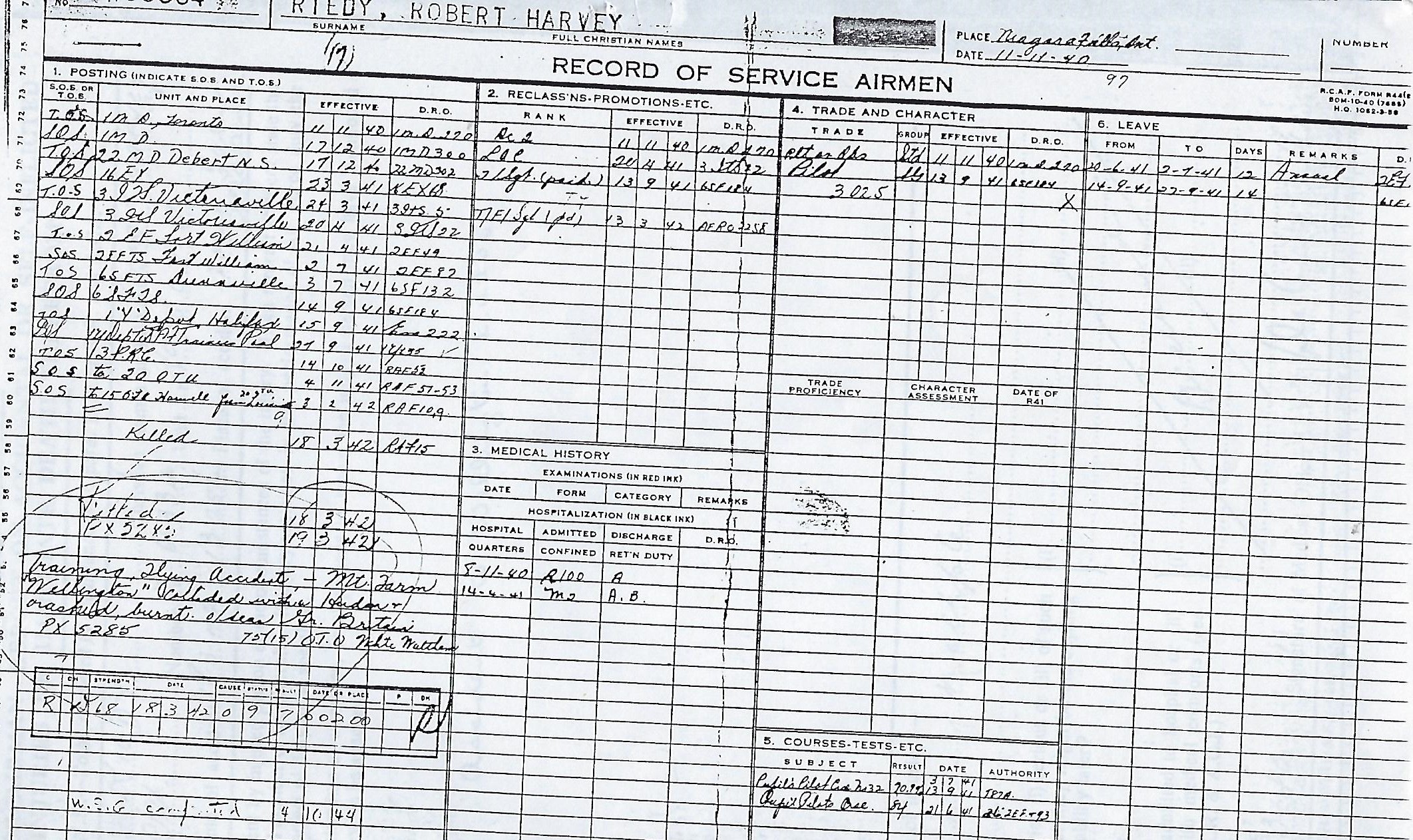
Riedy’s burial card, part of his service record in Ottawa, Canada, shows he was interred March 21, 1942, at the Canadian Military Extension of England’s Brookwood Cemetery.
(National Archives of Canada)

Two days later, Bob’s parents in Allentown, Pennsylvania, received a telegram from Ottawa, Canada. According to The Morning Call, it said he was “killed in action.” They were expected to learn the details later from his commander. Bob was buried in England’s Brookwood Military Cemetery. The Allentown church he attended, St. Paul’s Lutheran, was filled to capacity for a memorial service.

A letter from Bob – the fourth his parents received from him after his death – arrived in mid-April and included a clipping from The Times of London. A photo showed him and five other grinning fliers with the headline, “They swept into battle against the Scharnhorst and the Gneisenau.” The caption said they were among the airmen who, in February 1942, tried to stop the two German battleships from steaming home from the French coast.

Photo from The Times of London shows Riedy (arrow) with fellow fliers. They reportedly joined in trying to keep two Scharnhorst-class battleships from reaching German ports in the Channel Dash of February 11-13, 1942. Riedy sent the clip to his parents. It ran in The Morning Call of Allentown on April 16, 1942.

No. 15 OTU was one of the units that provided Wellingtons for the so-called Channel Dash. But the records of crews and aircraft are sketchy, so I couldn’t confirm that Bob participated.

In 1992, to mark the fiftieth anniversary of Bob’s death, The Morning Call ran a story about him based on letters, interviews and contemporary newspaper coverage. If Bob’s parents knew how he was killed, they apparently didn’t tell the newspapers. One of his Allentown pals said he remembered hearing that Bob’s Hawker Hurricane fighter was shot down over the English Channel.

Intrigued, I wrote to Ottawa for Bob’s service record and to London for RAF records. Months later, the reporter who did the original story wrote a column on my findings – that Bob’s life ended in a training accident.  I went on to write blogs about Bob and even tried to find out what became of the gunner who survived the crash, Sergeant W.J.D. Carter of the RAF Volunteer Reserve. There was nothing more to say, or so I thought.

Last November, The Morning Call emailed that a caller named Bruce Hoch wanted to speak with me about Bob. When I phoned Bruce at his home in Seekonk, Massachusetts, I was amazed to learn he had two medals posthumously awarded to Bob and one given to his parents.

Bruce Hoch of Seekonk, Massachusetts, returned Riedy’s medals to Allentown.

Bruce wanted to find a suitable home for the medals in Bob’s hometown. But how did he come to have them?

In the early 1940s, Bruce’s parents lived next door to Bob’s on Jackson Street in Allentown, and the couples were friends. Bruce’s father was just a few years older than Bob and didn’t know him. After Bob was killed, Russell and Mildred Hoch moved elsewhere in the city, with Bruce a toddler at the time. The Hochs remained friends with Harvey and Eda Riedy.

“My father used to go fishing with Harvey all the time,” Bruce said. “I think the friendship between them was somewhat due to [my father’s] being close to Robert’s age. … As I got older, I used to go with my father and Harvey fishing.”

Bruce’s parents ended up buying a home on South 10th Street in Allentown. When Eva died in 1968, Harvey came to live with the Hochs. He died the next year.

“When Harvey passed, what possessions he had at our house were left with my parents,” Bruce said. “My father gave Robert’s medals to me at the time. I was probably in my twenties. That’s how I came into possession of them, and they’ve been with me probably close to 50 years.”

Yanno mounted Riedy’s medals in this shadow box and set it atop the 213th Regiment Museum’s World War II display case. They are (from left) the War Medal 1939-1945; the Memorial Cross, given to Bob’s parents; and the Canadian Volunteer Service Medal.
(Photo courtesy of John Yanno)

Bruce’s job in a company of inventory specialists took him from Allentown to Hazleton and Lancaster, and then to Nashua, New Hampshire. He moved on, starting a small business in Seekonk.

“The medals stayed with me,” he said. “Every now and then, when Memorial Day would come around, it would work on my mind a little bit, because I’m seventy-two now, and if something happens to me, I don’t know what would happen with these medals.

“I didn’t want them to just fall into someone’s hands that are going to turn around and sell them or whatever. I wanted them to be somewhere where they would mean something to somebody, where people would be able to see them and read about them.”

Bruce saw a story I’d written about Bob online and called The Morning Call to reach me. I put him in touch with John Yanno of the 213th Regiment Museum at Allentown’s Charles C. Curtis Armory. The museum supports the 213th Regional Support Group, a National Guard unit, by maintaining a gallery of artifacts dating to the Civil War. The 213th Regiment is known as the “First Defenders,” so named by President Abraham Lincoln when he asked for soldiers to help defend the capital.

“We have displays from many of the wars that the United States was involved in and would be honored to add Bob’s medals to our collection,” John emailed Bruce.

When the three medals arrived, John found them in “great condition.” Two had been awarded posthumously to Bob — the War Medal 1939-1945, awarded by the United Kingdom to all full-time personnel of the Armed Forces and Merchant Marines, and the Canadian Volunteer Service Medal. The other is the Memorial Cross, given to his parents because their son died on active duty in the Canadian Forces.

The medals are now on display in the 213th Regiment Museum.

“I’m very, very happy to have gotten them down there,” Bruce said. “They’re back home where they really, truly belong.”

RCAF pilot’s medals come home to Pennsylvania

First of two parts

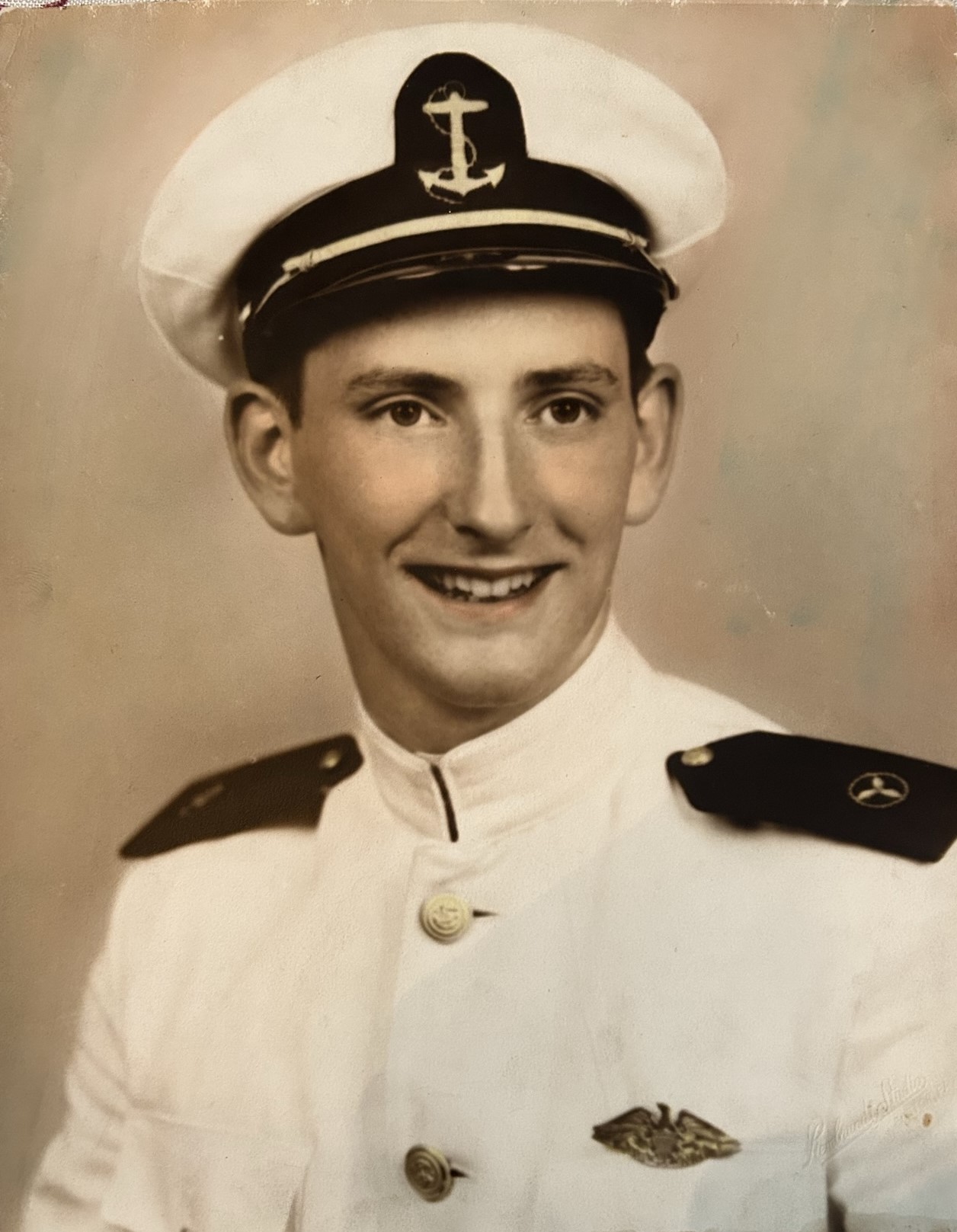
Sergeant-pilot Robert H. Riedy of Allentown, Pennsylvania, with the Royal Canadian Air Force in England, 1942

The last time I wrote about World War II flier Robert Harvey Riedy was seven years ago. Now someone wanted to talk to me about him. An editor at my former employer, The Morning Call of Allentown, Pennsylvania, emailed a transcription of a voicemail message. I didn’t recognize the man’s name. He left his phone number but didn’t say where he was calling from.

Riedy was a 1938 Allentown High School grad memorialized as the first serviceman from the city to die in Europe during the war. My file on him was more than 2 inches thick. What more was there to learn about him?

Bob Riedy was a YMCA summer camp leader and a swimmer, the only child of Harvey and Eva Riedy of Jackson Street near the Little Lehigh Creek. His dad was a cashier and freight agent for the Jersey Central and Reading railroads and a leader in the local Democratic Party.

Bob’s teachers and pals at Allentown High described him as brilliant. The yearbook says he “has good common sense and good judgment. … Because his mind is usually wandering around in the air, he is planning for a career in aviation.”

He graduated with honors at sixteen and followed through on his plan, studying aircraft maintenance at the Curtiss-Wright Technical Institute in Glendale, California. In April 1939, he made headlines across the country when he caught a ride home with a noted transport pilot, Frank Cordova, on a twin-engine Barkley Grow. Bob’s hometown newspaper crowed that he “contributed to the log of American aviation by being recorded as the first trans-continental hitchhiker through the clouds.”

Riedy in the 1938 Allentown High School yearbook, the Comus

After 14 months at Glendale, he found work at the Consolidated Aircraft Corp. in San Diego. Then in April 1940, he was hired as an aeronautical engineer at the Curtiss-Wright plant in Buffalo, New York, one of the largest airplane factories in the world, where he worked alongside college graduates.

Bob wrote to his parents from Toronto seven months later. He had quit his job and flouted U.S. neutrality by crossing the border to join the Dominion of Canada in the fight against the Nazis.

“I am in training with the Royal Canadian Air Force under the British Commonwealth Training Plan as a ‘special reserve,’ ” he wrote on December 13 from No. 1 Manning Depot. “After the completion of about eight to nine months’ training, I expect a commission as pilot-officer. … If they don’t give me a commission, I shall at least become a sergeant-pilot.”

His joining the RCAF hadn’t been “as sudden and impetuous as you may think,” he wrote to his buddy Charles Fegely in Allentown. “I had been contemplating it for some time. … For years I had cherished hopes of getting into the Royal Air Force. … This may sound a bit unpatriotic to you as it does to all my other friends, but … the RAF with its squadrons all over the world from Cairo to Singapore spells just a little more romance than ‘U.S. Army Air Corps.’ “

Riedy’s RCAF service record
(National Archives of Canada)

On December 17, 1940, he wired his parents that he was being transferred to Coastal Command and would be leaving the next day for RCAF Station Debert, Nova Scotia, a training site for pilots and aircrew from British Commonwealth nations.

 “I hope to become a writer someday,” Bob told The Morning Call when he was home for Christmas. “My experiences now should help me considerably.”

Returning to Canada, he took air navigation courses at No. 3 Initial Training School in Victoriaville, Quebec. After that, he was off to No. 2 Elementary Flying Training School at Fort William, Ontario, and then to No. 6 Service Flying Training School at Dunnville, Ontario.

Vickers Wellington Mk.1 bombers

In October 1941, Sergeant-Pilot Riedy ferried a bomber to England. “Arrived safe – having swell time,” he said in a cablegram to his parents. But in a letter to Charles Fegely, he made clear his disappointment: “In spite of the fact that I expected to fly fighters, they’ve stuck me on bombers.”

According to his RCAF service record, he was assigned to No. 20 Operational Training Unit at Lossiemouth, Scotland, which trained night bomber crews using the twin-engine Vickers Wellington. An OTU was the crews’ final training stage and included operational sorties.

On December 7, 1941, the day of the Pearl Harbor attack, Bob wrote to his YMCA friends at home that he had gotten out of flying bombers. “It was just like driving a truck, so I raised a stink – told them that my dad was a good friend of FDR and all that. It worked, and I’m being put back on fighters, which are a heck of a lot more fun.”

The Morning Call of March 21, 1942: Despite the headline, it’s unclear whether Riedy intended to seek a transfer to a U.S. unit. The story says “it is believed” that’s what he wanted, because he had asked his parents to send a copy of his birth certificate to the American authorities in London.

Bob’s service record doesn’t show him with a fighter unit. It has him remaining with No. 20 OTU until February 1942, when he was transferred to No. 15 OTU at RAF Harwell, which provided the same bomber training.

In his letter to his YMCA pals, Bob wrote about how grateful he was to the British servicewomen who kept him safe in the skies.

“Whenever the weather sets in and you get yourself lost (which is practically always with me) it’s invariably a woman control officer who gets you down in one piece and on the right side of the [English] channel. …

“Perhaps you think I’m eulogizing them too much, but when your life depends on them every time you take off, and when some 18-year-old girl, who is much more homesick than you are, fixes a jam in your guns in a hurried refuel – well, you want to let somebody hear about it.”

No British servicewoman or anyone else would be able to save him one day at an airfield near Oxford. He wouldn’t live to become a writer, but he wasn’t forgotten. Eighty-one years after Bob’s death, medals he earned were returned to his hometown for display in a place of honor. It happened after I called the man who wanted to talk to me about him.

COMING NEXT: A proper home for Riedy’s medals

A Christmas poem from a WWII merchant mariner

Cadet-Midshipman Frank Tone
(Courtesy of the Tone family)

Eighty years ago, a cadet from the U.S. Merchant Marine Academy named Frank Tone sent a Christmas poem from the Mediterranean to his parents in Easton, Pennsylvania. Eleven days later, he was killed aboard his Liberty ship during “little Pearl Harbor,” a Luftwaffe attack on the port of Bari, Italy.

Frank, a twenty-year-old engine cadet, was on the SS Samuel J. Tilden the night of December 2, 1943, when a bomb destroyed the engine room, where he was on watch. There was no body to recover.

Elsewhere in the harbor, Ju-88 bombers sank 17 Allied ships and killed more than 1,000 British and American servicemen and hundreds of civilians. The Liberty ship SS John Harvey exploded, killing all aboard and spreading deadly mustard gas in the air and water. No one was supposed to know about the chemical weapons cargo.

I wrote a two-part story about Frank that ran over the weekend in The Morning Call of Allentown, my old employer. His family provided a trove of material: old photos and original documents, including the Western Union telegram informing his parents he was missing in action, a “certificate of presumptive death” and several Victory Mail letters he wrote from the Mediterranean.

One of those letters to his family is intriguing. It was dated November 21, 1943, and included a two-stanza typewritten Christmas poem. Here it is:

Polish the star on the Christmas tree
And give it an extra sparkle for me
Then give it my share of your Christmas cheer
So we won’t feel so far apart this year.

Yes, I’m in the old world and you’re in the new
But “merry Christmas” can still ring true
For we’re winning the right to say again
“Peace on Earth, goodwill to men.”

Beneath it, Frank signed it in longhand, “Love to all.”

So, did Frank write the poem? If he didn’t, who did?

I turned to my friend Kenneth Woolley III at the Allentown Public Library, a tenacious researcher who helped me debunk the myth that Bethlehem Steel made the steel for New York City’s iconic Chrysler Building. “I like this mystery,” Kenny said. “I’ll see what I can turn up.”

The V-mail Frank Tone sent from his Liberty ship on November 21, 1943
(Courtesy of the Tone family)

Here’s what Kenny said after several weeks on the case:

“I had a few other librarians on the trail of this poem also. We could not find any mention or lines from the poem in any resource we tried. I checked first with all the U.S. newspapers and even U.K. newspapers. I also tried some poetry encyclopedias that let you search by keywords and text. Internet searching also turns up nothing with that text. Nothing shows up. This leads me to believe that
a) Frank wrote the poem himself.
b) Frank borrowed the poem from a friend or acquaintance who wrote it.
c) It was a generic poem being used by many in the military, but if this was the case, surely other examples in letters or postcards would have survived.

“I did try to find other examples of poetry on GI postcards and looked at many letters from GI’s to home and I did not find the poem. … 

“Also, the V-mail telegrams that I found online for Christmas tended to have pre-filled illustrations and cartoons. Sometimes they were little Christmas jingles and verse, but they were very illustrated text and fonts. My question would be: Did the GI’s fill these out themselves or was a telegraph operator on hand helping them fill them out? They might have had a bunch of ‘ideas’ and templates to give GI’s sending the telegram.

“Frank’s V-mail seems to be hand-typed, although the added Bible verse and poem seem to indicate a generic nature to it. So it really is difficult to say if he wrote it or not. I’d love to see all the V-mail held in collections in museums and libraries across the country that I found in my research to see if any follow Frank’s format. So far, his is fairly unique.”

What do you think of this mystery poem? Where did it come from?

A final salute to a Devil’s Brigade commando

Bert Winzer of the 1st Special Service Force in World War II

I met Bert Winzer in March 2012 at the annual banquet of Lehigh Valley Chapter 190, Military Order of the Purple Heart.

I’d go to those events at the Fullerton American Legion post in search of veterans’ stories for my employer, The Morning Call of Allentown.

Bert and I talked. He wowed me. During World War II, he fought in the 1st Special Service Force, better known as the Devil’s Brigade, an elite unit of Canadians and Americans made famous in the 1968 movie of the same name.

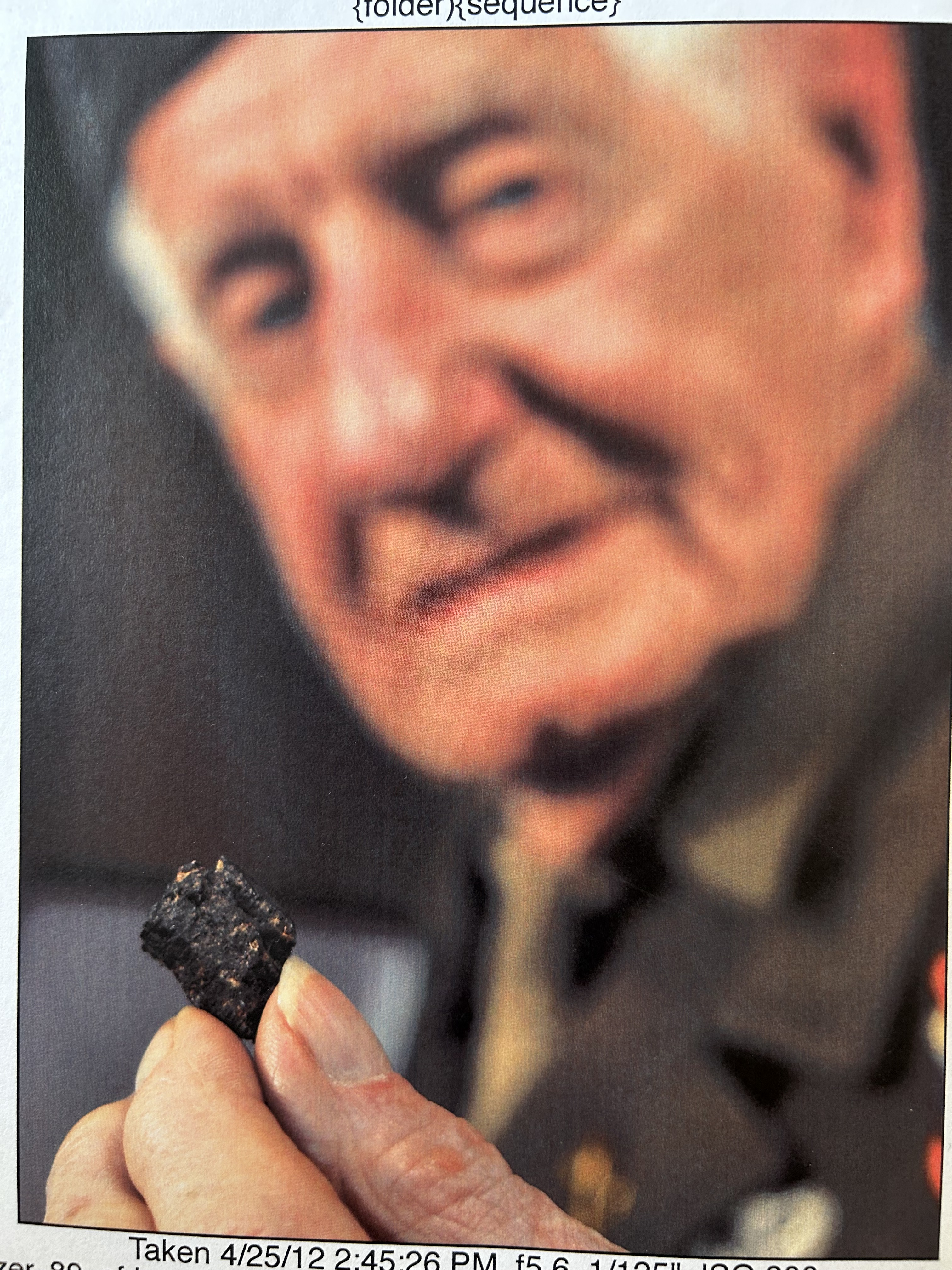
Winzer with shrapnel that was removed from his left shoulder in 1944

He agreed to be interviewed and told me his story over many hours at his home in Lower Macungie Township. The piece ran on Memorial Day 2012 as part of my “in their own words” series. I brought him a stack of copies.

After that, I saw him from time to time at veterans’ events like the Purple Heart banquets. He was also speaking at schools and in front of community groups.

When I visited him this summer at the skilled nursing facility where he was living, he pointed at the wall in front of him. “There, there!” he said. My story was taped on it. It was gratifying to know I had done something to make him proud. He deserved it.

Last month, I was among dozens of friends and family members who attended Bert’s 101st birthday party. Among the guests were two other 101-year-old World War II vets, Pearl Harbor survivor Dick Schimmel and Angelo Bokeko of the 13th Armored Division. Both were Bert’s pals.

Bert died in his sleep last Tuesday, October 24. I wrote about him again for the newspaper, this time with tears in my eyes.

War memories from idyllic Prince Edward Island

On the north shore of Canada’s Prince Edward Island is one of the most eloquent tributes to war dead I’ve ever seen.

Memorial to Canada’s war dead along a dunes trail in Prince Edward Island National Park, Cavendish. The toll was more than 66,000 lives lost in the First World War, more than 45,000 in the Second, 516 in Korea and 158 in Afghanistan.
(Source: Veterans Affairs Canada)

The stone monument, just a few feet high, stands along a dunes trail near the main beach at Cavendish, a locality well known as the site of the Anne of Green Gables house and a popular tourist attraction. Beyond the dunes lies the placid Gulf of St. Lawrence. Both land and sea are wondrous to the eye.

My wife and I came across the simple, dignified stone while walking the trail this month during our vacation on the island. Under an outline of a maple leaf, the words are etched in both English and French for tourists from all over the world to see:

“They will never know the beauty of this place, see the seasons change, enjoy nature’s chorus. All we enjoy we owe to them, men and women who lie buried in the earth of foreign lands and in the seven seas. Dedicated to the memory of Canadians who died overseas in the service of their country and so preserved our heritage.”

Prince Edward Island War Memorial in Charlottetown pays tribute to the islanders who “gloriously laid down their lives” in World Wars I and II, the Korean War and the Afghanistan War.

Days later, we met a Canadian with a deeply personal connection to wartime sacrifice and courage.

We were walking along the harbor of Charlottetown, the maritime province’s capital, when we saw an elderly woman sitting alone on a boardwalk bench. She stood up when we spoke with her.

I pointed to a fiercely dark cloud directly overhead, and wondered aloud why all of the other clouds around it were the brightest white. She said it seemed that a hand was going to reach down from the angry cloud and grab us.

The woman was Imelda Trainor, a native of New Brunswick soon to be ninety-nine years old. She lives in a condo just yards away and had stepped out for some air. Almost immediately, she was proudly telling us about her late husband.

Charlie, she said, was a Spitfire ace in World War II.

Flight Lieutenant Hugh Charles Trainor, a squadron leader in the Royal Canadian Air Force, racked up 8.5 kills. (You were an ace if you had five or more.)

Trainor, of 411 Squadron, was flying a Spitfire Mk IX-T when he shot down two Messerschmitt Bf 109s in Normandy over two days in June 1944, after D-Day. They were his third and fourth victories, according to Richard Bryant on Flickr.

Trainor became an ace the next month at the controls of a different Spitfire when he destroyed two more Me-109s on a single flight, Bryant says.

On September 19, 1944, while flying with 401 Squadron, Trainor took off from Belgium in a Spitfire LF Mk IX. The plane’s engine stopped because of problems with the fuel feed, according to the Aviation Safety Network. He bailed out over the Netherlands and was captured by the Germans.

The Canadian Army Reserve’s 36 Signal Regiment in the Gold Cup Parade on August 18, part of the island’s Old Home Week celebration in Charlottetown. The unit consists of communication squadrons from Glace Bay and Halifax in Nova Scotia and PEI’s Charlottetown.

Trainor was awarded the Distinguished Flying Cross and the Distinguished Service Order.

Back home in Atlantic Canada, he and Imelda were married in 1951. She was a nurse and flight attendant, and her husband a commercial pilot. They lived in Charlottetown and raised a family. Imelda said their son, forty years old, was struck by lightning while leading fellow construction workers off a Florida field. It grieved her to talk about it.

There was another World War II combat flier in Imelda’s family, her brother Gerald Vautour of the RCAF. He flew Mosquito fighter-bombers, she said, and was killed in 1944.

We walked with Imelda for a while, hugged her goodbye and watched as she turned on unsteady legs and made her way home.

A fallen doughboy’s well-traveled footlocker

Howard Lee Strohl’s World War I footlocker. His great-niece keeps it in the study of her home and uses it to store stationery supplies.

Last spring, I posted a two-part blog about Howard Lee Strohl, an Army officer who was killed in France in the First World War. A nice surprise followed. I heard from his great-niece, a researcher of her family’s history. She had never seen the photo that prompted me to write about him – the last picture taken of him before German artillery felled him in August 1918. Nor had she seen the letter he penned to his aunt and uncle in Allentown just days before his death.

Strohl with Ada Ruch of Hellertown, Pennsylvania, after their October 31, 1917, wedding in Augusta, Georgia, where he was training at Camp Hancock. He was twenty-two; Ada was eighteen. The image is a scan of a scan. “I don’t know what ever became of the original,” his great-niece said, “but we never had it.”

But she has something of Strohl’s that has survived the last 105 years – a terrific heirloom, his footlocker – and photos of him that I’m posting here.

The great-niece, whose name I’m withholding at her request, is an Army veteran of the Persian Gulf and Iraq wars who grew up and lives in the Washington, D.C., area. Her parents were from the Lehigh Valley, Strohl’s home turf. Her grandfather, Mitchell, was Strohl’s younger brother.

She said her father, Mitchell Jr., took the footlocker with him when he went to the Citadel, the Military College of South Carolina, in 1938. He was there for a year before entering the Naval Academy.

In Naval Academy tradition, everything is issued to midshipmen, down to their skivvies. So, the footlocker stayed home in Pennsylvania for the next four years and throughout his World War II service in the Pacific. It joined the naval officer again as he moved from post to post with his family every few years.

In the 1950s, he took the footlocker to Italy when he was ordered to Naples, and he had it in Paris for two years in the early Sixties. When his daughter was an Army officer, it went with her to Germany.

“The footlocker still has one of its original handles; the other is long gone,” she wrote. “The front, you can’t close and has been broken as long as I can remember. The footlocker still has a couple of the post-World War II shipping labels from my parents’ moves. The red one on the left from 1961 would have been from when the family went to Paris for my father’s retirement tour in the Navy, on the SS United States.

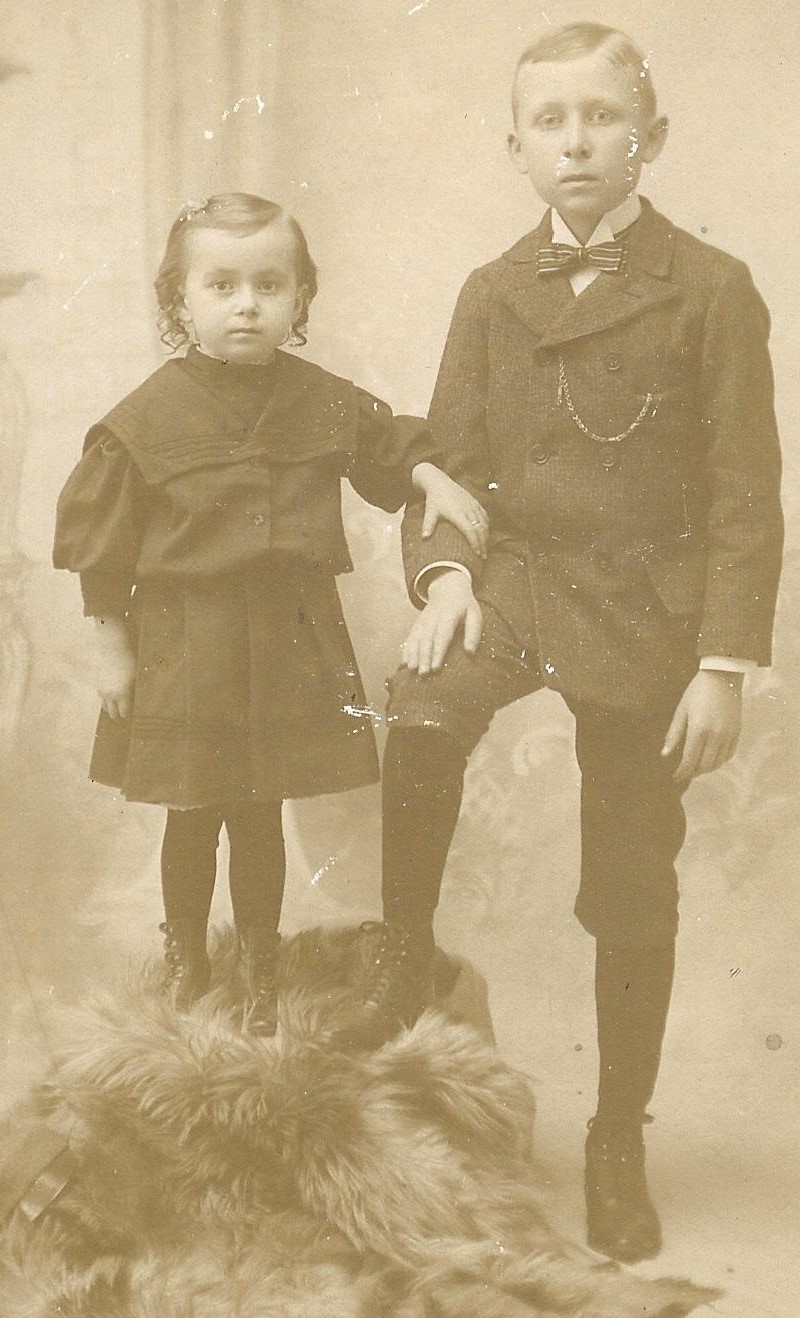
Howard (left) and his brother Morgan, circa 1897. “Unfortunately for Howard,” his great-niece said, “it was the fashion at the time, into the early twentieth century, to dress little boys up like little girls.”

“On the top of the footlocker, the Army Transport Service had painted a swath of tan paint with my father’s name, rank, serial number, and my grandparents’ address in Pennsylvania. I removed that with paint remover about 35 years ago. … If you look at old Sears, Roebuck catalogs of the 1900-18 period, or in specialty catalogs for military uniforms and equipment, you will see footlockers like these for general sale.”

I had no luck getting Lieutenant Howard Strohl’s personnel file from the National Personnel Records Center in St. Louis. It’s not there.

“If the record were here on July 12, 1973, it would have been in the area that suffered the most damage in the fire on that date and may have been destroyed,” an archives technician wrote. “The fire destroyed the major portion of records of Army military personnel for the period 1912 through 1959.”

Strohl’s great-niece said her late brother Randy, who got her started in genealogy research, hit the same roadblock years ago. But she shared two primary sources I hadn’t seen. One is an Army Transport Service manifest. It shows 2nd Lieutenant Strohl of the 109th Machine Gun Battalion shipped out to France from Hoboken, New Jersey, on April 30, 1918, aboard the troop transport Finland. Hoboken was the U.S. military’s main port of embarkation. The Finland, built in Philadelphia, had been an ocean liner.

The Strohls of Bethlehem, Pennsylvania, in April 1918: William and Abbie with sons (from left) Mitchell, Howard and Morgan. The couple had eight children, but only three lived to adulthood.

The other item is a burial card. Strohl was initially buried on the battlefield at Fismes, France, where he was killed in action. A diary kept by a Private John W. Feather has this August 9 entry: “Lieut. Strohl killed by a shell.” And this one for August 12: “George McKinney, Sam Curley and I recovered Sergeant Bechtel’s body from the bridge and buried it aside Lieut. Strohl and Wolfe.”

On October 26, Strohl was reburied in American Expeditionary Forces Cemetery 617 at Fismes. He didn’t come home for a year-and-a-half.

Strohl as a Pennsylvania National Guardsman. In 1916, he went to El Paso, Texas, after Mexican rebels attacked U.S. border towns. He was a private in Company M, 4th Infantry Regiment.

“It was not safe, nor could resources be devoted to returning human remains while the war was going on,” his great-niece said.

On April 9, 1921, his remains were disinterred. They were shipped from Antwerp, Belgium, to Hoboken, arriving on May 18. From there, they were sent to his father, William, in Bethlehem.

For months, I’ve puzzled over discrepancies in Howard Strohl’s story. Some references list him as dying August 8, not August 9, and put his rank as first lieutenant, not second lieutenant. While the National Personnel Records Center was a dead-end for Strohl’s official paperwork, I’m hoping the Army Human Resources Command at Fort Knox, Kentucky, has his casualty file. I wrote for it in early May but haven’t heard back.

His great-niece said I shouldn’t get too wrapped up in those particulars.

“In the end, a young man of twenty-three gave his life for his country, and his family mourned his passage from their presence, particularly his mother.  And that’s what we need to remember.”

Troubling WWII tales from a graveyard in France

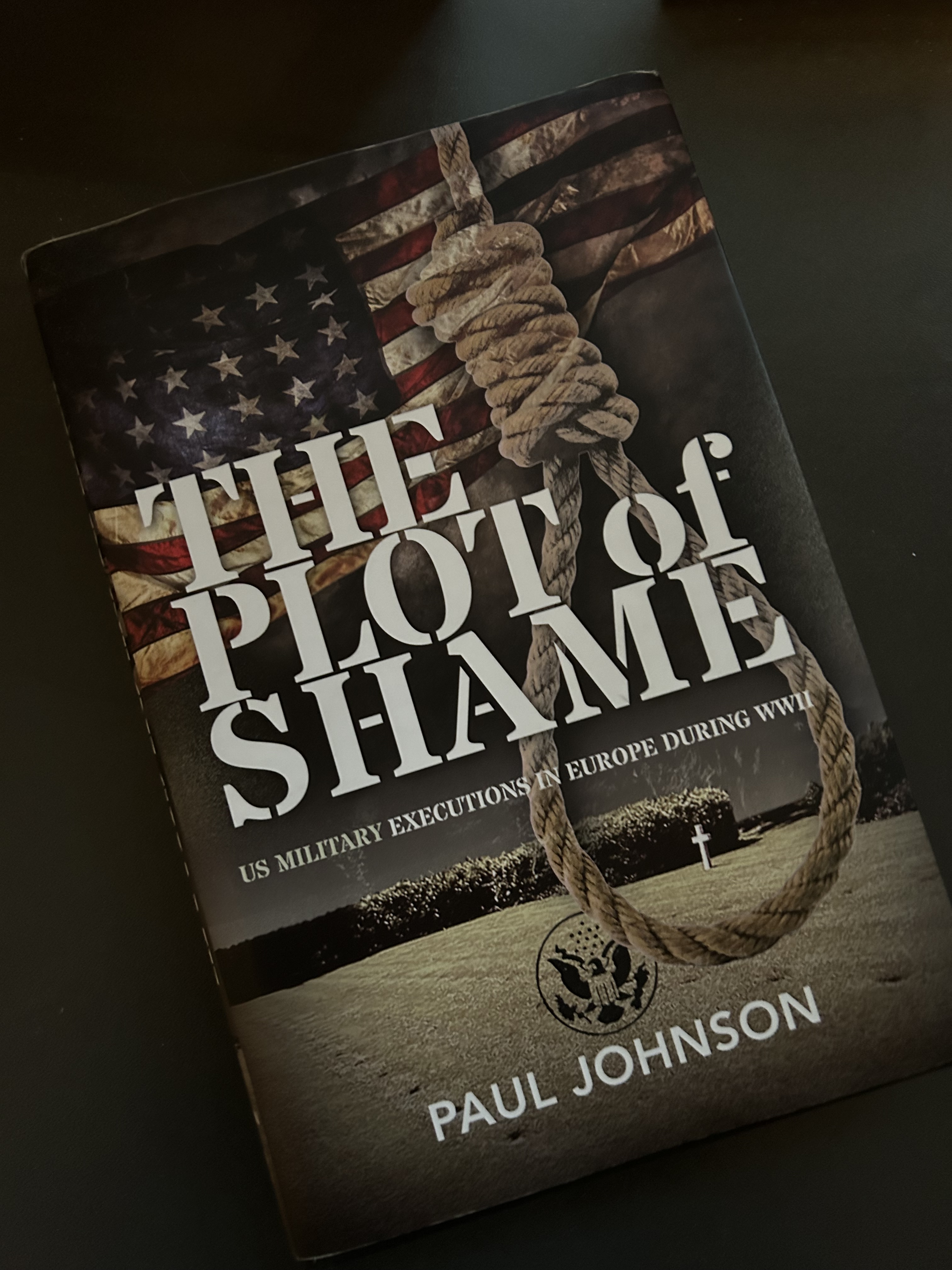
There’s a new book, The Plot of Shame, about American soldiers who were executed for crimes committed in Europe during World War II.

I’m in it.

No, so far as I know, I didn’t have a previous life as a violent criminal. It’s just that British military historian Paul Johnson used some info and photos from one of my blogs and credited me in the text.

Johnson’s book is about a semi-secret tract at the Oise-Aisne American Cemetery in northern France. Called Plot E, it holds the remains of ninety-four Americans put to death by the U.S. military for wartime crimes of rape and murder. (In all, ninety-six Americans were hanged or shot, but the remains of two lie elsewhere.) The stories from Plot E are chilling. Johnson tells them in detail, with background on the criminals, narratives of their vile deeds, and an emphasis on the victims, who were both soldiers and civilians.

A contemptible soldier I’ve written about is buried in Plot E. He was Werner E. Schmiedel, alias Robert Lane, a German-born resident of Lehigh County, Pennsylvania, and rogue Army private who led a notorious gang of deserters called the Lane Gang. He was hanged by the military in 1945 for gunning down an Italian man in a Rome wine shop.

Werner E. Schmiedel of Breinigsville, Pennsylvania, is buried in Plot E at the Oise-Aisne American Cemetery in France. On June 11, 1945, he was hanged by the U.S. Army at Aversa, Italy, for murdering a civilian. The mug shot was Prosecution Exhibit 3 at Schmiedel’s court-martial.
(National Personnel Records Center)

I told Schmiedel’s story in a 2015 piece for The Morning Call of Allentown, where I worked. Much of what I wrote was based on court-martial records from the National Personnel Records Center in St. Louis.

After I retired, I heard from a Joe LoPinto in upstate New York who wondered why his late father wasn’t in my story, which Joe’s son had seen online. The name John LoPinto didn’t ring a bell, but in fact he was a lead Army agent in the hunt for Schmiedel. What’s more, he had kept the complete report of the investigation, a document I didn’t have. Joe LoPinto shared it with me, along with stories his dad had told him about the case. With this new material, I wrote a blog in 2017 titled “Busting the Lane Gang: The John LoPinto Story.”

Johnson read my blog and emailed me in April 2022. His latest book, The Brookwood Killers, had just been published. It’s about twenty British soldiers who were executed for civil crimes and whose names are on a national memorial in Brookwood, Surrey. Now he was working on a book about Americans who’d been executed. The topic had been dealt with before, in an encyclopedic 2013 book by retired U.S. Army Colonel French L. MacLean called The Fifth Field, another name for Plot E. (I had interviewed MacLean for my newspaper story on Schmiedel.) Johnson knew of MacLean’s “excellent book” but wanted to look at the stories more from the victims’ perspective.  He hoped to use some of my blog’s info concerning John LoPinto’s report. After checking with Joe LoPinto, I gave the OK.

Technical Sergeant John LoPinto of Ithaca, New York, was an agent in the Army’s Criminal Investigation Division who played a key role in Schmiedel’s capture. In The Plot of Shame, Paul Johnson credits LoPinto’s son Joe and me for our help.
(Courtesy of Joe LoPinto)

I’ve just finished reading The Plot of Shame. Johnson is up front about its disturbing material. If we don’t have the stomach for it, he says in his intro, we should “close the cover” right then and there. But that didn’t stop me from reading every entry on every sordid case. I have to say, though, it was so disturbing that I kept laying it aside to pick up the cheery book I was reading, Lucy Maud Montgomery’s Anne of Green Gables. (I can explain. My wife and I will be taking a road trip to Prince Edward Island, so I had to get familiar with Anne’s story.)

It was wrenching to read about John “The Clumsy Hangman” Woods and botched executions, about soldiers convicted and sentenced to death on evidence that seemed less than damning, about the disproportionate number of Blacks among the doomed men. You learn about horrifying crimes, how they played out and to whom they happened. Johnson calls special attention to the victims, at the end of each account asking us to remember them. One more thing: I’m glad he included the desertion case of Private Eddie Slovik, a guy with a bad record who clearly didn’t belong in combat and who, it seems, was unjustly singled out for the firing squad. Slovik was buried in Plot E, but in 1987 his remains were returned to his hometown of Detroit.

We honor those Americans who served in World War II for their sacrifice and courage, but a few disgraced the flag instead of upholding it. They committed terrible acts against fellow soldiers and innocent men, women and children overseas. They should have been liberators, not rapists and murderers. We don’t like hearing about them, but it’s important that we have a record of who they were and the evil they did. The Plot of Shame helps fill that role.

A cousin, an uncle who died too young

They were soldiers. One was in Vietnam, the other in the Pacific during World War II. Here’s my tribute to them on this Memorial Day:

My cousin Nicky, an Army helicopter pilot, home on leave in June 1969 before going to Vietnam. (The spelling of his surname is different from mine.)

NICHOLAS LOUIS VENDITTI


Hometown: Malvern, Pennsylvania
Branch of service: Army
Rank: Warrant Officer 1
Unit: Americal Division Support Command
Date of death: July 15, 1969
Place: 312th Evacuation Hospital, Chu Lai, South Vietnam
Cause: Wounds suffered July 10, his sixth day in Vietnam, during a training accident involving a grenade
Age: 20
Burial: Philadelphia Memorial Park, Frazer

My Uncle Sam in the Army, 1941. After a year on a remote Pacific island, he would get a disability discharge.

SAMUEL VENDITTA


Hometown: Malvern, Pennsylvania
Branch of service: Army
Rank: Technician Fifth Grade
Unit: Battery F, 198th Coast Artillery
Date of death: May 10, 1950
Place: At home
Cause: Non-combat brain injury suffered in 1942 on Bora Bora in the Pacific
Age: 33
Burial: East Brandywine Baptist Church Cemetery, Guthriesville, Pennsylvania


Day after Strohl died, an order might’ve saved him

Last of two parts

This plaque commemorating Lieutenant Howard Lee Strohl (right) is on display at the Pennsylvania National Guard armory in Allentown.
(213th Regiment Museum, Charles C. Curtis Armory)

The museum at the National Guard armory in Allentown has a plaque with a photo showing two Army officers resting in a woods. They are Lawrence D. Howell and Howard L. Strohl, both lieutenants in Company D, 109th Machine Gun Battalion. A Lieutenant Fenstermacher caught them in a light moment, snapping the picture in July 1918 near Chateau-Thierry, France. The plaque reads: “Last picture of Lt. Strohl who made the Supreme Sacrifice Aug. 8, 1918 in an attempt to take his platoon across the Vesle at Fismes, France. Presented to Lt. Strohl’s Comrades by His Father – W.L. Strohl, Bethlehem, Pa.”

William Levinus Strohl
(Ancestry.com)

Howell, of Hawleyville, Connecticut, was kicked by a horse July 22 and severely wounded by shrapnel on August 7. Fismes is a village sixty-eight miles northeast of Paris, in the department of Marne. The Vesle River passes through the city of Reims, where French kings were crowned and German bombs fell. Strohl’s dad, William Levinus Strohl, toiled in a Bethlehem Steel rolling mill before becoming a grocer. One day in 1944, his heart failed while he sat in his kitchen. He’d lost his wife, Abbie, ten years earlier.

“August 8” is also on Howard Strohl’s gravestone in Towamensing Cemetery and turns up elsewhere, but appears to be an error. Army records, including the Company D casualty list, show he was killed August 9. So does a story in The Morning Call of Allentown, which quotes from a War Department telegram sent to Strohl’s widow. And the August 9 entry in a Company D diary says: “Lieut. Strohl was killed by shell.”

Ada Potts in 1940. She married Howard L. Strohl on October 31, 1917, in Augusta, Georgia, and was widowed less than ten months later. In 1920, she married William D. Potts.
(Newspapers.com)

His life ended just after the Battle of Fismes and Fismette began, during a furious shelling of the Americans.

The Company D diary is part of a short history of the unit put together by a captain with a prodigious name, Henry Melchior Muhlenberg Richards. His booklet was read on October 19, 1923, before the Lebanon County Historical Society, which had an interest in it because Company D was from Lebanon. Richards painted a picture of what was happening when Strohl was hit.

“The Germans retiring, a new line of battle was formed along the River Vesle, with Fismes, almost midway between Rheims and Soissons, the main point of attack. At this place and Fismettes, across the river, the carnage was awful, the best shock troops, including the famous Prussian Guards, being hurled, time after time, against it, and it was our 28th Division which successfully withstood the attack, at a fearful loss.”

Company D went into action at Fismes and Fismette on August 8. For six days, the Germans shelled and gassed them. “We also suffered from machine gun and sniper fire,” the unit history says, and flamethrowers.

Strohl was the only Company D officer killed.

Ada Strohl learned of her husband’s fate three weeks after the fact. When the telegram arrived at her parents’ home in Hellertown, she was holding the two-month-old son he’d never seen, baby Howard Ruch Strohl. “We regret to inform you that Lieut. Howard L. Strohl was killed in action on August 9th,” read the message from the adjutant general in Washington.

Company D unit history by Captain H.M.M. Richards of Lebanon, 1923

The Allentown newspaper called Strohl a “Martyr to Duty in Service of His Country.” The subhead said a “Boche bullet” got him, a detail that sprang from the writer’s imagination. It was shrapnel that felled the lieutenant, “the first native-born Bethlehem officer to give the last full measure of devotion to the cause of Liberty.”

If Strohl had survived one more day, he might have been headed home. The Lebanon Daily News reported on an order Strohl was about to receive. Major Harry D. Case of the 109th Machine Gun Battalion said Strohl “was killed the day previous to receipt of an order directing him to return to the United States to undertake instruction at one of the military camps.”

The letter Strohl sent from the Western Front to his aunt and uncle, Mr. and Mrs. Bert S. Miller, was delivered to their home in Allentown on September 7, almost a month after his death.

There’s some confusion about the final rank Strohl attained. It’s given as first lieutenant in some contemporary sources, including The Morning Call, which reported he got the promotion in France. The Company D history and casualty list identify him as a second lieutenant. So does postwar paperwork filed with the adjutant general of Pennsylvania. I’ve asked the National Personnel Records Center in St. Louis for Strohl’s file, which might settle the matter, if the file exists.

Norvin L. Vogel
(Newspapers.com)

The photo plaque from Strohl’s dad was given to the 213th Regiment Museum at the Charles C. Curtis Armory in April 2008, according to John Yanno, the museum volunteer who keeps track of artifacts. The donor isn’t listed in the records, but Yanno said other items donated about the same time came from retired Army Major Norvin L. Vogel Sr. of Allentown. A World War II veteran, Vogel fought in the Battle of the Bulge and received a Bronze Star. He died in 2021.

A seemingly out-of-place home for a photo of Strohl is the State Archives of North Carolina, but it’s there. The archives have materials “collected by the North Carolina Historical Commission largely between 1918 and 1926, to document the service of North Carolinians in World War I.” The record identifies Strohl as being from Bethlehem, Pennsylvania, and adds this note: “It is unknown why this portrait was collected by Robert B. House for the N.C. Historical Commission.”

Robert B. House
(State Archives of North Carolina)

Strohl had no connection to North Carolina that I could find.

But did he and House know each other? Both served in machine gun companies in France during the war, and both had been Army instructors in Georgia. The similarities end there. House was in the 26th Infantry Division and Strohl in the 28th. House was back in the States before Strohl arrived in France. And House became an instructor at Camp Gordon, northeast of Atlanta, about the time Strohl was leaving Camp Hancock, which was 145 miles away. It seems unlikely their paths had crossed.

House went on to edit the North Carolina Historical Review in the mid-1920s and became chancellor of the University of North Carolina at Chapel Hill.

Strohl’s widow, Ada, remarried in 1920 and had seven more children. The Gold Star Mothers of Bethlehem welcomed her into their midst, even though she wasn’t by-the-book eligible for membership. She outlived her soldier husband by almost half a century, passing in 1966 at the age of sixty-seven.

William D. Potts
(Newspapers.com)

Her second husband, William D. Potts, was in the Students’ Army Training Corps at Moravian College. Over the years, he was a printer and linotype operator at the Bethlehem Globe-Times and Lehigh Litho, an insurance agent, owner and operator of a Hellertown gas station, a Republican committeeman, and president of the borough’s Chamber of Commerce and Northampton County’s industrial development agency. He died in 1973.

Howard R. Strohl
(Newspapers.com)

Howard Ruch Strohl, an infant when his father was killed, had a risk-filled job in the Navy during World War II. He was on the crew of the Pearl Harbor-based gasoline tanker USS Halawa, which supplied fuel oil and diesel fuel to warships and out-of-the-way Navy posts. Later, he worked for Airco Industrial Gases in Bethlehem and was mayor of Hellertown. He was seventy-four when he died in 1993.

Doomed doughboy lamented ‘what this war is like’

First of two parts

U.S. Army officer Howard Lee Strohl wrote from France in the summer of 1918 in high spirits. The Germans, he said, were on the run.

Howard Lee Strohl of Bethlehem enlisted in the Pennsylvania National Guard on April 10, 1914, two months shy of his nineteenth birthday. He served on the Mexican border and with the American Expeditionary Forces in France.
(State Archives of North Carolina)

“I suppose you have read in the papers about the present American drive which started on the 15th of July, and that we are driving them before us like a bunch of cattle. The Hun is a very poor fighter when he has good opposition and only is good when he can see you and you can’t see him, or get a glimpse of him. He is in full retreat, by all appearances. He is going so fast that he is tiring us, chasing him.”

Lieutenant Strohl, twenty-three years old, was sitting in front of a captured German dugout in the wilderness some sixty miles northeast of Paris. He’d been so busy advancing with his machine gun company, he had to skip a few soldierly duties to scribble letters like this one.

The enemy, he told an aunt and uncle back home in Pennsylvania’s Lehigh Valley, “lived in grand style in these dugouts. They had chairs, tables, feather ticks and cushions, etc. Of course this stuff they took from the poor French people, whose homes they pillaged. The villages and towns are laid in waste. I was in one very large town where I’ll venture to say everything as large as a chicken coop was hit by artillery shell.

“Houses are leveled to the foundations. In this town the people are again moving back, even though their homes are smashed. They have set to work and started to clean, and fix things up as best they can, and make their demolished homes once more habitable.”

Strohl had a knack for the military life, proved to be a leader and rose steadily in rank during his five years of service.

He was born in 1895 in what was then the borough of South Bethlehem, now part of Bethlehem city. He lived there with his parents, William and Abbie, and brothers Morgan and Mitchell on East Third Street, right alongside a noisy, smoky plant that was transforming the nation’s skyline. Charles Schwab’s Bethlehem Steel Corporation would benefit mightily from the impending First World War to become America’s No. 2 steelmaker.

Doughboys of the 28th Infantry Division camp in the woods near Fismes, France. It’s August 1918, and they’re trying to avoid detection by German reconnaissance planes. Strohl would lose his life at Fismes.
(National Archives)

Strohl went to public schools and studied at the South Bethlehem Business College, which held its classes in a building four blocks from Lehigh University. After graduating in 1913, he kept the books for the Sauquoit silk mill. On Sundays, he sang in the choir at the First Reformed Church, founded in the mid-19th century by German immigrants.

He joined the National Guard out of a “spirit of adventure and desire to serve his country,” a newshound wrote, and was a private in Company M, 4th Infantry Regiment.

In June 1916, Pennsylvania’s National Guard was among state units called up after Mexican rebels, starting with Pancho Villa, attacked U.S. border towns. Company M and the other Pennsylvanians deployed to Texas and camped near El Paso. They marched, practiced on weapons and patrolled the border. Strohl was promoted to corporal there. In the fall, he made sergeant. By year’s end, Company M had gone home, and Strohl was commissioned a second lieutenant.

With the U.S. entry into the Great War in 1917, he was assigned to Company H in Lebanon, near Harrisburg, and called into federal service in August. The men sped to Georgia the next month for training with the 28th Infantry Division, newly formed from units of the Pennsylvania National Guard. At Camp Hancock in Augusta, they were picked for a machine gun detachment. British instructors drilled them, often on wooden guns because few actual guns were available. In October, they were transferred to Company D of the 107th Machine Gun Battalion.

That month in Augusta, he married a girl from back home, eighteen-year-old Ada Ruch.

The men of the 107th were transferred a final time in March 1918, becoming Company D, 109th Machine Gun Battalion. Strohl was made one of their instructors. A hard task awaited them when they steamed for France in early May aboard the British liner Aquitania. The Germans had launched their big spring offensive, a series of attacks along the Western Front.

Lieutenant Strohl arrived in Europe to do his part with the American Expeditionary Forces. At home, Ada was pregnant and staying with her parents, Titus and Mary Ruch, in Hellertown.

Strohl was a lieutenant in Company D, 109th Machine Gun Battalion, part of the 56th Infantry Brigade, 28th Infantry Division.
(Newspapers.com)

Strohl penned the letter to his aunt and uncle just before the opening phase of the Allied offensive that would end the war. Near the close of his message, he turned somber.

“Since on the line, I have seen all the grim horrors of warfare, and all this is but a common sight. You people back there cannot realize one bit what this war is like. You haven’t the slightest idea. Once you see it, then is the time one’s hatred for the Germans beams forth, and makes us more determined to crush him once and for all.”

He was proud of the job the 28th Division, then part of a French corps, and the other American units were doing.

“Our artillery is sure giving them h— and beating them down at their own game. He realizes now that he is up against a formidable army, and not a bunch of bluffers. His best troopers have been beaten down to defeat at the point of bayonets and rifle butts the last few days. … We are having considerable rainy weather, and many of our marches are made through downpours and mud ankle deep. But everyone rejoices just the same. None are downhearted, and all eager to do their bit. I am in good health, and living good; sleeping anywhere at all, and none the worse for such.”

Strohl dated his letter August 3, 1918. Six days later, German artillery cut him down.

COMING NEXT: Strohl in modern memory