Pennsylvania World War II veterans, standing from left: Harry Bean (Army), Russell Sattazahn (Army), Frank Stellar (Army), Milton Ripple (Navy), Eli Rauzon (Navy) and Jacob Vanino (Army). Seated from left: Edward Conrad (Navy), Stanley Isenberg (Army Air Corps), Joseph Haenn (Army Air Corps), Rubino Degenhart (Army), Dorothy Trate (‘Rosie the Riveter’), William Balabanow (Merchant Marines), James Determan (Army), Edward Czechowski (Navy), and Robert Pearce (Navy).
—
It was a stirring sight. Fourteen World War II veterans and a “Rosie the Riveter,” all around a hundred years old and beyond, including one gentleman of 108, were gathered last Friday at a church hall in Emmaus, Pennsylvania. The event marked the 80th anniversary of V-J Day, August 15, 1945, which celebrated the end of fighting against Japan.
Besides newspaper and TV coverage, dozens of people had come to meet and talk with these last survivors of the Greatest Generation. Only about 66,000 of the 16 million Americans who served in the war are still living. About 3,900 are Pennsylvanians.
My friend Meta Binder of Lehigh Valley Chapter 55 of the Battle of the Bulge Association had organized this salute at St. John’s Lutheran Church. The group’s president, another good friend, Steve Savage, had flown up from his new home in Florida to be there. Most of the honored guests had been gathered by 21-year-old Albright College student Tyler Boland, who has interviewed hundreds of World War II veterans so their stories will live on.
The vets were entertained with songs and dancing from the 1940s. A 10-year-old boy, James Papalia, who has written several books about a kid’s journey through time to World War II battles, read from his work.
I didn’t manage to speak with all of the vets. Here are the ones with whom I had that honor:
Haenn
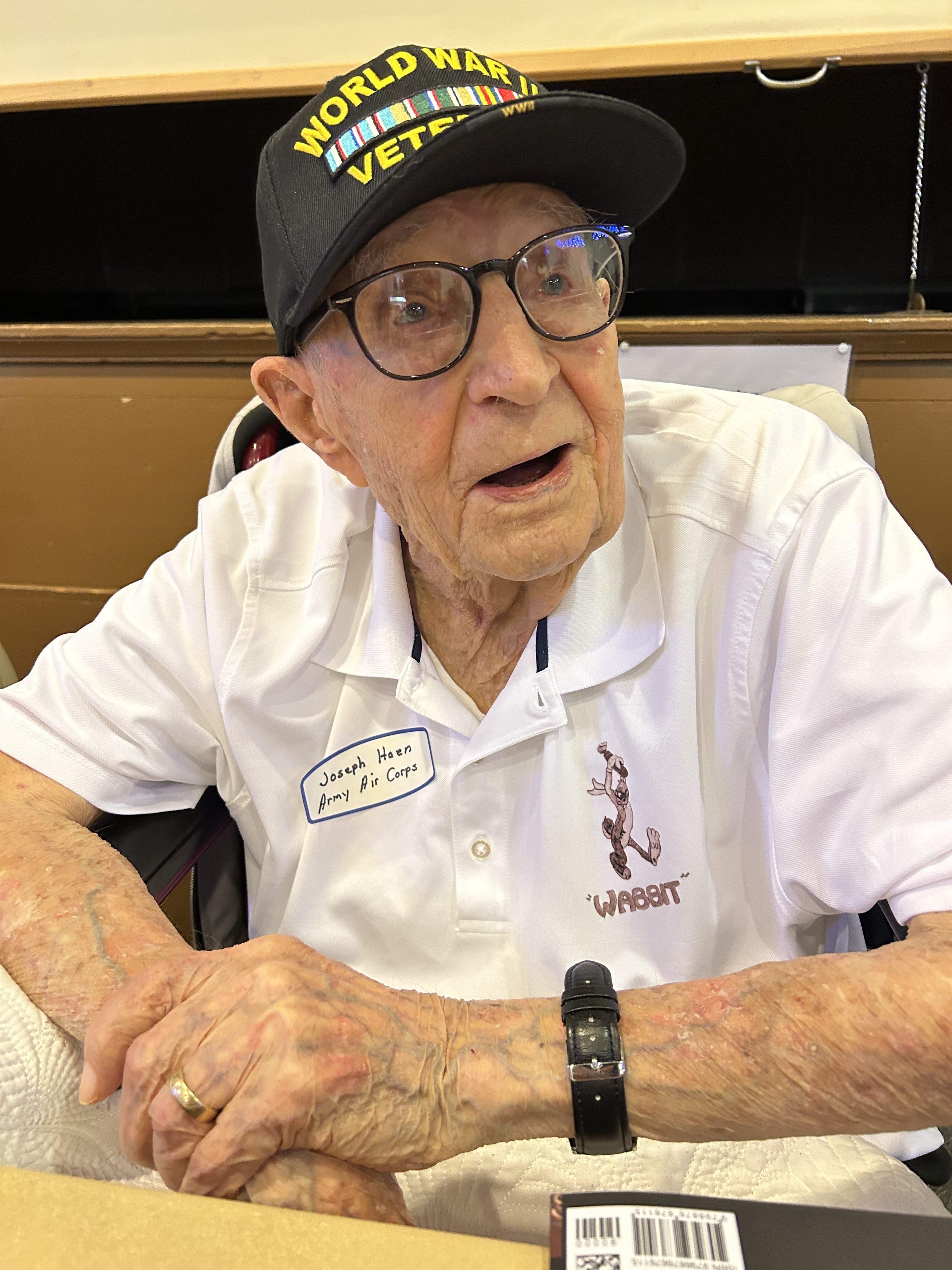
Joseph Haenn of Telford, Montgomery County, at 108 is the oldest World War II veteran in Pennsylvania. An assistant crew chief in the Army Air Corps, he worked on B-24 Liberators with the 8th Air Force’s 467th Bomb Group in England.
Determan
James Determan, 102, of Lititz, Lancaster County, served with the Americal Division’s 182nd Infantry Regiment at Leyte Gulf and Cebu in the Philippines. He carried a Browning automatic rifle and was awarded a Bronze Star.
Czechowski
Edward Czechowski, 100, from Reading, was a gunner on the destroyer USS Saufley in the Pacific, including Iwo Jima, Guam, Leyte Gulf and Okinawa. He received a Silver Star for blowing apart a kamikaze as the Japanese plane was about to hit his ship.
Sattazahn
Russell Sattazahn, 99, from Schaefferstown, Lebanon County, served with the 1st Infantry Division. In March 1945, he was severely wounded in Germany. He received two Bronze Stars and a Purple Heart.
Trate
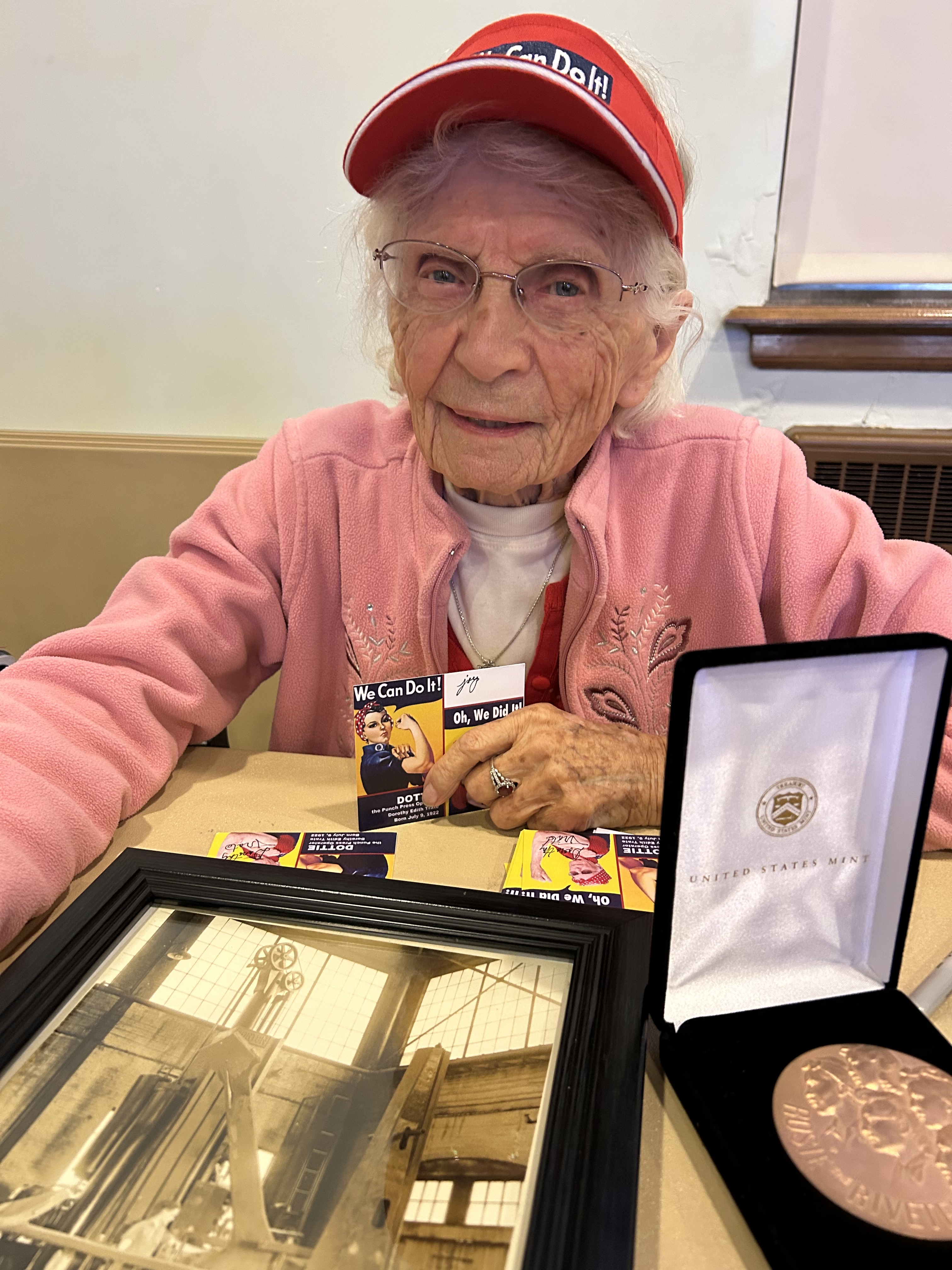
Dorothy Trate, 103, from Narvon, Lancaster County, was a punch press operator at the Doehler-Jarvis plant in Pottstown, which built parts for warplanes.
Bean
Harry Bean, 99, from Norristown, was a bazooka operator with the 351st Infantry Regiment, 88th Infantry Division, who fought the Germans in Italy.
Pearce
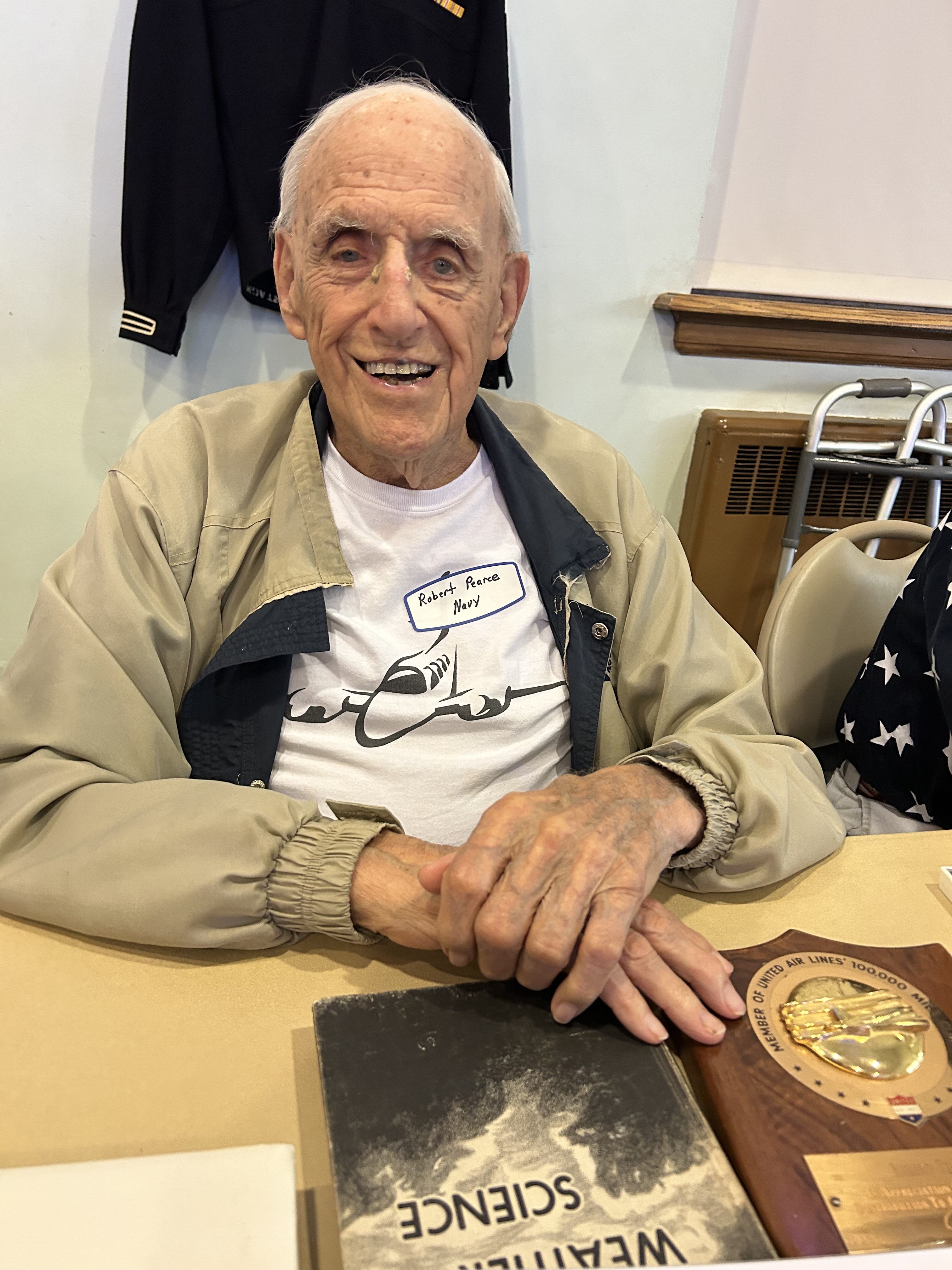
Robert Pearce, 102, of Lower Macungie, Lehigh County, was a Navy weatherman with Fleet Air Wing 10 on Palawan in the Philippines. He went “typhoon hunting” in PB4Y-2 Privateers to gather weather data.
Rauzon
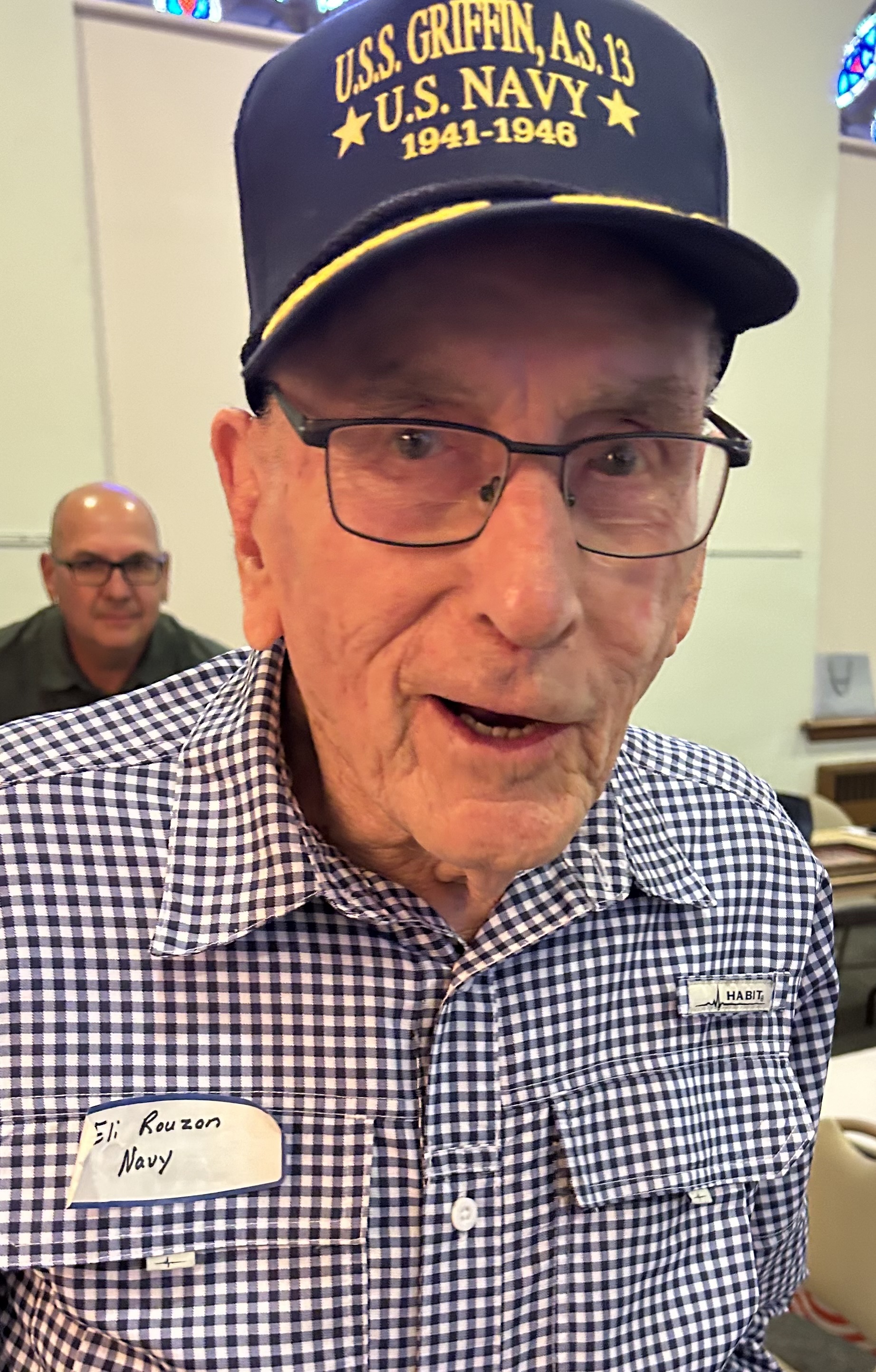
Eli Rauzon, 102, of Upper Macungie was a Navy electrical repairman on the submarine tender USS Griffin and worked on subs in Australia. He went on to serve in the Air Force during the Korean War and as a contractor for the Defense Department.
It was clear these and the other vets enjoyed getting the attention they richly deserve. As Meta Binder put it for The Morning Call of Allentown, “It is extremely important for their legacy to be preserved. … Let us never forget their sacrifices.”
“Thought you might enjoy a peaceful story of the war,” Dr. Jack E. Cole of Bethlehem, Pennsylvania, wrote to me in 1999. “It is true and unpublished.”
Here’s the former Army doctor’s account of his visit to Northern Ireland during World War II:
OFFICIAL LEAVE
Dr. Jack E. Cole was from Matamoras in northeastern Pennsylvania. He graduated from Penn State in 1937 and earned a degree in medicine from the University of Pennsylvania in 1941. (The Morning Call)
She reached for the pack of gum which I had extended to her. I watched in amazement as she unwrapped each stick and stuffed it into her mouth. Since it was my week’s supply, it was a minor tragedy, but I had had the pleasure of being awed.
We had boarded the train in Enniskillen, bound for Belfast. It just happened we entered the same compartment, and being the only occupants, struck up a conversation. We soon learned we were both physicians. In her Irish brogue, which she managed around a huge wad of gum, she asked, “What do you do for a baby with a fever? All I know is give an enema.” I pointed out other methods that might be used. I never saw her again after arrival at Belfast, but I still picture her giving enemas while chewing a large wad of gum.
My purpose in Belfast and surrounding territory was to visit my in-laws. The commander of the 13th Infantry Regiment had urged us to use up some of our accumulating leave time. I grasped this opportunity because I did want to meet some of my wife Lynn’s relatives and to explore Ulster.
When the 8th Infantry Division was preparing to depart the USA, those of us of lesser rank had no idea to which part of the world we were headed. Just in case, I asked my Irish-born father-in-law, Bill Darragh, for names and addresses of his relatives and friends in Northern Ireland. Unbelievably, I was plunked down a few kilometers from them.
Belfast was in total blackout, having been bombed by the Luftwaffe. Groping my way from the train station, I found a cab and requested the driver to help me find a bottle of whiskey before going to a hotel. He knew just the place. Going a few blocks, we stopped in utter blackness and he said, “Wait here, I’ll be right back.”
He handed me a bottle of Old Bushmills and asked for 5 pounds ($20.15). After paying, I took a swig and immediately exclaimed, “This is at least half water!”
“Sir, you didn’t expect pure whiskey, now did you?”
Although the whiskey wasn’t pure, the blackness was. I knew I was defeated. “Take me to a hotel.”
The hotel desk clerk was working in candlelight. “And what is this?” I asked as he handed me a black chunk. “That is peat, sir. Burn it in your fireplace. You’ll get a chunk each day you’re here.”
The bus ride to Ballymoney was pleasant. Certainly, Emerald Isle is a fitting name for this lush green bit of land. Ballymoney, a city of about 20,000 and the ancestral home of Lynn, wasn’t as pretty as the countryside. When I found the home of her Uncle Jim, it was far from affluent. In fact, it was downright humble.
Jim Jr. met me outside the house. He was courteous but wary. I’m sure there were many eyes peeking out windows. Here was I, resplendent in an Army officer’s uniform, captain’s bars flashing in the sunlight, visiting a peasant area. It wouldn’t be safe for them to invite me into their home, not knowing whether I was Catholic of Protestant, and I looked so majestic.
Jim directed me to the general store and home of Mr. Crumbie, a close friend of Bill Darragh’s. … He gladly invited me into his home behind the store. He and Mrs. Crumbie treated me to tea, crumpets and scones. Conversation was warm, with many questions about Bill and his family.
Departing their home through the store, Mr. Crumbie said, “Now wait. I have a present for your Mrs. Darragh. Not Bill’s Mrs. Darragh, but yours.” He evidently had forgotten my name. He pulled out a pile of handkerchiefs, all labeled Pure Irish Linen. As he went through the pile, he picked out certain ones, saying, “That’s linen.” I was polite enough not to ask what the others were made of.
The bus ride along the east coast of Ulster on the Antrim Coast Road terminating at Portrush was a thrilling experience. The craggy shore churned a constant display of waves crested with white water. The 4,000 residents of Portrush thrived on tourism, and their homes indicated affluence.
Here I visited another friend of Bill’s, a Mr. Kittough. He shrewdly determined my religious affiliation by asking if I was a member of the Craft. When I answered that since I reached my majority, I had not lived in any one place long enough to join the Masonic Order. He was satisfied that I was a suitable house guest.
He had a lovely home and treated me royally. When I refused milk and sugar in my tea, he was distressed that he had no lemon. The German U-boats were sinking many of the Allies’ supply ships, and as a result, lemons, if one could be found, were $5 apiece. I relieved his pain by accepting milk in my tea. After answering the usual questions about my father-in-law and his family, and some discussion on the war, I took my leave and headed for the Giant’s Causeway, a short distance of seven miles.
The Causeway is a spectacular promontory of columnar basalt composed mostly of irregular hexagons, caused by a rapid cooling of lava flows into the sea. It is a must for anyone visiting Ulster.
An elderly gentleman who oversaw the Causeway conducted us — I had picked up another officer as a companion — on a guided tour. Since it was toward the end of winter, he hadn’t seen a tourist for several weeks. His volubility was stunning. He told us many stories, one of which was how an Irishman had written the Star-Spangled Banner.
In the vicinity was one of those shelters scattered throughout the world, set up by service organizations to cater to the needs of American servicemen and women. The lieutenant and I sought hospice there. We were overwhelmingly greeted by a young woman who hadn’t seen a fellow American since autumn. She had undiluted whiskey. We celebrated. We put her to bed before we hit the sack and left a note the next morning thanking her for her exuberant hospitality.
Arriving in Enniskillen, I had to endure the usual post-leave letdown. The Allies had made progress in spite of my week-long absence.
—
Cole was wounded in Europe and received a Purple Heart.
He went on to have a family practice in Bethlehem. In the late 1960s and early ’70s, he was a Peace Corps physician in Afghanistan, Swaziland (now Eswatini) and India. In 1987, he led a United Church of Christ medical team in Honduras. He was an author and poet.
William J. Holmes was born in Carbondale, in northeastern Pennsylvania.
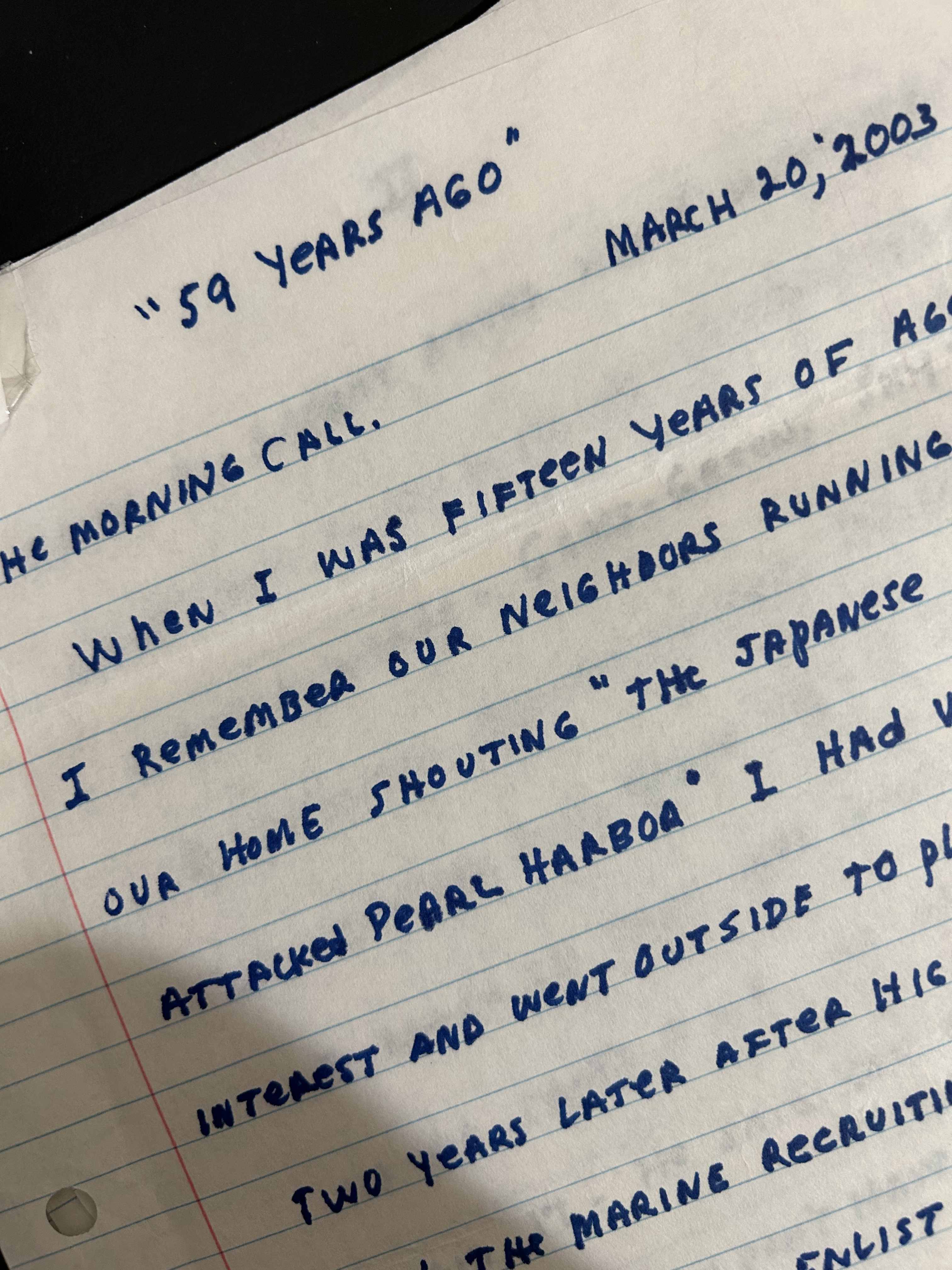
In 2003, William J. Holmes of Mertztown, Pennsylvania, wrote to The Morning Call of Allentown about his World War II service. His hand-printed, six-page letter landed on my desk.Itwasn’t published, and I don’t remember calling him about it.When I retired more than a dozen years later, his letter was among the papers I took home. It turned up yesterday while I was going through my files. Here is what Holmes wrote:
—
When I was 15 years of age, I remember our neighbors running into our home shouting, “The Japanese have attacked Pearl Harbor.” I had very little interest and went outside to play.
Two years later, after high school, I visited the Marine recruiting office in Wilkes-Barre, Pa., to enlist, as my older brother, John, was already in the Pacific since 1941 with the 2nd Marine Division. I passed all the written tests and was asked to repeat after him immediately what came to my mind as he mentioned certain words — grass-green, sky-blue, bird-wing, hammer-board. He stopped after board and asked why I said board.
I asked if that was wrong. He replied, “No, no that’s fine.” He asked my age. I said 17. He said, “You are not 17 1/2? I told him you don’t have to be 17 1/2 to join, just 17. He said for the last month the age was raised, as too many were enlisted in the Marines and this was temporary. In anger, he said: “If you want to join something, join the Navy. They take anybody.” I immediately walked a few blocks to the post office and was surprised that I could join for two years. This was because I would be in a reserve status for two years or duration of the war.
I had boot training at Bainbridge, Md., and was shipped to Treasure Island, Calif., a few week later. We were told that we would be on our way within 72 hours. We all laughed at this, as we were getting ready for meal time at 5 p.m. … Shortly, a Marine officer flew into the barracks and said: “Pack your seabags and be ready to go.” Someone asked about our meal, and he said: “You will eat on the ship.” While going under the Golden Gate Bridge, an officer told us, “The next time you pass under that bridge, you will either cry or be choked up. (He was right.)
Our first stop was Pearl Harbor. We dropped off 200 women Marines. … Next stop Enewitok, then Saipan, Ulithi and then the Philippines. I was attached to a repair-and-supply outfit. … All damaged ships that could make it to our area were repaired. Our ship was a converted Merchant Marine cargo-carrying vessel that held oxygen and blood plasma. These supplies from the States were loaded aboard, and we made periodic runs to Okinawa and back.
When the atom bomb was dropped, and we realized we would shortly get going home, there was a point system for leaving. Who were there the longest, had the most battle stars?
While waiting for my points, a group of American civilians asked if any of us would like to be flown home right away with a 30-day leave and sign up for another year. This was for Bikini A-bomb tests. I do not know to this day why I didn’t sign, although a lot did. I believe to this day that, had I been taken into the Marines instead of the Navy and had signed the Bikini paper, I may not have gotten back.
—
Holmes went on to serve in the Korean War. In civilian life, he worked as a letter carrier, a security guard at Lehigh Valley Hospital and as a police officer in Macungie. When he retired in 1992, he was a security guard for Kraft Foods. He was married with two sons.
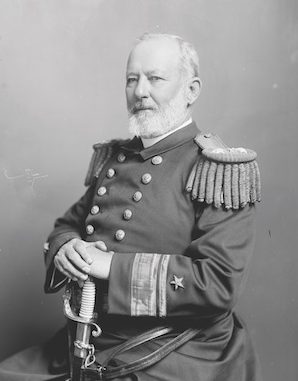
Rear Admiral Bancroft Gherardi of the U.S. Navy (IAVMuseum.org)
There was the Revolution and the War of 1812. But did you know we almost came to blows with Great Britain yet again?
Over a border in South America?
The Venezuelan crisis of 1895 is hardly mentioned anymore, but at the time, it was Page 1 news around the world. American newshounds wrote of a looming war with Britain. Speaking to the press, a famous U.S. admiral piped up that the first step should be to whip Canada.
The blow-up stemmed from a boundary dispute between Venezuela and the neighboring British colony of British Guiana, today’s Guyana. For decades, the Venezuelans argued that Britain claimed too much of their land. An 1835 survey commissioned by the British led to a boundary that gave Guiana an additional 30,000 square miles. It was called the Schomburgk Line after its surveyor. When gold was found in the disputed area, Britain snatched even more territory.
Robert Schomburgk (history.state.gov)
Fuming over these land grabs, Venezuela asked the U.S. for help and pointed to the Monroe Doctrine. That’s the U.S. policy that warned European powers against meddling in the Americas. If they did, it could be considered a hostile act.
Venezuelans wanted the U.S. to sponsor arbitration or use force against the Brits, but neither happened. Years passed before Washington flexed its muscle.
In 1895, invoking the Monroe Doctrine, newly appointed U.S. Secretary of State Richard Olney sent a strongly worded note to British Prime Minister and Foreign Secretary Lord Salisbury, demanding that the British submit the boundary dispute to arbitration. Salisbury’s response was that the Monroe Doctrine had no validity as international law. The United States found that response unacceptable, and in December 1895, President Grover Cleveland asked Congress for authorization to appoint a boundary commission, proposing that the commission’s findings be enforced “by every means.” Congress passed the measure unanimously, and talk of war with Great Britain began to circulate in the U.S. press.
If it came to war, how could the U.S. win?
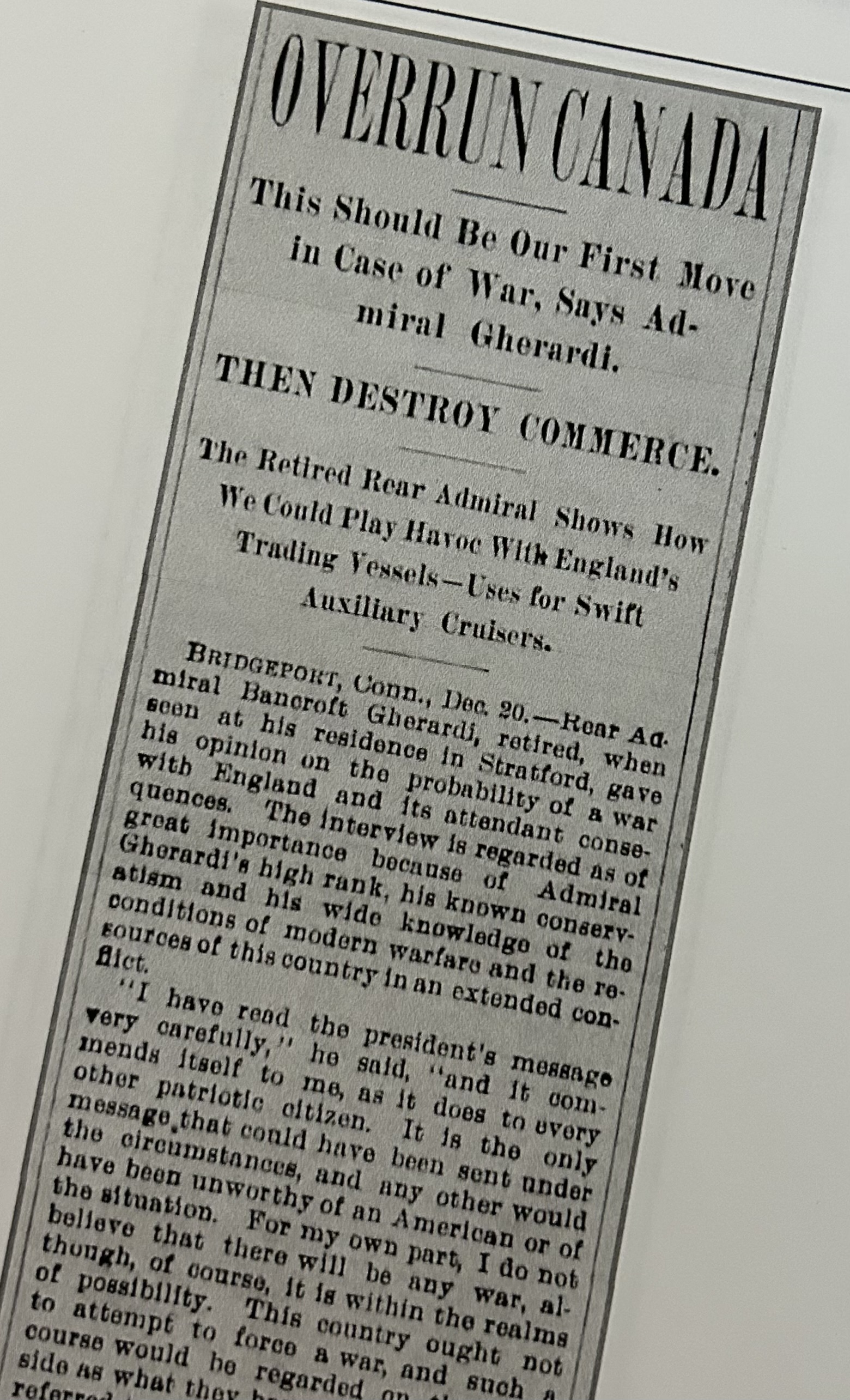
A high-ranking Navy veteran of the Civil War spoke up. He was retired Rear Admiral Bancroft Gherardi, hailed as “the most prominent Italian-American naval officer of the 19th century.” A reporter interviewed him at his home in Stratford, Connecticut.
Gherardi interview in the December 20, 1895, edition of The Buffalo News (Newspapers.com)
“Our first act in the event of war ought to be to overrun Canada,” Gherardi said, “and then throw upon the seas every possible commerce destroyer that we can muster.”
U.S. cruisers would disrupt British trade, he said, and bring London to its knees.
But invading our neighbors to the north, a dominion of the British Empire, and tangling with British merchant vessels probably wouldn’t be necessary, Gherardi said. After all, war with Britain was unlikely.
“I think England’s trade interests will forbid it. She is dependent upon all the world for her raw material, and of this she gets enormous supplies from us. She simply could not live if her markets were cut off from her.”
The widely read interview with Gherardi didn’t have anything more on Canada. In a separate story, a fellow rear admiral named Oscar F. Stanton added a little:
“In case of war, our coast defenses need to be put in better order. As commerce destroyers, our navy could be of great effect, but the long range of coast would expose many cities to an enemy’s guns and with little protection. Canada — oh yes, we could take Canada, and hold it too; our torpedo boats and rams could be utilized to protect American ports and shipping, and more of the former could be speedily built if necessary.”
When U.S. politician and railroad lawyer Chauncey M. Depew said Canada would be easy pickings, The Globe newspaper of London fired back: “The overwhelming naval strength of England would enable her to pour troops into Canada at any sight of danger. Small warships could be sent to the lakes, and Chicago, Detroit and Buffalo would be utterly at their mercy.”
Does Americans’ picking on Canada sound familiar? It should, since the current occupant of the White House has talked about making it the 51st state.
—
Admiral Gherardi was right that there would be no war, as tensions eased. The State Department’s “Milestones” column summarizes what happened:
Great Britain, under pressure in South Africa with the Boers and managing an empire that spanned the globe, could ill afford another conflict. Lord Salisbury’s government submitted the dispute to the American boundary commission and said nothing else of the Monroe Doctrine. Venezuela enthusiastically submitted to arbitration, certain that the commission would decide in its favor. However, when the commission finally rendered a decision on October 3, 1899, it directed that the border follow the Schomburgk Line. Although a rejection of Great Britain’s increasingly extravagant claims, the ruling preserved the 1835 demarcation. Disappointed, the Venezuelans quietly ratified the commission’s finding.
Talk of war with Mexico was firing up communities across the country 109 years ago. The press reflected and spurred on this patriotic fervor.
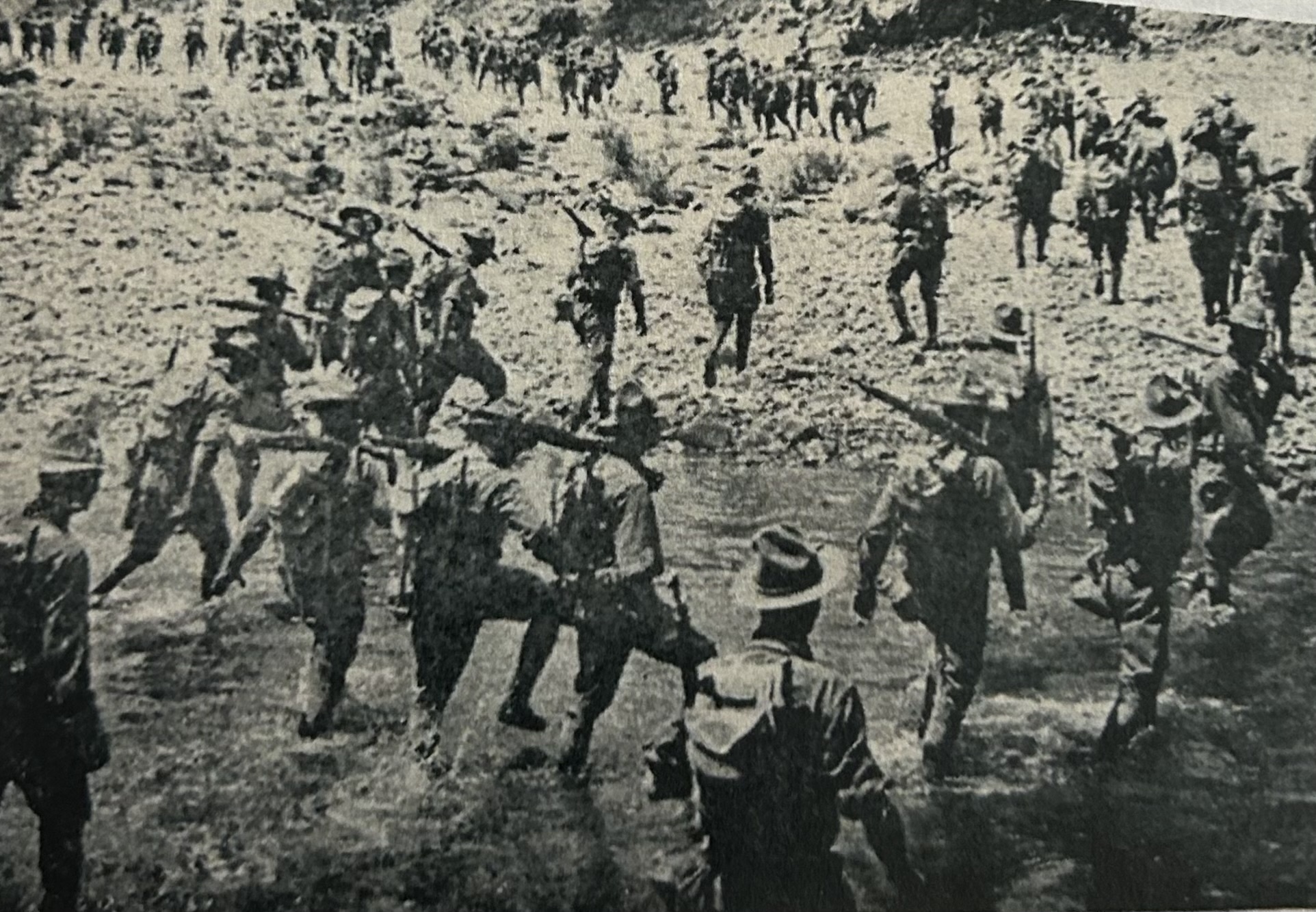
Pennsylvania National Guardsmen in training near Camp Stewart, Texas, 1916
The First World War was in its second year that summer of 1916, with French and German forces bloodying each other at Verdun on the Western Front. The U.S. wouldn’t join the fighting across the Atlantic for almost another year. But it only had to look to its southern neighbor to see an immediate, mortal threat.
Marauding Mexican revolutionaries were crossing into America. In March, hundreds of bandits under Pancho Villa raided a New Mexico town and nearby Army garrison. President Woodrow Wilson ordered a punitive expedition led by Brigadier General “Black Jack” Pershing and called for more than 100,000 National Guardsmen to protect the border.
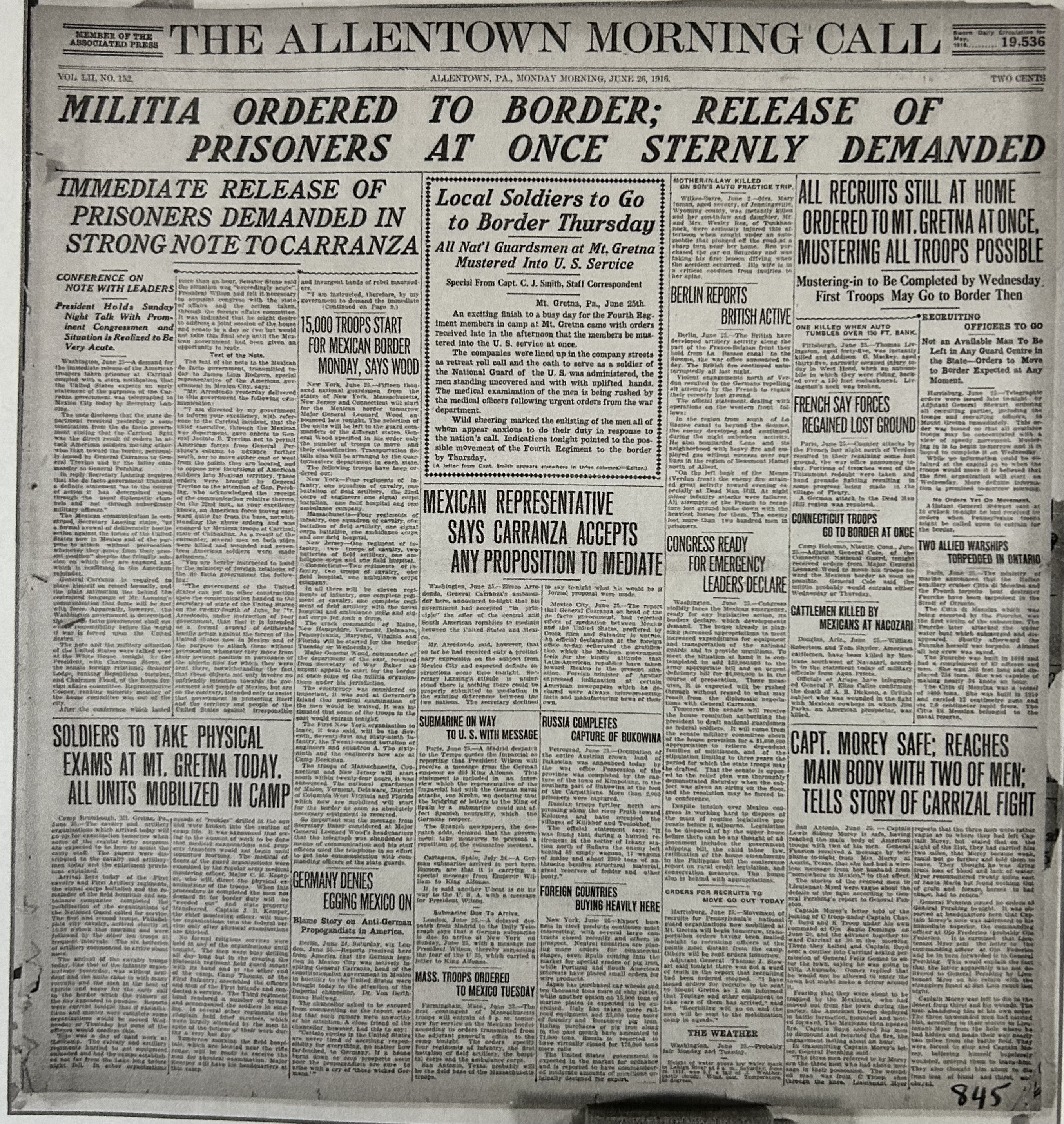
The Pennsylvania Guard’s staging area was Mount Gretna, an old cavalry site 32 miles east of Harrisburg. Here’s a sample of how my hometown’s Allentown Morning Callreported on the call-up of locals:
Wednesday, June 21, 1916
U.S.-Mexico tensions dominate Page 1 of the June 20, 1916, edition of The Allentown Morning Call. (Newspapers.com)
The Allentown soldiers will leave here on Saturday at six o’clock in the morning for Mount Gretna to enter the service of their country in the Mexico emergency and to guard the border from the invading hordes of bandits from the country to the south of the United States. They are on the keenest edge of the round of duty, and every man is ready to do his full duty. As soon as the orders came from Washington on Sunday night calling out all the militia of the different states, the men showed their readiness for duty and they have been earnestly awaiting the orders to leave. …
The companies at Easton, and Bethlehem, M, will join the Allentown soldiers, Companies B and D, and together will form the Lehigh Valley battalion, filling a special train. … No horses will be taken. … When the companies of the [4th Regiment] arrive at Mount Gretna Saturday, they will find the camp site ready for them. This will be their temporary home until they are ordered to the Mexican border, which may take several weeks at least. Meanwhile the time will be spent in drilling and equipping the men, the recruits without equipment being given either uniforms or arms.
Word went out of Harrisburg last night to the captains to recruit their companies to the full war strength of 150 men to a company at once. … There will be no difficulty in Allentown to get the full quota of men needed. … Men from both companies and the hospital corps are daily at work [at the armory] getting things in shape and drilling and preparing for their departure. Their friends gather in large force to see them at work and show their interest in their welfare. … One of the busiest men in the city is Dr. E.H. Dickenshied, major surgeon of the 4th Regiment. He has been overrun with applicants for the service who want to get a physical examination. …
Guardsmen on the march near El Paso, Texas
City Council did a patriotic act yesterday at a meeting when they decided to hold open the job of any employee of the city who might be in the service or who would enlist for the emergency. Hess Bros. [department store] with characteristic public spiritedness also made the announcement that in aid of the young men in its employ who are members of the National Guard of Pennsylvania or who may either enlist as volunteers, the firm will provide for their families by the continuance of the salaries. At the same time, [their jobs] will be reserved for them until their return from the front. …
So well will the movement [of troops] be managed, that no one can say it was poorly done or in a state of un-preparedness. The military authorities of the state have learned lessons from the war of 1898, and they are now keyed up to thoroughness. …
At Mount Gretna awaiting transfer by train to El Paso
Because of the fact that 85 men are eligible to be added to each of the local companies to bring them up to their war strength, it will give those of military inclination an opportunity to enlist and gratify their desires. Those who delight in carrying or following the flag can show their patriotism by enlisting for the service of their country. … Here is a chance for the men who have the pleasure in being uniformed and in drilling. At this time the country calls with a clarion call to duty, and it is a pleasure to see that the call is heeded so strongly by our young men.
—
In July, the men of the 4th Regiment, 7th Division, left Mount Gretna for El Paso, Texas. (The division was reorganized as the 28th Division in 1917.) At Camp Stewart on the town’s edge, they slept in tents, drilled and marched in the desert. Through the summer and fall and into the winter, no enemy tested the Guardsmen from across the Rio Grande. With the new year, the troops came home to a hero’s welcome.
The Morning Call chimed on January 15, 1917:
Every mother’s son of them answered the nation’s call and remained as long as they were ordered to stay, perform every duty they were called upon to perform and finally, when ordered, turned to their homes better men in mind and body than when they went away June 24 last. The splendid appearance of the men as they marched up Hamilton Street yesterday was remarked by practically every onlooker. Perfect carriage, precision of step, ruddy faces and clear eyes attracted attention, and Allentown was proud of its boys.
—
Photos are from Volume 5 of The 28th Division: Pennsylvania’s Guard in the World War, published in 1923, as reprinted in the booklet Mexican Expedition 1916-1917: History of the Allentown and Bethlehem National Guard.
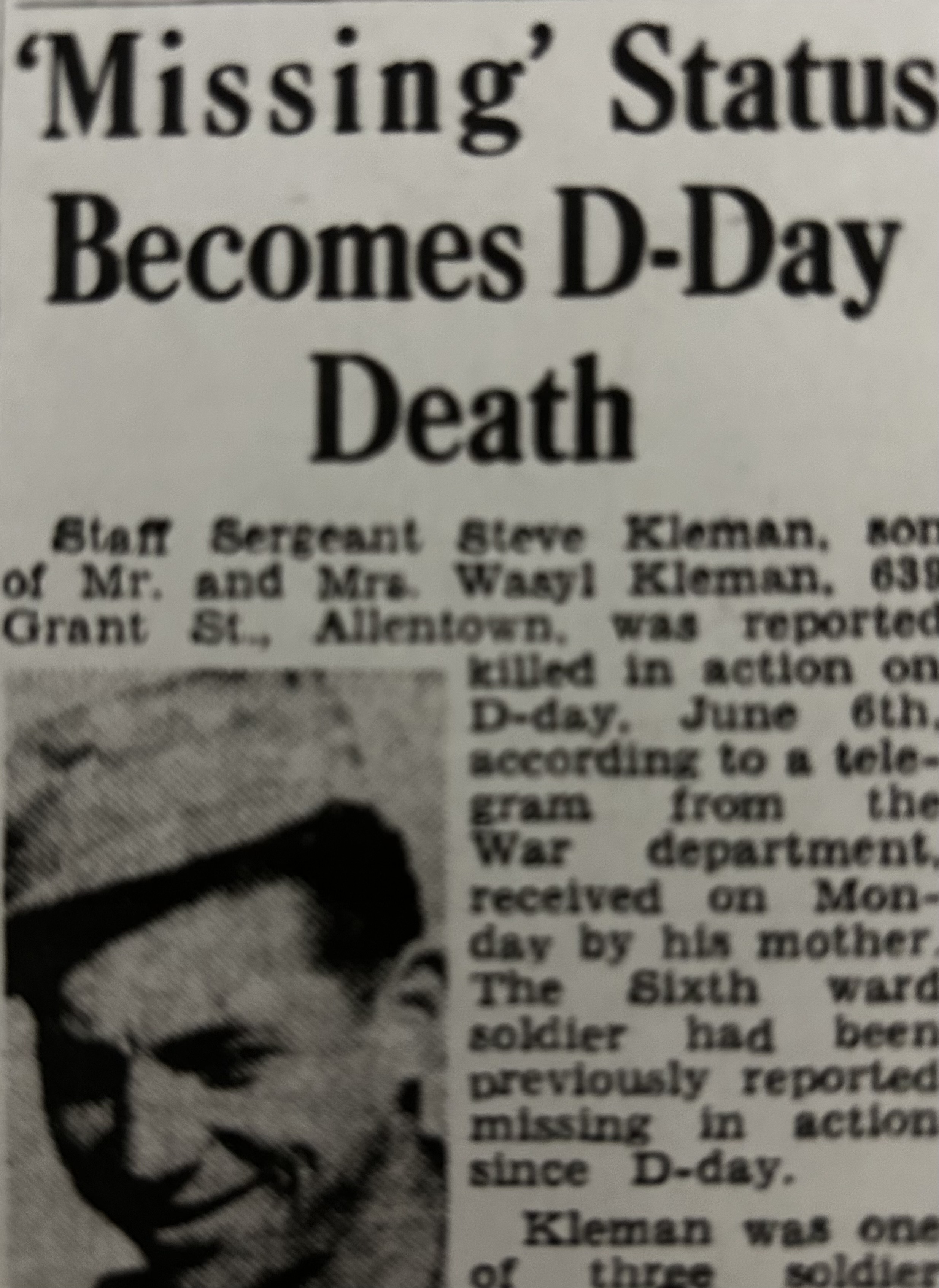
In civilian life, Steve Kleman machined parts for Mack trucks in his hometown of Allentown, Pennsylvania. Transformed into a soldier for World War II, he helped lead a unit of combat engineers onto Omaha Beach early on D-Day, the epic invasion of Nazi-occupied France on June 6, 1944.
“The landings were made under heavy mortar, artillery, and machine gun fire inasmuch as no infantry had preceded the landing of the engineers on Dog Green and part of Dog White beach.”
That’s from the after action report of the 121st Engineer Combat Battalion, 29th Infantry Division.
Staff Sergeant Kleman and the 40 other men of the battalion’s 2nd Platoon, Company B, neared the Normandy beach in an LCM, a landing craft mechanized, about 6 a.m. Each engineer carried satchel charges of TNT, a Bangalore torpedo, a rifle and full field pack. Melvin B. Farrell, who was on the craft, described what happened:
About 200 yards out, our LCM floundered, nosed up on a hidden sandbar and stuck fast. The operator seesawed back and forth, but she wouldn’t give. The machine gun fire rattling off the sides set up such a din of noise you could hardly think. The operator threw the ramp down and yelled, “Hit it!”
I was the third man out. We three wheeled left and jumped off the side of the ramp. Machine gun fire was now raking the inside of the LCM, and a high percentage of our men were killed before they could get out.
Melvin B. Farrell (6juin1944.com)
When the first three of us jumped, we landed in a shell hole, and what with all the luggage, we had plummeted to the bottom like a rock. We walked along the bottom until we climbed out of the hole. It seemed an eternity before we reached the surface. We were then on the barren sand, but there was another stretch of water between us and the beach. This stretch contained a maze of tank traps, mines and every object the Krauts could plant to thwart a landing attempt.
It all seemed unreal, a sort of dreaming while awake, men were screaming and dying all around me. I’ve often wondered if all the men prayed as fervently as I did.
The engineers’ immediate job was to blow up a masonry wall so tanks could get through.
Farrell made his way around tripwires attached to a Tellermine and blew a 20-foot gap in a tangled mess of barbed wire. He reached the wall, threw his satchel charges onto it and crawled to safety just before the explosion. As he and others huddled behind the wall’s wreckage, he looked toward the water where the first wave of infantry was about to land and saw his sergeant, Steve Kleman.
—
Kleman was the third of four children born to immigrants from Austrian Galicia. His parents, Wasyl Kleman and Anna Bujar, were married in 1915 in Allentown. Steve had a sister, Stella, and brothers Walter and Joseph. The family lived in the 6th Ward, between the Jordan Creek and Lehigh River. For much of his life in the city, Wasyl was a sweeper in a Mack Trucks machine shop.
Steve Kleman belonged to Boys Haven, which sought to steer kids away from delinquency, “to teach young people properly in their social hours, thereby acquiring the knowledge of what is the right and safe thing for young boys to do.” A 1944 story in The Morning Call says he attended Allentown High School, but I couldn’t find any mention of him in old school yearbooks.
In 1938, when he was 18, Kleman toiled out west for the Civilian Conservation Corps. At 6 feet and 185 pounds, he was suitably built for the work.
The Army called him in March 1942 while he was a turret lathe operator at Mack. Training followed at Camp Blanding, Florida. He left for England via Camp Kilmer, New Jersey, in the fall of 1943 and wrote to his parents that he arrived on October 12. The buildup for the Normandy invasion was underway. Kleman had seven months to get ready.
His brothers were in the war as well. Joseph was an Army private in Europe and Walter a Navy seaman on the aircraft carrier Ticonderoga in the Pacific. Both would survive.
A landing craft carries U.S. troops to Omaha Beach on June 6, 1944.
At 1 a.m. June 6 aboard a ship in the English Channel, according to Farrell’s account, the engineers were rousted and had breakfast of toast and coffee. A half-hour later, they began boarding the landing craft for transport to the beach. The channel was exceedingly rough.
“Waves would throw the LCM up out of the water, and it would slam down with a bone-breaking jar. Every man jack of us were so seasick we had regurgitated on ourselves and everyone around us by 5 a.m.”
Farrell got safely ashore despite a torrent of German machine gun fire. He and other engineers succeeded in blowing up the masonry wall, about four feet high and four feet thick.
“At this time our initial mission was completed, so we huddled behind the ragged remnants of the wall we had just blown. I turned my gaze toward the coming infantry and saw my sergeant, Steve Kleman, not 40 yards from me. He was sitting down, had been hit through both hips. I tried four times to get out to him to drag him in. Each time I left cover, a hail of machine gun fire would drive me back. By this time he had been hit so many times, it was hopeless.”
The battalion’s after action report notes: “It is estimated that 50% of this initial force were casualties, and 75% of the equipment was lost.”
—
July 26, 1944, story in The Morning Call of Allentown (Newspapers.com)
Within two weeks, Kleman’s parents got a telegram from the War Department saying he had been missing in action since D-Day. A follow-up telegram near the end of July reported he was killed June 6. His parents received their 24-year-old son’s last letter four days after his death.
St. Mary’s Ukrainian Orthodox Church, where his family worshiped and his father helped lead a war bonds drive, held a memorial Mass for Kleman on July 30.
In 1948, his remains were brought home. Military honors greeted him at a service led by Veterans of Foreign Wars Post 13 of Greater Allentown, and another Mass was said for him at St. Mary’s. He now lies in the parish cemetery.
Nicholas L. Venditti of Malvern, Pennsylvania, was an Army helicopter pilot with the Americal Division. He died July 15, 1969, at Chu Lai, Vietnam, of injuries from an accidental grenade blast. It was his 11th day in the war. He was 20 years old.
Great Valley High School Class of 1966
In foreground at Fort Polk, LouisianaAt Fort Rucker, Alabama, flanked by Skip Smith (left) and Tony Viall
Lieutenant Commander Edward N. Little after Fukuoka Camp 17 was liberated in September 1945 (National Archives)
An American naval officer and former POW was court-martialed after World War II on charges he collaborated with the Japanese. More than two dozen witnesses spoke against Lieutenant Commander Edward N. Little. One prison camp survivor, a soldier from Pennsylvania’s coal country, gave off-the-record testimony that wasn’t part of the trial. I’m going to share it with you.
Little was the highest-ranking Navy officer at Fukuoka Camp 17 on Japan’s Kyushu Island. He was in charge of the prisoners’ mess hall.
Fellow ex-prisoners said Little ate more than his share of food from Red Cross parcels, threw away edible rice as a punishment, deprived POWs of meals, beat a U.S. Army corporal and ordered the beating of another, reported four prisoners to the Japanese for stealing or selling food, two of whom were killed.
An online National Archives post gives a thorough account of Little’s case, detailing the charges against him, how he defended himself, and what became of him. It was written in 2018 by archives technician William Green. You can read it here.
Green’s source was the court-martial record of Little’s 1947 trial, which takes up 2,066 pages. I have it on a compact disc, which I got many years ago from the Department of the Navy’s Office of the Judge Advocate General. I’d been working on a story about POW Joseph L. Szczepanski, an Army Air Corps sergeant and onetime amateur boxer from Nanticoke who served in the Philippines.
Joe Szczepanski handles a canister of chemicals on Oahu, Hawaii, in 1938. At the time, he was serving with Company A, 1st Separate Chemical Warfare Systems Battalion.
Szczepanski, a clerk at Nichols Field outside Manila, was taken prisoner in April 1942 and walked in the Bataan Death March. He was held at Cabanatuan Camp 1 on Luzon and then at Fukuoka, where he was forced to work in a coal mine near Omuta. I wrote about him for The Morning Call of Allentown in 2009 and again in 2020, after his son Rick went to Japan to see where his father had been enslaved.
It was at Fukuoka that Sergeant Szczepanski came to revile Lieutenant Commander Little.
Later as a free man, Szczepanski testified for the War Crimes Office of the War Department about Japanese atrocities and mistreatment of prisoners. He was interviewed on April 1, 1947, in Larksville, Pennsylvania, near his hometown, by Special Agent Don B. Berntson of the Counter Intelligence Corps.
After Szczepanski died in 2005, Rick wrote to the National Personnel Records Center in St. Louis for his dad’s military file. He was surprised to get the report of Joe’s war-crimes testimony, in which he told of his own horrific experiences and complained bitterly about Little.
But Joe Szczepanski wouldn’t go on the record about the Navy officer, so Berntson wrote a separate, confidential report on which he listed Szczepanski as “reliable.” He noted Szczepanski thought Little had been tried and convicted “for his treason-like actions.” In fact, Little’s court-martial had begun in January 1947 and was still underway in Washington, D.C., at the time Berntson interviewed Szczepanski.
Szczepanski in 1946 at Valley Forge General Hospital after surgery on his broken nose. He spent 18 months recuperating from illnesses and injuries he suffered as a POW. The other man is unidentified.
Here is Berntson’s report:
CONFIDENTIAL War Department Counter Intelligence Corps Scranton, Pennsylvania 1 April 1947 Subject: Collaboration with Japanese during World War II by Navy Lieut. LITTLE, USN.
Summary of Information:
During war crime testimony of Sgt. JOSEPH L. SZCZEPANSKI … he related how at Fukuoka POW Camp No. 17, Japan, a U.S. Naval Lieutenant by the name of LITTLE had collaborated with the enemy, thus costing the lives of two American soldiers and causing severe beatings to a number of other American soldiers in order to make his own position with the Japanese solid and luxurious. SZCZEPANSKI stated that he did not want his name mentioned in connection with Lt. LITTLE’s criminal deeds and that he did not want it to become part of his regular testimony on conditions at Fukuoka Camp No. 17. He stated that he believes that Lt. LITTLE was court-martialed by the U.S. Navy at Brooklyn, N.Y., and that he was sentenced to twenty years in prison for his treason-like actions during the war.
The 1947 report on Szczepanski’s off-the-record testimony against Little
SZCZEPANSKI related how a pugilistic soldier from the 4th U.S. Marines, called “Jimmy the Greek” PAVLOCKAS, of either Detroit or Chicago, had never gotten along very well with Lt. LITTLE because of Lt. LITTLE’s being a “general bully” [who] considered no one’s welfare except his own and that of the Japanese. In November 1943, Jimmy the Greek was apprehended by Lt. LITTLE while trading his rice for cigarettes. He was in a group of soldiers doing the same thing, but Lt. LITTLE singled him out of the group, and rather than to take him before Major JOHN [R.] MAMEROW, USAAF (now of March Field, California), he took him to the Japanese camp commander who ordered PAVLOCKAS to a dungeon in 22- to 24-degree temperatures, clad in only pants and shirt and fed a half cup of rice and one cup of water per day. Thirty-nine days later PAVLOCKAS died of hunger and exposure.
SZCZEPANSKI related how an American soldier, NOAH C. HURD, had stolen food from the Red Cross warehouse due to the fact that the Japanese did not distribute it anyway. He was apprehended by LITTLE about June 1944 and subsequently taken to the Japanese camp commander, KEN YURI, who personally tried HURD and personally beheaded him with a samurai sword in the presence of a Lt. PERKINS, a Lt. CHRISTY, and a Lt. [Owen W.] ROMAINE of the U.S. Army. LITTLE was also responsible for the beating death of a U.S. Army Corporal KNIGHT following his stealing rice. He was beaten to death in a Jap guard house by guards and by the then-camp commander of Fukuoka No. 17, Captain ISAO FUKIHARA.
LITTLE also threatened death to Corporal SAMUEL SHULMAN, AAF, of New York City when he took offense at remarks made by LITTLE on one occasion.
My 2009 story about Szczepanski in The Morning Call of Allentown. It was based on interviews with his son Rick.
LITTLE was also responsible for the starving of an American soldier by the name of MONTOYA, believed to be from New Mexico, when he had received a stolen jacket from someone.
LITTLE had also reputedly told the Japanese that a half-bowl of rice was sufficient for the American soldiers when Major MAMEROW had attempted to have the Japanese increase the rations instead of to lessen them. LITTLE also took the initiative to prohibit smoking in the mess hall by U.S. Army personnel.
It is believed that LITTLE is a native of California and that his wife is a native of Brooklyn, N.Y.
Corporal JACK KUCHNER, of the Bronx, N.Y.C., can corroborate this aforementioned report together with the aforementioned U.S. Army officers and noncommissioned officers listed herein. Capt. HOWARD HEWLETT, U.S. Army Medical Corps, can also corroborate this testimony.
Don B. Berntson Special Agent Counter Intelligence Corps
The report misspells the names of Schulman, Fukuhara, Kei Yuri, Charles P. Christie and James G. Pavlakos, a Marine corporal. … Hurd’s correct name was Noah C. Heard. An Army corporal, he was beaten and killed in May 1944. Accounts of his execution differed. Some POWs said he was bayoneted to death, while Szczepanski and others said he was beheaded. … It’s not clear whether Szczepanski is referring to Benjamin or Horacio Montoya. Both brothers were at the Fukuoka camp and survived. … William N. Knight, an Army private, was starved and beaten to death. … Howard Hewlett appears to have been Thomas H. Hewlett. … Little was from Monrovia, California. … USAAF stands for U.S. Army Air Forces.
—
Szczepanski wasn’t alone in his hostility toward Little. In the court-martial, 31 witnesses testified against the commander. Among them was Schulman, an Army technical sergeant, who told the nine Navy officers hearing the case:
Entries in Szczepanski’s diary after he was freed from Fukuoka Camp 17 in Japan. He had been shipped there in July 1943 after more than a year at Cabanatuan Camp 1 on Luzon. The Fukuoka camp was liberated on September 2, 1945.
“Mr. Little was in charge of the mess hall. He had — and he wielded — a mighty stick. He had the full cooperation of the Japanese behind him. He can get just about anything he wanted from the Japanese. The Japanese liked Mr. Little, because they sure saved him a lot of guards and a lot of work, and the men were scared of Mr. Little because they knew that if they went against Mr. Little, he could cause trouble for them.
“Every man hated him in that camp. There wasn’t a one that didn’t hate him, including myself.”
Little and 42 others testified on his behalf. The defense argued he had not broken Navy regulations, which call for punishment “of any person in the Navy who refuses or fails to use his utmost exertions to detect, apprehend, and bring to punishment all offenders, or to aid all persons appointed for that purpose.” So, the argument went, Little had a duty to report offenders.
In June 1947, after five months of trial, he was found not guilty of the three charges against him — conduct unbecoming an officer and a gentleman, maltreatment of a person subject to his orders, and conduct to the prejudice of good order and discipline – plus 22 additional specifications.
—
As a POW, Szczepanski suffered from dry beriberi, dysentery, malaria, parasites in his blood, a hernia, a broken nose, a busted jaw with loss of teeth, and a broken instep from purposely crushing his foot with a chunk of coal to get out of work in the Omuta mine. Decades of mental and emotional stress followed.
He made a career of teaching Spanish at Bethlehem Catholic High School and died at 86.
“Dad never really got over what took place in the prison camps, until in the mid-1980s he finally let go,” Rick Szczepanski told me. “It didn’t bother him anymore.”
Here’s how that came about: At the Holocaust program 15 years ago, I interviewed a Dachau liberator, Don Burdick, on the auditorium stage. I had written about him for The Morning Call. Now I was invited back to join in commemorating the Jewish victims of Nazi Germany 80 years after its defeat. My wife came with me.
And here’s what I said:
Don in 1944 at home on furlough in Carbondale, Pa.
—
I knew Don Burdick from lunches of the Battle of the Bulge veterans. I’d go there to meet the vets, hear their stories and write about them. Don always wore a jacket and tie to these meetings and, in his rich, full voice, said the opening prayer.
His story was compelling. He was among the U.S. troops surrounded by the Germans at Bastogne. He was among the first Americans to enter Dachau. He took pictures there that he kept for always.
On the advice of The Morning Call’s editor, I split up Don’s story. His account of the Bulge ran during the battle’s anniversary in December 2008. His photos of the dead ran the following April with my story about his Dachau experience.
A photo Don took at Dachau in April 1945. He used a Voigtlander 35mm camera he had picked up in Germany.
It was in April 1945 that Don’s unit – a field artillery observation battalion – reached the camp near Munich. He was 21, a private first class. He carried a German camera he had picked up along the way.
The following is from the transcript of my interviews with him:
There was a noxious odor in the air. I said, “Smells like something rotten.”
Coming into Dachau, the closer you got, the stronger the odor was. It was putrid. As we were coming down this particular road, there were piles of bodies like you would stack lumber. The Germans had put quicklime on them to burn up the flesh. … The smell and sight of decaying bodies was gut-wrenching. I was sick to my stomach for days after that.
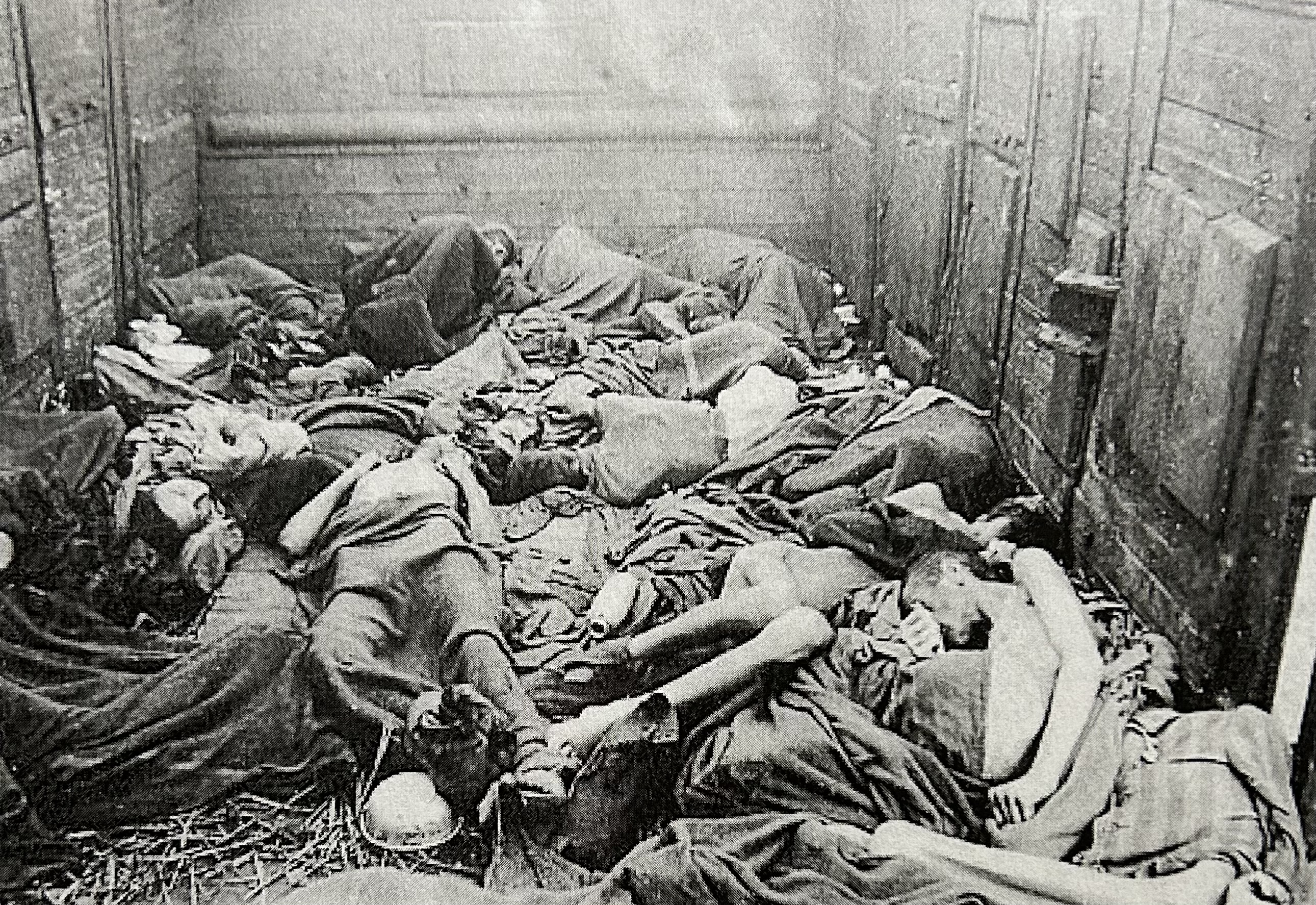
Don’s photo of U.S. Army troops inspecting rail cars holding the dead at Dachau
There were people clinging to the fences. They were emaciated, hardly covered with clothes. One building we looked at, we could see bodies piled like a pyramid. A guy said, “The only way we’re going to get them out is to bulldoze the building.”
I was so disgusted at what I was seeing. For me to explain this to somebody else, I felt the best way to do this was to take pictures. … When I developed the pictures, I knew that I had my evidence that I could support the fact that this was an atrocity, that it was a concentration camp, and I could verify what I had seen.
—
Reader response was immediate. It was in line with Don’s commitment to get the word out to as many people as possible.
The second of two parts of Don’s Battle of the Bulge story in December 2008: He was with Battery B, 16th Field Artillery Observation Battalion.
An English as a Second Language teacher at Allen High School said his students were reading the diary of Anne Frank and he’d be using Don’s story in his class. He wrote: “I think it would be a very enriching experience for these students to see how the Holocaust impacted and still does impact people, even within this community.”
When I passed this message on to Don, he offered to visit the class.
An English teacher at Northeast Middle School in Bethlehem asked if Don would speak to her eighth-graders. She wanted to prepare them for a visit from Auschwitz survivor Julius Jacobs. She wrote: “There’s no better way to help our students connect with history and truly understand it than hearing it firsthand.”
Yes, Don spoke to her classes. And in 2010, with me at his side, he spoke here for the Holocaust remembrance.
As a former teacher, Don aced these appearances. He had a presence and a keen ability to communicate. I’m glad I met him, became his friend and helped get his Dachau story out.
My April 2009 story about Don’s experience at Dachau. It included photos he took at the Nazi camp.
He had been at the camp for just one day, a soldier passing through early on. The gaunt survivors, he noted, weren’t being cared for. He didn’t see any medics while he was there. The suffering and death troubled him for a lifetime.
“I couldn’t believe that the human race could annihilate people in this atrocious way,” he said. “I had no idea the Germans would go to the length they did at Dachau.”
Don died eight years ago at his home in Forks Township. He was 93. His witness to the Holocaust will live on.
Home movies taken in 1944-45 in England by and for Mike Mento, a B-24 propeller mechanic from Downingtown, Pennsylvania
My Uncle Mike had been using movie cameras since the 1930s, so it was no surprise he took one to England during World War II.
A propeller mechanic working on B-24 Liberators, he shot film of the four-engine bombers on the ground and in the air, of his Army Air Corps buddies on the job and at play, of sightseeing London, the coast and the countryside. Sometimes he handed his camera to others.
My Uncle Mike at work
On this blog, I’m showing scenes he brought home. They total 44 minutes, edited down a little to cut out images that aren’t clear. Of the many people you’ll see, Mike is the only one smoking a cigar. At the beginning of the video, he’s pointing to a sign that says “Swing Club.”
A son of Italian immigrants, Michael Joseph Mento was born in 1912 in Downingtown, about 40 miles west of Philadelphia. He and his eight siblings grew up in the Johnsontown neighborhood, a town within a town and home for most of the borough’s residents of Italian descent.
Mike as a teen
In high school, Mike starred in sports. As an end on the football team, though just 5 foot 5, he was named to an all-county squad. In basketball, he was a high scorer known as “Midget Mike.” In baseball, he was so good at stealing bases, the local paper called him “nimble-footed.” He graduated from Downingtown High in 1932 and won the award for top athlete in his class of 64.
Mike bowled, swam, fished and hunted. He worked at Greenleaf’s Drug Store, pitched for an American Legion baseball team, took photos for newspapers, fixed up old cars. One was a Ford he called Riptide. “Where does Mike Mento get all these jalopies?” a Brandywine Archivenewshound wrote in 1939. “Further, how does he keep them in repair?”
The Archive described him as “the little fellow who smokes the big cigars.”
Three months after Pearl Harbor, Mike was drafted into the Army. He left his job as a liquor store clerk for four weeks of basic training at Keesler Field in Mississippi. That was followed by technical courses at Keesler’s school for B-24 mechanics. He moved on to Kearney Army Air Field in Nebraska, where the private first class was an instructor and got in some bowling and fishing.
Mike wasn’t the only Mento sportsman in the Army. His brother Andrew, known as “Sid,” was a staff sergeant stationed in North Africa. While Mike was at Kearney, Sid wrote home that he was playing in a baseball league organized by former Big League first baseman Zeke Bonura. In one wild game, Sid hit a home run. He said playing ball keeps the boys’ morale up.
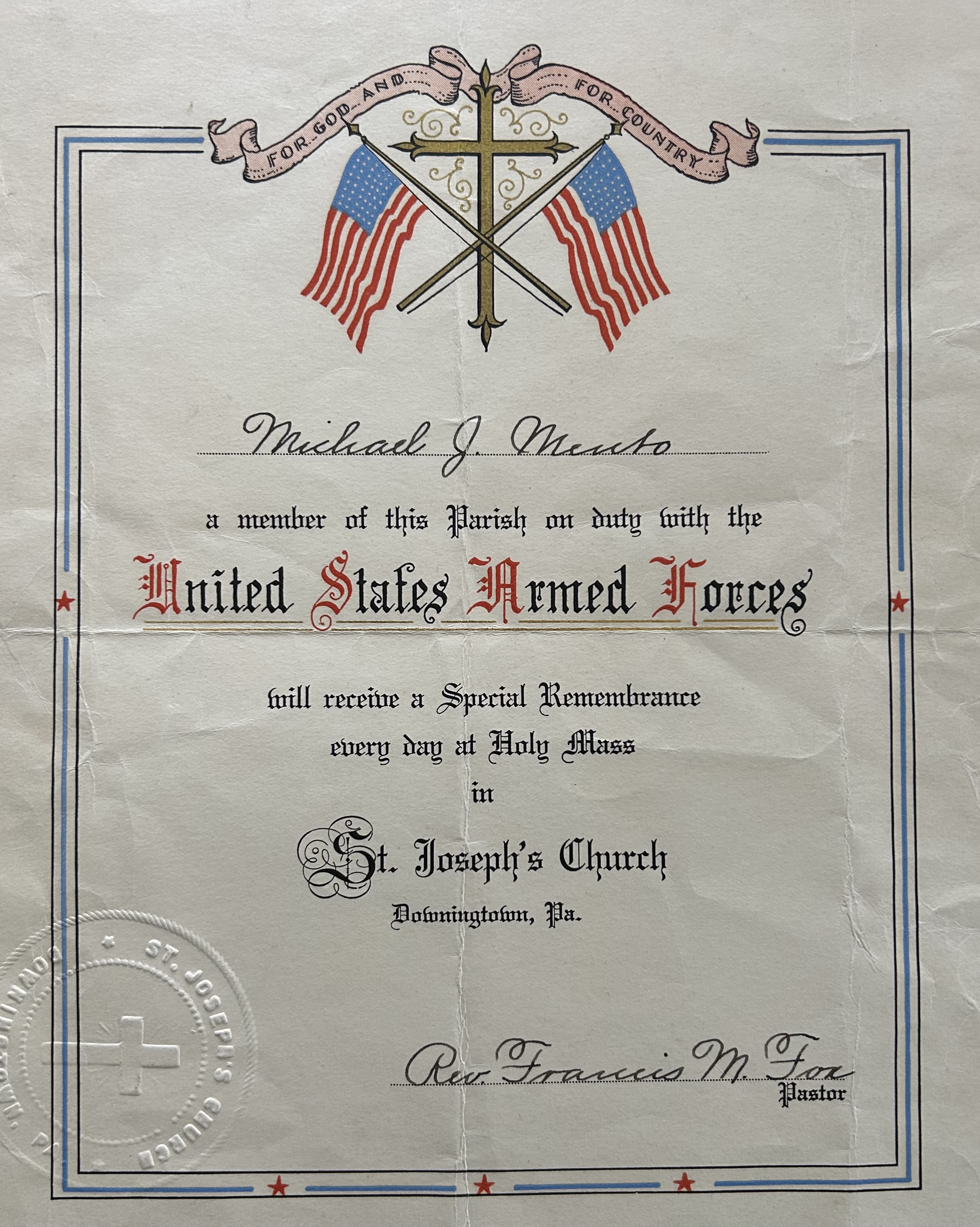
The pastor of St. Joseph’s Church in Downingtown pledged a ‘special remembrance’ for Mike every day he was in the war.
At the end of 1943, Mike shipped out to England and joined the 732nd Bomb Squadron, 453rd Bomb Group at Old Buckenham Airfield in Norfolk. He was 31. His job was to remove, inspect and overhaul propellers on the squadron’s 18 planes, which were hitting targets in Nazi Germany. He also put his movie camera to work.
Mike’s foreign service ended in May 1945, two weeks after Germany surrendered. He had racked up 17 months overseas without incident, perhaps thanks to prayers said for him every day at St. Joseph’s Church, where he was a member. On September 2, he was honorably discharged at Fort Dix, New Jersey, as a sergeant with the 590th Army Air Force Base Unit.
Mike’s bride, Hilda, outlived him by 56 years. She died last year, the day after turning 101.
Back in Downingtown, he led softball and bowling teams, chaired the fish restocking committee of the Sportsmen’s Club, helped to run the Young Men’s Association and became president of St. Anthony’s Lodge, of which he was voted most valuable member for 1947. At the 1951 banquet of the Amphibious Order of Frogs, where hundreds of members drank beer and dined on fried frog legs, Mike won the grand prize — a snazzy leather traveling bag.
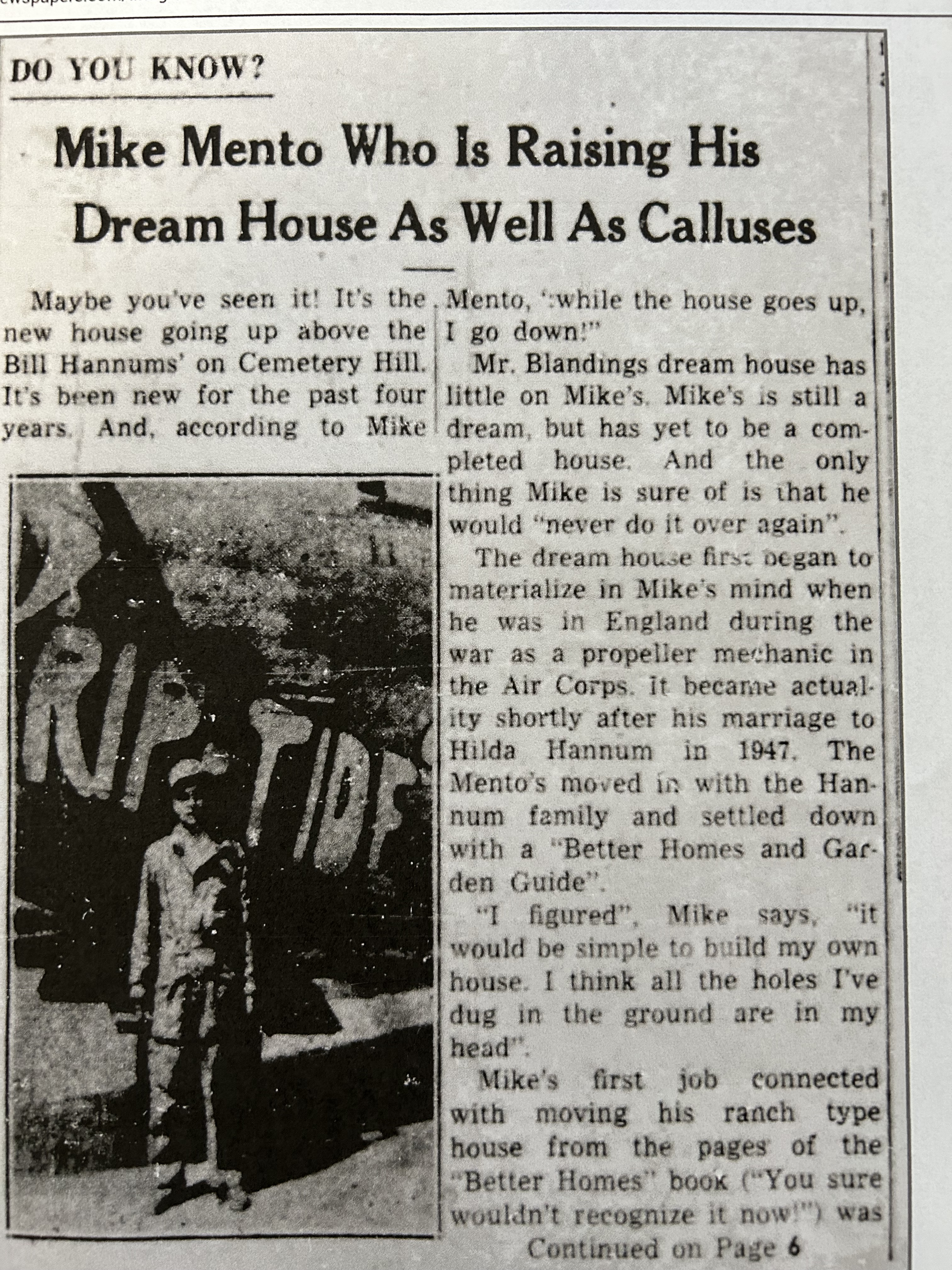
He married my mom’s sister, Hilda Hannum, in 1947. Aunt Hilda was a Downingtown High grad and registered nurse. She and Mike moved in with her parents, farmers Bill and Clara Hannum. Mike carried mail in the morning and clerked at the state liquor store in the evening. In between, he helped Bill on the farm. He spent years building a house on Cemetery Hill on land my grandparents provided.
An August 7, 1952, story in the Brandywine Archive about my uncle’s work on a house: The photo shows him in front of a B-24 bomber named ‘Rip Tide,’ which is what he called his Ford jalopy in the 1930s. (Newspapers.com)
Mike and Hilda had five daughters – my cousins Andrea, Michelle, Patricia, Diane and Jacqueline. A son, Joseph, lived only eight months.
In 1968, Uncle Mike died of cancer. He was just 56. My clearest memory of him is that he was my Confirmation sponsor when I was a kid at St. Joseph’s School. During the Catholic ritual, I glanced at him as he stood beside me, his head bowed in prayer, and felt I hardly knew him.





















 David Venditta